INTRODUCTION TO ORACLE AND SQL
UNIT-1
S. Vasuki, M.C.A.,
Assistant Professor,
Department of Computer Science
Sri Sarda Niketan College of Science for
Women, Karur.
Introduction to File:
Flat File, Database,
and Database
Structures
This presentation explores various types of files and databases used in
computer systems. We'll delve into the characteristics, advantages, and
disadvantages of flat files and provide an overview of different database
structures.
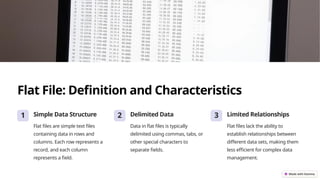
Flat File: Definition and Characteristics
1 Simple Data Structure
Flat files are simple text files
containing data in rows and
columns. Each row represents a
record, and each column
represents a field.
2 Delimited Data
Data in flat files is typically
delimited using commas, tabs, or
other special characters to
separate fields.
3 Limited Relationships
Flat files lack the ability to
establish relationships between
different data sets, making them
less efficient for complex data
management.
Advantages of Flat File
Easy to Create
Flat files can be easily created and
modified using basic text editors or
spreadsheet software.
Simple to Understand
Their straightforward structure
makes flat files easy to comprehend
and work with, even for non-
technical users.
Efficient for Small Datasets
Flat files are suitable for storing and
managing small datasets, especially
when complex relationships are not
required.
Disadvantages of Flat File
Data Redundancy
Duplicated information can lead to
inconsistencies and errors, making
data management challenging.
Data Integrity Issues
The lack of relationships makes it
difficult to enforce data consistency
and integrity, increasing the risk of
errors.
Limited Data Analysis
Flat files are not well-suited for complex
data analysis and reporting, requiring
manual manipulation for insights.
Introduction to Database: Definition and Importance
1
Organized Data
Databases are structured collections of data organized for efficient
storage, retrieval, and management.
2
Data Relationships
Databases allow for the establishment of relationships between different
data sets, enabling efficient data retrieval and analysis.
3
Data Integrity
Databases provide mechanisms to ensure data consistency and integrity,
minimizing errors and maintaining data accuracy.
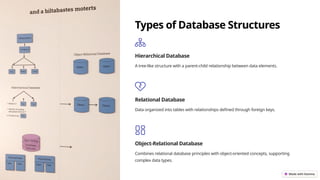
Types of Database Structures
Hierarchical Database
A tree-like structure with a parent-child relationship between data elements.
Relational Database
Data organized into tables with relationships defined through foreign keys.
Object-Relational Database
Combines relational database principles with object-oriented concepts, supporting
complex data types.
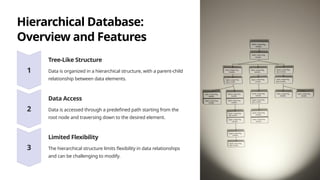
Hierarchical Database:
Overview and Features
Tree-Like Structure
Data is organized in a hierarchical structure, with a parent-child
relationship between data elements.
Data Access
Data is accessed through a predefined path starting from the
root node and traversing down to the desired element.
Limited Flexibility
The hierarchical structure limits flexibility in data relationships
and can be challenging to modify.
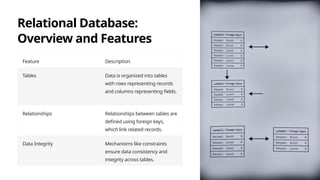
Relational Database:
Overview and Features
Feature Description
Tables Data is organized into tables
with rows representing records
and columns representing fields.
Relationships Relationships between tables are
defined using foreign keys,
which link related records.
Data Integrity Mechanisms like constraints
ensure data consistency and
integrity across tables.
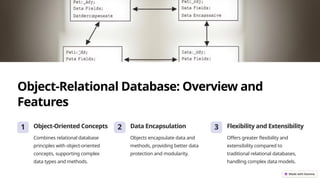
Object-Relational Database: Overview and
Features
1 Object-Oriented Concepts
Combines relational database
principles with object-oriented
concepts, supporting complex
data types and methods.
2 Data Encapsulation
Objects encapsulate data and
methods, providing better data
protection and modularity.
3 Flexibility and Extensibility
Offers greater flexibility and
extensibility compared to
traditional relational databases,
handling complex data models.

Unit 1 Introduction to Oracle and sql (6).pptx

  • 1.
    INTRODUCTION TO ORACLEAND SQL UNIT-1 S. Vasuki, M.C.A., Assistant Professor, Department of Computer Science Sri Sarda Niketan College of Science for Women, Karur.
  • 2.
    Introduction to File: FlatFile, Database, and Database Structures This presentation explores various types of files and databases used in computer systems. We'll delve into the characteristics, advantages, and disadvantages of flat files and provide an overview of different database structures.
  • 3.
    Flat File: Definitionand Characteristics 1 Simple Data Structure Flat files are simple text files containing data in rows and columns. Each row represents a record, and each column represents a field. 2 Delimited Data Data in flat files is typically delimited using commas, tabs, or other special characters to separate fields. 3 Limited Relationships Flat files lack the ability to establish relationships between different data sets, making them less efficient for complex data management.
  • 4.
    Advantages of FlatFile Easy to Create Flat files can be easily created and modified using basic text editors or spreadsheet software. Simple to Understand Their straightforward structure makes flat files easy to comprehend and work with, even for non- technical users. Efficient for Small Datasets Flat files are suitable for storing and managing small datasets, especially when complex relationships are not required.
  • 5.
    Disadvantages of FlatFile Data Redundancy Duplicated information can lead to inconsistencies and errors, making data management challenging. Data Integrity Issues The lack of relationships makes it difficult to enforce data consistency and integrity, increasing the risk of errors. Limited Data Analysis Flat files are not well-suited for complex data analysis and reporting, requiring manual manipulation for insights.
  • 6.
    Introduction to Database:Definition and Importance 1 Organized Data Databases are structured collections of data organized for efficient storage, retrieval, and management. 2 Data Relationships Databases allow for the establishment of relationships between different data sets, enabling efficient data retrieval and analysis. 3 Data Integrity Databases provide mechanisms to ensure data consistency and integrity, minimizing errors and maintaining data accuracy.
  • 7.
    Types of DatabaseStructures Hierarchical Database A tree-like structure with a parent-child relationship between data elements. Relational Database Data organized into tables with relationships defined through foreign keys. Object-Relational Database Combines relational database principles with object-oriented concepts, supporting complex data types.
  • 8.
    Hierarchical Database: Overview andFeatures Tree-Like Structure Data is organized in a hierarchical structure, with a parent-child relationship between data elements. Data Access Data is accessed through a predefined path starting from the root node and traversing down to the desired element. Limited Flexibility The hierarchical structure limits flexibility in data relationships and can be challenging to modify.
  • 9.
    Relational Database: Overview andFeatures Feature Description Tables Data is organized into tables with rows representing records and columns representing fields. Relationships Relationships between tables are defined using foreign keys, which link related records. Data Integrity Mechanisms like constraints ensure data consistency and integrity across tables.
  • 10.
    Object-Relational Database: Overviewand Features 1 Object-Oriented Concepts Combines relational database principles with object-oriented concepts, supporting complex data types and methods. 2 Data Encapsulation Objects encapsulate data and methods, providing better data protection and modularity. 3 Flexibility and Extensibility Offers greater flexibility and extensibility compared to traditional relational databases, handling complex data models.