Board/Staff Retreat 2012
“Directors	 are	 like	 
parsley	 on	 fish—	 
 decorative	 but	 
     useless.”
Irving Olds, former board chair of U.S. Steel
“All over the world, people just
like us serve on all sorts of boards.
  Some work incredibly well. Some
  leave members shell shocked or
        numb with frustration.”


     The Montessori Foundation
       “Serving on a Nonprofit Board”
The days of “sitting” on a
nonprofit board are over.
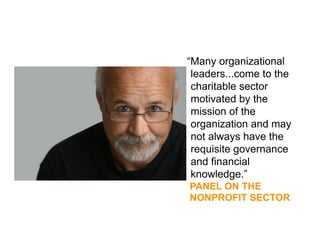
“Many organizational
 leaders...come to the
 charitable sector
 motivated by the
 mission of the
 organization and may
 not always have the
 requisite governance
 and financial
 knowledge.”
PANEL ON THE
NONPROFIT SECTOR
the top

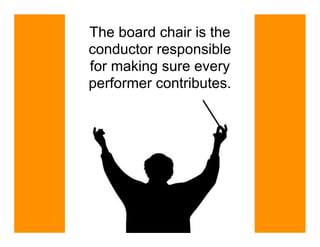
  10         things
Your Nonprofit Board
  Needs to Know
    (plus One Bonus Tip)
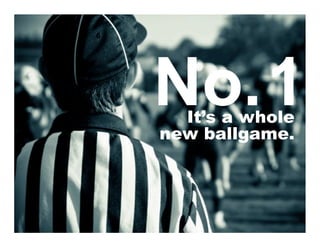
No. 1
  It’s a whole
new ballgame.
“You will be confronted
with questions every day
that test your morals.
Think carefully, and for
your sake, do the right
thing, not the easy thing.”
             Commencement Speaker
              St. Anselm College, 2002
“Ex-Tyco Chief
Executive Kozlowski
Sentenced to 8 to 25
      Years”
 Headline / Bloomberg.com / 09.19.2005
Strong Fundamental Values

“We must demand of ourselves
and of each other the highest
standards of individual and
corporate integrity. We safeguard
company assets. We comply with
all company policies and laws.”


Source: The Tyco Guide to Ethical Conduct
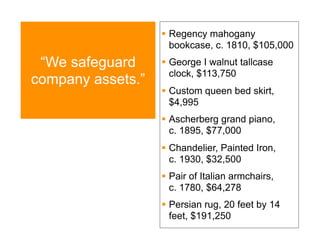
 Regency mahogany
                     bookcase, c. 1810, $105,000
 “We safeguard      George I walnut tallcase
                     clock, $113,750
company assets.”
                    Custom queen bed skirt,
                     $4,995
                    Ascherberg grand piano,
                     c. 1895, $77,000
                    Chandelier, Painted Iron,
                     c. 1930, $32,500
                    Pair of Italian armchairs,
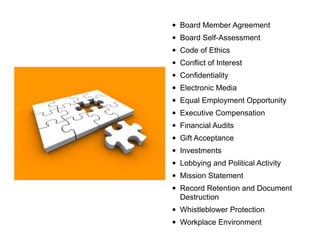
                     c. 1780, $64,278
                    Persian rug, 20 feet by 14
                     feet, $191,250
“In corporate
America, crime
pays. Handsomely.
Grotesquely, even.”
Arianna Huffington
Pigs at the Trough
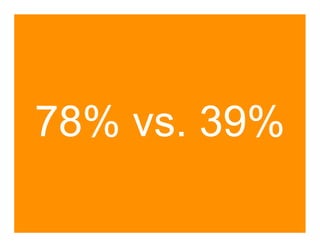
“We’ve got this idea
that business means
   anything goes.           ”
          R. Edward Freeman, Director
      Olsson Center for Applied Ethics
“It	 can	 be	 easy	 for	 	 	 	 	 	 	 	 	 
                                         	 
non-profits	 to	 feel	 that	 	 	 	 	 	   	 
 the	 problems	 of	 the	 	 	 	 	 	 	 	 	 
 private	 sector	 don’t	 	 	 	 	 	 	 	 	 
   relate	 to	 them...”	 
                              	 	 	 	 	 	 	 	 	 	 	 	 	 	 	 	 	 	 	 	 	 	 	 	 
                                                                            	 
   –Stephen	 D.	 Potts,	 Fellows	 Chairman	 	 	 	 	 	 	 	 	 	 	 	 	 	 	 	 	 
                                                                          	 
         Ethics	 Resource	 Center
“...that	 the	 ‘good	 	 	 	 	 	 	 	 	 	 
                                         	 
people’	 who	 populate	 	 	 	 	 	 	      	 
the	 non-profit	 world	 	 	 	 	 	 	 	    	 
are,	 by	 nature,	 more	 
    trustworthy.”	 	 	 	 	 	 	 	 	 	 	 	 	 
                                         	 

  –Stephen	 D.	 Potts,	 Fellows	 Chairman	 	 	 	 	 	 	 	 	 	 	 	 	 	 	 	 	 
                                                                         	 
        Ethics	 Resource	 Center
“This is a
 dangerous
 assumption.”
   Stephen D. Potts, Fellows Chairman
              Ethics Resource Center
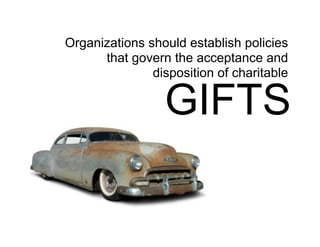
“Anderson
  woman pleads
 guilty to Humane
  Society theft”
Headline / The Herald Bulletin / 05.11.2009
“Her attorney...presented
the court with several
character letters from
acquaintances and
co-workers, and said
Sullivan provides live-in
care for her sick mother.”
Justin Schneider
The Herald Bulletin
“We haven’t had a serious
 review of the tax-exempt
laws since 1969. The world
 has changed since then,
and so has the charitable
community.” –Senator Chuck Grassley,
       Senate Committee on Finance
The New 990
 (version 2.0)
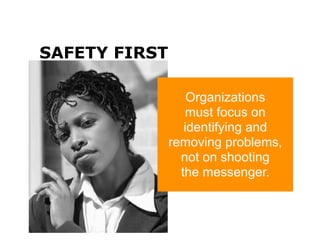
This is your

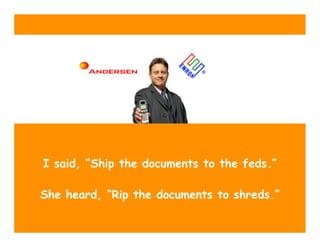
WAKE UP
     call
2. You have a duty of care.
Duty of Care
Board members have
an obligation to make
informed decisions
and to act with care
in their actions.
Commonly described
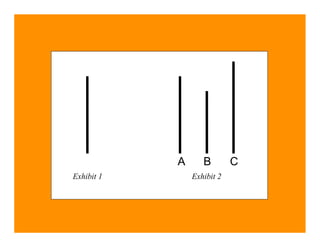
as the “care that an
ordinarily prudent
person would exercise
in a like position and
under similar
circumstances.”
“Once the Board was made aware of the
investigations of Sandusky...the Board, as a
governing body, failed to inquire reasonably
and to demand detailed information from
[President] Spanier.”
                 Report of the Special Investigative Counsel Regarding the
                Actions of The Pennsylvania State University Related to the
                     Child Sexual Abuse Committed by Gerald A. Sandusky
REMINDER    The duty of care          legally
           requires every board member to
            participate in meetings, provide
           operational and policy oversight,
            and exercise a reasonable level
             of care in making decisions on
                   the organization’s behalf.
Where on the
agenda does it
  say I get to
    speak?
The board chair is the
conductor responsible
for making sure every
performer contributes.
Board members who regularly
miss meetings are neglecting
      the duty of care.
Come prepared!
THREE:
You have a duty
  of loyalty.
DUTY OF LOYALTY

 Directors are obligated to set
 aside personal concerns and
 make decisions that are in the
best interest of the organization.
Conflict of
  >> INTEREST
“Getty Book Deal Led
  to Questions of
      Conflict”
 Headline / Los Angeles Times / 06.13.2006
“This is beyond self-
dealing. It’s insiders with a
    sweetheart deal.”

            -Frances Hill, professor at the
        University of Miami School of Law
BEST
Interest
full disclosure
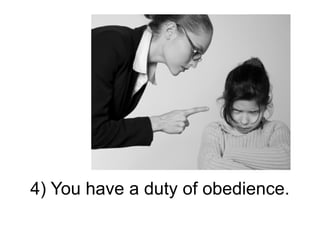
4) You have a duty of obedience.
DUTYOFOBEDIENCE


         Directors must remain
          faithful to the purpose
        of the organization, and
       operate within the stated
          bounds of its mission.
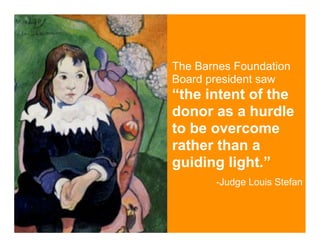
The Barnes Foundation
Board president saw
“the intent of the
donor as a hurdle
to be overcome
rather than a
guiding light.”
       -Judge Louis Stefan
“The duty of obedience is
often overlooked...precisely
because it is so basic as to
    be almost invisible.”
              Rob Atkinson
  Professor of Law, Florida State University
“mission drift”
a.k.a. duty of compliance
 Articles of
                 incorporation
Comply with:
                By-laws and other
                 governing documents

                Local, state, and
                 federal laws

                Registration and
                 reporting requirements

                IRS regulations
5. You have a duty to
   manage accounts.
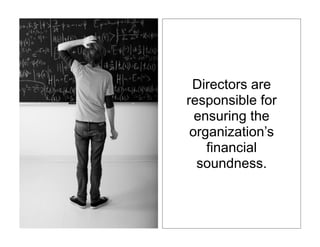
Directors are
responsible for
  ensuring the
 organization’s
    financial
  soundness.
“One of the primary duties
 of the board of directors of a
 charitable organization is to ensure
 that all financial matters of the
 organization are conducted legally,
 ethically, and in accordance with
 proper accounting rules.”


        PANEL ON THE NONPROFIT SECTOR
      Report to Congress and the Nonprofit Sector on
      Governance, Transparency, and Accountability
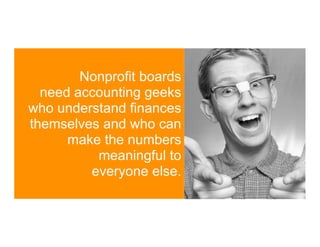
Nonprofit boards
  need accounting geeks
who understand finances
themselves and who can
      make the numbers
          meaningful to
         everyone else.
“Accountants	 aren’t	 
   just	 boring	 geeks	 
 anymore.	 We’re	 hot!”
Eva Rosenberg, author of Small Business Taxes Made Easy
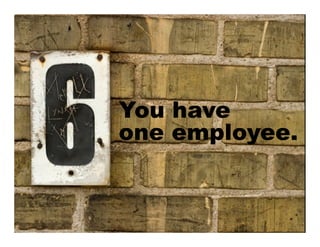
You have
one employee.
only one
 THE EXECUTIVE DIRECTOR IS THE SOLE
EMPLOYEE OF THE BOARD OF DIRECTORS
BEWARE
of meddling by self-proclaimed experts
They think nothing of going
    around the executive
  director and crossing the
 sacred line that separates
    board members from
         employees.
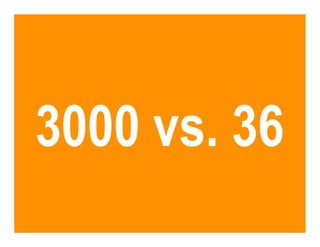
3000 vs. 36
D&O
INSURANCE
“Most of the lawsuits filed against nonprofit
  directors and officers involve some form of
  employment practices liability. Insurers are
becoming more keenly aware of this exposure
 and some have made subtle policy changes
     that restrict coverage in these areas.”


           Alliance of Nonprofits
  “Key Facts About Insurance and Legal Liability”
“…while acting in an official capacity…”
Volunteer Protection Act of 1997
“A volunteer of a nonprofit organization
 generally will be relieved of liability for
harm if the volunteer was acting within
 the scope of his responsibilities and if
 he was properly licensed, certified, or
      authorized for the activities.”

      Volunteer Protection Act of 1997
     Section 4. Limitation on Liability for Volunteers
Is it really worth the risk?
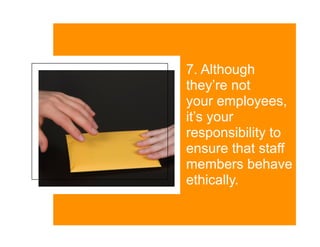
7. Although
they’re not
your employees,
it’s your
responsibility to
ensure that staff
members behave
ethically.
“People are
  basically honest.
  And they’re even
 more honest when
  you watch them.”
attributed to Alan “Ace” Greenberg
The Bear Stearns Companies
United States Sentencing Commission

    “Criminal liability can attach to an
  organization whenever an employee
   of the organization commits an act
   within the apparent scope of his or
 her employment, even if the employee
   acted directly contrary to company
         policy and instructions.”

Paula Desio, “An Overview of the Organizational Guidelines”
PRO
ACT        U.S. Federal
      Sentencing Guidelines

IVE    Seven guidelines used
        to determine whether
       an organization shares
         responsibility for the
          misbehavior of its
       employees; adherence
       can mitigate penalties
              and fines.
Establish compliance standards
and procedures for employees
and other agents to follow that
  are reasonably capable of
   reducing the prospect of
        criminal conduct.
codeofconduct:
POLICY COVERING THE ORGANIZATION’S
STANCE ON—AND EACH EMPLOYEE’S
RESPONSIBILITY FOR—WORKPLACE
ISSUES, INCLUDING HARASSMENT,
DIVERSITY, CONFLICTS OF INTEREST,
VIOLENCE, CONFIDENTIALITY, AND
EQUAL OPPORTUNITY.
“Was that wrong? Should I have not
    done that? I tell you I gotta plead
   ignorance on this thing because if
 anyone had said anything to me at all
when I first started here that that sort of
  thing was frowned upon, you know,
cause I’ve worked in a lot of offices and
 I tell you people do that all the time.”

                          George Costanza
                            Seinfeld, Episode 29
•   Board Member Agreement
•   Board Self-Assessment
•   Code of Ethics
•   Conflict of Interest
•   Confidentiality
•   Electronic Media
•   Equal Employment Opportunity
•   Executive Compensation
•   Financial Audits
•   Gift Acceptance
•   Investments
•   Lobbying and Political Activity
•   Mission Statement
•   Record Retention and Document
    Destruction
•   Whistleblower Protection
•   Workplace Environment
“One explanation that’s common in
the field of business ethics, and this
  may sound shocking, is that they
   just didn’t recognize the ethical
     issue for what it really was.”


    Thomas Dunfee, Wharton professor
Assign specific high-level
individual(s) the responsibility
   for overseeing the overall
  compliance with standards
        and procedures.
CEO
Chief Ethics Officer
Exercise “due care” not to
delegate discretionary authority
  to individuals with a known
    propensity to engage in
        illegal activities.
“I look forward to
pursuing my new
responsibilities and
continuing to make a
contribution as part of
Rite Aid’s world-class
team.”
                          -Chris Hall
     Senior VP-Real Estate and Planning
            former Chief Financial Officer
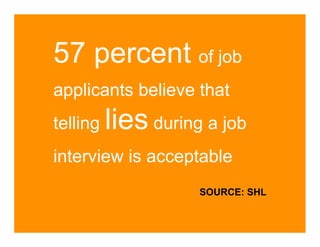
57 percent of job
applicants believe that
telling   lies during a job
interview is acceptable
                     SOURCE: SHL
“Marge, it
takes two to lie.
 One to lie and
 one to listen.”
   – Homer Simpson
Take steps to effectively
  communicate—to all levels
 of employees—the rules and
 expectations, such as holding
mandatory training programs and
 distributing written materials.
“Ethics programs are
   associated with higher
perceptions that employees
  are held accountable for
      ethics violations.”


   Source: Ethics Resource Center
78% vs. 39%
Take reasonable steps to
achieve compliance, including
  the use of monitoring and
auditing systems designed to
 detect criminal conduct and
  methods for employees to
report suspected wrongdoing
without the fear of retaliation.
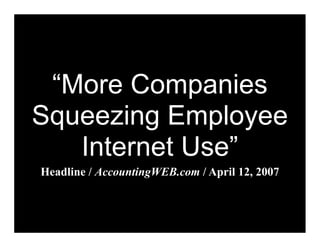
“More Companies
Squeezing Employee
   Internet Use”
Headline / AccountingWEB.com / April 12, 2007
elp-line
              hhotline:
Call our ethics
1-800-VIO-LATE
Consistently enforce the
standards through appropriate
   disciplinary mechanisms,
including punishing individuals
    responsible for failing to
       detect an offense.
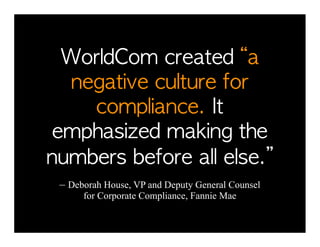
WorldCom	 created	 “a	 
  negative	 culture	 for	 
    compliance.	 It	 
emphasized	 making	 the	 
numbers	 before	 all	 else.”	 
 – Deborah House, VP and Deputy General Counsel
      for Corporate Compliance, Fannie Mae
Once an offense has
    been detected, take all
reasonable steps to respond
  appropriately and prevent
   further similar offenses.
“
Fool me once, shame on you.


                          ”
Fool me twice, shame on me.
why bother?
THE   softer SIDE OF SEARS
“This mitigating credit under
the guidelines is contingent upon
prompt reporting to the authorities
 and the non-involvement of high
   level personnel in the actual
         offense conduct.”
      Paula Desio, “An Overview of the
        Organizational Guidelines”
[8] Although they’re not your employees,
    it’s your responsibility to ensure that
    staff members are treated fairly.
fairlaborpractices

  Fair Labor Standards Act of
          1938 (FLSA)
 Stipulates minimum requirements for
compensation issues such as wages,
overtime, and equal pay, and specifies
  those employee classes exempted
          from its provisions.
“In fiscal year 2008, more than 197,000
  employees received a total of $140.2
 million in minimum wage and overtime
  back wages as a result of Fair Labor
    Standards Act (FLSA) violations.”

       U.S. Department of Labor
       2008 Statistics Fact Sheet
Are your employees “suffering” overtime?


 Non-exempt employees are prohibited from
 working more than 40 hours a week unless they
 are paid time and a half of their hourly rate.
 Example: An administrative assistant attends a
 board meeting one night to take minutes and
 the hours put the assistant over the 40-hour
 limitation. Did you pay the assistant overtime?
 Example: A bookkeeper attends your social
 fundraising event on Saturday evening to help
 count money. Is it overtime?
“New lawsuit claims
  back pay for some
part-time employees”
 Headline / FederalTimes.com / 04.17.2007
Donning, Doffing, Walking, & Waiting, L.P.A.
         Serious lawsuits only, please.
FMLA
“Termination of
      employees seeking
   FMLA leave continues
to be the primary reason
   that employees filed a
              complaint.”
U.S. Department of Labor
    2008 Statistics Fact Sheet
fundr aising
    <


9. The watchdogs are watching.
NEW
expectations
    in fundraising
privacy
Ask your donors
 if you can publicly
recognize their gifts
 or if they prefer to
remain anonymous.
Organizations should establish policies
      that govern the acceptance and
               disposition of charitable

                 GIFTS
RESTRICTED vs.
UNRESTRICTED
“Potential donors seek
more information than ever
 before when determining
 whether to respond to a
    charitable appeal.”
   – Art Taylor, BBB Wise Giving Alliance
Spend at least 65 percent of total
expenses on program activities.

Spend no more than 35 percent of
related contributions on fundraising.

Avoid accumulating funds that could
be used for current program activities.
FLATRATE
 (Not commissioned.)
10. SOx is coming.
Sarbanes-Oxley Act of 2002
Public Company Accounting Reform
and Investor Protection Act
CORPORATEGOVERNANCE


            Requirement of boards and
        auditors to oversee, direct, and
     report the organization’s practices
          on behalf of its shareholders.
“
              WHILE NEARLY ALL OF
              THE PROVISIONS OF THE
              ACT APPLY ONLY TO
              PUBLICLY TRADED
BoardSource   CORPORATIONS, THE
              PASSAGE OF THE BILL
              SERVED AS A WAKE-UP
              CALL TO THE ENTIRE
              NONPROFIT COMMUNITY.”
A
Audit-related functions
 should be performed
 only by independent,
     financially literate
              directors.
in·de·pend·ent
 Adjective. Free from the authority,
control, domination, or influence of
   somebody or something else.
“All	 nonprofit	 organizations	 that	 
 conduct	 outside	 audits,	 particularly	 
medium	 to	 large	 organizations,	 should	 
consider	 forming	 an	 audit	 committee	 
   and	 should	 separate	 the	 audit	 
    committee	 from	 the	 finance	 
              committee.”	 	 	 	 	 	 	 	 	 	 	 	 	 	 	 	 	 	 	 	 	 
         –BoardSource, “The Sarbanes-Oxley Act and
          Implications for Nonprofit Organizations”
financial
EXPERT
I
   Independent auditors
must be rotated and may
  not provide consulting
services unrelated to the
     organization’s audit.
Changing auditors every five
 years ensures fresh scrutiny. If
 that’s not practical, an option is
to ask the auditing firm to assign
   a different reviewing partner
          every five years.
“Nonprofit	 organizations	 
 would	 be	 well	 served	 to	 
adopt	 the	 Sarbanes-Oxley	 
rule	 of	 preventing	 auditing	 
firms	 from	 providing	 non-
     auditing	 services.”
        BoardSource
exceptions:
AUDITING FIRMS OFTEN PROVIDE
TAX SERVICES AND PREPARE
FORM 990 FOR THEIR NONPROFIT
CLIENTS. SUCH ARRANGEMENTS
MAY ACTUALLY REDUCE A
NONPROFIT’S EXPENSES.
M
          Management’s
    compensation should
 be determined based on
achievement of objective,
    predetermined goals.
“Senators critical of
 salary expenses at
Boys & Girls Clubs
    of America”
Headline / The Washington Post / 03.13.2010
Without specific,
WARNING
          measurable, and well-
          communicated grading
          criteria, outsiders will
          assume the worst about
          how evaluation decisions
          are determined.
QUESTION:


     Could you defend it?
D
Develop procedures for
  handling confidential
      and anonymous
           complaints.
“Employees who learned about
improper corporate adjustments appear
  to have feared senior management’s
     criticism or even the loss of
    their jobs. It was common for
 employees to be denigrated in
               public about their work.”
      Source: Report of Investigation by the Special Investigative
              Committee of the Board of Directors of WorldCom
SAFETY FIRST

                   Organizations
                   must focus on
                  identifying and
               removing problems,
                 not on shooting
                 the messenger.
M Monitor, justify, and
  carefully administer
intentional document
          destruction.
I said, “Ship the documents to the feds.”

She heard, “Rip the documents to shreds.”
L
Loans to directors and
 executive officers are
            prohibited.
At best, insider loans raise
   conflict-of-interest questions.
 At worst, they could qualify as
illegal executive compensation.
bonus tip:


avoid groupthink!
COHESION
A demonstrated tendency for a group
 to stay together and remain united in
the pursuit of its goals and objectives.
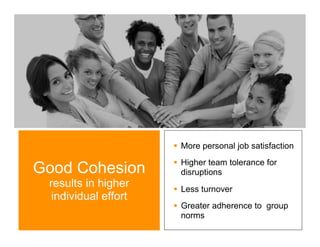
 More personal job satisfaction
                       Higher team tolerance for
Good Cohesion           disruptions
 results in higher     Less turnover
  individual effort
                       Greater adherence to group
                        norms
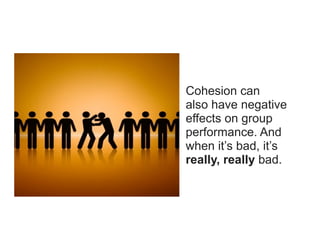
Cohesion can
also have negative
effects on group
performance. And
when it’s bad, it’s
really, really bad.
“Because people value their membership
  in cohesive groups, they are willing to
adjust their behavior to group standards.”

                      SUSAN CAROL LOSH, Ph.D.
                     FLORIDA STATE UNIVERSITY
GROUPTHINK
occurs when the pressure to
   conform within a group
 interferes with the group’s
   decision making ability.
A      B        C
Exhibit 1       Exhibit 2
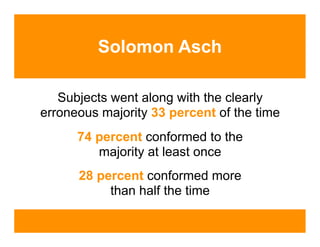
Solomon Asch

   Subjects went along with the clearly
erroneous majority 33 percent of the time
      74 percent conformed to the
         majority at least once
      28 percent conformed more
           than half the time
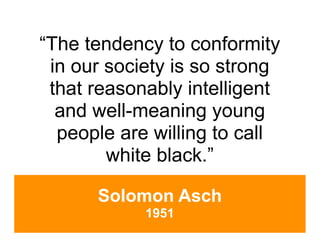
“The tendency to conformity
 in our society is so strong
 that reasonably intelligent
  and well-meaning young
  people are willing to call
        white black.”

      Solomon Asch
            1951
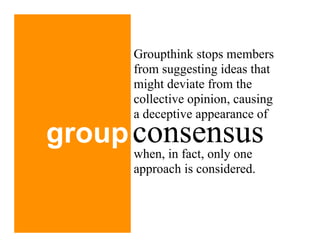
Groupthink stops members
      from suggesting ideas that
      might deviate from the
      collective opinion, causing
      a deceptive appearance of
group consensus
      when, in fact, only one
      approach is considered.
The days of “sitting” on a
nonprofit board are over.
the top

  10         things
Your Nonprofit Board
  Needs to Know
    (plus One Bonus Tip)
Unison

Unison

  • 1.
  • 2.
    “Directors are like parsley on fish— decorative but useless.” Irving Olds, former board chair of U.S. Steel
  • 3.
    “All over theworld, people just like us serve on all sorts of boards. Some work incredibly well. Some leave members shell shocked or numb with frustration.” The Montessori Foundation “Serving on a Nonprofit Board”
  • 4.
    The days of“sitting” on a nonprofit board are over.
  • 5.
    “Many organizational leaders...cometo the charitable sector motivated by the mission of the organization and may not always have the requisite governance and financial knowledge.” PANEL ON THE NONPROFIT SECTOR
  • 6.
    the top 10 things Your Nonprofit Board Needs to Know (plus One Bonus Tip)
  • 7.
    No. 1 It’s a whole new ballgame.
  • 8.
    “You will beconfronted with questions every day that test your morals. Think carefully, and for your sake, do the right thing, not the easy thing.” Commencement Speaker St. Anselm College, 2002
  • 9.
    “Ex-Tyco Chief Executive Kozlowski Sentencedto 8 to 25 Years” Headline / Bloomberg.com / 09.19.2005
  • 10.
    Strong Fundamental Values “Wemust demand of ourselves and of each other the highest standards of individual and corporate integrity. We safeguard company assets. We comply with all company policies and laws.” Source: The Tyco Guide to Ethical Conduct
  • 11.
     Regency mahogany bookcase, c. 1810, $105,000 “We safeguard  George I walnut tallcase clock, $113,750 company assets.”  Custom queen bed skirt, $4,995  Ascherberg grand piano, c. 1895, $77,000  Chandelier, Painted Iron, c. 1930, $32,500  Pair of Italian armchairs, c. 1780, $64,278  Persian rug, 20 feet by 14 feet, $191,250
  • 12.
    “In corporate America, crime pays.Handsomely. Grotesquely, even.” Arianna Huffington Pigs at the Trough
  • 13.
    “We’ve got thisidea that business means anything goes. ” R. Edward Freeman, Director Olsson Center for Applied Ethics
  • 14.
    “It can be easy for non-profits to feel that the problems of the private sector don’t relate to them...” –Stephen D. Potts, Fellows Chairman Ethics Resource Center
  • 15.
    “...that the ‘good people’ who populate the non-profit world are, by nature, more trustworthy.” –Stephen D. Potts, Fellows Chairman Ethics Resource Center
  • 16.
    “This is a dangerous assumption.” Stephen D. Potts, Fellows Chairman Ethics Resource Center
  • 17.
    “Anderson womanpleads guilty to Humane Society theft” Headline / The Herald Bulletin / 05.11.2009
  • 18.
    “Her attorney...presented the courtwith several character letters from acquaintances and co-workers, and said Sullivan provides live-in care for her sick mother.” Justin Schneider The Herald Bulletin
  • 19.
    “We haven’t hada serious review of the tax-exempt laws since 1969. The world has changed since then, and so has the charitable community.” –Senator Chuck Grassley, Senate Committee on Finance
  • 20.
    The New 990 (version 2.0)
  • 21.
  • 22.
    2. You havea duty of care.
  • 23.
    Duty of Care Boardmembers have an obligation to make informed decisions and to act with care in their actions.
  • 24.
    Commonly described as the“care that an ordinarily prudent person would exercise in a like position and under similar circumstances.”
  • 25.
    “Once the Boardwas made aware of the investigations of Sandusky...the Board, as a governing body, failed to inquire reasonably and to demand detailed information from [President] Spanier.” Report of the Special Investigative Counsel Regarding the Actions of The Pennsylvania State University Related to the Child Sexual Abuse Committed by Gerald A. Sandusky
  • 26.
    REMINDER The duty of care legally requires every board member to participate in meetings, provide operational and policy oversight, and exercise a reasonable level of care in making decisions on the organization’s behalf.
  • 27.
    Where on the agendadoes it say I get to speak?
  • 28.
    The board chairis the conductor responsible for making sure every performer contributes.
  • 29.
    Board members whoregularly miss meetings are neglecting the duty of care.
  • 30.
  • 31.
    THREE: You have aduty of loyalty.
  • 32.
    DUTY OF LOYALTY Directors are obligated to set aside personal concerns and make decisions that are in the best interest of the organization.
  • 33.
    Conflict of >> INTEREST
  • 34.
    “Getty Book DealLed to Questions of Conflict” Headline / Los Angeles Times / 06.13.2006
  • 35.
    “This is beyondself- dealing. It’s insiders with a sweetheart deal.” -Frances Hill, professor at the University of Miami School of Law
  • 36.
  • 37.
  • 38.
    4) You havea duty of obedience.
  • 39.
    DUTYOFOBEDIENCE Directors must remain faithful to the purpose of the organization, and operate within the stated bounds of its mission.
  • 40.
    The Barnes Foundation Boardpresident saw “the intent of the donor as a hurdle to be overcome rather than a guiding light.” -Judge Louis Stefan
  • 41.
    “The duty ofobedience is often overlooked...precisely because it is so basic as to be almost invisible.” Rob Atkinson Professor of Law, Florida State University
  • 42.
  • 43.
    a.k.a. duty ofcompliance
  • 44.
     Articles of incorporation Comply with:  By-laws and other governing documents  Local, state, and federal laws  Registration and reporting requirements  IRS regulations
  • 45.
    5. You havea duty to manage accounts.
  • 46.
    Directors are responsible for ensuring the organization’s financial soundness.
  • 47.
    “One of theprimary duties of the board of directors of a charitable organization is to ensure that all financial matters of the organization are conducted legally, ethically, and in accordance with proper accounting rules.” PANEL ON THE NONPROFIT SECTOR Report to Congress and the Nonprofit Sector on Governance, Transparency, and Accountability
  • 48.
    Nonprofit boards need accounting geeks who understand finances themselves and who can make the numbers meaningful to everyone else.
  • 49.
    “Accountants aren’t just boring geeks anymore. We’re hot!” Eva Rosenberg, author of Small Business Taxes Made Easy
  • 50.
  • 51.
    only one THEEXECUTIVE DIRECTOR IS THE SOLE EMPLOYEE OF THE BOARD OF DIRECTORS
  • 52.
    BEWARE of meddling byself-proclaimed experts
  • 53.
    They think nothingof going around the executive director and crossing the sacred line that separates board members from employees.
  • 54.
  • 55.
  • 56.
    “Most of thelawsuits filed against nonprofit directors and officers involve some form of employment practices liability. Insurers are becoming more keenly aware of this exposure and some have made subtle policy changes that restrict coverage in these areas.” Alliance of Nonprofits “Key Facts About Insurance and Legal Liability”
  • 57.
    “…while acting inan official capacity…”
  • 58.
  • 59.
    “A volunteer ofa nonprofit organization generally will be relieved of liability for harm if the volunteer was acting within the scope of his responsibilities and if he was properly licensed, certified, or authorized for the activities.” Volunteer Protection Act of 1997 Section 4. Limitation on Liability for Volunteers
  • 60.
    Is it reallyworth the risk?
  • 61.
    7. Although they’re not youremployees, it’s your responsibility to ensure that staff members behave ethically.
  • 62.
    “People are basically honest. And they’re even more honest when you watch them.” attributed to Alan “Ace” Greenberg The Bear Stearns Companies
  • 63.
    United States SentencingCommission “Criminal liability can attach to an organization whenever an employee of the organization commits an act within the apparent scope of his or her employment, even if the employee acted directly contrary to company policy and instructions.” Paula Desio, “An Overview of the Organizational Guidelines”
  • 64.
    PRO ACT U.S. Federal Sentencing Guidelines IVE Seven guidelines used to determine whether an organization shares responsibility for the misbehavior of its employees; adherence can mitigate penalties and fines.
  • 65.
    Establish compliance standards andprocedures for employees and other agents to follow that are reasonably capable of reducing the prospect of criminal conduct.
  • 66.
    codeofconduct: POLICY COVERING THEORGANIZATION’S STANCE ON—AND EACH EMPLOYEE’S RESPONSIBILITY FOR—WORKPLACE ISSUES, INCLUDING HARASSMENT, DIVERSITY, CONFLICTS OF INTEREST, VIOLENCE, CONFIDENTIALITY, AND EQUAL OPPORTUNITY.
  • 67.
    “Was that wrong?Should I have not done that? I tell you I gotta plead ignorance on this thing because if anyone had said anything to me at all when I first started here that that sort of thing was frowned upon, you know, cause I’ve worked in a lot of offices and I tell you people do that all the time.” George Costanza Seinfeld, Episode 29
  • 68.
    Board Member Agreement • Board Self-Assessment • Code of Ethics • Conflict of Interest • Confidentiality • Electronic Media • Equal Employment Opportunity • Executive Compensation • Financial Audits • Gift Acceptance • Investments • Lobbying and Political Activity • Mission Statement • Record Retention and Document Destruction • Whistleblower Protection • Workplace Environment
  • 69.
    “One explanation that’scommon in the field of business ethics, and this may sound shocking, is that they just didn’t recognize the ethical issue for what it really was.” Thomas Dunfee, Wharton professor
  • 70.
    Assign specific high-level individual(s)the responsibility for overseeing the overall compliance with standards and procedures.
  • 71.
  • 72.
    Exercise “due care”not to delegate discretionary authority to individuals with a known propensity to engage in illegal activities.
  • 73.
    “I look forwardto pursuing my new responsibilities and continuing to make a contribution as part of Rite Aid’s world-class team.” -Chris Hall Senior VP-Real Estate and Planning former Chief Financial Officer
  • 74.
    57 percent ofjob applicants believe that telling lies during a job interview is acceptable SOURCE: SHL
  • 75.
    “Marge, it takes twoto lie. One to lie and one to listen.” – Homer Simpson
  • 76.
    Take steps toeffectively communicate—to all levels of employees—the rules and expectations, such as holding mandatory training programs and distributing written materials.
  • 77.
    “Ethics programs are associated with higher perceptions that employees are held accountable for ethics violations.” Source: Ethics Resource Center
  • 78.
  • 79.
    Take reasonable stepsto achieve compliance, including the use of monitoring and auditing systems designed to detect criminal conduct and methods for employees to report suspected wrongdoing without the fear of retaliation.
  • 80.
    “More Companies Squeezing Employee Internet Use” Headline / AccountingWEB.com / April 12, 2007
  • 81.
    elp-line hhotline: Call our ethics 1-800-VIO-LATE
  • 82.
    Consistently enforce the standardsthrough appropriate disciplinary mechanisms, including punishing individuals responsible for failing to detect an offense.
  • 83.
    WorldCom created “a negative culture for compliance. It emphasized making the numbers before all else.” – Deborah House, VP and Deputy General Counsel for Corporate Compliance, Fannie Mae
  • 84.
    Once an offensehas been detected, take all reasonable steps to respond appropriately and prevent further similar offenses.
  • 85.
    “ Fool me once,shame on you. ” Fool me twice, shame on me.
  • 86.
  • 87.
    THE softer SIDE OF SEARS
  • 88.
    “This mitigating creditunder the guidelines is contingent upon prompt reporting to the authorities and the non-involvement of high level personnel in the actual offense conduct.” Paula Desio, “An Overview of the Organizational Guidelines”
  • 89.
    [8] Although they’renot your employees, it’s your responsibility to ensure that staff members are treated fairly.
  • 90.
    fairlaborpractices FairLabor Standards Act of 1938 (FLSA) Stipulates minimum requirements for compensation issues such as wages, overtime, and equal pay, and specifies those employee classes exempted from its provisions.
  • 91.
    “In fiscal year2008, more than 197,000 employees received a total of $140.2 million in minimum wage and overtime back wages as a result of Fair Labor Standards Act (FLSA) violations.” U.S. Department of Labor 2008 Statistics Fact Sheet
  • 92.
    Are your employees“suffering” overtime? Non-exempt employees are prohibited from working more than 40 hours a week unless they are paid time and a half of their hourly rate. Example: An administrative assistant attends a board meeting one night to take minutes and the hours put the assistant over the 40-hour limitation. Did you pay the assistant overtime? Example: A bookkeeper attends your social fundraising event on Saturday evening to help count money. Is it overtime?
  • 93.
    “New lawsuit claims back pay for some part-time employees” Headline / FederalTimes.com / 04.17.2007
  • 94.
    Donning, Doffing, Walking,& Waiting, L.P.A. Serious lawsuits only, please.
  • 95.
  • 96.
    “Termination of employees seeking FMLA leave continues to be the primary reason that employees filed a complaint.” U.S. Department of Labor 2008 Statistics Fact Sheet
  • 97.
    fundr aising < 9. The watchdogs are watching.
  • 98.
    NEW expectations in fundraising
  • 99.
  • 100.
    Ask your donors if you can publicly recognize their gifts or if they prefer to remain anonymous.
  • 101.
    Organizations should establishpolicies that govern the acceptance and disposition of charitable GIFTS
  • 102.
  • 103.
    “Potential donors seek moreinformation than ever before when determining whether to respond to a charitable appeal.” – Art Taylor, BBB Wise Giving Alliance
  • 104.
    Spend at least65 percent of total expenses on program activities. Spend no more than 35 percent of related contributions on fundraising. Avoid accumulating funds that could be used for current program activities.
  • 105.
  • 106.
    10. SOx iscoming.
  • 107.
    Sarbanes-Oxley Act of2002 Public Company Accounting Reform and Investor Protection Act
  • 108.
    CORPORATEGOVERNANCE Requirement of boards and auditors to oversee, direct, and report the organization’s practices on behalf of its shareholders.
  • 109.
    WHILE NEARLY ALL OF THE PROVISIONS OF THE ACT APPLY ONLY TO PUBLICLY TRADED BoardSource CORPORATIONS, THE PASSAGE OF THE BILL SERVED AS A WAKE-UP CALL TO THE ENTIRE NONPROFIT COMMUNITY.”
  • 110.
    A Audit-related functions shouldbe performed only by independent, financially literate directors.
  • 111.
    in·de·pend·ent Adjective. Freefrom the authority, control, domination, or influence of somebody or something else.
  • 112.
    “All nonprofit organizations that conduct outside audits, particularly medium to large organizations, should consider forming an audit committee and should separate the audit committee from the finance committee.” –BoardSource, “The Sarbanes-Oxley Act and Implications for Nonprofit Organizations”
  • 113.
  • 114.
    I Independent auditors must be rotated and may not provide consulting services unrelated to the organization’s audit.
  • 115.
    Changing auditors everyfive years ensures fresh scrutiny. If that’s not practical, an option is to ask the auditing firm to assign a different reviewing partner every five years.
  • 116.
    “Nonprofit organizations would be well served to adopt the Sarbanes-Oxley rule of preventing auditing firms from providing non- auditing services.” BoardSource
  • 117.
    exceptions: AUDITING FIRMS OFTENPROVIDE TAX SERVICES AND PREPARE FORM 990 FOR THEIR NONPROFIT CLIENTS. SUCH ARRANGEMENTS MAY ACTUALLY REDUCE A NONPROFIT’S EXPENSES.
  • 118.
    M Management’s compensation should be determined based on achievement of objective, predetermined goals.
  • 119.
    “Senators critical of salary expenses at Boys & Girls Clubs of America” Headline / The Washington Post / 03.13.2010
  • 120.
    Without specific, WARNING measurable, and well- communicated grading criteria, outsiders will assume the worst about how evaluation decisions are determined.
  • 121.
    QUESTION: Could you defend it?
  • 122.
    D Develop procedures for handling confidential and anonymous complaints.
  • 123.
    “Employees who learnedabout improper corporate adjustments appear to have feared senior management’s criticism or even the loss of their jobs. It was common for employees to be denigrated in public about their work.” Source: Report of Investigation by the Special Investigative Committee of the Board of Directors of WorldCom
  • 124.
    SAFETY FIRST Organizations must focus on identifying and removing problems, not on shooting the messenger.
  • 125.
    M Monitor, justify,and carefully administer intentional document destruction.
  • 126.
    I said, “Shipthe documents to the feds.” She heard, “Rip the documents to shreds.”
  • 127.
    L Loans to directorsand executive officers are prohibited.
  • 128.
    At best, insiderloans raise conflict-of-interest questions. At worst, they could qualify as illegal executive compensation.
  • 129.
  • 130.
    COHESION A demonstrated tendencyfor a group to stay together and remain united in the pursuit of its goals and objectives.
  • 131.
     More personaljob satisfaction  Higher team tolerance for Good Cohesion disruptions results in higher  Less turnover individual effort  Greater adherence to group norms
  • 132.
    Cohesion can also havenegative effects on group performance. And when it’s bad, it’s really, really bad.
  • 133.
    “Because people valuetheir membership in cohesive groups, they are willing to adjust their behavior to group standards.” SUSAN CAROL LOSH, Ph.D. FLORIDA STATE UNIVERSITY
  • 134.
    GROUPTHINK occurs when thepressure to conform within a group interferes with the group’s decision making ability.
  • 135.
    A B C Exhibit 1 Exhibit 2
  • 136.
    Solomon Asch Subjects went along with the clearly erroneous majority 33 percent of the time 74 percent conformed to the majority at least once 28 percent conformed more than half the time
  • 137.
    “The tendency toconformity in our society is so strong that reasonably intelligent and well-meaning young people are willing to call white black.” Solomon Asch 1951
  • 138.
    Groupthink stops members from suggesting ideas that might deviate from the collective opinion, causing a deceptive appearance of group consensus when, in fact, only one approach is considered.
  • 139.
    The days of“sitting” on a nonprofit board are over.
  • 140.
    the top 10 things Your Nonprofit Board Needs to Know (plus One Bonus Tip)