SEMINAR
PRESENTATION
TOPIC: UNION BUDGET 2020-21
SUBMITTED BY: KANWAL PREET
SUBMITTED TO:
M.COM HONS. FYIC 3RD YEAR
AJAYDEEP BRAR SIR
5TH SEM
ROLL NO.: 18051245
INTRODUCTION
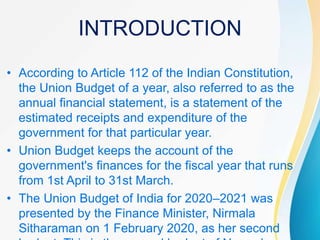
• According to Article 112 of the Indian Constitution,
the Union Budget of a year, also referred to as the
annual financial statement, is a statement of the
estimated receipts and expenditure of the
government for that particular year.
• Union Budget keeps the account of the
government's finances for the fiscal year that runs
from 1st April to 31st March.
• The Union Budget of India for 2020–2021 was
presented by the Finance Minister, Nirmala
Sitharaman on 1 February 2020, as her second
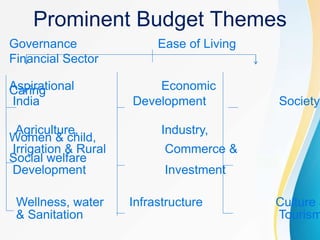
Prominent Budget Themes
Governance Ease of Living
Financial Sector
Aspirational EconomicCaring
India Development Society
Agriculture, Industry,
Women & child,
Irrigation & Rural Commerce &
Social welfare
Development Investment
Wellness, water Infrastructure Culture &
& Sanitation Tourism
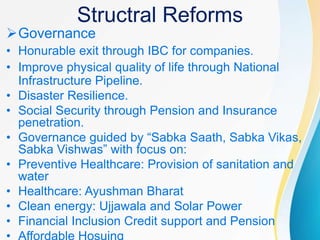
Structral Reforms
Governance
• Honurable exit through IBC for companies.
• Improve physical quality of life through National
Infrastructure Pipeline.
• Disaster Resilience.
• Social Security through Pension and Insurance
penetration.
• Governance guided by “Sabka Saath, Sabka Vikas,
Sabka Vishwas” with focus on:
• Preventive Healthcare: Provision of sanitation and
water
• Healthcare: Ayushman Bharat
• Clean energy: Ujjawala and Solar Power
• Financial Inclusion Credit support and Pension
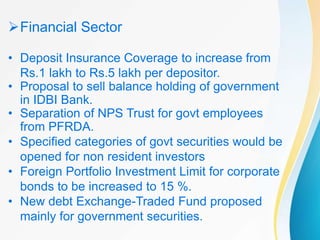
Financial Sector
• Deposit Insurance Coverage to increase from
Rs.1 lakh to Rs.5 lakh per depositor.
• Proposal to sell balance holding of government
in IDBI Bank.
• Separation of NPS Trust for govt employees
from PFRDA.
• Specified categories of govt securities would be
opened for non resident investors
• Foreign Portfolio Investment Limit for corporate
bonds to be increased to 15 %.
• New debt Exchange-Traded Fund proposed
mainly for government securities.
Aspirational India
Agriculture, Irrigation and Rural Development
• PM KUSUM to cover 20 lakh farmers for stand alone
solar pumps and further 15 lakh for grid connected
pumps.
• SHGs run Village storage scheme to be launched.
• “Kisan Rail” and “Krishi Udaan” to be launched by
Indian Railways and Ministry of Civil Aviation
respectively for a seamless national cold supply chain
for perishables.
• Increasing coverage of artificial insemination to 70
per cent.
• Doubling of milk processing capacity by 2025.
• Agricultural credit target of Rs.15 lakh crore for 2020-
• Fishery extension through 3477 Sagar Mitras and
500 fish FPOs.
• Raise fishery exports to Rs.1 lakh crore by 2024-25.
Wellness, Water and Sanitation
• More than 20 000 empanelled hospitals under More
than 20,000 empanelled hospitals under PM Jan
Arogya Yojana.
• FIT India movement launched to fight NCDs.
• “TB Harega Desh Jeetega” campaign launched to
end TB by 2025.
• Viability gap funding proposed for setting up
hospitals in the PPP mode.
• Expansion of Jan Aushadhi Kendra Scheme to all
districts by 2024.
• ODF Plus to sustain ODF behaviour.
Education and Skills
• About 150 higher educational institutions will
start apprenticeship embedded courses.
• Internship opportunities to fresh engineers by
urban local bodies.
• Special bridge courses to improve skill sets of
those seeking employment abroad.
• Degree level online education programmes for
students of deprived sections of the society.
• Ind-SAT to be conducted in Asia and Africa
under study in India programme.
• Proposal for a National Police University and a
National Forensic Science University.
• Rs. 99,300 crore for eduction sector in 2020-21
& Rs. 3000 crore for skill development.
Economic Development
Industry, Commerce and Investment
• EXIM Bank and SIDBI to handhold MSMEs in
exports markets.
• Extension of invoice financing to MSMEs
through TReDs.
• NIRVIK Scheme for higher export credit
disbursement launched.
• Setting up of an Investment Clearance Cell to
provide end to end facilitation.
• Scheme to encourage manufacturing of mobile
phones, electronic equipment and semi
conductor packaging.
Infrastructure
• National Logistics Policy to be launched soon
National Logistics Policy to be launched soon.
• Accelerated development of Highways.
• Corproatizing at least one major port.
• 100 more airports to be developed under UDAAN.
• Efforts to replace conventional energy Efforts to
replace conventional energy meters by prepaid smart
meters.
• Expand National Gas Grid to 27,000 km.
• Rs. 103 lakh crore National infrastructure Pipeline
projects announced.
• An international bullion exchange to be set up at
New Economy
• Knowledge Translation Clusters for emerging
technology sectors.
• Scaling up of Technology Clusters harbouring
test beds and small scale manufacturing
facilities.
• National Mission on Quantum Technologies and
applications with an outlay of Rs.8000 crore
proposed.
• Early life funding for start ups.
• Institute of Excellence in the field of Intellectual
property to be set up.
Caring Society
Women & Child, Social Welfare
• More than 6 lakh anganwadi workers equipped with
smart phones.
• A task force to be appointed to recommend regarding
lowering MMR and improving nutrition values.
Culture and Tourism
• Proposal to establish Indian Institute of Heritage and
conservation.
• 5 archaelogical sites to be developed as iconic sites.
• A museum on Numismatics andTrade to be
established.
• Maritime museum to be set up at Lothal.
Environment and Climate Change
• Coalition for Disaster Resilient workers
Infrastructure launched in september 2019.
• Encouragement to states implementing plans
for cleaner air in cities above 1 million.
Tax Proposals
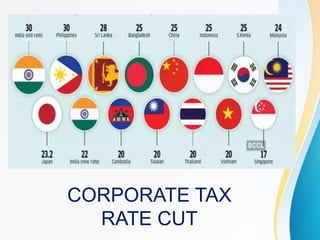
• Concessional corporate tax rate of 15 % to new
domestic companies in manufacturing and power
sector.
• Tax concession for sovereign wealth fund of
foreign governments and other foreign investments.
• Tax benefits to Start-ups by way of deduction of
100 % of their profits are enhanced by increasing
turnover limit and period of eligibility.
• Concessional tax rate for cooperatives proposed.
• Turnover threshold for audit of MSMEs increased.
• Extension of time limits pertaining to the tax
benefits for affordable housing.
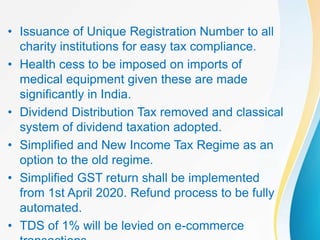
• Issuance of Unique Registration Number to all
charity institutions for easy tax compliance.
• Health cess to be imposed on imports of
medical equipment given these are made
significantly in India.
• Dividend Distribution Tax removed and classical
system of dividend taxation adopted.
• Simplified and New Income Tax Regime as an
option to the old regime.
• Simplified GST return shall be implemented
from 1st April 2020. Refund process to be fully
automated.
• TDS of 1% will be levied on e-commerce
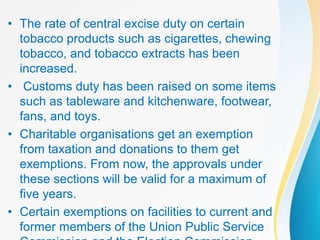
• The rate of central excise duty on certain
tobacco products such as cigarettes, chewing
tobacco, and tobacco extracts has been
increased.
• Customs duty has been raised on some items
such as tableware and kitchenware, footwear,
fans, and toys.
• Charitable organisations get an exemption
from taxation and donations to them get
exemptions. From now, the approvals under
these sections will be valid for a maximum of
five years.
• Certain exemptions on facilities to current and
former members of the Union Public Service
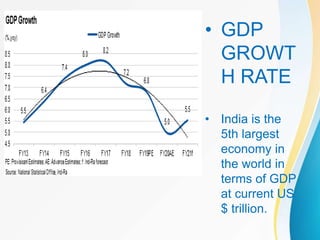
• GDP
GROWT
H RATE
• India is the
5th largest
economy in
the world in
terms of GDP
at current US
$ trillion.
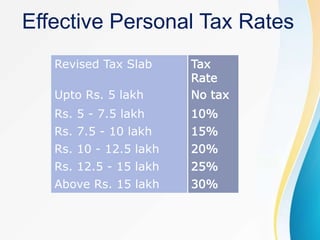
Effective Personal Tax Rates
Revised Tax Slab Tax
Rate
Upto Rs. 5 lakh No tax
Rs. 5 - 7.5 lakh 10%
Rs. 7.5 - 10 lakh 15%
Rs. 10 - 12.5 lakh 20%
Rs. 12.5 - 15 lakh 25%
Above Rs. 15 lakh 30%
CORPORATE TAX
RATE CUT
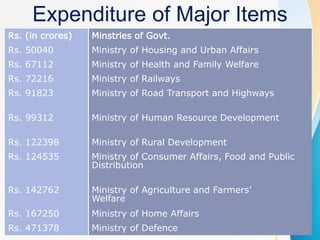
Expenditure of Major Items
Rs. (in crores) Minstries of Govt.
Rs. 50040 Ministry of Housing and Urban Affairs
Rs. 67112 Ministry of Health and Family Welfare
Rs. 72216 Ministry of Railways
Rs. 91823 Ministry of Road Transport and Highways
Rs. 99312 Ministry of Human Resource Development
Rs. 122398 Ministry of Rural Development
Rs. 124535 Ministry of Consumer Affairs, Food and Public
Distribution
Rs. 142762 Ministry of Agriculture and Farmers’
Welfare
Rs. 167250 Ministry of Home Affairs
Rs. 471378 Ministry of Defence
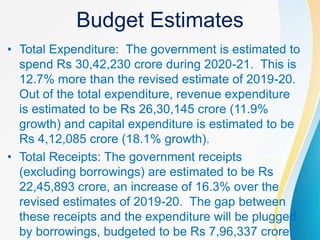
Budget Estimates
• Total Expenditure: The government is estimated to
spend Rs 30,42,230 crore during 2020-21. This is
12.7% more than the revised estimate of 2019-20.
Out of the total expenditure, revenue expenditure
is estimated to be Rs 26,30,145 crore (11.9%
growth) and capital expenditure is estimated to be
Rs 4,12,085 crore (18.1% growth).
• Total Receipts: The government receipts
(excluding borrowings) are estimated to be Rs
22,45,893 crore, an increase of 16.3% over the
revised estimates of 2019-20. The gap between
these receipts and the expenditure will be plugged
by borrowings, budgeted to be Rs 7,96,337 crore,
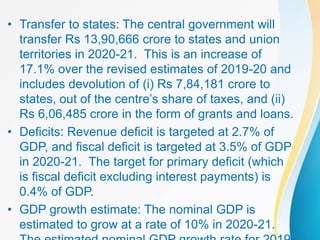
• Transfer to states: The central government will
transfer Rs 13,90,666 crore to states and union
territories in 2020-21. This is an increase of
17.1% over the revised estimates of 2019-20 and
includes devolution of (i) Rs 7,84,181 crore to
states, out of the centre’s share of taxes, and (ii)
Rs 6,06,485 crore in the form of grants and loans.
• Deficits: Revenue deficit is targeted at 2.7% of
GDP, and fiscal deficit is targeted at 3.5% of GDP
in 2020-21. The target for primary deficit (which
is fiscal deficit excluding interest payments) is
0.4% of GDP.
• GDP growth estimate: The nominal GDP is
estimated to grow at a rate of 10% in 2020-21.
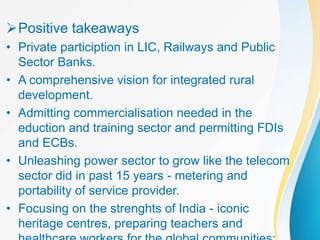
Positive takeaways
• Private particiption in LIC, Railways and Public
Sector Banks.
• A comprehensive vision for integrated rural
development.
• Admitting commercialisation needed in the
eduction and training sector and permitting FDIs
and ECBs.
• Unleashing power sector to grow like the telecom
sector did in past 15 years - metering and
portability of service provider.
• Focusing on the strenghts of India - iconic
heritage centres, preparing teachers and
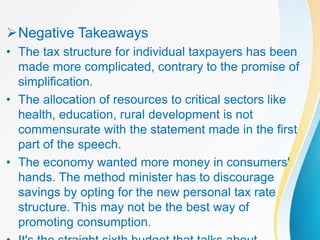
Negative Takeaways
• The tax structure for individual taxpayers has been
made more complicated, contrary to the promise of
simplification.
• The allocation of resources to critical sectors like
health, education, rural development is not
commensurate with the statement made in the first
part of the speech.
• The economy wanted more money in consumers'
hands. The method minister has to discourage
savings by opting for the new personal tax rate
structure. This may not be the best way of
promoting consumption.
To conclude, the Budget 2020-21 takes a pragmatic
approach to growth without compromising the hard
gains on fiscal rectitude. The stimulus is measured
and targeted to promote entrepreneurship, foster trust
and enable prosperity for citizens.

Union Budget 2020-21 ppt

  • 1.
    SEMINAR PRESENTATION TOPIC: UNION BUDGET2020-21 SUBMITTED BY: KANWAL PREET SUBMITTED TO: M.COM HONS. FYIC 3RD YEAR AJAYDEEP BRAR SIR 5TH SEM ROLL NO.: 18051245
  • 2.
    INTRODUCTION • According toArticle 112 of the Indian Constitution, the Union Budget of a year, also referred to as the annual financial statement, is a statement of the estimated receipts and expenditure of the government for that particular year. • Union Budget keeps the account of the government's finances for the fiscal year that runs from 1st April to 31st March. • The Union Budget of India for 2020–2021 was presented by the Finance Minister, Nirmala Sitharaman on 1 February 2020, as her second
  • 3.
    Prominent Budget Themes GovernanceEase of Living Financial Sector Aspirational EconomicCaring India Development Society Agriculture, Industry, Women & child, Irrigation & Rural Commerce & Social welfare Development Investment Wellness, water Infrastructure Culture & & Sanitation Tourism
  • 4.
    Structral Reforms Governance • Honurableexit through IBC for companies. • Improve physical quality of life through National Infrastructure Pipeline. • Disaster Resilience. • Social Security through Pension and Insurance penetration. • Governance guided by “Sabka Saath, Sabka Vikas, Sabka Vishwas” with focus on: • Preventive Healthcare: Provision of sanitation and water • Healthcare: Ayushman Bharat • Clean energy: Ujjawala and Solar Power • Financial Inclusion Credit support and Pension
  • 5.
    Financial Sector • DepositInsurance Coverage to increase from Rs.1 lakh to Rs.5 lakh per depositor. • Proposal to sell balance holding of government in IDBI Bank. • Separation of NPS Trust for govt employees from PFRDA. • Specified categories of govt securities would be opened for non resident investors • Foreign Portfolio Investment Limit for corporate bonds to be increased to 15 %. • New debt Exchange-Traded Fund proposed mainly for government securities.
  • 6.
    Aspirational India Agriculture, Irrigationand Rural Development • PM KUSUM to cover 20 lakh farmers for stand alone solar pumps and further 15 lakh for grid connected pumps. • SHGs run Village storage scheme to be launched. • “Kisan Rail” and “Krishi Udaan” to be launched by Indian Railways and Ministry of Civil Aviation respectively for a seamless national cold supply chain for perishables. • Increasing coverage of artificial insemination to 70 per cent. • Doubling of milk processing capacity by 2025. • Agricultural credit target of Rs.15 lakh crore for 2020-
  • 7.
    • Fishery extensionthrough 3477 Sagar Mitras and 500 fish FPOs. • Raise fishery exports to Rs.1 lakh crore by 2024-25. Wellness, Water and Sanitation • More than 20 000 empanelled hospitals under More than 20,000 empanelled hospitals under PM Jan Arogya Yojana. • FIT India movement launched to fight NCDs. • “TB Harega Desh Jeetega” campaign launched to end TB by 2025. • Viability gap funding proposed for setting up hospitals in the PPP mode. • Expansion of Jan Aushadhi Kendra Scheme to all districts by 2024. • ODF Plus to sustain ODF behaviour.
  • 8.
    Education and Skills •About 150 higher educational institutions will start apprenticeship embedded courses. • Internship opportunities to fresh engineers by urban local bodies. • Special bridge courses to improve skill sets of those seeking employment abroad. • Degree level online education programmes for students of deprived sections of the society. • Ind-SAT to be conducted in Asia and Africa under study in India programme. • Proposal for a National Police University and a National Forensic Science University. • Rs. 99,300 crore for eduction sector in 2020-21 & Rs. 3000 crore for skill development.
  • 9.
    Economic Development Industry, Commerceand Investment • EXIM Bank and SIDBI to handhold MSMEs in exports markets. • Extension of invoice financing to MSMEs through TReDs. • NIRVIK Scheme for higher export credit disbursement launched. • Setting up of an Investment Clearance Cell to provide end to end facilitation. • Scheme to encourage manufacturing of mobile phones, electronic equipment and semi conductor packaging.
  • 10.
    Infrastructure • National LogisticsPolicy to be launched soon National Logistics Policy to be launched soon. • Accelerated development of Highways. • Corproatizing at least one major port. • 100 more airports to be developed under UDAAN. • Efforts to replace conventional energy Efforts to replace conventional energy meters by prepaid smart meters. • Expand National Gas Grid to 27,000 km. • Rs. 103 lakh crore National infrastructure Pipeline projects announced. • An international bullion exchange to be set up at
  • 11.
    New Economy • KnowledgeTranslation Clusters for emerging technology sectors. • Scaling up of Technology Clusters harbouring test beds and small scale manufacturing facilities. • National Mission on Quantum Technologies and applications with an outlay of Rs.8000 crore proposed. • Early life funding for start ups. • Institute of Excellence in the field of Intellectual property to be set up.
  • 12.
    Caring Society Women &Child, Social Welfare • More than 6 lakh anganwadi workers equipped with smart phones. • A task force to be appointed to recommend regarding lowering MMR and improving nutrition values. Culture and Tourism • Proposal to establish Indian Institute of Heritage and conservation. • 5 archaelogical sites to be developed as iconic sites. • A museum on Numismatics andTrade to be established. • Maritime museum to be set up at Lothal.
  • 13.
    Environment and ClimateChange • Coalition for Disaster Resilient workers Infrastructure launched in september 2019. • Encouragement to states implementing plans for cleaner air in cities above 1 million.
  • 14.
    Tax Proposals • Concessionalcorporate tax rate of 15 % to new domestic companies in manufacturing and power sector. • Tax concession for sovereign wealth fund of foreign governments and other foreign investments. • Tax benefits to Start-ups by way of deduction of 100 % of their profits are enhanced by increasing turnover limit and period of eligibility. • Concessional tax rate for cooperatives proposed. • Turnover threshold for audit of MSMEs increased. • Extension of time limits pertaining to the tax benefits for affordable housing.
  • 15.
    • Issuance ofUnique Registration Number to all charity institutions for easy tax compliance. • Health cess to be imposed on imports of medical equipment given these are made significantly in India. • Dividend Distribution Tax removed and classical system of dividend taxation adopted. • Simplified and New Income Tax Regime as an option to the old regime. • Simplified GST return shall be implemented from 1st April 2020. Refund process to be fully automated. • TDS of 1% will be levied on e-commerce
  • 16.
    • The rateof central excise duty on certain tobacco products such as cigarettes, chewing tobacco, and tobacco extracts has been increased. • Customs duty has been raised on some items such as tableware and kitchenware, footwear, fans, and toys. • Charitable organisations get an exemption from taxation and donations to them get exemptions. From now, the approvals under these sections will be valid for a maximum of five years. • Certain exemptions on facilities to current and former members of the Union Public Service
  • 17.
    • GDP GROWT H RATE •India is the 5th largest economy in the world in terms of GDP at current US $ trillion.
  • 18.
    Effective Personal TaxRates Revised Tax Slab Tax Rate Upto Rs. 5 lakh No tax Rs. 5 - 7.5 lakh 10% Rs. 7.5 - 10 lakh 15% Rs. 10 - 12.5 lakh 20% Rs. 12.5 - 15 lakh 25% Above Rs. 15 lakh 30%
  • 19.
  • 20.
    Expenditure of MajorItems Rs. (in crores) Minstries of Govt. Rs. 50040 Ministry of Housing and Urban Affairs Rs. 67112 Ministry of Health and Family Welfare Rs. 72216 Ministry of Railways Rs. 91823 Ministry of Road Transport and Highways Rs. 99312 Ministry of Human Resource Development Rs. 122398 Ministry of Rural Development Rs. 124535 Ministry of Consumer Affairs, Food and Public Distribution Rs. 142762 Ministry of Agriculture and Farmers’ Welfare Rs. 167250 Ministry of Home Affairs Rs. 471378 Ministry of Defence
  • 21.
    Budget Estimates • TotalExpenditure: The government is estimated to spend Rs 30,42,230 crore during 2020-21. This is 12.7% more than the revised estimate of 2019-20. Out of the total expenditure, revenue expenditure is estimated to be Rs 26,30,145 crore (11.9% growth) and capital expenditure is estimated to be Rs 4,12,085 crore (18.1% growth). • Total Receipts: The government receipts (excluding borrowings) are estimated to be Rs 22,45,893 crore, an increase of 16.3% over the revised estimates of 2019-20. The gap between these receipts and the expenditure will be plugged by borrowings, budgeted to be Rs 7,96,337 crore,
  • 22.
    • Transfer tostates: The central government will transfer Rs 13,90,666 crore to states and union territories in 2020-21. This is an increase of 17.1% over the revised estimates of 2019-20 and includes devolution of (i) Rs 7,84,181 crore to states, out of the centre’s share of taxes, and (ii) Rs 6,06,485 crore in the form of grants and loans. • Deficits: Revenue deficit is targeted at 2.7% of GDP, and fiscal deficit is targeted at 3.5% of GDP in 2020-21. The target for primary deficit (which is fiscal deficit excluding interest payments) is 0.4% of GDP. • GDP growth estimate: The nominal GDP is estimated to grow at a rate of 10% in 2020-21.
  • 23.
    Positive takeaways • Privateparticiption in LIC, Railways and Public Sector Banks. • A comprehensive vision for integrated rural development. • Admitting commercialisation needed in the eduction and training sector and permitting FDIs and ECBs. • Unleashing power sector to grow like the telecom sector did in past 15 years - metering and portability of service provider. • Focusing on the strenghts of India - iconic heritage centres, preparing teachers and
  • 24.
    Negative Takeaways • Thetax structure for individual taxpayers has been made more complicated, contrary to the promise of simplification. • The allocation of resources to critical sectors like health, education, rural development is not commensurate with the statement made in the first part of the speech. • The economy wanted more money in consumers' hands. The method minister has to discourage savings by opting for the new personal tax rate structure. This may not be the best way of promoting consumption.
  • 25.
    To conclude, theBudget 2020-21 takes a pragmatic approach to growth without compromising the hard gains on fiscal rectitude. The stimulus is measured and targeted to promote entrepreneurship, foster trust and enable prosperity for citizens.