Auto-scalable
&
Low-cost
Analytics Solution
for Kirana Store
Runcy Oommen: Server & DB Architecture
Kirti Ranjan: Machine learning & Computer Vision
Rai Rajani: Analytics & Inventory Management
Overview
 Problem: Given the constraint on cost of investment and connectivity, the problem is to capture
sales data from Kirana store: accurately and real-time, to understand consumer behaviour and
automate inventory management.
 Solution: The proposed solution is to have a Raspberry Pi system (with camera, barcode scanner
and USB internet) for capturing the sell out information from the Kirana stores to understand the
store operations in effective way. The analytics solution aims to create meaningful micro-segments
based on stores activity captured through PoS data and Camera data. The data is then merged to
give signals on Spotfire around the stores reordering point based on fill rate of specific product
categories.
 Approach
Hardware Software Tech Stack
Business
Intelligence
• Low Cost Raspberry Pi
System
• Camera
• USB internet
• AWS Lambda (S3) with Object
detection algorithm (Python)
• MySQL
• Spotfire
• Architecture View
• DB Schema
• Analysis ready Data
• Portfolio View
• Micro Segment
• Inventory Management
Advantages
• App free approach: No dependency of having a computer or mobile with
good storage and processor
• No capability or interaction required from KIRAN Store Person
• Visualization dashboard is easily consumable by sales person/Manager
without any HOW TO USE training
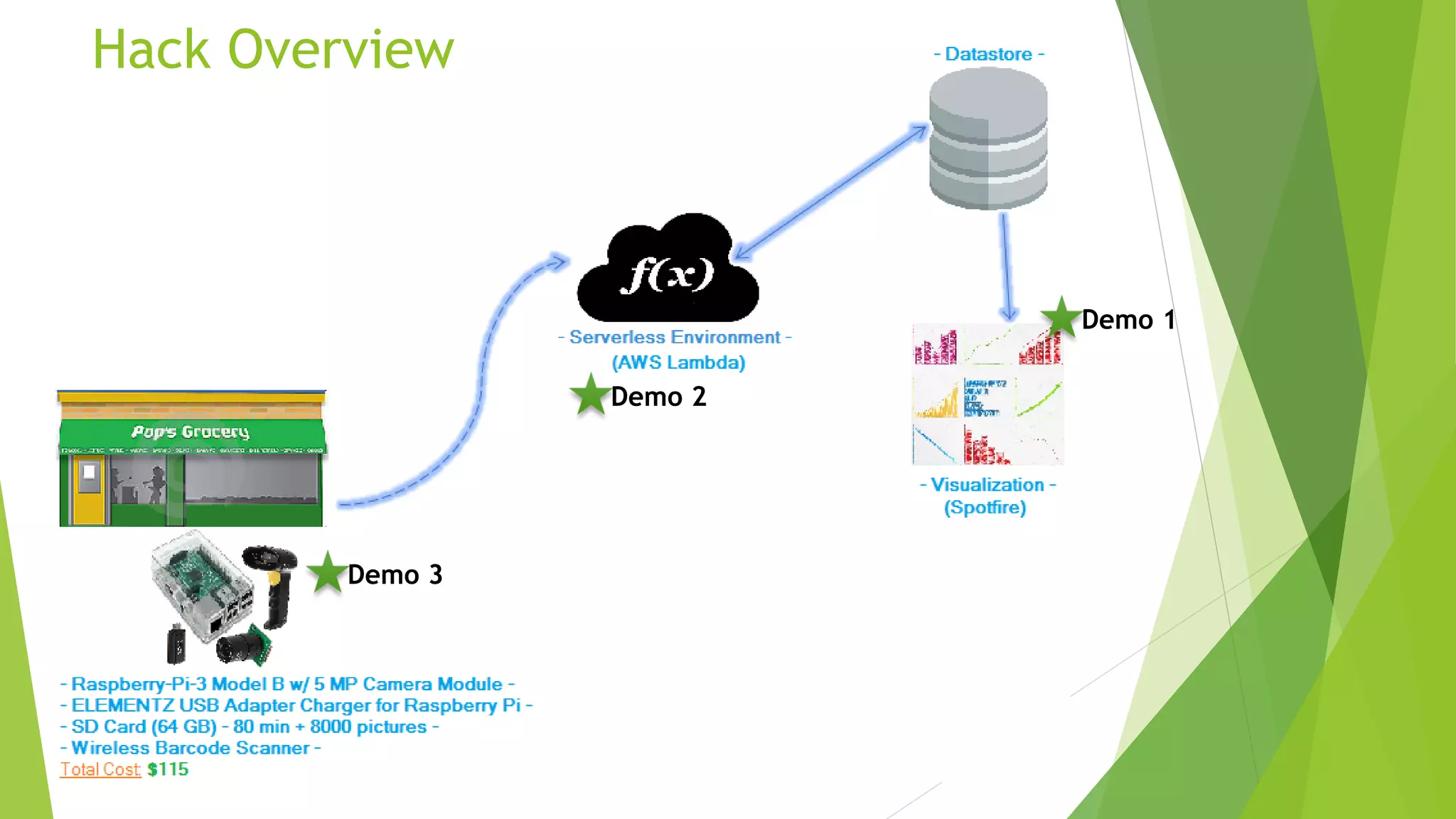
Hack Overview
Demo 1
Demo 2
Demo 3
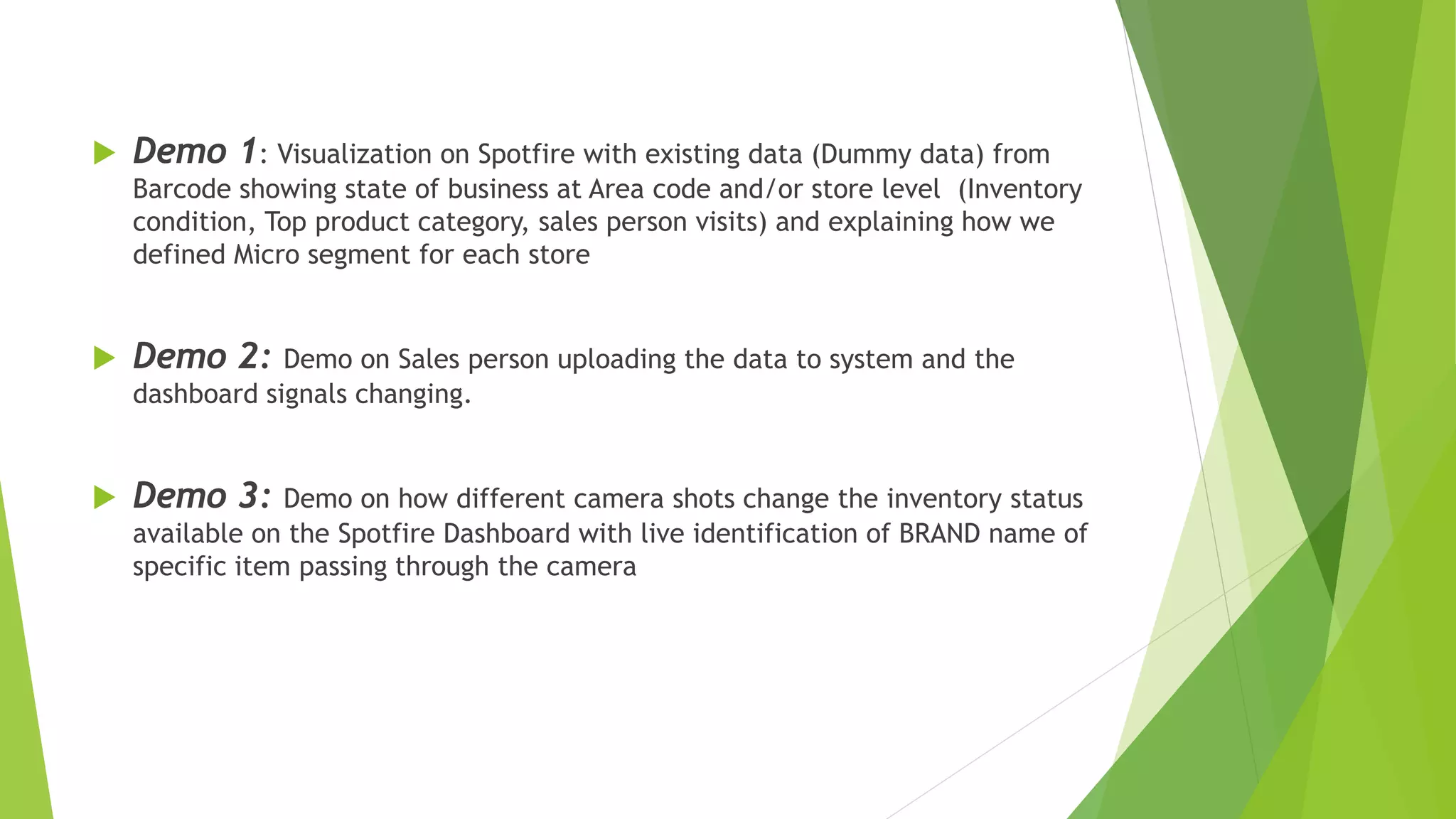
 Demo 1: Visualization on Spotfire with existing data (Dummy data) from
Barcode showing state of business at Area code and/or store level (Inventory
condition, Top product category, sales person visits) and explaining how we
defined Micro segment for each store
 Demo 2: Demo on Sales person uploading the data to system and the
dashboard signals changing.
 Demo 3: Demo on how different camera shots change the inventory status
available on the Spotfire Dashboard with live identification of BRAND name of
specific item passing through the camera
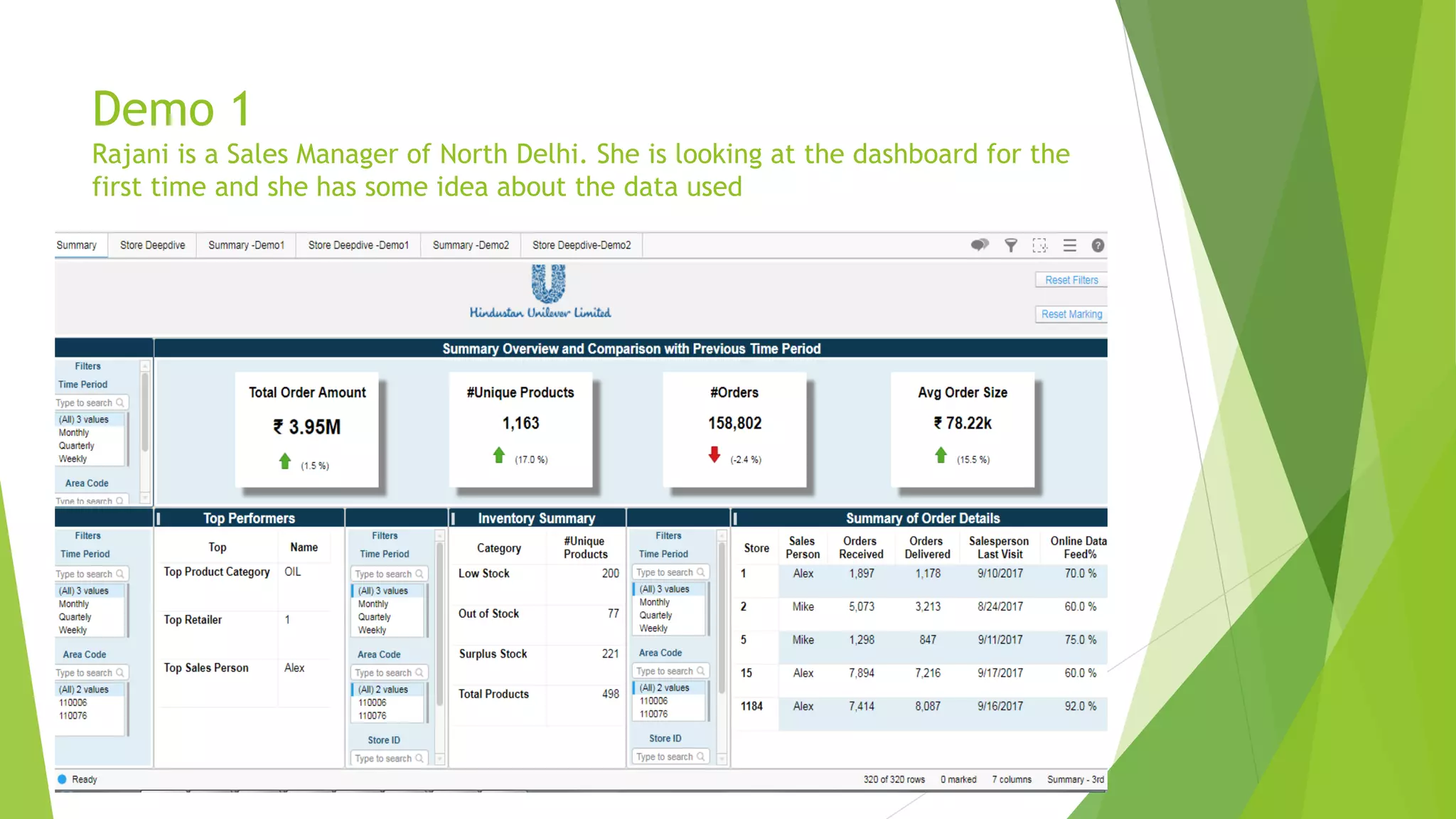
Demo 1
Rajani is a Sales Manager of North Delhi. She is looking at the dashboard for the
first time and she has some idea about the data used
Demo 2
AWS Lambda Functions coverts image and
bar-code data which will be stored in DB for
analytics consumption
DB Schema
Demo 3
 Image of Shelf
Demo 3
 Output of the ML algorithm
Vision
Hardware & Software: Vision
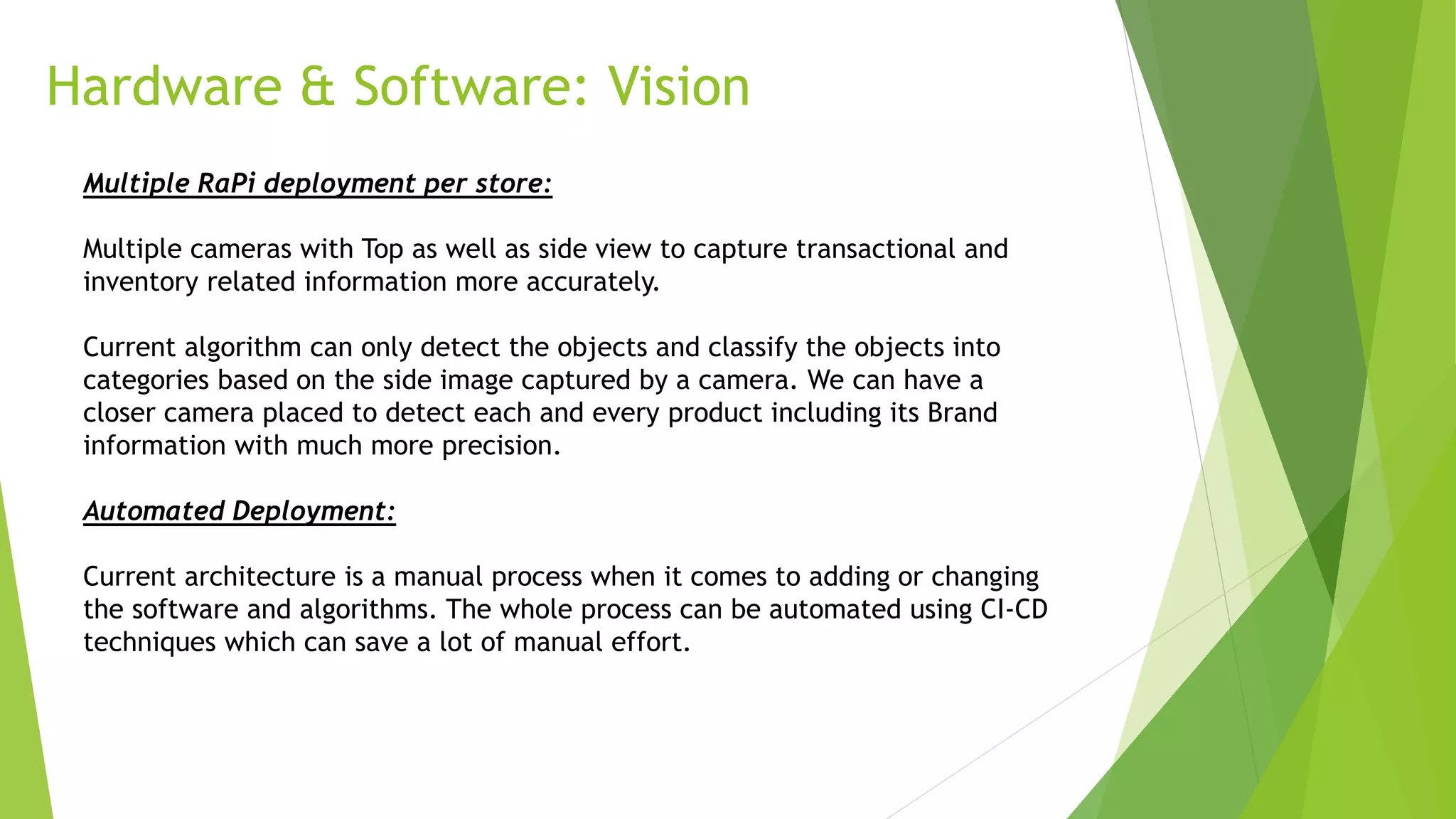
Multiple RaPi deployment per store:
Multiple cameras with Top as well as side view to capture transactional and
inventory related information more accurately.
Current algorithm can only detect the objects and classify the objects into
categories based on the side image captured by a camera. We can have a
closer camera placed to detect each and every product including its Brand
information with much more precision.
Automated Deployment:
Current architecture is a manual process when it comes to adding or changing
the software and algorithms. The whole process can be automated using CI-CD
techniques which can save a lot of manual effort.
Business Intelligence: Vision
Data Requirement
Sell in data from HUL to Kirana Store which includes
following columns
 Store Information
 Product information including price
 Channel information
 Promotions
Camera data from Kirana Store with more camera set
up near entrance and counters. Following information
cane be captured and created through advance
algorithms
 Footfall activity
 Gender information
 Age information
 Counter Actvity
 Product information
Kirana Store Product Master data
 Barcode
 Product information
 Price
GAP Analysis(Anomaly
detection to identify Gaps)
Promotion Effectiveness
Sales Person’s performance
Product Recommendation
Demand Forecasting
Possible
improvement
of current
Analysis/New
Analysis based
on new data
Future Challenges
 Challenge 1 : Existing basic system in Kirana Stores
• Not a replacement but a supplementary solution
• Only Camera-system to be deployed
• ETL processes to take care of data transformation
• ML model to decide hardware deployment based on store value, accessibility
and promotion area.
 Challenge 2: Incomplete and inconsistent data
 ML model to predict faulty data sources and type of inconsistency
 Methods such as fuzzy logic , NLTK- Wordnet and Vector matching using DL
algorithms, LSTM for data –imputation
 Integration of Web Scraping algorithms to fill current data availability gap
Thank you!

Unilever Hackathon

  • 1.
    Auto-scalable & Low-cost Analytics Solution for KiranaStore Runcy Oommen: Server & DB Architecture Kirti Ranjan: Machine learning & Computer Vision Rai Rajani: Analytics & Inventory Management
  • 2.
    Overview  Problem: Giventhe constraint on cost of investment and connectivity, the problem is to capture sales data from Kirana store: accurately and real-time, to understand consumer behaviour and automate inventory management.  Solution: The proposed solution is to have a Raspberry Pi system (with camera, barcode scanner and USB internet) for capturing the sell out information from the Kirana stores to understand the store operations in effective way. The analytics solution aims to create meaningful micro-segments based on stores activity captured through PoS data and Camera data. The data is then merged to give signals on Spotfire around the stores reordering point based on fill rate of specific product categories.  Approach Hardware Software Tech Stack Business Intelligence • Low Cost Raspberry Pi System • Camera • USB internet • AWS Lambda (S3) with Object detection algorithm (Python) • MySQL • Spotfire • Architecture View • DB Schema • Analysis ready Data • Portfolio View • Micro Segment • Inventory Management Advantages • App free approach: No dependency of having a computer or mobile with good storage and processor • No capability or interaction required from KIRAN Store Person • Visualization dashboard is easily consumable by sales person/Manager without any HOW TO USE training
  • 3.
  • 4.
     Demo 1:Visualization on Spotfire with existing data (Dummy data) from Barcode showing state of business at Area code and/or store level (Inventory condition, Top product category, sales person visits) and explaining how we defined Micro segment for each store  Demo 2: Demo on Sales person uploading the data to system and the dashboard signals changing.  Demo 3: Demo on how different camera shots change the inventory status available on the Spotfire Dashboard with live identification of BRAND name of specific item passing through the camera
  • 5.
    Demo 1 Rajani isa Sales Manager of North Delhi. She is looking at the dashboard for the first time and she has some idea about the data used
  • 6.
    Demo 2 AWS LambdaFunctions coverts image and bar-code data which will be stored in DB for analytics consumption DB Schema
  • 7.
  • 8.
     Image ofShelf Demo 3  Output of the ML algorithm
  • 9.
  • 10.
    Hardware & Software:Vision Multiple RaPi deployment per store: Multiple cameras with Top as well as side view to capture transactional and inventory related information more accurately. Current algorithm can only detect the objects and classify the objects into categories based on the side image captured by a camera. We can have a closer camera placed to detect each and every product including its Brand information with much more precision. Automated Deployment: Current architecture is a manual process when it comes to adding or changing the software and algorithms. The whole process can be automated using CI-CD techniques which can save a lot of manual effort.
  • 11.
    Business Intelligence: Vision DataRequirement Sell in data from HUL to Kirana Store which includes following columns  Store Information  Product information including price  Channel information  Promotions Camera data from Kirana Store with more camera set up near entrance and counters. Following information cane be captured and created through advance algorithms  Footfall activity  Gender information  Age information  Counter Actvity  Product information Kirana Store Product Master data  Barcode  Product information  Price GAP Analysis(Anomaly detection to identify Gaps) Promotion Effectiveness Sales Person’s performance Product Recommendation Demand Forecasting Possible improvement of current Analysis/New Analysis based on new data
  • 12.
    Future Challenges  Challenge1 : Existing basic system in Kirana Stores • Not a replacement but a supplementary solution • Only Camera-system to be deployed • ETL processes to take care of data transformation • ML model to decide hardware deployment based on store value, accessibility and promotion area.  Challenge 2: Incomplete and inconsistent data  ML model to predict faulty data sources and type of inconsistency  Methods such as fuzzy logic , NLTK- Wordnet and Vector matching using DL algorithms, LSTM for data –imputation  Integration of Web Scraping algorithms to fill current data availability gap
  • 13.