Unified Service Theory and Perspectives on Services Study Circle in Service Systems
What is a Service? “ A service is an abstract resource that represents a capability of performing tasks that represents a coherent functionality from the point of view of provider entities and requester entities. ”  (W3C) ” S ervices are heterogeneous outputs produced to order and typically consist of changes in the conditions of the consuming units realized by the activities of producers at the demand of the consumers.“ (United Nations) “ A service is the provision of something of value, in the context of some domain of application, by one party to another.” (Chris Preist)
What is a Service? “ A service is an abstract resource that represents a capability of performing tasks that represents a coherent functionality from the point of view of provider entities and requester entities. ”  (W3C) ” S ervices are heterogeneous outputs produced to order and typically consist of changes in the conditions of the consuming units realized by the activities of producers at the demand of the consumers.“ (United Nations) “ A service is the provision of something of value, in the context of some domain of application, by one party to another.” (Chris Preist)  Service properties Intangibility Inseparability Heterogeneity Perishability
Unified Service Theory ” Services are production processes wherein each customer supplies one or more input components for that customer’s unit of production. With non-service processes, groups of customers may contribute ideas to the design of the prodct, but individual customers’ only participation is to select, pay for, and consume the output.” Scott E. Sampson, ”The Unified Service Theory” in  Handbook of Service Science , ed. P. Maglio et al.,  Springer, 2010
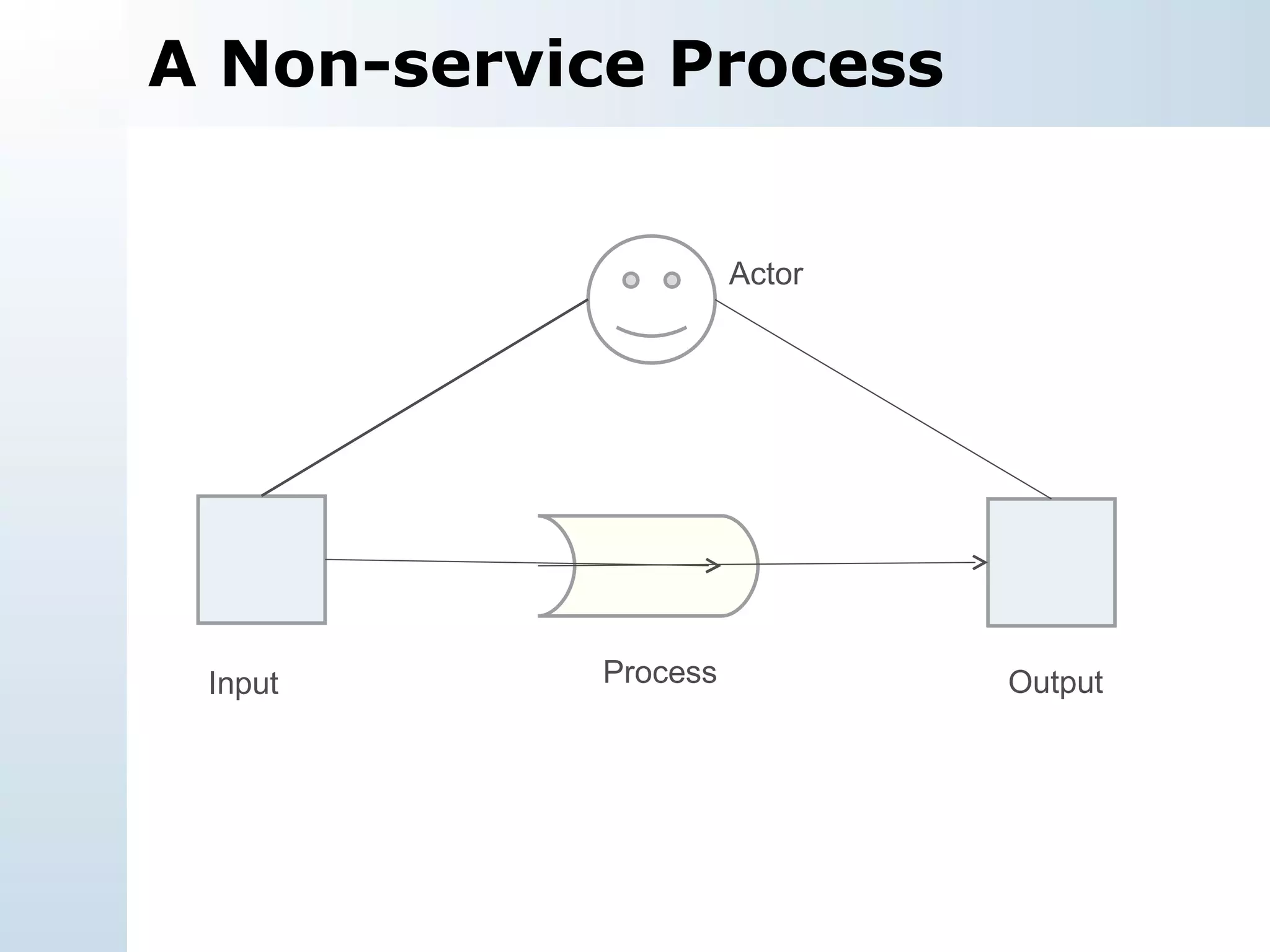
A Non-service Process Actor Process Input Output
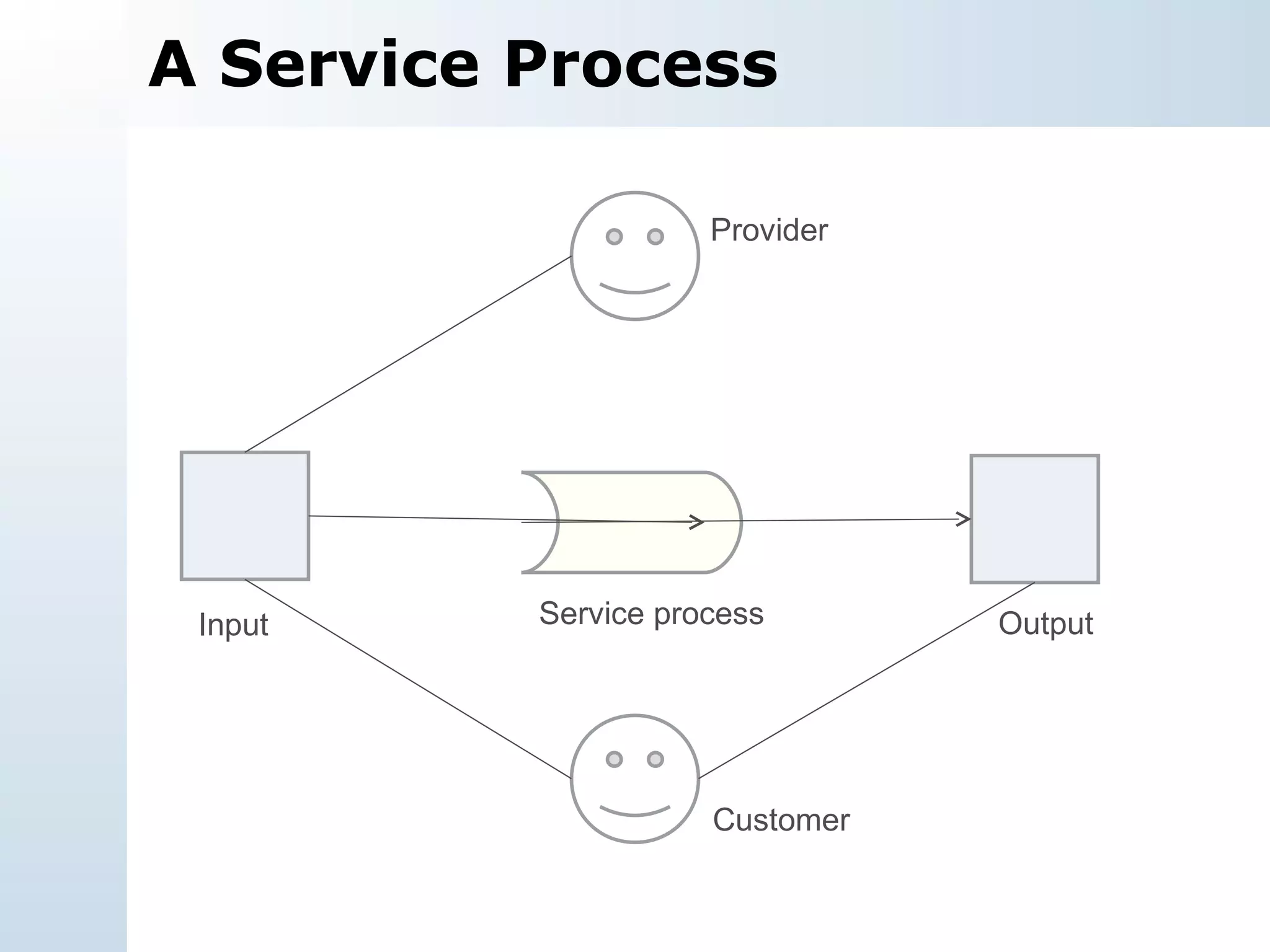
A Service Process Provider Customer Service process Input Output
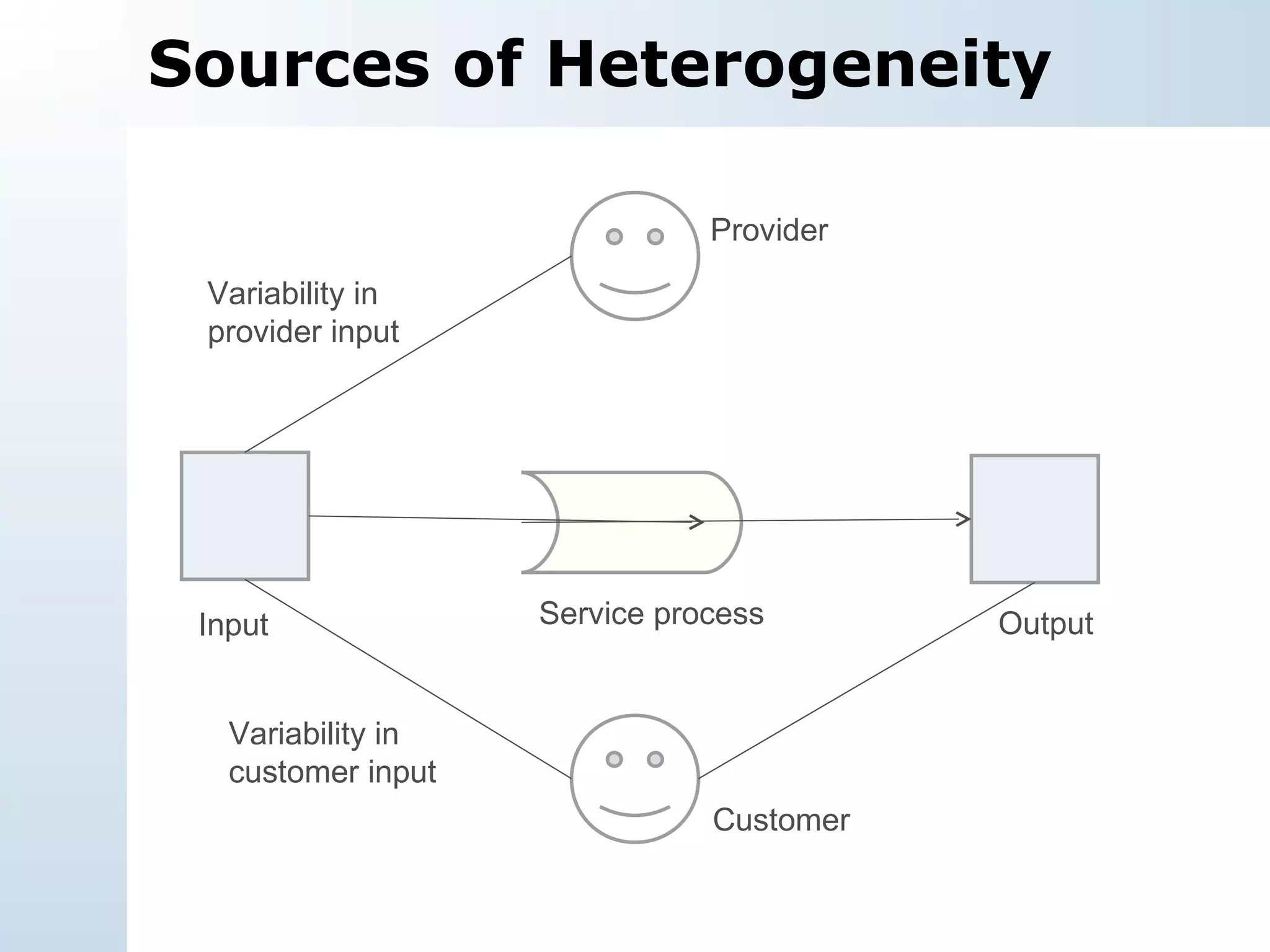
Sources of Heterogeneity Provider Customer Service process Input Output Variability in provider input Variability in customer input
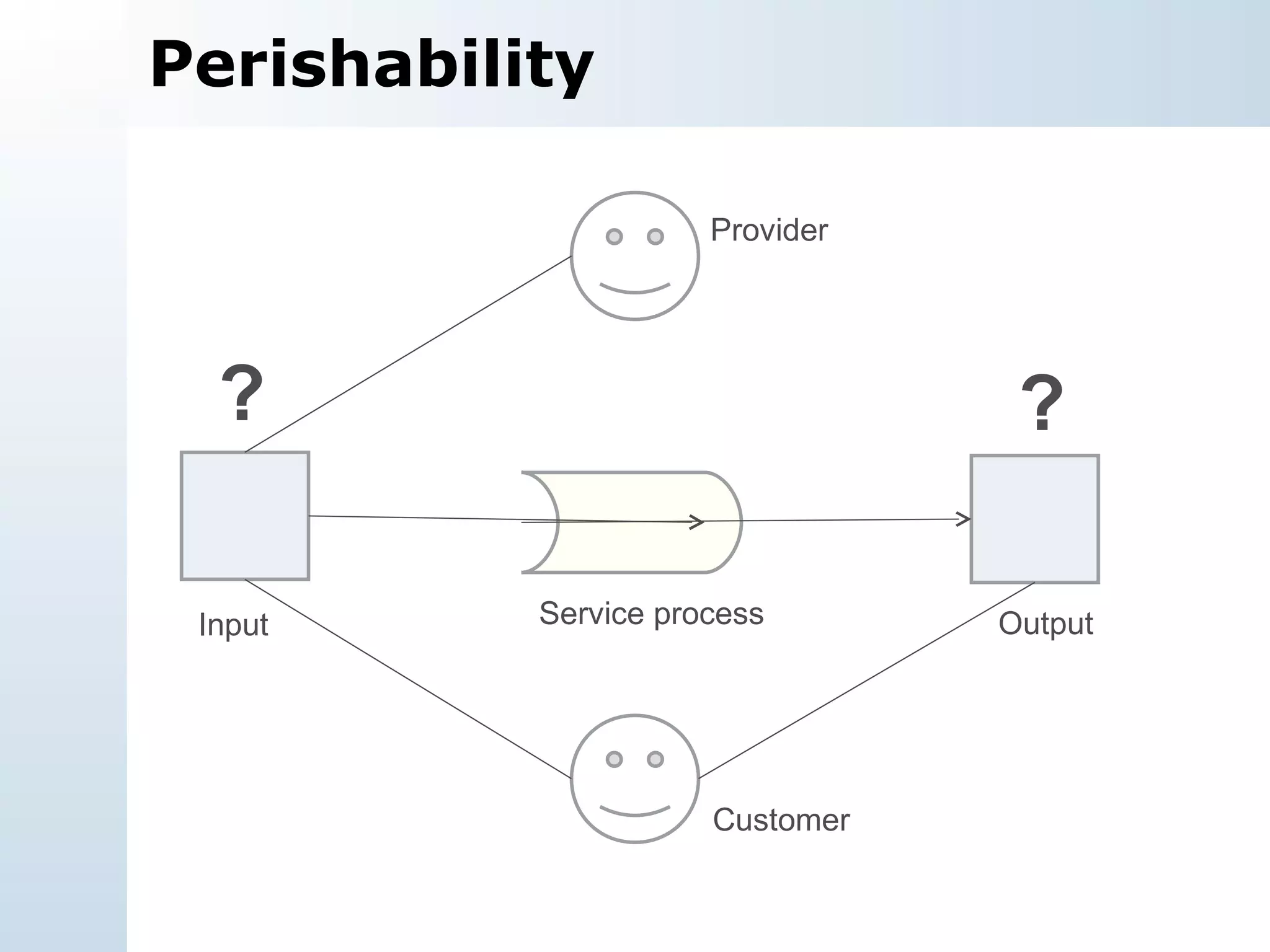
Perishability Provider Customer Service process Input Output ? ?
Management Applications Service development:  handling variability in customer input, robust processes Service innovation: finding new roles for customers in service processes
Are Services Processes? Sometimes we talk of services as resources: ” Our company offers car washing services”
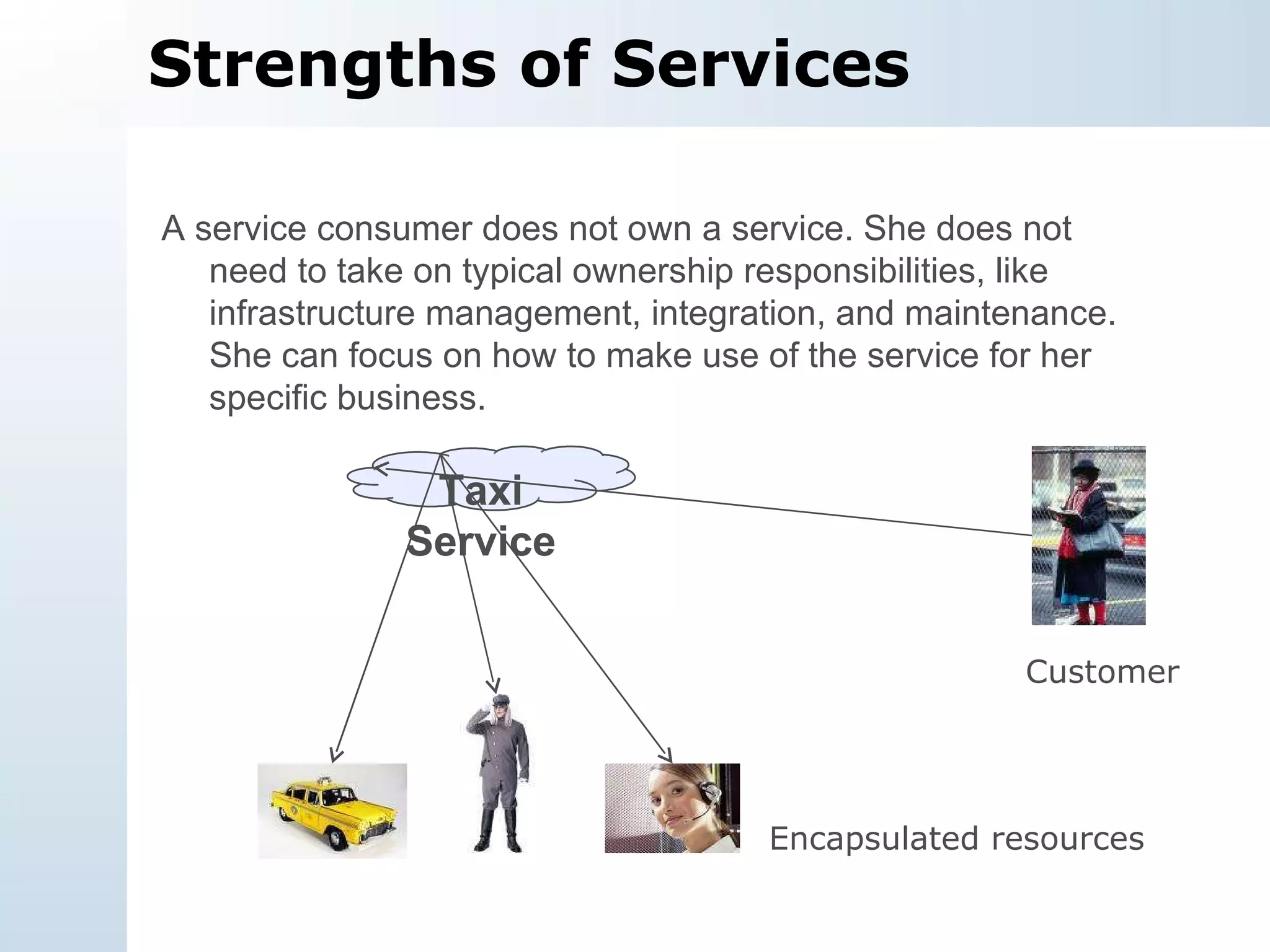
Strengths of Services A service consumer does not own a service. She does not need to take on typical ownership responsibilities, like infrastructure management, integration, and maintenance. She can focus on how to make use of the service for her specific business. Taxi Service Customer Encapsulated resources
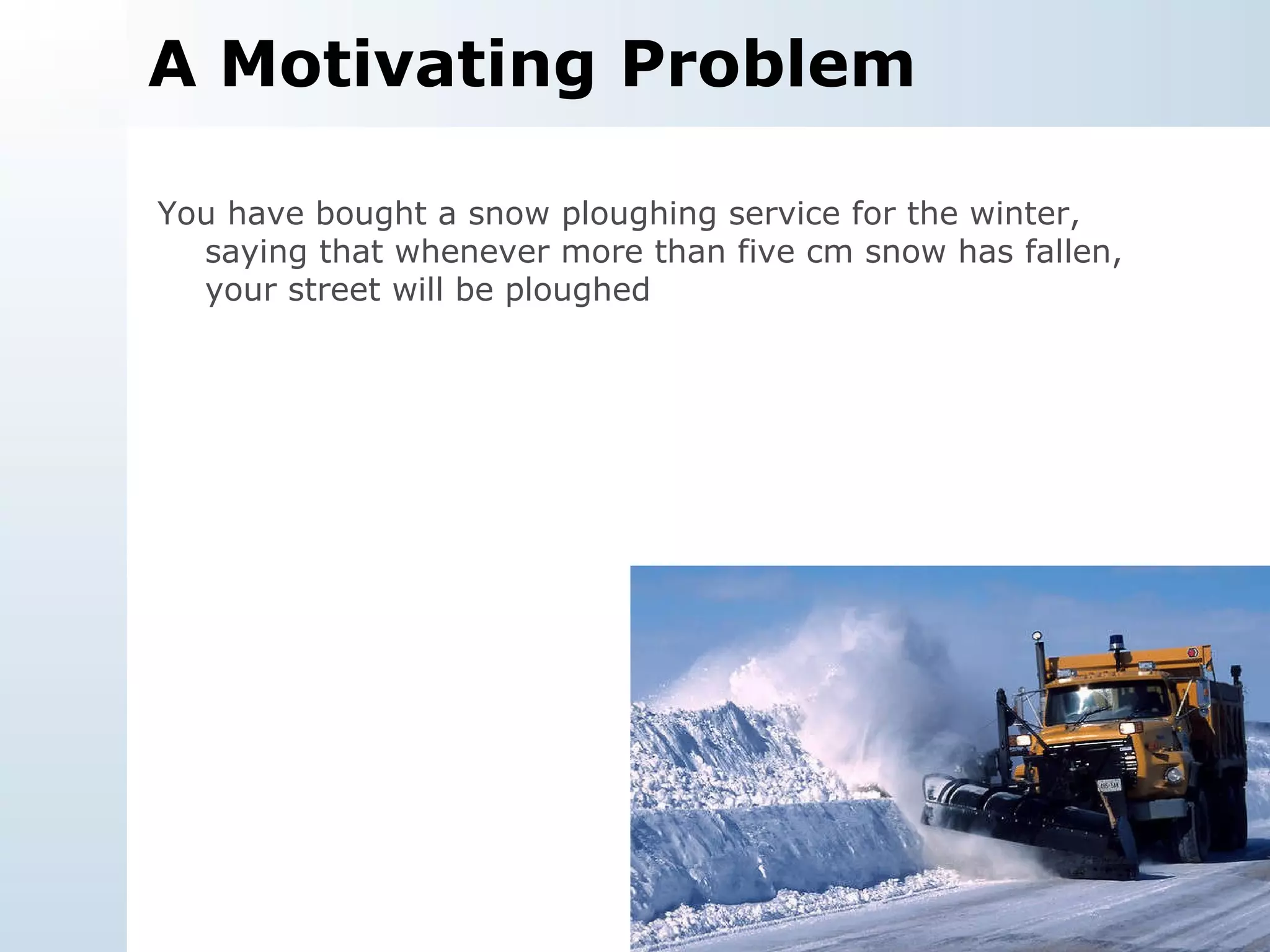
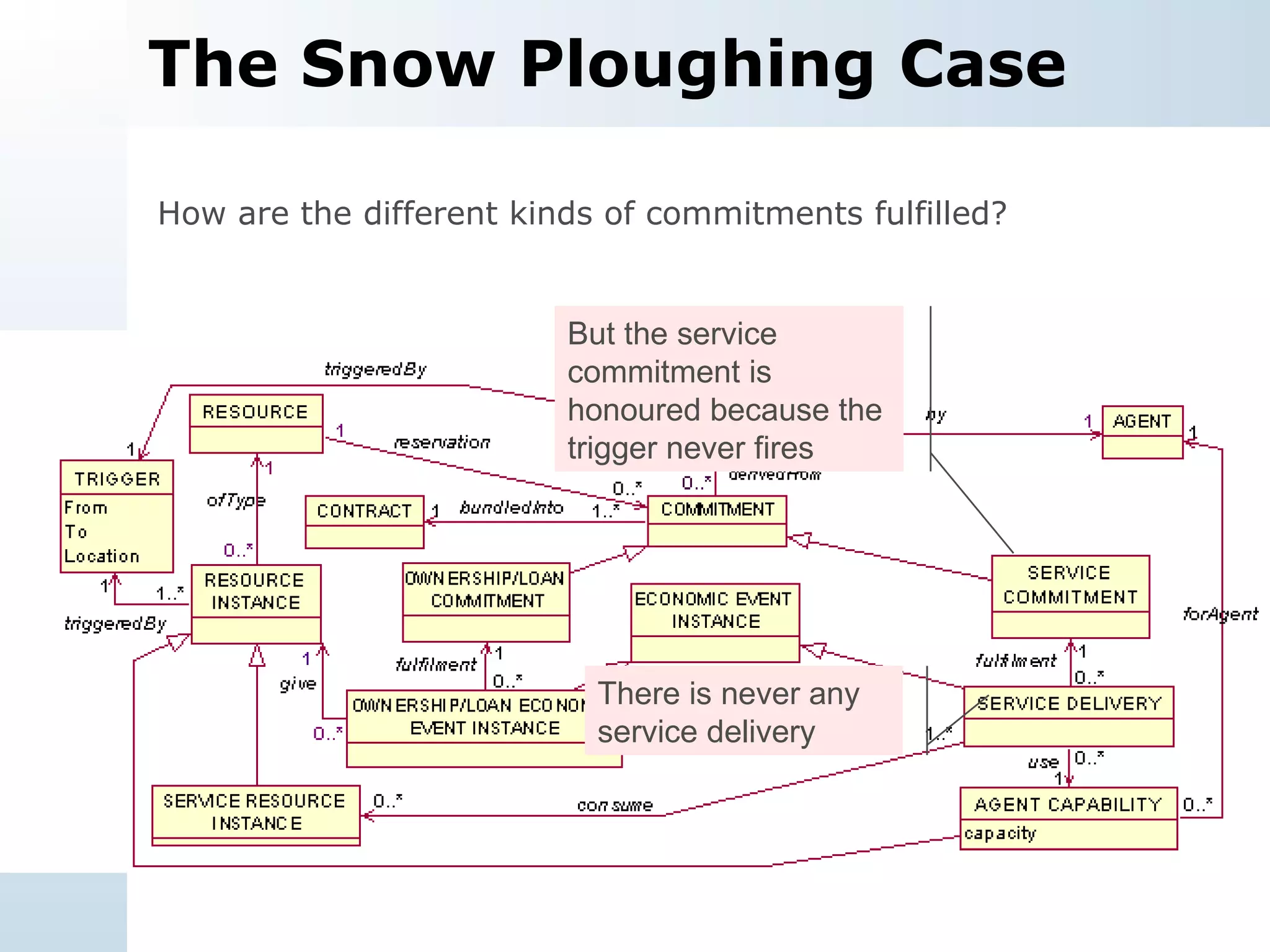
A Motivating Problem You have bought a snow ploughing service for the winter, saying that whenever more than five cm snow has fallen, your street will be ploughed
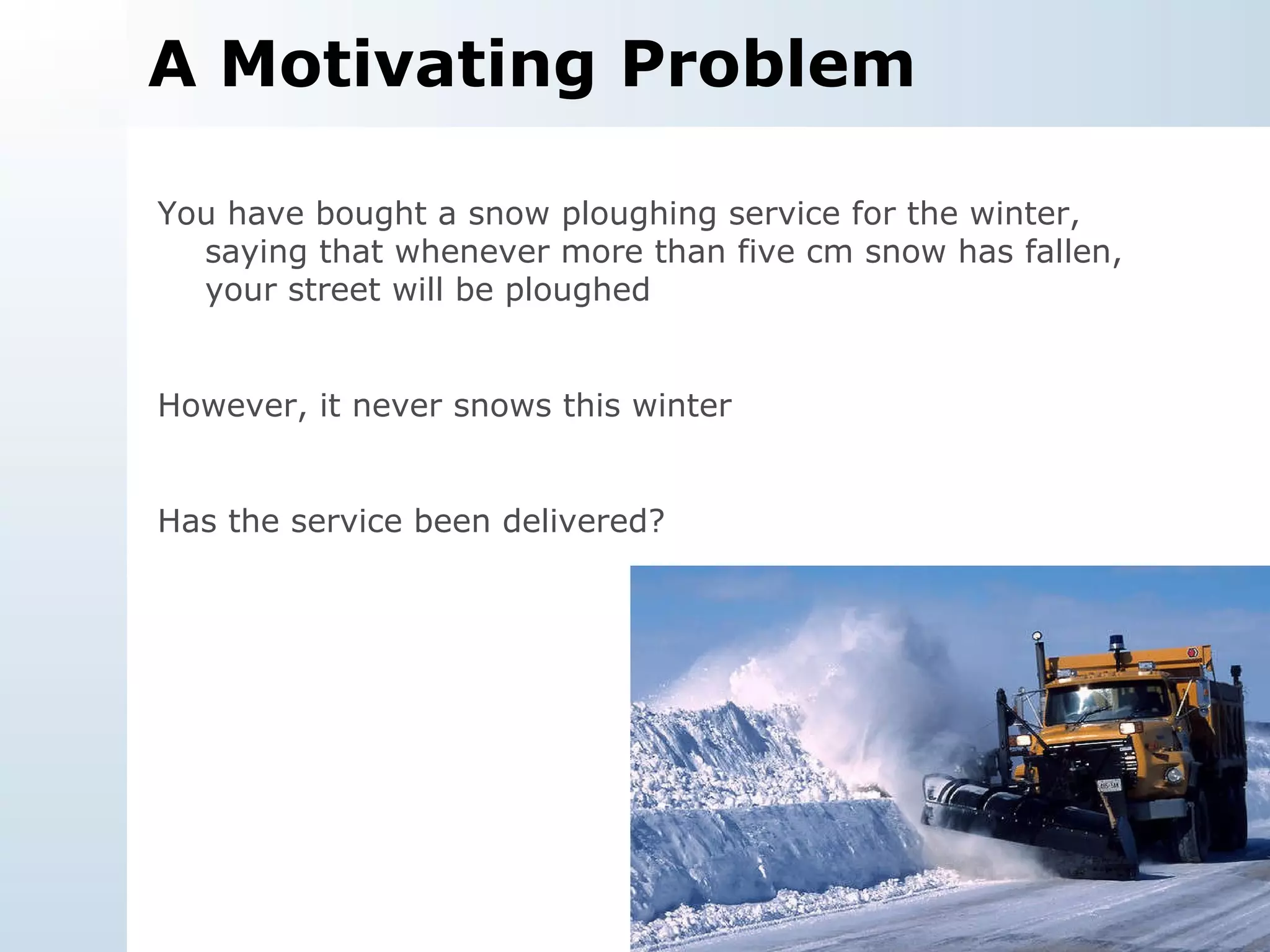
A Motivating Problem You have bought a snow ploughing service for the winter, saying that whenever more than five cm snow has fallen, your street will be ploughed However, it never snows this winter Has the service been delivered?
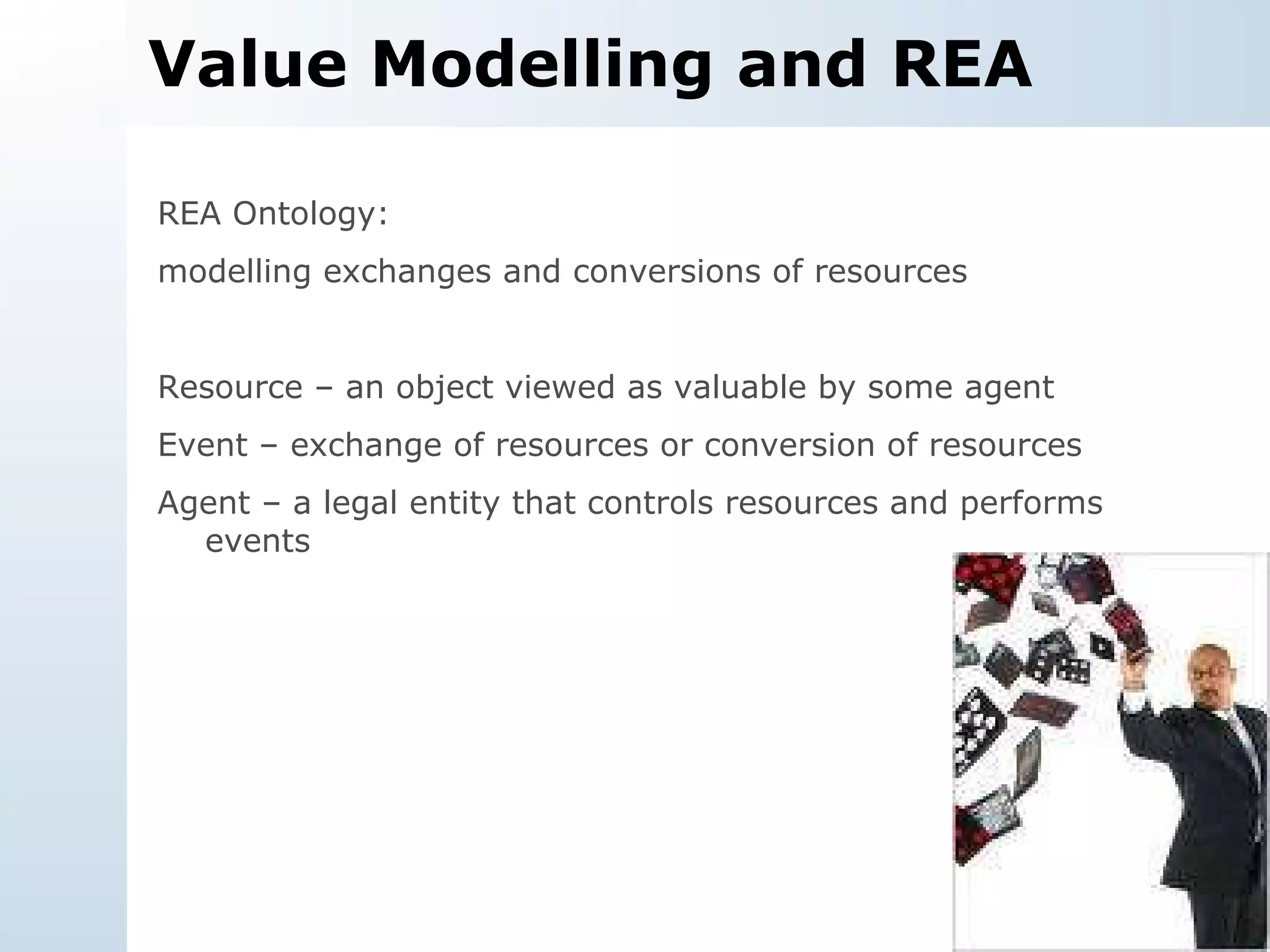
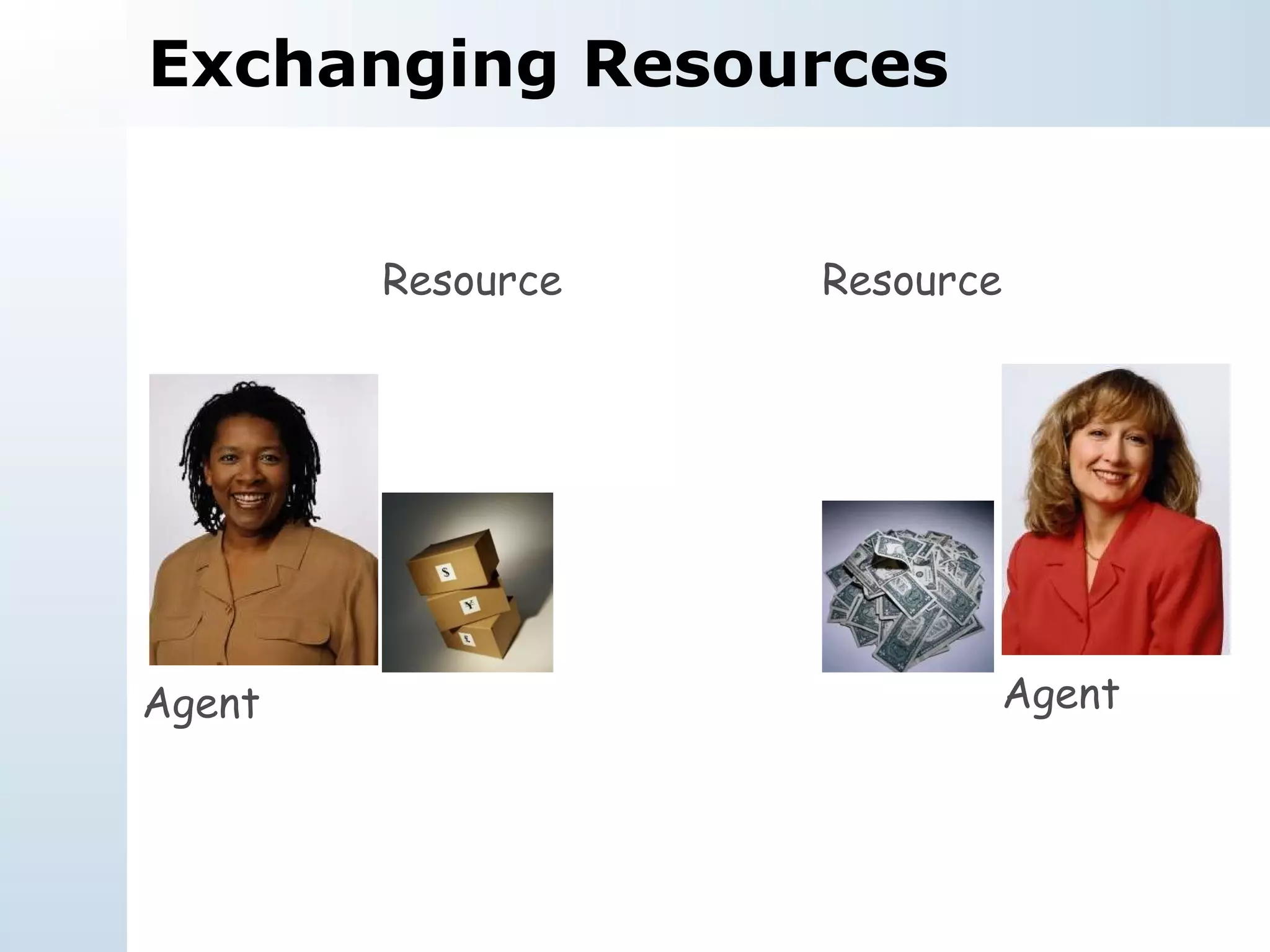
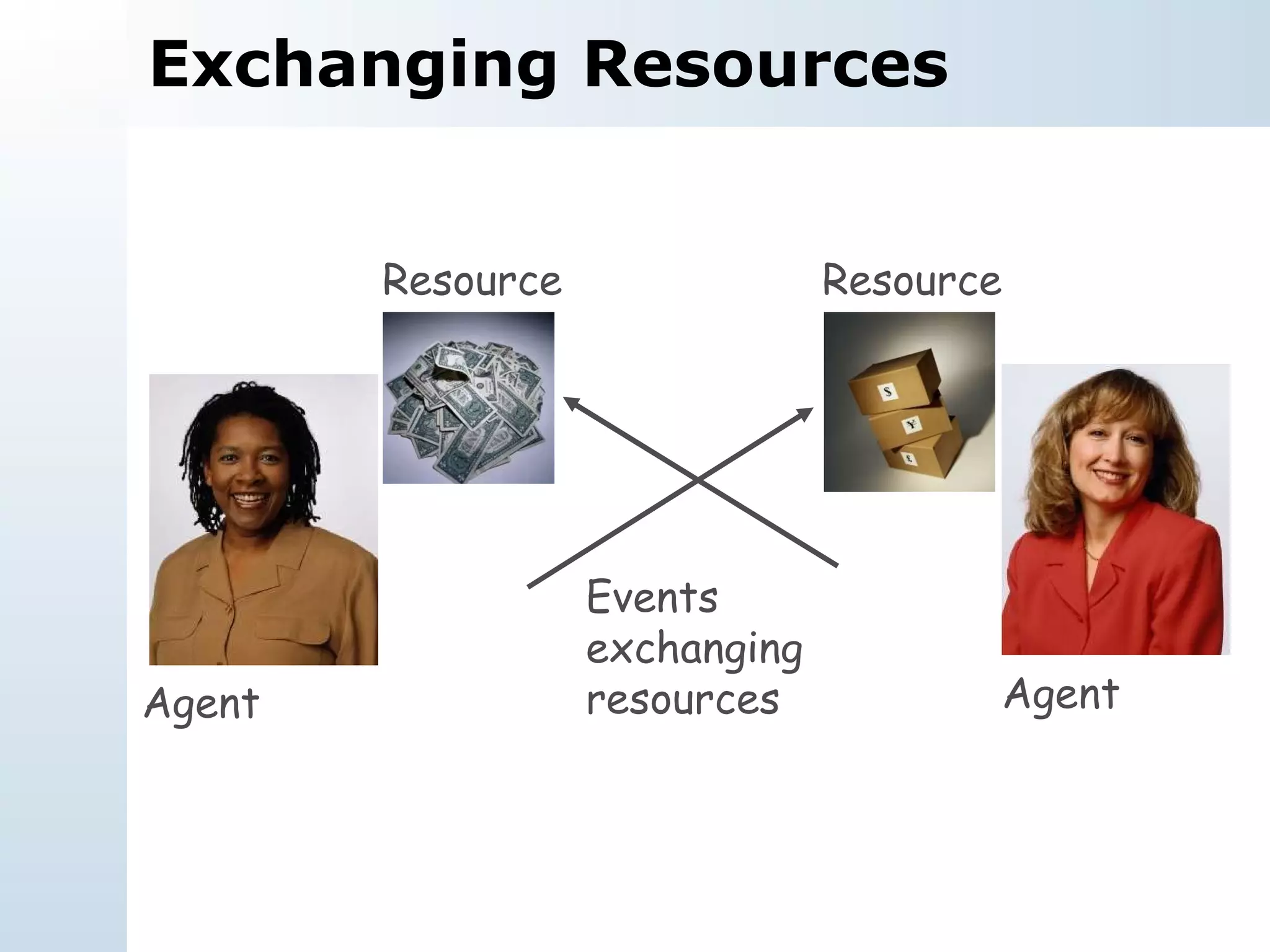
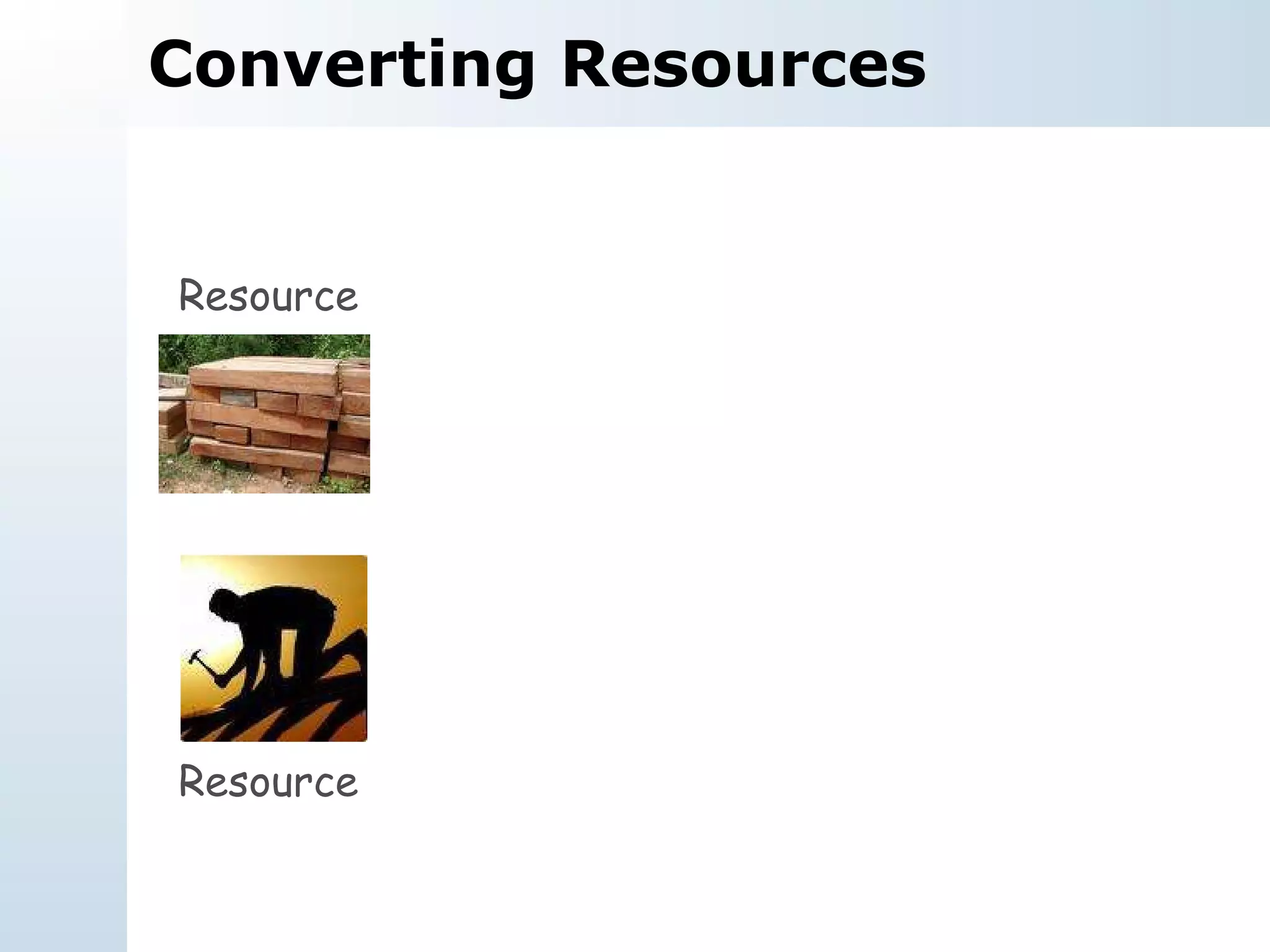
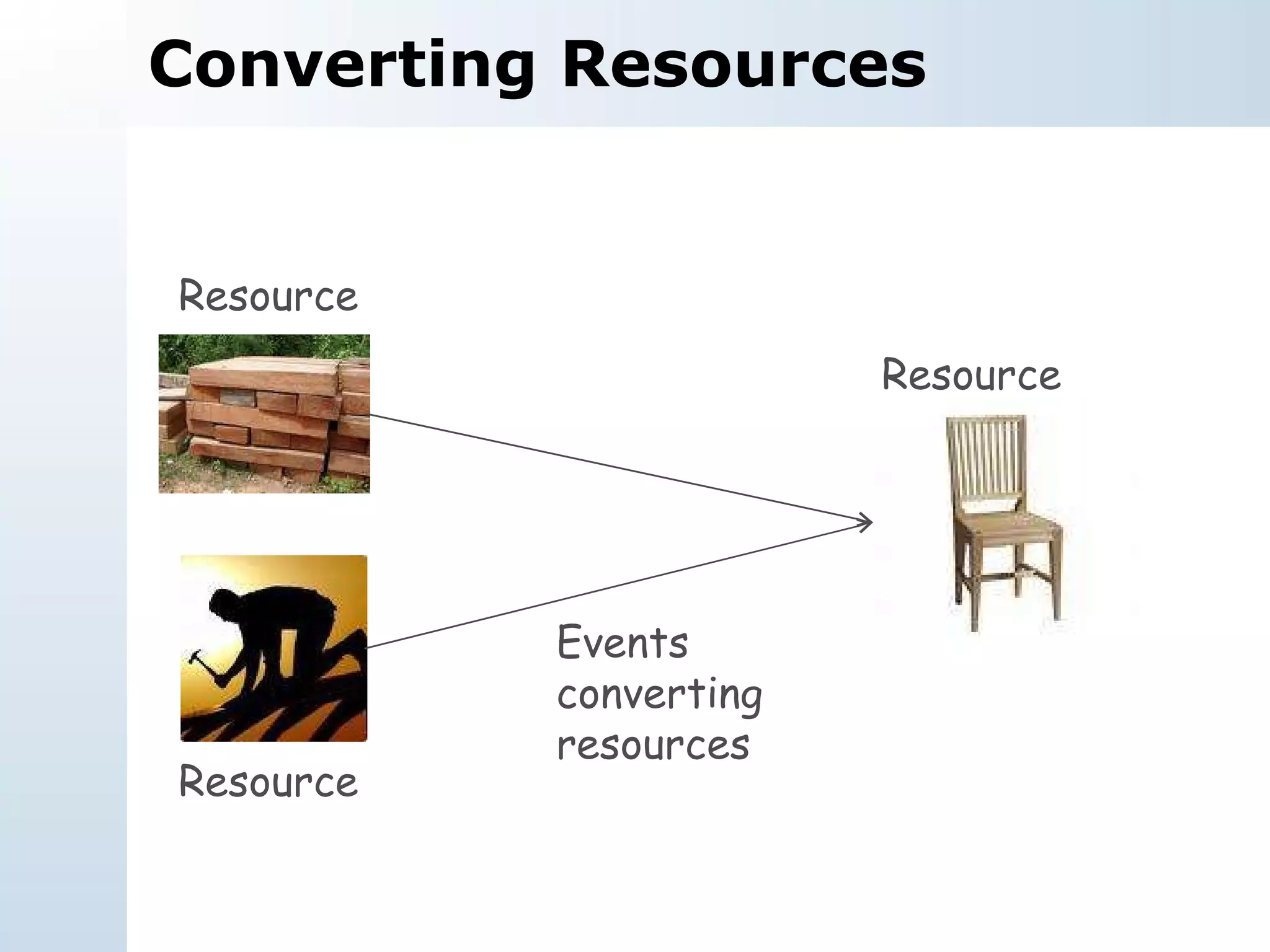
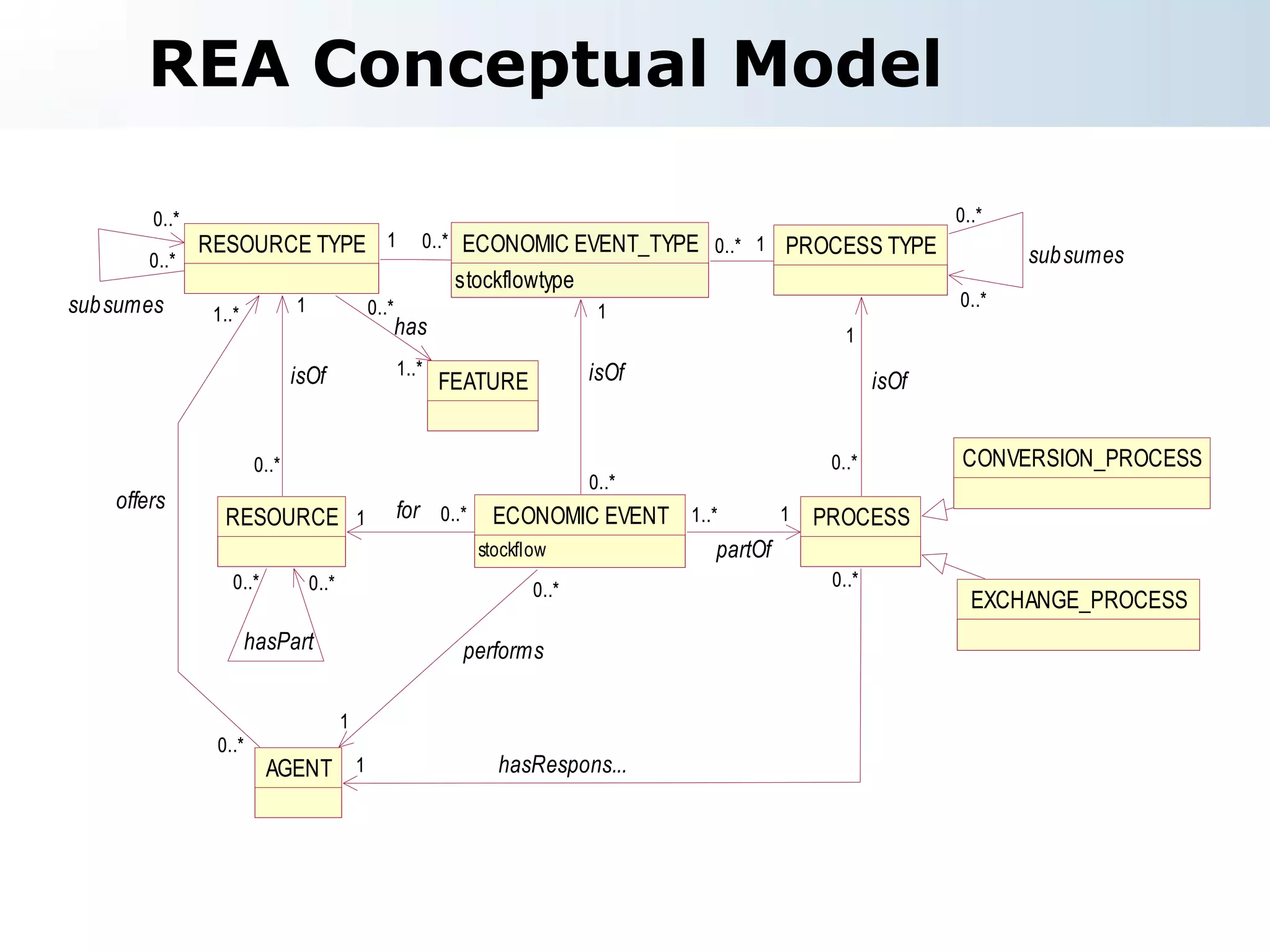
Value Modelling and REA REA Ontology:  modelling exchanges and conversions of resources Resource – an object viewed as valuable by some agent Event – exchange of resources or conversion of resources Agent – a legal entity that controls resources and performs events
Exchanging Resources Agent Agent Resource Resource
Exchanging Resources Agent Agent Resource Resource Events exchanging resources
Converting Resources Resource Resource
Converting Resources Resource Resource Resource Events converting resources
REA Conceptual Model
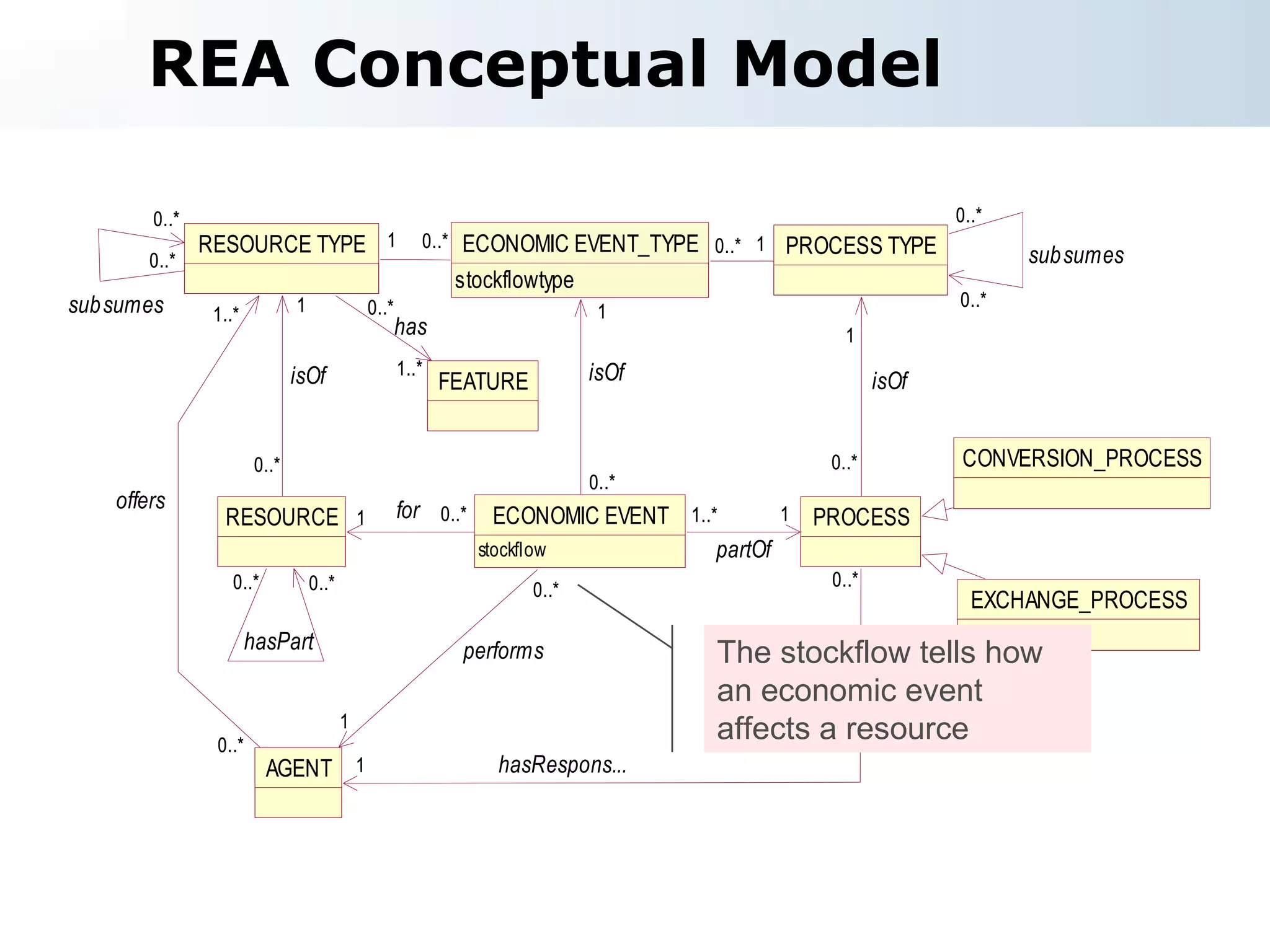
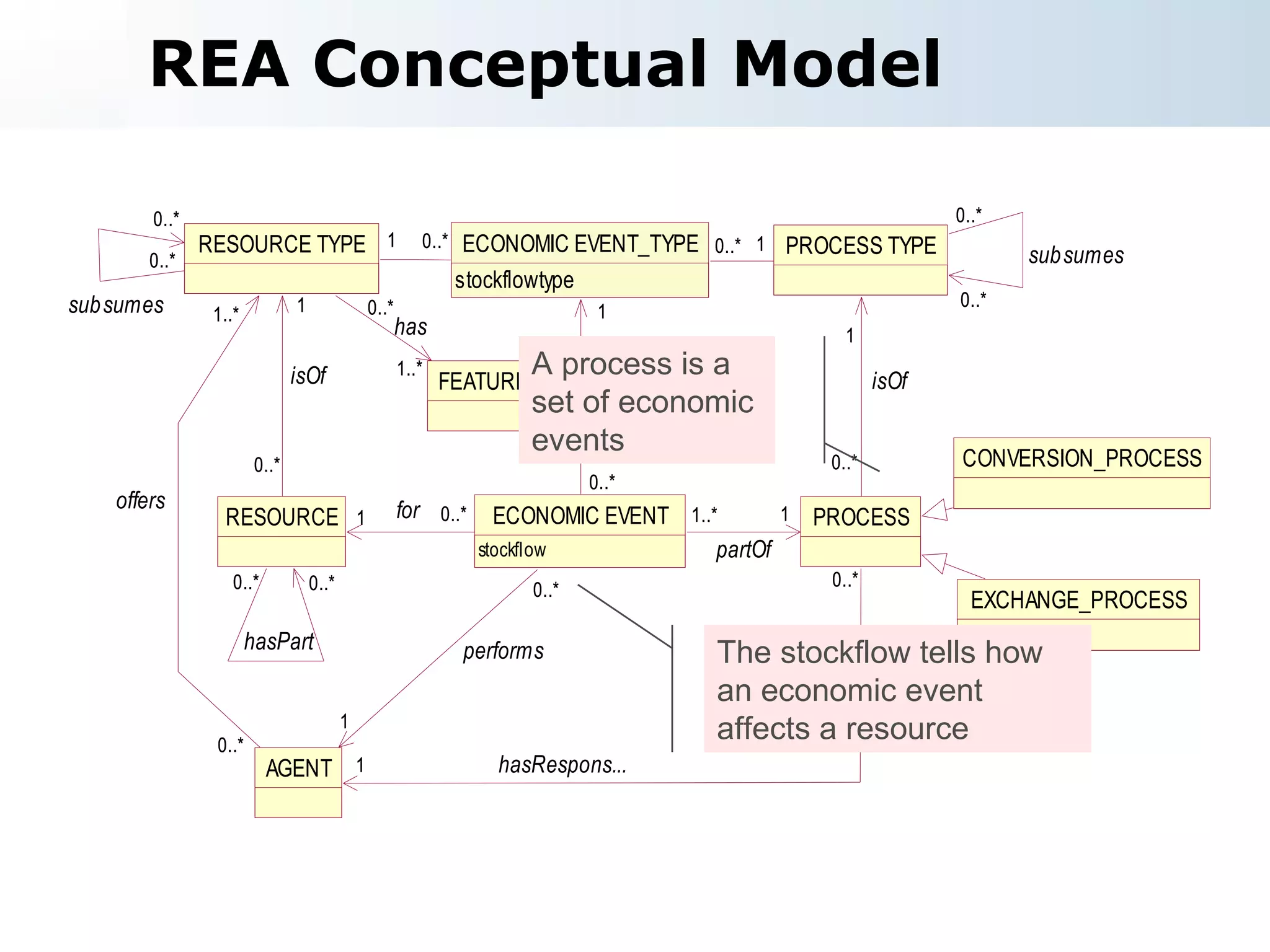
REA Conceptual Model The stockflow tells how an economic event affects a resource
REA Conceptual Model The stockflow tells how an economic event affects a resource A process is a set of economic events
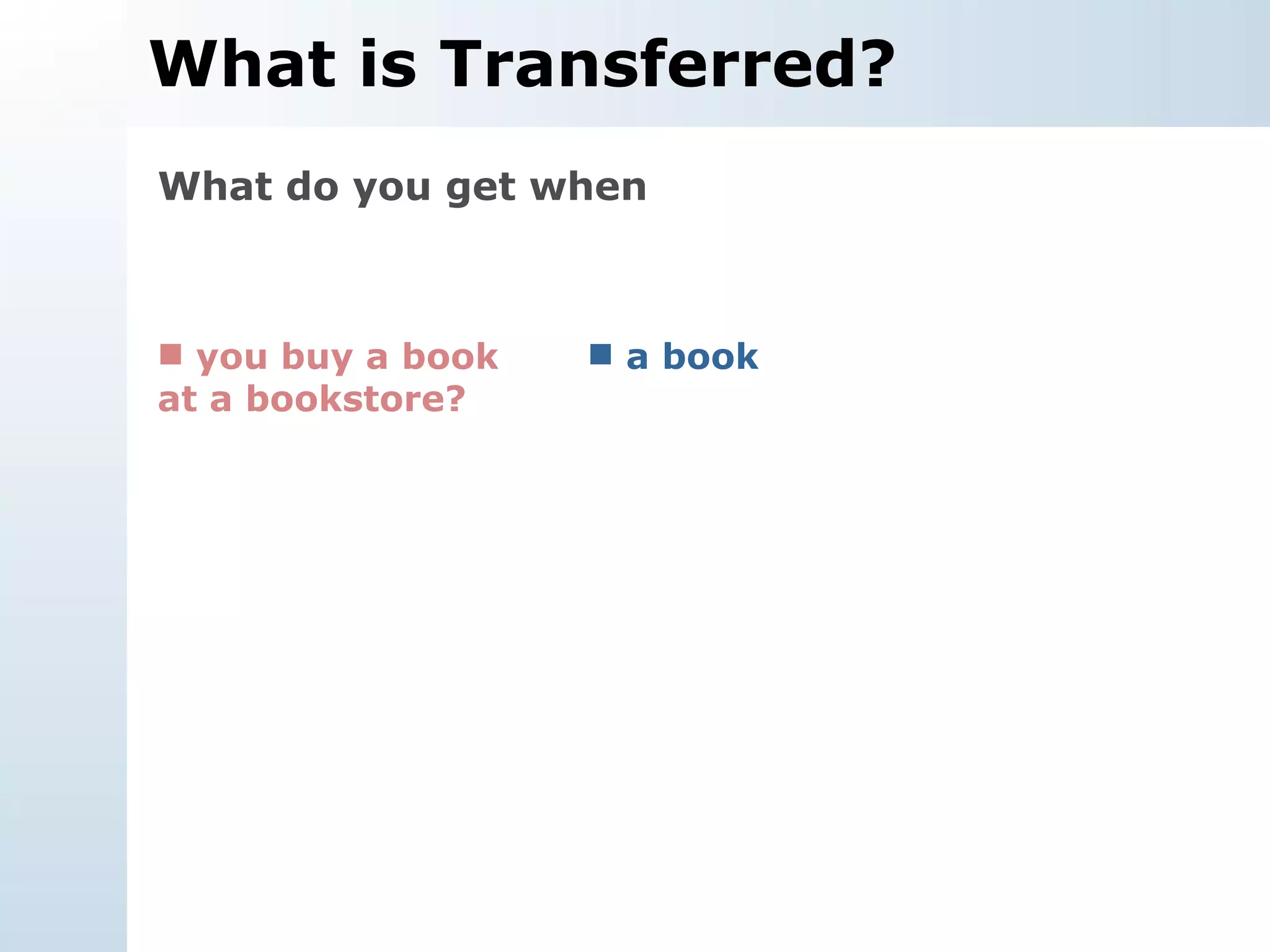
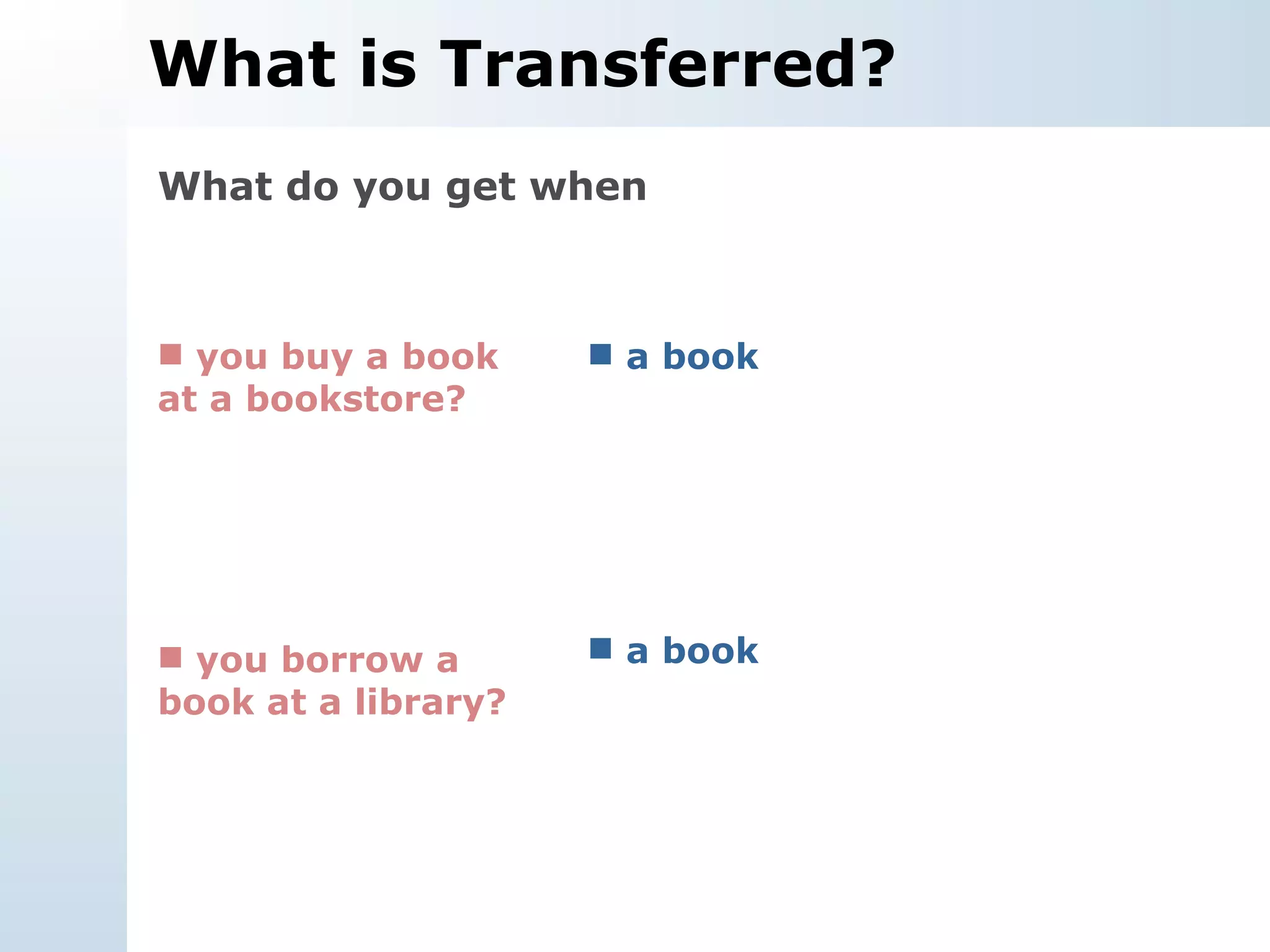
What is Transferred? What do you get when you buy a book at a bookstore?  a book
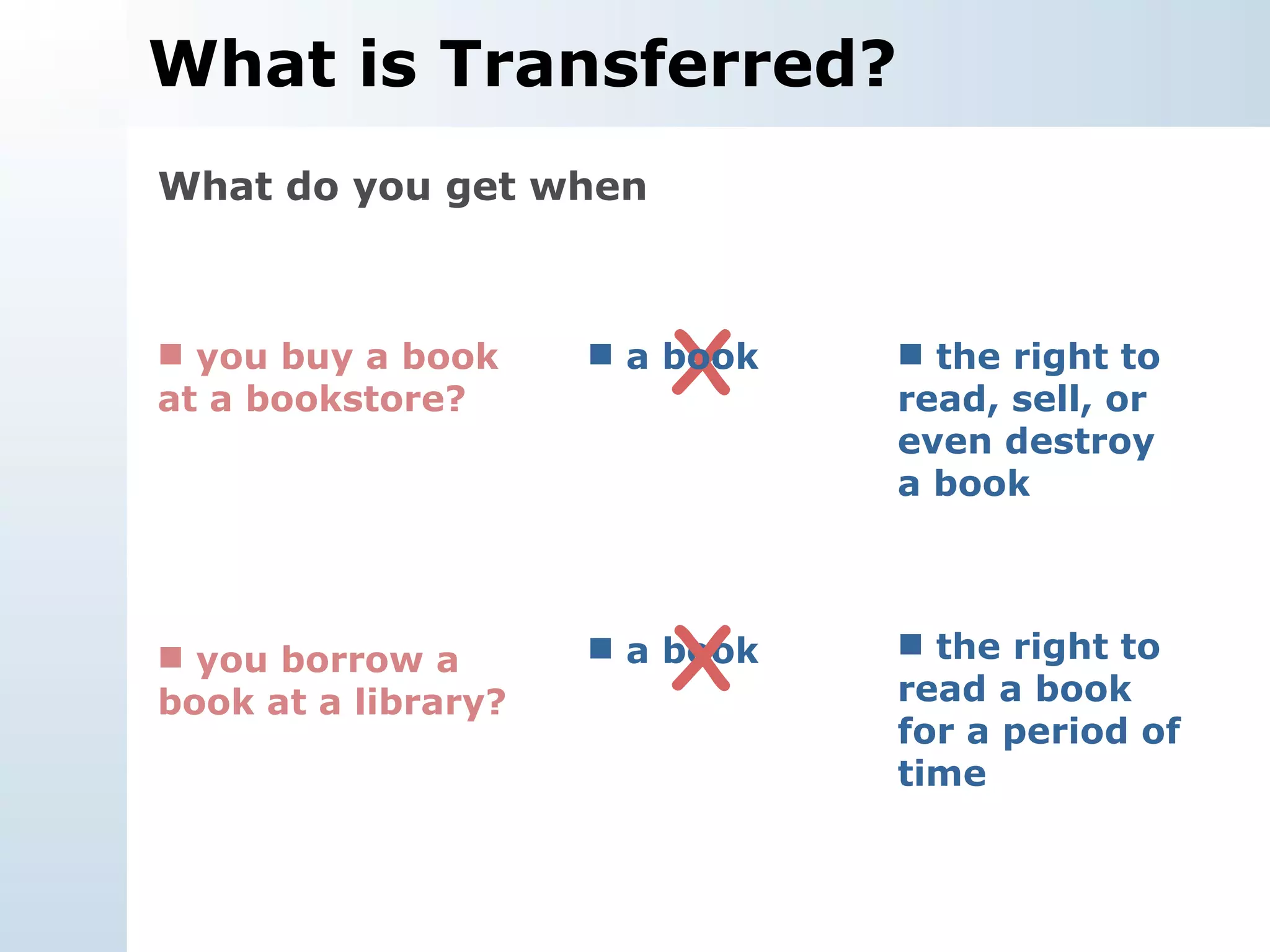
What is Transferred? What do you get when a book  you buy a book at a bookstore?  you borrow a book at a library? a book
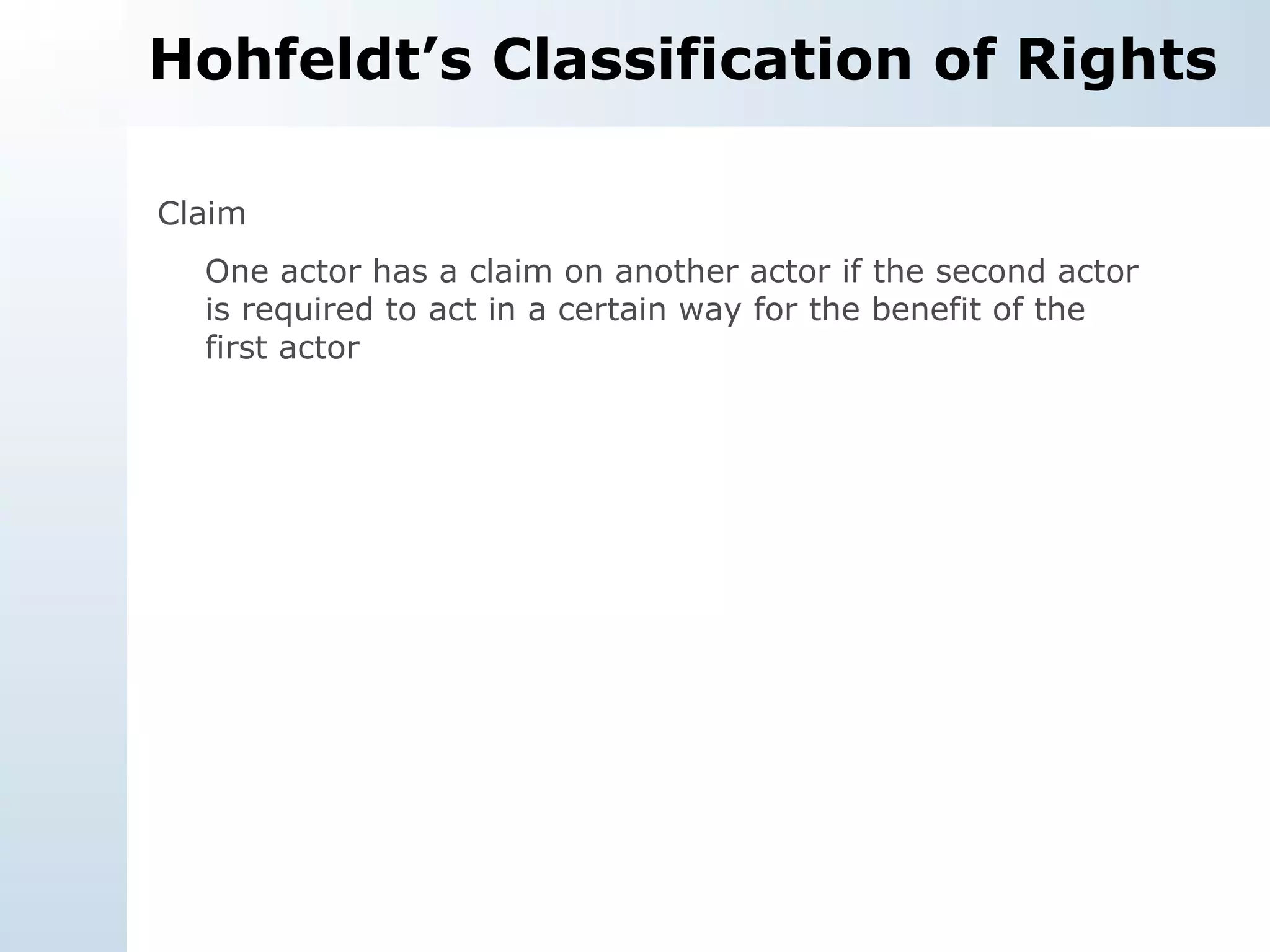
What is Transferred? What do you get when a book  the right to read, sell, or even destroy a book  you buy a book at a bookstore?  X X you borrow a book at a library? a book  the right to read a book for a period of time
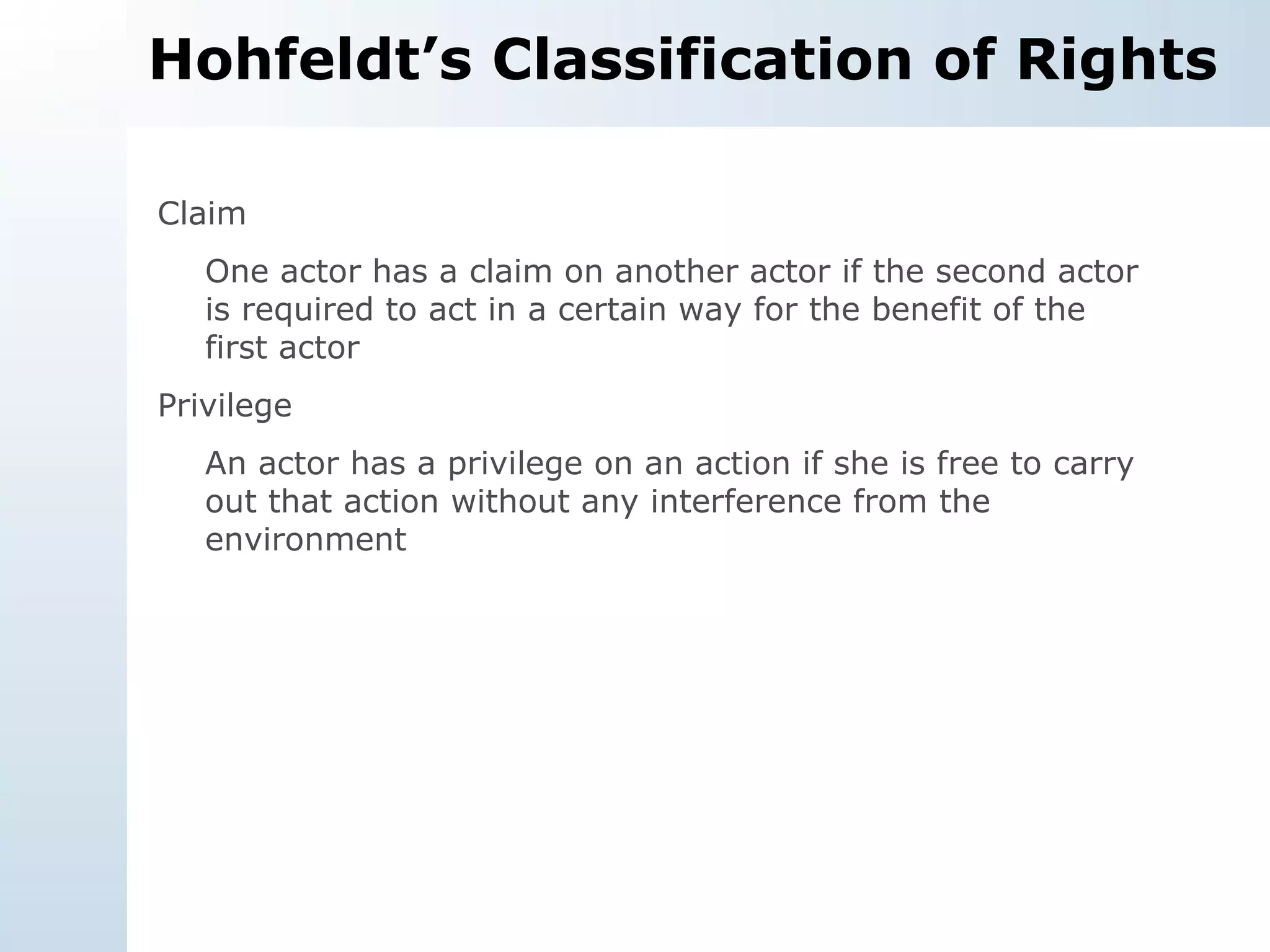
Hohfeldt’s Classification of Rights Claim One actor has a claim on another actor if the second actor is required to act in a certain way for the benefit of the first actor
Hohfeldt’s Classification of Rights Claim One actor has a claim on another actor if the second actor is required to act in a certain way for the benefit of the first actor Privilege An actor has a privilege on an action if she is free to carry out that action without any interference from the environment
Hohfeldt’s Classification of Rights Claim One actor has a claim on another actor if the second actor is required to act in a certain way for the benefit of the first actor Privilege An actor has a privilege on an action if she is free to carry out that action without any interference from the environment Power A power is the ability of an actor to create or modify social or legal relationships
Hohfeldt’s Classification of Rights Claim One actor has a claim on another actor if the second actor is required to act in a certain way for the benefit of the first actor Privilege An actor has a privilege on an action if she is free to carry out that action without any interference from the environment Power A power is the ability of an actor to create or modify social or legal relationships Immunity An immunity refers to the restriction of power of one actor in terms of creating relationships on behalf of another actor
Three Perspectives on Services Abstraction – focus on the use of resources Restricted access – accessing resources without owning them Co-creation – supplier and customer create value together
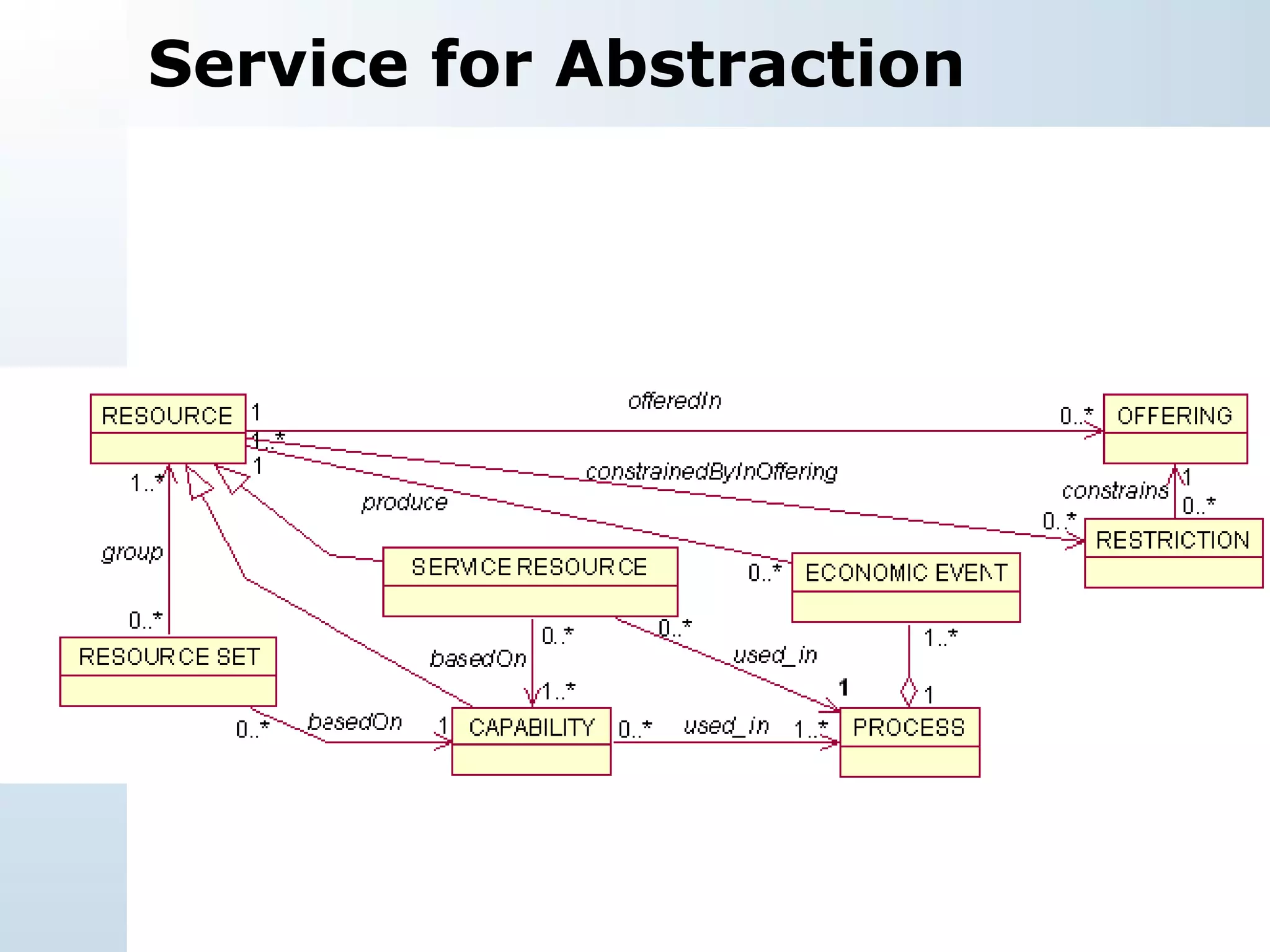
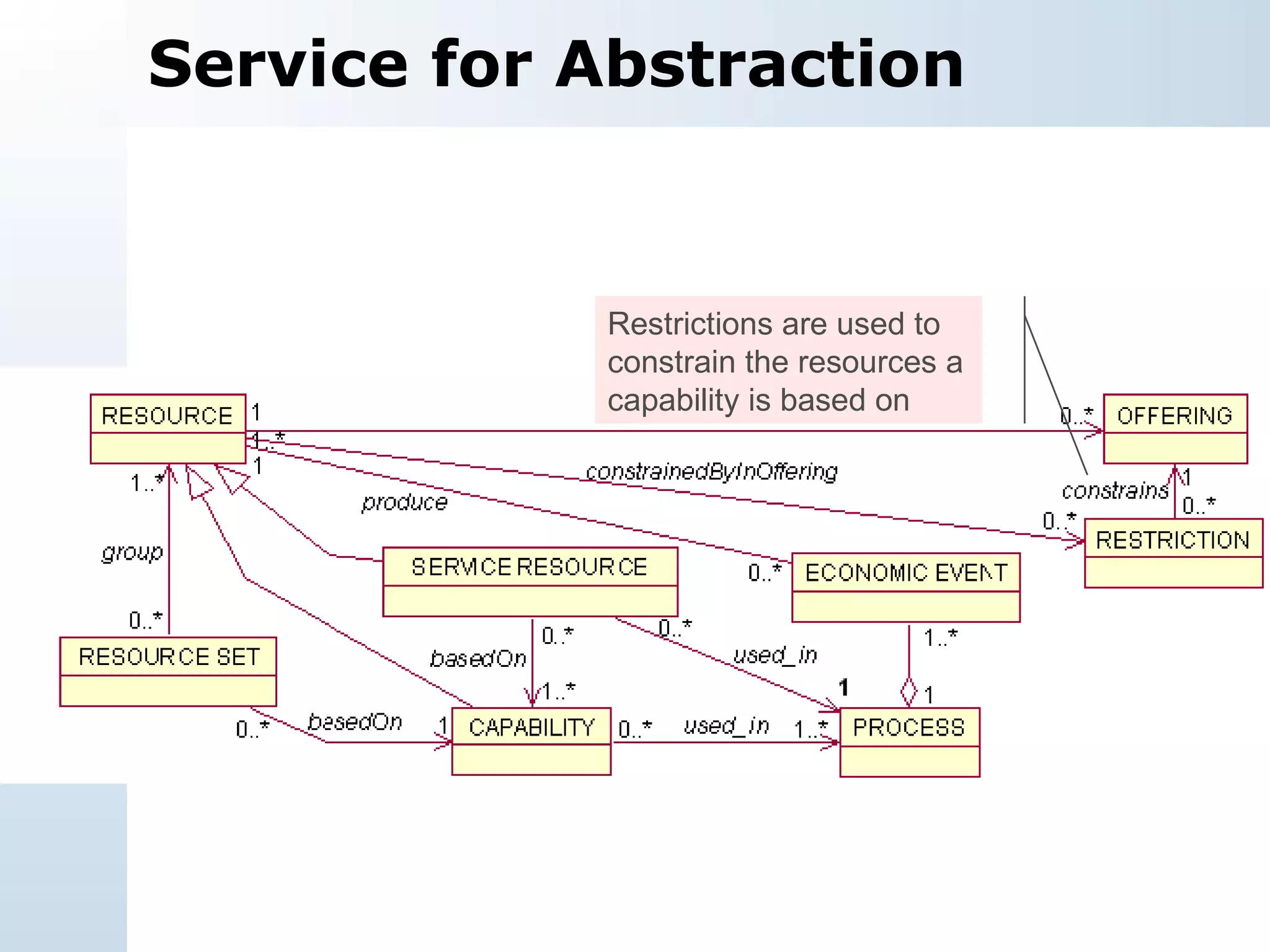
Service for Abstraction Goods are concrete resources having properties like weight, volume, and colour Service resources are abstract in the sense that they are defined only through the benefits they can bring A service resource is defined through the process in which it can be used
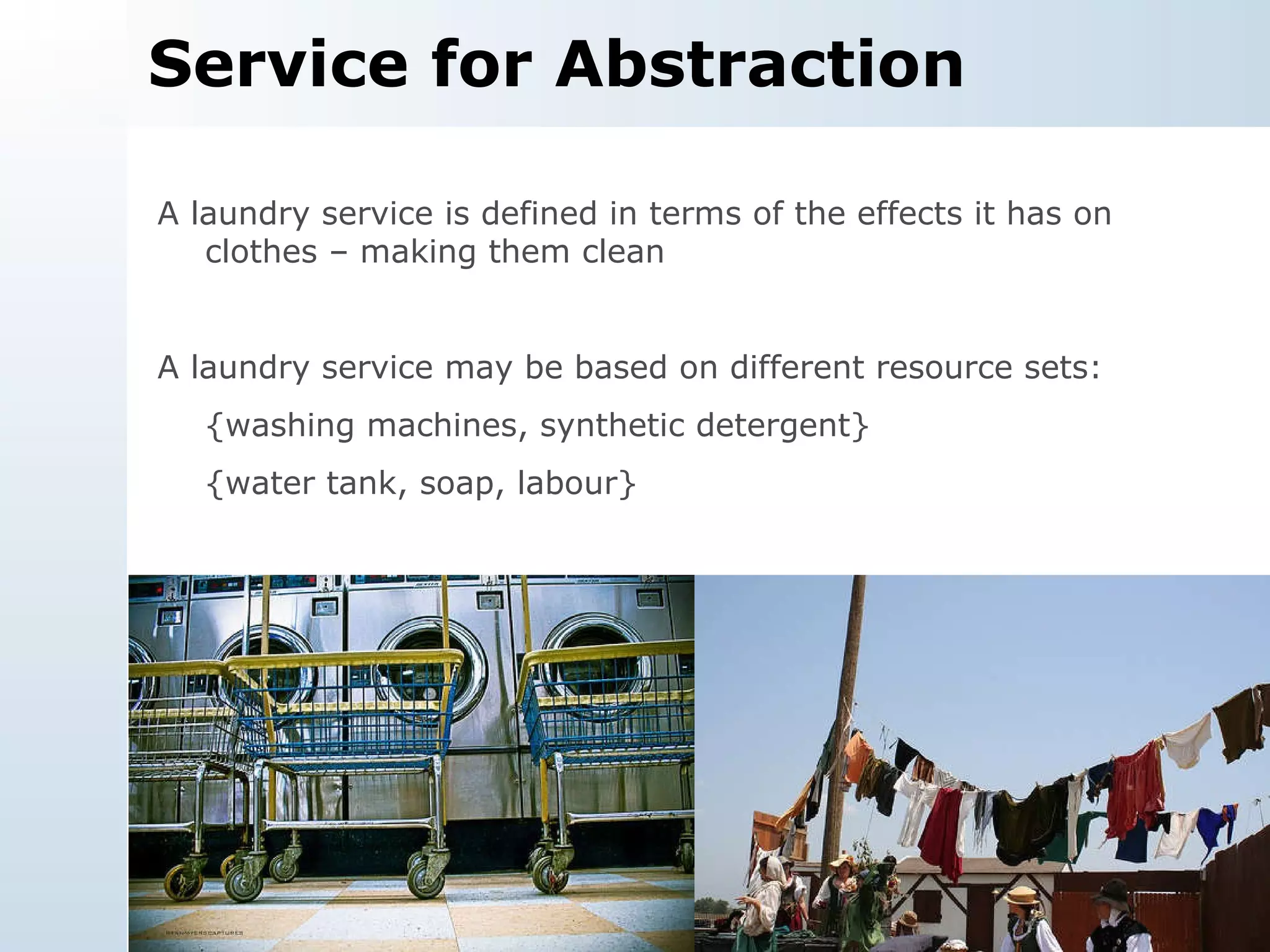
Service for Abstraction A laundry service is defined in terms of the effects it has on clothes – making them clean A laundry service may be based on different resource sets: {washing machines, synthetic detergent} {water tank, soap, labour}
Service for Abstraction
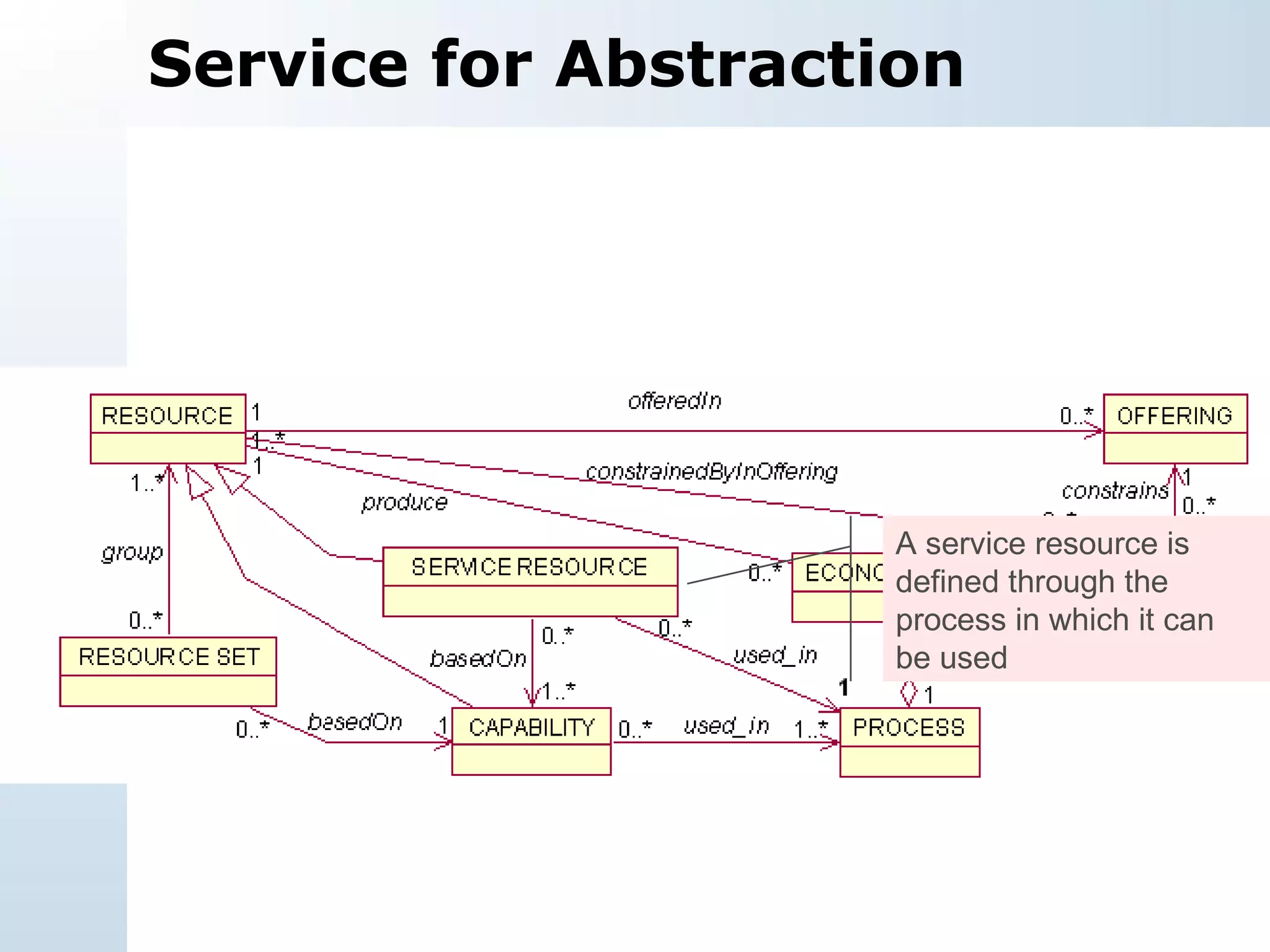
Service for Abstraction A service resource is defined through the process in which it can be used
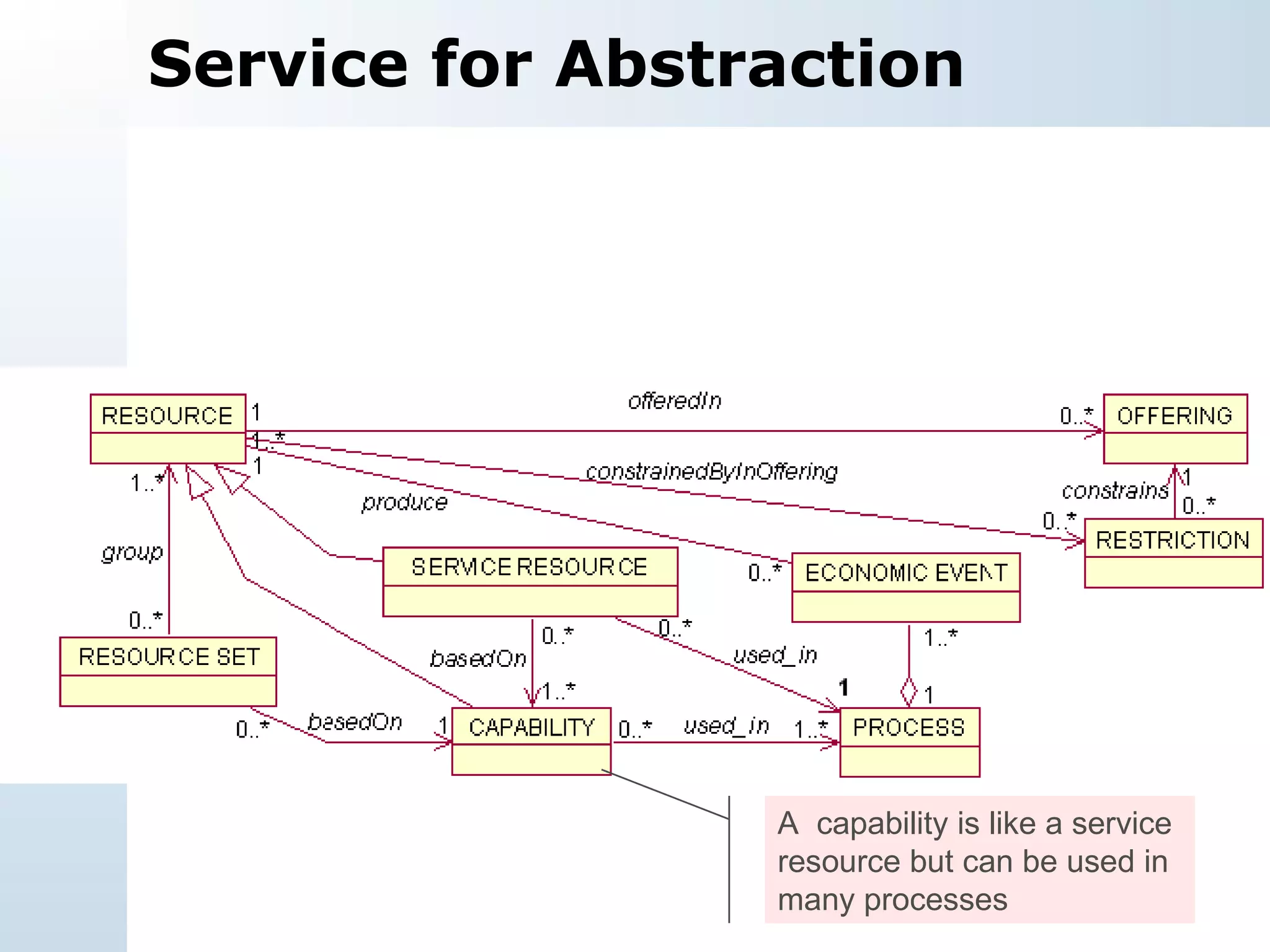
Service for Abstraction A  capability is like a service resource but can be used in many processes
Service for Abstraction Restrictions are used to constrain the resources a capability is based on
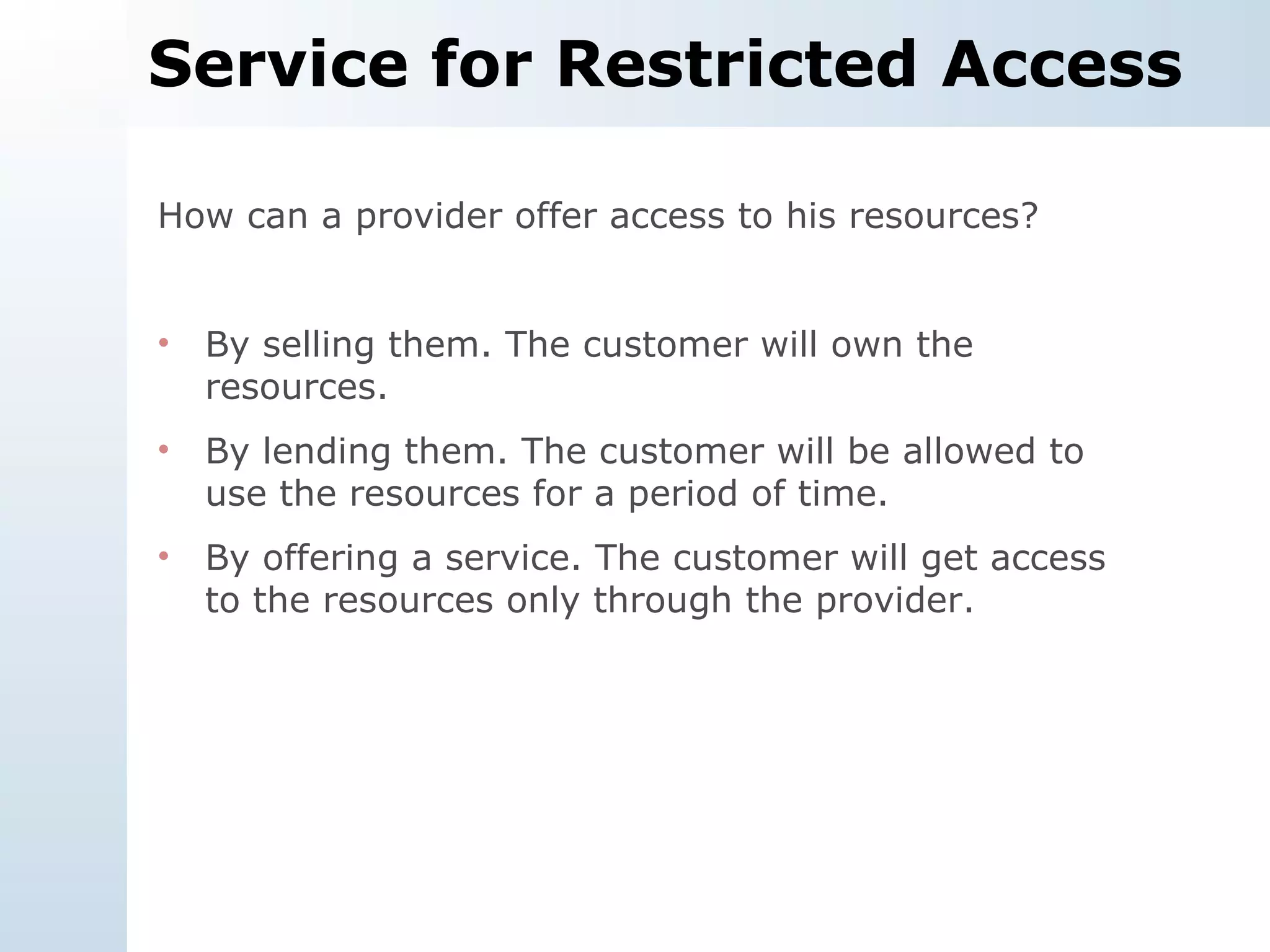
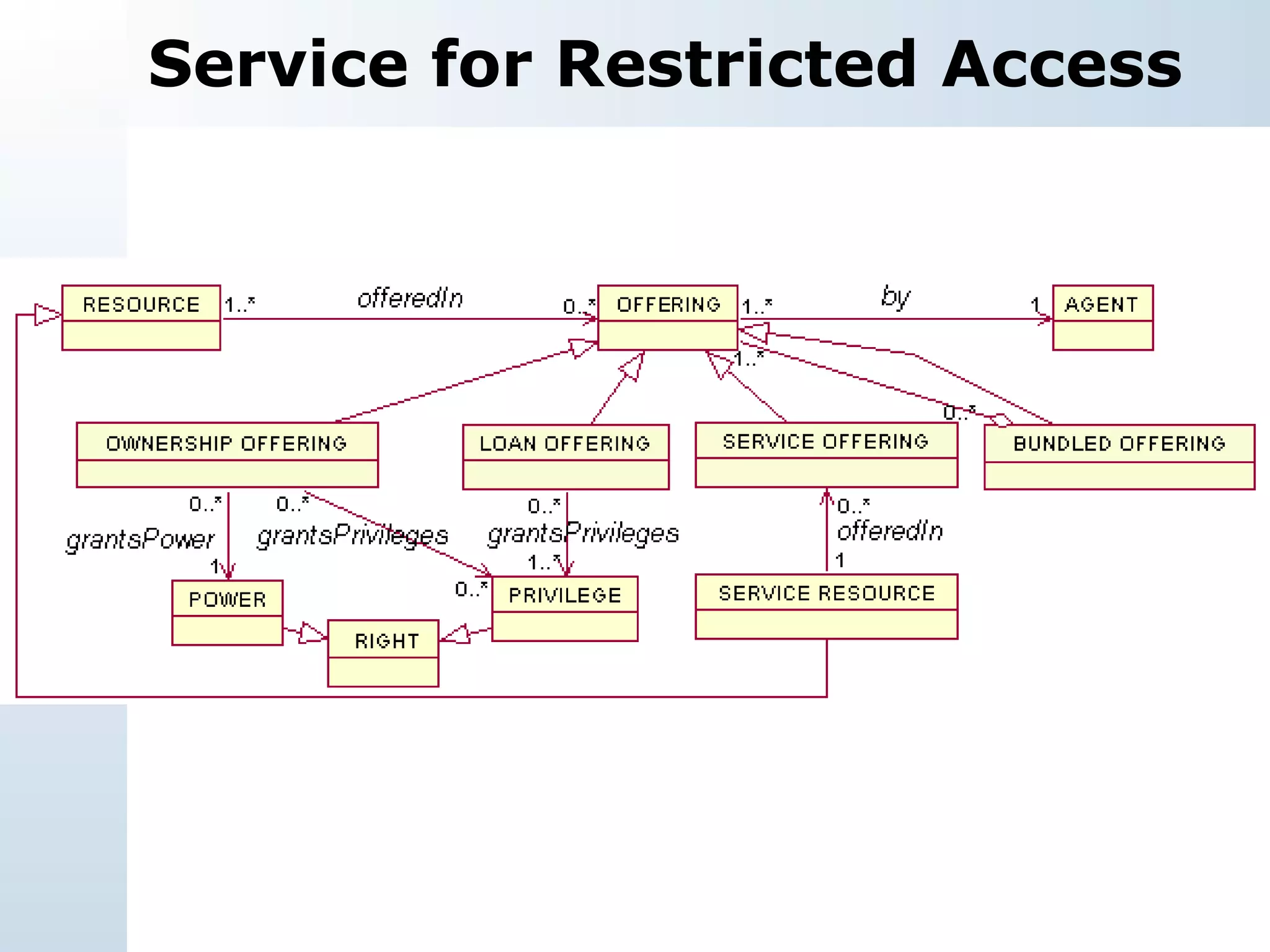
Service for Restricted Access How can a provider offer access to his resources? By selling them. The customer will own the resources. By lending them. The customer will be allowed to use the resources for a period of time. By offering a service. The customer will get access to the resources only through the provider.
Service for Restricted Access How can a provider offer access to his resources? By selling them. The customer will own the resources. All privileges Power
Service for Restricted Access How can a provider offer access to his resources? By selling them. The customer will own the resources. All privileges Power By lending them. The customer will be allowed to use the resources for a period of time. Some privileges
Service for Restricted Access How can a provider offer access to his resources? By selling them. The customer will own the resources. All privileges Power By loaning them. The customer will be allowed to use the resources for a period of time. Some privileges By offering a service. The customer will get access to the resources only through the provider. Claims
Service for Restricted Access
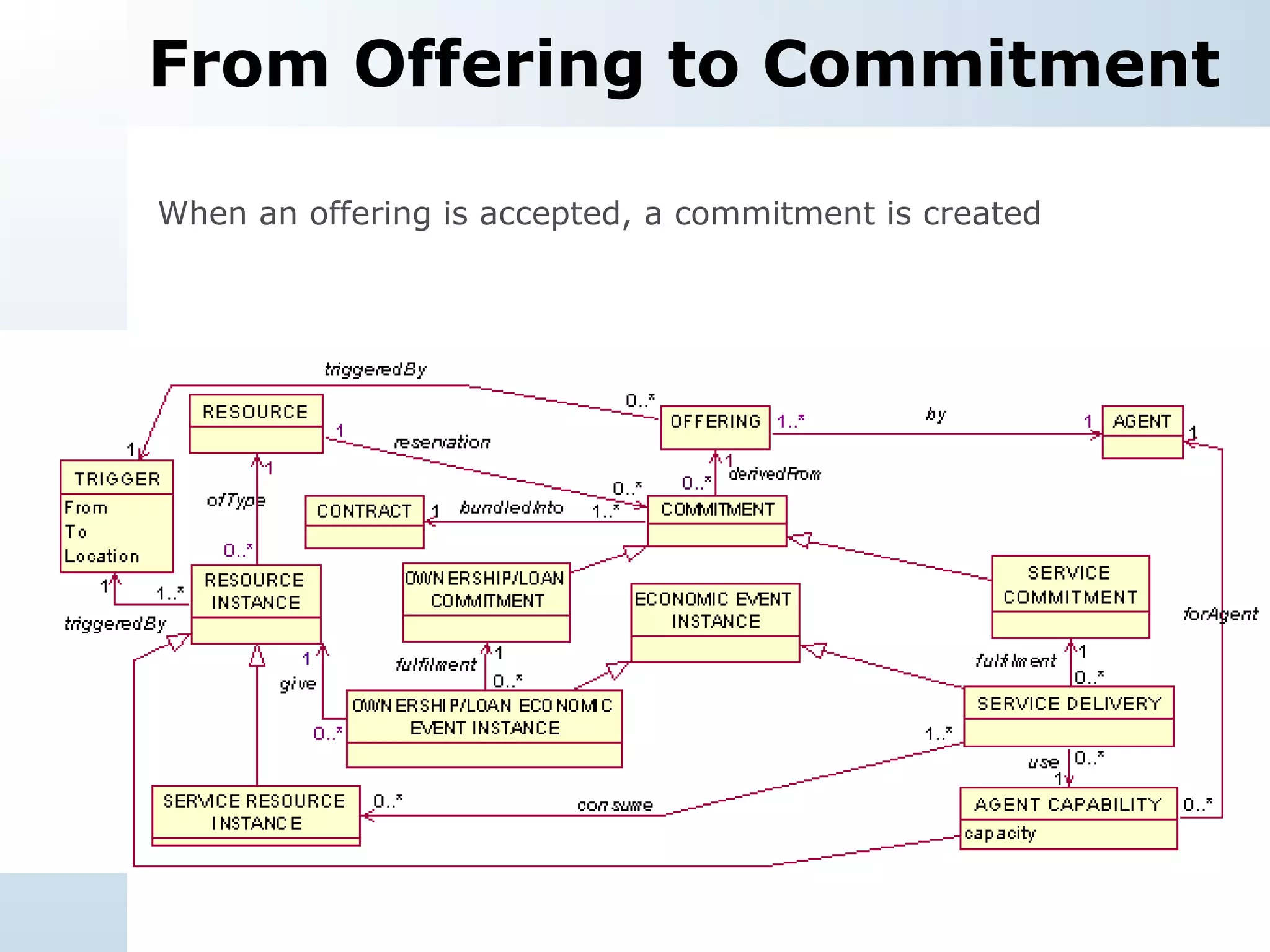
From Offering to Commitment When an offering is accepted, a commitment is created
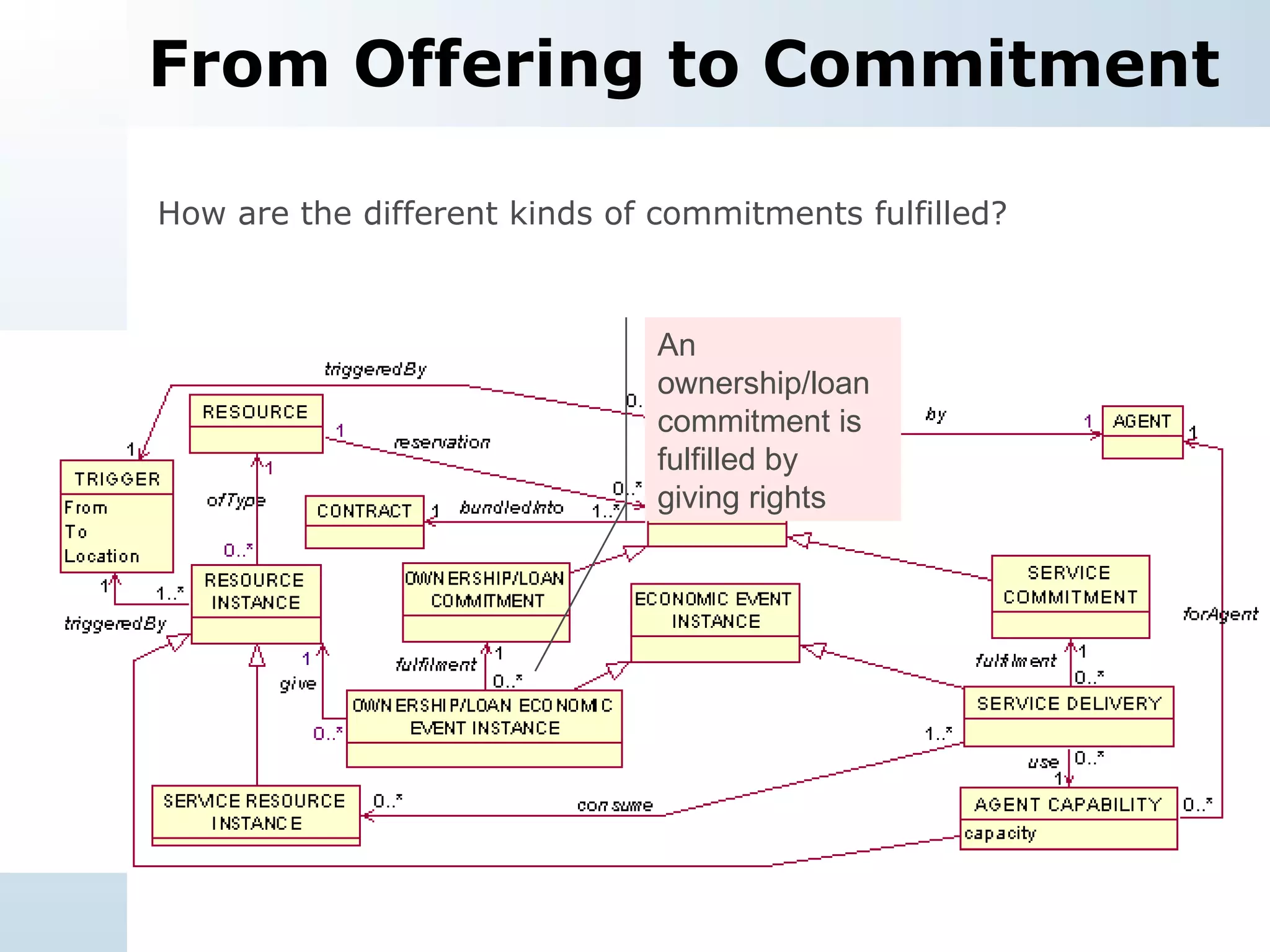
From Offering to Commitment How are the different kinds of commitments fulfilled? An ownership/loan commitment is fulfilled by giving rights
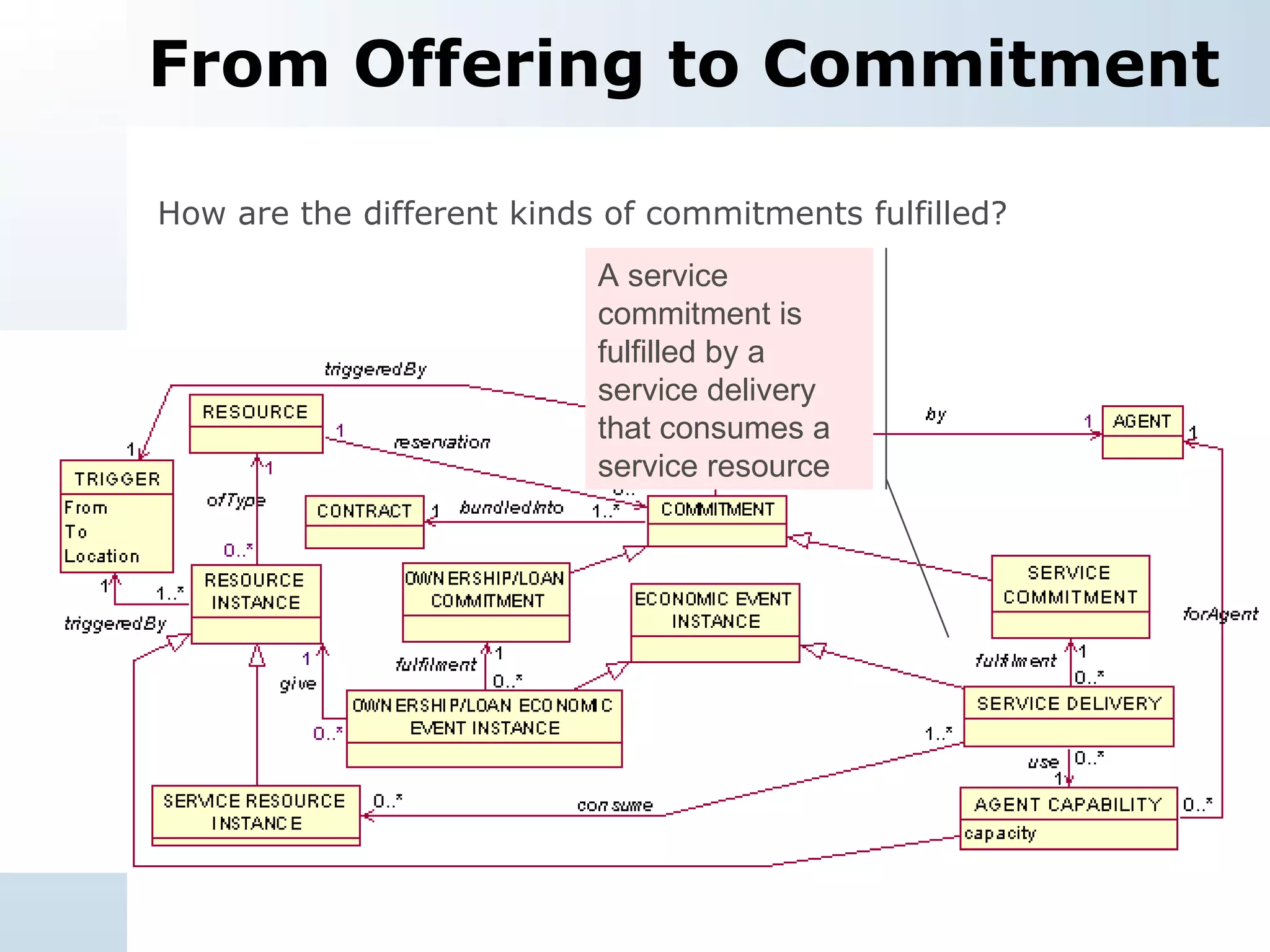
From Offering to Commitment How are the different kinds of commitments fulfilled? A service commitment is fulfilled by a service delivery that consumes a service resource
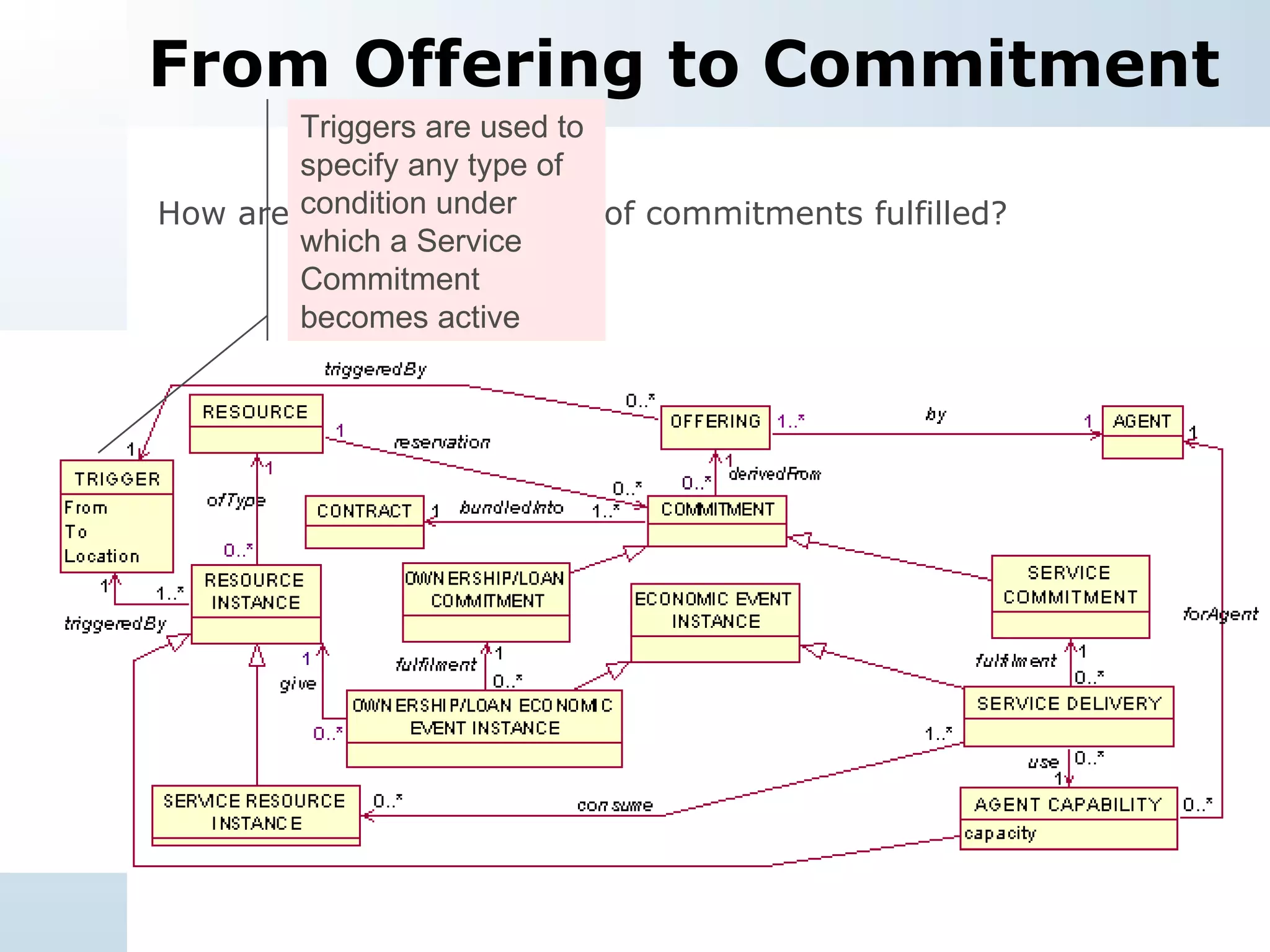
From Offering to Commitment How are the different kinds of commitments fulfilled? Triggers are used to specify any type of condition under which a Service Commitment becomes active
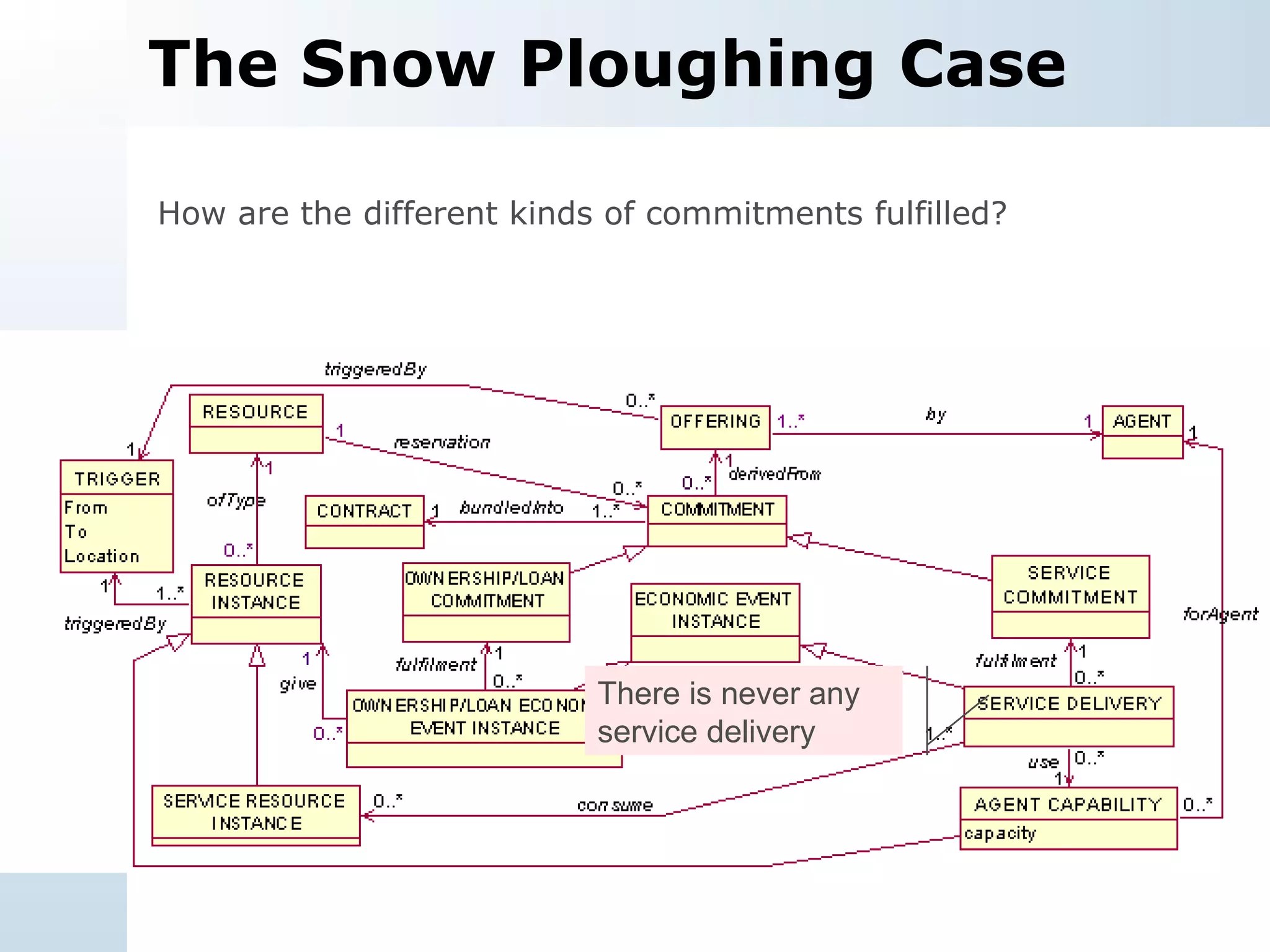
The Snow Ploughing Case How are the different kinds of commitments fulfilled? There is never any service delivery
The Snow Ploughing Case How are the different kinds of commitments fulfilled? There is never any service delivery But the service commitment is honoured because the trigger never fires
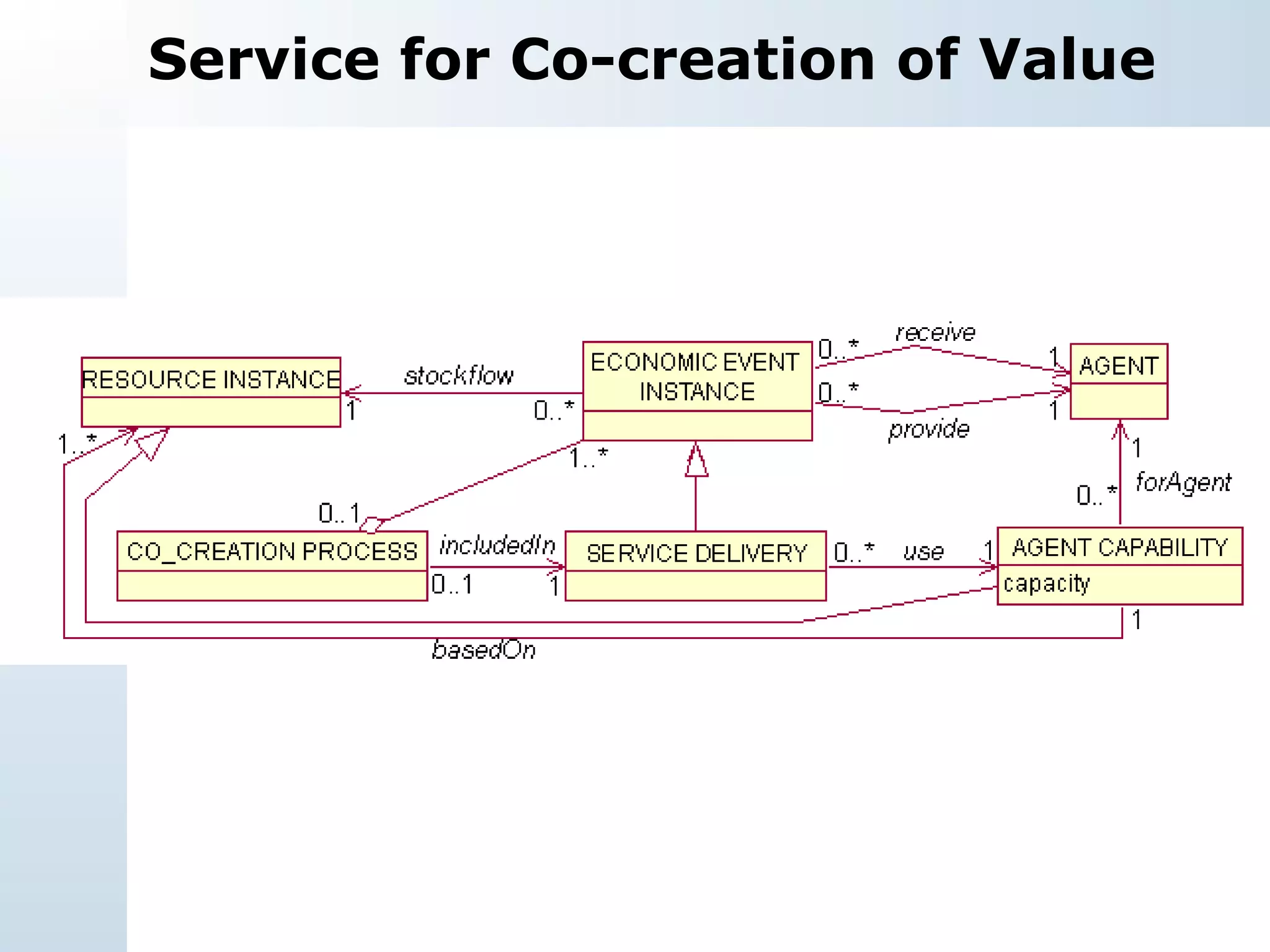
Service for Co-creation of Value Goods are produced internally at a provider who later on sells the goods to a customer  who uses them without the involvement of the provider Service deliveries are usually parts of processes where value is co-created in an interaction between provider and recipient The recipient provides some of his resources as input to the process
Service for Co-creation of Value
Concluding Remarks Three aspects on services Abstraction Restricted access Co-creation of value Captures the basics of several service analyses in the literature A basis for service descriptions

Unified Service Theory and Perspectives on Services

  • 1.
    Unified Service Theoryand Perspectives on Services Study Circle in Service Systems
  • 2.
    What is aService? “ A service is an abstract resource that represents a capability of performing tasks that represents a coherent functionality from the point of view of provider entities and requester entities. ” (W3C) ” S ervices are heterogeneous outputs produced to order and typically consist of changes in the conditions of the consuming units realized by the activities of producers at the demand of the consumers.“ (United Nations) “ A service is the provision of something of value, in the context of some domain of application, by one party to another.” (Chris Preist)
  • 3.
    What is aService? “ A service is an abstract resource that represents a capability of performing tasks that represents a coherent functionality from the point of view of provider entities and requester entities. ” (W3C) ” S ervices are heterogeneous outputs produced to order and typically consist of changes in the conditions of the consuming units realized by the activities of producers at the demand of the consumers.“ (United Nations) “ A service is the provision of something of value, in the context of some domain of application, by one party to another.” (Chris Preist) Service properties Intangibility Inseparability Heterogeneity Perishability
  • 4.
    Unified Service Theory” Services are production processes wherein each customer supplies one or more input components for that customer’s unit of production. With non-service processes, groups of customers may contribute ideas to the design of the prodct, but individual customers’ only participation is to select, pay for, and consume the output.” Scott E. Sampson, ”The Unified Service Theory” in Handbook of Service Science , ed. P. Maglio et al., Springer, 2010
  • 5.
    A Non-service ProcessActor Process Input Output
  • 6.
    A Service ProcessProvider Customer Service process Input Output
  • 7.
    Sources of HeterogeneityProvider Customer Service process Input Output Variability in provider input Variability in customer input
  • 8.
    Perishability Provider CustomerService process Input Output ? ?
  • 9.
    Management Applications Servicedevelopment: handling variability in customer input, robust processes Service innovation: finding new roles for customers in service processes
  • 10.
    Are Services Processes?Sometimes we talk of services as resources: ” Our company offers car washing services”
  • 11.
    Strengths of ServicesA service consumer does not own a service. She does not need to take on typical ownership responsibilities, like infrastructure management, integration, and maintenance. She can focus on how to make use of the service for her specific business. Taxi Service Customer Encapsulated resources
  • 12.
    A Motivating ProblemYou have bought a snow ploughing service for the winter, saying that whenever more than five cm snow has fallen, your street will be ploughed
  • 13.
    A Motivating ProblemYou have bought a snow ploughing service for the winter, saying that whenever more than five cm snow has fallen, your street will be ploughed However, it never snows this winter Has the service been delivered?
  • 14.
    Value Modelling andREA REA Ontology: modelling exchanges and conversions of resources Resource – an object viewed as valuable by some agent Event – exchange of resources or conversion of resources Agent – a legal entity that controls resources and performs events
  • 15.
    Exchanging Resources AgentAgent Resource Resource
  • 16.
    Exchanging Resources AgentAgent Resource Resource Events exchanging resources
  • 17.
  • 18.
    Converting Resources ResourceResource Resource Events converting resources
  • 19.
  • 20.
    REA Conceptual ModelThe stockflow tells how an economic event affects a resource
  • 21.
    REA Conceptual ModelThe stockflow tells how an economic event affects a resource A process is a set of economic events
  • 22.
    What is Transferred?What do you get when you buy a book at a bookstore? a book
  • 23.
    What is Transferred?What do you get when a book you buy a book at a bookstore? you borrow a book at a library? a book
  • 24.
    What is Transferred?What do you get when a book the right to read, sell, or even destroy a book you buy a book at a bookstore? X X you borrow a book at a library? a book the right to read a book for a period of time
  • 25.
    Hohfeldt’s Classification ofRights Claim One actor has a claim on another actor if the second actor is required to act in a certain way for the benefit of the first actor
  • 26.
    Hohfeldt’s Classification ofRights Claim One actor has a claim on another actor if the second actor is required to act in a certain way for the benefit of the first actor Privilege An actor has a privilege on an action if she is free to carry out that action without any interference from the environment
  • 27.
    Hohfeldt’s Classification ofRights Claim One actor has a claim on another actor if the second actor is required to act in a certain way for the benefit of the first actor Privilege An actor has a privilege on an action if she is free to carry out that action without any interference from the environment Power A power is the ability of an actor to create or modify social or legal relationships
  • 28.
    Hohfeldt’s Classification ofRights Claim One actor has a claim on another actor if the second actor is required to act in a certain way for the benefit of the first actor Privilege An actor has a privilege on an action if she is free to carry out that action without any interference from the environment Power A power is the ability of an actor to create or modify social or legal relationships Immunity An immunity refers to the restriction of power of one actor in terms of creating relationships on behalf of another actor
  • 29.
    Three Perspectives onServices Abstraction – focus on the use of resources Restricted access – accessing resources without owning them Co-creation – supplier and customer create value together
  • 30.
    Service for AbstractionGoods are concrete resources having properties like weight, volume, and colour Service resources are abstract in the sense that they are defined only through the benefits they can bring A service resource is defined through the process in which it can be used
  • 31.
    Service for AbstractionA laundry service is defined in terms of the effects it has on clothes – making them clean A laundry service may be based on different resource sets: {washing machines, synthetic detergent} {water tank, soap, labour}
  • 32.
  • 33.
    Service for AbstractionA service resource is defined through the process in which it can be used
  • 34.
    Service for AbstractionA capability is like a service resource but can be used in many processes
  • 35.
    Service for AbstractionRestrictions are used to constrain the resources a capability is based on
  • 36.
    Service for RestrictedAccess How can a provider offer access to his resources? By selling them. The customer will own the resources. By lending them. The customer will be allowed to use the resources for a period of time. By offering a service. The customer will get access to the resources only through the provider.
  • 37.
    Service for RestrictedAccess How can a provider offer access to his resources? By selling them. The customer will own the resources. All privileges Power
  • 38.
    Service for RestrictedAccess How can a provider offer access to his resources? By selling them. The customer will own the resources. All privileges Power By lending them. The customer will be allowed to use the resources for a period of time. Some privileges
  • 39.
    Service for RestrictedAccess How can a provider offer access to his resources? By selling them. The customer will own the resources. All privileges Power By loaning them. The customer will be allowed to use the resources for a period of time. Some privileges By offering a service. The customer will get access to the resources only through the provider. Claims
  • 40.
  • 41.
    From Offering toCommitment When an offering is accepted, a commitment is created
  • 42.
    From Offering toCommitment How are the different kinds of commitments fulfilled? An ownership/loan commitment is fulfilled by giving rights
  • 43.
    From Offering toCommitment How are the different kinds of commitments fulfilled? A service commitment is fulfilled by a service delivery that consumes a service resource
  • 44.
    From Offering toCommitment How are the different kinds of commitments fulfilled? Triggers are used to specify any type of condition under which a Service Commitment becomes active
  • 45.
    The Snow PloughingCase How are the different kinds of commitments fulfilled? There is never any service delivery
  • 46.
    The Snow PloughingCase How are the different kinds of commitments fulfilled? There is never any service delivery But the service commitment is honoured because the trigger never fires
  • 47.
    Service for Co-creationof Value Goods are produced internally at a provider who later on sells the goods to a customer who uses them without the involvement of the provider Service deliveries are usually parts of processes where value is co-created in an interaction between provider and recipient The recipient provides some of his resources as input to the process
  • 48.
  • 49.
    Concluding Remarks Threeaspects on services Abstraction Restricted access Co-creation of value Captures the basics of several service analyses in the literature A basis for service descriptions

Editor's Notes

  • #2 [Title of the course] Feb 26, 2011 Copyright © 2004-2005 NameOfTheOrganization. All rights reserved.
  • #3 [Title of the course] Feb 26, 2011 Copyright © 2004-2005 NameOfTheOrganization. All rights reserved. The book by Hruby introduces more than ten behavioral patterns. In this section, we will only discuss and exemplify a few of these. The Identification pattern is about identifying things by naming or numbering them. Location is about specifying where Economic Events take place. Due Date is a pattern for specifying time points governing when certain actions should be carried out, such as deadlines. Description is about handling unstructured information about entities, in particular Economic Resource Types. Value is a pattern for handling quantitative information about the value of REA entities.
  • #4 [Title of the course] Feb 26, 2011 Copyright © 2004-2005 NameOfTheOrganization. All rights reserved. The book by Hruby introduces more than ten behavioral patterns. In this section, we will only discuss and exemplify a few of these. The Identification pattern is about identifying things by naming or numbering them. Location is about specifying where Economic Events take place. Due Date is a pattern for specifying time points governing when certain actions should be carried out, such as deadlines. Description is about handling unstructured information about entities, in particular Economic Resource Types. Value is a pattern for handling quantitative information about the value of REA entities.
  • #12 [Title of the course] Feb 26, 2011 Copyright © 2004-2005 NameOfTheOrganization. All rights reserved. The book by Hruby introduces more than ten behavioral patterns. In this section, we will only discuss and exemplify a few of these. The Identification pattern is about identifying things by naming or numbering them. Location is about specifying where Economic Events take place. Due Date is a pattern for specifying time points governing when certain actions should be carried out, such as deadlines. Description is about handling unstructured information about entities, in particular Economic Resource Types. Value is a pattern for handling quantitative information about the value of REA entities.
  • #13 [Title of the course] Feb 26, 2011 Copyright © 2004-2005 NameOfTheOrganization. All rights reserved. The book by Hruby introduces more than ten behavioral patterns. In this section, we will only discuss and exemplify a few of these. The Identification pattern is about identifying things by naming or numbering them. Location is about specifying where Economic Events take place. Due Date is a pattern for specifying time points governing when certain actions should be carried out, such as deadlines. Description is about handling unstructured information about entities, in particular Economic Resource Types. Value is a pattern for handling quantitative information about the value of REA entities.
  • #14 [Title of the course] Feb 26, 2011 Copyright © 2004-2005 NameOfTheOrganization. All rights reserved. The book by Hruby introduces more than ten behavioral patterns. In this section, we will only discuss and exemplify a few of these. The Identification pattern is about identifying things by naming or numbering them. Location is about specifying where Economic Events take place. Due Date is a pattern for specifying time points governing when certain actions should be carried out, such as deadlines. Description is about handling unstructured information about entities, in particular Economic Resource Types. Value is a pattern for handling quantitative information about the value of REA entities.
  • #15 [Title of the course] Feb 26, 2011 Copyright © 2004-2005 NameOfTheOrganization. All rights reserved. The book by Hruby introduces more than ten behavioral patterns. In this section, we will only discuss and exemplify a few of these. The Identification pattern is about identifying things by naming or numbering them. Location is about specifying where Economic Events take place. Due Date is a pattern for specifying time points governing when certain actions should be carried out, such as deadlines. Description is about handling unstructured information about entities, in particular Economic Resource Types. Value is a pattern for handling quantitative information about the value of REA entities.
  • #16 [Title of the course] Feb 26, 2011 Copyright © 2004-2005 NameOfTheOrganization. All rights reserved. The book by Hruby introduces more than ten behavioral patterns. In this section, we will only discuss and exemplify a few of these. The Identification pattern is about identifying things by naming or numbering them. Location is about specifying where Economic Events take place. Due Date is a pattern for specifying time points governing when certain actions should be carried out, such as deadlines. Description is about handling unstructured information about entities, in particular Economic Resource Types. Value is a pattern for handling quantitative information about the value of REA entities.
  • #17 [Title of the course] Feb 26, 2011 Copyright © 2004-2005 NameOfTheOrganization. All rights reserved. The book by Hruby introduces more than ten behavioral patterns. In this section, we will only discuss and exemplify a few of these. The Identification pattern is about identifying things by naming or numbering them. Location is about specifying where Economic Events take place. Due Date is a pattern for specifying time points governing when certain actions should be carried out, such as deadlines. Description is about handling unstructured information about entities, in particular Economic Resource Types. Value is a pattern for handling quantitative information about the value of REA entities.
  • #18 [Title of the course] Feb 26, 2011 Copyright © 2004-2005 NameOfTheOrganization. All rights reserved. The book by Hruby introduces more than ten behavioral patterns. In this section, we will only discuss and exemplify a few of these. The Identification pattern is about identifying things by naming or numbering them. Location is about specifying where Economic Events take place. Due Date is a pattern for specifying time points governing when certain actions should be carried out, such as deadlines. Description is about handling unstructured information about entities, in particular Economic Resource Types. Value is a pattern for handling quantitative information about the value of REA entities.
  • #19 [Title of the course] Feb 26, 2011 Copyright © 2004-2005 NameOfTheOrganization. All rights reserved. The book by Hruby introduces more than ten behavioral patterns. In this section, we will only discuss and exemplify a few of these. The Identification pattern is about identifying things by naming or numbering them. Location is about specifying where Economic Events take place. Due Date is a pattern for specifying time points governing when certain actions should be carried out, such as deadlines. Description is about handling unstructured information about entities, in particular Economic Resource Types. Value is a pattern for handling quantitative information about the value of REA entities.
  • #20 [Title of the course] Feb 26, 2011 Copyright © 2004-2005 NameOfTheOrganization. All rights reserved. The book by Hruby introduces more than ten behavioral patterns. In this section, we will only discuss and exemplify a few of these. The Identification pattern is about identifying things by naming or numbering them. Location is about specifying where Economic Events take place. Due Date is a pattern for specifying time points governing when certain actions should be carried out, such as deadlines. Description is about handling unstructured information about entities, in particular Economic Resource Types. Value is a pattern for handling quantitative information about the value of REA entities.
  • #21 [Title of the course] Feb 26, 2011 Copyright © 2004-2005 NameOfTheOrganization. All rights reserved. The book by Hruby introduces more than ten behavioral patterns. In this section, we will only discuss and exemplify a few of these. The Identification pattern is about identifying things by naming or numbering them. Location is about specifying where Economic Events take place. Due Date is a pattern for specifying time points governing when certain actions should be carried out, such as deadlines. Description is about handling unstructured information about entities, in particular Economic Resource Types. Value is a pattern for handling quantitative information about the value of REA entities.
  • #22 [Title of the course] Feb 26, 2011 Copyright © 2004-2005 NameOfTheOrganization. All rights reserved. The book by Hruby introduces more than ten behavioral patterns. In this section, we will only discuss and exemplify a few of these. The Identification pattern is about identifying things by naming or numbering them. Location is about specifying where Economic Events take place. Due Date is a pattern for specifying time points governing when certain actions should be carried out, such as deadlines. Description is about handling unstructured information about entities, in particular Economic Resource Types. Value is a pattern for handling quantitative information about the value of REA entities.
  • #23 [Title of the course] Feb 26, 2011 Copyright © 2004-2005 NameOfTheOrganization. All rights reserved. The first question to think about for an exchange process is “What is transferred?” What kind of object is transferred? For example, what do you get when you buy a book at a bookstore? Well, one natural answer would be “I get a book”. But let us take one more question “What do you get when you borrow a book at a library?” A natural answer would again be “I get a book”. But stop, now it looks a bit fishy. We have two very different questions but we get the same answer to them. So, the answer cannot be that good, it is too general and vague, we need a more precise answer. In order to find a better answer, we should think about what we can do when we have bought or borrowed a book. If we buy a book, we have the right to do almost anything with it, we can read it, sell it, or even destroy it. But if we only borrow the book, we are much more restricted in what we can do with it – essentially we have only got the right to read the book for some period of time. Generalising this example, the answer to the question “What is transferred?” is “a right to a resource”. A right to do something with a resource. It is too simple to only say that you just get a resource, you also need to say what right you get on that resource.
  • #24 [Title of the course] Feb 26, 2011 Copyright © 2004-2005 NameOfTheOrganization. All rights reserved. The first question to think about for an exchange process is “What is transferred?” What kind of object is transferred? For example, what do you get when you buy a book at a bookstore? Well, one natural answer would be “I get a book”. But let us take one more question “What do you get when you borrow a book at a library?” A natural answer would again be “I get a book”. But stop, now it looks a bit fishy. We have two very different questions but we get the same answer to them. So, the answer cannot be that good, it is too general and vague, we need a more precise answer. In order to find a better answer, we should think about what we can do when we have bought or borrowed a book. If we buy a book, we have the right to do almost anything with it, we can read it, sell it, or even destroy it. But if we only borrow the book, we are much more restricted in what we can do with it – essentially we have only got the right to read the book for some period of time. Generalising this example, the answer to the question “What is transferred?” is “a right to a resource”. A right to do something with a resource. It is too simple to only say that you just get a resource, you also need to say what right you get on that resource.
  • #25 [Title of the course] Feb 26, 2011 Copyright © 2004-2005 NameOfTheOrganization. All rights reserved. The first question to think about for an exchange process is “What is transferred?” What kind of object is transferred? For example, what do you get when you buy a book at a bookstore? Well, one natural answer would be “I get a book”. But let us take one more question “What do you get when you borrow a book at a library?” A natural answer would again be “I get a book”. But stop, now it looks a bit fishy. We have two very different questions but we get the same answer to them. So, the answer cannot be that good, it is too general and vague, we need a more precise answer. In order to find a better answer, we should think about what we can do when we have bought or borrowed a book. If we buy a book, we have the right to do almost anything with it, we can read it, sell it, or even destroy it. But if we only borrow the book, we are much more restricted in what we can do with it – essentially we have only got the right to read the book for some period of time. Generalising this example, the answer to the question “What is transferred?” is “a right to a resource”. A right to do something with a resource. It is too simple to only say that you just get a resource, you also need to say what right you get on that resource.
  • #26 [Title of the course] Feb 26, 2011 Copyright © 2004-2005 NameOfTheOrganization. All rights reserved. The book by Hruby introduces more than ten behavioral patterns. In this section, we will only discuss and exemplify a few of these. The Identification pattern is about identifying things by naming or numbering them. Location is about specifying where Economic Events take place. Due Date is a pattern for specifying time points governing when certain actions should be carried out, such as deadlines. Description is about handling unstructured information about entities, in particular Economic Resource Types. Value is a pattern for handling quantitative information about the value of REA entities.
  • #27 [Title of the course] Feb 26, 2011 Copyright © 2004-2005 NameOfTheOrganization. All rights reserved. The book by Hruby introduces more than ten behavioral patterns. In this section, we will only discuss and exemplify a few of these. The Identification pattern is about identifying things by naming or numbering them. Location is about specifying where Economic Events take place. Due Date is a pattern for specifying time points governing when certain actions should be carried out, such as deadlines. Description is about handling unstructured information about entities, in particular Economic Resource Types. Value is a pattern for handling quantitative information about the value of REA entities.
  • #28 [Title of the course] Feb 26, 2011 Copyright © 2004-2005 NameOfTheOrganization. All rights reserved. The book by Hruby introduces more than ten behavioral patterns. In this section, we will only discuss and exemplify a few of these. The Identification pattern is about identifying things by naming or numbering them. Location is about specifying where Economic Events take place. Due Date is a pattern for specifying time points governing when certain actions should be carried out, such as deadlines. Description is about handling unstructured information about entities, in particular Economic Resource Types. Value is a pattern for handling quantitative information about the value of REA entities.
  • #29 [Title of the course] Feb 26, 2011 Copyright © 2004-2005 NameOfTheOrganization. All rights reserved. The book by Hruby introduces more than ten behavioral patterns. In this section, we will only discuss and exemplify a few of these. The Identification pattern is about identifying things by naming or numbering them. Location is about specifying where Economic Events take place. Due Date is a pattern for specifying time points governing when certain actions should be carried out, such as deadlines. Description is about handling unstructured information about entities, in particular Economic Resource Types. Value is a pattern for handling quantitative information about the value of REA entities.
  • #30 [Title of the course] Feb 26, 2011 Copyright © 2004-2005 NameOfTheOrganization. All rights reserved. The book by Hruby introduces more than ten behavioral patterns. In this section, we will only discuss and exemplify a few of these. The Identification pattern is about identifying things by naming or numbering them. Location is about specifying where Economic Events take place. Due Date is a pattern for specifying time points governing when certain actions should be carried out, such as deadlines. Description is about handling unstructured information about entities, in particular Economic Resource Types. Value is a pattern for handling quantitative information about the value of REA entities.
  • #31 [Title of the course] Feb 26, 2011 Copyright © 2004-2005 NameOfTheOrganization. All rights reserved. The book by Hruby introduces more than ten behavioral patterns. In this section, we will only discuss and exemplify a few of these. The Identification pattern is about identifying things by naming or numbering them. Location is about specifying where Economic Events take place. Due Date is a pattern for specifying time points governing when certain actions should be carried out, such as deadlines. Description is about handling unstructured information about entities, in particular Economic Resource Types. Value is a pattern for handling quantitative information about the value of REA entities.
  • #32 [Title of the course] Feb 26, 2011 Copyright © 2004-2005 NameOfTheOrganization. All rights reserved. The book by Hruby introduces more than ten behavioral patterns. In this section, we will only discuss and exemplify a few of these. The Identification pattern is about identifying things by naming or numbering them. Location is about specifying where Economic Events take place. Due Date is a pattern for specifying time points governing when certain actions should be carried out, such as deadlines. Description is about handling unstructured information about entities, in particular Economic Resource Types. Value is a pattern for handling quantitative information about the value of REA entities.
  • #33 [Title of the course] Feb 26, 2011 Copyright © 2004-2005 NameOfTheOrganization. All rights reserved. The book by Hruby introduces more than ten behavioral patterns. In this section, we will only discuss and exemplify a few of these. The Identification pattern is about identifying things by naming or numbering them. Location is about specifying where Economic Events take place. Due Date is a pattern for specifying time points governing when certain actions should be carried out, such as deadlines. Description is about handling unstructured information about entities, in particular Economic Resource Types. Value is a pattern for handling quantitative information about the value of REA entities.
  • #34 [Title of the course] Feb 26, 2011 Copyright © 2004-2005 NameOfTheOrganization. All rights reserved. The book by Hruby introduces more than ten behavioral patterns. In this section, we will only discuss and exemplify a few of these. The Identification pattern is about identifying things by naming or numbering them. Location is about specifying where Economic Events take place. Due Date is a pattern for specifying time points governing when certain actions should be carried out, such as deadlines. Description is about handling unstructured information about entities, in particular Economic Resource Types. Value is a pattern for handling quantitative information about the value of REA entities.
  • #35 [Title of the course] Feb 26, 2011 Copyright © 2004-2005 NameOfTheOrganization. All rights reserved. The book by Hruby introduces more than ten behavioral patterns. In this section, we will only discuss and exemplify a few of these. The Identification pattern is about identifying things by naming or numbering them. Location is about specifying where Economic Events take place. Due Date is a pattern for specifying time points governing when certain actions should be carried out, such as deadlines. Description is about handling unstructured information about entities, in particular Economic Resource Types. Value is a pattern for handling quantitative information about the value of REA entities.
  • #36 [Title of the course] Feb 26, 2011 Copyright © 2004-2005 NameOfTheOrganization. All rights reserved. The book by Hruby introduces more than ten behavioral patterns. In this section, we will only discuss and exemplify a few of these. The Identification pattern is about identifying things by naming or numbering them. Location is about specifying where Economic Events take place. Due Date is a pattern for specifying time points governing when certain actions should be carried out, such as deadlines. Description is about handling unstructured information about entities, in particular Economic Resource Types. Value is a pattern for handling quantitative information about the value of REA entities.
  • #37 [Title of the course] Feb 26, 2011 Copyright © 2004-2005 NameOfTheOrganization. All rights reserved. The book by Hruby introduces more than ten behavioral patterns. In this section, we will only discuss and exemplify a few of these. The Identification pattern is about identifying things by naming or numbering them. Location is about specifying where Economic Events take place. Due Date is a pattern for specifying time points governing when certain actions should be carried out, such as deadlines. Description is about handling unstructured information about entities, in particular Economic Resource Types. Value is a pattern for handling quantitative information about the value of REA entities.
  • #38 [Title of the course] Feb 26, 2011 Copyright © 2004-2005 NameOfTheOrganization. All rights reserved. The book by Hruby introduces more than ten behavioral patterns. In this section, we will only discuss and exemplify a few of these. The Identification pattern is about identifying things by naming or numbering them. Location is about specifying where Economic Events take place. Due Date is a pattern for specifying time points governing when certain actions should be carried out, such as deadlines. Description is about handling unstructured information about entities, in particular Economic Resource Types. Value is a pattern for handling quantitative information about the value of REA entities.
  • #39 [Title of the course] Feb 26, 2011 Copyright © 2004-2005 NameOfTheOrganization. All rights reserved. The book by Hruby introduces more than ten behavioral patterns. In this section, we will only discuss and exemplify a few of these. The Identification pattern is about identifying things by naming or numbering them. Location is about specifying where Economic Events take place. Due Date is a pattern for specifying time points governing when certain actions should be carried out, such as deadlines. Description is about handling unstructured information about entities, in particular Economic Resource Types. Value is a pattern for handling quantitative information about the value of REA entities.
  • #40 [Title of the course] Feb 26, 2011 Copyright © 2004-2005 NameOfTheOrganization. All rights reserved. The book by Hruby introduces more than ten behavioral patterns. In this section, we will only discuss and exemplify a few of these. The Identification pattern is about identifying things by naming or numbering them. Location is about specifying where Economic Events take place. Due Date is a pattern for specifying time points governing when certain actions should be carried out, such as deadlines. Description is about handling unstructured information about entities, in particular Economic Resource Types. Value is a pattern for handling quantitative information about the value of REA entities.
  • #41 [Title of the course] Feb 26, 2011 Copyright © 2004-2005 NameOfTheOrganization. All rights reserved. The book by Hruby introduces more than ten behavioral patterns. In this section, we will only discuss and exemplify a few of these. The Identification pattern is about identifying things by naming or numbering them. Location is about specifying where Economic Events take place. Due Date is a pattern for specifying time points governing when certain actions should be carried out, such as deadlines. Description is about handling unstructured information about entities, in particular Economic Resource Types. Value is a pattern for handling quantitative information about the value of REA entities.
  • #42 [Title of the course] Feb 26, 2011 Copyright © 2004-2005 NameOfTheOrganization. All rights reserved. The book by Hruby introduces more than ten behavioral patterns. In this section, we will only discuss and exemplify a few of these. The Identification pattern is about identifying things by naming or numbering them. Location is about specifying where Economic Events take place. Due Date is a pattern for specifying time points governing when certain actions should be carried out, such as deadlines. Description is about handling unstructured information about entities, in particular Economic Resource Types. Value is a pattern for handling quantitative information about the value of REA entities.
  • #43 [Title of the course] Feb 26, 2011 Copyright © 2004-2005 NameOfTheOrganization. All rights reserved. The book by Hruby introduces more than ten behavioral patterns. In this section, we will only discuss and exemplify a few of these. The Identification pattern is about identifying things by naming or numbering them. Location is about specifying where Economic Events take place. Due Date is a pattern for specifying time points governing when certain actions should be carried out, such as deadlines. Description is about handling unstructured information about entities, in particular Economic Resource Types. Value is a pattern for handling quantitative information about the value of REA entities.
  • #44 [Title of the course] Feb 26, 2011 Copyright © 2004-2005 NameOfTheOrganization. All rights reserved. The book by Hruby introduces more than ten behavioral patterns. In this section, we will only discuss and exemplify a few of these. The Identification pattern is about identifying things by naming or numbering them. Location is about specifying where Economic Events take place. Due Date is a pattern for specifying time points governing when certain actions should be carried out, such as deadlines. Description is about handling unstructured information about entities, in particular Economic Resource Types. Value is a pattern for handling quantitative information about the value of REA entities.
  • #45 [Title of the course] Feb 26, 2011 Copyright © 2004-2005 NameOfTheOrganization. All rights reserved. The book by Hruby introduces more than ten behavioral patterns. In this section, we will only discuss and exemplify a few of these. The Identification pattern is about identifying things by naming or numbering them. Location is about specifying where Economic Events take place. Due Date is a pattern for specifying time points governing when certain actions should be carried out, such as deadlines. Description is about handling unstructured information about entities, in particular Economic Resource Types. Value is a pattern for handling quantitative information about the value of REA entities.
  • #46 [Title of the course] Feb 26, 2011 Copyright © 2004-2005 NameOfTheOrganization. All rights reserved. The book by Hruby introduces more than ten behavioral patterns. In this section, we will only discuss and exemplify a few of these. The Identification pattern is about identifying things by naming or numbering them. Location is about specifying where Economic Events take place. Due Date is a pattern for specifying time points governing when certain actions should be carried out, such as deadlines. Description is about handling unstructured information about entities, in particular Economic Resource Types. Value is a pattern for handling quantitative information about the value of REA entities.
  • #47 [Title of the course] Feb 26, 2011 Copyright © 2004-2005 NameOfTheOrganization. All rights reserved. The book by Hruby introduces more than ten behavioral patterns. In this section, we will only discuss and exemplify a few of these. The Identification pattern is about identifying things by naming or numbering them. Location is about specifying where Economic Events take place. Due Date is a pattern for specifying time points governing when certain actions should be carried out, such as deadlines. Description is about handling unstructured information about entities, in particular Economic Resource Types. Value is a pattern for handling quantitative information about the value of REA entities.
  • #48 [Title of the course] Feb 26, 2011 Copyright © 2004-2005 NameOfTheOrganization. All rights reserved. The book by Hruby introduces more than ten behavioral patterns. In this section, we will only discuss and exemplify a few of these. The Identification pattern is about identifying things by naming or numbering them. Location is about specifying where Economic Events take place. Due Date is a pattern for specifying time points governing when certain actions should be carried out, such as deadlines. Description is about handling unstructured information about entities, in particular Economic Resource Types. Value is a pattern for handling quantitative information about the value of REA entities.
  • #49 [Title of the course] Feb 26, 2011 Copyright © 2004-2005 NameOfTheOrganization. All rights reserved. The book by Hruby introduces more than ten behavioral patterns. In this section, we will only discuss and exemplify a few of these. The Identification pattern is about identifying things by naming or numbering them. Location is about specifying where Economic Events take place. Due Date is a pattern for specifying time points governing when certain actions should be carried out, such as deadlines. Description is about handling unstructured information about entities, in particular Economic Resource Types. Value is a pattern for handling quantitative information about the value of REA entities.
  • #50 [Title of the course] Feb 26, 2011 Copyright © 2004-2005 NameOfTheOrganization. All rights reserved. The book by Hruby introduces more than ten behavioral patterns. In this section, we will only discuss and exemplify a few of these. The Identification pattern is about identifying things by naming or numbering them. Location is about specifying where Economic Events take place. Due Date is a pattern for specifying time points governing when certain actions should be carried out, such as deadlines. Description is about handling unstructured information about entities, in particular Economic Resource Types. Value is a pattern for handling quantitative information about the value of REA entities.