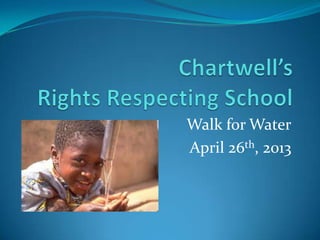
Walk for Water
April 26th, 2013
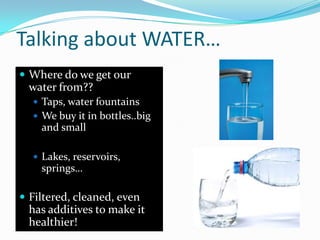
Talking about WATER…
 Where do we get our
water from??
 Taps, water fountains
 We buy it in bottles..big
and small
 Lakes, reservoirs,
springs…
 Filtered, cleaned, even
has additives to make it
healthier!
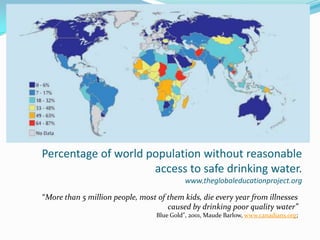
Percentage of world population without reasonable
access to safe drinking water.
www.theglobaleducationproject.org
“More than 5 million people, most of them kids, die every year from illnesses
caused by drinking poor quality water”
Blue Gold", 2001, Maude Barlow, www.canadians.org;
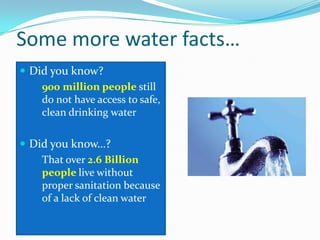
Some more water facts…
 Did you know?
 900 million people still
do not have access to safe,
clean drinking water
 Did you know…?
 That over 2.6 Billion
people live without
proper sanitation because
of a lack of clean water
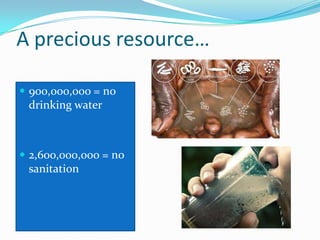
A precious resource…
 900,000,000 = no
drinking water
 2,600,000,000 = no
sanitation
Some help from kids…
 18.5 L = 18.5 Kg
 18.5 KG = 40.785 lbs
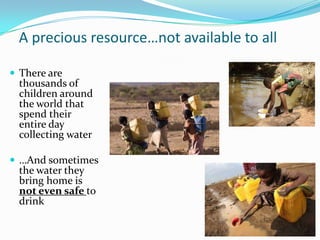
A precious resource…not available to all
 There are
thousands of
children around
the world that
spend their
entire day
collecting water
 …And sometimes
the water they
bring home is
not even safe to
drink
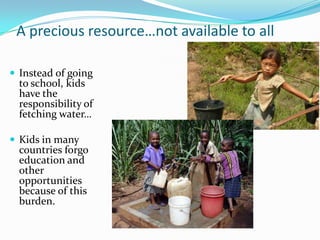
A precious resource…not available to all
 Instead of going
to school, kids
have the
responsibility of
fetching water…
 Kids in many
countries forgo
education and
other
opportunities
because of this
burden.
A precious resource…
 Let’s think about how
other people get their
water?
 How do we get our
water?
 Is it clean or dirty?
 Do we walk far to get it?
Sharing the Story of Solange…
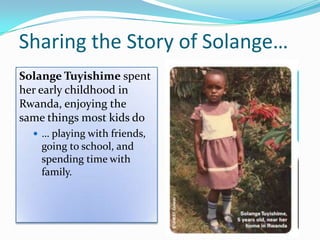
Solange Tuyishime spent
her early childhood in
Rwanda, enjoying the
same things most kids do
 … playing with friends,
going to school, and
spending time with
family.
Sharing the Story of Solange…
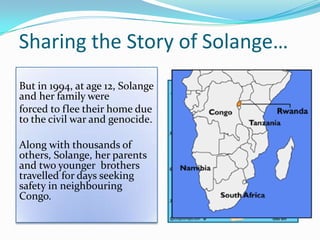
But in 1994, at age 12, Solange
and her family were
forced to flee their home due
to the civil war and genocide.
Along with thousands of
others, Solange, her parents
and two younger brothers
travelled for days seeking
safety in neighbouring
Congo.
Sharing the Story of Solange…
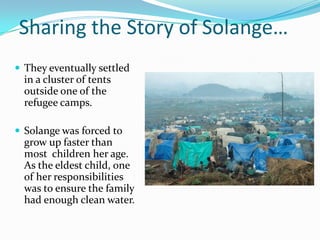
 They eventually settled
in a cluster of tents
outside one of the
refugee camps.
 Solange was forced to
grow up faster than
most children her age.
As the eldest child, one
of her responsibilities
was to ensure the family
had enough clean water.
Sharing the Story of Solange…
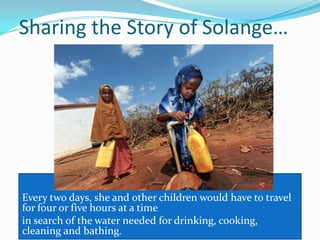
Every two days, she and other children would have to travel
for four or five hours at a time
in search of the water needed for drinking, cooking,
cleaning and bathing.
Sharing the Story of Solange…
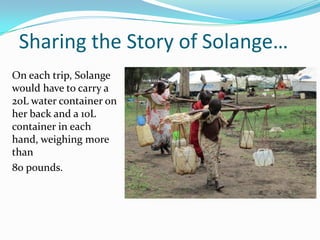
On each trip, Solange
would have to carry a
20L water container on
her back and a 10L
container in each
hand, weighing more
than
80 pounds.
Sharing the Story of Solange…
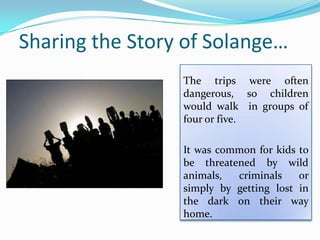
The trips were often
dangerous, so children
would walk in groups of
four or five.
It was common for kids to
be threatened by wild
animals, criminals or
simply by getting lost in
the dark on their way
home.
How UNICEF helped Solange…
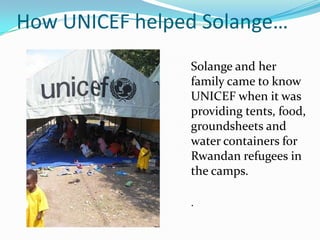
Solange and her
family came to know
UNICEF when it was
providing tents, food,
groundsheets and
water containers for
Rwandan refugees in
the camps.
.
How UNICEF helped Solange…
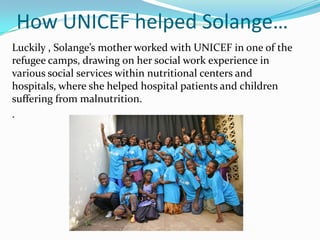
Luckily , Solange’s mother worked with UNICEF in one of the
refugee camps, drawing on her social work experience in
various social services within nutritional centers and
hospitals, where she helped hospital patients and children
suffering from malnutrition.
.
How UNICEF helped Solange…
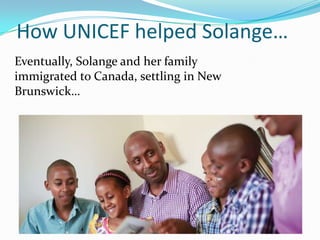
Eventually, Solange and her family
immigrated to Canada, settling in New
Brunswick…
How UNICEF helped Solange…
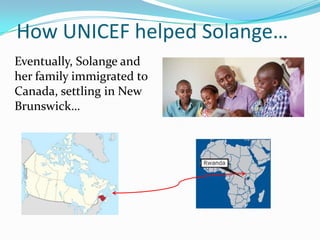
Eventually, Solange and
her family immigrated to
Canada, settling in New
Brunswick…
Solange Tuyshime: UNICEF Canada
Ambassador
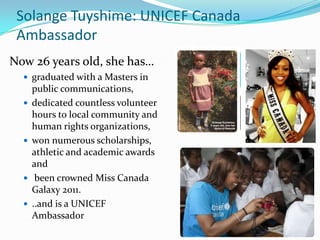
Now 26 years old, she has…
 graduated with a Masters in
public communications,
 dedicated countless volunteer
hours to local community and
human rights organizations,
 won numerous scholarships,
athletic and academic awards
and
 been crowned Miss Canada
Galaxy 2011.
 ..and is a UNICEF
Ambassador
Sharing the Story of Solange…
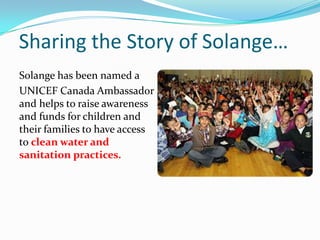
Solange has been named a
UNICEF Canada Ambassador
and helps to raise awareness
and funds for children and
their families to have access
to clean water and
sanitation practices.
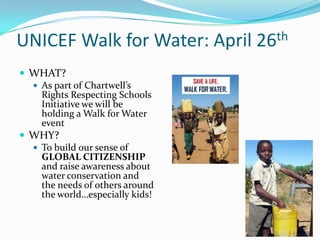
UNICEF Walk for Water: April 26th
 WHAT?
 As part of Chartwell’s
Rights Respecting Schools
Initiative we will be
holding a Walk for Water
event
 WHY?
 To build our sense of
GLOBAL CITIZENSHIP
and raise awareness about
water conservation and
the needs of others around
the world…especially kids!
UNICEF Walk for Water: April 26th
 WHEN?
 Kick Off Assembly on
Monday April 5th
 Fundraising Campaign April
5th – April 24th
 Walk for Water April 26th
 WHO?
 SAC members will work to
raise awareness and
GENERATE momentum
 STUDENTS will build their
awareness and collect
sponsors for their walk
UNICEF Walk for Water: April 26th
TO DO:
1) Donation of 5 dollars
per family;
2) Seek out further
sponsors; family friends,
neighbours, relatives, etc.
for a dollar to sponsor
your Walk for Water
3) bring a 4L milk jug
from home
UNICEF Walk for Water: April 26th
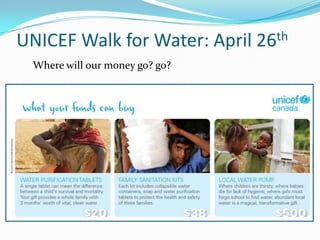
Where will our money go? go?
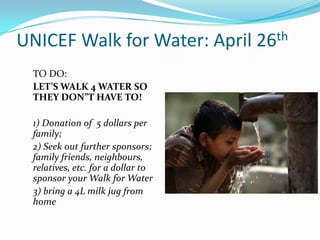
UNICEF Walk for Water: April 26th
TO DO:
LET’S WALK 4 WATER SO
THEY DON”T HAVE TO!
1) Donation of 5 dollars per
family;
2) Seek out further sponsors;
family friends, neighbours,
relatives, etc. for a dollar to
sponsor your Walk for Water
3) bring a 4L milk jug from
home

Unicef walk for water

  • 1.
  • 2.
    Talking about WATER… Where do we get our water from??  Taps, water fountains  We buy it in bottles..big and small  Lakes, reservoirs, springs…  Filtered, cleaned, even has additives to make it healthier!
  • 3.
    Percentage of worldpopulation without reasonable access to safe drinking water. www.theglobaleducationproject.org “More than 5 million people, most of them kids, die every year from illnesses caused by drinking poor quality water” Blue Gold", 2001, Maude Barlow, www.canadians.org;
  • 4.
    Some more waterfacts…  Did you know?  900 million people still do not have access to safe, clean drinking water  Did you know…?  That over 2.6 Billion people live without proper sanitation because of a lack of clean water
  • 5.
    A precious resource… 900,000,000 = no drinking water  2,600,000,000 = no sanitation
  • 6.
    Some help fromkids…  18.5 L = 18.5 Kg  18.5 KG = 40.785 lbs
  • 7.
    A precious resource…notavailable to all  There are thousands of children around the world that spend their entire day collecting water  …And sometimes the water they bring home is not even safe to drink
  • 8.
    A precious resource…notavailable to all  Instead of going to school, kids have the responsibility of fetching water…  Kids in many countries forgo education and other opportunities because of this burden.
  • 9.
    A precious resource… Let’s think about how other people get their water?  How do we get our water?  Is it clean or dirty?  Do we walk far to get it?
  • 10.
    Sharing the Storyof Solange… Solange Tuyishime spent her early childhood in Rwanda, enjoying the same things most kids do  … playing with friends, going to school, and spending time with family.
  • 11.
    Sharing the Storyof Solange… But in 1994, at age 12, Solange and her family were forced to flee their home due to the civil war and genocide. Along with thousands of others, Solange, her parents and two younger brothers travelled for days seeking safety in neighbouring Congo.
  • 12.
    Sharing the Storyof Solange…  They eventually settled in a cluster of tents outside one of the refugee camps.  Solange was forced to grow up faster than most children her age. As the eldest child, one of her responsibilities was to ensure the family had enough clean water.
  • 13.
    Sharing the Storyof Solange… Every two days, she and other children would have to travel for four or five hours at a time in search of the water needed for drinking, cooking, cleaning and bathing.
  • 14.
    Sharing the Storyof Solange… On each trip, Solange would have to carry a 20L water container on her back and a 10L container in each hand, weighing more than 80 pounds.
  • 15.
    Sharing the Storyof Solange… The trips were often dangerous, so children would walk in groups of four or five. It was common for kids to be threatened by wild animals, criminals or simply by getting lost in the dark on their way home.
  • 16.
    How UNICEF helpedSolange… Solange and her family came to know UNICEF when it was providing tents, food, groundsheets and water containers for Rwandan refugees in the camps. .
  • 17.
    How UNICEF helpedSolange… Luckily , Solange’s mother worked with UNICEF in one of the refugee camps, drawing on her social work experience in various social services within nutritional centers and hospitals, where she helped hospital patients and children suffering from malnutrition. .
  • 18.
    How UNICEF helpedSolange… Eventually, Solange and her family immigrated to Canada, settling in New Brunswick…
  • 19.
    How UNICEF helpedSolange… Eventually, Solange and her family immigrated to Canada, settling in New Brunswick…
  • 20.
    Solange Tuyshime: UNICEFCanada Ambassador Now 26 years old, she has…  graduated with a Masters in public communications,  dedicated countless volunteer hours to local community and human rights organizations,  won numerous scholarships, athletic and academic awards and  been crowned Miss Canada Galaxy 2011.  ..and is a UNICEF Ambassador
  • 21.
    Sharing the Storyof Solange… Solange has been named a UNICEF Canada Ambassador and helps to raise awareness and funds for children and their families to have access to clean water and sanitation practices.
  • 22.
    UNICEF Walk forWater: April 26th  WHAT?  As part of Chartwell’s Rights Respecting Schools Initiative we will be holding a Walk for Water event  WHY?  To build our sense of GLOBAL CITIZENSHIP and raise awareness about water conservation and the needs of others around the world…especially kids!
  • 23.
    UNICEF Walk forWater: April 26th  WHEN?  Kick Off Assembly on Monday April 5th  Fundraising Campaign April 5th – April 24th  Walk for Water April 26th  WHO?  SAC members will work to raise awareness and GENERATE momentum  STUDENTS will build their awareness and collect sponsors for their walk
  • 24.
    UNICEF Walk forWater: April 26th TO DO: 1) Donation of 5 dollars per family; 2) Seek out further sponsors; family friends, neighbours, relatives, etc. for a dollar to sponsor your Walk for Water 3) bring a 4L milk jug from home
  • 25.
    UNICEF Walk forWater: April 26th Where will our money go? go?
  • 26.
    UNICEF Walk forWater: April 26th TO DO: LET’S WALK 4 WATER SO THEY DON”T HAVE TO! 1) Donation of 5 dollars per family; 2) Seek out further sponsors; family friends, neighbours, relatives, etc. for a dollar to sponsor your Walk for Water 3) bring a 4L milk jug from home