UNEMPLOYMENT
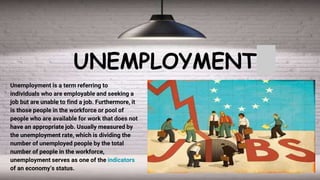
Unemployment is a term referring to
individuals who are employable and seeking a
job but are unable to find a job. Furthermore, it
is those people in the workforce or pool of
people who are available for work that does not
have an appropriate job. Usually measured by
the unemployment rate, which is dividing the
number of unemployed people by the total
number of people in the workforce,
unemployment serves as one of the indicators
of an economy’s status.
NSSO
NSSO stands for a national sample survey organization.
It is the organization under the ministry of statistics of the
government of India.
NSSO defines unemployment as a situation in which all
those who, owing to lack of work, are not working but
either seek work through employment exchanges,
intermediaries, friends or relatives or by making
applications to prospective employers or express their
willingness or availability for work under the prevailing
condition of work and remunerations
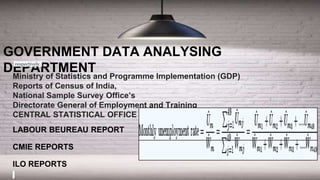
Ministry of Statistics and Programme Implementation (GDP)
Reports of Census of India,
National Sample Survey Office’s
Directorate General of Employment and Training
CENTRAL STATISTICAL OFFICE
LABOUR BEUREAU REPORT
CMIE REPORTS
ILO REPORTS
GOVERNMENT DATA ANALYSING
DEPARTMENT
respectively.
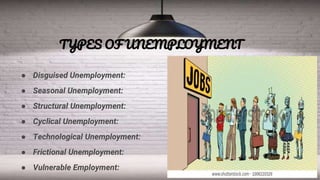
● Disguised Unemployment:
● Seasonal Unemployment:
● Structural Unemployment:
● Cyclical Unemployment:
● Technological Unemployment:
● Frictional Unemployment:
● Vulnerable Employment:
TYPES OF UNEMPLOYMENT
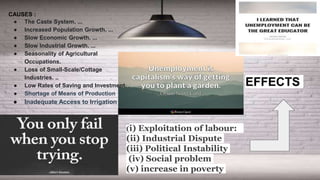
CAUSES :
● The Caste System. ...
● Increased Population Growth. ...
● Slow Economic Growth. ...
● Slow Industrial Growth. ...
● Seasonality of Agricultural
Occupations.
● Loss of Small-Scale/Cottage
Industries. ..
● Low Rates of Saving and Investment.
● Shortage of Means of Production
● Inadequate Access to Irrigation
(i) Exploitation of labour:
(ii) Industrial Dispute
(iii) Political Instability
(iv) Social problem
(v) increase in poverty
EFFECTS
Top 6 Strategies to Reduce Unemployment
1. Strategy 1# Use of Labour-intensive Technology:
2. Strategy 2# Accelerating Investment in Agriculture:
3. Strategy 3# Diversification of Agriculture:
4. Strategy 4# Labour-Intensive Industrial Growth:
5. Strategy 5# Services and Employment Growth:
6. Strategy 6# Education, Health and Employment
Generation:
Mahatma Gandhi National Rural Employment Guarantee Act 2005
Steps taken on Disguised
Unemployment
National Career Service
Scheme
National Rural Employment
Programme
Deen Dayal Antyodaya
Yojana
Unemployment policies are designed to
1. Improve skills / human capital to make people more flexible in the workplace
2. Provide stronger incentives to look for and accept work
3. Increase the occupational and geographical mobility of labour
4. Maintain a sufficiently high level of demand to create enough new jobs
5. Encourage entrepreneurship and innovation as a way of creating new products
and market demand which will generate new employment opportunities
Unemployment  nsso
Unemployment  nsso
Unemployment  nsso

Unemployment nsso

  • 2.
    UNEMPLOYMENT Unemployment is aterm referring to individuals who are employable and seeking a job but are unable to find a job. Furthermore, it is those people in the workforce or pool of people who are available for work that does not have an appropriate job. Usually measured by the unemployment rate, which is dividing the number of unemployed people by the total number of people in the workforce, unemployment serves as one of the indicators of an economy’s status.
  • 3.
    NSSO NSSO stands fora national sample survey organization. It is the organization under the ministry of statistics of the government of India. NSSO defines unemployment as a situation in which all those who, owing to lack of work, are not working but either seek work through employment exchanges, intermediaries, friends or relatives or by making applications to prospective employers or express their willingness or availability for work under the prevailing condition of work and remunerations
  • 4.
    Ministry of Statisticsand Programme Implementation (GDP) Reports of Census of India, National Sample Survey Office’s Directorate General of Employment and Training CENTRAL STATISTICAL OFFICE LABOUR BEUREAU REPORT CMIE REPORTS ILO REPORTS GOVERNMENT DATA ANALYSING DEPARTMENT respectively.
  • 5.
    ● Disguised Unemployment: ●Seasonal Unemployment: ● Structural Unemployment: ● Cyclical Unemployment: ● Technological Unemployment: ● Frictional Unemployment: ● Vulnerable Employment: TYPES OF UNEMPLOYMENT
  • 6.
    CAUSES : ● TheCaste System. ... ● Increased Population Growth. ... ● Slow Economic Growth. ... ● Slow Industrial Growth. ... ● Seasonality of Agricultural Occupations. ● Loss of Small-Scale/Cottage Industries. .. ● Low Rates of Saving and Investment. ● Shortage of Means of Production ● Inadequate Access to Irrigation (i) Exploitation of labour: (ii) Industrial Dispute (iii) Political Instability (iv) Social problem (v) increase in poverty EFFECTS
  • 7.
    Top 6 Strategiesto Reduce Unemployment 1. Strategy 1# Use of Labour-intensive Technology: 2. Strategy 2# Accelerating Investment in Agriculture: 3. Strategy 3# Diversification of Agriculture: 4. Strategy 4# Labour-Intensive Industrial Growth: 5. Strategy 5# Services and Employment Growth: 6. Strategy 6# Education, Health and Employment Generation:
  • 8.
    Mahatma Gandhi NationalRural Employment Guarantee Act 2005 Steps taken on Disguised Unemployment National Career Service Scheme National Rural Employment Programme Deen Dayal Antyodaya Yojana Unemployment policies are designed to 1. Improve skills / human capital to make people more flexible in the workplace 2. Provide stronger incentives to look for and accept work 3. Increase the occupational and geographical mobility of labour 4. Maintain a sufficiently high level of demand to create enough new jobs 5. Encourage entrepreneurship and innovation as a way of creating new products and market demand which will generate new employment opportunities