1
Reporters: Jude Vincent Dizon Ringon
and Kenneth James Jore Nillama
— Carl Jung
2
TIP
To keep the audience focused, always use the same
transition before a new topic
!
7
Verbal -words are your strongpoint. You prefer to use words both in
speech and in writing.
Visual - you prefer to use pictures, diagrams, images, and spatial
understanding to help you learn.
Musical/Auditory - you prefer using sounds or music or even
rhythms to help you learn.
Physical/Kinesthetic - you use your hands, body, and send of touch
to help you learn. You might 'act things out'.
8
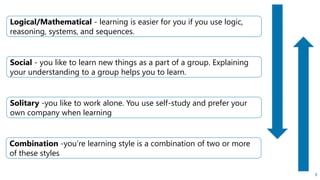
Logical/Mathematical - learning is easier for you if you use logic,
reasoning, systems, and sequences.
Social - you like to learn new things as a part of a group. Explaining
your understanding to a group helps you to learn.
Solitary -you like to work alone. You use self-study and prefer your
own company when learning
Combination -you’re learning style is a combination of two or more
of these styles
TIP
To keep the audience focused, always use the same
transition before a new topic
!
10
: Learner-centered
approaches value learners'
diverse backgrounds,
perspectives, and prior
knowledge, creating an
inclusive and non-
judgmental learning
environment.
1
11
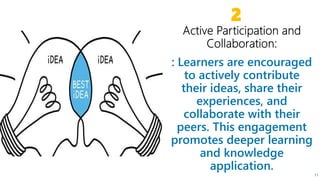
: Learners are encouraged
to actively contribute
their ideas, share their
experiences, and
collaborate with their
peers. This engagement
promotes deeper learning
and knowledge
application.
2
12
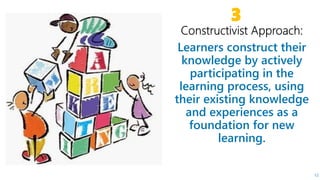
Learners construct their
knowledge by actively
participating in the
learning process, using
their existing knowledge
and experiences as a
foundation for new
learning.
3
13
Trainers design tasks that
are relevant to real-life
situations, enabling learners
to apply their learning to
practical scenarios. This
connection to real-world
applications enhances the
transferability of knowledge
and skills.
4
14
Ongoing assessment
allows trainers to monitor
learners' progress and
provide timely feedback.
This feedback informs
instructional adjustments
and helps tailor the
training to meet learners'
individual needs.
5
TIP
To keep the audience focused, always use the same
transition before a new topic
!
16 16
1
17 17
2
18 18
3
19 19
4
20 20
5
TIP
To keep the audience focused, always use the same
transition before a new topic
!
1
22
2
23
3
24
4
25
5
26
6
27
7
28
8
29
30
https://www.learnupon.com/blog/learner-
centered/#:~:text=What%20is%20a%20learner%2Dcentered,a
%20traditional%20instructor%2Dcentered%20approach
https://www.scribd.com/document/522939096/PROFTV02-
Chapter-8-Pretest
https://connect.springerpub.com/content/book/978-0-8261-
7718-6/part/part01/chapter/ch01
Neal Creative ©
THANK YOU FOR
LISTENING!!
Neal Creative | click & Learn more

UNDERSTANDING-LEARNER-CENTERED-APPROACHES-IN-TRAINERS-METHODOLOGY-1-ppt (1).pptx

Editor's Notes

  • #23 Combine an image and multiple key statements with a strong grid.
  • #24 Combine an image and multiple key statements with a strong grid.
  • #25 Combine an image and multiple key statements with a strong grid.
  • #26 Combine an image and multiple key statements with a strong grid.
  • #27 Combine an image and multiple key statements with a strong grid.
  • #28 Combine an image and multiple key statements with a strong grid.
  • #29 Combine an image and multiple key statements with a strong grid.
  • #30 Combine an image and multiple key statements with a strong grid.
  • #31 Combine an image and multiple key statements with a strong grid.