Understanding your options
   in book publishing
          Sarah O’Keefe
      Scriptorium Publishing
The traditional model

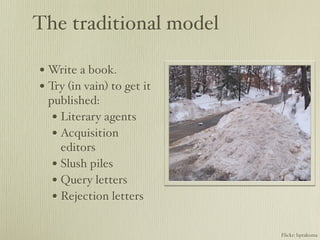
• Write a book.
• Try (in vain) to get it
 published:
  • Literary agents
  • Acquisition
    editors
  • Slush piles
  • Query letters
  • Rejection letters

                            Flickr: bptakoma
Traditional process

• Author provides
  manuscript
• Publisher provides:
   • Editorial
   • Production
   • Distribution
   • Marketing


                        Flickr: julia_manzerova
Vanity press

• Write a book.
• Pay someone to
  print it.
• Get your friends
  and family to buy it.


                          Flickr: dragonflyajt
The traditional publisher’s
business model
• Acquire certain hits.
• Make a pile of
  money on the hits.
• Subside the losers.
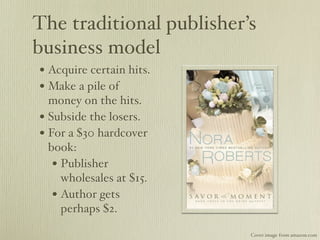
• For a $30 hardcover
  book:
   • Publisher
     wholesales at $15.
   • Author gets
     perhaps $2.

                          Cover image from amazon.com
Remainders are the industry’s
       dirty secret.
                           Flickr: daquellamanera
Distribution. The reason you
    need(ed) a publisher.
                               Flickr: ipalatin
The situation today…

• Traditional
  publishers are
  struggling.
• Self-publishing is
  viable.
• e-books are a big
  question mark.
• Nothing is certain.


                        Flickr: raindog
It’s a good time to be an
author.
• We have choices.
• Traditional publishing
• Go it alone with self-publishing.
• Or a hybrid model.
• e-books or print
Self-publishing options—
some examples
• Lulu and CreateSpace—if you think you can
    sell your book and just need someone to print
    and ship it.
•   Blurb—for coffee table books, especially one-
    off projects
•   Lightning Source and BookSurge—for small
    publishers who want distribution support.
Book publishing—the process

• Write (and write
  and revise and write
  again)
• Edit
• Produce
• Distribute
• Promote/market


                          Flickr: revdave
Writing

• Do it yourself.
• Hire a ghostwriter.
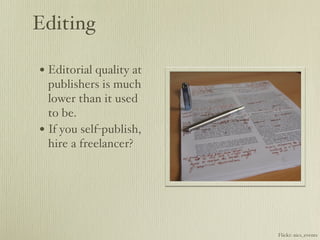
Editing

• Editorial quality at
  publishers is much
  lower than it used
  to be.
• If you self-publish,
  hire a freelancer?


                         Flickr: nics_events
Book production

• Print and print on
  demand
• PDF
• e-books: Kindle and
  ePub formats


                        Flickr: bootbearwdc
Distribution

• Distribution is (or
  was) the core value
  that publishers
  provided.
• Today, you can get
  your book
  distributed yourself.
• e-book distribution
  does not require
  physical media or
  transportation.
                          Flickr: bsuter
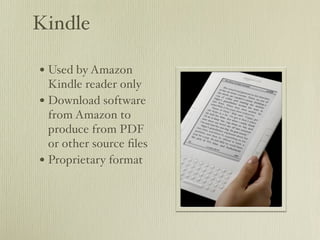
Kindle

• Used by Amazon
  Kindle reader only
• Download software
  from Amazon to
  produce from PDF
  or other source files
• Proprietary format
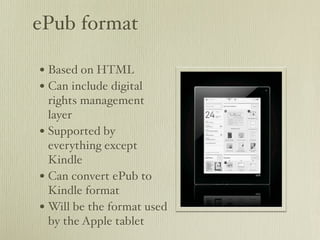
ePub format

• Based on HTML
• Can include digital
  rights management
  layer
• Supported by
  everything except
  Kindle
• Can convert ePub to
  Kindle format
• Will be the format used
  by the Apple tablet
Promotion

• Who is interested in your book?
   • Mass market?
   • Specialized audience?
• Find out how to reach your audience.
Self-publishing

• You take on all aspects of publishing process.
• Royalty rates are much higher than with a
    traditional publishing contract.
•   Risk is minimal because you can print on
    demand instead of creating huge inventory.
Digital rights management
(DRM)
• Protecting e-books from piracy, at least in
    theory
•   Book publishers are terrified of the music
    industry’s example
•   DRM is annoying and generally ineffective
Today’s hot issues

• Which e-book platform?
• Quality issues
• Publishing industry is built on the idea of the
 publisher as the middleman. The Internet
 affects industries with middlemen
 (disintermediation):
  • Travel agencies
  • Real estate
  • Car sales
  • Newspapers
  • Music
The future

• e-books will dominate.
• e-books will include
  new features that go
  beyond what paper
  offers.
• Barrier to entry to
  publishing will be
  lowered.
• Only publishers with a
  strong brand will
  survive.
                           Flickr: mgifford
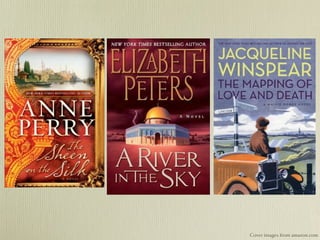
Cover images from amazon.com
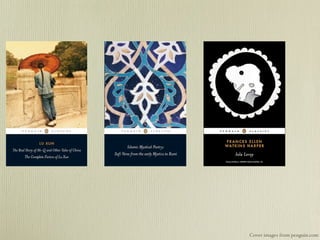
Cover images from penguin.com
Resources

• lulu.com
• blurb.com
• lightningsource.com
• createspace.com
• booksurge.com
• Check my blog for additional reading and links:
 sarahokeefe.wordpress.com

Understanding Your Options in Book Publishing

  • 1.
    Understanding your options in book publishing Sarah O’Keefe Scriptorium Publishing
  • 2.
    The traditional model •Write a book. • Try (in vain) to get it published: • Literary agents • Acquisition editors • Slush piles • Query letters • Rejection letters Flickr: bptakoma
  • 3.
    Traditional process • Authorprovides manuscript • Publisher provides: • Editorial • Production • Distribution • Marketing Flickr: julia_manzerova
  • 4.
    Vanity press • Writea book. • Pay someone to print it. • Get your friends and family to buy it. Flickr: dragonflyajt
  • 5.
    The traditional publisher’s businessmodel • Acquire certain hits. • Make a pile of money on the hits. • Subside the losers. • For a $30 hardcover book: • Publisher wholesales at $15. • Author gets perhaps $2. Cover image from amazon.com
  • 6.
    Remainders are theindustry’s dirty secret. Flickr: daquellamanera
  • 7.
    Distribution. The reasonyou need(ed) a publisher. Flickr: ipalatin
  • 8.
    The situation today… •Traditional publishers are struggling. • Self-publishing is viable. • e-books are a big question mark. • Nothing is certain. Flickr: raindog
  • 9.
    It’s a goodtime to be an author. • We have choices. • Traditional publishing • Go it alone with self-publishing. • Or a hybrid model. • e-books or print
  • 10.
    Self-publishing options— some examples •Lulu and CreateSpace—if you think you can sell your book and just need someone to print and ship it. • Blurb—for coffee table books, especially one- off projects • Lightning Source and BookSurge—for small publishers who want distribution support.
  • 11.
    Book publishing—the process •Write (and write and revise and write again) • Edit • Produce • Distribute • Promote/market Flickr: revdave
  • 12.
    Writing • Do ityourself. • Hire a ghostwriter.
  • 13.
    Editing • Editorial qualityat publishers is much lower than it used to be. • If you self-publish, hire a freelancer? Flickr: nics_events
  • 14.
    Book production • Printand print on demand • PDF • e-books: Kindle and ePub formats Flickr: bootbearwdc
  • 15.
    Distribution • Distribution is(or was) the core value that publishers provided. • Today, you can get your book distributed yourself. • e-book distribution does not require physical media or transportation. Flickr: bsuter
  • 16.
    Kindle • Used byAmazon Kindle reader only • Download software from Amazon to produce from PDF or other source files • Proprietary format
  • 17.
    ePub format • Basedon HTML • Can include digital rights management layer • Supported by everything except Kindle • Can convert ePub to Kindle format • Will be the format used by the Apple tablet
  • 18.
    Promotion • Who isinterested in your book? • Mass market? • Specialized audience? • Find out how to reach your audience.
  • 19.
    Self-publishing • You takeon all aspects of publishing process. • Royalty rates are much higher than with a traditional publishing contract. • Risk is minimal because you can print on demand instead of creating huge inventory.
  • 20.
    Digital rights management (DRM) •Protecting e-books from piracy, at least in theory • Book publishers are terrified of the music industry’s example • DRM is annoying and generally ineffective
  • 21.
    Today’s hot issues •Which e-book platform? • Quality issues • Publishing industry is built on the idea of the publisher as the middleman. The Internet affects industries with middlemen (disintermediation): • Travel agencies • Real estate • Car sales • Newspapers • Music
  • 22.
    The future • e-bookswill dominate. • e-books will include new features that go beyond what paper offers. • Barrier to entry to publishing will be lowered. • Only publishers with a strong brand will survive. Flickr: mgifford
  • 24.
  • 25.
    Cover images frompenguin.com
  • 26.
    Resources • lulu.com • blurb.com •lightningsource.com • createspace.com • booksurge.com • Check my blog for additional reading and links: sarahokeefe.wordpress.com

Editor's Notes

  • #2 * intros...what brings people there?
  • #3 slush pile -- the huge vat of unsolicited manuscripts that editors receive.
  • #5 show the various books I brought
  • #7 Books are sold on consignment. Bookseller can return unsold books to publisher for full credit. Those “bargain bins”? Authors get next to nothing when those sell. Books can be “stripped” (covers removed) and then destroyed instead of being returned to publisher. tons (literally) of books get pulped. HUGE amounts of books get returned because they are not sold. Book publisher is on the hook for these. As a result, leery of taking on new authors because of the very high likelihood that the book won’t sell and they’ll lose a pile of money. Understand that bookstores have very little risk in the traditional model.
  • #8 getting into 1000s of bookstores across the country is quite a difficult problem. But now, things are changing. * direct sales * Amazon distribution * print on demand * and especially, e-books
  • #9 more difficult than ever to get published. lulu and others make self-publishing possible.
  • #10 Several authors have self-published and then gotten nice hefty book contracts from a major publisher once the book gets some traction in the marketplace. The publishers are in a kerfluffle, but we as authors have options.
  • #13 probably not going to be any different if you self-publish vs. publish.
  • #14 publishers: provide an editor or ten self-publishing: you need to handle editing.
  • #15 publisher does this for you. Self-publishing...you have to do it yourself or get help. some technical hurdles here. Consider a book designer, especially for the cover. We DO judge books by their covers.
  • #16 One idea is to give away the e-book and charge for the printed book. Or, cheap e-books maybe a novella and then charge for the full novel? The sky is the limit. Include the e-book with print purchase?
  • #17 Yes, they did rip some books off the Kindle after people bought them. Ironically, this included George Orwell’s 1984.
  • #19 You have to do this whether you have a publisher or not.
  • #20 BUT...you have to write the book without an advance. Of course, you probably have to write the book before a mass-market publisher will look at it, too.
  • #21 piracy is easy. So make your books easy to buy and don’t wrap them in DRM -- that just makes them harder to buy. The only justification for DRM is when distribution of the content MUST be tracked, and the downsides of release exceed the upside. That is, classified government information.
  • #22 iPad or not? self-publishing has a lot of dreck. So, think about how to get your stuff out there and make people want it. reputation authority sample chapters?
  • #23 sorry, but paper is not compelling to the next generation, and distribution is a non-issue. Plus, there are possibilities with e-book that we don’t have with paper. just yesterday, a video from Penguin with interactive children’s books. Games built in. Use of iPad as a star chart to figure out what constellations you’re looking at. Kindle has dictionary built in.
  • #24 which of these evokes strong brand recognition? Who publishes John Grisham? J.K. Rowling?
  • #25 who is the brand here? the AUTHOR who publishes these authors? Do you know? second-strongest brand? NY Times! The publisher has abdicated; not even on the front cover. recommendation from the NY Times matters; but apparently, the publisher doesn’t.
  • #26 this is better. Also, not mass-market paperbacks.