UNPACKING THE
SELF
CHAPTER 2
I. Learning Objectives
1.Discuss the developmental aspect of the reproductive
system;
2.Describe the erogenous zones;
3.Explain human sexual behavior;
4.Characterize the diversity of sexual behavior; and
5.Describe sexually transmitted diseases; and
differentiate natural and artificial methods of
contraception.
Factors in the
Development of the
Physical Self
• The development of the individual is caused by two
interacting forces:
• Heredity (nature) is the transmission of traits or
characteristics from parents to offspring. It provides the
raw materials of which the individual is made up. Through
the genes, hereditary potentials like physical, mental,
social, emotional, and moral traits are passed down to
generations.
• Environment (nurture) is the sum total of the forces or
experiences that a person undergoes from conception to
old age. It also includes family, friends, school, nutrition,
and other agencies one is in contact with.
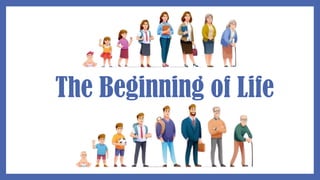
The Beginning of Life
LIFE BEGINS AT FERTILIZATION
Fertilization refers to the meeting of the female sex
cell and the male sex cell. These sex cells are
developed in the reproductive organs called gonads.
Gonads: Testes(male); Ovaries (female)
Gametes: Sperm cell(male); Egg cell(female)
The fertilized egg cell known as zygote contains all
the hereditary potentials from the parents. This
zygote goes to the uterus and continues to grow
during the gestation period of about 280 days or 36
weeks or 9 calendar months.
Marieb, E.N. (2001)
•Explains that the gonads (testes or ovaries)
begin to form until about eight week of
embryonic development. During the early
stages of human development, the
embryonic reproductive structures of males
and females are alike and are said to be in
the indifferent stage.
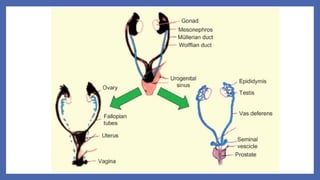
•The formation of male and female structures
depends on the presence of testosterone (primary
sex hormone: estrogen and progesterone, testosterone.)
•The embryonic testes release testosterone, and
the formation of the duct system and external
genitalia follows.
•In the case of female embryos that form ovaries,
it will cause the development of the female
ducts and external genitalia since testosterone
hormone is not produced.
MALE AND FEMALE
REPRODUCTIVE
ORGAN
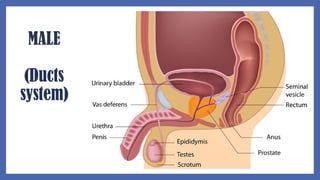
MALE
(Ducts
system)
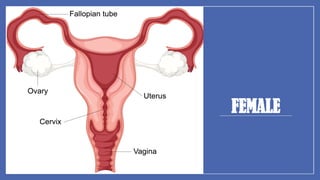
FEMALE
MENOPAUSE
•An entirely stop of ovulation and
menses, ending childbearing ability and
no longer experiencing menstruation in
females.
•There is no counterpart for menopause
in males. Healthy men are still able to
father offspring into their 80’s and
beyond.
STRANGE ABNORMALITIES:
•Gonads: Testes(male); Ovaries (female)
•Gametes: Sperm cell(male); Egg
cell(female)
I. PSEUDO HERMAPHRODITES- individuals
having accessory reproductive
structures that “do not match” their
gonads.
MALE PSEUDO
HERMAPHRODITISM
A genetic male develops the
female accessory structures in the
external genitalia because the
embryonic testes failed to
produce testosterone.
FEMALE PSEUDO
HERMAPHRODITISM
On the other hand, if a genetic
female is exposed to testosterone,
the embryo has ovaries but may
develop male accessory.
II. HERMAPHRODITES
The individuals who
possesses both ovarian and
testicular tissues, but this
condition is rare in nature.
PUBERTY
PUBERTY (10-15 years old)
•It is the period of life. When the
reproductive organ grow to their
adult size and become functional
under the influence of rising levels
of gonadal hormones.
CHANGES OCCURRING
DURING PUBERTY.
MALE
•Increase in the size of
reproductive organs
•Appearance of hair in pubic
area, axillary and face
FEMALE
•Budding of the breasts
•Menstrual period
•Ovulation and fertility
DISEASES ASSOCIATED WITH
THE REPRODUCTIVE SYSTEM
VAGINAL INFECTIONS (FEMALE)
1. Those usual infections include those caused by
“Escherichia Coli (E. Coli)” which spread through
digestive tract.
•In females, E. coli is a common cause of urinary tract
infections (UTIs). It can enter the urinary tract through
the urethra, leading to infections that may cause
symptoms like frequent urination, burning sensation
during urination, cloudy urine, and pelvic pain.
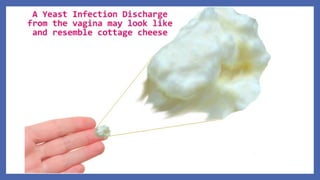
2. Yeast Infection (MALE AND FEMALE)
•Yeast is a vaginal infection is a
fungal infection that causes
irritation, discharge and intense
itchiness of the vagina and the vulva
(the tissues at the vaginal opening.)
Common
Inflammatory
Conditions
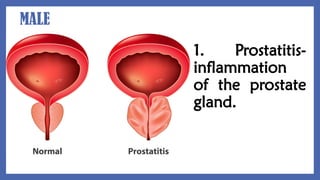
MALE
1. Prostatitis-
inflammation
of the prostate
gland.
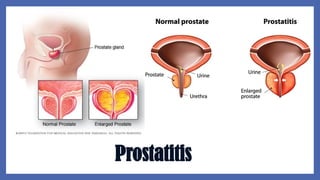
Prostatitis
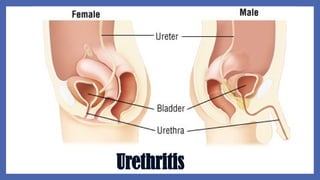
2. Urethritis- inflammation
of the urethra, the tube that
carries pee from the bladder out
of the body. (male and female)
Urethritis
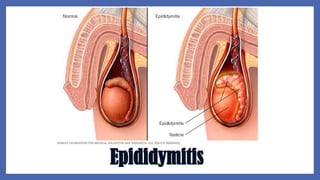
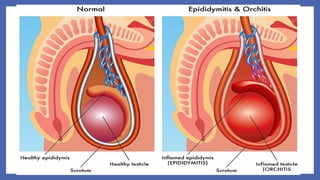
3. Epididymitis- inflammation
(swelling and irritation) of the
epididymis, a tube at the back of
the testicle that carries sperm.
4. Orchitis-is an inflammation
of one or both testicles.
Epididymitis
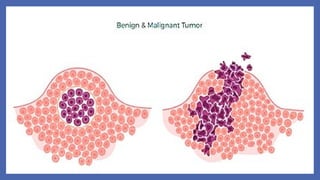
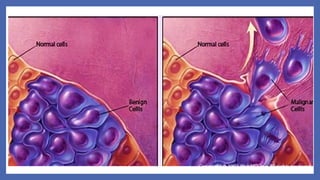
NEOPLASM
•An abnormal mass of tissue that forms
when cells grow and divide more than
they should or do not die when they
should. Neoplasms may be benign (not
cancer) or malignant (cancer). Benign
neoplasms may grow large but do not
spread into, or invade, nearby tissues or
other parts of the body.
IMPACT OF CULTURE IN
BODY IMAGE AND SELF-
ESTEEM
•The media, people around us, and
popular culture all influence our body
image. ... Seeing these images over and
over again is linked to poor body
image and feelings that our own bodies
are not okay. These feelings can affect
your child's self-esteem and negatively
affect their mental health and wellbeing.
•The culture in which we are surrounded
by, has a significant impact on how we
feel about ourselves and the manner in
which we think about our body. Many
cultural traditions also contribute to
body image and can influence either
negative or positive body image and
self-esteem.
•Culture is just one factor. While
culture alone is not responsible for a
poor or negative body image, the
influence and potential in which it
can impact how a person feels
about themselves and their body are
substantial.
Factors influenced one’s body image
and self-esteem.

•one's parents,
•peers,
•culture/media; or
•one's past experiences.
THE IMPORTANCE OF
BEAUTY
•Beauty is the manifestation of love
in form.
•Physical attractiveness may be so
important to us because we
associate other positive qualities
with a pleasing appearance.
UNDERSTANDING THE SELF-- - lesson 3.pptx

UNDERSTANDING THE SELF-- - lesson 3.pptx

  • 1.
  • 3.
    I. Learning Objectives 1.Discussthe developmental aspect of the reproductive system; 2.Describe the erogenous zones; 3.Explain human sexual behavior; 4.Characterize the diversity of sexual behavior; and 5.Describe sexually transmitted diseases; and differentiate natural and artificial methods of contraception.
  • 4.
    Factors in the Developmentof the Physical Self
  • 5.
    • The developmentof the individual is caused by two interacting forces: • Heredity (nature) is the transmission of traits or characteristics from parents to offspring. It provides the raw materials of which the individual is made up. Through the genes, hereditary potentials like physical, mental, social, emotional, and moral traits are passed down to generations. • Environment (nurture) is the sum total of the forces or experiences that a person undergoes from conception to old age. It also includes family, friends, school, nutrition, and other agencies one is in contact with.
  • 6.
  • 7.
    LIFE BEGINS ATFERTILIZATION Fertilization refers to the meeting of the female sex cell and the male sex cell. These sex cells are developed in the reproductive organs called gonads. Gonads: Testes(male); Ovaries (female) Gametes: Sperm cell(male); Egg cell(female) The fertilized egg cell known as zygote contains all the hereditary potentials from the parents. This zygote goes to the uterus and continues to grow during the gestation period of about 280 days or 36 weeks or 9 calendar months.
  • 8.
    Marieb, E.N. (2001) •Explainsthat the gonads (testes or ovaries) begin to form until about eight week of embryonic development. During the early stages of human development, the embryonic reproductive structures of males and females are alike and are said to be in the indifferent stage.
  • 9.
    •The formation ofmale and female structures depends on the presence of testosterone (primary sex hormone: estrogen and progesterone, testosterone.) •The embryonic testes release testosterone, and the formation of the duct system and external genitalia follows. •In the case of female embryos that form ovaries, it will cause the development of the female ducts and external genitalia since testosterone hormone is not produced.
  • 10.
  • 11.
  • 12.
  • 17.
    MENOPAUSE •An entirely stopof ovulation and menses, ending childbearing ability and no longer experiencing menstruation in females. •There is no counterpart for menopause in males. Healthy men are still able to father offspring into their 80’s and beyond.
  • 18.
    STRANGE ABNORMALITIES: •Gonads: Testes(male);Ovaries (female) •Gametes: Sperm cell(male); Egg cell(female) I. PSEUDO HERMAPHRODITES- individuals having accessory reproductive structures that “do not match” their gonads.
  • 19.
    MALE PSEUDO HERMAPHRODITISM A geneticmale develops the female accessory structures in the external genitalia because the embryonic testes failed to produce testosterone.
  • 20.
    FEMALE PSEUDO HERMAPHRODITISM On theother hand, if a genetic female is exposed to testosterone, the embryo has ovaries but may develop male accessory.
  • 21.
    II. HERMAPHRODITES The individualswho possesses both ovarian and testicular tissues, but this condition is rare in nature.
  • 23.
  • 24.
    PUBERTY (10-15 yearsold) •It is the period of life. When the reproductive organ grow to their adult size and become functional under the influence of rising levels of gonadal hormones.
  • 25.
  • 26.
    MALE •Increase in thesize of reproductive organs •Appearance of hair in pubic area, axillary and face
  • 27.
    FEMALE •Budding of thebreasts •Menstrual period •Ovulation and fertility
  • 28.
    DISEASES ASSOCIATED WITH THEREPRODUCTIVE SYSTEM
  • 29.
    VAGINAL INFECTIONS (FEMALE) 1.Those usual infections include those caused by “Escherichia Coli (E. Coli)” which spread through digestive tract. •In females, E. coli is a common cause of urinary tract infections (UTIs). It can enter the urinary tract through the urethra, leading to infections that may cause symptoms like frequent urination, burning sensation during urination, cloudy urine, and pelvic pain.
  • 30.
    2. Yeast Infection(MALE AND FEMALE) •Yeast is a vaginal infection is a fungal infection that causes irritation, discharge and intense itchiness of the vagina and the vulva (the tissues at the vaginal opening.)
  • 32.
  • 33.
  • 34.
  • 35.
    2. Urethritis- inflammation ofthe urethra, the tube that carries pee from the bladder out of the body. (male and female)
  • 36.
  • 37.
    3. Epididymitis- inflammation (swellingand irritation) of the epididymis, a tube at the back of the testicle that carries sperm. 4. Orchitis-is an inflammation of one or both testicles.
  • 38.
  • 40.
    NEOPLASM •An abnormal massof tissue that forms when cells grow and divide more than they should or do not die when they should. Neoplasms may be benign (not cancer) or malignant (cancer). Benign neoplasms may grow large but do not spread into, or invade, nearby tissues or other parts of the body.
  • 43.
    IMPACT OF CULTUREIN BODY IMAGE AND SELF- ESTEEM
  • 44.
    •The media, peoplearound us, and popular culture all influence our body image. ... Seeing these images over and over again is linked to poor body image and feelings that our own bodies are not okay. These feelings can affect your child's self-esteem and negatively affect their mental health and wellbeing.
  • 45.
    •The culture inwhich we are surrounded by, has a significant impact on how we feel about ourselves and the manner in which we think about our body. Many cultural traditions also contribute to body image and can influence either negative or positive body image and self-esteem.

  • 46.
    •Culture is justone factor. While culture alone is not responsible for a poor or negative body image, the influence and potential in which it can impact how a person feels about themselves and their body are substantial.
  • 47.
    Factors influenced one’sbody image and self-esteem. •one's parents, •peers, •culture/media; or •one's past experiences.
  • 48.
  • 49.
    •Beauty is themanifestation of love in form. •Physical attractiveness may be so important to us because we associate other positive qualities with a pleasing appearance.
Editor's Notes

  • #7 Sex cell- egg cell and sperm cell Deoxyribonucleic acid-DNA-contain genes (katangian) inherited
  • #11 Bladder- serves as the reservoir and a storage of urine Testes- responsible for making sperm and are also involved in producing a hormone called testosterone. Prostate Gland- surrounds your urethra. Your seminal vesicle and prostate gland make fluid that combined with sperm cells to create semen. Epididymis- Store the sperm for maturation and transport it to vas deferens Vas Deferens- transports mature sperm to the urethra in preparation for ejaculation. Duct system- passageway of sperm or any fluids from reproductive system Scrotum-protects the testes
  • #12 Ovary- produce eggs for fertilization and they make the hormones estrogen and progesterone. Fallopian Tube- collect the mature egg cell from ovaries and provide passage to the fertilized ovum to reach the uterus for implantation. Uterus- nurtures the fertilized ovum The ovum then implants into the endometrium (uterus lining) that allows egg to get nutrients from the blood vessels. Cervix- allows fluids, such as menstrual blood, to pass from the uterus into the vagina
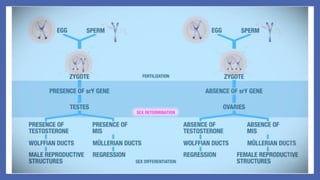
  • #14 Sex determination is therefore based on the presence of the absence of a Y chromosome and the srY gene Sex determination sets the stage for sex differentiation. The embryo possesses both rudimentary(undeveloped) structures called Wolffian (male) and Mullerian (female) Ducts. This development structure depends on the presence or absence of: Testosterone and Mullerian inhibiting substance (MIS-preventing the development of female reproductive organs in males) (2 hormones are produced by testes) Testosterone will act on the Wolffian ducts to promote the development of male reproductive structures MIS will act on Mullerian ducts to prevent the development of female organs. Thus, the presence of two hormones will cause the fetus to develop male organs
  • #15 Sex determination is therefore based on the presence of the absence of a Y chromosome and the srY gene Sex determination sets the stage for sex differentiation. The embryo possesses both rudimentary(undeveloped) structures called Wolffian (male) and Mullerian (female) Ducts. This development structure depends on the presence or absence of: Testosterone and Mullerian Inhibiting Substance (MIS-preventing the development of female reproductive organs in males) (2 hormones are produced by testes) Testosterone will act on the Wolffian ducts to promote the development of male reproductive structures MIS will act on Mullerian ducts to prevent the development of female organs. Thus, the presence of two hormones will cause the fetus to develop male organs
  • #16 Sex determination is therefore based on the presence of the absence of a Y chromosome and the srY gene Sex determination sets the stage for sex differentiation. The embryo possesses both rudimentary(undeveloped) structures called Wolffian (male) and Mullerian (female) Ducts. This development structure depends on the presence or absence of: Testosterone and Mullerian Inhibiting Substance (MIS-preventing the development of female reproductive organs in males) (2 hormones are produced by testes) Testosterone will act on the Wolffian ducts to promote the development of male reproductive structures MIS will act on Mullerian ducts to prevent the development of female organs. Thus, the presence of two hormones will cause the fetus to develop male organs
  • #18 23 pairs of chromosomes XY-male XX- female A hormone called Androgens are considered "male hormones," they are present in both males and females, but typically in higher levels in males. The most well-known androgen is testosterone During puberty in males, androgens stimulate the development of secondary sexual characteristics, such as: Growth of facial and body hair Deepening of the voice Enlargement of the penis and testes Increased muscle mass
  • #19 Male pseudohermaphrodites: 46,XY (23 pairs) chromosomes but ambiguous or female-like genitalia due to androgen-related issues. Genetically male pero ang genitalia ay pambabae
  • #20 Female pseudohermaphrodites: 46,XX chromosomes but ambiguous or male-like genitalia due to excess androgens. Gynecomastia (guy-nuh-koh-MAS-tee-uh) is an increase in the amount of breast gland tissue in boys or men, caused by an imbalance of the hormones estrogen and testosterone.
  • #29 eh·shr·i·kee·uh
  • #30 Treatment: antibiotic
  • #33 Function of prostate gland- The prostate's primary function is to produce the fluid that nourishes and transports sperm (seminal fluid). Causes: Bacteria. Contributing factor: stress, lifestyle, hormonal changes Treatment for prostatitis varies depending on the type and cause. Antibiotics Long term antibiotics Pain reliever Physical therapy Lifestyle change
  • #34 Not a cancer Prostatitis: Involves inflammation; Prostate Cancer: Refers to the uncontrolled growth of cancerous cells in the prostate gland. How to know if you have prostate cancer or prostatitis? Various other medical tests, such as blood tests, ultrasound, and biopsies
  • #35 Infectious Causes: Bacterial Infections, urinary tract infections (UTIs), Viral Infections: Herpes simplex virus (HSV), Non-Infectious Causes: Irritation or Injury: Caused by Sexual activity or trauma Use of certain products (e.g., soaps, lotions, spermicides) Chemical Irritants: Exposure to irritants such as soaps, lotions, or feminine hygiene products.
  • #37 Epididymitis are caused by bacterial infection from a urinary tract infection or a sexually transmissible infection (STI) such as gonorrhoea or chlamydia. Treatment options include antibiotics and bed rest. Orchitis treatment: Viral Orchitis: Rest: Allowing the body to heal. Bacterial Orchitis: Antibiotics: If caused by a bacterial infection Non-Infectious Orchitis: Rest and Pain Management