The Relationship
Between Language
and Religion
What is Language?
• Language is the most powerful means of communication,
vehicle of expression of cultural values and aspirations
and instrument of conserving culture. As such language is
an important means to acquire and preserve the identity of a
particular group or community.
• Among the various cultural symbols – religion, race, language,
traditions and customs, etc. that differentiate one ethnic group
from the other, language is the most potent cultural marker
providing for group identity. Its spatial spread over a fixed
territory makes language more important than religion as a
basis of ethnic identity formation.
What is Religion?
Religion is what people believe about God
or gods. It's about how we think the world
was made and how we should live.
Different religions have different ideas and
ways of doing things. People often go to
special places like churches or temples for
their religion.
CHARACTERISTICS OF RELIGION
1.A belief in anthropomorphic
supernatural being, such as spirit
and Gods.
2.A focus on the sacred supernatural,
where sacred refers to a feeling of
reverence and awe.
3. The presence of the supernatural power
or energy that is found on supernatural
beings as well as physical beings and
objects.
4. The performance of the ritual activities
that involves the manipulation of sacred
object to communicate to supernatural
beings and/or to influence or control
events.
5. The articulation of worldview and moral
codes through narratives and other means.
6. Provide the creation and maintenance of
social bonds and mechanism of social
control within a community; provide
explanation for unknown and a sense of
control for individuals.
 RITUAL
• The performance of ceremonial
acts prescribed by a tradition or
sacred law. It is thus possible to
view ritual as a way of defining or
describing humans.
The Role of Religion in Society
1.Religion’s Influence on Society
1. Religion deeply impacts society and culture,
functioning as a social matter that affects
communities, not just individuals.
2.Community Response to the Sacred
1. Religion is often a community's response to what
it considers sacred, expressed through shared
beliefs, prayers, rituals, and codes of conduct.
The Role of Religion in Society
3. Belief in an Unconditioned Reality
Most people believe in an infinite, absolute reality that
is beyond human understanding, which goes by various
names (e.g., God, Allah, Tao, Brahman).
4. Cultural and Historical Origins of Religions
Religions arise from specific historical and cultural
contexts and have unique histories and perspectives,
much like languages.
The Role of Religion in Society
5. Religion and Language Parallels
Just as languages evolve with culture, religions also change
over time and can be imposed by dominant cultures or powers.
6. Misunderstanding and Division
Differences in religious beliefs can lead to
misunderstanding or prejudice, similar to language barriers, which
may result in exclusion or distrust.
7. Challenges of Understanding
Lack of understanding can amplify differences, making it harder
for communities to bridge gaps between religious perspectives.
How are Language and Religion Connected?
Language and religion are like good friends. They often work
together. Many religions use special words or languages. For example,
some Muslims use Arabic for prayers, even if they speak a different
language at home.
There is another more dangerous, way in which religions are like
languages. Just as speakers of one language often misunderstand speakers
of another language, followers of one religion may find another one
comical or grotesque. Similarly, as people who speak one language may
exclude people who do not, followers of one religion may use religious
differences as a reason to dislike or distrust followers of another religion
(Harris, 2013). Thus, our inability to understand one another may magnify
our differences.
Languages in Different Religions
• Language has been one of the main means to
portray a religion. Of course other means such as
religious customs, symbols and chants have been
used. However for a religion to survive among the
coming generations, it has to be communicated and
this is where language plays its role. Here the
researcher will discuss four main religions and the
use of language in the respective religions.
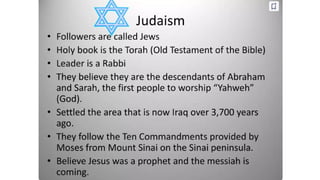
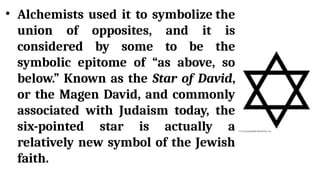
• Alchemists used it to symbolize the
union of opposites, and it is
considered by some to be the
symbolic epitome of “as above, so
below.” Known as the Star of David,
or the Magen David, and commonly
associated with Judaism today, the
six-pointed star is actually a
relatively new symbol of the Jewish
faith.
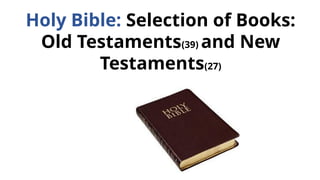
Holy Bible: Selection of Books:
Old Testaments(39) and New
Testaments(27)
CUSTOMS
AND
PRACTICES
1. HOLY BAPTISM
• Symbolizes the birth in Christian World.
Baptism is literally and symbolically not
only cleansing, but also dying and rising
again with Christ. Catholics believe
baptism is necessary to cleanse the taint of
original sin, and so commonly baptize
infants.
• It is an act of remembrance of
Jesus Christ’s sacrificial love.
First Communion is a ceremony
in some Christian traditions
during which a person first
receives the Eucharist.
1. HOLY COMMUNION
3. CHRISTMAS
• It is usually on December 25 of every
year , commemorates the birth of
Christ.
• the Filipino Christmas is more
centered on Jesus than on Santa Claus.
4. EASTER
• Also known as resurrection Sunday,
celebrates the resurrection of Jesus
Christ.
• Easter Egg- Eggs in particular are a clear
symbol of rebirth and fertility. So it may
not seem surprising that Easter eggs are
often associated with Easter.
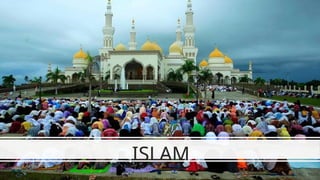
ISLAM
• Allah is their “One God”
• They believed that Mohammed
was God’s last prophet (Born in
Meccas 570 CE) and received
revelations from God through the
Angel Gabriel.
• QURAN- Holy Book of Islam
CUSTOMS
AND
PRACTICES
5 Pillars of Islam:
1.Shahadah- statement of faith: “There is
no God but the one true God and
Mohammed is His Messenger”
2.Salat- the prayer that is Practiced 5 times.
3.Zakat- monetary offering for the poor. It
comprises the 2.5% of a Muslim’s
assets.
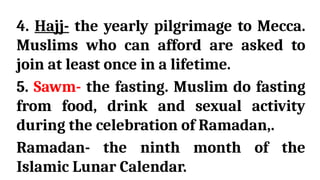
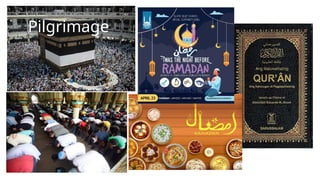
4. Hajj- the yearly pilgrimage to Mecca.
Muslims who can afford are asked to
join at least once in a lifetime.
5. Sawm- the fasting. Muslim do fasting
from food, drink and sexual activity
during the celebration of Ramadan,.
Ramadan- the ninth month of the
Islamic Lunar Calendar.
2 Major Festivals
• Eidul-Fitr- the celebration of
the end of Ramadan or fasting
• Eidul- Adha- celebrated within
the completion of the
pilgrimage, the Hajj.
Pilgrimage
Languages in
Different Religions
• In Islam, the Arabic language holds a unique and sacred
status because it is the language in which the Qur'an, the
holy scripture of Islam, was revealed to Prophet
Muhammad (peace be upon him).
According to Syed Muhammad Naquib al-Attas,
"Islamized Arabic" is elevated because it serves as a medium
for divine revelation, which distinguishes it from other
languages that evolve due to cultural and traditional
influences. Al-Attas asserts that Islamic Arabic is perfected to
a superlative level, as it remains fixed and unchanged,
preserving the divine message's authenticity and integrity
over time.
• Sanskrit was historically the main language of
Hinduism, carrying Vedic knowledge for thousands of
years. Over time, regional languages like Hindi, Bengali,
and Tamil evolved from it, changing meanings while
staying linguistically related. As Hinduism spread to the
West, English became a prominent medium for
expressing its traditions, adapting ancient concepts to
modern contexts.As Hinduism expands in the West, the
emerging forms of ancient traditions are naturally being
reflected through the medium of Western languages, the most
prominent of which is English.
Languages in Different Religions
• In Christianity, Hebrew was the original
language as well as the holy language. It was
widespread in Jewish religious literature and is
widely believed by Orthodox Jews. Over time and
with the spread of Christianity, the lingua franca
became English. Ironically English is the most
widely used language in the world today.
Languages in Different Religions
• Islam: Uses Arabic for the Quran
• Christianity: Started with Hebrew, now uses
many languages
• Hinduism: Uses Sanskrit and other Indian
languages
Language in Religious Ceremonies
Religious ceremonies often use special
language:
• Special prayers
• Songs or chants
• Blessings
• Reading from holy books
Respecting Different Religious Languages
It's important to respect the languages used in
different religions, even if we don't understand
them. This shows we care about other people's
beliefs.
Language Bringing Religious People Together

Language-and-Religion--L5.pptx..........

  • 1.
  • 2.
    What is Language? •Language is the most powerful means of communication, vehicle of expression of cultural values and aspirations and instrument of conserving culture. As such language is an important means to acquire and preserve the identity of a particular group or community. • Among the various cultural symbols – religion, race, language, traditions and customs, etc. that differentiate one ethnic group from the other, language is the most potent cultural marker providing for group identity. Its spatial spread over a fixed territory makes language more important than religion as a basis of ethnic identity formation.
  • 3.
    What is Religion? Religionis what people believe about God or gods. It's about how we think the world was made and how we should live. Different religions have different ideas and ways of doing things. People often go to special places like churches or temples for their religion.
  • 4.
    CHARACTERISTICS OF RELIGION 1.Abelief in anthropomorphic supernatural being, such as spirit and Gods. 2.A focus on the sacred supernatural, where sacred refers to a feeling of reverence and awe.
  • 5.
    3. The presenceof the supernatural power or energy that is found on supernatural beings as well as physical beings and objects. 4. The performance of the ritual activities that involves the manipulation of sacred object to communicate to supernatural beings and/or to influence or control events.
  • 6.
    5. The articulationof worldview and moral codes through narratives and other means. 6. Provide the creation and maintenance of social bonds and mechanism of social control within a community; provide explanation for unknown and a sense of control for individuals.
  • 7.
     RITUAL • Theperformance of ceremonial acts prescribed by a tradition or sacred law. It is thus possible to view ritual as a way of defining or describing humans.
  • 8.
    The Role ofReligion in Society 1.Religion’s Influence on Society 1. Religion deeply impacts society and culture, functioning as a social matter that affects communities, not just individuals. 2.Community Response to the Sacred 1. Religion is often a community's response to what it considers sacred, expressed through shared beliefs, prayers, rituals, and codes of conduct.
  • 9.
    The Role ofReligion in Society 3. Belief in an Unconditioned Reality Most people believe in an infinite, absolute reality that is beyond human understanding, which goes by various names (e.g., God, Allah, Tao, Brahman). 4. Cultural and Historical Origins of Religions Religions arise from specific historical and cultural contexts and have unique histories and perspectives, much like languages.
  • 10.
    The Role ofReligion in Society 5. Religion and Language Parallels Just as languages evolve with culture, religions also change over time and can be imposed by dominant cultures or powers. 6. Misunderstanding and Division Differences in religious beliefs can lead to misunderstanding or prejudice, similar to language barriers, which may result in exclusion or distrust. 7. Challenges of Understanding Lack of understanding can amplify differences, making it harder for communities to bridge gaps between religious perspectives.
  • 11.
    How are Languageand Religion Connected? Language and religion are like good friends. They often work together. Many religions use special words or languages. For example, some Muslims use Arabic for prayers, even if they speak a different language at home. There is another more dangerous, way in which religions are like languages. Just as speakers of one language often misunderstand speakers of another language, followers of one religion may find another one comical or grotesque. Similarly, as people who speak one language may exclude people who do not, followers of one religion may use religious differences as a reason to dislike or distrust followers of another religion (Harris, 2013). Thus, our inability to understand one another may magnify our differences.
  • 12.
    Languages in DifferentReligions • Language has been one of the main means to portray a religion. Of course other means such as religious customs, symbols and chants have been used. However for a religion to survive among the coming generations, it has to be communicated and this is where language plays its role. Here the researcher will discuss four main religions and the use of language in the respective religions.
  • 16.
    • Alchemists usedit to symbolize the union of opposites, and it is considered by some to be the symbolic epitome of “as above, so below.” Known as the Star of David, or the Magen David, and commonly associated with Judaism today, the six-pointed star is actually a relatively new symbol of the Jewish faith.
  • 18.
    Holy Bible: Selectionof Books: Old Testaments(39) and New Testaments(27)
  • 19.
  • 20.
    1. HOLY BAPTISM •Symbolizes the birth in Christian World. Baptism is literally and symbolically not only cleansing, but also dying and rising again with Christ. Catholics believe baptism is necessary to cleanse the taint of original sin, and so commonly baptize infants.
  • 21.
    • It isan act of remembrance of Jesus Christ’s sacrificial love. First Communion is a ceremony in some Christian traditions during which a person first receives the Eucharist. 1. HOLY COMMUNION
  • 22.
    3. CHRISTMAS • Itis usually on December 25 of every year , commemorates the birth of Christ. • the Filipino Christmas is more centered on Jesus than on Santa Claus.
  • 23.
    4. EASTER • Alsoknown as resurrection Sunday, celebrates the resurrection of Jesus Christ. • Easter Egg- Eggs in particular are a clear symbol of rebirth and fertility. So it may not seem surprising that Easter eggs are often associated with Easter.
  • 24.
  • 25.
    • Allah istheir “One God” • They believed that Mohammed was God’s last prophet (Born in Meccas 570 CE) and received revelations from God through the Angel Gabriel. • QURAN- Holy Book of Islam
  • 26.
  • 27.
    5 Pillars ofIslam: 1.Shahadah- statement of faith: “There is no God but the one true God and Mohammed is His Messenger” 2.Salat- the prayer that is Practiced 5 times. 3.Zakat- monetary offering for the poor. It comprises the 2.5% of a Muslim’s assets.
  • 28.
    4. Hajj- theyearly pilgrimage to Mecca. Muslims who can afford are asked to join at least once in a lifetime. 5. Sawm- the fasting. Muslim do fasting from food, drink and sexual activity during the celebration of Ramadan,. Ramadan- the ninth month of the Islamic Lunar Calendar.
  • 29.
    2 Major Festivals •Eidul-Fitr- the celebration of the end of Ramadan or fasting • Eidul- Adha- celebrated within the completion of the pilgrimage, the Hajj.
  • 30.
  • 31.
  • 32.
    • In Islam,the Arabic language holds a unique and sacred status because it is the language in which the Qur'an, the holy scripture of Islam, was revealed to Prophet Muhammad (peace be upon him). According to Syed Muhammad Naquib al-Attas, "Islamized Arabic" is elevated because it serves as a medium for divine revelation, which distinguishes it from other languages that evolve due to cultural and traditional influences. Al-Attas asserts that Islamic Arabic is perfected to a superlative level, as it remains fixed and unchanged, preserving the divine message's authenticity and integrity over time.
  • 33.
    • Sanskrit washistorically the main language of Hinduism, carrying Vedic knowledge for thousands of years. Over time, regional languages like Hindi, Bengali, and Tamil evolved from it, changing meanings while staying linguistically related. As Hinduism spread to the West, English became a prominent medium for expressing its traditions, adapting ancient concepts to modern contexts.As Hinduism expands in the West, the emerging forms of ancient traditions are naturally being reflected through the medium of Western languages, the most prominent of which is English.
  • 34.
    Languages in DifferentReligions • In Christianity, Hebrew was the original language as well as the holy language. It was widespread in Jewish religious literature and is widely believed by Orthodox Jews. Over time and with the spread of Christianity, the lingua franca became English. Ironically English is the most widely used language in the world today.
  • 35.
    Languages in DifferentReligions • Islam: Uses Arabic for the Quran • Christianity: Started with Hebrew, now uses many languages • Hinduism: Uses Sanskrit and other Indian languages
  • 36.
    Language in ReligiousCeremonies Religious ceremonies often use special language: • Special prayers • Songs or chants • Blessings • Reading from holy books
  • 37.
    Respecting Different ReligiousLanguages It's important to respect the languages used in different religions, even if we don't understand them. This shows we care about other people's beliefs. Language Bringing Religious People Together

Editor's Notes

  • #1 "Today, we’ll explore how language and religion influence each other. Language expresses religious beliefs and traditions, while religion shapes language through sacred texts and rituals. Let’s discuss their historical connection and impact on our lives."
  • #2 Language is essential for communication, expressing cultural values, and preserving identity (cultural norms, traditions, and beliefs). It helps communities maintain their traditions and pass on their heritage. Language is the most powerful cultural marker of ethnic identity because it ties people to a specific territory. Unlike religion can be practiced by people from different regions or backgrounds.
  • #3 a set of beliefs, practices, and values that relate people to what they consider to be sacred, divine, or spiritual. 
  • #17 Some Christian believe in Trinitarian God: God the Father (Creator), God the Son (Savior), God the Holy Spirit (Sustainer). They believed that Jesus Christ is , God the Son, who came into flesh, to spread the Good News of Salvation.
  • #25 He is the final prophet in Islam He is considered the "Seal of the Prophets," meaning no further prophets will come after him Hee began receiving revelations from Allah at the age of 40 through the angel Gabriel. These revelations were compiled into Islam's holy book, the Qur'an. Muhammad's mission was to preach monotheism, justice, compassion, and the impo
  • #32 This linguistic stability reflects the importance of the Arabic language in maintaining the external unity and identity of the Muslim community (Ummah).
  • #33 Vedic knowledge refers to the spiritual, philosophical, and practical teachings contained in the Vedas, the oldest and most sacred texts of Hinduism
  • #37 It's important to respect the languages used in different religions, even if we don't understand them. This shows we care about other people's beliefs. Sometimes, people from different countries who follow the same religion can talk to each other using their religion's special language. This helps them feel connected. REMEMBER: Language and religion are both big parts of who we are. They help us understand the world and each other. Being kind and respectful to all languages and religions helps make the world a better place!