The Physical and Sexual Self
CHAPTER 2 LESSON 1
ABSTRACTION
Abstraction
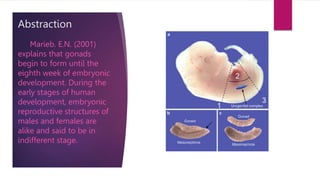
Marieb. E.N. (2001)
explains that gonads
begin to form until the
eighth week of embryonic
development. During the
early stages of human
development, embryonic
reproductive structures of
males and females are
alike and said to be in
indifferent stage.
Abstraction
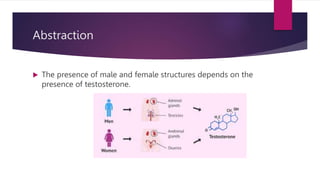
 The presence of male and female structures depends on the
presence of testosterone.
Abstraction
Any intervention with the normal pattern of sex hormone
production in the embryo results in strange abnormalities.
 Pseudo hermaphrodites are formed who are individuals
having accessory reproductive structures that do not “match”
their gonads while true hermaphrodites are individuals who
passes both ovarian and testicular tissues but this condition
in rare in nature.
Abstraction
 Cryptorchidism is a condition usually occurs in young males
and causes sterility.
 Abnormal separation of chromosomes during meiosis can
lead to congenital defects of the reproductive system.
Abstraction
 Condition also affect males primarily such as phimosis, which
is due to narrowing of the foreskin of the male reproductive
structure and misplaced urethral openings.
Abstraction
 Puberty is the period of life, generally between the ages of 10
to 15 years old, when the reproductive -organs grow to their
adult size and become functional under the influence of
rising levels of gonadal hormones (testosterone on males and
estrogen on females).
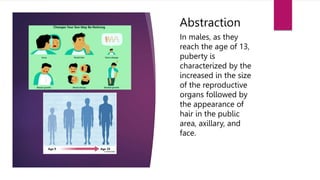
In males, as they
reach the age of 13,
puberty is
characterized by the
increased in the size
of the reproductive
organs followed by
the appearance of
hair in the public
area, axillary, and
face.
Abstraction
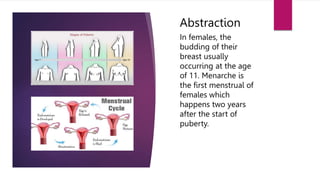
In females, the
budding of their
breast usually
occurring at the age
of 11. Menarche is
the first menstrual of
females which
happens two years
after the start of
puberty.
Abstraction
Diseases Associated with the
Reproductive System
Diseases Associated with the Reproductive
System
 Infections are most common problems
associated with the reproductive system in
adults, vaginal infections are more common in
young and elderly women whose resistance
to diseases are low.
Diseases Associated with the Reproductive
System
 Usual infections include those caused by
Escherichia coli (E.coli) which spread through
the digestive tract; the sexually transmitted
microorganisms such as syphilis, gonorrhea,
and herpes virus; and yeast infection (type of
fungus).
Diseases Associated with the Reproductive
System
 In males, most common inflammatory
conditions are prostatitis, urethritis, and
epididymitis, all of which may follow sexual
contacts in which Sexually Transmitted
Disease (STD) microorganisms are
transmitted.
Diseases Associated with the Reproductive
System
 Orchiditis, or inflammation of the testes is rather uncommon
but serious because it can cause sterility.
 Neoplasm are major threat to reproductive organs. Tumors of
the breasts and cervix are the most common reproductive
cancers in adult females, and prostate cancer is a problem in
adult male.
Diseases Associated with the Reproductive
System
 Menopause occurs when females no longer experience
menstruation.
 Production of estrogen may still continue after menopause
but ovaries finally stop functioning as endocrine organs.
Reproductive organs begin to atrophy when estrogen no
longer released from the body.
Diseases Associated with the Reproductive
System
Consequences of having estrogen deficiency are:
 vaginal infections become common,
 vagina becomes dry,
 mood changes,
 intense vasodilation of skin’s blood vessels,
 “hot flashes”,
 gradual thinning of the skin,
 loss of bone mass and slowly rising blood cholesterol levels.
Diseases Associated with the Reproductive
System
There is no counterpart for menopause in
males. Although aging men show a steady
decline in testosterone secretion, their
reproductive capability seems unending.
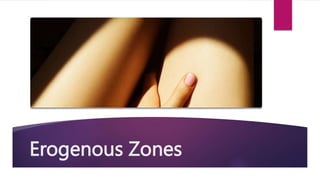
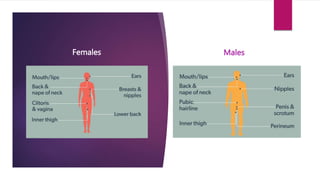
Erogenous Zones
Erogenous Zones
 refer to parts of the body that are primarily
receptive and increase sexual arousal when
touched in a sexual manner.
Erogenous Zones
 some commonly known erogenous zones are
the mouth, breast, genitals and anus. Other
common areas of the body that can be
aroused easily may include the neck,
abdomen, and feet.
Females Males
Human Sexual Behavior
 According to Gebhard P.H. 2017, Human
sexual behavior is defined as any activity –
solitary, between two persons, or in a group-
that induces arousal.
Human Sexual Behavior
Types of Behavior
The various type of HSB are usually classified on the gender and
the number of participants.
•Solitary behavior means only one is involve
•Socio Sexual involving one or more individual
- Heterosexual means Male and Female
- Homo Sexual means Male and male, Female and Female
Types of Behavior
1. Solitary Behavior
- Self-gratification is self-stimulation with the intention of
causing sexual arousal and, generally sexual climax. It mostly
takes place in private as an end in itself, but can also be done in
a sociosexual relationship.
Types of Behavior
- Majority of male and female have sexual
fantasies while they practice sexual gratification.
Types of Behavior
Example.
Ideal sexual partners and activities that has not experienced
and even might avoid in real life.
- some adolescents become aggressive when they respond
to stimuli that the rate of teenage pregnancy is increasing in
our time.
Types of Behavior
-The psychological significance of self-
gratification lies in how the individual regards it.
Types of Behavior
For some:
 It is laden with guilt.
 It is a release of tension with no emotional
content.
 It is also another source of pleasure to be
enjoyed for its own sake.
Types of Behavior
2. Sociosexual Behavior
- Heterosexual behavior is the greatest amount of
sociosexual behavior that occurs between only one
male and one female.
Types of Behavior
- Petting differs from hugging, kissing, and generalized caresses
of the clothed body to practice involving stimulation of the
genitals.
Types of Behavior
- Petting has been regarded as a near-universal human
experience.
- Coitus, the insertion of the male reproductive structure
into the female reproductive organ. Viewed by society quite
differently depending upon the marital status of the individuals.
Types of Behavior
Types of Coitus
• Premarital coitus – majority of human societies allow
premarital coitus, at least under certain circumstances. In
modern western society, it is most likely tolerated but not
encouraged.
Types of Behavior
• Marital coitus – in some societies, marital coitus is considered
to be an obligation.
• Extramarital coitus – involving wives is generally condemned
and, if permitted, is allowed only under exceptional conditions
or with specific persons.
Types of Behavior
• Post marital coitus – is almost always ignored. Ex. coitus by
separated, divorced and widowed persons.
- There is a difficulty in enforcing abstinence among sexually
experienced and usually older people for societies that try to
confine coitus in married couples.
Physiology of Human Sexual
Response
Physiology of Human Sexual Response
- the human sexual response follows a pattern of
sequential stages or phases when sexual activity is
continued:
Excitement phase
Excitement phase
-it is caused by increase in pulse and blood pressure; a sudden rise in
blood supply to the surface of the body resulting in increased skin
temperature, flushing, and swelling of all distensible body parts;
(particularly noticeable in the male reproductive structure or the penis and female breasts)
Excitement phase
-more rapid breathing, the secretion of genital fluids, vaginal
expansion, and a general increase in muscle tension.
-These symptoms of arousal eventually increase to a near
maximal physiological level that leads to the next stage.
(Flirting, teasing, foreplay)
Plateau phase
Plateau phase
-it has multiple terms, coitus, intercourse, mating, love-
making or generally knows as THE SEX.
-it is generally a brief duration. If stimulation is continued
orgasm usually occurs.
Sexual climax
Sexual climax
-it is marked by a feeling of abrupt, intense pleasure, and
spams of the pelvic muscles causing contraction of the female
reproductive organ and ejaculation by the male. It is
characterized by involuntary vocalizations.
(generally ejaculation for men, squirting for women)
Sexual climax
-Sexual climax may last for a few seconds (normally
not ever 10), after which the individual enters the
resolution phase.
Resolution phase
Resolution phase
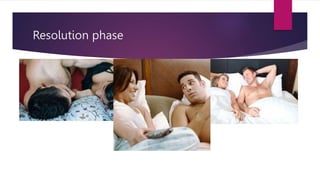
-the last stage the refers to the return to a normal
or subnormal physiological state. Both males and
females has the same response sequence making the
male to return normal even after the stimulation
continues;
Resolution phase
-but continued stimulation can produce additional orgasms
in females. Females are physically capable of repeated orgasms
without intervening “rest periods” required by males.
(pillow talk; intimate conversation between lovers in bed before or after sex)
Nervous system problems
 The entire nervous system plays a significant role
during sexual response. In the presence of a
stimulus, the efferent cerebrospinal nerves transmit
the sensory messages to the brain. The brain will
then interpret it and dictate what will be the
immediate or appropriate response of the body.
Nervous system
problems
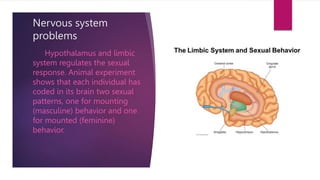
Hypothalamus and limbic
system regulates the sexual
response. Animal experiment
shows that each individual has
coded in its brain two sexual
patterns, one for mounting
(masculine) behavior and one
for mounted (feminine)
behavior.
Nervous system problems
 Also, there is some reflex (not controlled by brain)
sexual response. This reflex is mediated by the
lowest spinal cord of the both male and female, but
the brain can overrule and suppress such reflex
activity of when an individual decides that a sexual
response is socially in appropriate.
Sexual Problems
Sexual Problems
Sexual Problems involved three
categories Physiology, Psychological and
Social in origin.
Sexual Problems
 Physiology problems
-the abnormal development of genitalia or that part of n europhysiology.
-can be resolved through medication or surgery.
 Psychological problems
-comprise by far the largest category, they are socially induced inhibitions,
maladaptive attitudes, ignorance and sexual myths held by society.
Sexual Problems
 Premature emissions of semen
-is a common problem especially to young males due to excessive tensions in
a male who has been sexually deprived.
 Erectile impotence
-is almost always a psychological origin in males under 40; in older males.
It is common problems and requires no therapy.
-Causes: physical causes, fear of being impotent, self-perpetuating problem,
disinterest in sexual partner, fatigue, distraction of nonsexual worries,
Intoxication.
Sexual Problems
 Erectile impotence
- is almost always a psychological origin in males under 40; in older
males. It is common problems and requires no therapy
-Causes: physical causes, fear of being impotent, self-perpetuating
problem, disinterest in sexual partner, fatigue, distraction of nonsexual
worries, intoxication.
 Ejaculatory impotence
- the inability to ejaculate in coitus, is a common psychogenic origin
Sexual Problems
 Vaginismus
- is a strong spasm of the pelvic musculature
constructing the female reproductive
organ due to anti sexual conditioning or
psychological trauma but this can be treated.
Sexually Transmitted Diseases (STDs)
Sexually transmitted diseases (STDs)
 or sexually transmitted infections (STIs), are infections that are
passed from one person to another through sexual contact.
 The contact is usually vaginal, oral, and anal sex. But
sometimes they can spread through other intimate physical
contact. STDs can be caused by bacteria, viruses, and parasites.
Sexually transmitted diseases (STDs)
 STDs are an important global health priority because of their
devastating impact on women and infants and their inter-
relationships with HIV/AIDS.
 STDs and HIV are linked by biological interactions and
because both infections occur in the same populations.
 STDs lead to long-term health problems usually on woman
and infants.
How does STD affect a woman?
 Women often have more serious health problems from STIs
than men.
 Chlamydia and gonorrhea, left untreated, raise the risk of
chronic pelvic pain and life-threatening ectopic pregnancy.
Chlamydia and gonorrhea also can cause infertility.
What are the
symptoms of
sexually
diseases (STDs)?
 Unusual discharge from the penis or vagina.
 Sores or warts on the genital area
Painful or frequent urination.
 Itching and redness in the genital area.
 Blisters or sores in or around the mouth.
 Abdominal vaginal odor.
 Anal itching, soreness, bleeding.
 Abdominal pain.
 Fever.
TYPES OF STDs
Chlamydia
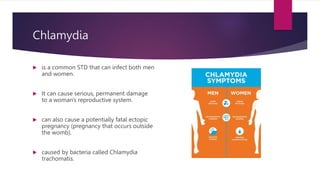
 is a common STD that can infect both men
and women.
 It can cause serious, permanent damage
to a woman's reproductive system.
 can also cause a potentially fatal ectopic
pregnancy (pregnancy that occurs outside
the womb).
 caused by bacteria called Chlamydia
trachomatis.
Gonorrhea
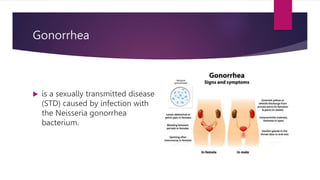
 is a sexually transmitted disease
(STD) caused by infection with
the Neisseria gonorrhea
bacterium.
Gonorrhea
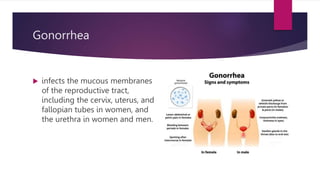
 infects the mucous membranes
of the reproductive tract,
including the cervix, uterus, and
fallopian tubes in women, and
the urethra in women and men.
Syphilis
 is a sexually transmitted infection that
can cause serious health problems if
it is not treated.
 cause of syphilis is a bacterium called
Treponema pallidum.
 most common way syphilis is spread
is through contact with an infected
person's sore during sexual activity.
Syphilis
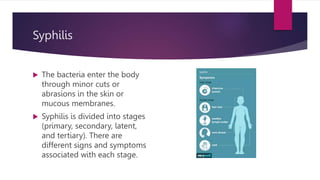
 The bacteria enter the body
through minor cuts or
abrasions in the skin or
mucous membranes.
 Syphilis is divided into stages
(primary, secondary, latent,
and tertiary). There are
different signs and symptoms
associated with each stage.
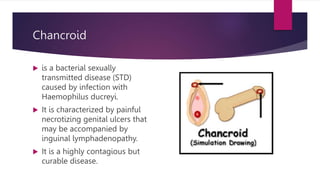
Chancroid
 is a bacterial sexually
transmitted disease (STD)
caused by infection with
Haemophilus ducreyi.
 It is characterized by painful
necrotizing genital ulcers that
may be accompanied by
inguinal lymphadenopathy.
 It is a highly contagious but
curable disease.
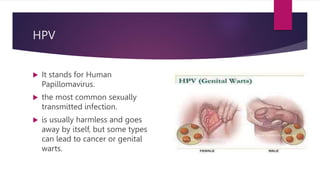
HPV
 It stands for Human
Papillomavirus.
 the most common sexually
transmitted infection.
 is usually harmless and goes
away by itself, but some types
can lead to cancer or genital
warts.
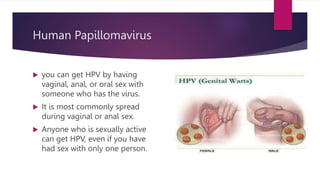
Human Papillomavirus
 you can get HPV by having
vaginal, anal, or oral sex with
someone who has the virus.
 It is most commonly spread
during vaginal or anal sex.
 Anyone who is sexually active
can get HPV, even if you have
had sex with only one person.
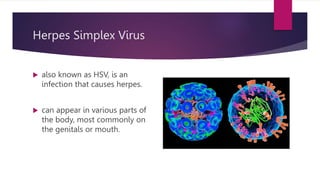
Herpes Simplex Virus
 also known as HSV, is an
infection that causes herpes.
 can appear in various parts of
the body, most commonly on
the genitals or mouth.
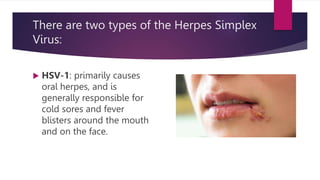
There are two types of the Herpes Simplex
Virus:
 HSV-1: primarily causes
oral herpes, and is
generally responsible for
cold sores and fever
blisters around the mouth
and on the face.
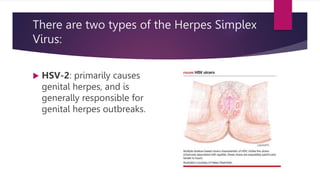
There are two types of the Herpes Simplex
Virus:
 HSV-2: primarily causes
genital herpes, and is
generally responsible for
genital herpes outbreaks.
Herpes Simplex Virus
 The Herpes Simplex
Virus is a contagious
virus that can be
transmitted from
person to person
through direct contact.
Herpes Simplex Virus
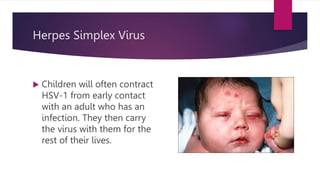
 Children will often contract
HSV-1 from early contact
with an adult who has an
infection. They then carry
the virus with them for the
rest of their lives.
Trichomonas Vaginalis
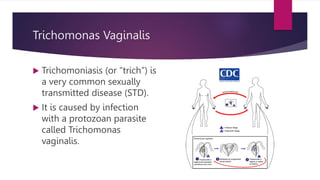
 Trichomoniasis (or “trich”) is
a very common sexually
transmitted disease (STD).
 It is caused by infection
with a protozoan parasite
called Trichomonas
vaginalis.
Trichomonas Vaginalis
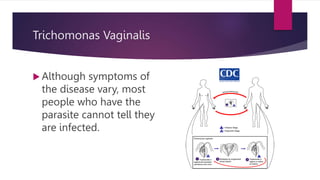
 Although symptoms of
the disease vary, most
people who have the
parasite cannot tell they
are infected.
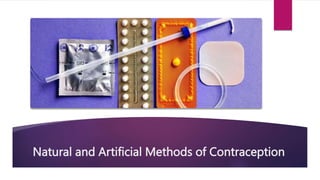
Natural and Artificial Methods of Contraception
Natural Method
 no chemical or foreign body introduction into the human
body.
 used by people who are conscious of their religious belief.
 cost – effective.
Natural Methods
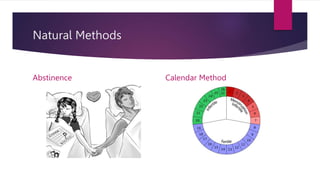
a. Abstinence
 most effective natural birth control.
 refraining from sexual intercourse.
b. Calendar Method
 also called as the rhythm method.
 withholding from coitus during the days that the woman is fertile.
Natural Methods
Abstinence Calendar Method
Natural Methods
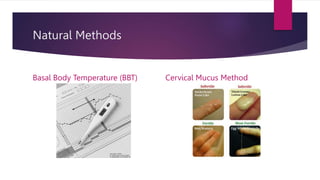
c. Basal Body Temperature (BBT)
 enabling women to determine the fertile and infertile periods using a
very accurate thermometer.
 a woman’s body temperature rises slightly after ovulation at about half
way through her menstrual cycle.
d. Cervical Mucus Method
 Avoiding coitus when the cervical mucus is copious and watery which
means a woman is fertile.
Natural Methods
Basal Body Temperature (BBT) Cervical Mucus Method
Natural Methods
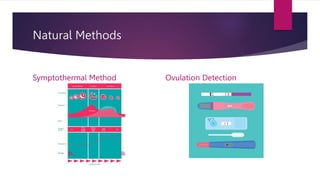
e. Symptothermal Method
 a combination of the BBT method and the cervical mucus method.
f. Ovulation Detection
 uses an over-the-counter kit that requires the urine sample of the woman.
 predict ovulation through the surge of luteinizing hormone (LH).
Natural Methods
Symptothermal Method Ovulation Detection
Natural Methods
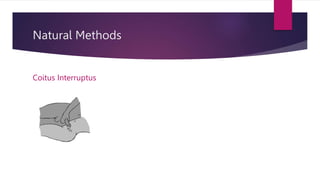
g. Coitus Interruptus
 a couple still goes on with coitus, but the man withdraws the
moment he ejaculates.
Natural Methods
Coitus Interruptus
Natural and Artificial Methods of Contraception
Artificial Methods
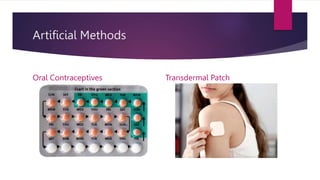
a. Oral Contraceptives
 contains synthetic estrogen and progesterone that suppresses the Follicle
Stimulating Hormone (FSH) and LH to prevent ovulation.
b. Transdermal Patch
 contains both estrogen and progesterone
 one patch every week for three weeks on the following areas: upper outer
arm, upper torso, abdomen, or buttocks.
Artificial Methods
Oral Contraceptives Transdermal Patch
Artificial Methods
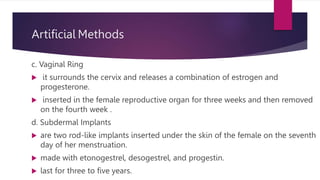
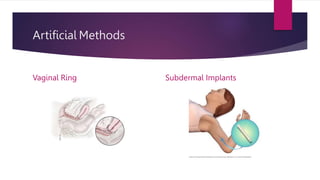
c. Vaginal Ring
 it surrounds the cervix and releases a combination of estrogen and
progesterone.
 inserted in the female reproductive organ for three weeks and then removed
on the fourth week .
d. Subdermal Implants
 are two rod-like implants inserted under the skin of the female on the seventh
day of her menstruation.
 made with etonogestrel, desogestrel, and progestin.

 last for three to five years.
Artificial Methods
Vaginal Ring Subdermal Implants
Artificial Methods
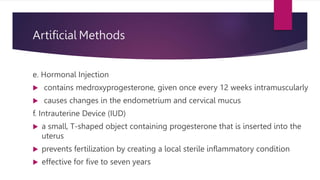
e. Hormonal Injection
 contains medroxyprogesterone, given once every 12 weeks intramuscularly
 causes changes in the endometrium and cervical mucus
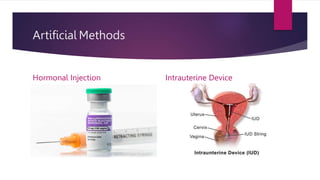
f. Intrauterine Device (IUD)
 a small, T-shaped object containing progesterone that is inserted into the
uterus
 prevents fertilization by creating a local sterile inflammatory condition
 effective for five to seven years
Artificial Methods
Hormonal Injection Intrauterine Device
Artificial Methods
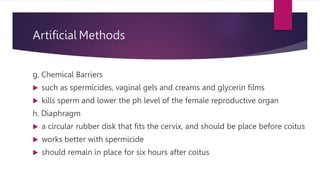
g. Chemical Barriers
 such as spermicides, vaginal gels and creams and glycerin films
 kills sperm and lower the ph level of the female reproductive organ
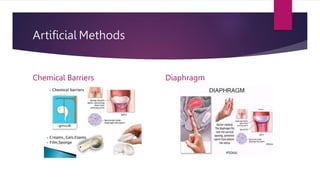
h. Diaphragm
 a circular rubber disk that fits the cervix, and should be place before coitus
 works better with spermicide
 should remain in place for six hours after coitus
Artificial Methods
Chemical Barriers Diaphragm
Artificial Methods
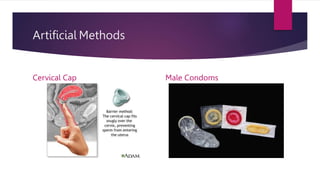
i. Cervical Cap
 made of soft rubber and fitted on the rim of the cervix.
 could stay in place not more than 48 hours.
j. Male Condoms
 a latex or synthetic rubber sheath that is placed on the erect male
reproductive organ before coitus.
 can prevent STIs.
Artificial Methods
Cervical Cap Male Condoms
Artificial Methods
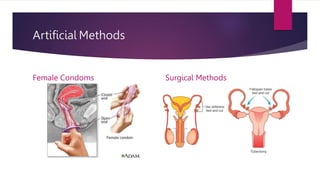
k. Female Condoms
 made up of latex rubber sheaths that are pre-
lubricated with spermicide.
 usually bounded with two rings.
Artificial Methods
l. Surgical Methods
 in vasectomy, a small incision is made on each side of the scrotum, and
the vas deferens is then tied, cauterized, cut, or plugged to block the
passage of sperm.
 in women, tubal ligation is performed after menstruation and before
ovulation. It is done s all through a cutting, cauterizing, or blocking the
fallopian tube to inhibit passage of both the sperm and the ovary.
Artificial Methods
Female Condoms Surgical Methods
References
 Erogenous Zones. 2017. University of California, Santa Barbara. Accessed October 11, 2017.
http://www.soc.ucsb.edu/sexinfo/aricle/erogenous-zones.
 Gebhard, Paul Henry. 2017. Human Sexual Behavior. Accessed October 11, 2017.
https://www.britannica.com/topic/human-sexual-behavior.
 Marieb, Elaine. N. 2001. Essential of Human Anatomy and Physiology 6th Ed.
Pearosns Education Asia Pte. Ltd. pp 504-507.
 Natural and Artificial Methods of Contraception, 2017. Accessed October 11, 2017.
https://nurselabs.com/family-planning-methods/.
 Sexually Transmitted Disease Surveillance. 2016. U.S Department of Health and Human Services Centers for
Disease Control and Prevention. Accessed October 11, 2017.
https://www.cdc.gov/std/stats16/CDC_2016_STDS_Report-for508WebSep21_2017_1644.pdf.
 Sexually Transmitted Diseases-Specific Research. 2016. US National Institute of Health, National Institute of Allergy
and Infectious Diseases. Accessed October 11, 2017.
https://www.niaid.nih.gov/diseases-conditions/std-research.
“
”
ALWAYS ASK FOR CONSENT AND
PRACTICE SAFE SEX
-EVERYONE

The Physical and Sexual Self.pptx

  • 1.
    The Physical andSexual Self CHAPTER 2 LESSON 1
  • 2.
  • 3.
    Abstraction Marieb. E.N. (2001) explainsthat gonads begin to form until the eighth week of embryonic development. During the early stages of human development, embryonic reproductive structures of males and females are alike and said to be in indifferent stage.
  • 4.
    Abstraction  The presenceof male and female structures depends on the presence of testosterone.
  • 5.
    Abstraction Any intervention withthe normal pattern of sex hormone production in the embryo results in strange abnormalities.  Pseudo hermaphrodites are formed who are individuals having accessory reproductive structures that do not “match” their gonads while true hermaphrodites are individuals who passes both ovarian and testicular tissues but this condition in rare in nature.
  • 6.
    Abstraction  Cryptorchidism isa condition usually occurs in young males and causes sterility.  Abnormal separation of chromosomes during meiosis can lead to congenital defects of the reproductive system.
  • 7.
    Abstraction  Condition alsoaffect males primarily such as phimosis, which is due to narrowing of the foreskin of the male reproductive structure and misplaced urethral openings.
  • 8.
    Abstraction  Puberty isthe period of life, generally between the ages of 10 to 15 years old, when the reproductive -organs grow to their adult size and become functional under the influence of rising levels of gonadal hormones (testosterone on males and estrogen on females).
  • 9.
    In males, asthey reach the age of 13, puberty is characterized by the increased in the size of the reproductive organs followed by the appearance of hair in the public area, axillary, and face. Abstraction
  • 10.
    In females, the buddingof their breast usually occurring at the age of 11. Menarche is the first menstrual of females which happens two years after the start of puberty. Abstraction
  • 11.
    Diseases Associated withthe Reproductive System
  • 12.
    Diseases Associated withthe Reproductive System  Infections are most common problems associated with the reproductive system in adults, vaginal infections are more common in young and elderly women whose resistance to diseases are low.
  • 13.
    Diseases Associated withthe Reproductive System  Usual infections include those caused by Escherichia coli (E.coli) which spread through the digestive tract; the sexually transmitted microorganisms such as syphilis, gonorrhea, and herpes virus; and yeast infection (type of fungus).
  • 14.
    Diseases Associated withthe Reproductive System  In males, most common inflammatory conditions are prostatitis, urethritis, and epididymitis, all of which may follow sexual contacts in which Sexually Transmitted Disease (STD) microorganisms are transmitted.
  • 15.
    Diseases Associated withthe Reproductive System  Orchiditis, or inflammation of the testes is rather uncommon but serious because it can cause sterility.  Neoplasm are major threat to reproductive organs. Tumors of the breasts and cervix are the most common reproductive cancers in adult females, and prostate cancer is a problem in adult male.
  • 16.
    Diseases Associated withthe Reproductive System  Menopause occurs when females no longer experience menstruation.  Production of estrogen may still continue after menopause but ovaries finally stop functioning as endocrine organs. Reproductive organs begin to atrophy when estrogen no longer released from the body.
  • 17.
    Diseases Associated withthe Reproductive System Consequences of having estrogen deficiency are:  vaginal infections become common,  vagina becomes dry,  mood changes,  intense vasodilation of skin’s blood vessels,  “hot flashes”,  gradual thinning of the skin,  loss of bone mass and slowly rising blood cholesterol levels.
  • 18.
    Diseases Associated withthe Reproductive System There is no counterpart for menopause in males. Although aging men show a steady decline in testosterone secretion, their reproductive capability seems unending.
  • 19.
  • 20.
    Erogenous Zones  referto parts of the body that are primarily receptive and increase sexual arousal when touched in a sexual manner.
  • 21.
    Erogenous Zones  somecommonly known erogenous zones are the mouth, breast, genitals and anus. Other common areas of the body that can be aroused easily may include the neck, abdomen, and feet.
  • 22.
  • 23.
  • 24.
    Human Sexual Behavior According to Gebhard P.H. 2017, Human sexual behavior is defined as any activity – solitary, between two persons, or in a group- that induces arousal.
  • 25.
    Human Sexual Behavior Typesof Behavior The various type of HSB are usually classified on the gender and the number of participants. •Solitary behavior means only one is involve •Socio Sexual involving one or more individual - Heterosexual means Male and Female - Homo Sexual means Male and male, Female and Female
  • 26.
    Types of Behavior 1.Solitary Behavior - Self-gratification is self-stimulation with the intention of causing sexual arousal and, generally sexual climax. It mostly takes place in private as an end in itself, but can also be done in a sociosexual relationship.
  • 27.
    Types of Behavior -Majority of male and female have sexual fantasies while they practice sexual gratification.
  • 28.
    Types of Behavior Example. Idealsexual partners and activities that has not experienced and even might avoid in real life. - some adolescents become aggressive when they respond to stimuli that the rate of teenage pregnancy is increasing in our time.
  • 29.
    Types of Behavior -Thepsychological significance of self- gratification lies in how the individual regards it.
  • 30.
    Types of Behavior Forsome:  It is laden with guilt.  It is a release of tension with no emotional content.  It is also another source of pleasure to be enjoyed for its own sake.
  • 31.
    Types of Behavior 2.Sociosexual Behavior - Heterosexual behavior is the greatest amount of sociosexual behavior that occurs between only one male and one female.
  • 32.
    Types of Behavior -Petting differs from hugging, kissing, and generalized caresses of the clothed body to practice involving stimulation of the genitals.
  • 33.
    Types of Behavior -Petting has been regarded as a near-universal human experience. - Coitus, the insertion of the male reproductive structure into the female reproductive organ. Viewed by society quite differently depending upon the marital status of the individuals.
  • 34.
    Types of Behavior Typesof Coitus • Premarital coitus – majority of human societies allow premarital coitus, at least under certain circumstances. In modern western society, it is most likely tolerated but not encouraged.
  • 35.
    Types of Behavior •Marital coitus – in some societies, marital coitus is considered to be an obligation. • Extramarital coitus – involving wives is generally condemned and, if permitted, is allowed only under exceptional conditions or with specific persons.
  • 36.
    Types of Behavior •Post marital coitus – is almost always ignored. Ex. coitus by separated, divorced and widowed persons. - There is a difficulty in enforcing abstinence among sexually experienced and usually older people for societies that try to confine coitus in married couples.
  • 37.
    Physiology of HumanSexual Response
  • 38.
    Physiology of HumanSexual Response - the human sexual response follows a pattern of sequential stages or phases when sexual activity is continued:
  • 39.
  • 40.
    Excitement phase -it iscaused by increase in pulse and blood pressure; a sudden rise in blood supply to the surface of the body resulting in increased skin temperature, flushing, and swelling of all distensible body parts; (particularly noticeable in the male reproductive structure or the penis and female breasts)
  • 41.
    Excitement phase -more rapidbreathing, the secretion of genital fluids, vaginal expansion, and a general increase in muscle tension. -These symptoms of arousal eventually increase to a near maximal physiological level that leads to the next stage. (Flirting, teasing, foreplay)
  • 42.
  • 43.
    Plateau phase -it hasmultiple terms, coitus, intercourse, mating, love- making or generally knows as THE SEX. -it is generally a brief duration. If stimulation is continued orgasm usually occurs.
  • 44.
  • 45.
    Sexual climax -it ismarked by a feeling of abrupt, intense pleasure, and spams of the pelvic muscles causing contraction of the female reproductive organ and ejaculation by the male. It is characterized by involuntary vocalizations. (generally ejaculation for men, squirting for women)
  • 46.
    Sexual climax -Sexual climaxmay last for a few seconds (normally not ever 10), after which the individual enters the resolution phase.
  • 47.
  • 48.
    Resolution phase -the laststage the refers to the return to a normal or subnormal physiological state. Both males and females has the same response sequence making the male to return normal even after the stimulation continues;
  • 49.
    Resolution phase -but continuedstimulation can produce additional orgasms in females. Females are physically capable of repeated orgasms without intervening “rest periods” required by males. (pillow talk; intimate conversation between lovers in bed before or after sex)
  • 50.
  • 51.
    Nervous system problems The entire nervous system plays a significant role during sexual response. In the presence of a stimulus, the efferent cerebrospinal nerves transmit the sensory messages to the brain. The brain will then interpret it and dictate what will be the immediate or appropriate response of the body.
  • 52.
    Nervous system problems Hypothalamus andlimbic system regulates the sexual response. Animal experiment shows that each individual has coded in its brain two sexual patterns, one for mounting (masculine) behavior and one for mounted (feminine) behavior.
  • 53.
    Nervous system problems Also, there is some reflex (not controlled by brain) sexual response. This reflex is mediated by the lowest spinal cord of the both male and female, but the brain can overrule and suppress such reflex activity of when an individual decides that a sexual response is socially in appropriate.
  • 54.
  • 55.
    Sexual Problems Sexual Problemsinvolved three categories Physiology, Psychological and Social in origin.
  • 56.
    Sexual Problems  Physiologyproblems -the abnormal development of genitalia or that part of n europhysiology. -can be resolved through medication or surgery.  Psychological problems -comprise by far the largest category, they are socially induced inhibitions, maladaptive attitudes, ignorance and sexual myths held by society.
  • 57.
    Sexual Problems  Prematureemissions of semen -is a common problem especially to young males due to excessive tensions in a male who has been sexually deprived.  Erectile impotence -is almost always a psychological origin in males under 40; in older males. It is common problems and requires no therapy. -Causes: physical causes, fear of being impotent, self-perpetuating problem, disinterest in sexual partner, fatigue, distraction of nonsexual worries, Intoxication.
  • 58.
    Sexual Problems  Erectileimpotence - is almost always a psychological origin in males under 40; in older males. It is common problems and requires no therapy -Causes: physical causes, fear of being impotent, self-perpetuating problem, disinterest in sexual partner, fatigue, distraction of nonsexual worries, intoxication.  Ejaculatory impotence - the inability to ejaculate in coitus, is a common psychogenic origin
  • 59.
    Sexual Problems  Vaginismus -is a strong spasm of the pelvic musculature constructing the female reproductive organ due to anti sexual conditioning or psychological trauma but this can be treated.
  • 60.
  • 61.
    Sexually transmitted diseases(STDs)  or sexually transmitted infections (STIs), are infections that are passed from one person to another through sexual contact.  The contact is usually vaginal, oral, and anal sex. But sometimes they can spread through other intimate physical contact. STDs can be caused by bacteria, viruses, and parasites.
  • 62.
    Sexually transmitted diseases(STDs)  STDs are an important global health priority because of their devastating impact on women and infants and their inter- relationships with HIV/AIDS.  STDs and HIV are linked by biological interactions and because both infections occur in the same populations.  STDs lead to long-term health problems usually on woman and infants.
  • 63.
    How does STDaffect a woman?  Women often have more serious health problems from STIs than men.  Chlamydia and gonorrhea, left untreated, raise the risk of chronic pelvic pain and life-threatening ectopic pregnancy. Chlamydia and gonorrhea also can cause infertility.
  • 64.
    What are the symptomsof sexually diseases (STDs)?  Unusual discharge from the penis or vagina.  Sores or warts on the genital area Painful or frequent urination.  Itching and redness in the genital area.  Blisters or sores in or around the mouth.  Abdominal vaginal odor.  Anal itching, soreness, bleeding.  Abdominal pain.  Fever.
  • 65.
  • 66.
    Chlamydia  is acommon STD that can infect both men and women.  It can cause serious, permanent damage to a woman's reproductive system.  can also cause a potentially fatal ectopic pregnancy (pregnancy that occurs outside the womb).  caused by bacteria called Chlamydia trachomatis.
  • 67.
    Gonorrhea  is asexually transmitted disease (STD) caused by infection with the Neisseria gonorrhea bacterium.
  • 68.
    Gonorrhea  infects themucous membranes of the reproductive tract, including the cervix, uterus, and fallopian tubes in women, and the urethra in women and men.
  • 69.
    Syphilis  is asexually transmitted infection that can cause serious health problems if it is not treated.  cause of syphilis is a bacterium called Treponema pallidum.  most common way syphilis is spread is through contact with an infected person's sore during sexual activity.
  • 70.
    Syphilis  The bacteriaenter the body through minor cuts or abrasions in the skin or mucous membranes.  Syphilis is divided into stages (primary, secondary, latent, and tertiary). There are different signs and symptoms associated with each stage.
  • 71.
    Chancroid  is abacterial sexually transmitted disease (STD) caused by infection with Haemophilus ducreyi.  It is characterized by painful necrotizing genital ulcers that may be accompanied by inguinal lymphadenopathy.  It is a highly contagious but curable disease.
  • 72.
    HPV  It standsfor Human Papillomavirus.  the most common sexually transmitted infection.  is usually harmless and goes away by itself, but some types can lead to cancer or genital warts.
  • 73.
    Human Papillomavirus  youcan get HPV by having vaginal, anal, or oral sex with someone who has the virus.  It is most commonly spread during vaginal or anal sex.  Anyone who is sexually active can get HPV, even if you have had sex with only one person.
  • 74.
    Herpes Simplex Virus also known as HSV, is an infection that causes herpes.  can appear in various parts of the body, most commonly on the genitals or mouth.
  • 75.
    There are twotypes of the Herpes Simplex Virus:  HSV-1: primarily causes oral herpes, and is generally responsible for cold sores and fever blisters around the mouth and on the face.
  • 76.
    There are twotypes of the Herpes Simplex Virus:  HSV-2: primarily causes genital herpes, and is generally responsible for genital herpes outbreaks.
  • 77.
    Herpes Simplex Virus The Herpes Simplex Virus is a contagious virus that can be transmitted from person to person through direct contact.
  • 78.
    Herpes Simplex Virus Children will often contract HSV-1 from early contact with an adult who has an infection. They then carry the virus with them for the rest of their lives.
  • 79.
    Trichomonas Vaginalis  Trichomoniasis(or “trich”) is a very common sexually transmitted disease (STD).  It is caused by infection with a protozoan parasite called Trichomonas vaginalis.
  • 80.
    Trichomonas Vaginalis  Althoughsymptoms of the disease vary, most people who have the parasite cannot tell they are infected.
  • 81.
    Natural and ArtificialMethods of Contraception
  • 82.
    Natural and ArtificialMethods of Contraception Natural Method  no chemical or foreign body introduction into the human body.  used by people who are conscious of their religious belief.  cost – effective.
  • 83.
    Natural Methods a. Abstinence most effective natural birth control.  refraining from sexual intercourse. b. Calendar Method  also called as the rhythm method.  withholding from coitus during the days that the woman is fertile.
  • 84.
  • 85.
    Natural Methods c. BasalBody Temperature (BBT)  enabling women to determine the fertile and infertile periods using a very accurate thermometer.  a woman’s body temperature rises slightly after ovulation at about half way through her menstrual cycle. d. Cervical Mucus Method  Avoiding coitus when the cervical mucus is copious and watery which means a woman is fertile.
  • 86.
    Natural Methods Basal BodyTemperature (BBT) Cervical Mucus Method
  • 87.
    Natural Methods e. SymptothermalMethod  a combination of the BBT method and the cervical mucus method. f. Ovulation Detection  uses an over-the-counter kit that requires the urine sample of the woman.  predict ovulation through the surge of luteinizing hormone (LH).
  • 88.
  • 89.
    Natural Methods g. CoitusInterruptus  a couple still goes on with coitus, but the man withdraws the moment he ejaculates.
  • 90.
  • 91.
    Natural and ArtificialMethods of Contraception Artificial Methods a. Oral Contraceptives  contains synthetic estrogen and progesterone that suppresses the Follicle Stimulating Hormone (FSH) and LH to prevent ovulation. b. Transdermal Patch  contains both estrogen and progesterone  one patch every week for three weeks on the following areas: upper outer arm, upper torso, abdomen, or buttocks.
  • 92.
  • 93.
    Artificial Methods c. VaginalRing  it surrounds the cervix and releases a combination of estrogen and progesterone.  inserted in the female reproductive organ for three weeks and then removed on the fourth week . d. Subdermal Implants  are two rod-like implants inserted under the skin of the female on the seventh day of her menstruation.  made with etonogestrel, desogestrel, and progestin.  last for three to five years.
  • 94.
  • 95.
    Artificial Methods e. HormonalInjection  contains medroxyprogesterone, given once every 12 weeks intramuscularly  causes changes in the endometrium and cervical mucus f. Intrauterine Device (IUD)  a small, T-shaped object containing progesterone that is inserted into the uterus  prevents fertilization by creating a local sterile inflammatory condition  effective for five to seven years
  • 96.
  • 97.
    Artificial Methods g. ChemicalBarriers  such as spermicides, vaginal gels and creams and glycerin films  kills sperm and lower the ph level of the female reproductive organ h. Diaphragm  a circular rubber disk that fits the cervix, and should be place before coitus  works better with spermicide  should remain in place for six hours after coitus
  • 98.
  • 99.
    Artificial Methods i. CervicalCap  made of soft rubber and fitted on the rim of the cervix.  could stay in place not more than 48 hours. j. Male Condoms  a latex or synthetic rubber sheath that is placed on the erect male reproductive organ before coitus.  can prevent STIs.
  • 100.
  • 101.
    Artificial Methods k. FemaleCondoms  made up of latex rubber sheaths that are pre- lubricated with spermicide.  usually bounded with two rings.
  • 102.
    Artificial Methods l. SurgicalMethods  in vasectomy, a small incision is made on each side of the scrotum, and the vas deferens is then tied, cauterized, cut, or plugged to block the passage of sperm.  in women, tubal ligation is performed after menstruation and before ovulation. It is done s all through a cutting, cauterizing, or blocking the fallopian tube to inhibit passage of both the sperm and the ovary.
  • 103.
  • 104.
    References  Erogenous Zones.2017. University of California, Santa Barbara. Accessed October 11, 2017. http://www.soc.ucsb.edu/sexinfo/aricle/erogenous-zones.  Gebhard, Paul Henry. 2017. Human Sexual Behavior. Accessed October 11, 2017. https://www.britannica.com/topic/human-sexual-behavior.  Marieb, Elaine. N. 2001. Essential of Human Anatomy and Physiology 6th Ed. Pearosns Education Asia Pte. Ltd. pp 504-507.  Natural and Artificial Methods of Contraception, 2017. Accessed October 11, 2017. https://nurselabs.com/family-planning-methods/.  Sexually Transmitted Disease Surveillance. 2016. U.S Department of Health and Human Services Centers for Disease Control and Prevention. Accessed October 11, 2017. https://www.cdc.gov/std/stats16/CDC_2016_STDS_Report-for508WebSep21_2017_1644.pdf.  Sexually Transmitted Diseases-Specific Research. 2016. US National Institute of Health, National Institute of Allergy and Infectious Diseases. Accessed October 11, 2017. https://www.niaid.nih.gov/diseases-conditions/std-research.
  • 105.
    “ ” ALWAYS ASK FORCONSENT AND PRACTICE SAFE SEX -EVERYONE