Retirement Plan Fees
Retirement plan fees are complicated. Between administration, investment management, recordkeeping, consulting,
revenue sharing, sub-TA and 12b-1, it isn’t always clear to plan participants or plan sponsors exactly what they’re
paying, how much they’re paying or even who’s paying the fees.
ERISA Section 408(b)(2) states that plan fiduciaries have to determine whether the agreements and compensation of
service providers are “reasonable.” The rule requires service providers to supply plans with disclosures to help them
determine if fees are “reasonable.” NFP helps fiduciaries with this complicated determination by identifying:
 All of the total plan cost components
 The various primary drivers of retirement plan pricing
 The role of revenue sharing
Cost Components
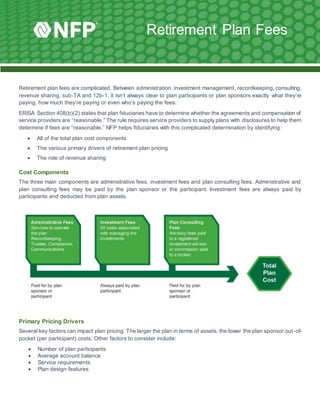
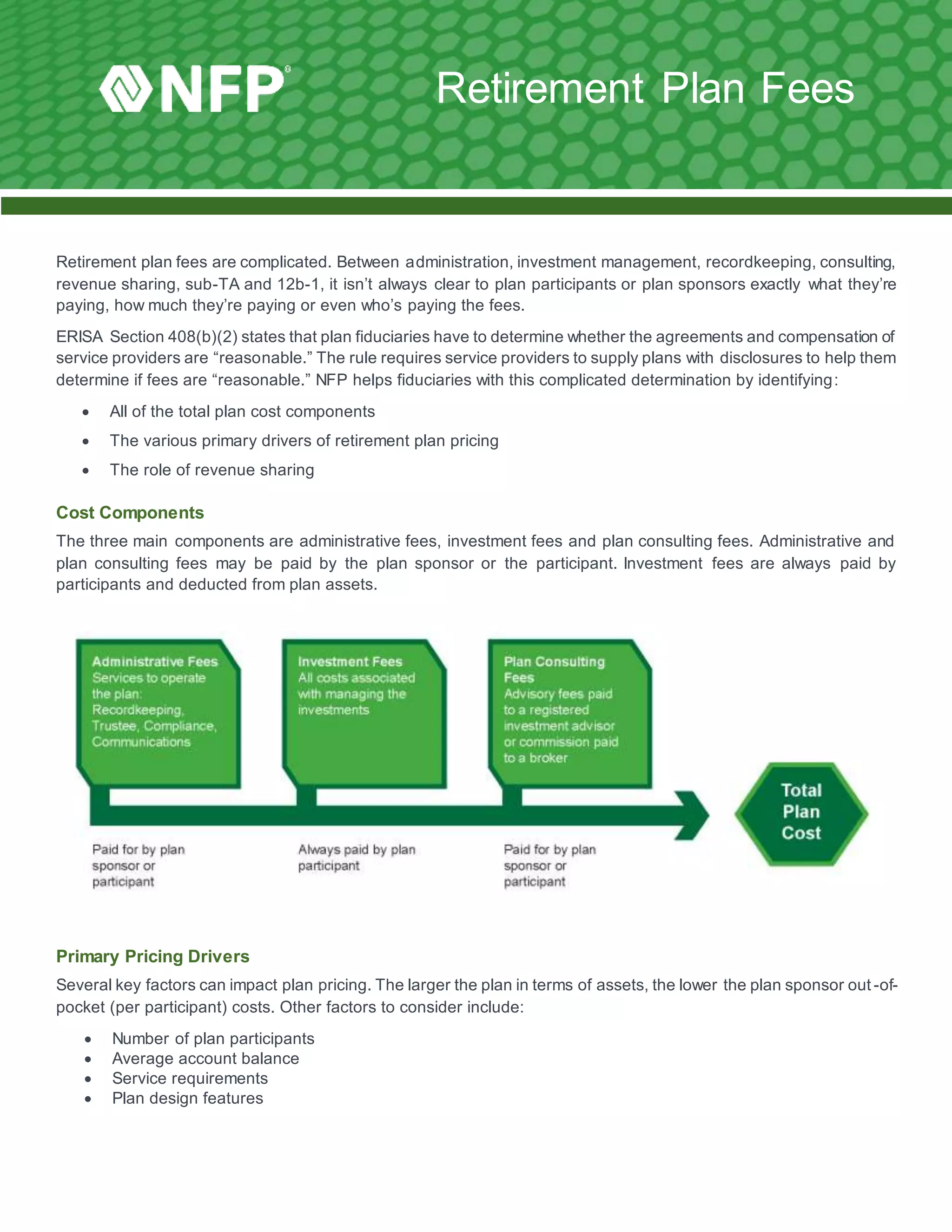
The three main components are administrative fees, investment fees and plan consulting fees. Administrative and
plan consulting fees may be paid by the plan sponsor or the participant. Investment fees are always paid by
participants and deducted from plan assets.
Primary Pricing Drivers
Several key factors can impact plan pricing. The larger the plan in terms of assets, the lower the plan sponsor out -of-
pocket (per participant) costs. Other factors to consider include:
 Number of plan participants
 Average account balance
 Service requirements
 Plan design features
NFP 1405 Davis Avenue Endw ell, NY 13760 I nfp.com/retirement
Insurance services offered throughNFP Corporate Services (NY), LLC, a subsidiary ofNFP Corp. (NFP). Securities offered through Kestra Investment Services, LLC
(Kestra IS), member FINRA/SIPC. Investment advisoryservices offered throughKestraAdvisory Services, LLC(KestraAS), an affiliate ofKestraIS. Neither Kestra IS
nor Kestra AS are affiliated with NFP or NFP Corporate Services (NY), LLC.
Retirement Plan Fees
Revenue Sharing
Revenue sharing includes payments made by investment managers to service providers or plan consultants for a
portion of the revenue generated from the management of a particular fund or funds. Historically, such allowance may
or may not be known to a plan sponsor. Regardless, it’s imperative that plan sponsors with fiduciary oversight of their
organization’s retirement plan understand the distribution systems that most investment management organizations
use and how they share revenue.
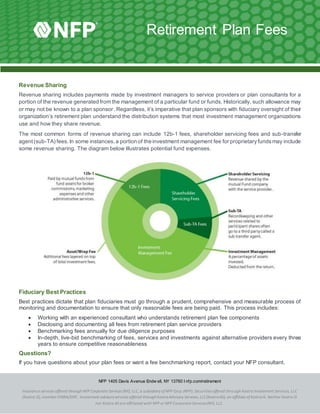
The most common forms of revenue sharing can include 12b-1 fees, shareholder servicing fees and sub-transfer
agent(sub-TA) fees. In some instances, a portion of the investment management fee for proprietaryfundsmay include
some revenue sharing. The diagram below illustrates potential fund expenses.
Fiduciary Best Practices
Best practices dictate that plan fiduciaries must go through a prudent, comprehensive and measurable process of
monitoring and documentation to ensure that only reasonable fees are being paid. This process includes:
 Working with an experienced consultant who understands retirement plan fee components
 Disclosing and documenting all fees from retirement plan service providers
 Benchmarking fees annually for due diligence purposes
 In-depth, live-bid benchmarking of fees, services and investments against alternative providers every three
years to ensure competitive reasonableness
Questions?
If you have questions about your plan fees or want a fee benchmarking report, contact your NFP consultant.

Understanding Retirement Plan Fees (1)

  • 1.
    Retirement Plan Fees Retirementplan fees are complicated. Between administration, investment management, recordkeeping, consulting, revenue sharing, sub-TA and 12b-1, it isn’t always clear to plan participants or plan sponsors exactly what they’re paying, how much they’re paying or even who’s paying the fees. ERISA Section 408(b)(2) states that plan fiduciaries have to determine whether the agreements and compensation of service providers are “reasonable.” The rule requires service providers to supply plans with disclosures to help them determine if fees are “reasonable.” NFP helps fiduciaries with this complicated determination by identifying:  All of the total plan cost components  The various primary drivers of retirement plan pricing  The role of revenue sharing Cost Components The three main components are administrative fees, investment fees and plan consulting fees. Administrative and plan consulting fees may be paid by the plan sponsor or the participant. Investment fees are always paid by participants and deducted from plan assets. Primary Pricing Drivers Several key factors can impact plan pricing. The larger the plan in terms of assets, the lower the plan sponsor out -of- pocket (per participant) costs. Other factors to consider include:  Number of plan participants  Average account balance  Service requirements  Plan design features
  • 2.
    NFP 1405 DavisAvenue Endw ell, NY 13760 I nfp.com/retirement Insurance services offered throughNFP Corporate Services (NY), LLC, a subsidiary ofNFP Corp. (NFP). Securities offered through Kestra Investment Services, LLC (Kestra IS), member FINRA/SIPC. Investment advisoryservices offered throughKestraAdvisory Services, LLC(KestraAS), an affiliate ofKestraIS. Neither Kestra IS nor Kestra AS are affiliated with NFP or NFP Corporate Services (NY), LLC. Retirement Plan Fees Revenue Sharing Revenue sharing includes payments made by investment managers to service providers or plan consultants for a portion of the revenue generated from the management of a particular fund or funds. Historically, such allowance may or may not be known to a plan sponsor. Regardless, it’s imperative that plan sponsors with fiduciary oversight of their organization’s retirement plan understand the distribution systems that most investment management organizations use and how they share revenue. The most common forms of revenue sharing can include 12b-1 fees, shareholder servicing fees and sub-transfer agent(sub-TA) fees. In some instances, a portion of the investment management fee for proprietaryfundsmay include some revenue sharing. The diagram below illustrates potential fund expenses. Fiduciary Best Practices Best practices dictate that plan fiduciaries must go through a prudent, comprehensive and measurable process of monitoring and documentation to ensure that only reasonable fees are being paid. This process includes:  Working with an experienced consultant who understands retirement plan fee components  Disclosing and documenting all fees from retirement plan service providers  Benchmarking fees annually for due diligence purposes  In-depth, live-bid benchmarking of fees, services and investments against alternative providers every three years to ensure competitive reasonableness Questions? If you have questions about your plan fees or want a fee benchmarking report, contact your NFP consultant.