Understanding Philippine
Citizenship
Explore theessentials of Philippine citizenship. Learn
about its significance. Understand the laws that govern
it. Discover the rights and obligations it entails. This
presentation will guide you through modes of
acquisition. We'll cover retention and re-acquisition.
by Teacher Angelica Pantig
2.
Modes of AcquiringPhilippine Citizenship
Philippine citizenship can be acquired through several means.
Citizenship by Birth
Based on the principle of
Jus Sanguinis, citizenship
is determined by parentage.
Citizenship by
Naturalization
Meeting specific
requirements. Following a
detailed process.
Citizenship by Marriage
Available to foreign
spouses of Filipino
citizens under certain
conditions.
3.
Jus Sanguinis: Citizenship
byBlood
Learn about Jus Sanguinis, the primary way Filipinos
gain citizenship.
1 Parentage
Citizenship is
conferred based on
having Filipino
parents.
2 Proving Parentage
Requires
documentation.
Meeting specific
legal criteria.
3 Common Scenarios
Applies to children born in and outside the Philippines.
4.
Naturalization: Becoming a
FilipinoCitizen
Naturalization is the process for foreigners to become Filipino citizens.
1 Requirements
Include residency. Good moral character. Language
proficiency.
2 Step-by-Step Process
Involves application. Interviews. Court proceedings.
3 Relevant Laws
Governed by Commonwealth Act No. 473 (as amended).
5.
Citizenship by Marriage
Foreignspouses of Filipino citizens can apply for citizenship through marriage.
Requirements
Includes continuous
residency. Following
marriage.
Process
Involves submitting required
documents. Attending
interviews.
Potential Issues
Considerations include
annulment or separation.
6.
Dual Citizenship inthe Philippines
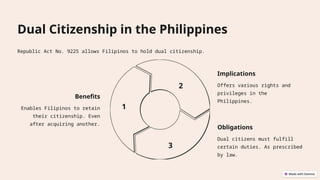
Republic Act No. 9225 allows Filipinos to hold dual citizenship.
Benefits
Enables Filipinos to retain
their citizenship. Even
after acquiring another.
1
Implications
Offers various rights and
privileges in the
Philippines.
2
Obligations
Dual citizens must fulfill
certain duties. As prescribed
by law.
3
7.
Losing and Reacquiring
Citizenship
Philippinecitizenship can be lost under specific circumstances.
Circumstances
Voluntary renunciation. Acquisition of foreign
citizenship. These can lead to loss of
citizenship.
Reacquiring Citizenship
Process available under Republic Act No. 9225.
Allows former citizens to regain their status.
Considerations
Important to understand the implications. Comply
with legal requirements.
8.
Significance of Philippine
Citizenship
UnderstandingPhilippine citizenship is vital for
Filipinos everywhere.
Learn more.
Explore available
resources. Stay
informed.
Value your
rights. Embrace
your
responsibilities.
Contribute to the
nation.
Seek assistance.
Contact
Philippine
embassies or
consulates. Get
guidance.