Understanding Operating Systems Fifth Edition Chapter 5 Process  Management
Learning Objectives Several causes of system deadlock The difference between preventing and avoiding deadlocks How to detect and recover from deadlocks The concept of process starvation and how to detect and recover from it The concept of a race and how to prevent it The difference between deadlock, starvation, and race Understanding Operating Systems, Fifth Edition
Deadlock Resource sharing Memory management and processor sharing Many programs competing for limited resources Lack of  process synchronization  consequences Deadlock:  “deadly embrace” Two or more  jobs placed in HOLD state Jobs waiting for unavailable  vital resource System comes to standstill Resolved via  external intervention Starvation Infinite postponement of job Understanding Operating Systems, Fifth Edition
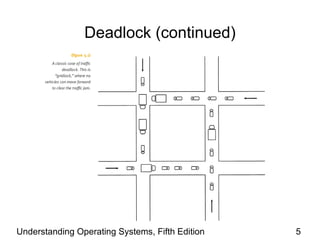
Deadlock (continued) More serious than starvation Affects entire system  Affects more than one job Not just a few programs All system resources become unavailable Example: traffic jam (Figure 5.1) More prevalent in interactive systems Real-time systems Deadlocks quickly become critical situations No simple and immediate solution Understanding Operating Systems, Fifth Edition
Deadlock (continued) Understanding Operating Systems, Fifth Edition
Seven Cases of Deadlock Nonsharable/nonpreemptable resources Allocated to jobs requiring same type of resources Resource types locked by competing jobs File requests Databases Dedicated device allocation Multiple device allocation  Spooling Disk sharing Network Understanding Operating Systems, Fifth Edition
Case 1: Deadlocks on File Requests Jobs request and hold files for execution duration Example (Figure 5.2) Two programs (P1, P2) and two files (F1, F2) Deadlock sequence P1 has access to F1 and also requires F2 P2 has access to F2 and also requires F1  Deadlock remains  Until one program withdrawn  or Until one program forcibly removed and file released Other programs requiring F1 or F2 Put on hold for duration of situation Understanding Operating Systems, Fifth Edition
Case 1: Deadlocks on File Requests  (continued) Understanding Operating Systems, Fifth Edition
Case 2: Deadlocks in Databases Two  processes   access and lock database records Locking Technique  One   user locks out all other users Users working with database Three locking levels Entire database for duration of request Subsection of database  Individual record  until request completed Understanding Operating Systems, Fifth Edition
Case 2: Deadlocks in Databases  (continued) Example: two processes (P1 and P2) Each needs to update two records (R1 and R2) Deadlock sequence P1 accesses R1 and locks it P2 accesses R2 and locks it P1 requests R2 but locked by P2 P2 requests R1 but locked by P1 Race between processes Results when locking not used  Causes incorrect final version of data Depends on process execution order Understanding Operating Systems, Fifth Edition
Case 2: Deadlocks in Databases  (continued) Understanding Operating Systems, Fifth Edition
Case 3: Deadlocks in Dedicated  Device Allocation Limited number   of dedicated devices Example Two   programs  (P1, P2) Need two tape drives each Only two tape drives in system Deadlock sequence P1 requests tape drive 1 and gets it P2 requests tape drive 2 and gets it P1 requests tape drive 2 but blocked P2 requests tape drive 1 but blocked Understanding Operating Systems, Fifth Edition
Case 4: Deadlocks in Multiple  Device Allocation Several processes request and hold dedicated devices Example (Figure 5.4) Three programs (P1, P2, P3) Three dedicated devices (tape drive, printer, plotter) Deadlock sequence P1 requests and gets tape drive P2 requests and gets printer P3 requests and gets the plotter P1 requests printer but blocked P2 requests plotter but blocked P3 requests tape drive but blocked Understanding Operating Systems, Fifth Edition
Case 4: Deadlocks in Multiple  Device Allocation (continued) Understanding Operating Systems, Fifth Edition
Case 5: Deadlocks in Spooling Virtual device Dedicated device  made sharable Example  Printer:  high-speed   disk device between printer and CPU Spooling Process Disk accepts output from several users Acts as temporary storage for output Output resides in disk area until printer accepts job data Understanding Operating Systems, Fifth Edition
Case 5: Deadlocks in Spooling (continued) Deadlock sequence Printer needs all job output before printing begins Spooling system fills disk space area No  one job has entire print output in spool area Results in partially completed output for all jobs Results in deadlock Understanding Operating Systems, Fifth Edition
Case 6: Deadlocks in a Network No network protocols controlling network message flow Example (Figure 5.5) Seven computers on network Each on different nodes Direction of arrows  Indicates message flow Deadlock sequence All available buffer space fills Understanding Operating Systems, Fifth Edition
Case 6: Deadlocks in a Network (continued) Understanding Operating Systems, Fifth Edition
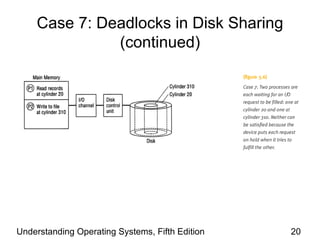
Case 7: Deadlocks in Disk Sharing Competing   processes send conflicting commands Scenario:  disk access Example (Figure 5.6) Two processes  Each process waiting for I/O request One  at cylinder 20 and   one at cylinder 310 Deadlock sequence Neither I/O request satisfied Device puts   request on hold   while attempting to fulfill other request for each request Livelock  results Understanding Operating Systems, Fifth Edition
Case 7: Deadlocks in Disk Sharing (continued) Understanding Operating Systems, Fifth Edition
Conditions for Deadlock Four conditions simultaneously occurring prior to deadlock or livelock Mutual exclusion Resource holding No preemption Circular wait All needed by operating system Must recognize simultaneous occurrence of four conditions Resolving deadlock Removal of one condition Understanding Operating Systems, Fifth Edition
Conditions for Deadlock (continued ) Mutual exclusion Allowing only one process access to dedicated resource Resource holding Holding resource and not releasing it Waiting for other job to retreat No preemption Lack of temporary reallocation of resources Understanding Operating Systems, Fifth Edition
Conditions for Deadlock (continued ) Circular wait Each process involved in impasse Waiting voluntarily resource release by another so at least one can continue All four required for deadlock occurrence Deadlock remains until one condition removed Understanding Operating Systems, Fifth Edition
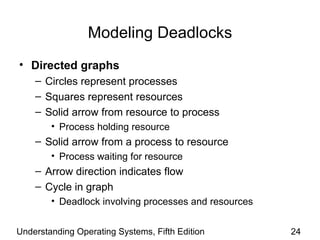
Modeling Deadlocks Directed graphs Circles represent processes  Squares represent resources Solid  arrow  from resource to process  Process   holding resource Solid  arrow  from a process to resource Process   waiting for resource Arrow direction indicates flow Cycle in graph Deadlock   involving processes and resources Understanding Operating Systems, Fifth Edition
Modeling Deadlocks (continued ) Understanding Operating Systems, Fifth Edition
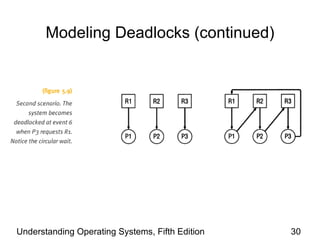
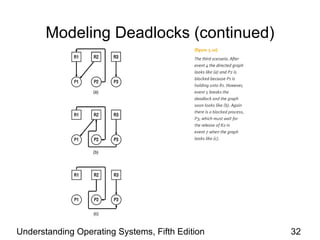
Modeling Deadlocks (continued ) Three graph scenarios to help detect deadlocks System has three processes (P1, P2, P3) System has three resources (R1, R2, R3) Scenario one: no deadlock Resources released before next process request Scenario two: deadlock Processes waiting for resource held by another Scenario three: no deadlock Resources released before deadlock Understanding Operating Systems, Fifth Edition
Modeling Deadlocks (continued ) No deadlock Resources released before next process request Understanding Operating Systems, Fifth Edition
Modeling Deadlocks (continued ) Understanding Operating Systems, Fifth Edition
Modeling Deadlocks (continued ) Deadlock Processes waiting for resource held by another Understanding Operating Systems, Fifth Edition
Modeling Deadlocks (continued ) Understanding Operating Systems, Fifth Edition
Modeling Deadlocks (continued ) No deadlock Resources released before deadlock Understanding Operating Systems, Fifth Edition
Modeling Deadlocks (continued ) Understanding Operating Systems, Fifth Edition
Modeling Deadlocks (continued ) Another example Resources of same type Allocated individually or grouped in same process Graph clusters devices into one entity Allocated individually or grouped in different process Graph clusters devices into one entity Understanding Operating Systems, Fifth Edition
Modeling Deadlocks (continued ) Understanding Operating Systems, Fifth Edition
Strategies for Handling Deadlocks Prevention Prevent occurrence of one condition Mutual exclusion, resource holding, no preemption, circular wait Avoidance Avoid deadlock if it becomes probable Detection Detect deadlock when it occurs Recover gracefully Recovery Resume system normalcy quickly and gracefully Understanding Operating Systems, Fifth Edition
Strategies for Handling Deadlocks (continued) Prevention  eliminates one of four conditions Complication: every resource cannot be eliminated from every condition Mutual exclusion Some resources must allocate exclusively Bypassed if I/O device uses spooling Resource holding  Bypassed if jobs request every necessary resource at creation time Multiprogramming degree significantly decreased Idle peripheral devices Understanding Operating Systems, Fifth Edition
Strategies for Handling Deadlocks (continued) Prevention (continued) No preemption  Bypassed if  operating system allowed to   deallocate resources from jobs Okay  if job state easily saved and restored Not accepted  to preempt dedicated I/O device or files during modification Circular wait  Bypassed if  operating system prevents circle formation Use  hierarchical ordering  scheme Require s  jobs to anticipate resource request order Difficult to satisfy all users Understanding Operating Systems, Fifth Edition
Strategies for Handling Deadlocks (continued) Avoidance:  use if condition cannot be removed System knows ahead of time  Sequence of   requests associated with each active process Dijkstra ’s  Bankers Algorithm  Regulate s  resources allocation to avoid deadlock No customer granted loan exceeding bank’s total capital All customers given maximum credit limit  No customer allowed to borrow over limit Sum of all loans will not exceed bank’s total capital Understanding Operating Systems, Fifth Edition
Strategies for Handling Deadlocks (continued) Understanding Operating Systems, Fifth Edition
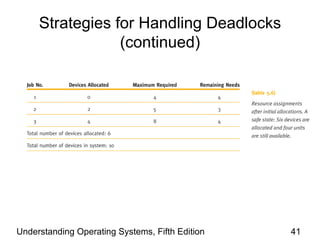
Strategies for Handling Deadlocks (continued) Operating systems deadlock avoidance assurances Never satisfy request if job state moves from safe  to  unsafe Identify job with smallest number of remaining resources N umber of available resources => number   needed for s elected  job to complete Block request jeopardizing safe state Understanding Operating Systems, Fifth Edition
Strategies for Handling Deadlocks (continued) Problems with the Banker’s Algorithm Jobs must state maximum number needed resources Requires constant number of total resources for each class  Number of jobs must remain fixed Possible high overhead cost incurred  Resources not well utilized Algorithm assumes worst case Scheduling suffers  Result of poor utilization Jobs kept waiting for resource allocation Understanding Operating Systems, Fifth Edition
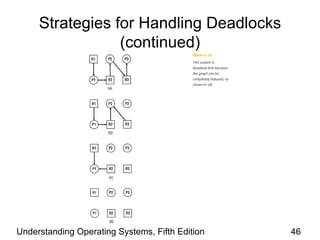
Strategies for Handling Deadlocks (continued) Detection:  build directed resource graphs  Look for cycles Algorithm detecting circularity  Executed whenever appropriate Detection algorithm Remove process using current resource and not waiting for one Remove process waiting for one resource class Not fully allocated Go back to step 1  Repeat steps 1 and 2 until all connecting lines removed Understanding Operating Systems, Fifth Edition
Strategies for Handling Deadlocks (continued) Understanding Operating Systems, Fifth Edition
Strategies for Handling Deadlocks (continued) Recovery Deadlock untangled  once  detected System returns to   normal  quickly All recovery methods have at least one victim Recovery methods Terminate every job   active in system Restart jobs from beginning Terminate only jobs involved in deadlock Ask users to resubmit jobs Identify jobs involved in deadlock Terminate   jobs one at a time Understanding Operating Systems, Fifth Edition
Strategies for Handling Deadlocks (continued) Recovery methods (continued) Interrupt jobs with record (snapshot) of progress Select nondeadlocked job Preempt its resources Allocate resources to deadlocked process Stop new jobs from entering system Allow nondeadlocked jobs to complete Releases resources when complete No victim Understanding Operating Systems, Fifth Edition
Strategies for Handling Deadlocks (continued) Factors to consider Select victim with least-negative effect on the system Most common Job priority under consideration: high-priority jobs usually untouched CPU time used by job: jobs close to completion usually left alone Number of other jobs affected if job   selected as victim Jobs modifying data: usually not selected for termination (a database issue) Understanding Operating Systems, Fifth Edition
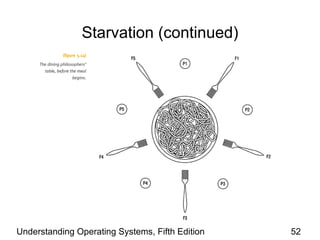
Starvation Job execution prevented Waiting for resources that never become available Results from conservative resource allocation Example “ The dining philosophers” by Dijkstra  Starvation avoidance Implement algorithm tracking how long each job waiting for resources (aging) Block new jobs until starving jobs satisfied Understanding Operating Systems, Fifth Edition
Starvation (continued) Understanding Operating Systems, Fifth Edition
Summary Operating system Dynamically allocates resources Avoids deadlock and starvation Four methods for dealing with deadlocks Prevention, avoidance, detection, recovery Prevention Remove simultaneous occurrence of one or more conditions  System will become deadlock-free Prevention algorithms  Complex algorithms and high execution overhead Understanding Operating Systems, Fifth Edition
Summary (continued) Avoid deadlocks Clearly identify safe and unsafe states Keep reserve  resources to guarantee job completion Disadvantage  System not fully utilized No prevention support  System  must detect  and  recover from deadlocks Detection  relies on selection of victim   Understanding Operating Systems, Fifth Edition

Understanding operating systems 5th ed ch05

  • 1.
    Understanding Operating SystemsFifth Edition Chapter 5 Process Management
  • 2.
    Learning Objectives Severalcauses of system deadlock The difference between preventing and avoiding deadlocks How to detect and recover from deadlocks The concept of process starvation and how to detect and recover from it The concept of a race and how to prevent it The difference between deadlock, starvation, and race Understanding Operating Systems, Fifth Edition
  • 3.
    Deadlock Resource sharingMemory management and processor sharing Many programs competing for limited resources Lack of process synchronization consequences Deadlock: “deadly embrace” Two or more jobs placed in HOLD state Jobs waiting for unavailable vital resource System comes to standstill Resolved via external intervention Starvation Infinite postponement of job Understanding Operating Systems, Fifth Edition
  • 4.
    Deadlock (continued) Moreserious than starvation Affects entire system Affects more than one job Not just a few programs All system resources become unavailable Example: traffic jam (Figure 5.1) More prevalent in interactive systems Real-time systems Deadlocks quickly become critical situations No simple and immediate solution Understanding Operating Systems, Fifth Edition
  • 5.
    Deadlock (continued) UnderstandingOperating Systems, Fifth Edition
  • 6.
    Seven Cases ofDeadlock Nonsharable/nonpreemptable resources Allocated to jobs requiring same type of resources Resource types locked by competing jobs File requests Databases Dedicated device allocation Multiple device allocation Spooling Disk sharing Network Understanding Operating Systems, Fifth Edition
  • 7.
    Case 1: Deadlockson File Requests Jobs request and hold files for execution duration Example (Figure 5.2) Two programs (P1, P2) and two files (F1, F2) Deadlock sequence P1 has access to F1 and also requires F2 P2 has access to F2 and also requires F1 Deadlock remains Until one program withdrawn or Until one program forcibly removed and file released Other programs requiring F1 or F2 Put on hold for duration of situation Understanding Operating Systems, Fifth Edition
  • 8.
    Case 1: Deadlockson File Requests (continued) Understanding Operating Systems, Fifth Edition
  • 9.
    Case 2: Deadlocksin Databases Two processes access and lock database records Locking Technique One user locks out all other users Users working with database Three locking levels Entire database for duration of request Subsection of database Individual record until request completed Understanding Operating Systems, Fifth Edition
  • 10.
    Case 2: Deadlocksin Databases (continued) Example: two processes (P1 and P2) Each needs to update two records (R1 and R2) Deadlock sequence P1 accesses R1 and locks it P2 accesses R2 and locks it P1 requests R2 but locked by P2 P2 requests R1 but locked by P1 Race between processes Results when locking not used Causes incorrect final version of data Depends on process execution order Understanding Operating Systems, Fifth Edition
  • 11.
    Case 2: Deadlocksin Databases (continued) Understanding Operating Systems, Fifth Edition
  • 12.
    Case 3: Deadlocksin Dedicated Device Allocation Limited number of dedicated devices Example Two programs (P1, P2) Need two tape drives each Only two tape drives in system Deadlock sequence P1 requests tape drive 1 and gets it P2 requests tape drive 2 and gets it P1 requests tape drive 2 but blocked P2 requests tape drive 1 but blocked Understanding Operating Systems, Fifth Edition
  • 13.
    Case 4: Deadlocksin Multiple Device Allocation Several processes request and hold dedicated devices Example (Figure 5.4) Three programs (P1, P2, P3) Three dedicated devices (tape drive, printer, plotter) Deadlock sequence P1 requests and gets tape drive P2 requests and gets printer P3 requests and gets the plotter P1 requests printer but blocked P2 requests plotter but blocked P3 requests tape drive but blocked Understanding Operating Systems, Fifth Edition
  • 14.
    Case 4: Deadlocksin Multiple Device Allocation (continued) Understanding Operating Systems, Fifth Edition
  • 15.
    Case 5: Deadlocksin Spooling Virtual device Dedicated device made sharable Example Printer: high-speed disk device between printer and CPU Spooling Process Disk accepts output from several users Acts as temporary storage for output Output resides in disk area until printer accepts job data Understanding Operating Systems, Fifth Edition
  • 16.
    Case 5: Deadlocksin Spooling (continued) Deadlock sequence Printer needs all job output before printing begins Spooling system fills disk space area No one job has entire print output in spool area Results in partially completed output for all jobs Results in deadlock Understanding Operating Systems, Fifth Edition
  • 17.
    Case 6: Deadlocksin a Network No network protocols controlling network message flow Example (Figure 5.5) Seven computers on network Each on different nodes Direction of arrows Indicates message flow Deadlock sequence All available buffer space fills Understanding Operating Systems, Fifth Edition
  • 18.
    Case 6: Deadlocksin a Network (continued) Understanding Operating Systems, Fifth Edition
  • 19.
    Case 7: Deadlocksin Disk Sharing Competing processes send conflicting commands Scenario: disk access Example (Figure 5.6) Two processes Each process waiting for I/O request One at cylinder 20 and one at cylinder 310 Deadlock sequence Neither I/O request satisfied Device puts request on hold while attempting to fulfill other request for each request Livelock results Understanding Operating Systems, Fifth Edition
  • 20.
    Case 7: Deadlocksin Disk Sharing (continued) Understanding Operating Systems, Fifth Edition
  • 21.
    Conditions for DeadlockFour conditions simultaneously occurring prior to deadlock or livelock Mutual exclusion Resource holding No preemption Circular wait All needed by operating system Must recognize simultaneous occurrence of four conditions Resolving deadlock Removal of one condition Understanding Operating Systems, Fifth Edition
  • 22.
    Conditions for Deadlock(continued ) Mutual exclusion Allowing only one process access to dedicated resource Resource holding Holding resource and not releasing it Waiting for other job to retreat No preemption Lack of temporary reallocation of resources Understanding Operating Systems, Fifth Edition
  • 23.
    Conditions for Deadlock(continued ) Circular wait Each process involved in impasse Waiting voluntarily resource release by another so at least one can continue All four required for deadlock occurrence Deadlock remains until one condition removed Understanding Operating Systems, Fifth Edition
  • 24.
    Modeling Deadlocks Directedgraphs Circles represent processes Squares represent resources Solid arrow from resource to process Process holding resource Solid arrow from a process to resource Process waiting for resource Arrow direction indicates flow Cycle in graph Deadlock involving processes and resources Understanding Operating Systems, Fifth Edition
  • 25.
    Modeling Deadlocks (continued) Understanding Operating Systems, Fifth Edition
  • 26.
    Modeling Deadlocks (continued) Three graph scenarios to help detect deadlocks System has three processes (P1, P2, P3) System has three resources (R1, R2, R3) Scenario one: no deadlock Resources released before next process request Scenario two: deadlock Processes waiting for resource held by another Scenario three: no deadlock Resources released before deadlock Understanding Operating Systems, Fifth Edition
  • 27.
    Modeling Deadlocks (continued) No deadlock Resources released before next process request Understanding Operating Systems, Fifth Edition
  • 28.
    Modeling Deadlocks (continued) Understanding Operating Systems, Fifth Edition
  • 29.
    Modeling Deadlocks (continued) Deadlock Processes waiting for resource held by another Understanding Operating Systems, Fifth Edition
  • 30.
    Modeling Deadlocks (continued) Understanding Operating Systems, Fifth Edition
  • 31.
    Modeling Deadlocks (continued) No deadlock Resources released before deadlock Understanding Operating Systems, Fifth Edition
  • 32.
    Modeling Deadlocks (continued) Understanding Operating Systems, Fifth Edition
  • 33.
    Modeling Deadlocks (continued) Another example Resources of same type Allocated individually or grouped in same process Graph clusters devices into one entity Allocated individually or grouped in different process Graph clusters devices into one entity Understanding Operating Systems, Fifth Edition
  • 34.
    Modeling Deadlocks (continued) Understanding Operating Systems, Fifth Edition
  • 35.
    Strategies for HandlingDeadlocks Prevention Prevent occurrence of one condition Mutual exclusion, resource holding, no preemption, circular wait Avoidance Avoid deadlock if it becomes probable Detection Detect deadlock when it occurs Recover gracefully Recovery Resume system normalcy quickly and gracefully Understanding Operating Systems, Fifth Edition
  • 36.
    Strategies for HandlingDeadlocks (continued) Prevention eliminates one of four conditions Complication: every resource cannot be eliminated from every condition Mutual exclusion Some resources must allocate exclusively Bypassed if I/O device uses spooling Resource holding Bypassed if jobs request every necessary resource at creation time Multiprogramming degree significantly decreased Idle peripheral devices Understanding Operating Systems, Fifth Edition
  • 37.
    Strategies for HandlingDeadlocks (continued) Prevention (continued) No preemption Bypassed if operating system allowed to deallocate resources from jobs Okay if job state easily saved and restored Not accepted to preempt dedicated I/O device or files during modification Circular wait Bypassed if operating system prevents circle formation Use hierarchical ordering scheme Require s jobs to anticipate resource request order Difficult to satisfy all users Understanding Operating Systems, Fifth Edition
  • 38.
    Strategies for HandlingDeadlocks (continued) Avoidance: use if condition cannot be removed System knows ahead of time Sequence of requests associated with each active process Dijkstra ’s Bankers Algorithm Regulate s resources allocation to avoid deadlock No customer granted loan exceeding bank’s total capital All customers given maximum credit limit No customer allowed to borrow over limit Sum of all loans will not exceed bank’s total capital Understanding Operating Systems, Fifth Edition
  • 39.
    Strategies for HandlingDeadlocks (continued) Understanding Operating Systems, Fifth Edition
  • 40.
    Strategies for HandlingDeadlocks (continued) Understanding Operating Systems, Fifth Edition
  • 41.
    Strategies for HandlingDeadlocks (continued) Understanding Operating Systems, Fifth Edition
  • 42.
    Strategies for HandlingDeadlocks (continued) Understanding Operating Systems, Fifth Edition
  • 43.
    Strategies for HandlingDeadlocks (continued) Operating systems deadlock avoidance assurances Never satisfy request if job state moves from safe to unsafe Identify job with smallest number of remaining resources N umber of available resources => number needed for s elected job to complete Block request jeopardizing safe state Understanding Operating Systems, Fifth Edition
  • 44.
    Strategies for HandlingDeadlocks (continued) Problems with the Banker’s Algorithm Jobs must state maximum number needed resources Requires constant number of total resources for each class Number of jobs must remain fixed Possible high overhead cost incurred Resources not well utilized Algorithm assumes worst case Scheduling suffers Result of poor utilization Jobs kept waiting for resource allocation Understanding Operating Systems, Fifth Edition
  • 45.
    Strategies for HandlingDeadlocks (continued) Detection: build directed resource graphs Look for cycles Algorithm detecting circularity Executed whenever appropriate Detection algorithm Remove process using current resource and not waiting for one Remove process waiting for one resource class Not fully allocated Go back to step 1 Repeat steps 1 and 2 until all connecting lines removed Understanding Operating Systems, Fifth Edition
  • 46.
    Strategies for HandlingDeadlocks (continued) Understanding Operating Systems, Fifth Edition
  • 47.
    Strategies for HandlingDeadlocks (continued) Understanding Operating Systems, Fifth Edition
  • 48.
    Strategies for HandlingDeadlocks (continued) Recovery Deadlock untangled once detected System returns to normal quickly All recovery methods have at least one victim Recovery methods Terminate every job active in system Restart jobs from beginning Terminate only jobs involved in deadlock Ask users to resubmit jobs Identify jobs involved in deadlock Terminate jobs one at a time Understanding Operating Systems, Fifth Edition
  • 49.
    Strategies for HandlingDeadlocks (continued) Recovery methods (continued) Interrupt jobs with record (snapshot) of progress Select nondeadlocked job Preempt its resources Allocate resources to deadlocked process Stop new jobs from entering system Allow nondeadlocked jobs to complete Releases resources when complete No victim Understanding Operating Systems, Fifth Edition
  • 50.
    Strategies for HandlingDeadlocks (continued) Factors to consider Select victim with least-negative effect on the system Most common Job priority under consideration: high-priority jobs usually untouched CPU time used by job: jobs close to completion usually left alone Number of other jobs affected if job selected as victim Jobs modifying data: usually not selected for termination (a database issue) Understanding Operating Systems, Fifth Edition
  • 51.
    Starvation Job executionprevented Waiting for resources that never become available Results from conservative resource allocation Example “ The dining philosophers” by Dijkstra Starvation avoidance Implement algorithm tracking how long each job waiting for resources (aging) Block new jobs until starving jobs satisfied Understanding Operating Systems, Fifth Edition
  • 52.
    Starvation (continued) UnderstandingOperating Systems, Fifth Edition
  • 53.
    Starvation (continued) UnderstandingOperating Systems, Fifth Edition
  • 54.
    Summary Operating systemDynamically allocates resources Avoids deadlock and starvation Four methods for dealing with deadlocks Prevention, avoidance, detection, recovery Prevention Remove simultaneous occurrence of one or more conditions System will become deadlock-free Prevention algorithms Complex algorithms and high execution overhead Understanding Operating Systems, Fifth Edition
  • 55.
    Summary (continued) Avoiddeadlocks Clearly identify safe and unsafe states Keep reserve resources to guarantee job completion Disadvantage System not fully utilized No prevention support System must detect and recover from deadlocks Detection relies on selection of victim Understanding Operating Systems, Fifth Edition