Understanding
Java byte code
and the class file format
0xCAFEBABE
source code
byte code
JVM
javac scalac groovyc jrubyc
JIT compilerinterpreter
class loader
creates
reads
runs
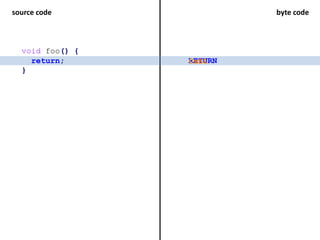
source code byte code
void foo() {
}
RETURNreturn; 0xB1
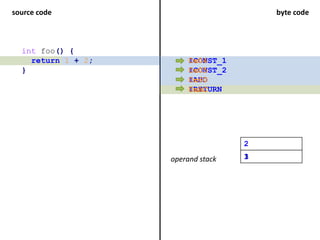
source code byte code
int foo() {
return 1 + 2;
}
ICONST_1
ICONST_2
IADD
operand stack 1
2
13
IRETURN
0x04
0x05
0x60
0xAC
source code byte code
ICONST_2
IADD
IRETURN
BIPUSH
int foo() {
return 11 + 2;
}
operand stack 11
2
1113
0x05
0x60
0xAC
0x10 110x0B
source code byte code
int foo(int i) {
return i + 1;
}
ILOAD_1
ICONST_1
IADD
IRETURN
operand stack
local variable array
1 : i
0 : this
i
1
ii + 1
0x1B
0x04
0x60
0xAC
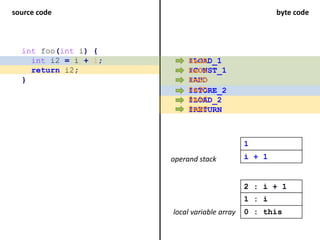
source code byte code
ILOAD_1
ICONST_1
IADD
operand stack
local variable array
1 : i
0 : this
1
i
int foo(int i) {
int i2 = i + 1;
return i2;
}
ISTORE_2
ILOAD_2
IRETURN
2 : i + 1
ii + 1
2 :2 : i + 1
0x1B
0x04
0x60
0x3D
0x1C
0xAC
source code byte code
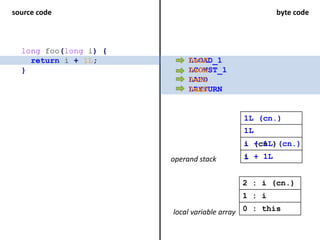
long foo(long i) {
return i + 1L;
}
LLOAD_1
LCONST_1
LADD
LRETURN
operand stack
local variable array
2 : i (cn.)
1 : i
0 : this
i (cn.)
i
0x1F
0x0A
0x61
0xAD
i (cn.)
i
1L
1L (cn.)
i + 1L
i + 1L (cn.)
source code byte code
short foo(short i) {
return (short) (i + 1);
}
ILOAD_1
ICONST_1
IADD
I2S
IRETURN
operand stack
local variable array
1 : i
0 : this
1
iii + 1
0x1B
0x04
0x60
0x93
0xAC
Java type JVM type (non-array) JVM descriptor stack slots
boolean
I
Z 1
byte B 1
short S 1
char C 1
int I 1
long L J 2
float F F 1
double D D 2
void - V 0
java.lang.Object A Ljava/lang/Object; 1
source code byte code
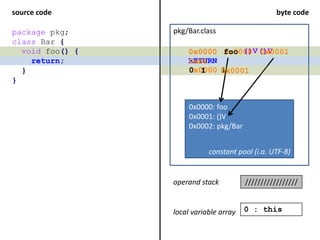
pkg/Bar.class
void foo() {
return;
}
RETURN
package pkg;
class Bar {
}
constant pool (i.a. UTF-8)
0x0000
0x0000: foo
0x0001: ()V
0x0002: pkg/Bar
0xB1
0x0000 0x0000foo ()V()V0x0001
0x00000 1 10x0001
operand stack /////////////////
local variable array 0 : this
source code byte code
package pkg;
class Bar {
public static void foo() {
return;
}
}
RETURN
0x0009
operand stack /////////////////
local variable array /////////////////
0 0
Modifier Value
static 0x0008
public 0x0001
0x0009
constant pool
0xB1
0x0000 0x0000
0x0000 0x0001foo ()V
source code byte code
package pkg;
class Bar {
int foo(int i) {
return foo(i + 1);
}
}
ILOAD_1
ICONST_1
IADD
INVOKEVIRTUAL pkg/Bar foo (I)I
ALOAD_0
IRETURN
operand stack
local variable array
1 : i
0 : this
this
i
1
this
ii + 1
foo(i + 1)
0x2A
0x1B
0x04
0x60
0xAC
0xB6
constant pool
0x0002 0x0000 0x0001
source code byte code
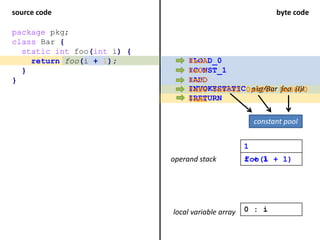
package pkg;
class Bar {
static int foo(int i) {
return foo(i + 1);
}
}
ILOAD_0
ICONST_1
IADD
INVOKESTATIC pkg/Bar foo (I)I
IRETURN
operand stack
local variable array 0 : i
i
1
ii + 1foo(i + 1)
0x1A
0x04
0x60
0xB8 0x0002 0x0001 0x0000
0xAC
constant pool
source code byte code
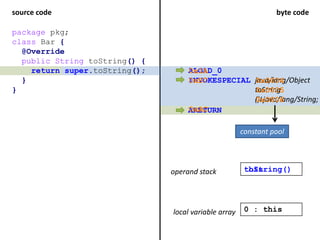
package pkg;
class Bar {
@Override
public String toString() {
return super.toString();
}
}
ALOAD_0
INVOKESPECIAL java/lang/Object
toString
()Ljava/lang/String;
ARETURN
operand stack
local variable array 0 : this
thistoString()
0x1A
0xB7 0x0004
0x0005
0x0006
0xAC
constant pool
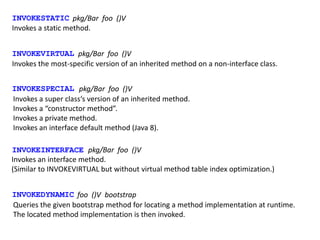
INVOKESPECIAL
INVOKEVIRTUAL
INVOKESTATIC
INVOKEINTERFACE
INVOKEDYNAMIC
Invokes a static method.
pkg/Bar foo ()V
pkg/Bar foo ()V
Invokes the most-specific version of an inherited method on a non-interface class.
pkg/Bar foo ()V
Invokes a super class‘s version of an inherited method.
Invokes a “constructor method”.
Invokes a private method.
Invokes an interface default method (Java 8).
pkg/Bar foo ()V
Invokes an interface method.
(Similar to INVOKEVIRTUAL but without virtual method table index optimization.)
foo ()V bootstrap
Queries the given bootstrap method for locating a method implementation at runtime.
(MethodHandle: Combines a specific method and an INVOKE* instruction.)
void foo() {
???(); // invokedynamic
}
foo() ? qux()
bootstrap()
bar()
void foo() {
bar();
}
In theory, this could be achieved by using reflection. However, using invokedynamic
offers a more native approach. This is especially important when dealing with
primitive types (double boxing).
Used to implement lambda expressions, more important for dynamic languages.
source code byte code
0x1A
0x06
0xA4
0x03
0xAC
0x1A
0x04
0x60
0xB8 0x0002 0x0000 0x0001
0xAC
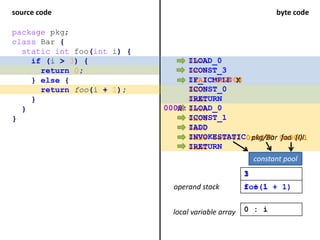
package pkg;
class Bar {
static int foo(int i) {
if (i > 3) {
return 0;
} else {
return foo(i + 1);
}
}
}
ILOAD_0
ICONST_3
IF_ICMPLE
ICONST_0
IRETURN
ILOAD_0
ICONST_1
IADD
INVOKESTATIC
IRETURN
pkg/Bar foo (I)I
X
X:
operand stack
local variable array 0 : i
i
3
i
1
i + 1foo(i + 1)
constant pool
0x0008
0008:
java.lang.VerifyError: Inconsistent stackmap frames at branch
target XXX in method pkg.Bar.foo(I)I
at offset YYY
type inferencing
(until Java 5, failover for Java 6)
Follow any possible path of jump
instructions: Assert the consistency of the
contents of the operand stack and local
variable array for any possible path.
Inference might require several iterations
over a method‘s byte code.
Legacy: -XX:-UseSplitVerifier
type checking
(from Java 6)
The verifier rejects malformed class files and byte code:
• compliance to class file format
• type safety
• access violations
Require the otherwise infered information
about the contents of the operand stack
and the local variable array to be
embedded in the code as stack map frames
at any target of a jump instruction.
Checking requires exactly one iteration over
a method‘s byte code.
source code byte code
int foo() {
try {
return 1;
} catch (Exception e) {
return 0;
}
}
ICONST_1
IRETURN
ICONST_0
IRETURN
exception table:
0000:
0001:
0002:
0003:
<from> <to> <catch> java/lang/Exception0x0000 0x0001 0x0002
constant pool
0x0005
0x04
0xAC
0x03
0xAC
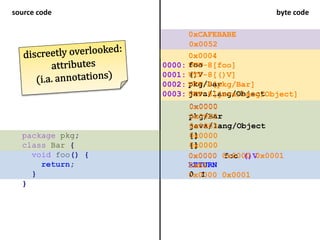
source code byte code
package pkg;
class Bar {
void foo() {
return;
}
}
RETURN
0x0000 foo ()V
0 1
foo
()V
pkg/Bar
java/lang/Object
0x0000
pkg/Bar
java/lang/Object
[]
[]
0xCAFEBABE
0x0052
0000:
0001:
0002:
0003:
0x0000
0x0002
0x0003
0x0000
0x0000
0x0000 0x0000 0x0001
0xB1
0x0000 0x0001
UTF-8[foo]
UTF-8[()V]
UTF-8[pkg/Bar]
UTF-8[java/lang/Object]
0x0004
class Service {
@Secured(user = "ADMIN")
void deleteEverything() {
if(!"ADMIN".equals(UserHolder.user)) {
throw new IllegalStateException("Wrong user");
}
// delete everything...
}
}
redefine class
(build time, agent)
create subclass
(Liskov substitution)
class SecuredService extends Service {
@Override
void deleteEverything() {
if(!"ADMIN".equals(UserHolder.user)) {
throw new IllegalStateException("Wrong user");
}
super.deleteEverything();
}
}
class Service {
@Secured(user = "ADMIN")
void deleteEverything() {
// delete everything...
}
}
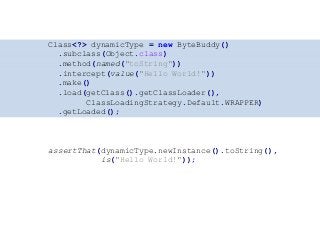
Class<?> dynamicType = new ByteBuddy()
.subclass(Object.class)
.method(named("toString"))
.intercept(value("Hello World!"))
.make()
.load(getClass().getClassLoader(),
ClassLoadingStrategy.Default.WRAPPER)
.getLoaded();
assertThat(dynamicType.newInstance().toString(),
is("Hello World!"));
http://rafael.codes
@rafaelcodes
http://documents4j.com
https://github.com/documents4j/documents4j
http://bytebuddy.net
https://github.com/raphw/byte-buddy

Understanding Java byte code and the class file format

  • 1.
    Understanding Java byte code andthe class file format
  • 2.
    0xCAFEBABE source code byte code JVM javacscalac groovyc jrubyc JIT compilerinterpreter class loader creates reads runs
  • 3.
    source code bytecode void foo() { } RETURNreturn; 0xB1
  • 4.
    source code bytecode int foo() { return 1 + 2; } ICONST_1 ICONST_2 IADD operand stack 1 2 13 IRETURN 0x04 0x05 0x60 0xAC
  • 5.
    source code bytecode ICONST_2 IADD IRETURN BIPUSH int foo() { return 11 + 2; } operand stack 11 2 1113 0x05 0x60 0xAC 0x10 110x0B
  • 6.
    source code bytecode int foo(int i) { return i + 1; } ILOAD_1 ICONST_1 IADD IRETURN operand stack local variable array 1 : i 0 : this i 1 ii + 1 0x1B 0x04 0x60 0xAC
  • 7.
    source code bytecode ILOAD_1 ICONST_1 IADD operand stack local variable array 1 : i 0 : this 1 i int foo(int i) { int i2 = i + 1; return i2; } ISTORE_2 ILOAD_2 IRETURN 2 : i + 1 ii + 1 2 :2 : i + 1 0x1B 0x04 0x60 0x3D 0x1C 0xAC
  • 8.
    source code bytecode long foo(long i) { return i + 1L; } LLOAD_1 LCONST_1 LADD LRETURN operand stack local variable array 2 : i (cn.) 1 : i 0 : this i (cn.) i 0x1F 0x0A 0x61 0xAD i (cn.) i 1L 1L (cn.) i + 1L i + 1L (cn.)
  • 9.
    source code bytecode short foo(short i) { return (short) (i + 1); } ILOAD_1 ICONST_1 IADD I2S IRETURN operand stack local variable array 1 : i 0 : this 1 iii + 1 0x1B 0x04 0x60 0x93 0xAC
  • 10.
    Java type JVMtype (non-array) JVM descriptor stack slots boolean I Z 1 byte B 1 short S 1 char C 1 int I 1 long L J 2 float F F 1 double D D 2 void - V 0 java.lang.Object A Ljava/lang/Object; 1
  • 11.
    source code bytecode pkg/Bar.class void foo() { return; } RETURN package pkg; class Bar { } constant pool (i.a. UTF-8) 0x0000 0x0000: foo 0x0001: ()V 0x0002: pkg/Bar 0xB1 0x0000 0x0000foo ()V()V0x0001 0x00000 1 10x0001 operand stack ///////////////// local variable array 0 : this
  • 12.
    source code bytecode package pkg; class Bar { public static void foo() { return; } } RETURN 0x0009 operand stack ///////////////// local variable array ///////////////// 0 0 Modifier Value static 0x0008 public 0x0001 0x0009 constant pool 0xB1 0x0000 0x0000 0x0000 0x0001foo ()V
  • 13.
    source code bytecode package pkg; class Bar { int foo(int i) { return foo(i + 1); } } ILOAD_1 ICONST_1 IADD INVOKEVIRTUAL pkg/Bar foo (I)I ALOAD_0 IRETURN operand stack local variable array 1 : i 0 : this this i 1 this ii + 1 foo(i + 1) 0x2A 0x1B 0x04 0x60 0xAC 0xB6 constant pool 0x0002 0x0000 0x0001
  • 14.
    source code bytecode package pkg; class Bar { static int foo(int i) { return foo(i + 1); } } ILOAD_0 ICONST_1 IADD INVOKESTATIC pkg/Bar foo (I)I IRETURN operand stack local variable array 0 : i i 1 ii + 1foo(i + 1) 0x1A 0x04 0x60 0xB8 0x0002 0x0001 0x0000 0xAC constant pool
  • 15.
    source code bytecode package pkg; class Bar { @Override public String toString() { return super.toString(); } } ALOAD_0 INVOKESPECIAL java/lang/Object toString ()Ljava/lang/String; ARETURN operand stack local variable array 0 : this thistoString() 0x1A 0xB7 0x0004 0x0005 0x0006 0xAC constant pool
  • 16.
    INVOKESPECIAL INVOKEVIRTUAL INVOKESTATIC INVOKEINTERFACE INVOKEDYNAMIC Invokes a staticmethod. pkg/Bar foo ()V pkg/Bar foo ()V Invokes the most-specific version of an inherited method on a non-interface class. pkg/Bar foo ()V Invokes a super class‘s version of an inherited method. Invokes a “constructor method”. Invokes a private method. Invokes an interface default method (Java 8). pkg/Bar foo ()V Invokes an interface method. (Similar to INVOKEVIRTUAL but without virtual method table index optimization.) foo ()V bootstrap Queries the given bootstrap method for locating a method implementation at runtime. (MethodHandle: Combines a specific method and an INVOKE* instruction.)
  • 17.
    void foo() { ???();// invokedynamic } foo() ? qux() bootstrap() bar() void foo() { bar(); } In theory, this could be achieved by using reflection. However, using invokedynamic offers a more native approach. This is especially important when dealing with primitive types (double boxing). Used to implement lambda expressions, more important for dynamic languages.
  • 18.
    source code bytecode 0x1A 0x06 0xA4 0x03 0xAC 0x1A 0x04 0x60 0xB8 0x0002 0x0000 0x0001 0xAC package pkg; class Bar { static int foo(int i) { if (i > 3) { return 0; } else { return foo(i + 1); } } } ILOAD_0 ICONST_3 IF_ICMPLE ICONST_0 IRETURN ILOAD_0 ICONST_1 IADD INVOKESTATIC IRETURN pkg/Bar foo (I)I X X: operand stack local variable array 0 : i i 3 i 1 i + 1foo(i + 1) constant pool 0x0008 0008:
  • 19.
    java.lang.VerifyError: Inconsistent stackmapframes at branch target XXX in method pkg.Bar.foo(I)I at offset YYY type inferencing (until Java 5, failover for Java 6) Follow any possible path of jump instructions: Assert the consistency of the contents of the operand stack and local variable array for any possible path. Inference might require several iterations over a method‘s byte code. Legacy: -XX:-UseSplitVerifier type checking (from Java 6) The verifier rejects malformed class files and byte code: • compliance to class file format • type safety • access violations Require the otherwise infered information about the contents of the operand stack and the local variable array to be embedded in the code as stack map frames at any target of a jump instruction. Checking requires exactly one iteration over a method‘s byte code.
  • 20.
    source code bytecode int foo() { try { return 1; } catch (Exception e) { return 0; } } ICONST_1 IRETURN ICONST_0 IRETURN exception table: 0000: 0001: 0002: 0003: <from> <to> <catch> java/lang/Exception0x0000 0x0001 0x0002 constant pool 0x0005 0x04 0xAC 0x03 0xAC
  • 21.
    source code bytecode package pkg; class Bar { void foo() { return; } } RETURN 0x0000 foo ()V 0 1 foo ()V pkg/Bar java/lang/Object 0x0000 pkg/Bar java/lang/Object [] [] 0xCAFEBABE 0x0052 0000: 0001: 0002: 0003: 0x0000 0x0002 0x0003 0x0000 0x0000 0x0000 0x0000 0x0001 0xB1 0x0000 0x0001 UTF-8[foo] UTF-8[()V] UTF-8[pkg/Bar] UTF-8[java/lang/Object] 0x0004
  • 22.
    class Service { @Secured(user= "ADMIN") void deleteEverything() { if(!"ADMIN".equals(UserHolder.user)) { throw new IllegalStateException("Wrong user"); } // delete everything... } } redefine class (build time, agent) create subclass (Liskov substitution) class SecuredService extends Service { @Override void deleteEverything() { if(!"ADMIN".equals(UserHolder.user)) { throw new IllegalStateException("Wrong user"); } super.deleteEverything(); } } class Service { @Secured(user = "ADMIN") void deleteEverything() { // delete everything... } }
  • 23.
    Class<?> dynamicType =new ByteBuddy() .subclass(Object.class) .method(named("toString")) .intercept(value("Hello World!")) .make() .load(getClass().getClassLoader(), ClassLoadingStrategy.Default.WRAPPER) .getLoaded(); assertThat(dynamicType.newInstance().toString(), is("Hello World!"));
  • 24.