ARGUMENT
W H A T I S A N A R G U M E N T ?
Prepared by:
Juvelyn B. Binondo
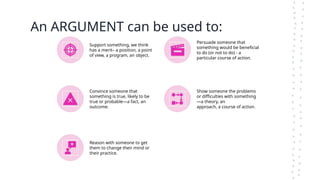
An ARGUMENT can be used to:
Support something, we think
has a merit– a position, a point
of view, a program, an object.
Persuade someone that
something would be beneficial
to do (or not to do) - a
particular course of action.
Convince someone that
something is true, likely to be
true or probable—a fact, an
outcome.
Show someone the problems
or difficulties with something
—a theory, an
approach, a course of action.
Reason with someone to get
them to change their mind or
their practice.
An ARGUMENT
is NOT:
• a statement of fact (i.e. Cebu is the Queen
City of the South.)
• an assertion or claim (i.e. Wearing a seatbelt
reduces the risk of injury.)
• a prescriptive statement (i.e. The
Government should spend more
money on healthcare.)
• a conditional statement (i.e. If you drink,
you will damage your brain.)
• a series of statements about the same thing.
An ARGUMENT IS:
• a group of statements of which one
is a proposition or claim that is
supported by at least one of the
other statements
Example:
Drinking water daily is good for your
health as it cleans out your liver and
reduces the level of toxins in your blood.
PURPOSE
The purpose of an argument is to get others to
believe what it is you are
asserting or claiming. You need to use an argument
when the point you are making may not be well known
or may not be well accepted or where you know there
is some disagreement or alternative perspective,
because of these, you have to give reasons to support
your position.
The Toulmin Model
of Argument
Stephen Toulmin indicates three
major, necessary parts of an argument—
the claim, the support, and the
warrants.
CLAIM
This is the main point, the thesis,
the controlling idea. The claim may be
directly stated (usually at the first of a
text, but sometimes at the end, especially
for effect) or the claim may be implied.
You can find the claim by asking the
question, "What is the author trying to
prove?"
SUPPORT
These are the reasons given in
support of the claim; they are also known
as evidence, proof, data, arguments, or
grounds. The support of a claim can
come in the form of facts and statistics,
expert opinions, examples, explanations,
and logical reasoning. You can find the
support by asking, "What does the author
say to persuade the reader of the claim?"
WARRANTS
These are the assumptions or
presuppositions underlying the argument.
Warrants are generally accepted beliefs and
values, common ways our culture or society
views things; because they are so commonplace,
warrants are almost always unstated and implied.
The author and audience may either share these
beliefs, or the author’s warrants may be in
conflict with audience’s generally held beliefs
and cultural norms and values.
WARRANTS
Warrants are important because they
are the "common ground" of author and
audience; shared warrants invite the
audience to participate by unconsciously
supplying part of the argument. Warrants are
also important because they provide the
underlying reasons linking the claim and the
support. You can infer the warrants by
asking, "What’s causing the author to say the
things s/he does?" or "Where’s the author
coming from?"
Here’s an example:
Claim
Universities should reinstate affirmative action admissions.
Support
Affirmative action provides equal access to education policies
for all ethnic groups.
Warrant
Equality of access is a basic American value.
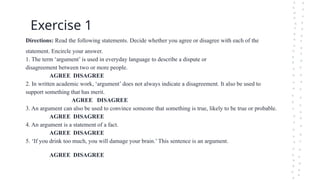
Exercise 1
Directions: Read the following statements. Decide whether you agree or disagree with each of the
statement. Encircle your answer.
1. The term ‘argument’ is used in everyday language to describe a dispute or
disagreement between two or more people.
AGREE DISAGREE
2. In written academic work, ‘argument’ does not always indicate a disagreement. It also be used to
support something that has merit.
AGREE DISAGREE
3. An argument can also be used to convince someone that something is true, likely to be true or probable.
AGREE DISAGREE
4. An argument is a statement of a fact.
AGREE DISAGREE
5. ‘If you drink too much, you will damage your brain.’ This sentence is an argument.
AGREE DISAGREE
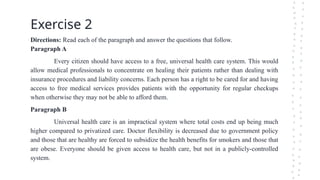
Exercise 2
Directions: Read each of the paragraph and answer the questions that follow.
Paragraph A
Every citizen should have access to a free, universal health care system. This would
allow medical professionals to concentrate on healing their patients rather than dealing with
insurance procedures and liability concerns. Each person has a right to be cared for and having
access to free medical services provides patients with the opportunity for regular checkups
when otherwise they may not be able to afford them.
Paragraph B
Universal health care is an impractical system where total costs end up being much
higher compared to privatized care. Doctor flexibility is decreased due to government policy
and those that are healthy are forced to subsidize the health benefits for smokers and those that
are obese. Everyone should be given access to health care, but not in a publicly-controlled
system.
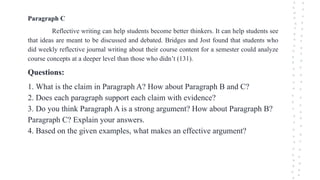
Paragraph C
Reflective writing can help students become better thinkers. It can help students see
that ideas are meant to be discussed and debated. Bridges and Jost found that students who
did weekly reflective journal writing about their course content for a semester could analyze
course concepts at a deeper level than those who didn’t (131).
Questions:
1. What is the claim in Paragraph A? How about Paragraph B and C?
2. Does each paragraph support each claim with evidence?
3. Do you think Paragraph A is a strong argument? How about Paragraph B?
Paragraph C? Explain your answers.
4. Based on the given examples, what makes an effective argument?
What is a POSITION PAPER?
• A position paper presents the writer’s
stand or viewpoint on a particular issue.
• You have the power to change the
opinions and attitudes of others when
you write a position paper.
• A position paper can be an essential
tool in bringing about societal change.
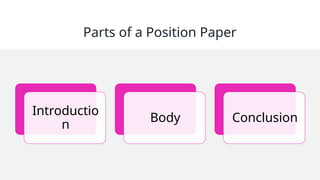
Parts of a Position Paper
Introductio
n
Body Conclusion
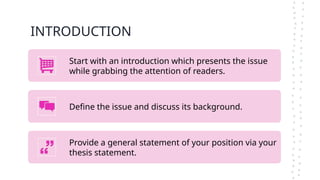
INTRODUCTION
Start with an introduction which presents the issue
while grabbing the attention of readers.
Define the issue and discuss its background.
Provide a general statement of your position via your
thesis statement.
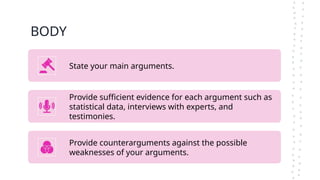
BODY
State your main arguments.
Provide sufficient evidence for each argument such as
statistical data, interviews with experts, and
testimonies.
Provide counterarguments against the possible
weaknesses of your arguments.
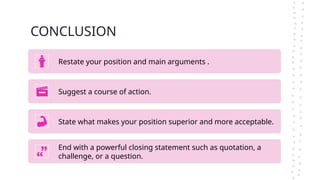
CONCLUSION
Restate your position and main arguments .
Suggest a course of action.
State what makes your position superior and more acceptable.
End with a powerful closing statement such as quotation, a
challenge, or a question.
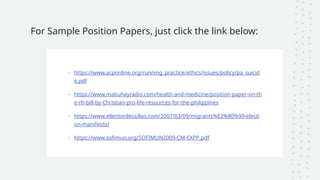
For Sample Position Papers, just click the link below:
• https://www.acponline.org/running_practice/ethics/issues/policy/pa_suicid
e.pdf
• https://www.mabuhayradio.com/health-and-medicine/position-paper-on-th
e-rh-bill-by-Christian-pro-life-resources-for-the-philippines
• https://www.ellentordessillas.com/2007/03/09/migrants%E2%80%99-electi
on-manifesto/
• https://www.sofimun.org/SOFIMUN2009-CM-EXPP.pdf
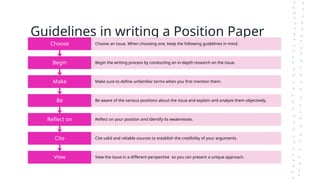
Guidelines in writing a Position Paper
View View the issue in a different perspective so you can present a unique approach.
Cite Cite valid and reliable sources to establish the credibility of your arguments.
Reflect on Reflect on your position and identify its weaknesses.
Be Be aware of the various positions about the issue and explain and analyze them objectively.
Make Make sure to define unfamiliar terms when you first mention them.
Begin Begin the writing process by conducting an in-depth research on the issue.
Choose Choose an issue. When choosing one, keep the following guidelines in mind.
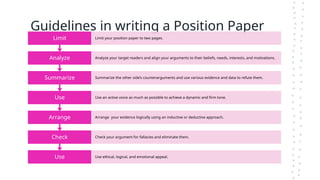
Guidelines in writing a Position Paper
Use Use ethical, logical, and emotional appeal.
Check Check your argument for fallacies and eliminate them.
Arrange Arrange your evidence logically using an inductive or deductive approach.
Use Use an active voice as much as possible to achieve a dynamic and firm tone.
Summarize Summarize the other side’s counterarguments and use various evidence and data to refute them.
Analyze Analyze your target readers and align your arguments to their beliefs, needs, interests, and motivations.
Limit Limit your position paper to two pages.
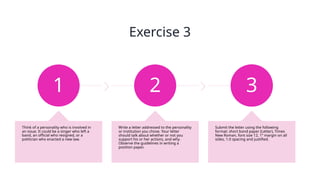
Exercise 3
1
Think of a personality who is involved in
an issue. It could be a singer who left a
band, an official who resigned, or a
politician who enacted a new law.
2
Write a letter addressed to the personality
or institution you chose. Your letter
should talk about whether or not you
support his or her actions, and why.
Observe the guidelines in writing a
position paper.
3
Submit the letter using the following
format: short bond paper (Letter), Times
New Roman, font size 12, 1” margin on all
sides, 1.0 spacing and justified.
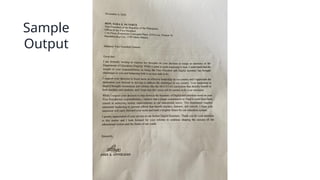
Sample
Output
Any Questions?
Raise your words,
not your voice.
It is rain that grows
flowers, not thunder.
-RUMI
Thank you for listening!
Be safe and God Bless, everyone!

Understanding Argument and Position Paper.pptx

  • 1.
    ARGUMENT W H AT I S A N A R G U M E N T ? Prepared by: Juvelyn B. Binondo
  • 2.
    An ARGUMENT canbe used to: Support something, we think has a merit– a position, a point of view, a program, an object. Persuade someone that something would be beneficial to do (or not to do) - a particular course of action. Convince someone that something is true, likely to be true or probable—a fact, an outcome. Show someone the problems or difficulties with something —a theory, an approach, a course of action. Reason with someone to get them to change their mind or their practice.
  • 3.
    An ARGUMENT is NOT: •a statement of fact (i.e. Cebu is the Queen City of the South.) • an assertion or claim (i.e. Wearing a seatbelt reduces the risk of injury.) • a prescriptive statement (i.e. The Government should spend more money on healthcare.) • a conditional statement (i.e. If you drink, you will damage your brain.) • a series of statements about the same thing.
  • 4.
    An ARGUMENT IS: •a group of statements of which one is a proposition or claim that is supported by at least one of the other statements Example: Drinking water daily is good for your health as it cleans out your liver and reduces the level of toxins in your blood.
  • 5.
    PURPOSE The purpose ofan argument is to get others to believe what it is you are asserting or claiming. You need to use an argument when the point you are making may not be well known or may not be well accepted or where you know there is some disagreement or alternative perspective, because of these, you have to give reasons to support your position.
  • 6.
    The Toulmin Model ofArgument Stephen Toulmin indicates three major, necessary parts of an argument— the claim, the support, and the warrants.
  • 7.
    CLAIM This is themain point, the thesis, the controlling idea. The claim may be directly stated (usually at the first of a text, but sometimes at the end, especially for effect) or the claim may be implied. You can find the claim by asking the question, "What is the author trying to prove?"
  • 8.
    SUPPORT These are thereasons given in support of the claim; they are also known as evidence, proof, data, arguments, or grounds. The support of a claim can come in the form of facts and statistics, expert opinions, examples, explanations, and logical reasoning. You can find the support by asking, "What does the author say to persuade the reader of the claim?"
  • 9.
    WARRANTS These are theassumptions or presuppositions underlying the argument. Warrants are generally accepted beliefs and values, common ways our culture or society views things; because they are so commonplace, warrants are almost always unstated and implied. The author and audience may either share these beliefs, or the author’s warrants may be in conflict with audience’s generally held beliefs and cultural norms and values.
  • 10.
    WARRANTS Warrants are importantbecause they are the "common ground" of author and audience; shared warrants invite the audience to participate by unconsciously supplying part of the argument. Warrants are also important because they provide the underlying reasons linking the claim and the support. You can infer the warrants by asking, "What’s causing the author to say the things s/he does?" or "Where’s the author coming from?"
  • 11.
    Here’s an example: Claim Universitiesshould reinstate affirmative action admissions. Support Affirmative action provides equal access to education policies for all ethnic groups. Warrant Equality of access is a basic American value.
  • 12.
    Exercise 1 Directions: Readthe following statements. Decide whether you agree or disagree with each of the statement. Encircle your answer. 1. The term ‘argument’ is used in everyday language to describe a dispute or disagreement between two or more people. AGREE DISAGREE 2. In written academic work, ‘argument’ does not always indicate a disagreement. It also be used to support something that has merit. AGREE DISAGREE 3. An argument can also be used to convince someone that something is true, likely to be true or probable. AGREE DISAGREE 4. An argument is a statement of a fact. AGREE DISAGREE 5. ‘If you drink too much, you will damage your brain.’ This sentence is an argument. AGREE DISAGREE
  • 13.
    Exercise 2 Directions: Readeach of the paragraph and answer the questions that follow. Paragraph A Every citizen should have access to a free, universal health care system. This would allow medical professionals to concentrate on healing their patients rather than dealing with insurance procedures and liability concerns. Each person has a right to be cared for and having access to free medical services provides patients with the opportunity for regular checkups when otherwise they may not be able to afford them. Paragraph B Universal health care is an impractical system where total costs end up being much higher compared to privatized care. Doctor flexibility is decreased due to government policy and those that are healthy are forced to subsidize the health benefits for smokers and those that are obese. Everyone should be given access to health care, but not in a publicly-controlled system.
  • 14.
    Paragraph C Reflective writingcan help students become better thinkers. It can help students see that ideas are meant to be discussed and debated. Bridges and Jost found that students who did weekly reflective journal writing about their course content for a semester could analyze course concepts at a deeper level than those who didn’t (131). Questions: 1. What is the claim in Paragraph A? How about Paragraph B and C? 2. Does each paragraph support each claim with evidence? 3. Do you think Paragraph A is a strong argument? How about Paragraph B? Paragraph C? Explain your answers. 4. Based on the given examples, what makes an effective argument?
  • 15.
    What is aPOSITION PAPER?
  • 16.
    • A positionpaper presents the writer’s stand or viewpoint on a particular issue. • You have the power to change the opinions and attitudes of others when you write a position paper. • A position paper can be an essential tool in bringing about societal change.
  • 17.
    Parts of aPosition Paper Introductio n Body Conclusion
  • 18.
    INTRODUCTION Start with anintroduction which presents the issue while grabbing the attention of readers. Define the issue and discuss its background. Provide a general statement of your position via your thesis statement.
  • 19.
    BODY State your mainarguments. Provide sufficient evidence for each argument such as statistical data, interviews with experts, and testimonies. Provide counterarguments against the possible weaknesses of your arguments.
  • 20.
    CONCLUSION Restate your positionand main arguments . Suggest a course of action. State what makes your position superior and more acceptable. End with a powerful closing statement such as quotation, a challenge, or a question.
  • 21.
    For Sample PositionPapers, just click the link below: • https://www.acponline.org/running_practice/ethics/issues/policy/pa_suicid e.pdf • https://www.mabuhayradio.com/health-and-medicine/position-paper-on-th e-rh-bill-by-Christian-pro-life-resources-for-the-philippines • https://www.ellentordessillas.com/2007/03/09/migrants%E2%80%99-electi on-manifesto/ • https://www.sofimun.org/SOFIMUN2009-CM-EXPP.pdf
  • 22.
    Guidelines in writinga Position Paper View View the issue in a different perspective so you can present a unique approach. Cite Cite valid and reliable sources to establish the credibility of your arguments. Reflect on Reflect on your position and identify its weaknesses. Be Be aware of the various positions about the issue and explain and analyze them objectively. Make Make sure to define unfamiliar terms when you first mention them. Begin Begin the writing process by conducting an in-depth research on the issue. Choose Choose an issue. When choosing one, keep the following guidelines in mind.
  • 23.
    Guidelines in writinga Position Paper Use Use ethical, logical, and emotional appeal. Check Check your argument for fallacies and eliminate them. Arrange Arrange your evidence logically using an inductive or deductive approach. Use Use an active voice as much as possible to achieve a dynamic and firm tone. Summarize Summarize the other side’s counterarguments and use various evidence and data to refute them. Analyze Analyze your target readers and align your arguments to their beliefs, needs, interests, and motivations. Limit Limit your position paper to two pages.
  • 24.
    Exercise 3 1 Think ofa personality who is involved in an issue. It could be a singer who left a band, an official who resigned, or a politician who enacted a new law. 2 Write a letter addressed to the personality or institution you chose. Your letter should talk about whether or not you support his or her actions, and why. Observe the guidelines in writing a position paper. 3 Submit the letter using the following format: short bond paper (Letter), Times New Roman, font size 12, 1” margin on all sides, 1.0 spacing and justified.
  • 25.
  • 26.
  • 27.
    Raise your words, notyour voice. It is rain that grows flowers, not thunder. -RUMI
  • 28.
    Thank you forlistening! Be safe and God Bless, everyone!