Broadening of the horizon
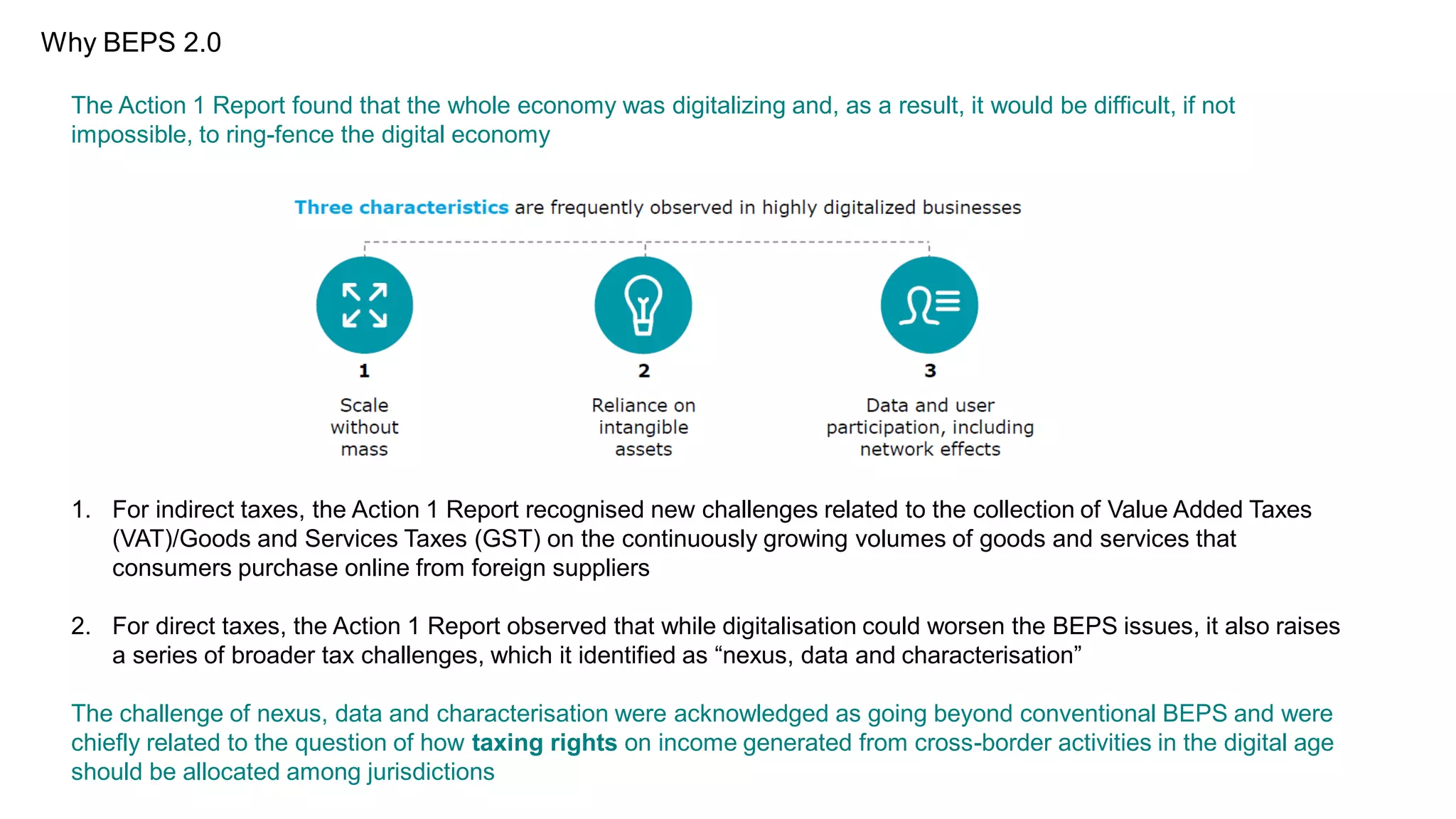
Why BEPS 2.0
The Action 1 Report found that the whole economy was digitalizing and, as a result, it would be difficult, if not
impossible, to ring-fence the digital economy
1. For indirect taxes, the Action 1 Report recognised new challenges related to the collection of Value Added Taxes
(VAT)/Goods and Services Taxes (GST) on the continuously growing volumes of goods and services that
consumers purchase online from foreign suppliers
2. For direct taxes, the Action 1 Report observed that while digitalisation could worsen the BEPS issues, it also raises
a series of broader tax challenges, which it identified as “nexus, data and characterisation”
The challenge of nexus, data and characterisation were acknowledged as going beyond conventional BEPS and were
chiefly related to the question of how taxing rights on income generated from cross-border activities in the digital age
should be allocated among jurisdictions
Digital Tax
Pillar 1
user
contributions
marketing
intangibles
significant
economic
presence
Pillar 2
minimum
effective tax
Composition of BEPS 2.0
allocation of
taxing rights, and
seeks to
undertake a
coherent and
concurrent review
of the profit
allocation and
nexus rules
right to tax back where
other jurisdictions have
not exercised their
primary taxing rights or
the payment is otherwise
subject to low levels of
effective taxation
Income
Inclusion
Tax on base-
eroding
payments
Pillar 1
Pillar 1 – Prime Focus Area
New Nexus Rule
Profit Allocation
Taxing Rights
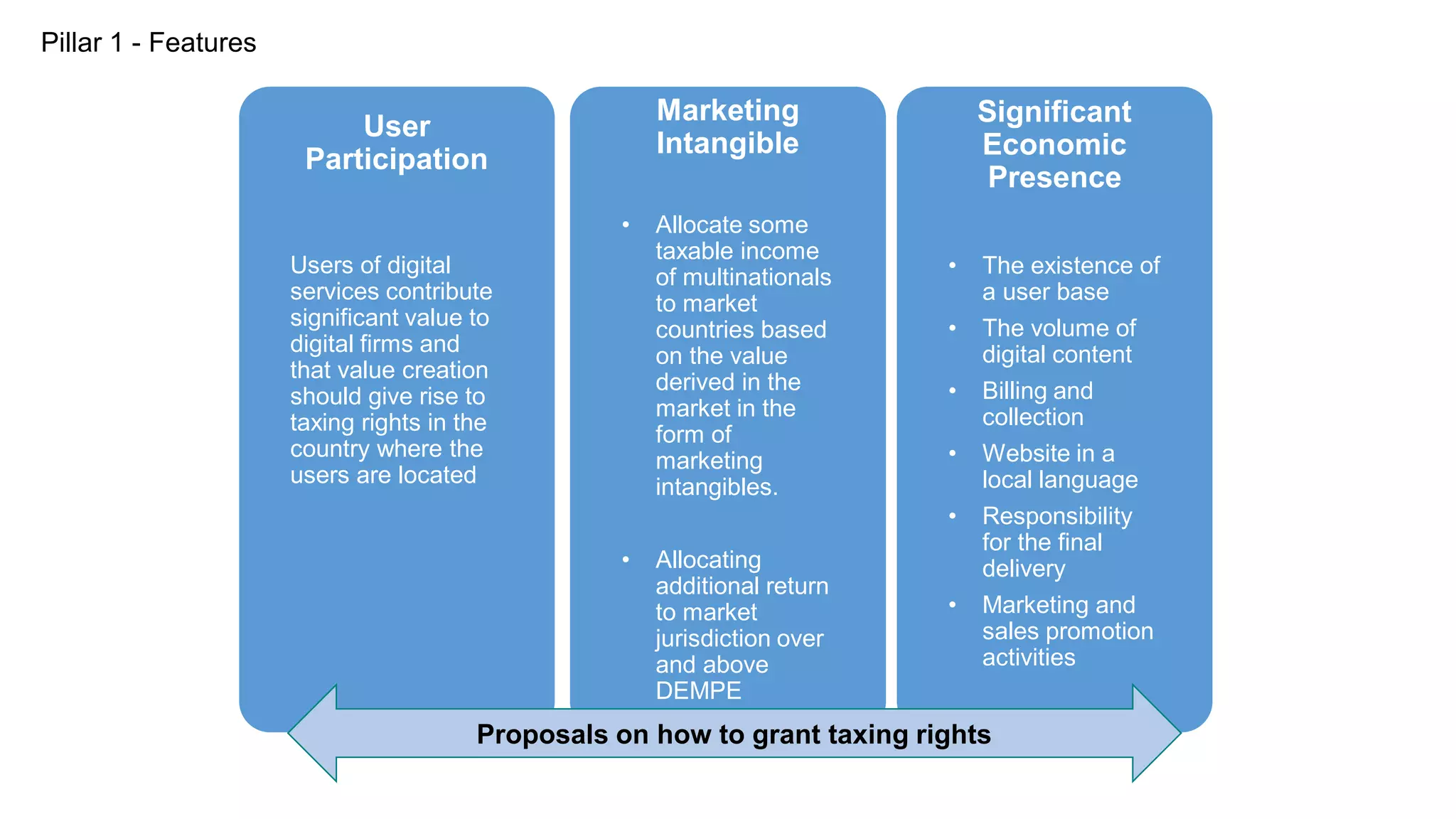
Pillar 1 - Features
User
Participation
Users of digital
services contribute
significant value to
digital firms and
that value creation
should give rise to
taxing rights in the
country where the
users are located
Marketing
Intangible
• Allocate some
taxable income
of multinationals
to market
countries based
on the value
derived in the
market in the
form of
marketing
intangibles.
• Allocating
additional return
to market
jurisdiction over
and above
DEMPE
Significant
Economic
Presence
• The existence of
a user base
• The volume of
digital content
• Billing and
collection
• Website in a
local language
• Responsibility
for the final
delivery
• Marketing and
sales promotion
activities
Proposals on how to grant taxing rights
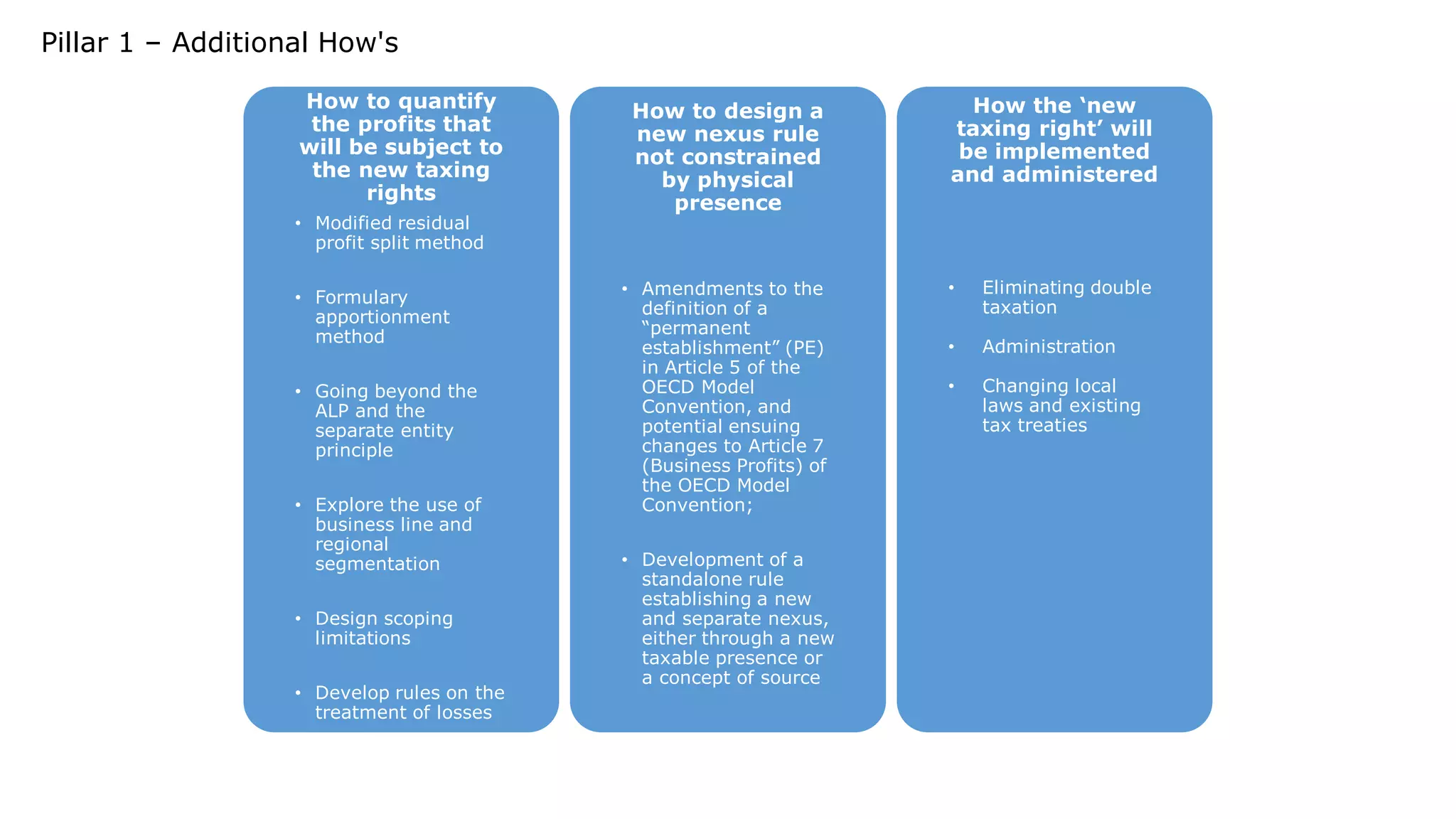
Pillar 1 – Additional How's
How to quantify
the profits that
will be subject to
the new taxing
rights
• Modified residual
profit split method
• Formulary
apportionment
method
• Going beyond the
ALP and the
separate entity
principle
• Explore the use of
business line and
regional
segmentation
• Design scoping
limitations
• Develop rules on the
treatment of losses
How to design a
new nexus rule
not constrained
by physical
presence
• Amendments to the
definition of a
“permanent
establishment” (PE)
in Article 5 of the
OECD Model
Convention, and
potential ensuing
changes to Article 7
(Business Profits) of
the OECD Model
Convention;
• Development of a
standalone rule
establishing a new
and separate nexus,
either through a new
taxable presence or
a concept of source
How the ‘new
taxing right’ will
be implemented
and administered
• Eliminating double
taxation
• Administration
• Changing local
laws and existing
tax treaties
Pillar 1 - Need of new Nexus Rule
Service Fees Paid
Profit allocation & Taxing right
No Profit allocation & Taxing right
• Existing PE rule restricts countries from tax without physical presence
• Proposed rule intends to change that and give taxing right based on sale
Existing Rule
Country A
(PE)
Country C
(PE)
Country B
(No PE)
Country D
(No PE)
Streaming
Service
Proposed Rule
Country A
(PE)
Country C
(PE)
Country B
(No PE)
Country D
(No PE)
Streaming
Service
Pillar 1 - New Profit Allocation Rule
3tier mechanism
Existing profit
allocation rules
could not apply
where there is no
nexus. “Unified
Approach” puts
forward a new profit
allocation rule.
This new rule goes
beyond the arm’s-
length principle by
using a formulary
approach.
Total Group
Profit
Deemed
Routine
Profit
Deemed
Residual
Profit
Amount B:
Fixed
return
established
for certain
“baseline”
or routine
marketing
and
distribution
activities
profits
attributable to
market
jurisdictions
profits
attributable to
other factors
(i.e. IP)
Amount A:
Allocation of deemed
residual profit to
eligible market
jurisdiction based on
agreed allocation key
(e.g. sales)
Amount C:
Dispute related to
Amount B, to be
resolved using ALP
and will be subject to
dispute resolution
mechanism (e.g. APA
and MAP)
No clear guidance on how to deal with losses
Pillar 2
Pillar 2 – Addressing remaining BEPS issue
Base Eroding Payment
• Denying deductions or
imposing source-based
taxation, including by way of
withholding taxes
• Denying treaty benefits
Income Inclusion
The income inclusion rule would
subject a multinational to tax on
its global income at a minimum
rate, with the aim of reducing
incentives to shift profits to low
tax jurisdictions
Global anti-Base Erosion (GloBE)
seeks to address remaining BEPS risks or profit shifting to entities that
are subject to no or low taxation
Multilateral approach – Stretching beyond digitalized economy - changing domestic law and tax treaties
Income not
subject to
minimum tax
rate
Income
inclusion rule
Switch over rule
Underpayment
tax rule
Subject to tax
rule
Pillar 2 – Design aspect
GloBE
Carve-outs
and
Thresholds
Blending
Financial
Account for
tax base
determination
Pillar 2 - Tax Base
Choice of
accounting
standard
Consolidated financial
statements
Accounting standard
applicable to the UHQ
Subsidiar
y of UHQ
Preparation of
accounts based on
local GAAP
Preparation of
accounts based on
UHQ GAAP
Consolidated Adjusted
Income
Adjustment for Permanent
Difference
Adjustment for
Temporary
Difference
Carry-forward of excess taxes and tax attributes
Deferred tax accounting
Multi-year averaging
Own sets of challenges
Determining of tax
base
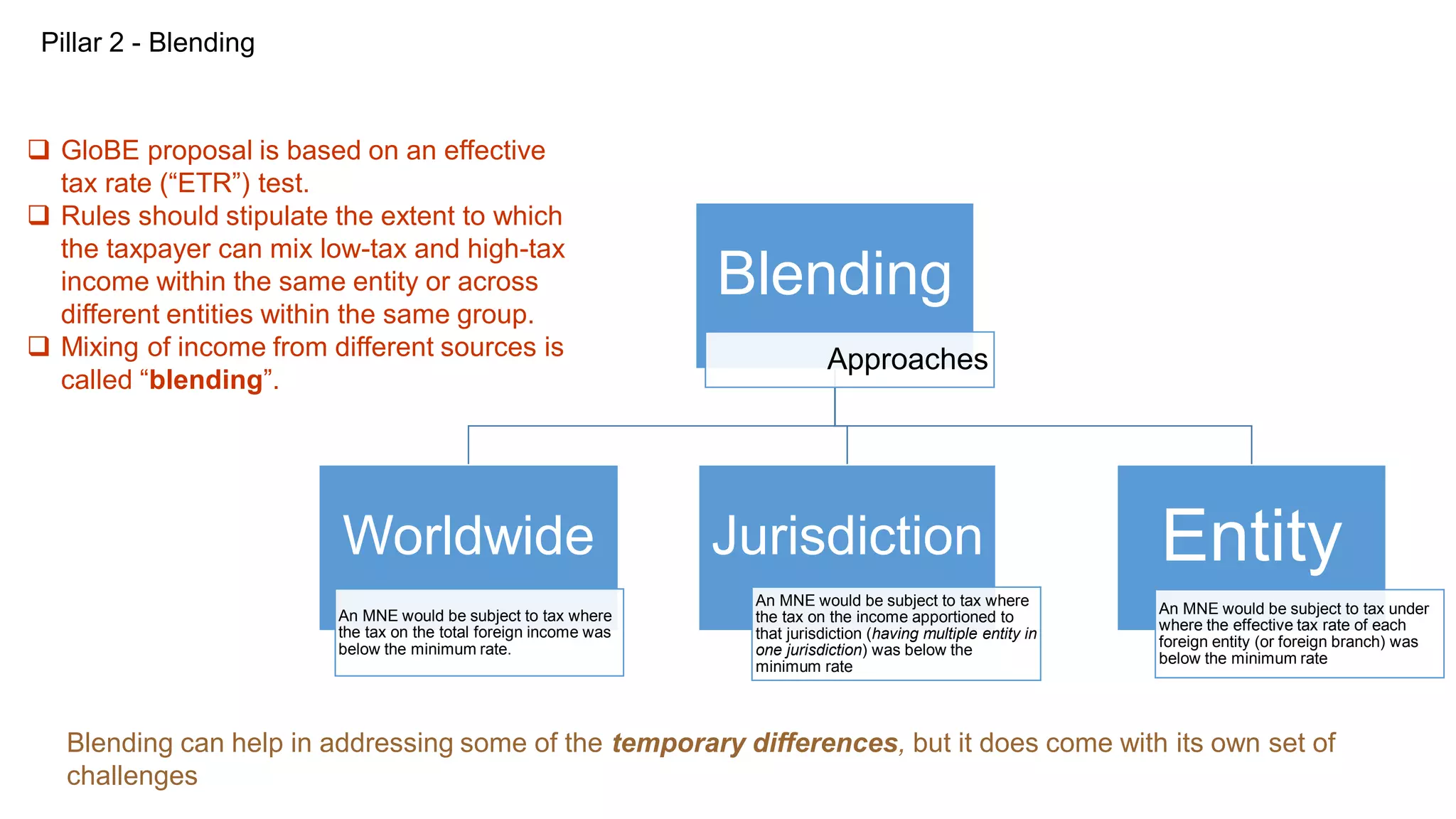
Pillar 2 - Blending
Blending
Approaches
Worldwide
An MNE would be subject to tax where
the tax on the total foreign income was
below the minimum rate.
Jurisdiction
An MNE would be subject to tax where
the tax on the income apportioned to
that jurisdiction (having multiple entity in
one jurisdiction) was below the
minimum rate
Entity
An MNE would be subject to tax under
where the effective tax rate of each
foreign entity (or foreign branch) was
below the minimum rate
Blending can help in addressing some of the temporary differences, but it does come with its own set of
challenges
 GloBE proposal is based on an effective
tax rate (“ETR”) test.
 Rules should stipulate the extent to which
the taxpayer can mix low-tax and high-tax
income within the same entity or across
different entities within the same group.
 Mixing of income from different sources is
called “blending”.
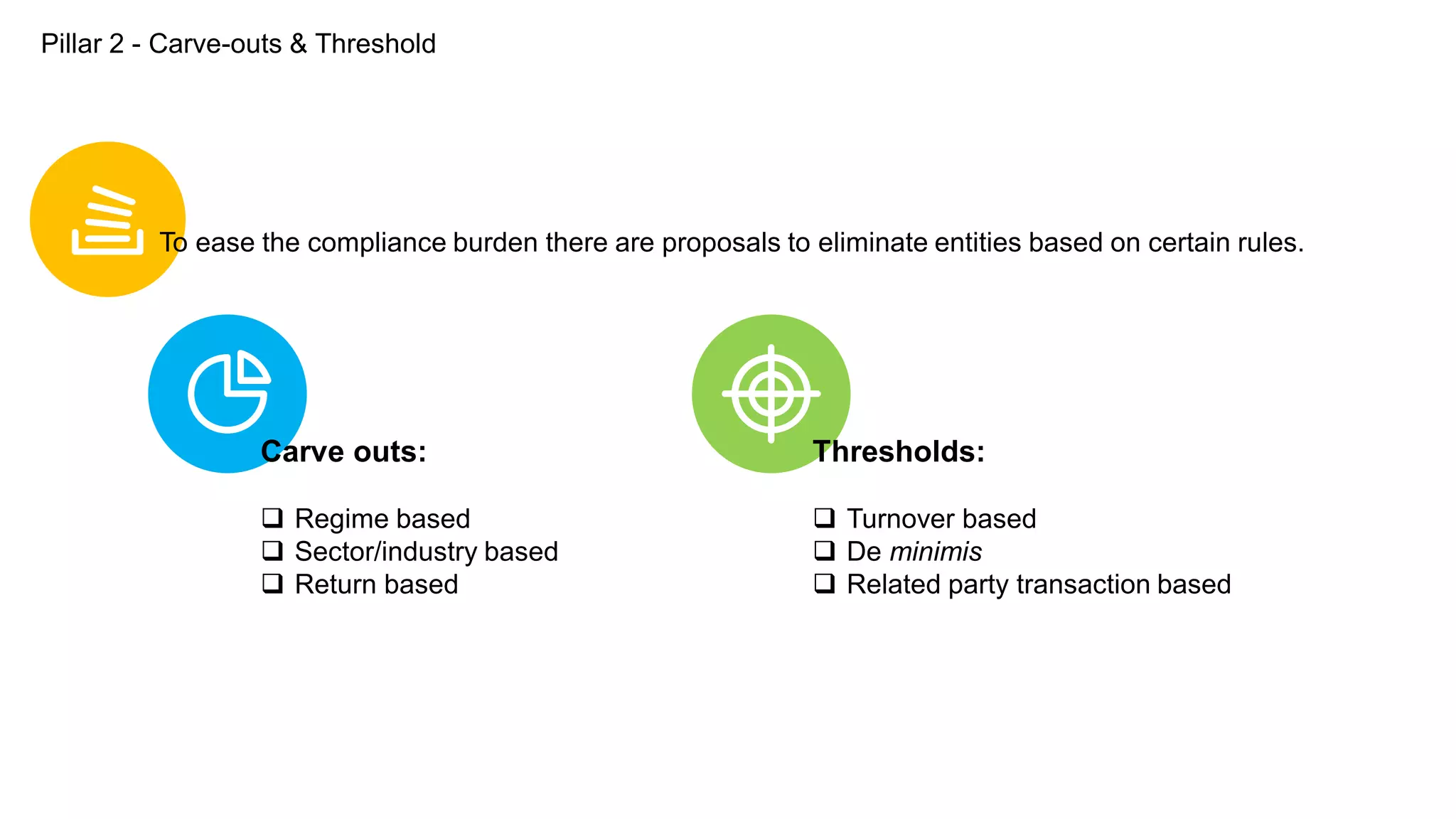
Pillar 2 - Carve-outs & Threshold
To ease the compliance burden there are proposals to eliminate entities based on certain rules.
Carve outs:
 Regime based
 Sector/industry based
 Return based
Thresholds:
 Turnover based
 De minimis
 Related party transaction based
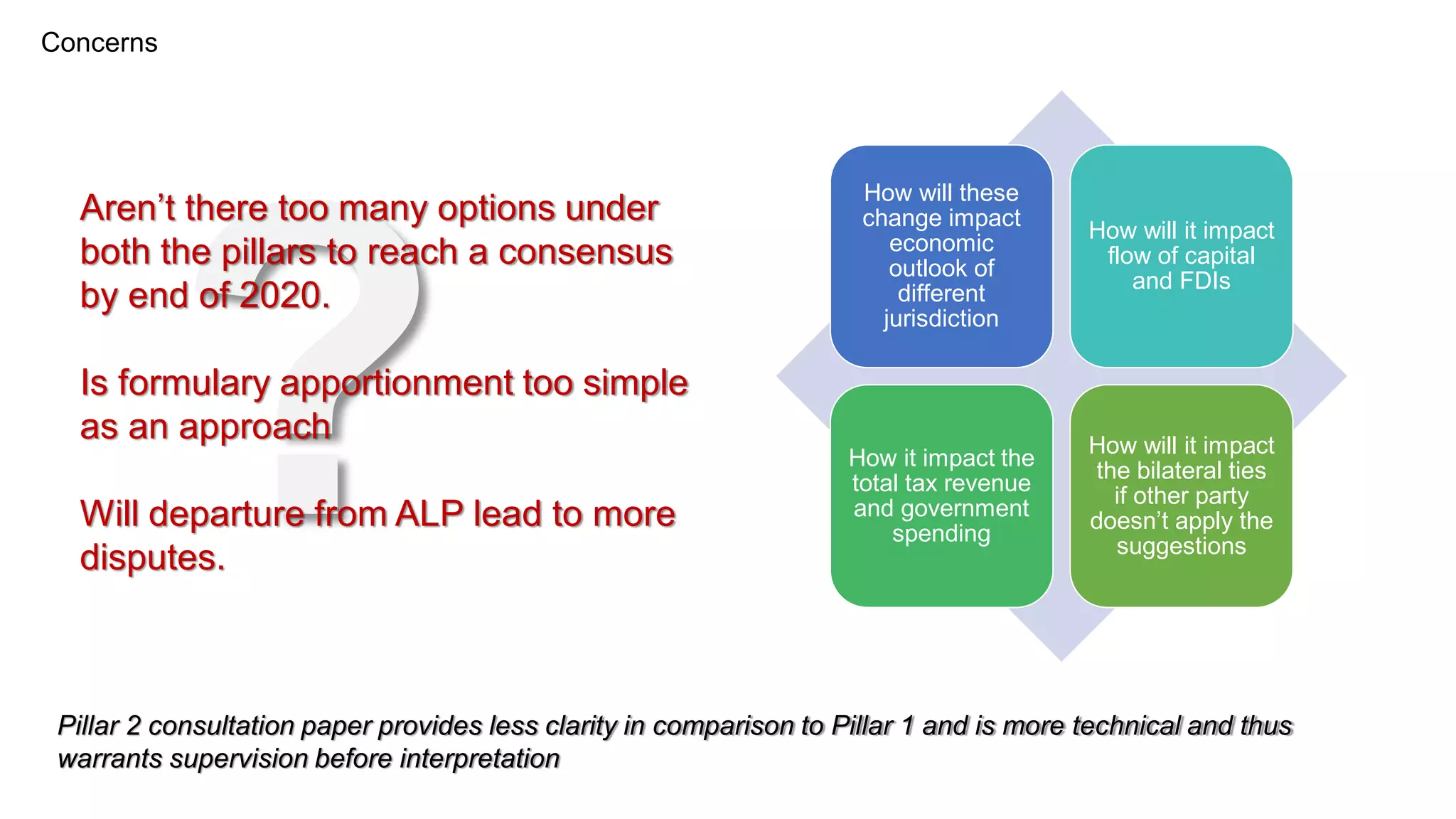
Concerns
How will these
change impact
economic
outlook of
different
jurisdiction
How will it impact
flow of capital
and FDIs
How it impact the
total tax revenue
and government
spending
How will it impact
the bilateral ties
if other party
doesn’t apply the
suggestions
Aren’t there too many options under
both the pillars to reach a consensus
by end of 2020.
Is formulary apportionment too simple
as an approach
Will departure from ALP lead to more
disputes.
Pillar 2 consultation paper provides less clarity in comparison to Pillar 1 and is more technical and thus
warrants supervision before interpretation
Key Words:
Pillar 1 - Nexus & Profit Allocation
Pillar 2 – Minimum Tax
Thank you

BEPS 2.0

  • 1.
  • 2.
    Why BEPS 2.0 TheAction 1 Report found that the whole economy was digitalizing and, as a result, it would be difficult, if not impossible, to ring-fence the digital economy 1. For indirect taxes, the Action 1 Report recognised new challenges related to the collection of Value Added Taxes (VAT)/Goods and Services Taxes (GST) on the continuously growing volumes of goods and services that consumers purchase online from foreign suppliers 2. For direct taxes, the Action 1 Report observed that while digitalisation could worsen the BEPS issues, it also raises a series of broader tax challenges, which it identified as “nexus, data and characterisation” The challenge of nexus, data and characterisation were acknowledged as going beyond conventional BEPS and were chiefly related to the question of how taxing rights on income generated from cross-border activities in the digital age should be allocated among jurisdictions
  • 3.
    Digital Tax Pillar 1 user contributions marketing intangibles significant economic presence Pillar2 minimum effective tax Composition of BEPS 2.0 allocation of taxing rights, and seeks to undertake a coherent and concurrent review of the profit allocation and nexus rules right to tax back where other jurisdictions have not exercised their primary taxing rights or the payment is otherwise subject to low levels of effective taxation Income Inclusion Tax on base- eroding payments
  • 4.
  • 5.
    Pillar 1 –Prime Focus Area New Nexus Rule Profit Allocation Taxing Rights
  • 6.
    Pillar 1 -Features User Participation Users of digital services contribute significant value to digital firms and that value creation should give rise to taxing rights in the country where the users are located Marketing Intangible • Allocate some taxable income of multinationals to market countries based on the value derived in the market in the form of marketing intangibles. • Allocating additional return to market jurisdiction over and above DEMPE Significant Economic Presence • The existence of a user base • The volume of digital content • Billing and collection • Website in a local language • Responsibility for the final delivery • Marketing and sales promotion activities Proposals on how to grant taxing rights
  • 7.
    Pillar 1 –Additional How's How to quantify the profits that will be subject to the new taxing rights • Modified residual profit split method • Formulary apportionment method • Going beyond the ALP and the separate entity principle • Explore the use of business line and regional segmentation • Design scoping limitations • Develop rules on the treatment of losses How to design a new nexus rule not constrained by physical presence • Amendments to the definition of a “permanent establishment” (PE) in Article 5 of the OECD Model Convention, and potential ensuing changes to Article 7 (Business Profits) of the OECD Model Convention; • Development of a standalone rule establishing a new and separate nexus, either through a new taxable presence or a concept of source How the ‘new taxing right’ will be implemented and administered • Eliminating double taxation • Administration • Changing local laws and existing tax treaties
  • 8.
    Pillar 1 -Need of new Nexus Rule Service Fees Paid Profit allocation & Taxing right No Profit allocation & Taxing right • Existing PE rule restricts countries from tax without physical presence • Proposed rule intends to change that and give taxing right based on sale Existing Rule Country A (PE) Country C (PE) Country B (No PE) Country D (No PE) Streaming Service Proposed Rule Country A (PE) Country C (PE) Country B (No PE) Country D (No PE) Streaming Service
  • 9.
    Pillar 1 -New Profit Allocation Rule 3tier mechanism Existing profit allocation rules could not apply where there is no nexus. “Unified Approach” puts forward a new profit allocation rule. This new rule goes beyond the arm’s- length principle by using a formulary approach. Total Group Profit Deemed Routine Profit Deemed Residual Profit Amount B: Fixed return established for certain “baseline” or routine marketing and distribution activities profits attributable to market jurisdictions profits attributable to other factors (i.e. IP) Amount A: Allocation of deemed residual profit to eligible market jurisdiction based on agreed allocation key (e.g. sales) Amount C: Dispute related to Amount B, to be resolved using ALP and will be subject to dispute resolution mechanism (e.g. APA and MAP) No clear guidance on how to deal with losses
  • 10.
  • 11.
    Pillar 2 –Addressing remaining BEPS issue Base Eroding Payment • Denying deductions or imposing source-based taxation, including by way of withholding taxes • Denying treaty benefits Income Inclusion The income inclusion rule would subject a multinational to tax on its global income at a minimum rate, with the aim of reducing incentives to shift profits to low tax jurisdictions Global anti-Base Erosion (GloBE) seeks to address remaining BEPS risks or profit shifting to entities that are subject to no or low taxation Multilateral approach – Stretching beyond digitalized economy - changing domestic law and tax treaties Income not subject to minimum tax rate Income inclusion rule Switch over rule Underpayment tax rule Subject to tax rule
  • 12.
    Pillar 2 –Design aspect GloBE Carve-outs and Thresholds Blending Financial Account for tax base determination
  • 13.
    Pillar 2 -Tax Base Choice of accounting standard Consolidated financial statements Accounting standard applicable to the UHQ Subsidiar y of UHQ Preparation of accounts based on local GAAP Preparation of accounts based on UHQ GAAP Consolidated Adjusted Income Adjustment for Permanent Difference Adjustment for Temporary Difference Carry-forward of excess taxes and tax attributes Deferred tax accounting Multi-year averaging Own sets of challenges Determining of tax base
  • 14.
    Pillar 2 -Blending Blending Approaches Worldwide An MNE would be subject to tax where the tax on the total foreign income was below the minimum rate. Jurisdiction An MNE would be subject to tax where the tax on the income apportioned to that jurisdiction (having multiple entity in one jurisdiction) was below the minimum rate Entity An MNE would be subject to tax under where the effective tax rate of each foreign entity (or foreign branch) was below the minimum rate Blending can help in addressing some of the temporary differences, but it does come with its own set of challenges  GloBE proposal is based on an effective tax rate (“ETR”) test.  Rules should stipulate the extent to which the taxpayer can mix low-tax and high-tax income within the same entity or across different entities within the same group.  Mixing of income from different sources is called “blending”.
  • 15.
    Pillar 2 -Carve-outs & Threshold To ease the compliance burden there are proposals to eliminate entities based on certain rules. Carve outs:  Regime based  Sector/industry based  Return based Thresholds:  Turnover based  De minimis  Related party transaction based
  • 16.
    Concerns How will these changeimpact economic outlook of different jurisdiction How will it impact flow of capital and FDIs How it impact the total tax revenue and government spending How will it impact the bilateral ties if other party doesn’t apply the suggestions Aren’t there too many options under both the pillars to reach a consensus by end of 2020. Is formulary apportionment too simple as an approach Will departure from ALP lead to more disputes. Pillar 2 consultation paper provides less clarity in comparison to Pillar 1 and is more technical and thus warrants supervision before interpretation
  • 17.
    Key Words: Pillar 1- Nexus & Profit Allocation Pillar 2 – Minimum Tax Thank you