






16 March 2018
15:00 – 16:00 (CET)
Join the discussion
Ask questions and comment throughout the
webcast:
CTP.Contact@oecd.org
@OECDtax or #OECDTaxTalks
2015 Action 1 Report
• Digitalisation of the economy, instead of the
“digital economy”
• BEPS is exacerbated by the digital economy
• VAT: new rules, with destination principle for
determining the place of taxation of cross-border
supplies and effective collection mechanisms
• CIT: no agreement, monitoring of developments
with next report in 2020
•
•
•
•
–
–
–
–
–
–
•
•
•
•
•
Access the report → http://oe.cd/digitaltax
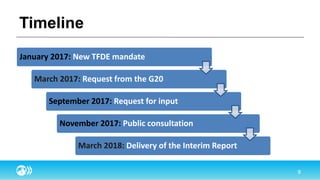
Timeline
January 2017: New TFDE mandate
March 2017: Request from the G20
September 2017: Request for input
November 2017: Public consultation
March 2018: Delivery of the Interim Report
Business models and value creation
Complex reality. Three key factors prevalent in highly
digitalised businesses (HDBs):
1. Cross-jurisdictional local scale without local mass
– HDBs often highly involved in economic life of a jurisdiction
without any significant, physical presence
2. Reliance on intangible assets, including IP
– Intangible assets crucial support of business models of HDBs
3. Data, user participation and their synergies with IP
User participation: countries’ views
• General agreement:
– Data and user participation are common
characteristics of highly digitalised businesses
• Current different opinions on
– Whether and the extent to which they represent
contribution to value creation by enterprise
User participation: countries’ views
1. Role of user participation is a unique and important driver
of value creation
– Allows HDBs to collect a great deal of information and monetise
it in various ways (e.g., pricing, advertisement)
2. The action by HDBs to source data from users is NOT an
activity to which profit should be attributed
– User’s contributed data, content and other information similar
to any other input sourced from an independent, third party
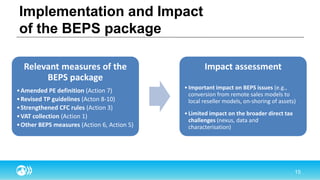
Implementation and Impact
of the BEPS package
Relevant measures of the
BEPS package
•Amended PE definition (Action 7)
•Revised TP guidelines (Acton 8-10)
•Strengthened CFC rules (Action 3)
•VAT collection (Action 1)
•Other BEPS measures (Action 6, Action 5)
Impact assessment
•Important impact on BEPS issues (e.g.,
conversion from remote sales models to
local reseller models, on-shoring of assets)
•Limited impact on the broader direct tax
challenges (nexus, data and
characterisation)
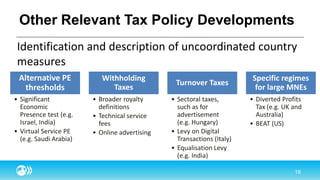
Other Relevant Tax Policy Developments
Identification and description of uncoordinated country
measures
Alternative PE
thresholds
• Significant
Economic
Presence test (e.g.
Israel, India)
• Virtual Service PE
(e.g. Saudi Arabia)
Withholding
Taxes
• Broader royalty
definitions
• Technical service
fees
• Online advertising
Turnover Taxes
• Sectoral taxes,
such as for
advertisement
(e.g. Hungary)
• Levy on Digital
Transactions (Italy)
• Equalisation Levy
(e.g. India)
Specific regimes
for large MNEs
• Diverted Profits
Tax (e.g. UK and
Australia)
• BEAT (US)
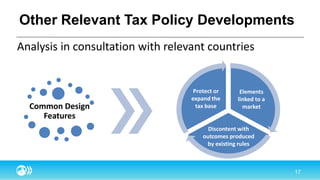
Other Relevant Tax Policy Developments
Common Design
Features
Protect or
expand the
tax base
Elements
linked to a
market
Discontent with
outcomes produced
by existing rules
Analysis in consultation with relevant countries
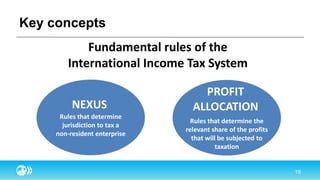
Key concepts
Fundamental rules of the
International Income Tax System
NEXUS PROFIT
ALLOCATI
ON
PROFIT
ALLOCATION
Rules that determine
jurisdiction to tax a
non-resident enterprise
Rules that determine the
relevant share of the profits
that will be subjected to
taxation
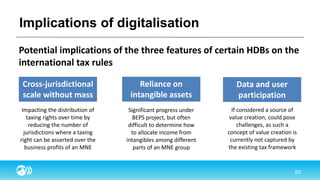
Implications of digitalisation
Potential implications of the three features of certain HDBs on the
international tax rules
Cross-jurisdictional
scale without mass
Reliance on
intangible assets
Data and user
participation
Impacting the distribution of
taxing rights over time by
reducing the number of
jurisdictions where a taxing
right can be asserted over the
business profits of an MNE
Significant progress under
BEPS project, but often
difficult to determine how
to allocate income from
intangibles among different
parts of an MNE group
If considered a source of
value creation, could pose
challenges, as such a
concept of value creation is
currently not captured by
the existing tax framework
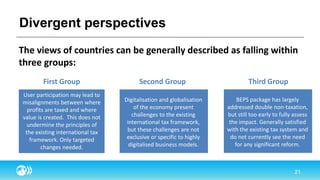
Divergent perspectives
The views of countries can be generally described as falling within
three groups:
User participation may lead to
misalignments between where
profits are taxed and where
value is created. This does not
undermine the principles of
the existing international tax
framework. Only targeted
changes needed.
BEPS package has largely
addressed double non-taxation,
but still too early to fully assess
the impact. Generally satisfied
with the existing tax system and
do not currently see the need
for any significant reform.
First Group Third GroupSecond Group
Digitalisation and globalisation
of the economy present
challenges to the existing
international tax framework,
but these challenges are not
exclusive or specific to highly
digitalised business models.
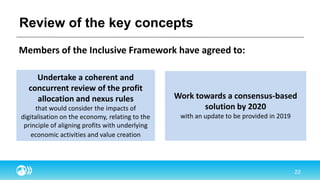
Review of the key concepts
Members of the Inclusive Framework have agreed to:
Undertake a coherent and
concurrent review of the profit
allocation and nexus rules
that would consider the impacts of
digitalisation on the economy, relating to the
principle of aligning profits with underlying
economic activities and value creation
Work towards a consensus-based
solution by 2020
with an update to be provided in 2019
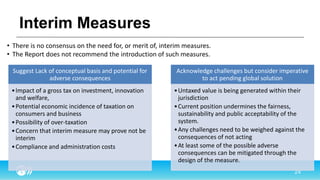
Interim Measures
Suggest Lack of conceptual basis and potential for
adverse consequences
•Impact of a gross tax on investment, innovation
and welfare,
•Potential economic incidence of taxation on
consumers and business
•Possibility of over-taxation
•Concern that interim measure may prove not be
interim
•Compliance and administration costs
Acknowledge challenges but consider imperative
to act pending global solution
•Untaxed value is being generated within their
jurisdiction
•Current position undermines the fairness,
sustainability and public acceptability of the
system.
•Any challenges need to be weighed against the
consequences of not acting
•At least some of the possible adverse
consequences can be mitigated through the
design of the measure.
• There is no consensus on the need for, or merit of, interim measures.
• The Report does not recommend the introduction of such measures.
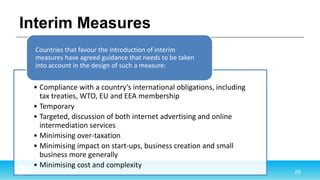
Interim Measures
• Compliance with a country’s international obligations, including
tax treaties, WTO, EU and EEA membership
• Temporary
• Targeted, discussion of both internet advertising and online
intermediation services
• Minimising over-taxation
• Minimising impact on start-ups, business creation and small
business more generally
• Minimising cost and complexity
Countries that favour the introduction of interim
measures have agreed guidance that needs to be taken
into account in the design of such a measure:
Beyond the international tax rules
• Gig and sharing economies, the rise of non-
standard work and the role of online multi-
sided platforms
• Supporting innovation while ensuring a level-
playing field
Beyond the international tax rules
• Digital tools for better taxpayer service
• Harnessing big data for improved tax
compliance
• Risks from new technology, such as blockchain
which underlies crypto-currencies.
Next phase of work
• Next TFDE meeting in July 2018
• Delivery of final report by 2020, with 2019 update
• Test feasibility of technical options relating to profit
attribution and nexus
• Monitor the impact of BEPS implementation and the
introduction of any unilateral measures
• Explore opportunities and risks for tax policy and
administration as a result of new technologies
OECD Tax Talks #9 - 16 March 2018

OECD Tax Talks #9 - 16 March 2018

  • 1.
    16 March 2018 15:00– 16:00 (CET)
  • 2.
    Join the discussion Askquestions and comment throughout the webcast: CTP.Contact@oecd.org @OECDtax or #OECDTaxTalks
  • 4.
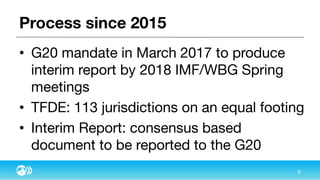
    2015 Action 1Report • Digitalisation of the economy, instead of the “digital economy” • BEPS is exacerbated by the digital economy • VAT: new rules, with destination principle for determining the place of taxation of cross-border supplies and effective collection mechanisms • CIT: no agreement, monitoring of developments with next report in 2020
  • 5.
  • 6.
  • 7.
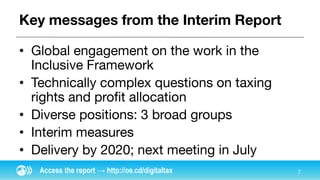
    • • • • • Access the report→ http://oe.cd/digitaltax
  • 9.
    Timeline January 2017: NewTFDE mandate March 2017: Request from the G20 September 2017: Request for input November 2017: Public consultation March 2018: Delivery of the Interim Report
  • 11.
    Business models andvalue creation Complex reality. Three key factors prevalent in highly digitalised businesses (HDBs): 1. Cross-jurisdictional local scale without local mass – HDBs often highly involved in economic life of a jurisdiction without any significant, physical presence 2. Reliance on intangible assets, including IP – Intangible assets crucial support of business models of HDBs 3. Data, user participation and their synergies with IP
  • 12.
    User participation: countries’views • General agreement: – Data and user participation are common characteristics of highly digitalised businesses • Current different opinions on – Whether and the extent to which they represent contribution to value creation by enterprise
  • 13.
    User participation: countries’views 1. Role of user participation is a unique and important driver of value creation – Allows HDBs to collect a great deal of information and monetise it in various ways (e.g., pricing, advertisement) 2. The action by HDBs to source data from users is NOT an activity to which profit should be attributed – User’s contributed data, content and other information similar to any other input sourced from an independent, third party
  • 15.
    Implementation and Impact ofthe BEPS package Relevant measures of the BEPS package •Amended PE definition (Action 7) •Revised TP guidelines (Acton 8-10) •Strengthened CFC rules (Action 3) •VAT collection (Action 1) •Other BEPS measures (Action 6, Action 5) Impact assessment •Important impact on BEPS issues (e.g., conversion from remote sales models to local reseller models, on-shoring of assets) •Limited impact on the broader direct tax challenges (nexus, data and characterisation)
  • 16.
    Other Relevant TaxPolicy Developments Identification and description of uncoordinated country measures Alternative PE thresholds • Significant Economic Presence test (e.g. Israel, India) • Virtual Service PE (e.g. Saudi Arabia) Withholding Taxes • Broader royalty definitions • Technical service fees • Online advertising Turnover Taxes • Sectoral taxes, such as for advertisement (e.g. Hungary) • Levy on Digital Transactions (Italy) • Equalisation Levy (e.g. India) Specific regimes for large MNEs • Diverted Profits Tax (e.g. UK and Australia) • BEAT (US)
  • 17.
    Other Relevant TaxPolicy Developments Common Design Features Protect or expand the tax base Elements linked to a market Discontent with outcomes produced by existing rules Analysis in consultation with relevant countries
  • 19.
    Key concepts Fundamental rulesof the International Income Tax System NEXUS PROFIT ALLOCATI ON PROFIT ALLOCATION Rules that determine jurisdiction to tax a non-resident enterprise Rules that determine the relevant share of the profits that will be subjected to taxation
  • 20.
    Implications of digitalisation Potentialimplications of the three features of certain HDBs on the international tax rules Cross-jurisdictional scale without mass Reliance on intangible assets Data and user participation Impacting the distribution of taxing rights over time by reducing the number of jurisdictions where a taxing right can be asserted over the business profits of an MNE Significant progress under BEPS project, but often difficult to determine how to allocate income from intangibles among different parts of an MNE group If considered a source of value creation, could pose challenges, as such a concept of value creation is currently not captured by the existing tax framework
  • 21.
    Divergent perspectives The viewsof countries can be generally described as falling within three groups: User participation may lead to misalignments between where profits are taxed and where value is created. This does not undermine the principles of the existing international tax framework. Only targeted changes needed. BEPS package has largely addressed double non-taxation, but still too early to fully assess the impact. Generally satisfied with the existing tax system and do not currently see the need for any significant reform. First Group Third GroupSecond Group Digitalisation and globalisation of the economy present challenges to the existing international tax framework, but these challenges are not exclusive or specific to highly digitalised business models.
  • 22.
    Review of thekey concepts Members of the Inclusive Framework have agreed to: Undertake a coherent and concurrent review of the profit allocation and nexus rules that would consider the impacts of digitalisation on the economy, relating to the principle of aligning profits with underlying economic activities and value creation Work towards a consensus-based solution by 2020 with an update to be provided in 2019
  • 24.
    Interim Measures Suggest Lackof conceptual basis and potential for adverse consequences •Impact of a gross tax on investment, innovation and welfare, •Potential economic incidence of taxation on consumers and business •Possibility of over-taxation •Concern that interim measure may prove not be interim •Compliance and administration costs Acknowledge challenges but consider imperative to act pending global solution •Untaxed value is being generated within their jurisdiction •Current position undermines the fairness, sustainability and public acceptability of the system. •Any challenges need to be weighed against the consequences of not acting •At least some of the possible adverse consequences can be mitigated through the design of the measure. • There is no consensus on the need for, or merit of, interim measures. • The Report does not recommend the introduction of such measures.
  • 25.
    Interim Measures • Compliancewith a country’s international obligations, including tax treaties, WTO, EU and EEA membership • Temporary • Targeted, discussion of both internet advertising and online intermediation services • Minimising over-taxation • Minimising impact on start-ups, business creation and small business more generally • Minimising cost and complexity Countries that favour the introduction of interim measures have agreed guidance that needs to be taken into account in the design of such a measure:
  • 27.
    Beyond the internationaltax rules • Gig and sharing economies, the rise of non- standard work and the role of online multi- sided platforms • Supporting innovation while ensuring a level- playing field
  • 28.
    Beyond the internationaltax rules • Digital tools for better taxpayer service • Harnessing big data for improved tax compliance • Risks from new technology, such as blockchain which underlies crypto-currencies.
  • 30.
    Next phase ofwork • Next TFDE meeting in July 2018 • Delivery of final report by 2020, with 2019 update • Test feasibility of technical options relating to profit attribution and nexus • Monitor the impact of BEPS implementation and the introduction of any unilateral measures • Explore opportunities and risks for tax policy and administration as a result of new technologies