UMTS Channels Overview
Mahesh Khade
mkhade@hssworld.com
Agenda
• UMTS Channels
• Physical Channels and attributes
• Transport Channels and attributes
• Logical Channels and attributes
• Questions..
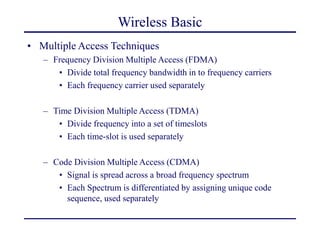
Wireless Basic
• Multiple Access Techniques
– Frequency Division Multiple Access (FDMA)
• Divide total frequency bandwidth in to frequency carriers
• Each frequency carrier used separately
– Time Division Multiple Access (TDMA)
• Divide frequency into a set of timeslots
• Each time-slot is used separately
– Code Division Multiple Access (CDMA)
• Signal is spread across a broad frequency spectrum
• Each Spectrum is differentiated by assigning unique code
sequence, used separately
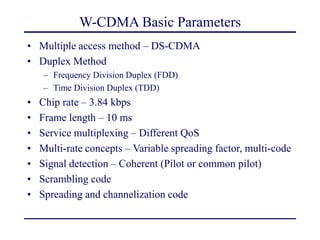
W-CDMA Basic Parameters
• Multiple access method – DS-CDMA
• Duplex Method
– Frequency Division Duplex (FDD)
– Time Division Duplex (TDD)
• Chip rate – 3.84 kbps
• Frame length – 10 ms
• Service multiplexing – Different QoS
• Multi-rate concepts – Variable spreading factor, multi-code
• Signal detection – Coherent (Pilot or common pilot)
• Scrambling code
• Spreading and channelization code
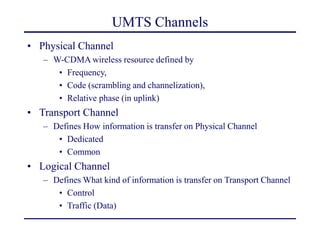
UMTS Channels
• Physical Channel
– W-CDMA wireless resource defined by
• Frequency,
• Code (scrambling and channelization),
• Relative phase (in uplink)
• Transport Channel
– Defines How information is transfer on Physical Channel
• Dedicated
• Common
• Logical Channel
– Defines What kind of information is transfer on Transport Channel
• Control
• Traffic (Data)
Physical Channels
W-CDMA Wireless Resource
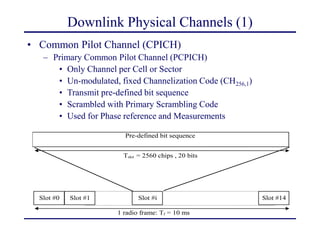
Downlink Physical Channels (1)
• Common Pilot Channel (CPICH)
– Primary Common Pilot Channel (PCPICH)
• Only Channel per Cell or Sector
• Un-modulated, fixed Channelization Code (CH256,1)
• Transmit pre-defined bit sequence
• Scrambled with Primary Scrambling Code
• Used for Phase reference and Measurements
Pre-defined bit sequence
Slot #0 Slot #1 Slot #i Slot #14
Tslot = 2560 chips , 20 bits
1 radio frame: Tf = 10 ms
Common Pilot Channel frame structure
– Secondary Common Pilot Channel (SCPICH) [Optional]
• Any Channelization Code with SF 256 (CH256,x)
• Scrambled with Primary or Secondary Scrambling Code
• Specific usage with narrow antenna beams in “hot spots” or
“high traffic density areas”
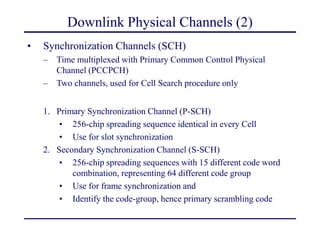
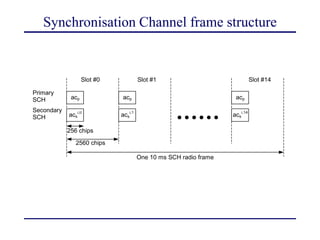
Downlink Physical Channels (2)
• Synchronization Channels (SCH)
– Time multiplexed with Primary Common Control Physical
Channel (PCCPCH)
– Two channels, used for Cell Search procedure only
1. Primary Synchronization Channel (P-SCH)
• 256-chip spreading sequence identical in every Cell
• Use for slot synchronization
2. Secondary Synchronization Channel (S-SCH)
• 256-chip spreading sequences with 15 different code word
combination, representing 64 different code group
• Use for frame synchronization and
• Identify the code-group, hence primary scrambling code
Synchronisation Channel frame structure
Primary
SCH
Secondary
SCH
256 chips
2560 chips
One 10 ms SCH radio frame
acs
i,0
acp
acs
i,1
acp
acs
i,14
acp
Slot #0 Slot #1 Slot #14
Downlink Physical Channels (3)
• Common Control Physical Channels
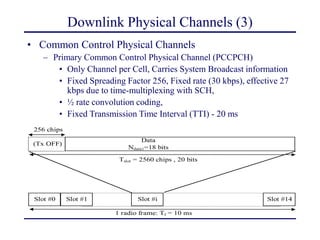
– Primary Common Control Physical Channel (PCCPCH)
• Only Channel per Cell, Carries System Broadcast information
• Fixed Spreading Factor 256, Fixed rate (30 kbps), effective 27
kbps due to time-multiplexing with SCH,
• ½ rate convolution coding,
• Fixed Transmission Time Interval (TTI) - 20 ms
Data
Ndata1=18 bits
Slot #0 Slot #1 Slot #i Slot #14
Tslot = 2560 chips , 20 bits
1 radio frame: Tf = 10 ms
(Tx OFF)
256 chips
Downlink Physical Channels (4)
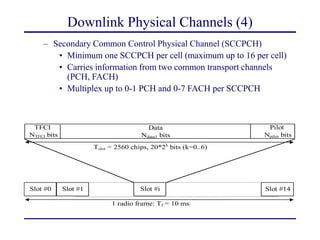
– Secondary Common Control Physical Channel (SCCPCH)
• Minimum one SCCPCH per cell (maximum up to 16 per cell)
• Carries information from two common transport channels
(PCH, FACH)
• Multiplex up to 0-1 PCH and 0-7 FACH per SCCPCH
Slot #0 Slot #1 Slot #i Slot #14
Tslot = 2560 chips, 20*2k
bits (k=0..6)
Pilot
Npilot bits
Data
Ndata1 bits
1 radio frame: Tf = 10 ms
TFCI
NTFCI bits
Downlink Physical Channels (5)
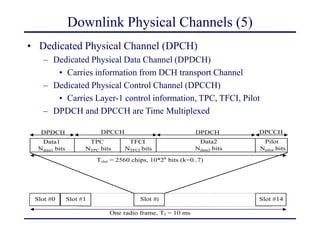
• Dedicated Physical Channel (DPCH)
– Dedicated Physical Data Channel (DPDCH)
• Carries information from DCH transport Channel
– Dedicated Physical Control Channel (DPCCH)
• Carries Layer-1 control information, TPC, TFCI, Pilot
– DPDCH and DPCCH are Time Multiplexed
One radio frame, Tf = 10 ms
TPC
NTPC bits
Slot #0 Slot #1 Slot #i Slot #14
Tslot = 2560 chips, 10*2k
bits (k=0..7)
Data2
Ndata2 bits
DPDCH
TFCI
NTFCI bits
Pilot
Npilot bits
Data1
Ndata1 bits
DPDCH DPCCH DPCCH
Downlink DPCH frame structure
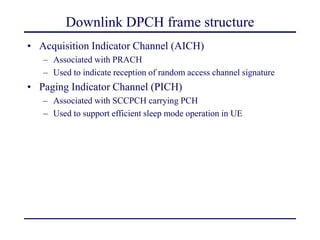
• Acquisition Indicator Channel (AICH)
– Associated with PRACH
– Used to indicate reception of random access channel signature
• Paging Indicator Channel (PICH)
– Associated with SCCPCH carrying PCH
– Used to support efficient sleep mode operation in UE
Uplink Physical Channels (1)
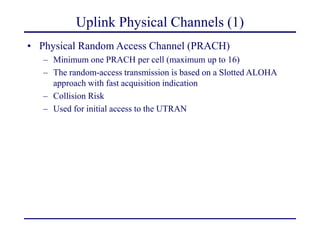
• Physical Random Access Channel (PRACH)
– Minimum one PRACH per cell (maximum up to 16)
– The random-access transmission is based on a Slotted ALOHA
approach with fast acquisition indication
– Collision Risk
– Used for initial access to the UTRAN
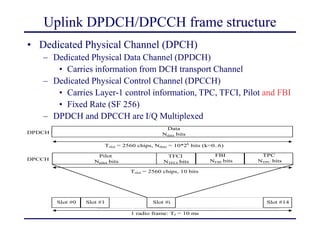
Uplink DPDCH/DPCCH frame structure
• Dedicated Physical Channel (DPCH)
– Dedicated Physical Data Channel (DPDCH)
• Carries information from DCH transport Channel
– Dedicated Physical Control Channel (DPCCH)
• Carries Layer-1 control information, TPC, TFCI, Pilot and FBI
• Fixed Rate (SF 256)
– DPDCH and DPCCH are I/Q Multiplexed
Pilot
Npilot bits
TPC
NTPC bits
Data
Ndata bits
Slot #0 Slot #1 Slot #i Slot #14
Tslot = 2560 chips, 10 bits
1 radio frame: Tf = 10 ms
DPDCH
DPCCH
FBI
NFBI bits
TFCI
NTFCI bits
Tslot = 2560 chips, Ndata = 10*2k
bits (k=0..6)
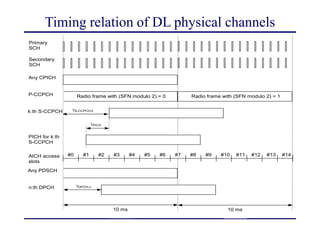
Timing relation of DL physical channels
k:th S-CCPCH
AICH access
slots
Secondary
SCH
Primary
SCH
S-CCPCH,k
10 ms
PICH
#0 #1 #2 #3 #14
#13
#12
#11
#10
#9
#8
#7
#6
#5
#4
Radio frame with (SFN modulo 2) = 0 Radio frame with (SFN modulo 2) = 1
DPCH,n
P-CCPCH
Any CPICH
PICH for k:th
S-CCPCH
Any PDSCH
n:th DPCH
10 ms
Physical Layer Procedures
• Power Control
– Fast Closed loop power control
• Inner loop power control (SIR target)
• Outer loop power control (BER target)
– Open loop power control
• Measurements
• Cell Search Procedure
Transport Channels
- Defines How information is transfer
- Service provided by Physical Layer
Transport Channel Attributes (1)
• Transport Block (TB)
– This is the basic unit exchanged between L1 and L2 (MAC)
• Transport Block Set (TBS)
– Set of Transport Blocks exchanged between L1 and MAC at the
same time instance
• Transport Block Size
– Number of bits in a Transport Block
– Transport Block Size is always fixed within a Transport Block Set
• Transport Block Set Size
– Number of bits in a Transport Block Set
– Also can be defined as :- TB Size x Number of TB, (e.g. 336 x 0,
336 x 2)
Transport Channel Attributes (2)
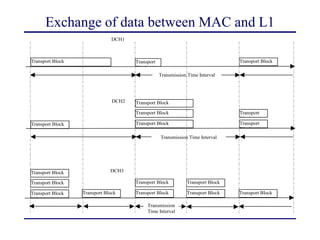
• Transmission Time Interval (TTI)
– Time-interval at which TBS exchanged between L1 and L2 (MAC)
– Periodicity at which TBS is transferred or received by the Physical
Layer on the radio interface
– Multiple of the minimum interleaving period (e.g. 10ms, the length
of one Radio Frame).
Exchange of data between MAC and L1
DCH3
Transmission
Time Interval
DCH2
Transmission Time Interval
DCH1
Transmission Time Interval
Transport Block
Transport Block
Transport Block
Transport Block
Transport
Block
Transport Block
Transport Block
Transport Block
Transport
Block
Transport
Block
Transport Block
Transport Block
Transport Block
Transport Block
Transport Block Transport Block
Transport Block
Transport Block
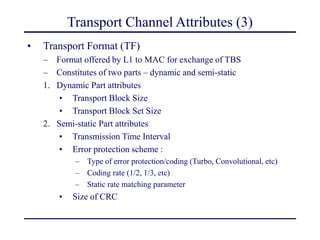
Transport Channel Attributes (3)
• Transport Format (TF)
– Format offered by L1 to MAC for exchange of TBS
– Constitutes of two parts – dynamic and semi-static
1. Dynamic Part attributes
• Transport Block Size
• Transport Block Set Size
2. Semi-static Part attributes
• Transmission Time Interval
• Error protection scheme :
– Type of error protection/coding (Turbo, Convolutional, etc)
– Coding rate (1/2, 1/3, etc)
– Static rate matching parameter
• Size of CRC
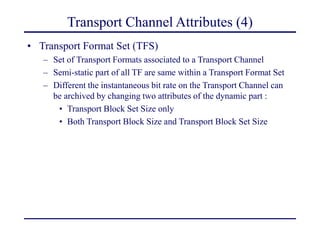
Transport Channel Attributes (4)
• Transport Format Set (TFS)
– Set of Transport Formats associated to a Transport Channel
– Semi-static part of all TF are same within a Transport Format Set
– Different the instantaneous bit rate on the Transport Channel can
be archived by changing two attributes of the dynamic part :
• Transport Block Set Size only
• Both Transport Block Size and Transport Block Set Size
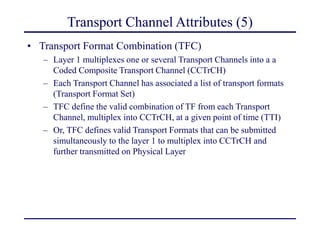
Transport Channel Attributes (5)
• Transport Format Combination (TFC)
– Layer 1 multiplexes one or several Transport Channels into a a
Coded Composite Transport Channel (CCTrCH)
– Each Transport Channel has associated a list of transport formats
(Transport Format Set)
– TFC define the valid combination of TF from each Transport
Channel, multiplex into CCTrCH, at a given point of time (TTI)
– Or, TFC defines valid Transport Formats that can be submitted
simultaneously to the layer 1 to multiplex into CCTrCH and
further transmitted on Physical Layer
Transport Channel Attributes (6)
• Transport Format Combination Set (TFCS)
– Defined as a set of Transport Format Combinations on a Coded
Composite Transport Channel
Transport Channel Attributes (7)
• Transport Format Indicator (TFI)
– TFI is a label for a specific TF within a transport format set
– one-to-one correspondence between a TFI and TF
– Used in the inter-layer communication between MAC and L1 each
time a transport block set is exchanged
• Transport Format Combination Indicator (TFCI)
– TFCI is label for a specific TFC within TFCS
– one-to-one correspondence between a TFCI and TFC
– Use to inform receiving side TFC used, while multiplex into
CCTrCH, hence indicates how to decode, de-multiplex and deliver
the received data on the appropriate Transport Channels
Transport Channel Attributes (8)
• Calculated Transport Format Combination (CTFC)
– Use to efficiently represent and signal the current valid Transport
Format Combinations (using arithmetic's :-(..)
Transport Channels
• Common Transport Channels
– Broadcast Channel (BCH)
– Paging Channel (PCH)
– Forward Access Channel (FACH)
– Random Access Channel (RACH)
– Common Packet Channel (CPCH)
• Dedicated Transport Channels
– Dedicated Channel (DCH)
• Shared Transport Channels
– Downlink Shared Transport Channel (DSCH)
– High-Speed Downlink Shared Transport Channel (HS-DSCH)
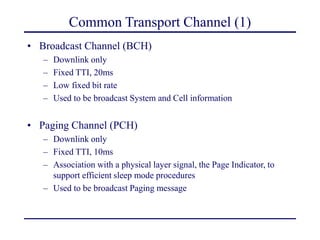
Common Transport Channel (1)
• Broadcast Channel (BCH)
– Downlink only
– Fixed TTI, 20ms
– Low fixed bit rate
– Used to be broadcast System and Cell information
• Paging Channel (PCH)
– Downlink only
– Fixed TTI, 10ms
– Association with a physical layer signal, the Page Indicator, to
support efficient sleep mode procedures
– Used to be broadcast Paging message
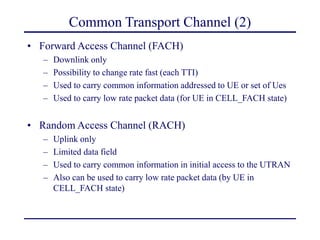
Common Transport Channel (2)
• Forward Access Channel (FACH)
– Downlink only
– Possibility to change rate fast (each TTI)
– Used to carry common information addressed to UE or set of Ues
– Used to carry low rate packet data (for UE in CELL_FACH state)
• Random Access Channel (RACH)
– Uplink only
– Limited data field
– Used to carry common information in initial access to the UTRAN
– Also can be used to carry low rate packet data (by UE in
CELL_FACH state)
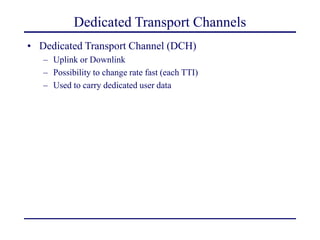
Dedicated Transport Channels
• Dedicated Transport Channel (DCH)
– Uplink or Downlink
– Possibility to change rate fast (each TTI)
– Used to carry dedicated user data
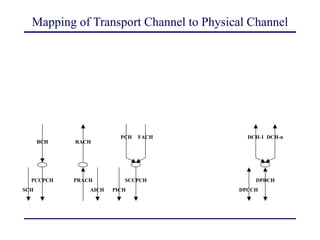
Mapping of Transport Channel to Physical Channel
PCCPCH
BCH
PRACH
AICH PICH
RACH
SCCPCH
SCH
PCH FACH
DPDCH
DPCCH
DCH-1 DCH-n
Logical Channels
- What kind of information is transfer
- Service provided by MAC
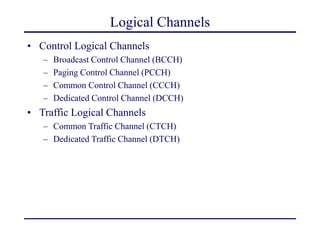
Logical Channels
• Control Logical Channels
– Broadcast Control Channel (BCCH)
– Paging Control Channel (PCCH)
– Common Control Channel (CCCH)
– Dedicated Control Channel (DCCH)
• Traffic Logical Channels
– Common Traffic Channel (CTCH)
– Dedicated Traffic Channel (DTCH)
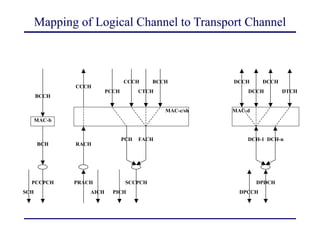
Mapping of Logical Channel to Transport Channel
PCCPCH
BCH
PRACH
AICH PICH
RACH
SCCPCH
SCH
PCH FACH
DPDCH
DPCCH
DCH-1 DCH-n
MAC-b
MAC-c/sh MAC-d
CCCH
CCCH
BCCH
CTCH
PCCH
BCCH DCCH
DCCH
DCCH
DTCH
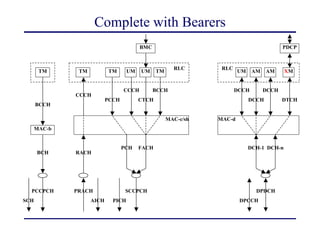
Complete with Bearers
PCCPCH
BCH
PRACH
AICH PICH
RACH
SCCPCH
SCH
PCH FACH
DPDCH
DPCCH
DCH-1 DCH-n
MAC-b
MAC-c/sh MAC-d
CCCH
CCCH
BCCH
CTCH
PCCH
BCCH DCCH
DCCH
DCCH
DTCH
TM TM TM UM UM TM UM AM AM XM
RLC
RLC
BMC PDCP
Thank You!!

UMTS Channel Overview - Transport/logical

  • 1.
    UMTS Channels Overview MaheshKhade mkhade@hssworld.com
  • 2.
    Agenda • UMTS Channels •Physical Channels and attributes • Transport Channels and attributes • Logical Channels and attributes • Questions..
  • 3.
    Wireless Basic • MultipleAccess Techniques – Frequency Division Multiple Access (FDMA) • Divide total frequency bandwidth in to frequency carriers • Each frequency carrier used separately – Time Division Multiple Access (TDMA) • Divide frequency into a set of timeslots • Each time-slot is used separately – Code Division Multiple Access (CDMA) • Signal is spread across a broad frequency spectrum • Each Spectrum is differentiated by assigning unique code sequence, used separately
  • 4.
    W-CDMA Basic Parameters •Multiple access method – DS-CDMA • Duplex Method – Frequency Division Duplex (FDD) – Time Division Duplex (TDD) • Chip rate – 3.84 kbps • Frame length – 10 ms • Service multiplexing – Different QoS • Multi-rate concepts – Variable spreading factor, multi-code • Signal detection – Coherent (Pilot or common pilot) • Scrambling code • Spreading and channelization code
  • 5.
    UMTS Channels • PhysicalChannel – W-CDMA wireless resource defined by • Frequency, • Code (scrambling and channelization), • Relative phase (in uplink) • Transport Channel – Defines How information is transfer on Physical Channel • Dedicated • Common • Logical Channel – Defines What kind of information is transfer on Transport Channel • Control • Traffic (Data)
  • 6.
  • 7.
    Downlink Physical Channels(1) • Common Pilot Channel (CPICH) – Primary Common Pilot Channel (PCPICH) • Only Channel per Cell or Sector • Un-modulated, fixed Channelization Code (CH256,1) • Transmit pre-defined bit sequence • Scrambled with Primary Scrambling Code • Used for Phase reference and Measurements Pre-defined bit sequence Slot #0 Slot #1 Slot #i Slot #14 Tslot = 2560 chips , 20 bits 1 radio frame: Tf = 10 ms
  • 8.
    Common Pilot Channelframe structure – Secondary Common Pilot Channel (SCPICH) [Optional] • Any Channelization Code with SF 256 (CH256,x) • Scrambled with Primary or Secondary Scrambling Code • Specific usage with narrow antenna beams in “hot spots” or “high traffic density areas”
  • 9.
    Downlink Physical Channels(2) • Synchronization Channels (SCH) – Time multiplexed with Primary Common Control Physical Channel (PCCPCH) – Two channels, used for Cell Search procedure only 1. Primary Synchronization Channel (P-SCH) • 256-chip spreading sequence identical in every Cell • Use for slot synchronization 2. Secondary Synchronization Channel (S-SCH) • 256-chip spreading sequences with 15 different code word combination, representing 64 different code group • Use for frame synchronization and • Identify the code-group, hence primary scrambling code
  • 10.
    Synchronisation Channel framestructure Primary SCH Secondary SCH 256 chips 2560 chips One 10 ms SCH radio frame acs i,0 acp acs i,1 acp acs i,14 acp Slot #0 Slot #1 Slot #14
  • 11.
    Downlink Physical Channels(3) • Common Control Physical Channels – Primary Common Control Physical Channel (PCCPCH) • Only Channel per Cell, Carries System Broadcast information • Fixed Spreading Factor 256, Fixed rate (30 kbps), effective 27 kbps due to time-multiplexing with SCH, • ½ rate convolution coding, • Fixed Transmission Time Interval (TTI) - 20 ms Data Ndata1=18 bits Slot #0 Slot #1 Slot #i Slot #14 Tslot = 2560 chips , 20 bits 1 radio frame: Tf = 10 ms (Tx OFF) 256 chips
  • 12.
    Downlink Physical Channels(4) – Secondary Common Control Physical Channel (SCCPCH) • Minimum one SCCPCH per cell (maximum up to 16 per cell) • Carries information from two common transport channels (PCH, FACH) • Multiplex up to 0-1 PCH and 0-7 FACH per SCCPCH Slot #0 Slot #1 Slot #i Slot #14 Tslot = 2560 chips, 20*2k bits (k=0..6) Pilot Npilot bits Data Ndata1 bits 1 radio frame: Tf = 10 ms TFCI NTFCI bits
  • 13.
    Downlink Physical Channels(5) • Dedicated Physical Channel (DPCH) – Dedicated Physical Data Channel (DPDCH) • Carries information from DCH transport Channel – Dedicated Physical Control Channel (DPCCH) • Carries Layer-1 control information, TPC, TFCI, Pilot – DPDCH and DPCCH are Time Multiplexed One radio frame, Tf = 10 ms TPC NTPC bits Slot #0 Slot #1 Slot #i Slot #14 Tslot = 2560 chips, 10*2k bits (k=0..7) Data2 Ndata2 bits DPDCH TFCI NTFCI bits Pilot Npilot bits Data1 Ndata1 bits DPDCH DPCCH DPCCH
  • 14.
    Downlink DPCH framestructure • Acquisition Indicator Channel (AICH) – Associated with PRACH – Used to indicate reception of random access channel signature • Paging Indicator Channel (PICH) – Associated with SCCPCH carrying PCH – Used to support efficient sleep mode operation in UE
  • 15.
    Uplink Physical Channels(1) • Physical Random Access Channel (PRACH) – Minimum one PRACH per cell (maximum up to 16) – The random-access transmission is based on a Slotted ALOHA approach with fast acquisition indication – Collision Risk – Used for initial access to the UTRAN
  • 16.
    Uplink DPDCH/DPCCH framestructure • Dedicated Physical Channel (DPCH) – Dedicated Physical Data Channel (DPDCH) • Carries information from DCH transport Channel – Dedicated Physical Control Channel (DPCCH) • Carries Layer-1 control information, TPC, TFCI, Pilot and FBI • Fixed Rate (SF 256) – DPDCH and DPCCH are I/Q Multiplexed Pilot Npilot bits TPC NTPC bits Data Ndata bits Slot #0 Slot #1 Slot #i Slot #14 Tslot = 2560 chips, 10 bits 1 radio frame: Tf = 10 ms DPDCH DPCCH FBI NFBI bits TFCI NTFCI bits Tslot = 2560 chips, Ndata = 10*2k bits (k=0..6)
  • 17.
    Timing relation ofDL physical channels k:th S-CCPCH AICH access slots Secondary SCH Primary SCH S-CCPCH,k 10 ms PICH #0 #1 #2 #3 #14 #13 #12 #11 #10 #9 #8 #7 #6 #5 #4 Radio frame with (SFN modulo 2) = 0 Radio frame with (SFN modulo 2) = 1 DPCH,n P-CCPCH Any CPICH PICH for k:th S-CCPCH Any PDSCH n:th DPCH 10 ms
  • 18.
    Physical Layer Procedures •Power Control – Fast Closed loop power control • Inner loop power control (SIR target) • Outer loop power control (BER target) – Open loop power control • Measurements • Cell Search Procedure
  • 19.
    Transport Channels - DefinesHow information is transfer - Service provided by Physical Layer
  • 20.
    Transport Channel Attributes(1) • Transport Block (TB) – This is the basic unit exchanged between L1 and L2 (MAC) • Transport Block Set (TBS) – Set of Transport Blocks exchanged between L1 and MAC at the same time instance • Transport Block Size – Number of bits in a Transport Block – Transport Block Size is always fixed within a Transport Block Set • Transport Block Set Size – Number of bits in a Transport Block Set – Also can be defined as :- TB Size x Number of TB, (e.g. 336 x 0, 336 x 2)
  • 21.
    Transport Channel Attributes(2) • Transmission Time Interval (TTI) – Time-interval at which TBS exchanged between L1 and L2 (MAC) – Periodicity at which TBS is transferred or received by the Physical Layer on the radio interface – Multiple of the minimum interleaving period (e.g. 10ms, the length of one Radio Frame).
  • 22.
    Exchange of databetween MAC and L1 DCH3 Transmission Time Interval DCH2 Transmission Time Interval DCH1 Transmission Time Interval Transport Block Transport Block Transport Block Transport Block Transport Block Transport Block Transport Block Transport Block Transport Block Transport Block Transport Block Transport Block Transport Block Transport Block Transport Block Transport Block Transport Block Transport Block
  • 23.
    Transport Channel Attributes(3) • Transport Format (TF) – Format offered by L1 to MAC for exchange of TBS – Constitutes of two parts – dynamic and semi-static 1. Dynamic Part attributes • Transport Block Size • Transport Block Set Size 2. Semi-static Part attributes • Transmission Time Interval • Error protection scheme : – Type of error protection/coding (Turbo, Convolutional, etc) – Coding rate (1/2, 1/3, etc) – Static rate matching parameter • Size of CRC
  • 24.
    Transport Channel Attributes(4) • Transport Format Set (TFS) – Set of Transport Formats associated to a Transport Channel – Semi-static part of all TF are same within a Transport Format Set – Different the instantaneous bit rate on the Transport Channel can be archived by changing two attributes of the dynamic part : • Transport Block Set Size only • Both Transport Block Size and Transport Block Set Size
  • 25.
    Transport Channel Attributes(5) • Transport Format Combination (TFC) – Layer 1 multiplexes one or several Transport Channels into a a Coded Composite Transport Channel (CCTrCH) – Each Transport Channel has associated a list of transport formats (Transport Format Set) – TFC define the valid combination of TF from each Transport Channel, multiplex into CCTrCH, at a given point of time (TTI) – Or, TFC defines valid Transport Formats that can be submitted simultaneously to the layer 1 to multiplex into CCTrCH and further transmitted on Physical Layer
  • 26.
    Transport Channel Attributes(6) • Transport Format Combination Set (TFCS) – Defined as a set of Transport Format Combinations on a Coded Composite Transport Channel
  • 27.
    Transport Channel Attributes(7) • Transport Format Indicator (TFI) – TFI is a label for a specific TF within a transport format set – one-to-one correspondence between a TFI and TF – Used in the inter-layer communication between MAC and L1 each time a transport block set is exchanged • Transport Format Combination Indicator (TFCI) – TFCI is label for a specific TFC within TFCS – one-to-one correspondence between a TFCI and TFC – Use to inform receiving side TFC used, while multiplex into CCTrCH, hence indicates how to decode, de-multiplex and deliver the received data on the appropriate Transport Channels
  • 28.
    Transport Channel Attributes(8) • Calculated Transport Format Combination (CTFC) – Use to efficiently represent and signal the current valid Transport Format Combinations (using arithmetic's :-(..)
  • 29.
    Transport Channels • CommonTransport Channels – Broadcast Channel (BCH) – Paging Channel (PCH) – Forward Access Channel (FACH) – Random Access Channel (RACH) – Common Packet Channel (CPCH) • Dedicated Transport Channels – Dedicated Channel (DCH) • Shared Transport Channels – Downlink Shared Transport Channel (DSCH) – High-Speed Downlink Shared Transport Channel (HS-DSCH)
  • 30.
    Common Transport Channel(1) • Broadcast Channel (BCH) – Downlink only – Fixed TTI, 20ms – Low fixed bit rate – Used to be broadcast System and Cell information • Paging Channel (PCH) – Downlink only – Fixed TTI, 10ms – Association with a physical layer signal, the Page Indicator, to support efficient sleep mode procedures – Used to be broadcast Paging message
  • 31.
    Common Transport Channel(2) • Forward Access Channel (FACH) – Downlink only – Possibility to change rate fast (each TTI) – Used to carry common information addressed to UE or set of Ues – Used to carry low rate packet data (for UE in CELL_FACH state) • Random Access Channel (RACH) – Uplink only – Limited data field – Used to carry common information in initial access to the UTRAN – Also can be used to carry low rate packet data (by UE in CELL_FACH state)
  • 32.
    Dedicated Transport Channels •Dedicated Transport Channel (DCH) – Uplink or Downlink – Possibility to change rate fast (each TTI) – Used to carry dedicated user data
  • 33.
    Mapping of TransportChannel to Physical Channel PCCPCH BCH PRACH AICH PICH RACH SCCPCH SCH PCH FACH DPDCH DPCCH DCH-1 DCH-n
  • 34.
    Logical Channels - Whatkind of information is transfer - Service provided by MAC
  • 35.
    Logical Channels • ControlLogical Channels – Broadcast Control Channel (BCCH) – Paging Control Channel (PCCH) – Common Control Channel (CCCH) – Dedicated Control Channel (DCCH) • Traffic Logical Channels – Common Traffic Channel (CTCH) – Dedicated Traffic Channel (DTCH)
  • 36.
    Mapping of LogicalChannel to Transport Channel PCCPCH BCH PRACH AICH PICH RACH SCCPCH SCH PCH FACH DPDCH DPCCH DCH-1 DCH-n MAC-b MAC-c/sh MAC-d CCCH CCCH BCCH CTCH PCCH BCCH DCCH DCCH DCCH DTCH
  • 37.
    Complete with Bearers PCCPCH BCH PRACH AICHPICH RACH SCCPCH SCH PCH FACH DPDCH DPCCH DCH-1 DCH-n MAC-b MAC-c/sh MAC-d CCCH CCCH BCCH CTCH PCCH BCCH DCCH DCCH DCCH DTCH TM TM TM UM UM TM UM AM AM XM RLC RLC BMC PDCP
  • 38.