Business Agility through Governance
PMI Atlanta Governance Forum
August 26, 2015
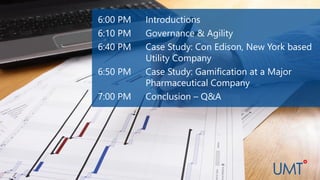
6:00 PM Introductions
6:10 PM Governance & Agility
6:40 PM Case Study: Con Edison, New York based
Utility Company
6:50 PM Case Study: Gamification at a Major
Pharmaceutical Company
7:00 PM Conclusion – Q&A
www.umt.com
Introductions
www.umt.com
Introducing Brian Feder, UMT SVP
Education
 BSME from University of Florida
 MBA from NYU Stern School of Business
 PMP from PMI
 Work Experience
 10+ years prior to UMT and NYU
 10+ years at UMT, from Consultant to SVP
 Extensive client list
 Author of White Papers and Case Studies
 Personal
 Marathon runner & Triathlon “competitor”
 Weekend soccer coach
 I enjoy long walks on the beach…. (really!)
www.umt.com
Ludvic Baquié
Business Development Manager
UMT Consulting Group
678 559 9265
ludvic.baquie@umt.com
www.umt.com
Name
Company
Role
Governance Experience
Objective for Attending
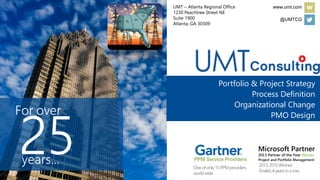
Portfolio & Project Strategy
Process Definition
Organizational Change
PMO Design
Oneofonly15PPMproviders
worldwide
2013,2010Winner;
Finalist,4yearsinarow
www.umt.com
@UMTCG
UMT – Atlanta Regional Office
1230 Peachtree Street NE
Suite 1900
Atlanta, GA 30309
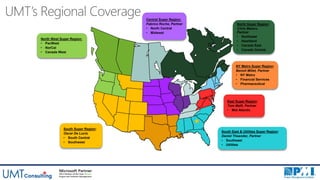
UMT’s Regional Coverage
Project Management
North West Super Region:
• PacWest
• NorCal
• Canada West
East Super Region:
Tom Malfi, Partner
• Mid Atlantic
Central Super Region:
Fabrice Roche, Partner
• North Central
• Midwest
South Super Region:
Oscar De Lucio
• South Central
• Southwest
North Super Region:
Chris Matero,
Partner
• Northeast
• Heartland
• Canada East
• Canada Central
NY Metro Super Region:
Benoit Millet, Partner
• NY Metro
• Financial Services
• Pharmaceutical
South East & Utilities Super Region:
Daniel Theander, Partner
• Southeast
• Utilities
UMT & Microsoft Relationship
Microsoft
Acquires
UMT
Portfolio
Manager
Microsoft
releases
Portfolio
Server
UMT
becomes a
Microsoft
Certified
Partner
Government
Our Clients
www.umt.com
Governance and Agility
• The heart of Organizational Agility is the capacity to identify/capture opportunities (and
dodge threats) with assurance and more quickly than rivals do (Sull, 2010)
• Organizations that best, most quickly, align strategy with execution, benefit from up to a 6%
better EBITDA margin than their least aligned peers
Put something
here, maybe
Agility: From Decision to Deployment
EPMO 2.0
When companies fail to execute on a strategy, the first thing managers often think
to do is restructure; however, research shows that improving information flows is
more effective than any other approach to enhancing execution
Most common mandate given to an EPMO is that of reporting on the health and
progress of various high-visibility initiatives in operation across the enterprise
A properly designed, implemented and operated “EPMO 2.0”, when deployed as a
robust command and support center for the entire enterprise, top-to-bottom, is
able to take on this role in a systematic and comprehensive way, and should be
mandated with the responsibility for achieving organizational agility
Core
Content
Portfolio Solutions encapsulate
Three-dimensions of
Core Content
The most comprehensive PPM implementation framework
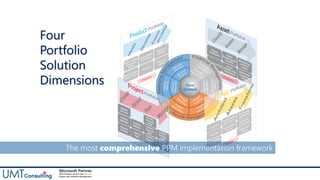
Four
Portfolio
Solution
Dimensions Core
Content
The most comprehensive PPM implementation framework
Core
Content
Pillars of an EPMO
Implementation
Framework
The most comprehensive PPM implementation framework
Core
Content
Core
Content
Core
Content
Core
Content
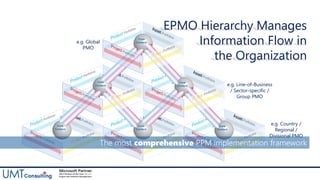
EPMO Hierarchy Manages
Information Flow in
the Organization
Core
Content
Core
Content
e.g. Global
PMO
e.g. Line-of-Business
/ Sector-specific /
Group PMO
e.g. Country /
Regional /
Divisional PMO
The most comprehensive PPM implementation framework
Seven Dimensions of the Roadmap for Success
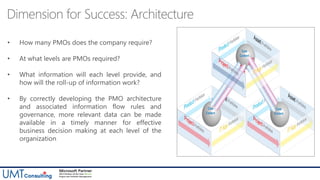
• How many PMOs does the company require?
• At what levels are PMOs required?
• What information will each level provide, and
how will the roll-up of information work?
• By correctly developing the PMO architecture
and associated information flow rules and
governance, more relevant data can be made
available in a timely manner for effective
business decision making at each level of the
organization
Put something
here, maybe
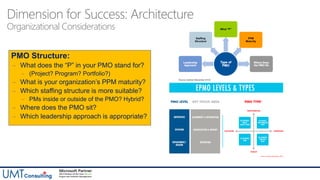
Dimension for Success: Architecture
Organizational Considerations
PMO Structure:
– What does the “P” in your PMO stand for?
– (Project? Program? Portfolio?)
– What is your organization’s PPM maturity?
– Which staffing structure is more suitable?
– PMs inside or outside of the PMO? Hybrid?
– Where does the PMO sit?
– Which leadership approach is appropriate?
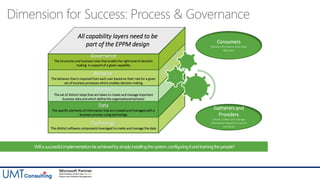
Dimension for Success: Architecture
Consumers
Review information and make
decisions
Gatherers and
Providers
Create, collect and manage
information based on a set of
standards
Data
The specific elements of information that are created and managed with a
business process using technology
Process
The set of distinct steps that are taken to create and manage important
business data and which define the organizational behavior
Behavior
The behavior that is required from each user based on their role for a given
set of business processes which enables decision making
Technology
The distinct software components leveraged to create and manage the data
Governance
The structures and business rules that enable the right level of decision
making in support of a given capability
.
.
.
All capability layers need to be
part of the EPPM design
Dimension for Success: Process & Governance
• A structured approach to translating strategy
into execution will most likely include well-
known business process mapping
• Core capabilities, once identified, can be
compared against newly deployed strategies,
and analyzed to determine whether operational
shortcomings have been exposed or, more
rarely, whether wholesale capability gaps need
to be remedied to maintain strategic alignment
• Modern PMOs will typically embrace the
ubiquitous portfolio governance model of
‘Create’, ‘Select’, ‘Plan’, ‘Manage’
Dimension for Success: Process & Governance
Data
Process
Behavior
Technology
Governance
• Effective visualization is critical to leveraging information
in consistent decision-making by non-technical
stakeholders
• Superior insights are obtained when the business’s
strategy is integrated into the data management,
analytics, and visualization implementation
• Intelligent design of data analyses and KPI visualizations
strongly depends on the questions being addressed and
the demands and station of the consumer
Put something
here, maybe
Dimension for Success: Visualization
• To make effective capital planning and investment control (CPIC) decisions, executives must
provide, at an early stage in their portfolio’s life cycle, a long-term vision combined with effective
planning and execution
Put something
here, maybe
Dimension for Success: Capital Projects
Capital
Portfolio
Customers
Shareholders
Regulators
Employees
Risk Mgmt.
Operations
Strategic
Growth
Safety
• The balanced capital investment portfolio needs to take into
account risks, returns, and business goals and relies on a solid
repeatable process and the gathering of accurate and
complete data
• Successful strategy deployment and execution is predicated on alignment with an organizations’
financial management activities as led by the office of the CFO
• Initiatives that are funded across functions need to be managed in a manner that is insightful to
both operational and financial executives at all levels of the organization
Put something
here, maybe
Dimension for Success: Financial Integration
• A solid information technology framework is
essential to achieving a high performance
PMO and is an integral part of the strategy
decision and deployment equation
• There are enterprise-grade software
platforms (customizable and adjustable) that
can provide a strong foundation and the
necessary tight integration between a wide
scope of functional PPM capabilities
Put something
here, maybe
Dimension for Success: Technology
• Building and evolving a framework that is readily
adopted by all stakeholders is the necessary
hallmark of a PMO transformation that succeeds
where other standardized methodologies have
failed
• Implementing agile environments requires a
strong dedicated effort to change the way
employees at all levels in a company think and
operate at the day to day level
• Ultimately, adoption is the single most important
dimension of a successful roadmap
Put something
here, maybe
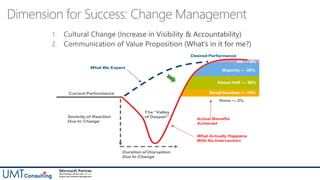
Dimension for Success: Change Management
1.
2.
Majority — 38%
About Half — 38%
Small Number — 19%-
What We Expect
Desired Performance
Current Performance
None — 2%
The “Valley
of Despair”Severity of Reaction
Due to Change
Duration of Disruption
Due to Change
Actual Benefits
Achieved
What Actually Happens
With No Intervention
All — 4%
Dimension for Success: Change Management
29
Sample Solution Overview: 2 min video…
30
Gamification Case Study
The use of game elements and game
design techniques in non-game contexts
What is Gamification?
Why Gamification?
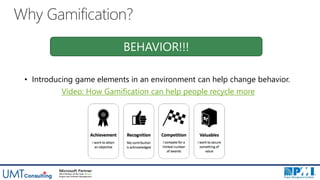
• Introducing game elements in an environment can help change behavior.
BEHAVIOR!!!
Video: How Gamification can help people recycle more
Example: Increasing Compliance




Game Elements to Introduce
1.
2.
3.
4.
5.
6.
7.
8.
9.
10.
11.
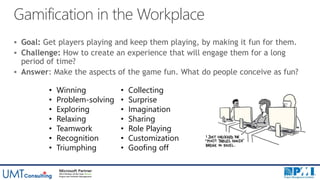
Gamification in the Workplace



• Winning
• Problem-solving
• Exploring
• Relaxing
• Teamwork
• Recognition
• Triumphing
• Collecting
• Surprise
• Imagination
• Sharing
• Role Playing
• Customization
• Goofing off
Example: Contribution to Collaboration





Gamification in PPM
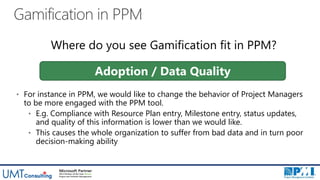
• For instance in PPM, we would like to change the behavior of Project Managers
to be more engaged with the PPM tool.
• E.g. Compliance with Resource Plan entry, Milestone entry, status updates,
and quality of this information is lower than we would like.
• This causes the whole organization to suffer from bad data and in turn poor
decision-making ability
Adoption / Data Quality
Where do you see Gamification fit in PPM?
Case Study Context
Adoption Step 1: Measure
Adoption Step 2: Choose Your Governance
Gamification Example in PPM
Case Study Summary
RISKS:
• Oppressively monitoring users could frustrate and
demotivate them.
• Cannot turn this into a glorified compliance system.
• In a real game, no one hounds you over email to play the
next level (or update your resource plan)
• The GAME vs. the JOB:
• Gamification is designed to have some beneficial to the
business
• Players could focus on game to the extent that there is a
divergence from intended outcome
Any questions?
Brian Feder
UMT, SVP
Brian.Feder@umt.com
917 627 3860
http://www.umt.com
Ludvic Baquié
UMT, BDM
Ludvic.Baquie@umt.com
678 559 9265

UMT_PMI-ATL Governance Agility_Final

  • 1.
    Business Agility throughGovernance PMI Atlanta Governance Forum August 26, 2015
  • 2.
    6:00 PM Introductions 6:10PM Governance & Agility 6:40 PM Case Study: Con Edison, New York based Utility Company 6:50 PM Case Study: Gamification at a Major Pharmaceutical Company 7:00 PM Conclusion – Q&A
  • 3.
  • 4.
    www.umt.com Introducing Brian Feder,UMT SVP Education  BSME from University of Florida  MBA from NYU Stern School of Business  PMP from PMI  Work Experience  10+ years prior to UMT and NYU  10+ years at UMT, from Consultant to SVP  Extensive client list  Author of White Papers and Case Studies  Personal  Marathon runner & Triathlon “competitor”  Weekend soccer coach  I enjoy long walks on the beach…. (really!)
  • 5.
    www.umt.com Ludvic Baquié Business DevelopmentManager UMT Consulting Group 678 559 9265 ludvic.baquie@umt.com
  • 6.
  • 7.
    Portfolio & ProjectStrategy Process Definition Organizational Change PMO Design Oneofonly15PPMproviders worldwide 2013,2010Winner; Finalist,4yearsinarow www.umt.com @UMTCG UMT – Atlanta Regional Office 1230 Peachtree Street NE Suite 1900 Atlanta, GA 30309
  • 8.
    UMT’s Regional Coverage ProjectManagement North West Super Region: • PacWest • NorCal • Canada West East Super Region: Tom Malfi, Partner • Mid Atlantic Central Super Region: Fabrice Roche, Partner • North Central • Midwest South Super Region: Oscar De Lucio • South Central • Southwest North Super Region: Chris Matero, Partner • Northeast • Heartland • Canada East • Canada Central NY Metro Super Region: Benoit Millet, Partner • NY Metro • Financial Services • Pharmaceutical South East & Utilities Super Region: Daniel Theander, Partner • Southeast • Utilities
  • 9.
    UMT & MicrosoftRelationship Microsoft Acquires UMT Portfolio Manager Microsoft releases Portfolio Server UMT becomes a Microsoft Certified Partner
  • 10.
  • 11.
  • 12.
    • The heartof Organizational Agility is the capacity to identify/capture opportunities (and dodge threats) with assurance and more quickly than rivals do (Sull, 2010) • Organizations that best, most quickly, align strategy with execution, benefit from up to a 6% better EBITDA margin than their least aligned peers Put something here, maybe Agility: From Decision to Deployment
  • 13.
    EPMO 2.0 When companiesfail to execute on a strategy, the first thing managers often think to do is restructure; however, research shows that improving information flows is more effective than any other approach to enhancing execution Most common mandate given to an EPMO is that of reporting on the health and progress of various high-visibility initiatives in operation across the enterprise A properly designed, implemented and operated “EPMO 2.0”, when deployed as a robust command and support center for the entire enterprise, top-to-bottom, is able to take on this role in a systematic and comprehensive way, and should be mandated with the responsibility for achieving organizational agility
  • 14.
    Core Content Portfolio Solutions encapsulate Three-dimensionsof Core Content The most comprehensive PPM implementation framework
  • 15.
    Four Portfolio Solution Dimensions Core Content The mostcomprehensive PPM implementation framework
  • 16.
    Core Content Pillars of anEPMO Implementation Framework The most comprehensive PPM implementation framework
  • 17.
    Core Content Core Content Core Content Core Content EPMO Hierarchy Manages InformationFlow in the Organization Core Content Core Content e.g. Global PMO e.g. Line-of-Business / Sector-specific / Group PMO e.g. Country / Regional / Divisional PMO The most comprehensive PPM implementation framework
  • 18.
    Seven Dimensions ofthe Roadmap for Success
  • 19.
    • How manyPMOs does the company require? • At what levels are PMOs required? • What information will each level provide, and how will the roll-up of information work? • By correctly developing the PMO architecture and associated information flow rules and governance, more relevant data can be made available in a timely manner for effective business decision making at each level of the organization Put something here, maybe Dimension for Success: Architecture
  • 20.
    Organizational Considerations PMO Structure: –What does the “P” in your PMO stand for? – (Project? Program? Portfolio?) – What is your organization’s PPM maturity? – Which staffing structure is more suitable? – PMs inside or outside of the PMO? Hybrid? – Where does the PMO sit? – Which leadership approach is appropriate? Dimension for Success: Architecture
  • 21.
    Consumers Review information andmake decisions Gatherers and Providers Create, collect and manage information based on a set of standards Data The specific elements of information that are created and managed with a business process using technology Process The set of distinct steps that are taken to create and manage important business data and which define the organizational behavior Behavior The behavior that is required from each user based on their role for a given set of business processes which enables decision making Technology The distinct software components leveraged to create and manage the data Governance The structures and business rules that enable the right level of decision making in support of a given capability . . . All capability layers need to be part of the EPPM design Dimension for Success: Process & Governance
  • 22.
    • A structuredapproach to translating strategy into execution will most likely include well- known business process mapping • Core capabilities, once identified, can be compared against newly deployed strategies, and analyzed to determine whether operational shortcomings have been exposed or, more rarely, whether wholesale capability gaps need to be remedied to maintain strategic alignment • Modern PMOs will typically embrace the ubiquitous portfolio governance model of ‘Create’, ‘Select’, ‘Plan’, ‘Manage’ Dimension for Success: Process & Governance Data Process Behavior Technology Governance
  • 23.
    • Effective visualizationis critical to leveraging information in consistent decision-making by non-technical stakeholders • Superior insights are obtained when the business’s strategy is integrated into the data management, analytics, and visualization implementation • Intelligent design of data analyses and KPI visualizations strongly depends on the questions being addressed and the demands and station of the consumer Put something here, maybe Dimension for Success: Visualization
  • 24.
    • To makeeffective capital planning and investment control (CPIC) decisions, executives must provide, at an early stage in their portfolio’s life cycle, a long-term vision combined with effective planning and execution Put something here, maybe Dimension for Success: Capital Projects Capital Portfolio Customers Shareholders Regulators Employees Risk Mgmt. Operations Strategic Growth Safety • The balanced capital investment portfolio needs to take into account risks, returns, and business goals and relies on a solid repeatable process and the gathering of accurate and complete data
  • 25.
    • Successful strategydeployment and execution is predicated on alignment with an organizations’ financial management activities as led by the office of the CFO • Initiatives that are funded across functions need to be managed in a manner that is insightful to both operational and financial executives at all levels of the organization Put something here, maybe Dimension for Success: Financial Integration
  • 26.
    • A solidinformation technology framework is essential to achieving a high performance PMO and is an integral part of the strategy decision and deployment equation • There are enterprise-grade software platforms (customizable and adjustable) that can provide a strong foundation and the necessary tight integration between a wide scope of functional PPM capabilities Put something here, maybe Dimension for Success: Technology
  • 27.
    • Building andevolving a framework that is readily adopted by all stakeholders is the necessary hallmark of a PMO transformation that succeeds where other standardized methodologies have failed • Implementing agile environments requires a strong dedicated effort to change the way employees at all levels in a company think and operate at the day to day level • Ultimately, adoption is the single most important dimension of a successful roadmap Put something here, maybe Dimension for Success: Change Management
  • 28.
    1. 2. Majority — 38% AboutHalf — 38% Small Number — 19%- What We Expect Desired Performance Current Performance None — 2% The “Valley of Despair”Severity of Reaction Due to Change Duration of Disruption Due to Change Actual Benefits Achieved What Actually Happens With No Intervention All — 4% Dimension for Success: Change Management
  • 29.
  • 30.
  • 31.
    The use ofgame elements and game design techniques in non-game contexts What is Gamification?
  • 32.
    Why Gamification? • Introducinggame elements in an environment can help change behavior. BEHAVIOR!!! Video: How Gamification can help people recycle more
  • 33.
  • 34.
    Game Elements toIntroduce 1. 2. 3. 4. 5. 6. 7. 8. 9. 10. 11.
  • 35.
    Gamification in theWorkplace    • Winning • Problem-solving • Exploring • Relaxing • Teamwork • Recognition • Triumphing • Collecting • Surprise • Imagination • Sharing • Role Playing • Customization • Goofing off
  • 36.
    Example: Contribution toCollaboration     
  • 37.
    Gamification in PPM •For instance in PPM, we would like to change the behavior of Project Managers to be more engaged with the PPM tool. • E.g. Compliance with Resource Plan entry, Milestone entry, status updates, and quality of this information is lower than we would like. • This causes the whole organization to suffer from bad data and in turn poor decision-making ability Adoption / Data Quality Where do you see Gamification fit in PPM?
  • 38.
  • 39.
  • 40.
    Adoption Step 2:Choose Your Governance
  • 41.
  • 42.
    Case Study Summary RISKS: •Oppressively monitoring users could frustrate and demotivate them. • Cannot turn this into a glorified compliance system. • In a real game, no one hounds you over email to play the next level (or update your resource plan) • The GAME vs. the JOB: • Gamification is designed to have some beneficial to the business • Players could focus on game to the extent that there is a divergence from intended outcome
  • 43.
  • 44.
    Brian Feder UMT, SVP Brian.Feder@umt.com 917627 3860 http://www.umt.com Ludvic Baquié UMT, BDM Ludvic.Baquie@umt.com 678 559 9265