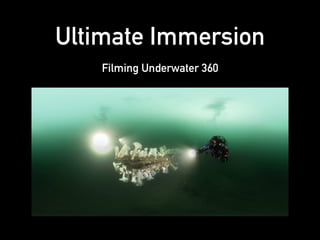
Ultimate Immersion
Filming Underwater 360
Why 360?
The most powerful way to share Underwater World
without getting wet
VR-Pro VR-YL3 array
My path
• Certified to SCUBA dive 1990

• Documenting shipwrecks - changes over time 

• Sharing underwater world with non-divers 

• Environmental filmmaking 2004

• In 2014 it became clear that 360 was perfect medium to capture
underwater storm drains

• 360 video returns sense of transparency to environmental
storytelling and outreach (viewer can look around and come to their
own conclusion)
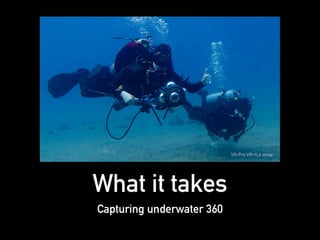
What it takes
Capturing underwater 360
VR-Pro VR-YL6 array
Diving
• Underwater camera operator must be a skilled diver

• Proper equipment 

• Environment

• Local knowledge
Camera/housing
• Crisp focus

• Neutrally buoyant or slightly
positive

• Balanced

• Easy to access cameras

• Proper camera system for job
VR-Pro VR-YL6 array
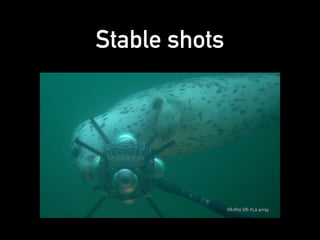
Stable shots
VR-Pro VR-YL6 array
Monopod
• Static

• Comfortable for most viewers

• Establishing shot 

• Close focus wide angle

• Often easier to stitch
Monopod
Negatively buoyant
Diver handheld
• Dynamic shot

• Pelagic animals (whales, dolphins, sharks, snorkel, etc..)

• Motion sometimes less comfortable for viewers 

• More challenging stitch due to motion/variable distances 

• May need stabilization in post with MochaVR

• Be SURE to respect the distance all around, I have tendency
to swim too close to bottom which will impact ease of stitch
Diver Handheld
T-handle can be helpful for stabilizing shot
Boxfish Research array
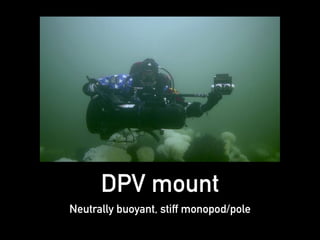
DPV mount
• Additional diver skill set needed

• Not always available at destination

• Very stable moving footage

• Dynamic shot
DPV mount
Neutrally buoyant, stiff monopod/pole
Sled
• Useful for stereo180

• Adds stability and inertia

• Ability to mount lights
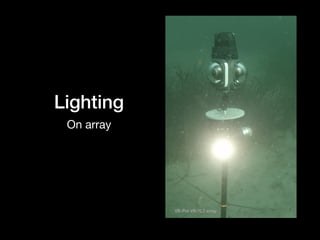
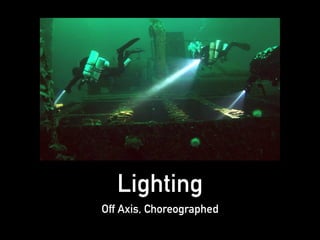
Lighting
• Ambient

• On array

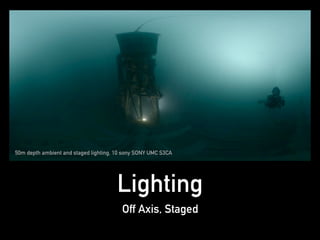
• Off Axis - staged

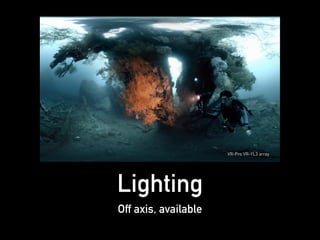
• Off Axis - available

• Off Axis - choreographed
Lighting
Ambient
VR-Pro VR-YL3 array
Ambient lighting
• 10m or shallower

• Often needs color grade in post

• Keep sun position in mind for exposure and lens flare
issues
Lighting
On array
VR-Pro VR-YL3 array
On array
• Challenging

• Issues include

• Exposure

• Lens flare

• Backscatter

• Light placement
Lighting
Off Axis, Staged
50m depth ambient and staged lighting, 10 sony SONY UMC S3CA
Off Axis, Staged
• More set up time

• Larger team to coordinate

• Exposure issues if you do not have camera controls

• I refer to this as “museum lighting”
Lighting
Off axis, available
VR-Pro VR-YL3 array
Off Axis, Available
• Good results 

• Coordination with lighting team

• Foreground lighting

• Lighting points of interest (artifacts, critters)

• Backlighting
Lighting
Off Axis, Choreographed
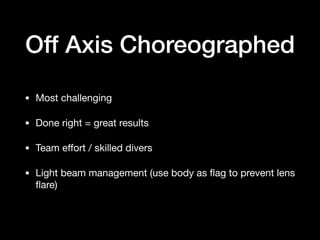
Off Axis Choreographed
• Most challenging 

• Done right = great results 

• Team effort / skilled divers 

• Light beam management (use body as flag to prevent lens
flare)
A few more tips
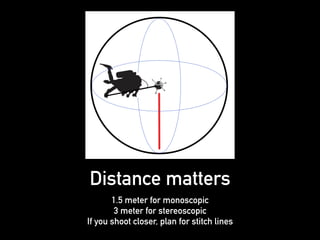
Distance matters
1.5 meter for monoscopic
3 meter for stereoscopic
If you shoot closer, plan for stitch lines
Primary subject in one lens
Shooting sequence
• modified BBC 5 shot technique to help ensure story from footage

• Wide (establishing)

• Close focus wide angle subject

• Close focus wide angle diver

• Over the shoulder of diver

• Unusual shot

• Interview (many underwater stories benefit from topside footage)
VR-Pro VR-YL3 array
Trends
Trends
• Housings for existing unibody design cameras 

• Stereo 180

• Larger sensor camera arrays

• 10 X SONY UMC S3CA

• 3 and 4 Sony A7s2 and Panasonic GH5 array with
Entanyia 200/250
Trends
Serial content 

Narrative Story

Documentary

Additional user base coming from consumer space

Education / Conservation
Thank you!
Questions?

Ultimate immersion