Alan Freeman
Presentation to colloquium on ‘Perspectives on the Crisis in
Ukraine’ at the Ukrainian Labour Temple, Winnipeg
18 June 2014
 United Nations Statistical Database
 Oxford Handbook of the Russian Economy
 Post-Globalization Initiative
 Alternativy
 Links
 Rosstat
 londonmet.academia.edu/AlanFreeman
 slideshare.net/alanfreeman777
 vimeo.com/alanfreeman
 ideas.repec.org/e/pfr102.html
 Afreeman@iwgvt.org
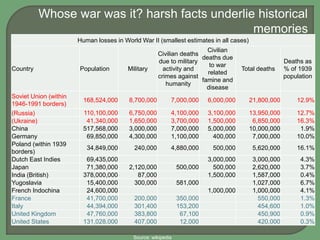
Human losses in World War II (smallest estimates in all cases)
Country Population Military
Civilian deaths
due to military
activity and
crimes against
humanity
Civilian
deaths due
to war
related
famine and
disease
Total deaths
Deaths as
% of 1939
population
Soviet Union (within
1946-1991 borders)
168,524,000 8,700,000 7,000,000 6,000,000 21,800,000 12.9%
(Russia) 110,100,000 6,750,000 4,100,000 3,100,000 13,950,000 12.7%
(Ukraine) 41,340,000 1,650,000 3,700,000 1,500,000 6,850,000 16.3%
China 517,568,000 3,000,000 7,000,000 5,000,000 10,000,000 1.9%
Germany 69,850,000 4,300,000 1,100,000 400,000 7,000,000 10.0%
Poland (within 1939
borders)
34,849,000 240,000 4,880,000 500,000 5,620,000 16.1%
Dutch East Indies 69,435,000 3,000,000 3,000,000 4.3%
Japan 71,380,000 2,120,000 500,000 500,000 2,620,000 3.7%
India (British) 378,000,000 87,000 1,500,000 1,587,000 0.4%
Yugoslavia 15,400,000 300,000 581,000 1,027,000 6.7%
French Indochina 24,600,000 1,000,000 1,000,000 4.1%
France 41,700,000 200,000 350,000 550,000 1.3%
Italy 44,394,000 301,400 153,200 454,600 1.0%
United Kingdom 47,760,000 383,800 67,100 450,900 0.9%
United States 131,028,000 407,000 12,000 420,000 0.3%
Whose war was it? harsh facts underlie historical
memories
Source: wikipedia
0
5
10
15
20
25
1970
1972
1974
1976
1978
1980
1982
1984
1986
1988
1990
1992
1994
1996
1998
2000
2002
2004
2006
2008
2010
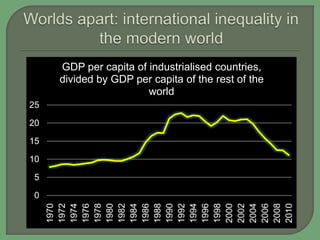
GDP per capita of industrialised countries,
divided by GDP per capita of the rest of the
world
The ‘economic nationalist’ programme
‘Why I am challenging Putin’
Sergei Glazyev’s 2004 election statement
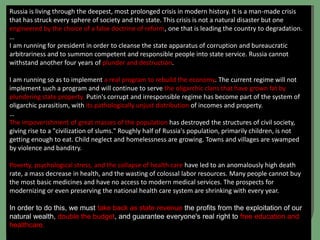
Russia is living through the deepest, most prolonged crisis in modern history. It is a man-made crisis
that has struck every sphere of society and the state. This crisis is not a natural disaster but one
engineered by the choice of a false doctrine of reform, one that is leading the country to degradation.
…
I am running for president in order to cleanse the state apparatus of corruption and bureaucratic
arbitrariness and to summon competent and responsible people into state service. Russia cannot
withstand another four years of plunder and destruction.
I am running so as to implement a real program to rebuild the economy. The current regime will not
implement such a program and will continue to serve the oligarchic clans that have grown fat by
plundering state property. Putin's corrupt and irresponsible regime has become part of the system of
oligarchic parasitism, with its pathologically unjust distribution of incomes and property.
…
The impoverishment of great masses of the population has destroyed the structures of civil society,
giving rise to a "civilization of slums." Roughly half of Russia's population, primarily children, is not
getting enough to eat. Child neglect and homelessness are growing. Towns and villages are swamped
by violence and banditry.
Poverty, psychological stress, and the collapse of health care have led to an anomalously high death
rate, a mass decrease in health, and the wasting of colossal labor resources. Many people cannot buy
the most basic medicines and have no access to modern medical services. The prospects for
modernizing or even preserving the national health care system are shrinking with every year.
In order to do this, we must take back as state revenue the profits from the exploitation of our
natural wealth, double the budget, and guarantee everyone's real right to free education and
healthcare.
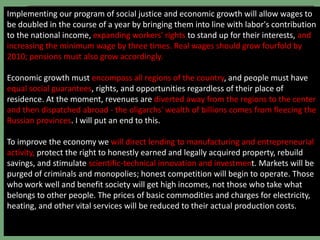
Implementing our program of social justice and economic growth will allow wages to
be doubled in the course of a year by bringing them into line with labor's contribution
to the national income, expanding workers' rights to stand up for their interests, and
increasing the minimum wage by three times. Real wages should grow fourfold by
2010; pensions must also grow accordingly.
Economic growth must encompass all regions of the country, and people must have
equal social guarantees, rights, and opportunities regardless of their place of
residence. At the moment, revenues are diverted away from the regions to the center
and then dispatched abroad - the oligarchs' wealth of billions comes from fleecing the
Russian provinces. I will put an end to this.
To improve the economy we will direct lending to manufacturing and entrepreneurial
activity, protect the right to honestly earned and legally acquired property, rebuild
savings, and stimulate scientific-technical innovation and investment. Markets will be
purged of criminals and monopolies; honest competition will begin to operate. Those
who work well and benefit society will get high incomes, not those who take what
belongs to other people. The prices of basic commodities and charges for electricity,
heating, and other vital services will be reduced to their actual production costs.
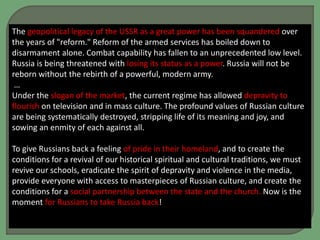
The geopolitical legacy of the USSR as a great power has been squandered over
the years of "reform." Reform of the armed services has boiled down to
disarmament alone. Combat capability has fallen to an unprecedented low level.
Russia is being threatened with losing its status as a power. Russia will not be
reborn without the rebirth of a powerful, modern army.
…
Under the slogan of the market, the current regime has allowed depravity to
flourish on television and in mass culture. The profound values of Russian culture
are being systematically destroyed, stripping life of its meaning and joy, and
sowing an enmity of each against all.
To give Russians back a feeling of pride in their homeland, and to create the
conditions for a revival of our historical spiritual and cultural traditions, we must
revive our schools, eradicate the spirit of depravity and violence in the media,
provide everyone with access to masterpieces of Russian culture, and create the
conditions for a social partnership between the state and the church. Now is the
moment for Russians to take Russia back!
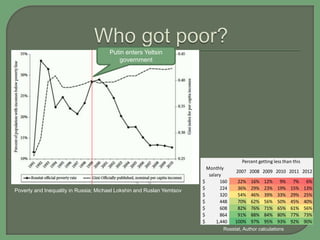
Poverty and Inequality in Russia; Michael Lokshin and Ruslan Yemtsov
Monthly
salary
2007 2008 2009 2010 2011 2012
160$ 22% 16% 12% 9% 7% 6%
224$ 36% 29% 23% 19% 15% 13%
320$ 54% 46% 39% 33% 29% 25%
448$ 70% 62% 56% 50% 45% 40%
608$ 82% 76% 71% 65% 61% 56%
864$ 91% 88% 84% 80% 77% 73%
1,440$ 100% 97% 95% 93% 92% 90%
Percent getting less than this
Rosstat, Author calculations
Putin enters Yeltsin
government
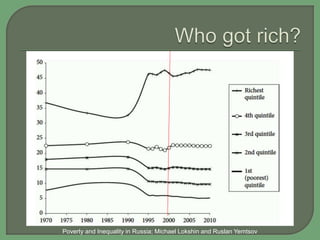
Poverty and Inequality in Russia; Michael Lokshin and Ruslan Yemtsov
$0
$5,000
$10,000
$15,000
$20,000
$25,000
$30,000
$35,000
$40,000
$45,000
$50,000
1970
1973
1976
1979
1982
1985
1988
1991
1994
1997
2000
2003
2006
2009
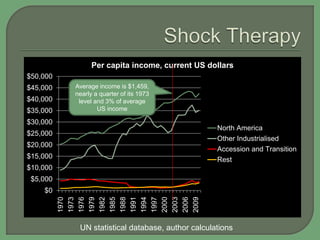
Per capita income, current US dollars
North America
Other Industrialised
Accession and Transition
Rest
Average income is $1,459,
nearly a quarter of its 1973
level and 3% of average
US income
UN statistical database, author calculations
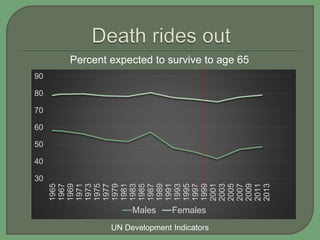
30
40
50
60
70
80
90
1965
1967
1969
1971
1973
1975
1977
1979
1981
1983
1985
1987
1989
1991
1993
1995
1997
1999
2001
2003
2005
2007
2009
2011
2013
Males Females
Percent expected to survive to age 65
UN Development Indicators
-15%
-10%
-5%
0%
5%
10%
15%
1980
1982
1984
1986
1988
1990
1992
1994
1996
1998
2000
2002
2004
2006
2008
2010
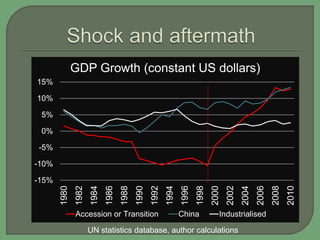
GDP Growth (constant US dollars)
Accession or Transition China Industrialised
UN statistics database, author calculations
-15%
-10%
-5%
0%
5%
10%
15%
20%
1993
1994
1995
1996
1997
1998
1999
2000
2001
2002
2003
2004
2005
2006
2007
2008
2009
2010
2011
2012
2013
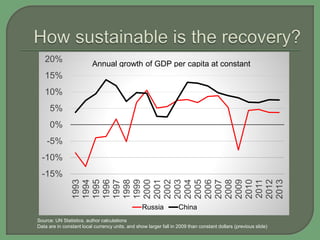
Russia China
Annual growth of GDP per capita at constant
Source: UN Statistics, author calculations
Data are in constant local currency units, and show larger fall in 2009 than constant dollars (previous slide)
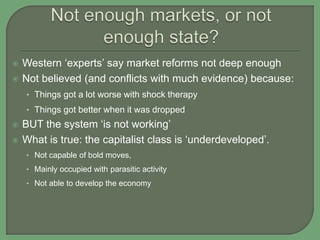
 Western ‘experts’ say market reforms not deep enough
 Not believed (and conflicts with much evidence) because:
• Things got a lot worse with shock therapy
• Things got better when it was dropped
 BUT the system ‘is not working’
 What is true: the capitalist class is ‘underdeveloped’.
• Not capable of bold moves,
• Mainly occupied with parasitic activity
• Not able to develop the economy
 ‘West-facing’ trade strategy, in a bi-oceanic continental economy
 Multi-ethnic state facing huge and growing regional disparities
 Social Justice and the ‘oligarchic model’
• Poor social provision, generalised poverty,
• Ostentatious and largely parasitic ‘nouveau riche’ class
• Monopolistic, resource-dominated industrial sectors incapable of modernising
 ‘Strong’ state, neoliberal economic model
• Capital sought from outside
• Unprotected capital markets
• Little or no state involvement in development
• Resource dependency
 Widespread passivity of the population
 Collapse of all forms of social support
 ‘Ostalgia’ for everything that once provided it, or
might do so in future
 Mixed up together
• Soviet Union
• State authority in all forms
• Russian historical tradition and cultural values
• Church
• Family
 A genuinely territorial Russian national question – the integrity of a
multinational state governing a continental economy
 Genuine language question for Russian speakers outside RSFSR.
Harsh discrimination of many kinds (eg Latvia)
 When the left does not defend either, the right takes it up
• Usually as ethnic nationalism
• No economic way out (Zhirinovsky is an ardent neoliberal)
• The ‘fourth way’ of Dugin, Zavtra is not a coherent political force
• The right is essentially a ‘Putin lobby’
• In the absence of a mass left with an active base, appears more powerful
than it is
 Economic unity contradicts ethnic nationalism and conservatism
• Requires full equality and wide social freedoms
• Social conservatism rests on passivity: relies on state support for its mass base
 Putin and the state bureaucracy ‘use’ the right against the left,
because they are threatened by mass action and discontent
• Ethnic nationalist and socially conservative forces constantly appear more
powerful than they really are
• Presented by Western (and Russian!) Media as if the ‘real’ basis of the Russian
state and society
 Does not correspond to the real relation of class forces
 When the working class acts, the right are not seen
Which forces can solve these problems?
• A siege economy under threat of dismemberment
• A fundamentally ‘poor’ economy (NOT an imperial
one)
• A ‘continental’ and multinational society
• An overwhelmingly working population
DON’T LOOK AT THE PEOPLE, LOOK AT THE
POLICIES
NO INTERVENTION
SYSTEMATIC NEUTRALITY
DEMILITARISED ARCTIC BASED ON RESOURCE-SHARING AND
ENVIRONMENTAL PROTECTION
BILATERAL COMPLEMENTARY TRADE
RESPECT THE NATIONAL INTEGRITY OF THE RUSSIAN STATE
RESPECT AND SUPPORT THE RIGHTS OF RUSSIAN SPEAKERS
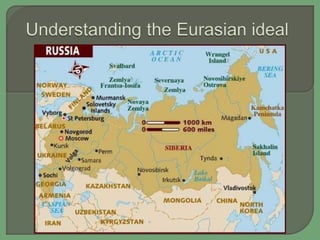
RECOGNISE THE ECONOMIC INTEGRITY OF EURASIA
OPEN A DIALOGUE WITH NATIONALIST AND EMANCIPATORY
MOVEMENTS

Ukraine: the russian dimension

  • 1.
    Alan Freeman Presentation tocolloquium on ‘Perspectives on the Crisis in Ukraine’ at the Ukrainian Labour Temple, Winnipeg 18 June 2014
  • 2.
     United NationsStatistical Database  Oxford Handbook of the Russian Economy  Post-Globalization Initiative  Alternativy  Links  Rosstat  londonmet.academia.edu/AlanFreeman  slideshare.net/alanfreeman777  vimeo.com/alanfreeman  ideas.repec.org/e/pfr102.html  Afreeman@iwgvt.org
  • 3.
    Human losses inWorld War II (smallest estimates in all cases) Country Population Military Civilian deaths due to military activity and crimes against humanity Civilian deaths due to war related famine and disease Total deaths Deaths as % of 1939 population Soviet Union (within 1946-1991 borders) 168,524,000 8,700,000 7,000,000 6,000,000 21,800,000 12.9% (Russia) 110,100,000 6,750,000 4,100,000 3,100,000 13,950,000 12.7% (Ukraine) 41,340,000 1,650,000 3,700,000 1,500,000 6,850,000 16.3% China 517,568,000 3,000,000 7,000,000 5,000,000 10,000,000 1.9% Germany 69,850,000 4,300,000 1,100,000 400,000 7,000,000 10.0% Poland (within 1939 borders) 34,849,000 240,000 4,880,000 500,000 5,620,000 16.1% Dutch East Indies 69,435,000 3,000,000 3,000,000 4.3% Japan 71,380,000 2,120,000 500,000 500,000 2,620,000 3.7% India (British) 378,000,000 87,000 1,500,000 1,587,000 0.4% Yugoslavia 15,400,000 300,000 581,000 1,027,000 6.7% French Indochina 24,600,000 1,000,000 1,000,000 4.1% France 41,700,000 200,000 350,000 550,000 1.3% Italy 44,394,000 301,400 153,200 454,600 1.0% United Kingdom 47,760,000 383,800 67,100 450,900 0.9% United States 131,028,000 407,000 12,000 420,000 0.3% Whose war was it? harsh facts underlie historical memories Source: wikipedia
  • 4.
  • 5.
    The ‘economic nationalist’programme ‘Why I am challenging Putin’ Sergei Glazyev’s 2004 election statement
  • 6.
    Russia is livingthrough the deepest, most prolonged crisis in modern history. It is a man-made crisis that has struck every sphere of society and the state. This crisis is not a natural disaster but one engineered by the choice of a false doctrine of reform, one that is leading the country to degradation. … I am running for president in order to cleanse the state apparatus of corruption and bureaucratic arbitrariness and to summon competent and responsible people into state service. Russia cannot withstand another four years of plunder and destruction. I am running so as to implement a real program to rebuild the economy. The current regime will not implement such a program and will continue to serve the oligarchic clans that have grown fat by plundering state property. Putin's corrupt and irresponsible regime has become part of the system of oligarchic parasitism, with its pathologically unjust distribution of incomes and property. … The impoverishment of great masses of the population has destroyed the structures of civil society, giving rise to a "civilization of slums." Roughly half of Russia's population, primarily children, is not getting enough to eat. Child neglect and homelessness are growing. Towns and villages are swamped by violence and banditry. Poverty, psychological stress, and the collapse of health care have led to an anomalously high death rate, a mass decrease in health, and the wasting of colossal labor resources. Many people cannot buy the most basic medicines and have no access to modern medical services. The prospects for modernizing or even preserving the national health care system are shrinking with every year. In order to do this, we must take back as state revenue the profits from the exploitation of our natural wealth, double the budget, and guarantee everyone's real right to free education and healthcare.
  • 7.
    Implementing our programof social justice and economic growth will allow wages to be doubled in the course of a year by bringing them into line with labor's contribution to the national income, expanding workers' rights to stand up for their interests, and increasing the minimum wage by three times. Real wages should grow fourfold by 2010; pensions must also grow accordingly. Economic growth must encompass all regions of the country, and people must have equal social guarantees, rights, and opportunities regardless of their place of residence. At the moment, revenues are diverted away from the regions to the center and then dispatched abroad - the oligarchs' wealth of billions comes from fleecing the Russian provinces. I will put an end to this. To improve the economy we will direct lending to manufacturing and entrepreneurial activity, protect the right to honestly earned and legally acquired property, rebuild savings, and stimulate scientific-technical innovation and investment. Markets will be purged of criminals and monopolies; honest competition will begin to operate. Those who work well and benefit society will get high incomes, not those who take what belongs to other people. The prices of basic commodities and charges for electricity, heating, and other vital services will be reduced to their actual production costs.
  • 8.
    The geopolitical legacyof the USSR as a great power has been squandered over the years of "reform." Reform of the armed services has boiled down to disarmament alone. Combat capability has fallen to an unprecedented low level. Russia is being threatened with losing its status as a power. Russia will not be reborn without the rebirth of a powerful, modern army. … Under the slogan of the market, the current regime has allowed depravity to flourish on television and in mass culture. The profound values of Russian culture are being systematically destroyed, stripping life of its meaning and joy, and sowing an enmity of each against all. To give Russians back a feeling of pride in their homeland, and to create the conditions for a revival of our historical spiritual and cultural traditions, we must revive our schools, eradicate the spirit of depravity and violence in the media, provide everyone with access to masterpieces of Russian culture, and create the conditions for a social partnership between the state and the church. Now is the moment for Russians to take Russia back!
  • 10.
    Poverty and Inequalityin Russia; Michael Lokshin and Ruslan Yemtsov Monthly salary 2007 2008 2009 2010 2011 2012 160$ 22% 16% 12% 9% 7% 6% 224$ 36% 29% 23% 19% 15% 13% 320$ 54% 46% 39% 33% 29% 25% 448$ 70% 62% 56% 50% 45% 40% 608$ 82% 76% 71% 65% 61% 56% 864$ 91% 88% 84% 80% 77% 73% 1,440$ 100% 97% 95% 93% 92% 90% Percent getting less than this Rosstat, Author calculations Putin enters Yeltsin government
  • 11.
    Poverty and Inequalityin Russia; Michael Lokshin and Ruslan Yemtsov
  • 12.
    $0 $5,000 $10,000 $15,000 $20,000 $25,000 $30,000 $35,000 $40,000 $45,000 $50,000 1970 1973 1976 1979 1982 1985 1988 1991 1994 1997 2000 2003 2006 2009 Per capita income,current US dollars North America Other Industrialised Accession and Transition Rest Average income is $1,459, nearly a quarter of its 1973 level and 3% of average US income UN statistical database, author calculations
  • 13.
  • 14.
    -15% -10% -5% 0% 5% 10% 15% 1980 1982 1984 1986 1988 1990 1992 1994 1996 1998 2000 2002 2004 2006 2008 2010 GDP Growth (constantUS dollars) Accession or Transition China Industrialised UN statistics database, author calculations
  • 15.
    -15% -10% -5% 0% 5% 10% 15% 20% 1993 1994 1995 1996 1997 1998 1999 2000 2001 2002 2003 2004 2005 2006 2007 2008 2009 2010 2011 2012 2013 Russia China Annual growthof GDP per capita at constant Source: UN Statistics, author calculations Data are in constant local currency units, and show larger fall in 2009 than constant dollars (previous slide)
  • 16.
     Western ‘experts’say market reforms not deep enough  Not believed (and conflicts with much evidence) because: • Things got a lot worse with shock therapy • Things got better when it was dropped  BUT the system ‘is not working’  What is true: the capitalist class is ‘underdeveloped’. • Not capable of bold moves, • Mainly occupied with parasitic activity • Not able to develop the economy
  • 17.
     ‘West-facing’ tradestrategy, in a bi-oceanic continental economy  Multi-ethnic state facing huge and growing regional disparities  Social Justice and the ‘oligarchic model’ • Poor social provision, generalised poverty, • Ostentatious and largely parasitic ‘nouveau riche’ class • Monopolistic, resource-dominated industrial sectors incapable of modernising  ‘Strong’ state, neoliberal economic model • Capital sought from outside • Unprotected capital markets • Little or no state involvement in development • Resource dependency
  • 18.
     Widespread passivityof the population  Collapse of all forms of social support  ‘Ostalgia’ for everything that once provided it, or might do so in future  Mixed up together • Soviet Union • State authority in all forms • Russian historical tradition and cultural values • Church • Family
  • 20.
     A genuinelyterritorial Russian national question – the integrity of a multinational state governing a continental economy  Genuine language question for Russian speakers outside RSFSR. Harsh discrimination of many kinds (eg Latvia)  When the left does not defend either, the right takes it up • Usually as ethnic nationalism • No economic way out (Zhirinovsky is an ardent neoliberal) • The ‘fourth way’ of Dugin, Zavtra is not a coherent political force • The right is essentially a ‘Putin lobby’ • In the absence of a mass left with an active base, appears more powerful than it is
  • 21.
     Economic unitycontradicts ethnic nationalism and conservatism • Requires full equality and wide social freedoms • Social conservatism rests on passivity: relies on state support for its mass base  Putin and the state bureaucracy ‘use’ the right against the left, because they are threatened by mass action and discontent • Ethnic nationalist and socially conservative forces constantly appear more powerful than they really are • Presented by Western (and Russian!) Media as if the ‘real’ basis of the Russian state and society  Does not correspond to the real relation of class forces  When the working class acts, the right are not seen
  • 22.
    Which forces cansolve these problems? • A siege economy under threat of dismemberment • A fundamentally ‘poor’ economy (NOT an imperial one) • A ‘continental’ and multinational society • An overwhelmingly working population DON’T LOOK AT THE PEOPLE, LOOK AT THE POLICIES
  • 23.
    NO INTERVENTION SYSTEMATIC NEUTRALITY DEMILITARISEDARCTIC BASED ON RESOURCE-SHARING AND ENVIRONMENTAL PROTECTION BILATERAL COMPLEMENTARY TRADE RESPECT THE NATIONAL INTEGRITY OF THE RUSSIAN STATE RESPECT AND SUPPORT THE RIGHTS OF RUSSIAN SPEAKERS RECOGNISE THE ECONOMIC INTEGRITY OF EURASIA OPEN A DIALOGUE WITH NATIONALIST AND EMANCIPATORY MOVEMENTS