A Business      Environment Analysis Of      ‘UNITED KINGDOM’PresentersMd Mojahid IslamMd K R KhanManoj Agrawal
INTRODUCTIONThe United Kingdom, the UK, or Britain is a sovereign state located off the north-western coast of continental Europe.
It is governed by a parliamentary system with its seat of government in the capital city of London
UK is surrounded by the Atlantic Ocean, the North Sea, the English Channel, and the Irish Sea. 
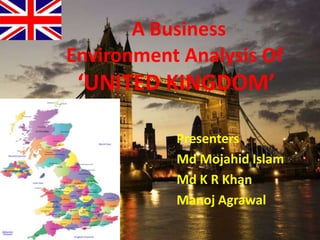
Continue…………..     The United Kingdom is a constitutional monarchy and unitary state. It is a country consisting of four countriescountriesCapitalsEngland----------------------London Wales------------------------CardiffScotland---------------------EdinburghNorthern Ireland-----------BelfastNational Capital - London
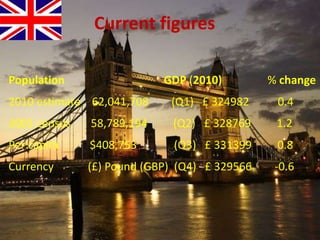
Current figuresPopulation                                   GDP (2010)                % change2010 estimate    62,041,708        (Q1)   £ 324982          0.4 2001 census       58,789,194         (Q2)   £ 328769         1.2Per capita           $408,753             (Q3)   £ 331399         0.8Currency            (£) Pound (GBP)  (Q4)   £ 329566        -0.6
ECONOMYThe economy of the United Kingdom is the sixth-largest national economy in the world measured by nominal GDP and purchasing power parity (PPP)
third-largest in Europe measured by nominal GDP
second-largest measured by PPP
the 20th highest in the world in nominal terms and the 17th highest measured by PPPContinue……….The UK is a member of the Commonwealth of Nations, the European Union, the G7, the G8, the G20, the International Monetary Fund, the Organization for Economic Co-operation and Development, the World Bank, the World Trade Organization and the United Nations.
The UK is one of the world's most globalised countries. London is the world's largest financial centre alongside New York, has the largest city GDP in Europe and is home to the headquarters of more than 100 of Europe's 500 largest companiesThe Industrial RevolutionIn the 18th century the UK was the first country in the world to industrialize, and for much of the 19th century possessed a dominant role in the global economy
the major technological advances associated with the industrial revolution were concerned with spinning. James Hargreaves created the Spinning Jenny, a device that could perform the work of a number of spinning wheelsContinue………..During the First Industrial Revolution, the industrialist replaced the merchant as the dominant figure in the capitalist system. In the latter decades of the 19th century, when the ultimate control and direction of large industry came into the hands of financiers, industrial capitalism gave way to financial capitalism and the corporation
New products and services were also introduced which greatly increased international trade2008-09 recession and quantitative easingThe UK entered its worst recession in 2008 after World War 2, as part of a global economic downturn.
On 5 March 2009, the Bank of England announced that they would pump £75 billion of new capital into the British economy, through a process known as quantitative easing.
The economy began to climb its way back into growth in late 2009: by Q4 of 2009 with a weak 0.4%; followed by a 0.3% growth in Q1 of 2010.MANUFACTURINGManufacturing is one of the fastest growing sectors of the UK’s economyThis sector strengthening to the British economy since the 1960s,
In manufacturing industry accounted for 16% of national output in the UK and for 13% of employment Aerospace industry Aerospace industry of the UK is the second largest aerospace industry in the world
The industry employs around 113,000 people directly and around 276,000 indirectly
Annual turnover of around £20 billion.Pharmaceutical industryEmployees around 67,000 people in the UK
Contribution of £8.4 billion to the UK's GDP
Investment in R&D of £3.9 billion
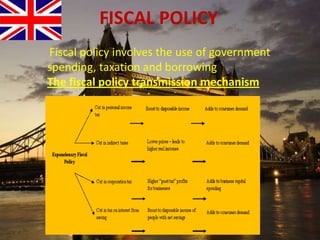
UK exports pharmaceutical products total £14.6 billionFISCAL POLICY     Fiscal policy involves the use of government spending, taxation and borrowing The fiscal policy transmission mechanism
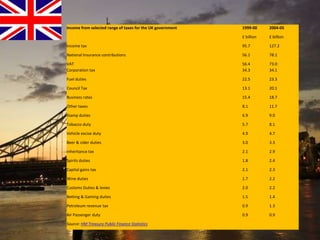
TaxationDirect taxation is levied on income, wealth and profit. Direct taxes include income tax, national insurance contributions, capital gains tax, and corporation tax.
Indirect taxes are taxes on spending – such as excise duties on fuel, cigarettes and alcohol and Value Added Tax (VAT) on many different goods and services
MONETARY POLICYThe regulation of the money supply and interest rates by a central bank    The purpose of Monetary policy is:     1. Directly control the rate of inflation     2. Influence the level of economic activity     3. Influence the Exchange rate
              There are 2 types of Monetary Policy:Direct Control of the Money Supply: This was used in the early period of Demand Management, but hasn’t been used in the UK in the 1990s.Influencing the demand for credit by using interest rates.This is the main tool of current UK monetary policy
        The role and function of the Bank     of England   1. The issuing of notes and coins. This allows the B of E to control the Supply of cash in      the economy    2.The Banker of the commercial banks. E.g. Natwest will have an account at the B of E
            Continue……… 3. Acting as a lender of last resort. If commercial banks need to give money to their customers they can always borrow from the B of E.4. Issuing and managing government debt. The bank of England will sell Bills to the private sector to raise money for the PSNCR.5. Set the base Interest rate which determines the Mortgage rates and other commercial interest rates
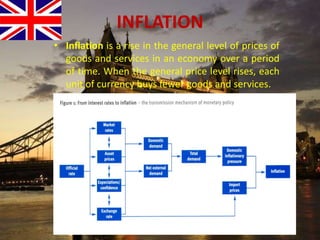
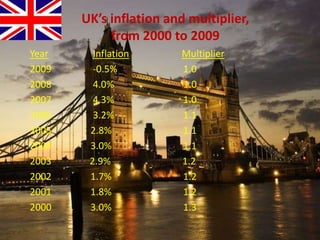
INFLATIONInflation is a rise in the general level of prices of goods and services in an economy over a period of time. When the general price level rises, each unit of currency buys fewer goods and services.UK’s inflation and multiplier, from 2000 to 2009 YearInflationMultiplier2009	             -0.5%	                        1.02008	             4.0%                             1.02007	             4.3%	                        1.02006	             3.2%	                        1.12005	            2.8%	                        1.12004	            3.0%	                        1.12003                2.9%                              1.22002	            1.7%	                        1.22001	            1.8%	                        1.22000	            3.0%	                        1.3
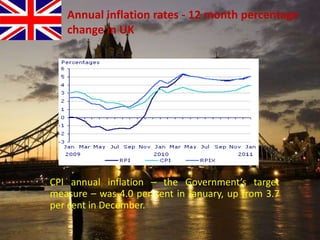
Annual inflation rates - 12 month percentage change in UK     CPI annual inflation – the Government’s target measure – was 4.0 per cent in January, up from 3.7 per cent in December.
RECENT BUSINESS ACTIVITIESU.K entered a recession Q2 of 2008, according to the UK Office of National Statistics (ONS) and exited it in Q4 of 2009.
By the end of the recession the economy had shrunk by 4.9%
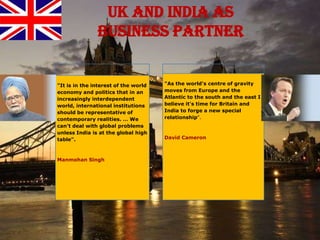
The unemployment rate among 18 to 24-year-olds has risen from 11.9% to 17.3%.UK AND INDIA AS BUSINESS PARTNER
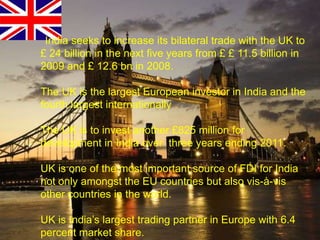
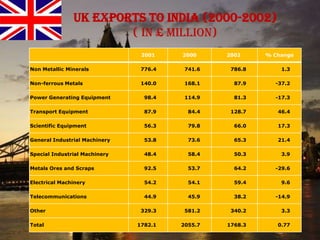
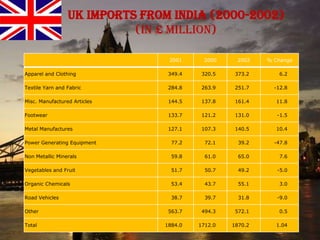
       India seeks to increase its bilateral trade with the UK to £ 24 billion in the next five years from £ £ 11.5 billion in 2009 and £ 12.6 bn in 2008.The UK is the largest European investor in India and the fourth largest internationally .The UK is to invest another £825 million for development in India over  three years ending 2011. UK is one of the most important source of FDI for India not only amongst the EU countries but also vis-à-vis other countries in the world.UK is India’s largest trading partner in Europe with 6.4 percent market share.
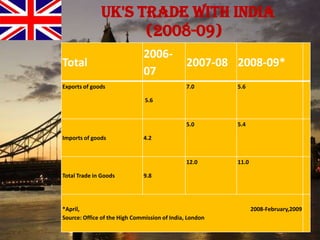
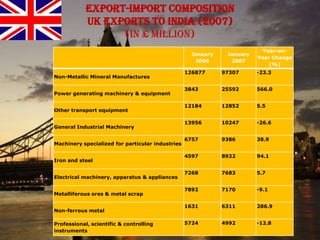
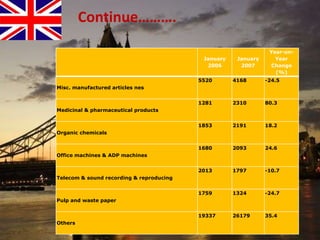
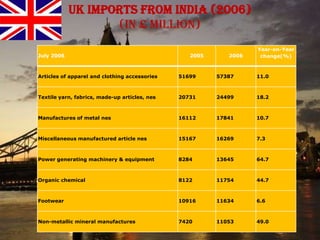
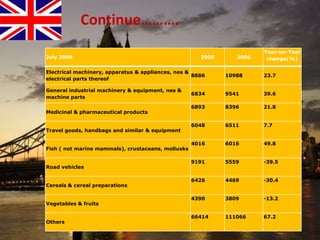
  UK's Trade with India (2008-09)

Uk presentation

  • 1.
    A Business Environment Analysis Of ‘UNITED KINGDOM’PresentersMd Mojahid IslamMd K R KhanManoj Agrawal
  • 2.
    INTRODUCTIONThe United Kingdom,the UK, or Britain is a sovereign state located off the north-western coast of continental Europe.
  • 3.
    It is governedby a parliamentary system with its seat of government in the capital city of London
  • 4.
    UK is surroundedby the Atlantic Ocean, the North Sea, the English Channel, and the Irish Sea. 
  • 5.
    Continue………….. The United Kingdom is a constitutional monarchy and unitary state. It is a country consisting of four countriescountriesCapitalsEngland----------------------London Wales------------------------CardiffScotland---------------------EdinburghNorthern Ireland-----------BelfastNational Capital - London
  • 6.
    Current figuresPopulation GDP (2010) % change2010 estimate 62,041,708 (Q1) £ 324982 0.4 2001 census 58,789,194 (Q2) £ 328769 1.2Per capita $408,753 (Q3) £ 331399 0.8Currency (£) Pound (GBP) (Q4) £ 329566 -0.6
  • 7.
    ECONOMYThe economy ofthe United Kingdom is the sixth-largest national economy in the world measured by nominal GDP and purchasing power parity (PPP)
  • 8.
    third-largest in Europemeasured by nominal GDP
  • 9.
  • 10.
    the 20th highestin the world in nominal terms and the 17th highest measured by PPPContinue……….The UK is a member of the Commonwealth of Nations, the European Union, the G7, the G8, the G20, the International Monetary Fund, the Organization for Economic Co-operation and Development, the World Bank, the World Trade Organization and the United Nations.
  • 11.
    The UK isone of the world's most globalised countries. London is the world's largest financial centre alongside New York, has the largest city GDP in Europe and is home to the headquarters of more than 100 of Europe's 500 largest companiesThe Industrial RevolutionIn the 18th century the UK was the first country in the world to industrialize, and for much of the 19th century possessed a dominant role in the global economy
  • 12.
    the major technologicaladvances associated with the industrial revolution were concerned with spinning. James Hargreaves created the Spinning Jenny, a device that could perform the work of a number of spinning wheelsContinue………..During the First Industrial Revolution, the industrialist replaced the merchant as the dominant figure in the capitalist system. In the latter decades of the 19th century, when the ultimate control and direction of large industry came into the hands of financiers, industrial capitalism gave way to financial capitalism and the corporation
  • 13.
    New products andservices were also introduced which greatly increased international trade2008-09 recession and quantitative easingThe UK entered its worst recession in 2008 after World War 2, as part of a global economic downturn.
  • 14.
    On 5 March2009, the Bank of England announced that they would pump £75 billion of new capital into the British economy, through a process known as quantitative easing.
  • 15.
    The economy beganto climb its way back into growth in late 2009: by Q4 of 2009 with a weak 0.4%; followed by a 0.3% growth in Q1 of 2010.MANUFACTURINGManufacturing is one of the fastest growing sectors of the UK’s economyThis sector strengthening to the British economy since the 1960s,
  • 16.
    In manufacturing industryaccounted for 16% of national output in the UK and for 13% of employment Aerospace industry Aerospace industry of the UK is the second largest aerospace industry in the world
  • 17.
    The industry employsaround 113,000 people directly and around 276,000 indirectly
  • 18.
    Annual turnover ofaround £20 billion.Pharmaceutical industryEmployees around 67,000 people in the UK
  • 19.
    Contribution of £8.4billion to the UK's GDP
  • 20.
    Investment in R&Dof £3.9 billion
  • 21.
    UK exports pharmaceuticalproducts total £14.6 billionFISCAL POLICY Fiscal policy involves the use of government spending, taxation and borrowing The fiscal policy transmission mechanism
  • 22.
    TaxationDirect taxation is leviedon income, wealth and profit. Direct taxes include income tax, national insurance contributions, capital gains tax, and corporation tax.
  • 23.
    Indirect taxes are taxeson spending – such as excise duties on fuel, cigarettes and alcohol and Value Added Tax (VAT) on many different goods and services
  • 24.
    MONETARY POLICYThe regulationof the money supply and interest rates by a central bank The purpose of Monetary policy is: 1. Directly control the rate of inflation 2. Influence the level of economic activity 3. Influence the Exchange rate
  • 25.
    There are 2 types of Monetary Policy:Direct Control of the Money Supply: This was used in the early period of Demand Management, but hasn’t been used in the UK in the 1990s.Influencing the demand for credit by using interest rates.This is the main tool of current UK monetary policy
  • 26.
    The role and function of the Bank of England 1. The issuing of notes and coins. This allows the B of E to control the Supply of cash in the economy 2.The Banker of the commercial banks. E.g. Natwest will have an account at the B of E
  • 27.
    Continue……… 3. Acting as a lender of last resort. If commercial banks need to give money to their customers they can always borrow from the B of E.4. Issuing and managing government debt. The bank of England will sell Bills to the private sector to raise money for the PSNCR.5. Set the base Interest rate which determines the Mortgage rates and other commercial interest rates
  • 28.
    INFLATIONInflation is arise in the general level of prices of goods and services in an economy over a period of time. When the general price level rises, each unit of currency buys fewer goods and services.UK’s inflation and multiplier, from 2000 to 2009 YearInflationMultiplier2009 -0.5% 1.02008 4.0% 1.02007 4.3% 1.02006 3.2% 1.12005 2.8% 1.12004 3.0% 1.12003 2.9% 1.22002 1.7% 1.22001 1.8% 1.22000 3.0% 1.3
  • 29.
    Annual inflation rates- 12 month percentage change in UK CPI annual inflation – the Government’s target measure – was 4.0 per cent in January, up from 3.7 per cent in December.
  • 30.
    RECENT BUSINESS ACTIVITIESU.Kentered a recession Q2 of 2008, according to the UK Office of National Statistics (ONS) and exited it in Q4 of 2009.
  • 31.
    By the endof the recession the economy had shrunk by 4.9%
  • 32.
    The unemployment rateamong 18 to 24-year-olds has risen from 11.9% to 17.3%.UK AND INDIA AS BUSINESS PARTNER
  • 33.
    India seeks to increase its bilateral trade with the UK to £ 24 billion in the next five years from £ £ 11.5 billion in 2009 and £ 12.6 bn in 2008.The UK is the largest European investor in India and the fourth largest internationally .The UK is to invest another £825 million for development in India over  three years ending 2011. UK is one of the most important source of FDI for India not only amongst the EU countries but also vis-à-vis other countries in the world.UK is India’s largest trading partner in Europe with 6.4 percent market share.
  • 34.
    UK'sTrade with India (2008-09)