142 Country Assessments /Mongolia
0.0
0.5
1.0
1.5
2.0
2.5
3.0
3.5
4.0
Financial institutionsInfrastructureEnergyCorporate
Agribusiness
Generalindustry
Realestate
Telecommunications
Electricpower
Naturalresources
Sustainableenergy
Railways
Roads
Urbantransport
Water
Banking
IAOFS
Capitalmarkets
PE
MSMEfinance
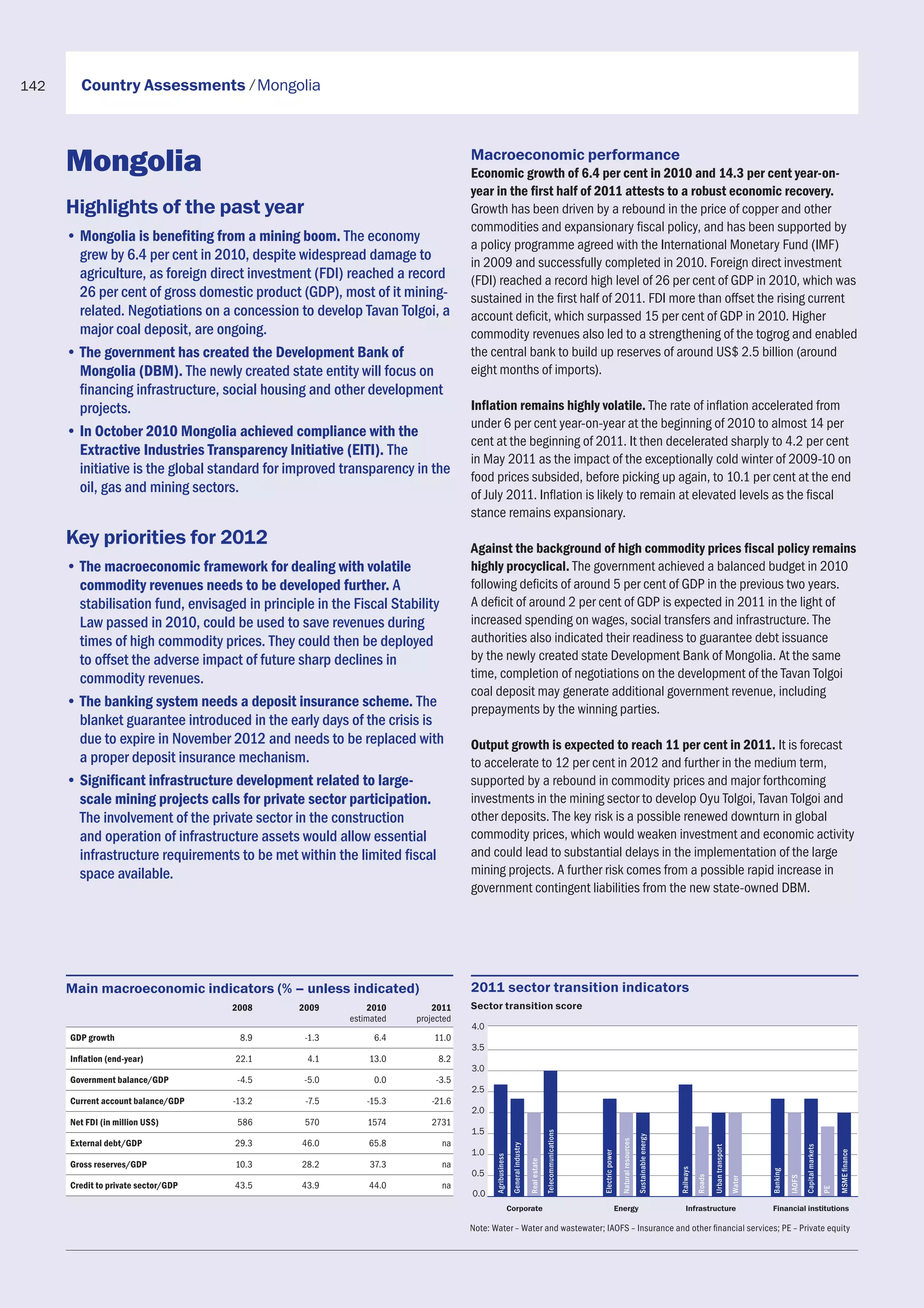
Note: Water – Water and wastewater; IAOFS – Insurance and other financial services; PE – Private equity
2011 sector transition indicators
Sector transition score
Mongolia
Highlights of the past year
• Mongolia is benefiting from a mining boom. The economy
grew by 6.4 per cent in 2010, despite widespread damage to
agriculture, as foreign direct investment (FDI) reached a record
26 per cent of gross domestic product (GDP), most of it mining-
related. Negotiations on a concession to develop Tavan Tolgoi, a
major coal deposit, are ongoing.
• The government has created the Development Bank of
Mongolia (DBM). The newly created state entity will focus on
financing infrastructure, social housing and other development
projects.
• In October 2010 Mongolia achieved compliance with the
Extractive Industries Transparency Initiative (EITI). The
initiative is the global standard for improved transparency in the
oil, gas and mining sectors.
Key priorities for 2012
• The macroeconomic framework for dealing with volatile
commodity revenues needs to be developed further. A
stabilisation fund, envisaged in principle in the Fiscal Stability
Law passed in 2010, could be used to save revenues during
times of high commodity prices. They could then be deployed
to offset the adverse impact of future sharp declines in
commodity revenues.
• The banking system needs a deposit insurance scheme. The
blanket guarantee introduced in the early days of the crisis is
due to expire in November 2012 and needs to be replaced with
a proper deposit insurance mechanism.
• Significant infrastructure development related to large-
scale mining projects calls for private sector participation.
The involvement of the private sector in the construction
and operation of infrastructure assets would allow essential
infrastructure requirements to be met within the limited fiscal
space available.
Macroeconomic performance
Economic growth of 6.4 per cent in 2010 and 14.3 per cent year-on-
year in the first half of 2011 attests to a robust economic recovery.
Growth has been driven by a rebound in the price of copper and other
commodities and expansionary fiscal policy, and has been supported by
a policy programme agreed with the International Monetary Fund (IMF)
in 2009 and successfully completed in 2010. Foreign direct investment
(FDI) reached a record high level of 26 per cent of GDP in 2010, which was
sustained in the first half of 2011. FDI more than offset the rising current
account deficit, which surpassed 15 per cent of GDP in 2010. Higher
commodity revenues also led to a strengthening of the togrog and enabled
the central bank to build up reserves of around US$ 2.5 billion (around
eight months of imports).
Inflation remains highly volatile. The rate of inflation accelerated from
under 6 per cent year-on-year at the beginning of 2010 to almost 14 per
cent at the beginning of 2011. It then decelerated sharply to 4.2 per cent
in May 2011 as the impact of the exceptionally cold winter of 2009-10 on
food prices subsided, before picking up again, to 10.1 per cent at the end
of July 2011. Inflation is likely to remain at elevated levels as the fiscal
stance remains expansionary.
Against the background of high commodity prices fiscal policy remains
highly procyclical. The government achieved a balanced budget in 2010
following deficits of around 5 per cent of GDP in the previous two years.
A deficit of around 2 per cent of GDP is expected in 2011 in the light of
increased spending on wages, social transfers and infrastructure. The
authorities also indicated their readiness to guarantee debt issuance
by the newly created state Development Bank of Mongolia. At the same
time, completion of negotiations on the development of the Tavan Tolgoi
coal deposit may generate additional government revenue, including
prepayments by the winning parties.
Output growth is expected to reach 11 per cent in 2011. It is forecast
to accelerate to 12 per cent in 2012 and further in the medium term,
supported by a rebound in commodity prices and major forthcoming
investments in the mining sector to develop Oyu Tolgoi, Tavan Tolgoi and
other deposits. The key risk is a possible renewed downturn in global
commodity prices, which would weaken investment and economic activity
and could lead to substantial delays in the implementation of the large
mining projects. A further risk comes from a possible rapid increase in
government contingent liabilities from the new state-owned DBM.
Main macroeconomic indicators (% – unless indicated)
2008 2009 2010
estimated
2011
projected
GDP growth 8.9 -1.3 6.4 11.0
Inflation (end-year) 22.1 4.1 13.0 8.2
Government balance/GDP -4.5 -5.0 0.0 -3.5
Current account balance/GDP -13.2 -7.5 -15.3 -21.6
Net FDI (in million US$) 586 570 1574 2731
External debt/GDP 29.3 46.0 65.8 na
Gross reserves/GDP 10.3 28.2 37.3 na
Credit to private sector/GDP 43.5 43.9 44.0 na
143Transition Report /Country Assessments1989
1990
1991
1992
1993
1994
1995
1996
1997
1998
1999
2000
2001
2002
2003
2004
2005
2006
2007
2008
2009
2010
2011
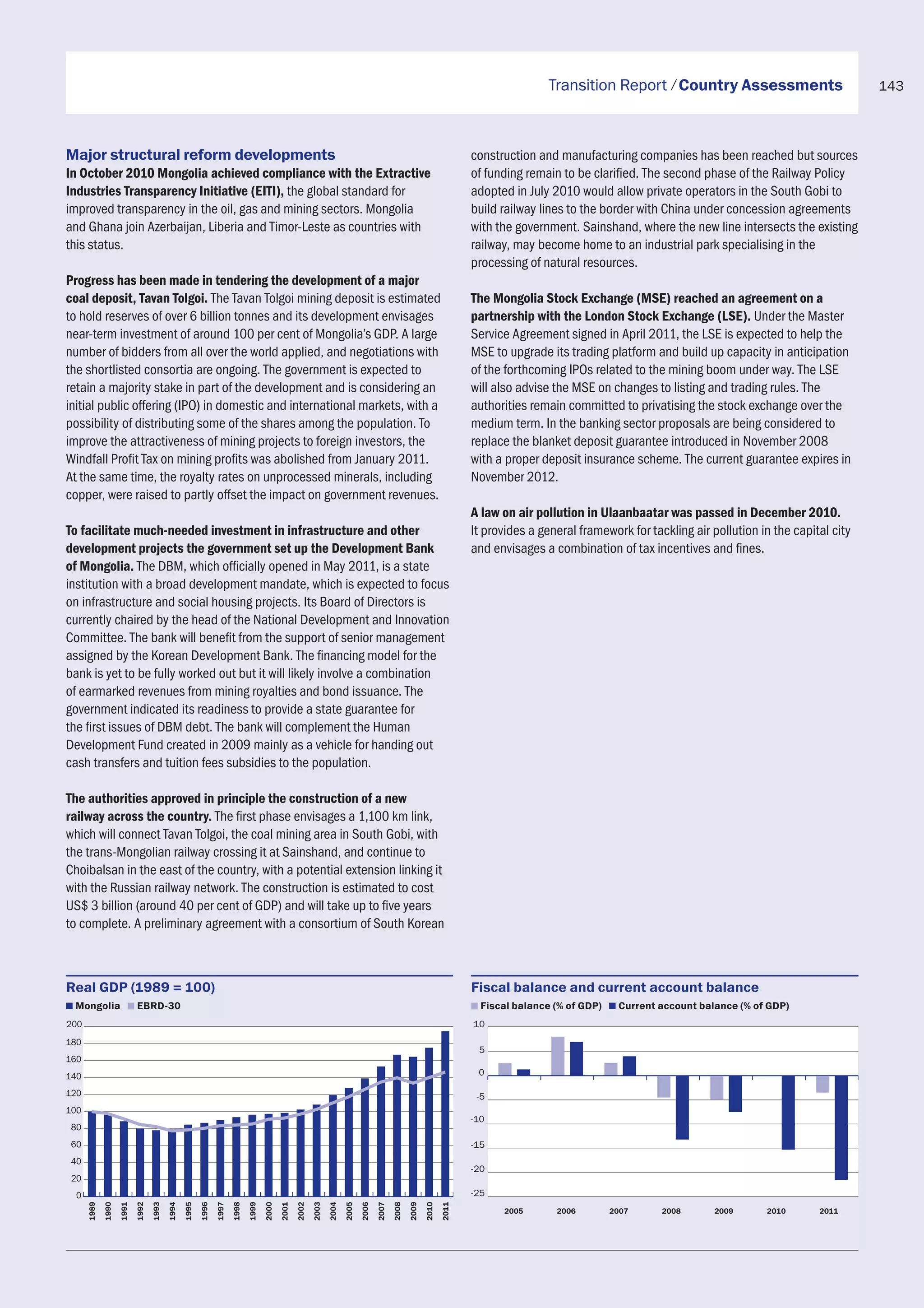
Real GDP (1989 = 100)
Mongolia EBRD-30
0
20
40
60
80
100
120
140
160
180
200
Fiscal balance and current account balance
Fiscal balance (% of GDP) Current account balance (% of GDP)
-25
-20
-15
-10
-5
0
5
10
2005 2006 2007 2008 2009 2010 2011
Major structural reform developments
In October 2010 Mongolia achieved compliance with the Extractive
Industries Transparency Initiative (EITI), the global standard for
improved transparency in the oil, gas and mining sectors. Mongolia
and Ghana join Azerbaijan, Liberia and Timor-Leste as countries with
this status.
Progress has been made in tendering the development of a major
coal deposit, Tavan Tolgoi. The Tavan Tolgoi mining deposit is estimated
to hold reserves of over 6 billion tonnes and its development envisages
near-term investment of around 100 per cent of Mongolia’s GDP. A large
number of bidders from all over the world applied, and negotiations with
the shortlisted consortia are ongoing. The government is expected to
retain a majority stake in part of the development and is considering an
initial public offering (IPO) in domestic and international markets, with a
possibility of distributing some of the shares among the population. To
improve the attractiveness of mining projects to foreign investors, the
Windfall Profit Tax on mining profits was abolished from January 2011.
At the same time, the royalty rates on unprocessed minerals, including
copper, were raised to partly offset the impact on government revenues.
To facilitate much-needed investment in infrastructure and other
development projects the government set up the Development Bank
of Mongolia. The DBM, which officially opened in May 2011, is a state
institution with a broad development mandate, which is expected to focus
on infrastructure and social housing projects. Its Board of Directors is
currently chaired by the head of the National Development and Innovation
Committee. The bank will benefit from the support of senior management
assigned by the Korean Development Bank. The financing model for the
bank is yet to be fully worked out but it will likely involve a combination
of earmarked revenues from mining royalties and bond issuance. The
government indicated its readiness to provide a state guarantee for
the first issues of DBM debt. The bank will complement the Human
Development Fund created in 2009 mainly as a vehicle for handing out
cash transfers and tuition fees subsidies to the population.
The authorities approved in principle the construction of a new
railway across the country. The first phase envisages a 1,100 km link,
which will connect Tavan Tolgoi, the coal mining area in South Gobi, with
the trans-Mongolian railway crossing it at Sainshand, and continue to
Choibalsan in the east of the country, with a potential extension linking it
with the Russian railway network. The construction is estimated to cost
US$ 3 billion (around 40 per cent of GDP) and will take up to five years
to complete. A preliminary agreement with a consortium of South Korean
construction and manufacturing companies has been reached but sources
of funding remain to be clarified. The second phase of the Railway Policy
adopted in July 2010 would allow private operators in the South Gobi to
build railway lines to the border with China under concession agreements
with the government. Sainshand, where the new line intersects the existing
railway, may become home to an industrial park specialising in the
processing of natural resources.
The Mongolia Stock Exchange (MSE) reached an agreement on a
partnership with the London Stock Exchange (LSE). Under the Master
Service Agreement signed in April 2011, the LSE is expected to help the
MSE to upgrade its trading platform and build up capacity in anticipation
of the forthcoming IPOs related to the mining boom under way. The LSE
will also advise the MSE on changes to listing and trading rules. The
authorities remain committed to privatising the stock exchange over the
medium term. In the banking sector proposals are being considered to
replace the blanket deposit guarantee introduced in November 2008
with a proper deposit insurance scheme. The current guarantee expires in
November 2012.
A law on air pollution in Ulaanbaatar was passed in December 2010.
It provides a general framework for tackling air pollution in the capital city
and envisages a combination of tax incentives and fines.

2012, REPORT, Transition Report 2011 (Mongolia data), EBRD and the Economic Research Institute

  • 1.
    142 Country Assessments/Mongolia 0.0 0.5 1.0 1.5 2.0 2.5 3.0 3.5 4.0 Financial institutionsInfrastructureEnergyCorporate Agribusiness Generalindustry Realestate Telecommunications Electricpower Naturalresources Sustainableenergy Railways Roads Urbantransport Water Banking IAOFS Capitalmarkets PE MSMEfinance Note: Water – Water and wastewater; IAOFS – Insurance and other financial services; PE – Private equity 2011 sector transition indicators Sector transition score Mongolia Highlights of the past year • Mongolia is benefiting from a mining boom. The economy grew by 6.4 per cent in 2010, despite widespread damage to agriculture, as foreign direct investment (FDI) reached a record 26 per cent of gross domestic product (GDP), most of it mining- related. Negotiations on a concession to develop Tavan Tolgoi, a major coal deposit, are ongoing. • The government has created the Development Bank of Mongolia (DBM). The newly created state entity will focus on financing infrastructure, social housing and other development projects. • In October 2010 Mongolia achieved compliance with the Extractive Industries Transparency Initiative (EITI). The initiative is the global standard for improved transparency in the oil, gas and mining sectors. Key priorities for 2012 • The macroeconomic framework for dealing with volatile commodity revenues needs to be developed further. A stabilisation fund, envisaged in principle in the Fiscal Stability Law passed in 2010, could be used to save revenues during times of high commodity prices. They could then be deployed to offset the adverse impact of future sharp declines in commodity revenues. • The banking system needs a deposit insurance scheme. The blanket guarantee introduced in the early days of the crisis is due to expire in November 2012 and needs to be replaced with a proper deposit insurance mechanism. • Significant infrastructure development related to large- scale mining projects calls for private sector participation. The involvement of the private sector in the construction and operation of infrastructure assets would allow essential infrastructure requirements to be met within the limited fiscal space available. Macroeconomic performance Economic growth of 6.4 per cent in 2010 and 14.3 per cent year-on- year in the first half of 2011 attests to a robust economic recovery. Growth has been driven by a rebound in the price of copper and other commodities and expansionary fiscal policy, and has been supported by a policy programme agreed with the International Monetary Fund (IMF) in 2009 and successfully completed in 2010. Foreign direct investment (FDI) reached a record high level of 26 per cent of GDP in 2010, which was sustained in the first half of 2011. FDI more than offset the rising current account deficit, which surpassed 15 per cent of GDP in 2010. Higher commodity revenues also led to a strengthening of the togrog and enabled the central bank to build up reserves of around US$ 2.5 billion (around eight months of imports). Inflation remains highly volatile. The rate of inflation accelerated from under 6 per cent year-on-year at the beginning of 2010 to almost 14 per cent at the beginning of 2011. It then decelerated sharply to 4.2 per cent in May 2011 as the impact of the exceptionally cold winter of 2009-10 on food prices subsided, before picking up again, to 10.1 per cent at the end of July 2011. Inflation is likely to remain at elevated levels as the fiscal stance remains expansionary. Against the background of high commodity prices fiscal policy remains highly procyclical. The government achieved a balanced budget in 2010 following deficits of around 5 per cent of GDP in the previous two years. A deficit of around 2 per cent of GDP is expected in 2011 in the light of increased spending on wages, social transfers and infrastructure. The authorities also indicated their readiness to guarantee debt issuance by the newly created state Development Bank of Mongolia. At the same time, completion of negotiations on the development of the Tavan Tolgoi coal deposit may generate additional government revenue, including prepayments by the winning parties. Output growth is expected to reach 11 per cent in 2011. It is forecast to accelerate to 12 per cent in 2012 and further in the medium term, supported by a rebound in commodity prices and major forthcoming investments in the mining sector to develop Oyu Tolgoi, Tavan Tolgoi and other deposits. The key risk is a possible renewed downturn in global commodity prices, which would weaken investment and economic activity and could lead to substantial delays in the implementation of the large mining projects. A further risk comes from a possible rapid increase in government contingent liabilities from the new state-owned DBM. Main macroeconomic indicators (% – unless indicated) 2008 2009 2010 estimated 2011 projected GDP growth 8.9 -1.3 6.4 11.0 Inflation (end-year) 22.1 4.1 13.0 8.2 Government balance/GDP -4.5 -5.0 0.0 -3.5 Current account balance/GDP -13.2 -7.5 -15.3 -21.6 Net FDI (in million US$) 586 570 1574 2731 External debt/GDP 29.3 46.0 65.8 na Gross reserves/GDP 10.3 28.2 37.3 na Credit to private sector/GDP 43.5 43.9 44.0 na
  • 2.
    143Transition Report /CountryAssessments1989 1990 1991 1992 1993 1994 1995 1996 1997 1998 1999 2000 2001 2002 2003 2004 2005 2006 2007 2008 2009 2010 2011 Real GDP (1989 = 100) Mongolia EBRD-30 0 20 40 60 80 100 120 140 160 180 200 Fiscal balance and current account balance Fiscal balance (% of GDP) Current account balance (% of GDP) -25 -20 -15 -10 -5 0 5 10 2005 2006 2007 2008 2009 2010 2011 Major structural reform developments In October 2010 Mongolia achieved compliance with the Extractive Industries Transparency Initiative (EITI), the global standard for improved transparency in the oil, gas and mining sectors. Mongolia and Ghana join Azerbaijan, Liberia and Timor-Leste as countries with this status. Progress has been made in tendering the development of a major coal deposit, Tavan Tolgoi. The Tavan Tolgoi mining deposit is estimated to hold reserves of over 6 billion tonnes and its development envisages near-term investment of around 100 per cent of Mongolia’s GDP. A large number of bidders from all over the world applied, and negotiations with the shortlisted consortia are ongoing. The government is expected to retain a majority stake in part of the development and is considering an initial public offering (IPO) in domestic and international markets, with a possibility of distributing some of the shares among the population. To improve the attractiveness of mining projects to foreign investors, the Windfall Profit Tax on mining profits was abolished from January 2011. At the same time, the royalty rates on unprocessed minerals, including copper, were raised to partly offset the impact on government revenues. To facilitate much-needed investment in infrastructure and other development projects the government set up the Development Bank of Mongolia. The DBM, which officially opened in May 2011, is a state institution with a broad development mandate, which is expected to focus on infrastructure and social housing projects. Its Board of Directors is currently chaired by the head of the National Development and Innovation Committee. The bank will benefit from the support of senior management assigned by the Korean Development Bank. The financing model for the bank is yet to be fully worked out but it will likely involve a combination of earmarked revenues from mining royalties and bond issuance. The government indicated its readiness to provide a state guarantee for the first issues of DBM debt. The bank will complement the Human Development Fund created in 2009 mainly as a vehicle for handing out cash transfers and tuition fees subsidies to the population. The authorities approved in principle the construction of a new railway across the country. The first phase envisages a 1,100 km link, which will connect Tavan Tolgoi, the coal mining area in South Gobi, with the trans-Mongolian railway crossing it at Sainshand, and continue to Choibalsan in the east of the country, with a potential extension linking it with the Russian railway network. The construction is estimated to cost US$ 3 billion (around 40 per cent of GDP) and will take up to five years to complete. A preliminary agreement with a consortium of South Korean construction and manufacturing companies has been reached but sources of funding remain to be clarified. The second phase of the Railway Policy adopted in July 2010 would allow private operators in the South Gobi to build railway lines to the border with China under concession agreements with the government. Sainshand, where the new line intersects the existing railway, may become home to an industrial park specialising in the processing of natural resources. The Mongolia Stock Exchange (MSE) reached an agreement on a partnership with the London Stock Exchange (LSE). Under the Master Service Agreement signed in April 2011, the LSE is expected to help the MSE to upgrade its trading platform and build up capacity in anticipation of the forthcoming IPOs related to the mining boom under way. The LSE will also advise the MSE on changes to listing and trading rules. The authorities remain committed to privatising the stock exchange over the medium term. In the banking sector proposals are being considered to replace the blanket deposit guarantee introduced in November 2008 with a proper deposit insurance scheme. The current guarantee expires in November 2012. A law on air pollution in Ulaanbaatar was passed in December 2010. It provides a general framework for tackling air pollution in the capital city and envisages a combination of tax incentives and fines.