a path or a resource
                                                                           for learning?
                 José Lagarto
       Universidade Católica Portuguesa
               26-29 June 2012
Image from http://2.bp.blogspot.com/__9iF-sF0ic8/S-zAYff-uVI/AAAAAAAABCY/CB-
CbW0b-nA/s1600/open+doors.jpg
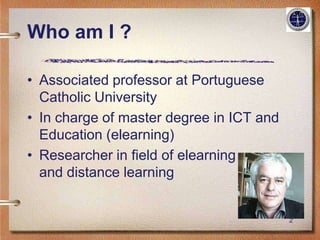
Who am I ?

• Associated professor at Portuguese
  Catholic University
• In charge of master degree in ICT and
  Education (elearning)
• Researcher in field of elearning
  and distance learning


                                          2
UGC – definitions

    • UGC – user generated contet
               or
     … User created content


        Content created by users
      (in HE institutions… or not)
OCDE – UGC definition
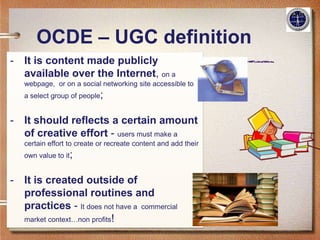
- It is content made publicly
  available over the Internet, on a
   webpage, or on a social networking site accessible to
   a select group of people;


- It should reflects a certain amount
  of creative effort - users must make a
   certain effort to create or recreate content and add their
   own value to it;


- It is created outside of
  professional routines and
  practices - It does not have a commercial
  market context…non profits!
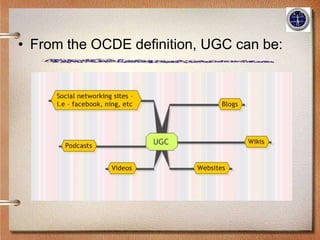
• From the OCDE definition, UGC can be:
UGC – a concede definition
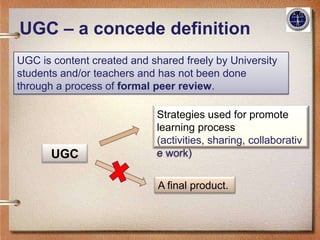
UGC is content created and shared freely by University
students and/or teachers and has not been done
through a process of formal peer review.

                             Strategies used for promote
                             learning process
                             (activities, sharing, collaborativ
       UGC                   e work)


                             A final product.
From UGC to OER’s

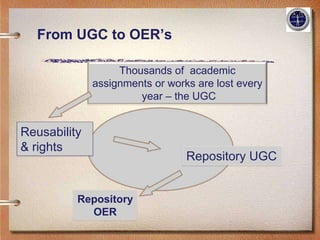
                   Thousands of academic
              assignments or works are lost every
                       year – the UGC


Reusability
& rights
                                 Repository UGC


          Repository
            OER
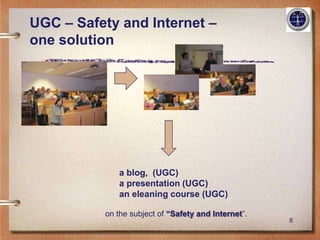
UGC – Safety and Internet –
one solution


             a blog, (UGC)
             a presentation (UGC)
             an eleaning course (UGC)

          on the subject of “Safety and Internet”.
                                                     8
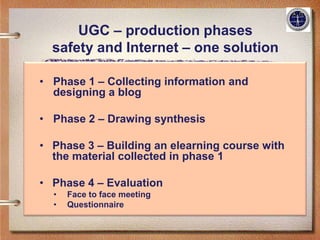
UGC – production phases
  safety and Internet – one solution

• Phase 1 – Collecting information and
  designing a blog

• Phase 2 – Drawing synthesis

• Phase 3 – Building an elearning course with
  the material collected in phase 1

• Phase 4 – Evaluation
  •   Face to face meeting
  •   Questionnaire
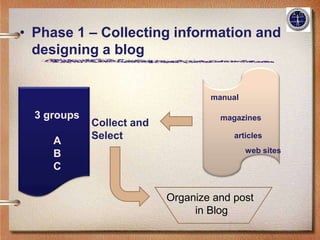
• Phase 1 – Collecting information and
  designing a blog


                                   manual

  3 groups                           magazines
             Collect and
     A       Select                     articles

     B                                      web sites

     C

                           Organize and post
                                in Blog
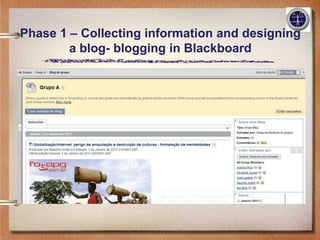
Phase 1 – Collecting information and designing
        a blog- blogging in Blackboard
Phase 1 – Collecting information and designing
       a blog - blogging in Blackboard


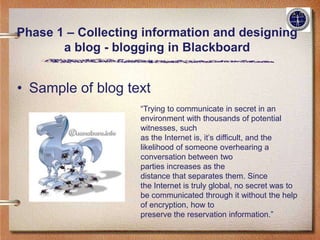
• Sample of blog text
                    “Trying to communicate in secret in an
                    environment with thousands of potential
                    witnesses, such
                    as the Internet is, it’s difficult, and the
                    likelihood of someone overhearing a
                    conversation between two
                    parties increases as the
                    distance that separates them. Since
                    the Internet is truly global, no secret was to
                    be communicated through it without the help
                    of encryption, how to
                    preserve the reservation information.”
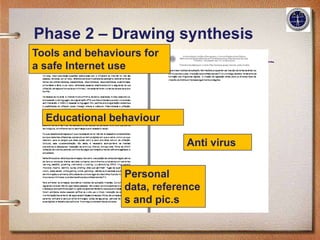
Phase 2 – Drawing synthesis
Tools and behaviours for
a safe Internet use


  Educational behaviour

                             Anti virus

                 Personal
                 data, reference
                 s and pic.s
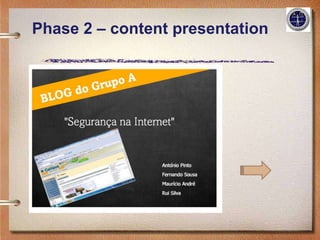
Phase 2 – content presentation
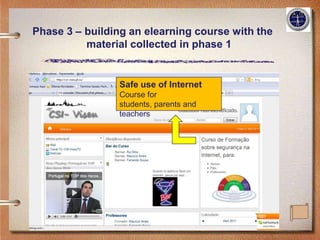
Phase 3 – building an elearning course with the
          material collected in phase 1


                 Safe use of Internet
                 Course for
                 students, parents and
                 teachers
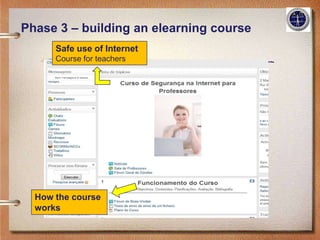
Phase 3 – building an elearning course
      Safe use of Internet
      Course for teachers


  How the course
  works
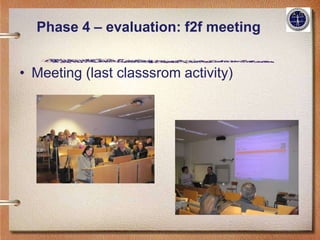
Phase 4 – evaluation: f2f meeting


• Meeting (last classsrom activity)
Evaluation – finding
           evidences

• Data gathering methods

  – Observation and document analysis
  – Online survey
  – Written assignment
Quiz categories


   Evaluation
                      • research, posting and critique of selected
   of personal          contents to the blog in the Blackboard
 and group work

    Evaluating
                      • of content blogs of the other groups
    the quality

Evaluating level of   • that resulted from the presentations of
    knowledge           groups


Evaluation of the
                      • elearning course
  final product

                                                                     19
Student’s perceptions about UGC
             strategy


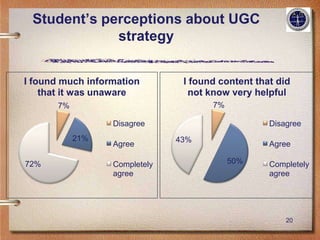
I found much information        I found content that did
    that it was unaware           not know very helpful
       7%                             7%

                  Disagree                         Disagree
            21%                43%
                  Agree                            Agree

72%               Completely               50%     Completely
                  agree                            agree


                                                       20
Student’s perceptions about UGC
              strategy

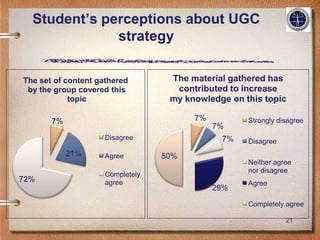
The set of content gathered        The material gathered has
 by the group covered this          contributed to increase
            topic                  my knowledge on this topic

       7%                               7%          Strongly disagree
                                             7%
                     Disagree                 7%    Disagree
            21%      Agree        50%
                                                    Neither agree
                                                    nor disagree
                     Completely
72%                  agree                          Agree
                                             29%
                                                    Completely agree

                                                               21
Student’s perceptions about UGC
                   strategy

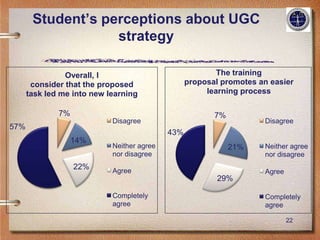
                Overall, I                                The training
       consider that the proposed                 proposal promotes an easier
      task led me into new learning                    learning process

              7%                                         7%
                            Disagree                                 Disagree
57%
                                            43%
                   14%
                            Neither agree                     21%    Neither agree
                            nor disagree                             nor disagree
                   22%      Agree                                    Agree
                                                          29%

                            Completely                               Completely
                            agree                                    agree

                                                                             22
Some conclusions from the field


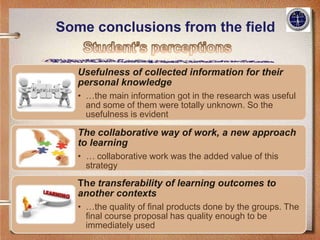
   Usefulness of collected information for their
   personal knowledge
   • …the main information got in the research was useful
     and some of them were totally unknown. So the
     usefulness is evident

   The collaborative way of work, a new approach
   to learning
   • … collaborative work was the added value of this
     strategy

   The transferability of learning outcomes to
   another contexts
   • …the quality of final products done by the groups. The
     final course proposal has quality enough to be
     immediately used
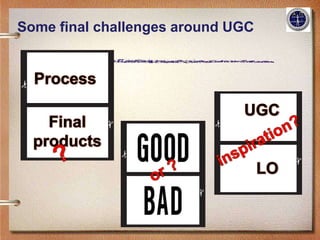
Some final challenges around UGC
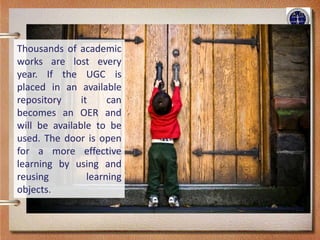
Thousands of academic
works are lost every
year. If the UGC is
placed in an available
repository     it     can
becomes an OER and
will be available to be
used. The door is open
for a more effective
learning by using and
reusing          learning
objects.
                   Image from http://overthemaze.files.wordpress.com/2011/11/door-closed-w-little-boy.jpg
Thank you very much

  jlagarto@ucp.pt

Ugc edmedia2012

  • 1.
    a path ora resource for learning? José Lagarto Universidade Católica Portuguesa 26-29 June 2012 Image from http://2.bp.blogspot.com/__9iF-sF0ic8/S-zAYff-uVI/AAAAAAAABCY/CB- CbW0b-nA/s1600/open+doors.jpg
  • 2.
    Who am I? • Associated professor at Portuguese Catholic University • In charge of master degree in ICT and Education (elearning) • Researcher in field of elearning and distance learning 2
  • 3.
    UGC – definitions • UGC – user generated contet or … User created content Content created by users (in HE institutions… or not)
  • 4.
    OCDE – UGCdefinition - It is content made publicly available over the Internet, on a webpage, or on a social networking site accessible to a select group of people; - It should reflects a certain amount of creative effort - users must make a certain effort to create or recreate content and add their own value to it; - It is created outside of professional routines and practices - It does not have a commercial market context…non profits!
  • 5.
    • From theOCDE definition, UGC can be:
  • 6.
    UGC – aconcede definition UGC is content created and shared freely by University students and/or teachers and has not been done through a process of formal peer review. Strategies used for promote learning process (activities, sharing, collaborativ UGC e work) A final product.
  • 7.
    From UGC toOER’s Thousands of academic assignments or works are lost every year – the UGC Reusability & rights Repository UGC Repository OER
  • 8.
    UGC – Safetyand Internet – one solution a blog, (UGC) a presentation (UGC) an eleaning course (UGC) on the subject of “Safety and Internet”. 8
  • 9.
    UGC – productionphases safety and Internet – one solution • Phase 1 – Collecting information and designing a blog • Phase 2 – Drawing synthesis • Phase 3 – Building an elearning course with the material collected in phase 1 • Phase 4 – Evaluation • Face to face meeting • Questionnaire
  • 10.
    • Phase 1– Collecting information and designing a blog manual 3 groups magazines Collect and A Select articles B web sites C Organize and post in Blog
  • 11.
    Phase 1 –Collecting information and designing a blog- blogging in Blackboard
  • 12.
    Phase 1 –Collecting information and designing a blog - blogging in Blackboard • Sample of blog text “Trying to communicate in secret in an environment with thousands of potential witnesses, such as the Internet is, it’s difficult, and the likelihood of someone overhearing a conversation between two parties increases as the distance that separates them. Since the Internet is truly global, no secret was to be communicated through it without the help of encryption, how to preserve the reservation information.”
  • 13.
    Phase 2 –Drawing synthesis Tools and behaviours for a safe Internet use Educational behaviour Anti virus Personal data, reference s and pic.s
  • 14.
    Phase 2 –content presentation
  • 15.
    Phase 3 –building an elearning course with the material collected in phase 1 Safe use of Internet Course for students, parents and teachers
  • 16.
    Phase 3 –building an elearning course Safe use of Internet Course for teachers How the course works
  • 17.
    Phase 4 –evaluation: f2f meeting • Meeting (last classsrom activity)
  • 18.
    Evaluation – finding evidences • Data gathering methods – Observation and document analysis – Online survey – Written assignment
  • 19.
    Quiz categories Evaluation • research, posting and critique of selected of personal contents to the blog in the Blackboard and group work Evaluating • of content blogs of the other groups the quality Evaluating level of • that resulted from the presentations of knowledge groups Evaluation of the • elearning course final product 19
  • 20.
    Student’s perceptions aboutUGC strategy I found much information I found content that did that it was unaware not know very helpful 7% 7% Disagree Disagree 21% 43% Agree Agree 72% Completely 50% Completely agree agree 20
  • 21.
    Student’s perceptions aboutUGC strategy The set of content gathered The material gathered has by the group covered this contributed to increase topic my knowledge on this topic 7% 7% Strongly disagree 7% Disagree 7% Disagree 21% Agree 50% Neither agree nor disagree Completely 72% agree Agree 29% Completely agree 21
  • 22.
    Student’s perceptions aboutUGC strategy Overall, I The training consider that the proposed proposal promotes an easier task led me into new learning learning process 7% 7% Disagree Disagree 57% 43% 14% Neither agree 21% Neither agree nor disagree nor disagree 22% Agree Agree 29% Completely Completely agree agree 22
  • 23.
    Some conclusions fromthe field Usefulness of collected information for their personal knowledge • …the main information got in the research was useful and some of them were totally unknown. So the usefulness is evident The collaborative way of work, a new approach to learning • … collaborative work was the added value of this strategy The transferability of learning outcomes to another contexts • …the quality of final products done by the groups. The final course proposal has quality enough to be immediately used
  • 24.
  • 25.
    Thousands of academic worksare lost every year. If the UGC is placed in an available repository it can becomes an OER and will be available to be used. The door is open for a more effective learning by using and reusing learning objects. Image from http://overthemaze.files.wordpress.com/2011/11/door-closed-w-little-boy.jpg
  • 26.
    Thank you verymuch jlagarto@ucp.pt