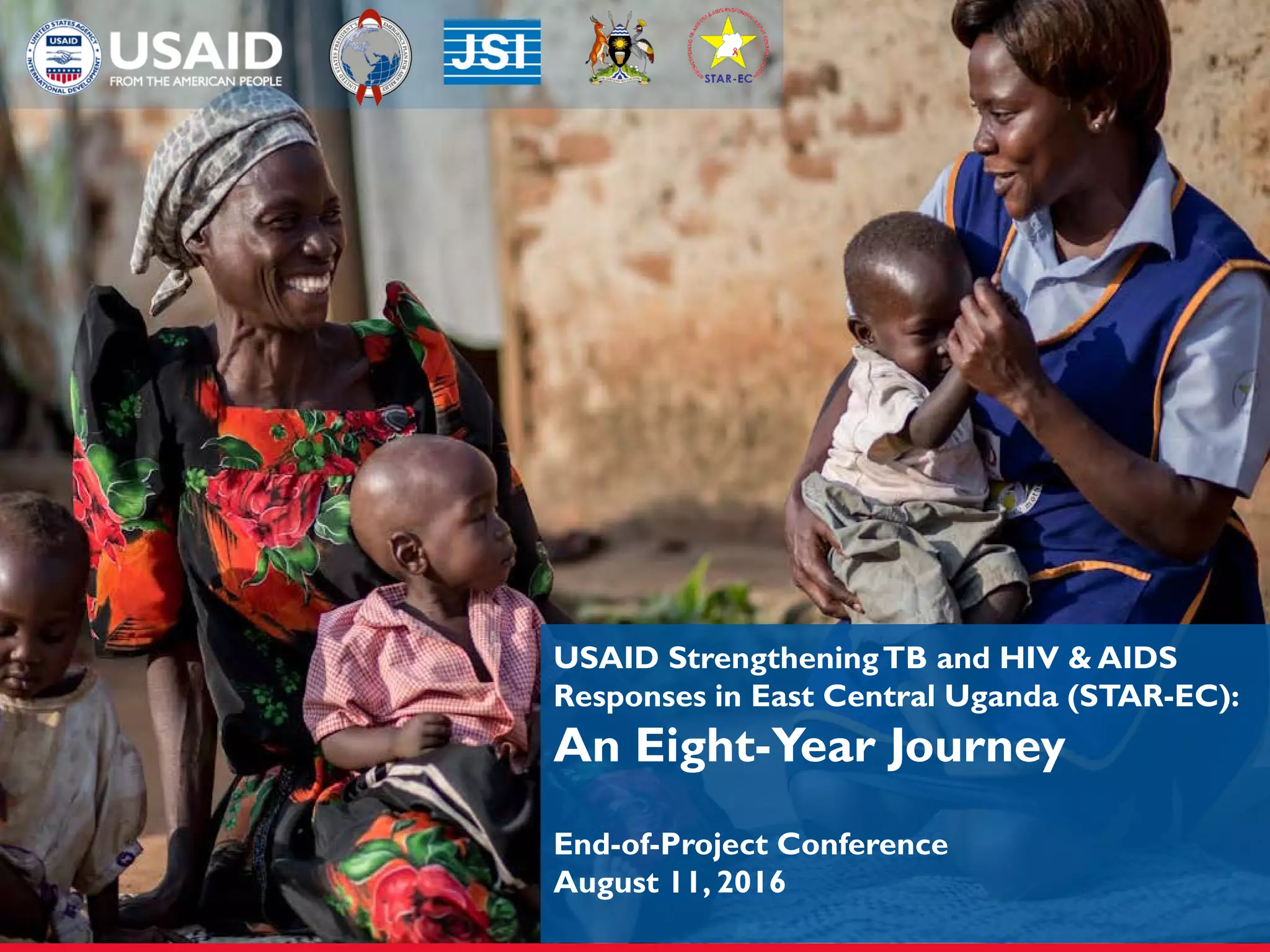
USAID StrengtheningTB and HIV & AIDS
Responses in East Central Uganda (STAR-EC):
An Eight-Year Journey
End-of-Project Conference
August 11, 2016
What We’ll Cover Today:
STAR-EC’s Eight-Year Journey
1. Where we started
2. STAR-EC goal and objectives
3. What we achieved
a. HIV
b. TB
c. Health system strengthening
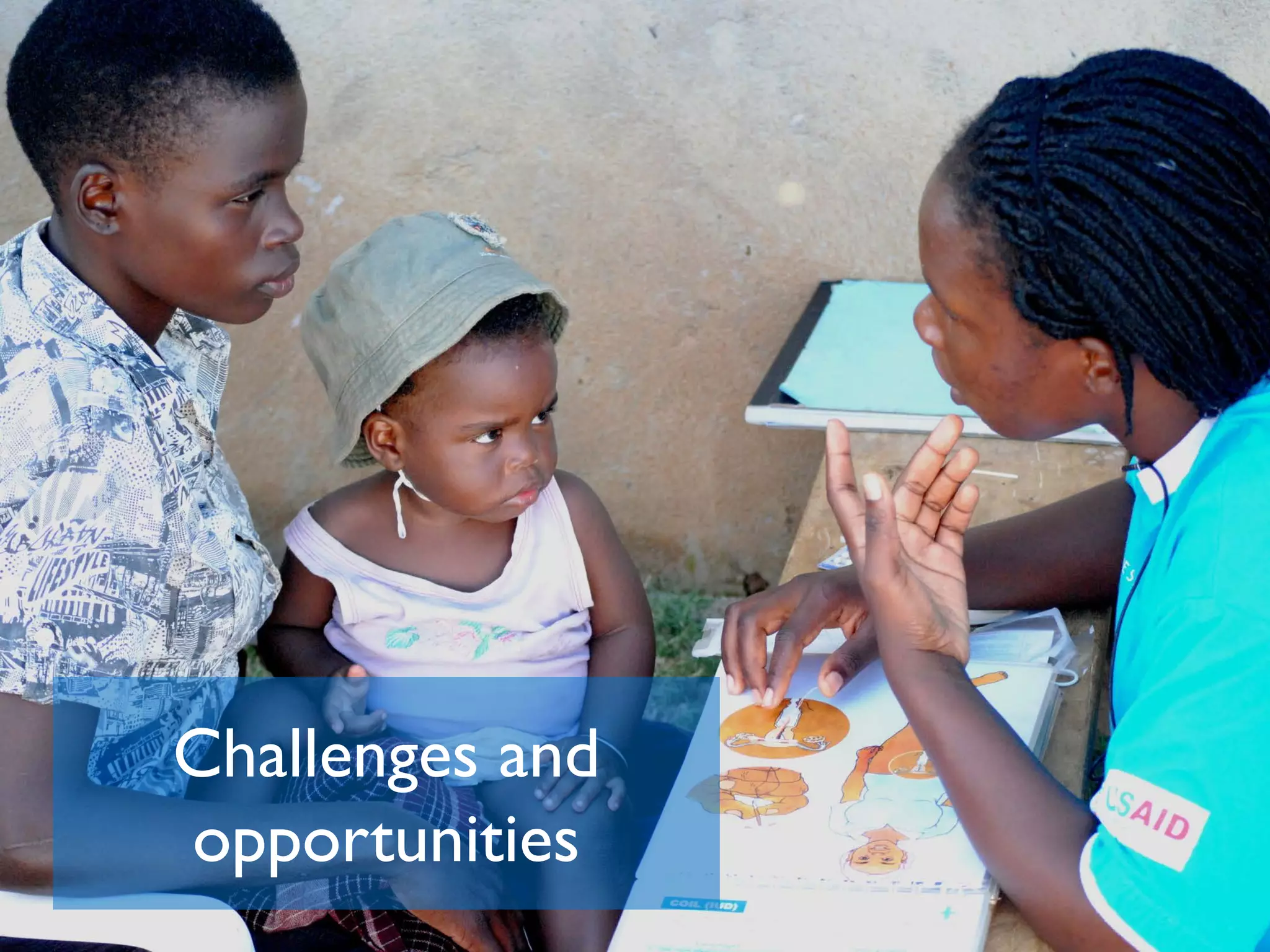
4. Challenges and opportunities
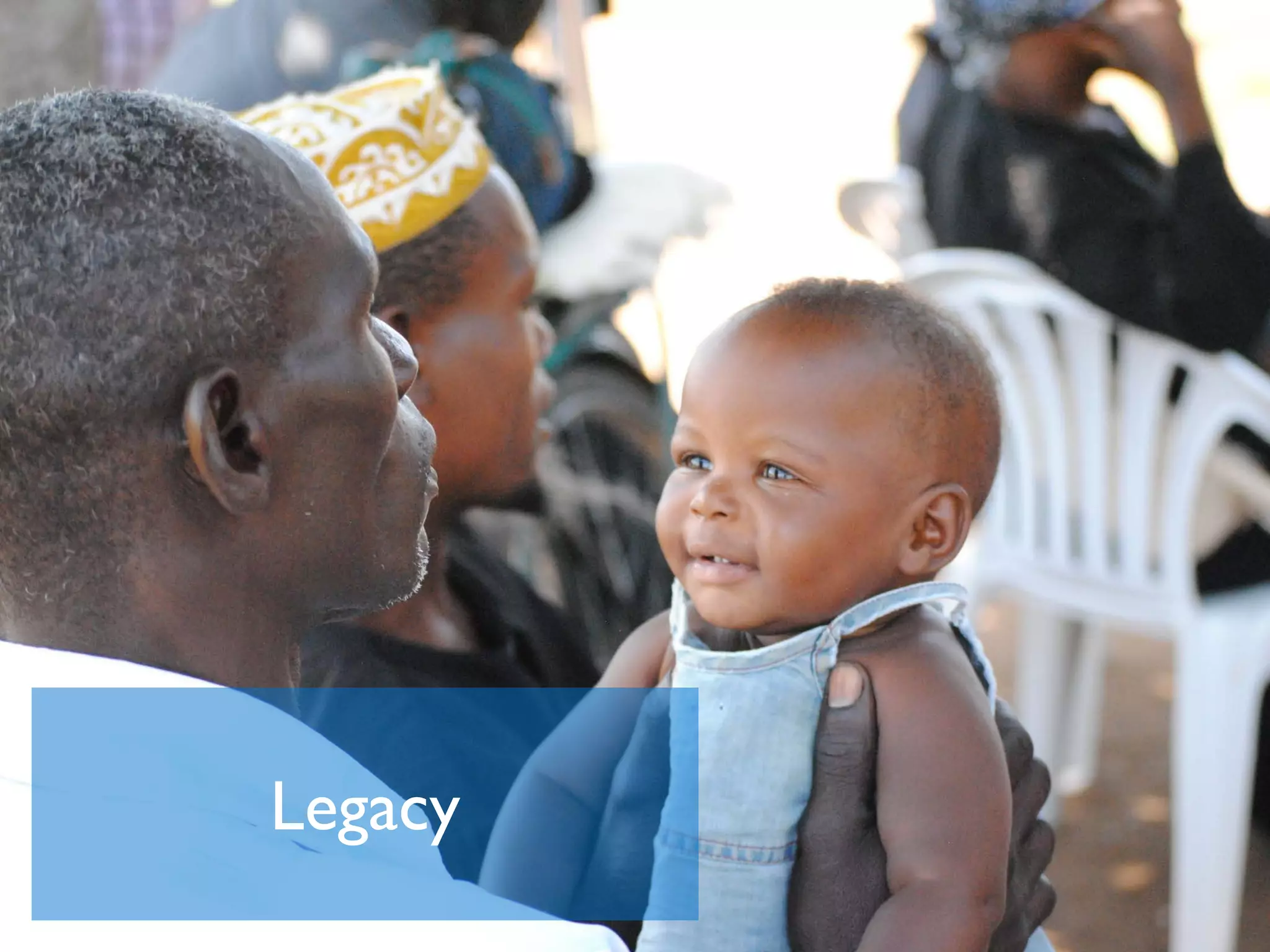
5. Legacy
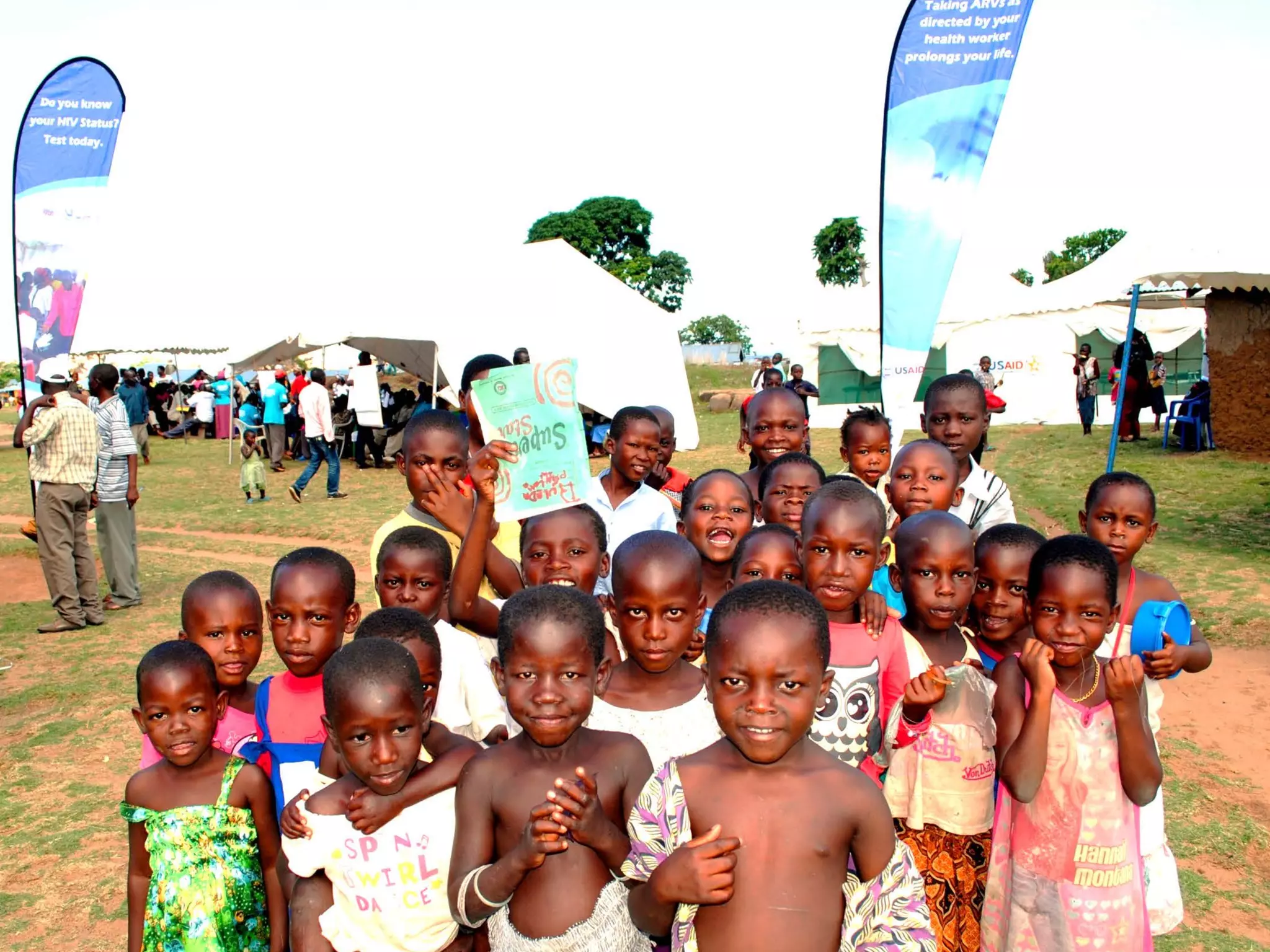
Photo: USAID
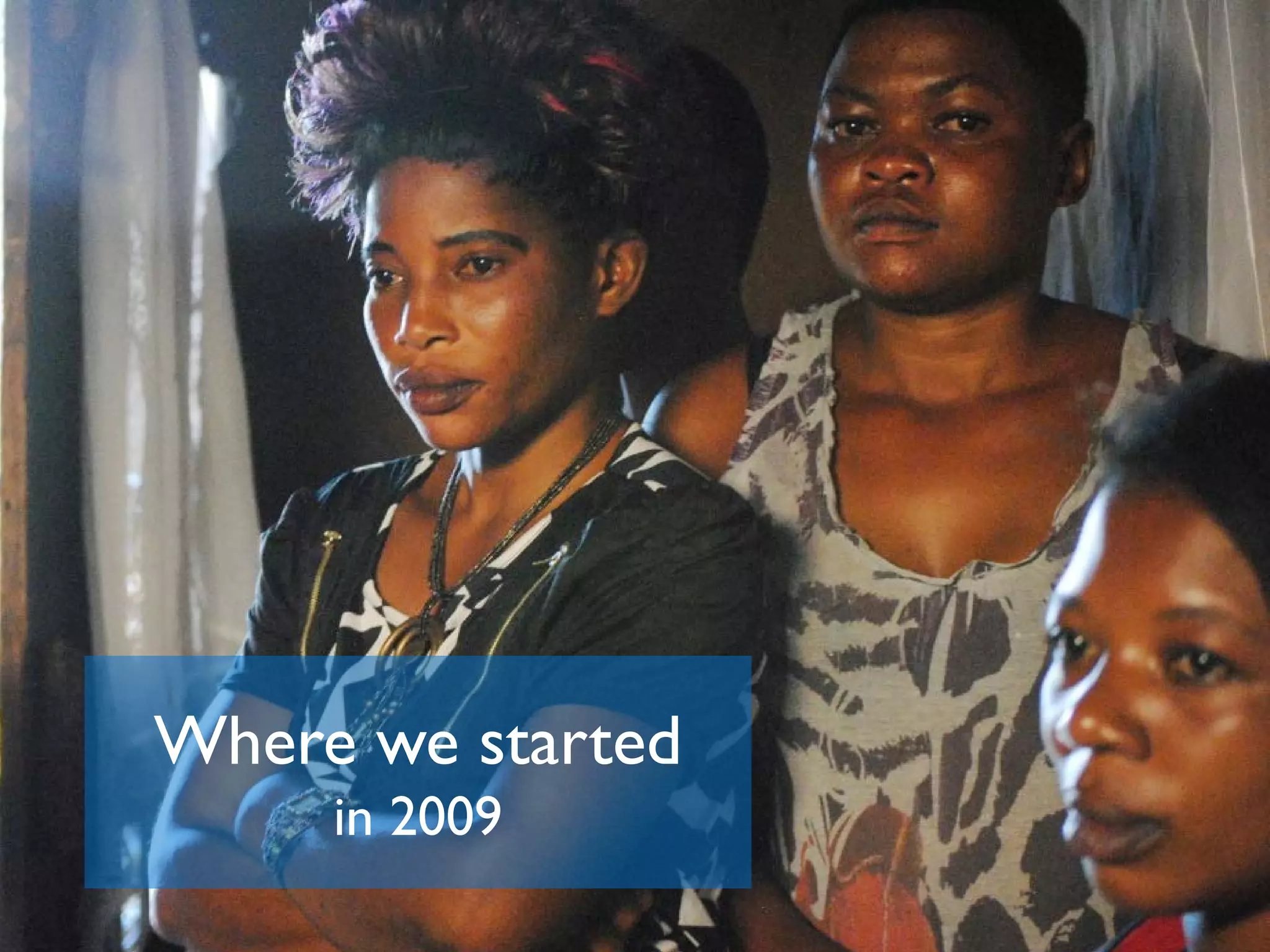
Where we started
in 2009
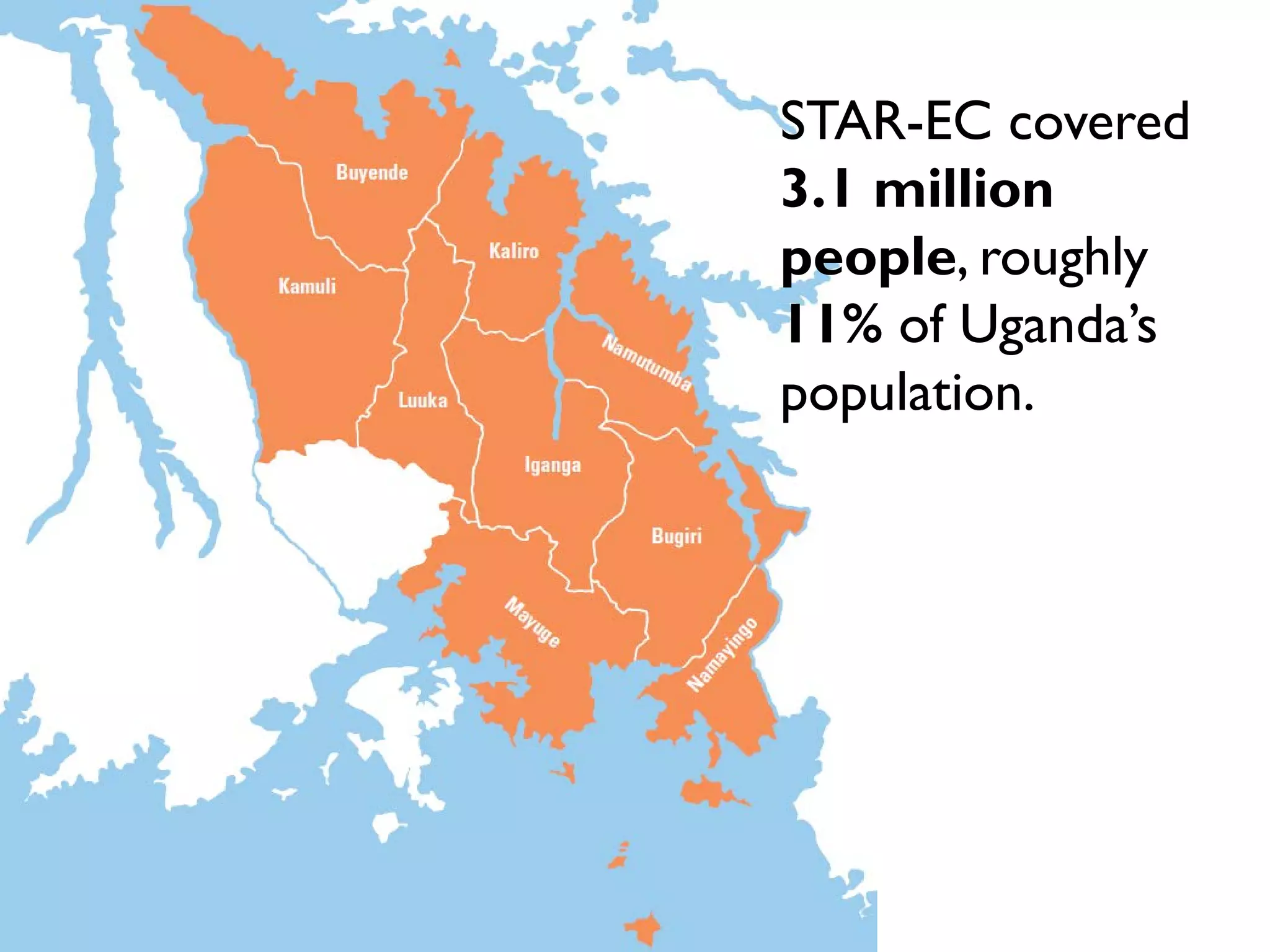
STAR-EC covered
3.1 million
people, roughly
11% of Uganda’s
population.
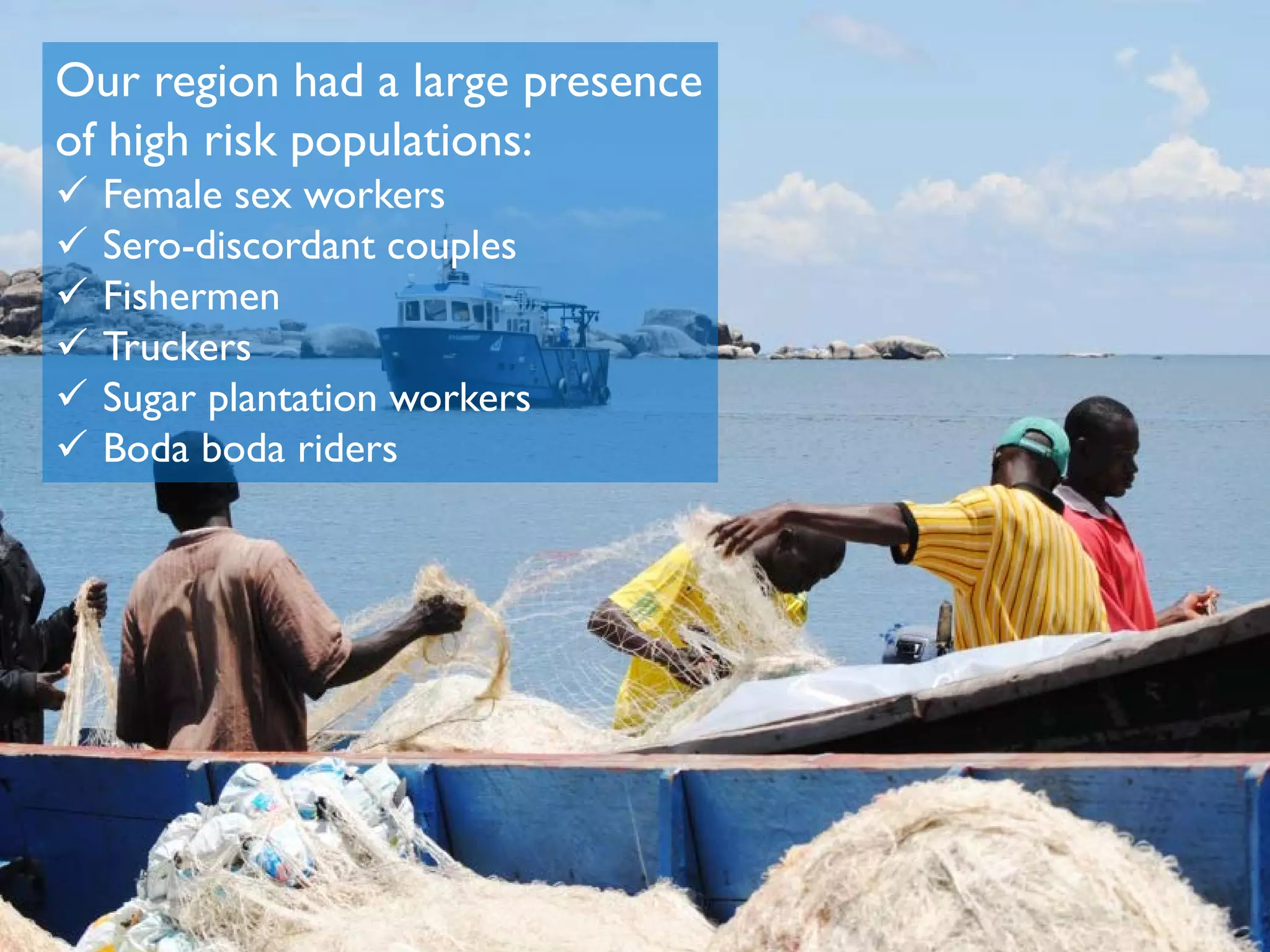
Our region had a large presence
of high risk populations:
 Female sex workers
 Sero-discordant couples
 Fishermen
 Truckers
 Sugar plantation workers
 Boda boda riders
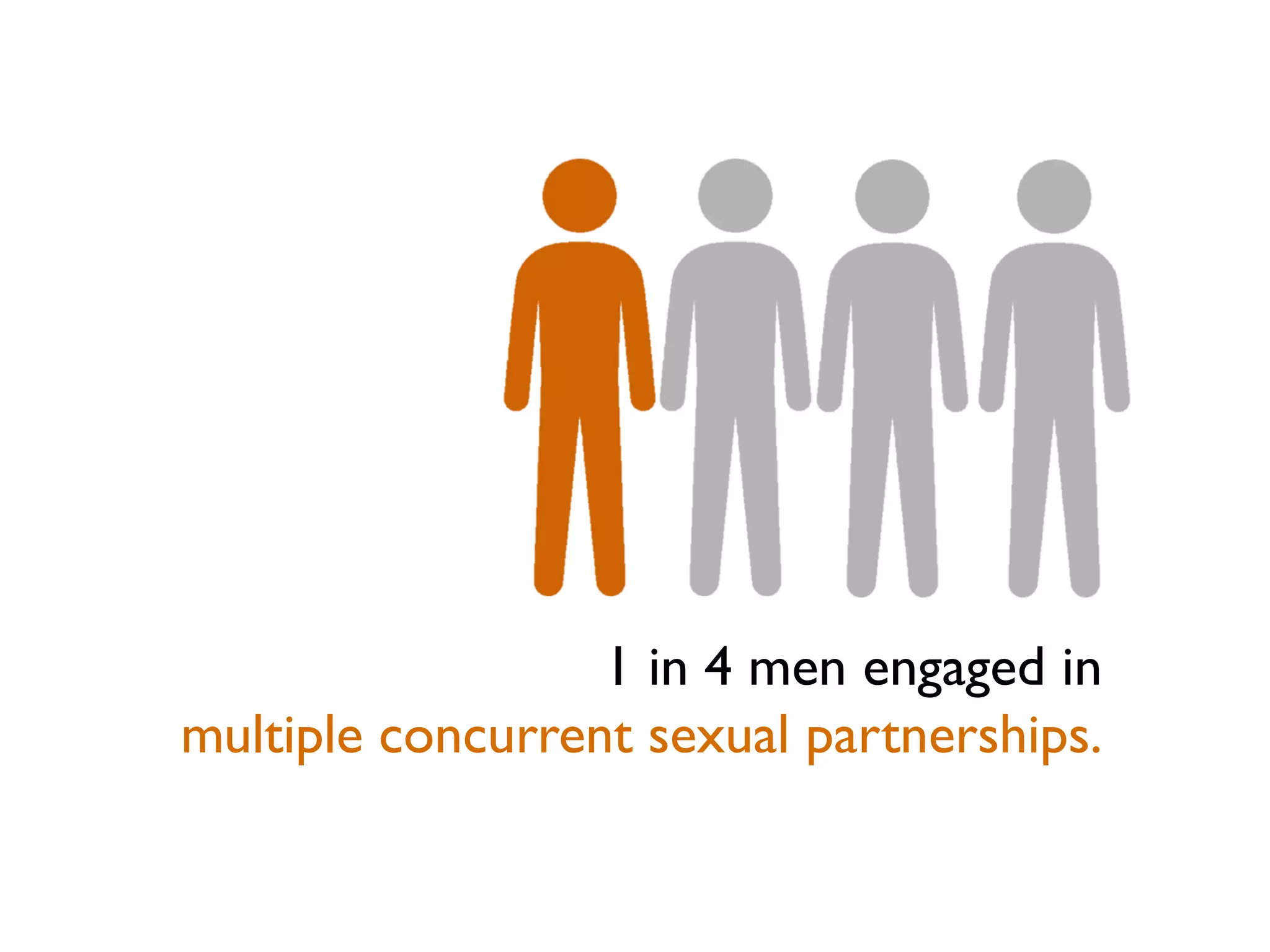
1 in 4 men engaged in
multiple concurrent sexual partnerships.
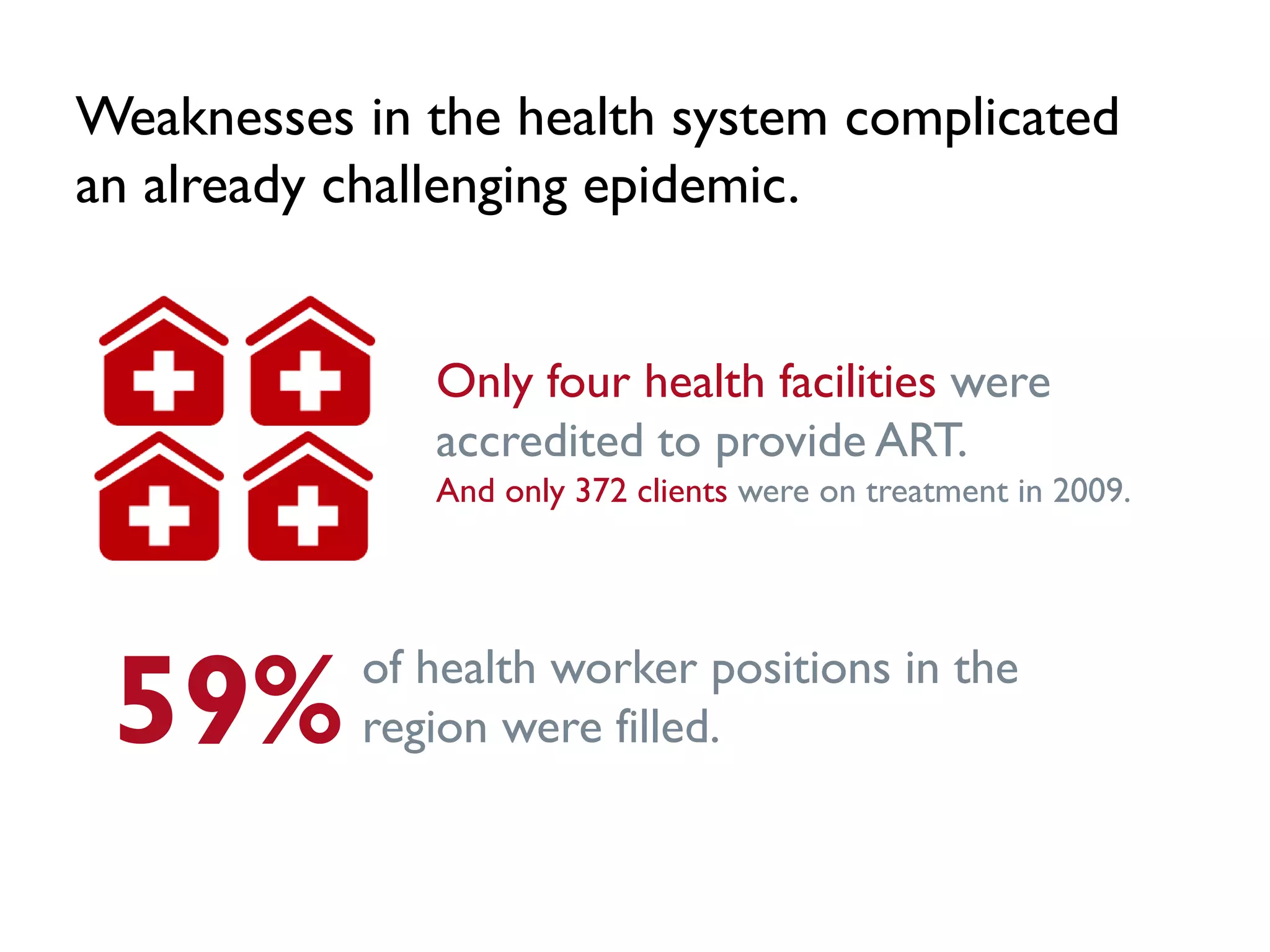
Weaknesses in the health system complicated
an already challenging epidemic.
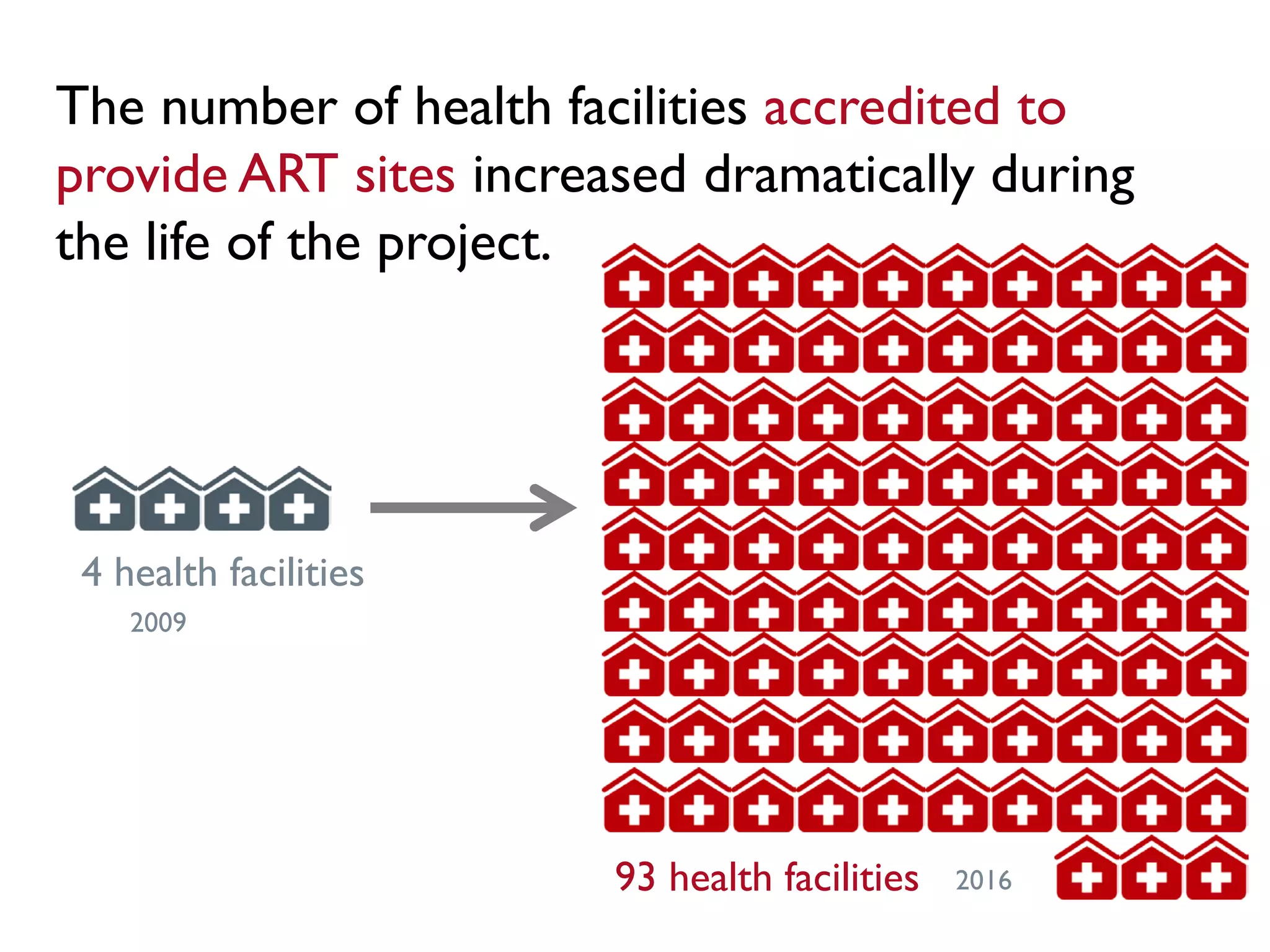
Only four health facilities were
accredited to provide ART.
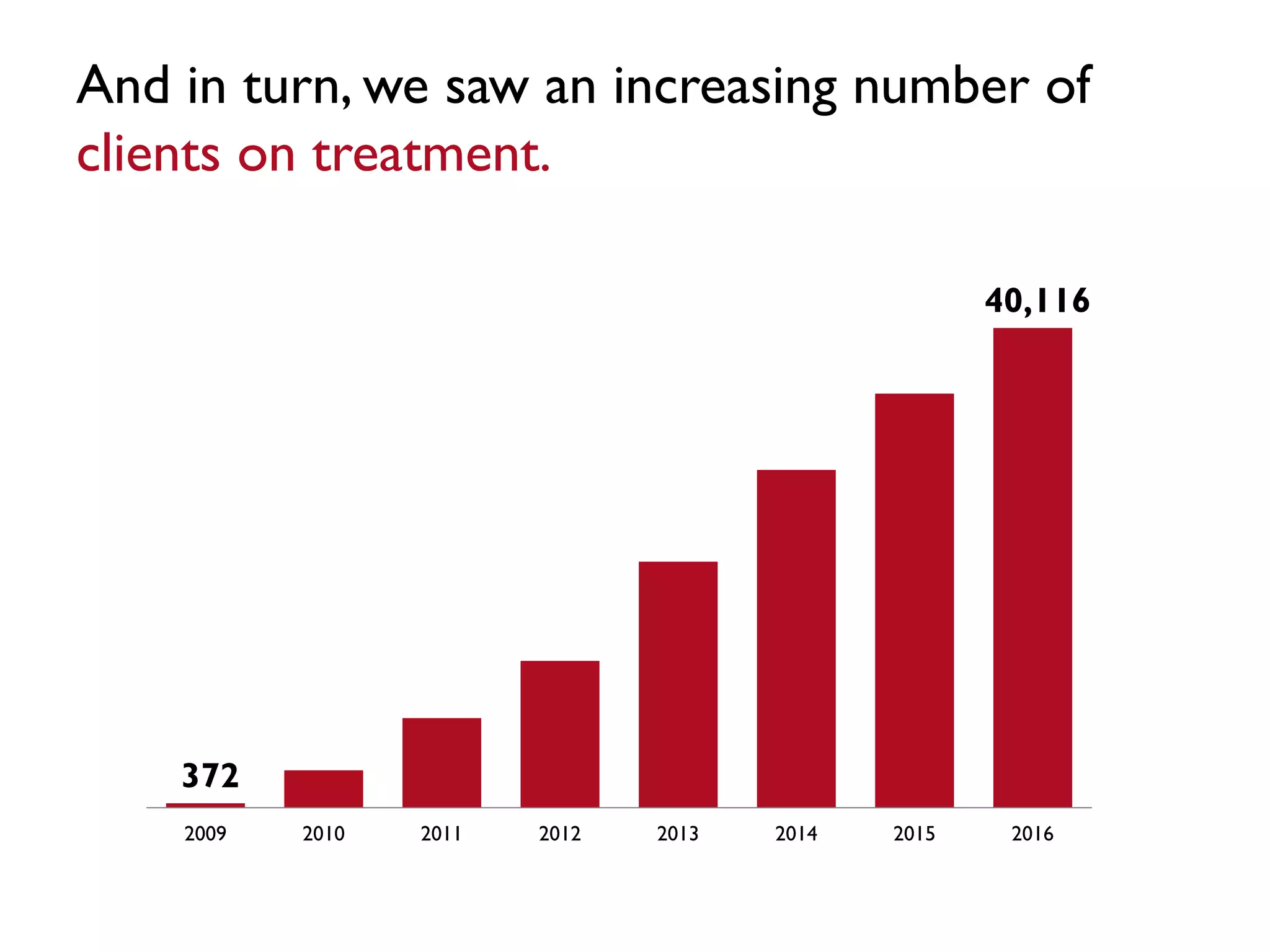
And only 372 clients were on treatment in 2009.
59%of health worker positions in the
region were filled.
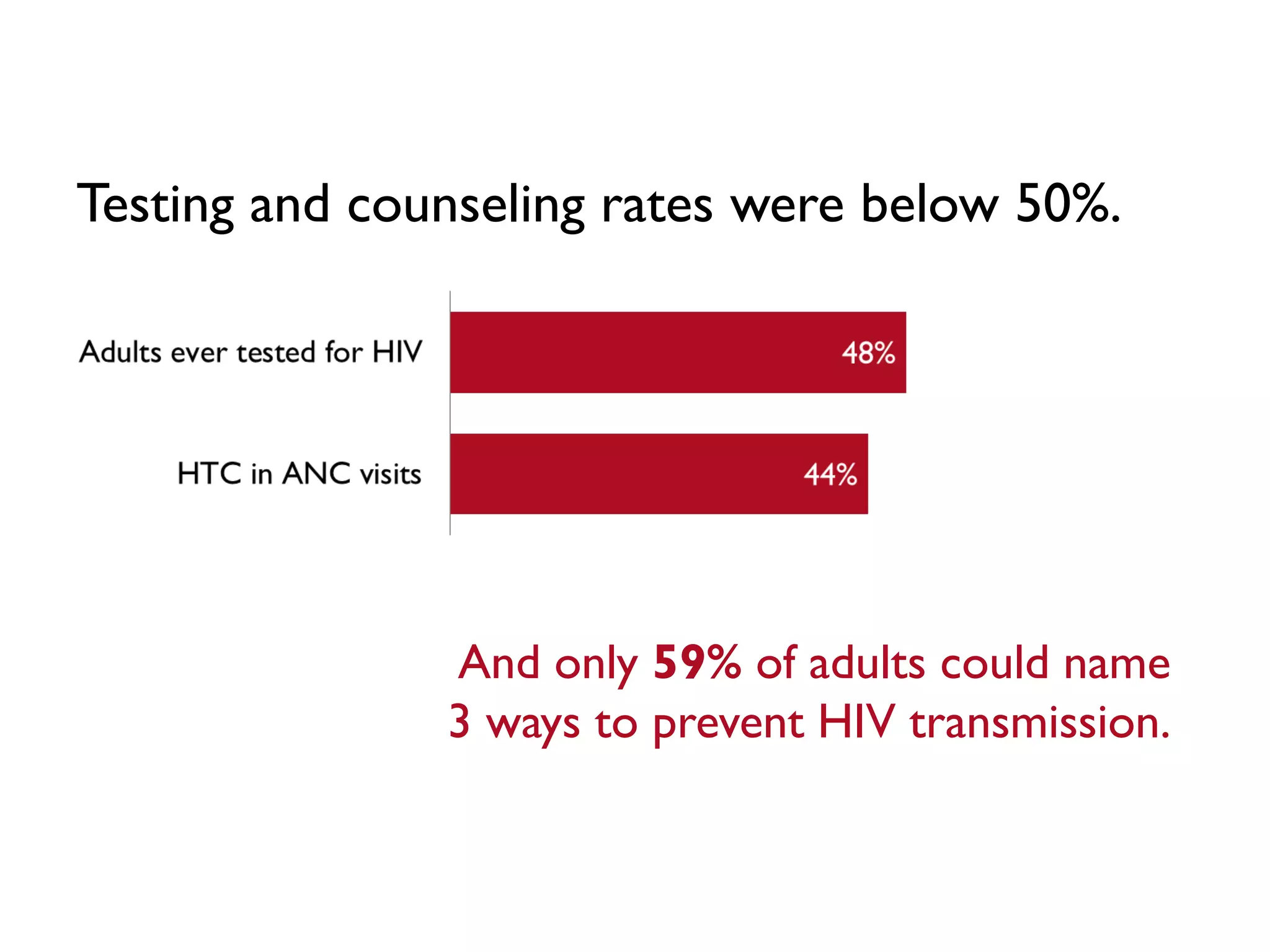
Testing and counseling rates were below 50%.
And only 59% of adults could name
3 ways to prevent HIV transmission.
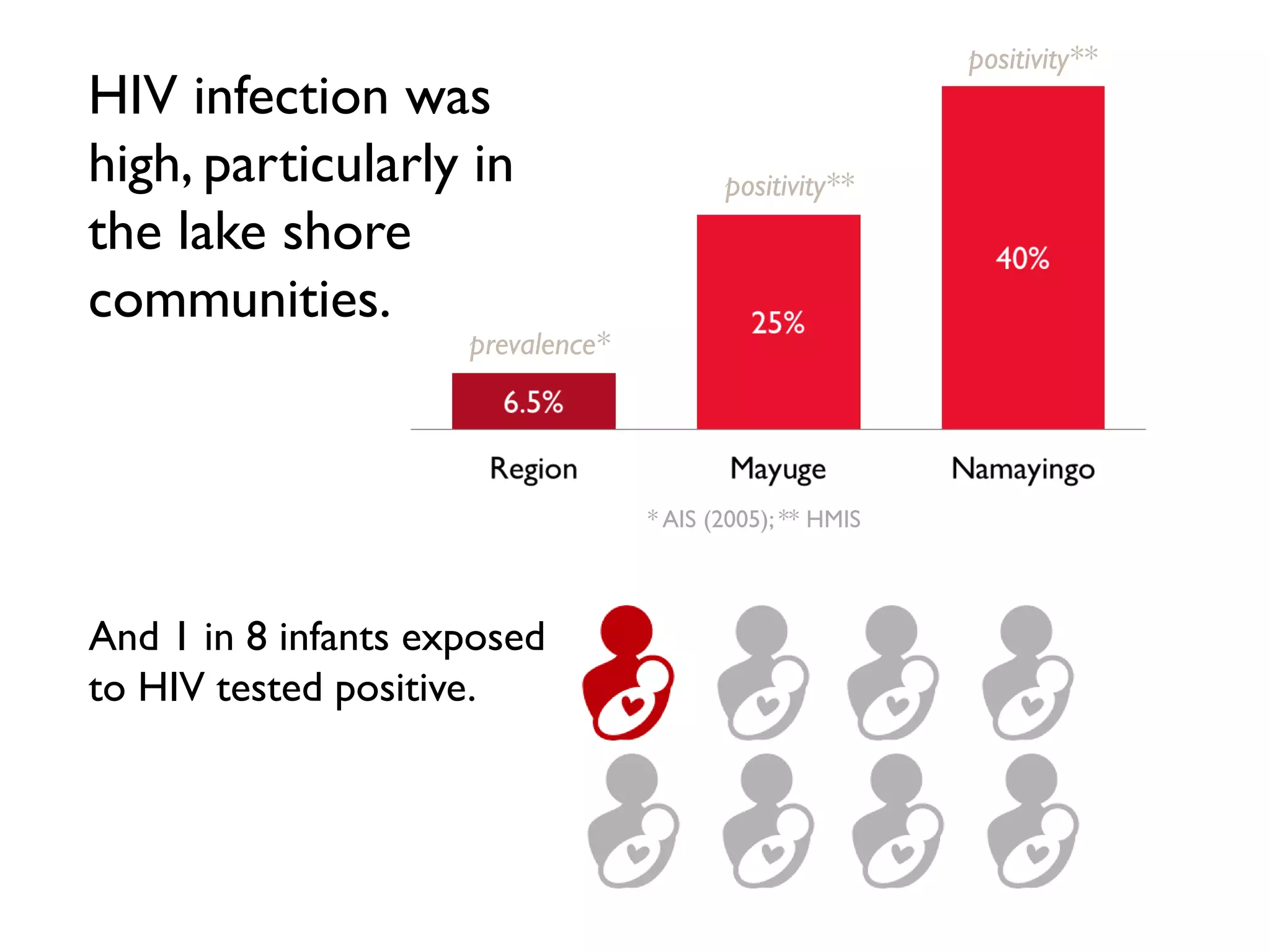
HIV infection was
high, particularly in
the lake shore
communities.
And 1 in 8 infants exposed
to HIV tested positive.
prevalence*
positivity**
positivity**
* AIS (2005); ** HMIS
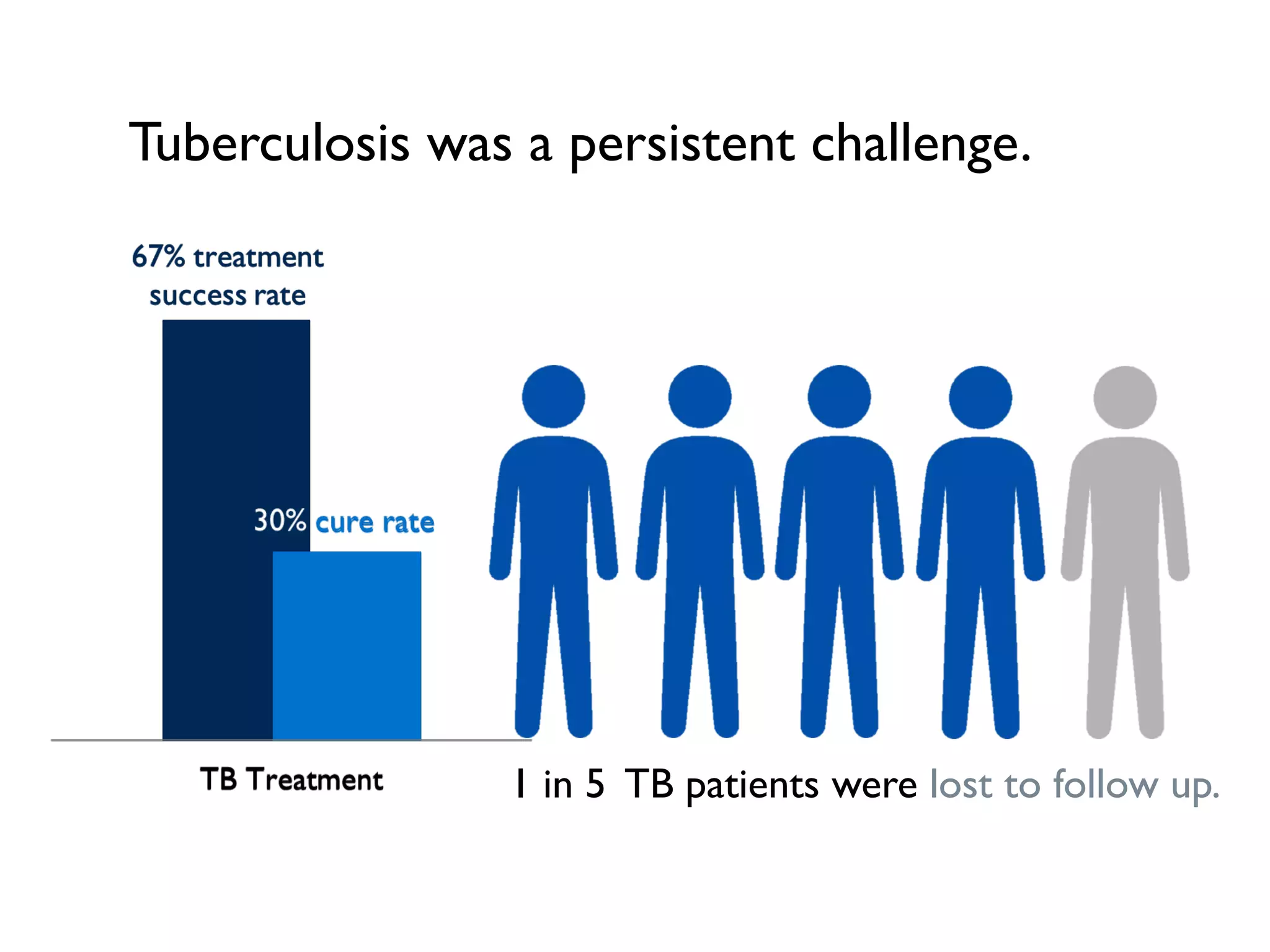
1 in 5 TB patients were lost to follow up.
Tuberculosis was a persistent challenge.
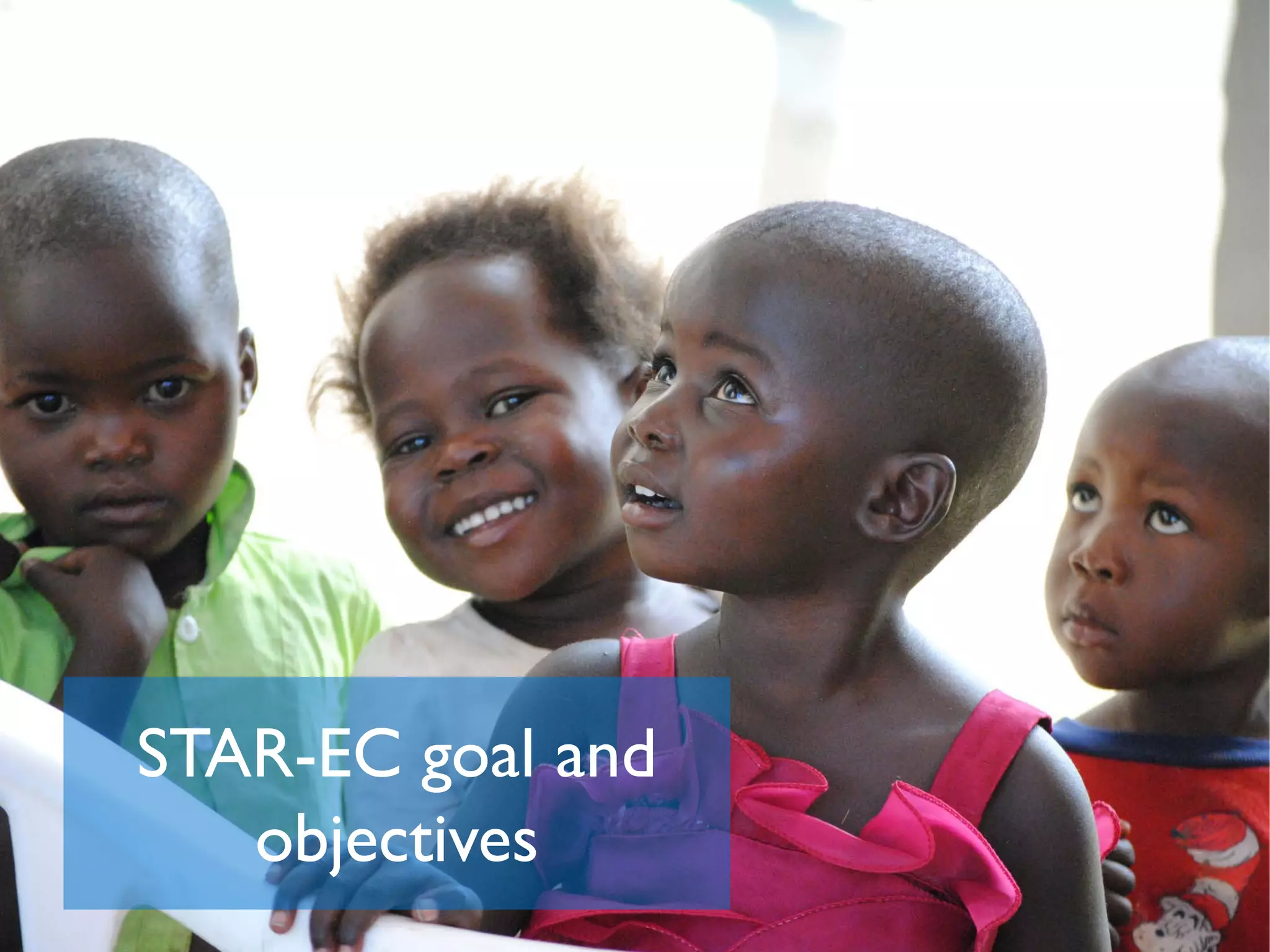
STAR-EC goal and
objectives
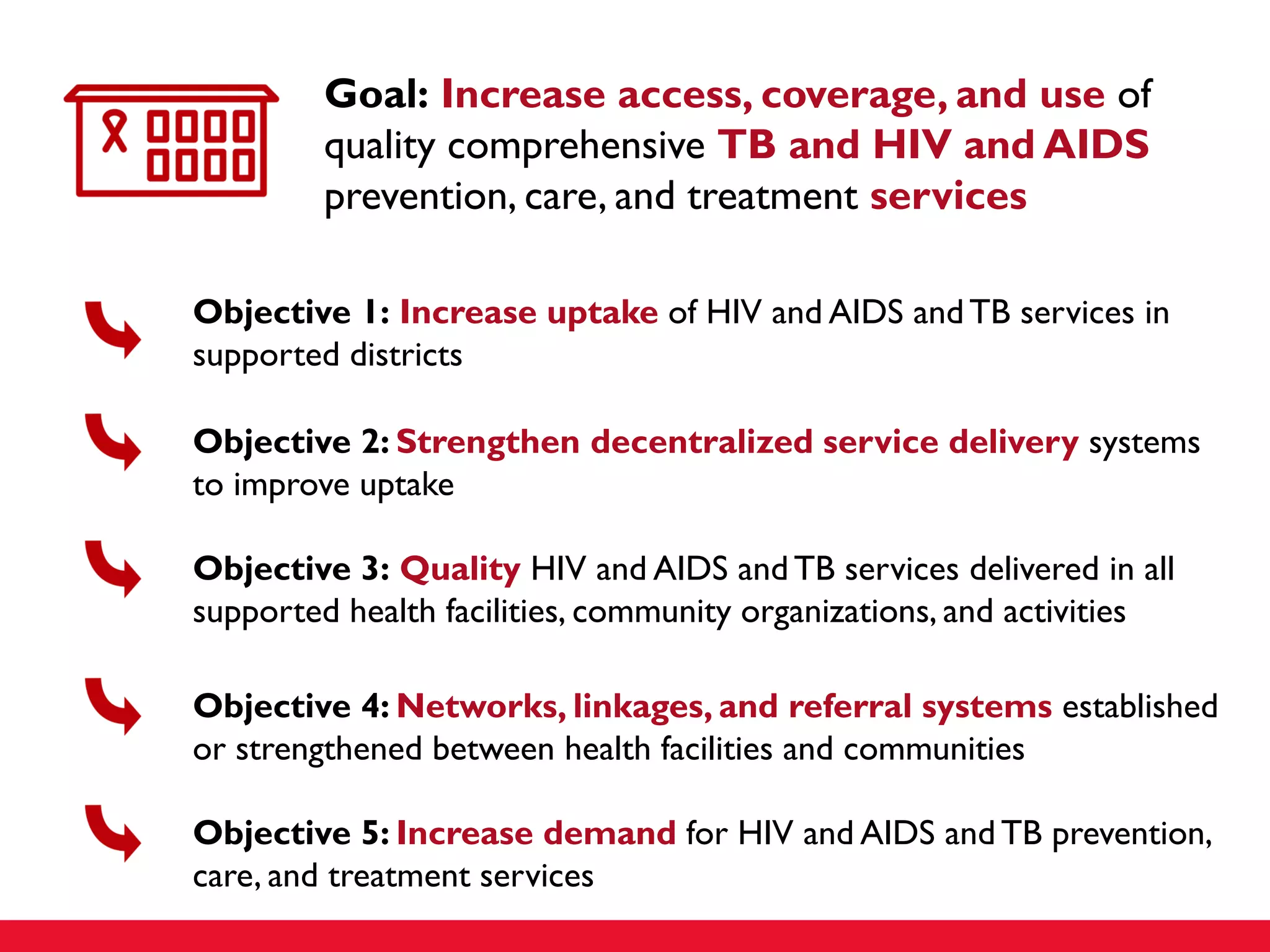
Goal: Increase access, coverage, and use of
quality comprehensive TB and HIV and AIDS
prevention, care, and treatment services
Objective 1: Increase uptake of HIV and AIDS and TB services in
supported districts
Objective 2: Strengthen decentralized service delivery systems
to improve uptake
Objective 3: Quality HIV and AIDS and TB services delivered in all
supported health facilities, community organizations, and activities
Objective 4: Networks, linkages, and referral systems established
or strengthened between health facilities and communities
Objective 5: Increase demand for HIV and AIDS and TB prevention,
care, and treatment services
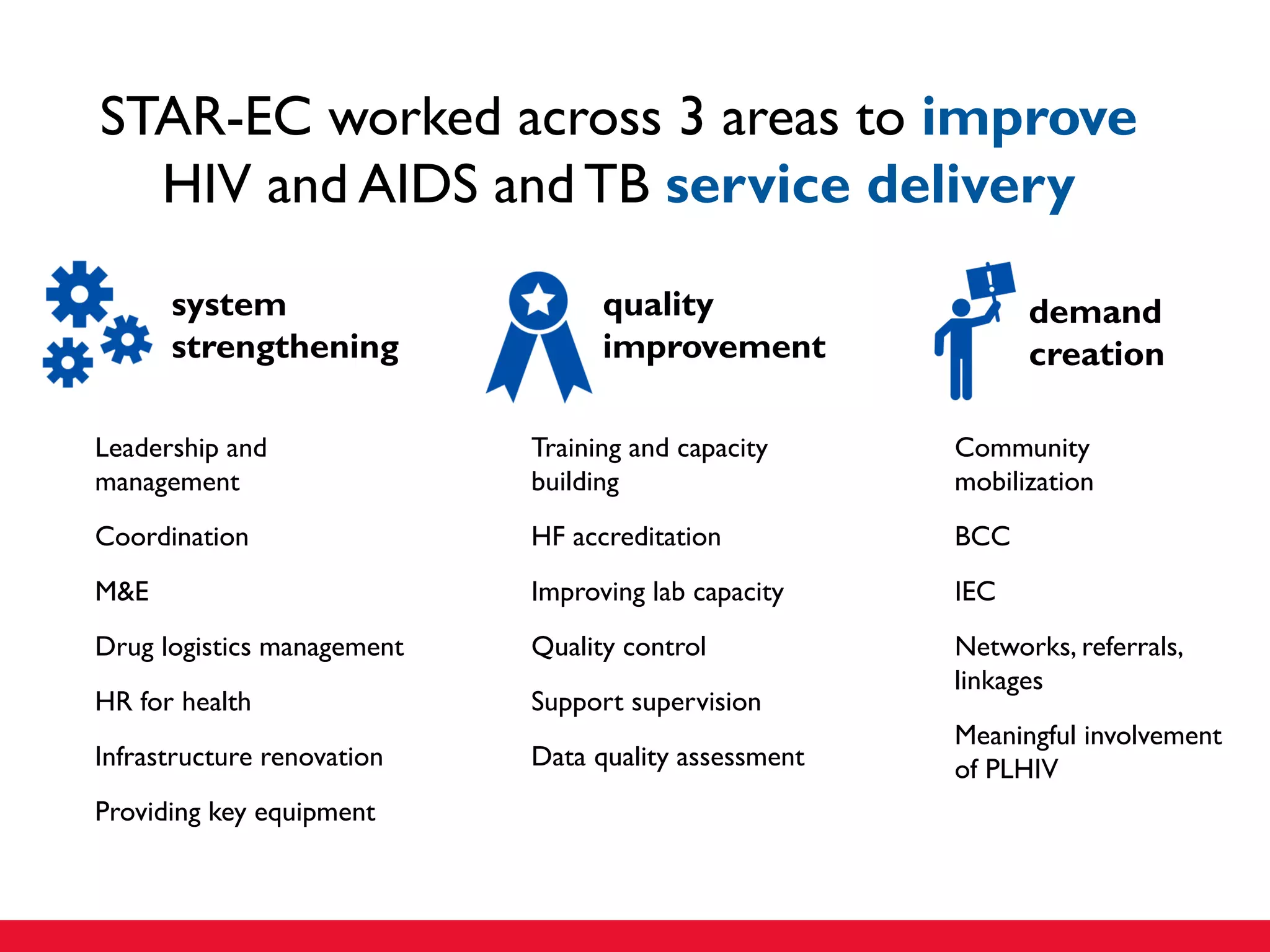
STAR-EC worked across 3 areas to improve
HIV and AIDS and TB service delivery
system
strengthening
demand
creation
quality
improvement
Community
mobilization
BCC
IEC
Networks, referrals,
linkages
Meaningful involvement
of PLHIV
Training and capacity
building
HF accreditation
Improving lab capacity
Quality control
Support supervision
Data quality assessment
Leadership and
management
Coordination
M&E
Drug logistics management
HR for health
Infrastructure renovation
Providing key equipment
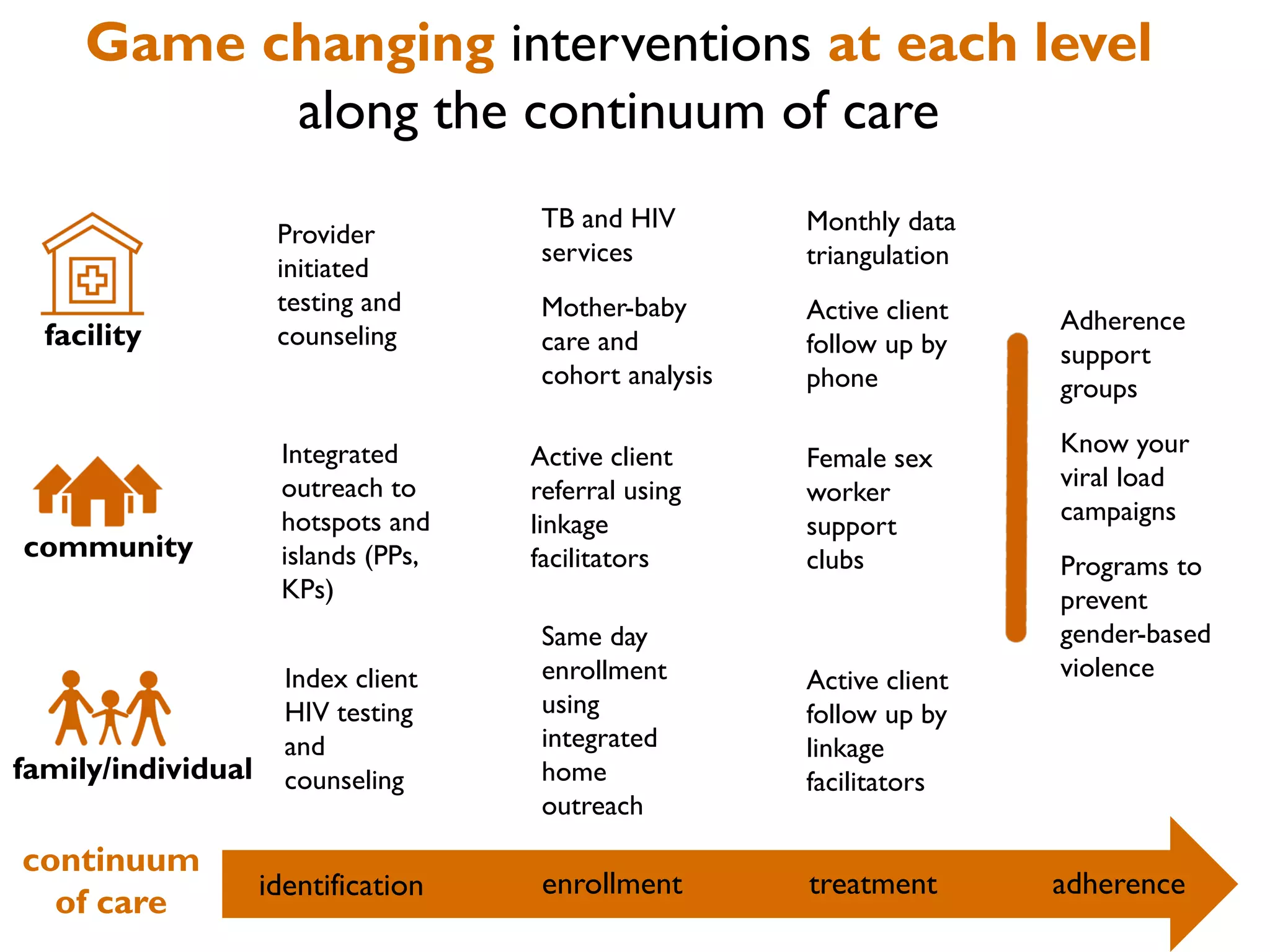
Game changing interventions at each level
along the continuum of care
facility
family/individual
community
identification adherencetreatmentenrollment
Adherence
support
groups
Know your
viral load
campaigns
Programs to
prevent
gender-based
violence
Monthly data
triangulation
Active client
follow up by
phone
Female sex
worker
support
clubs
Active client
follow up by
linkage
facilitators
Active client
referral using
linkage
facilitators
Same day
enrollment
using
integrated
home
outreach
TB and HIV
services
Mother-baby
care and
cohort analysis
Provider
initiated
testing and
counseling
Integrated
outreach to
hotspots and
islands (PPs,
KPs)
Index client
HIV testing
and
counseling
continuum
of care
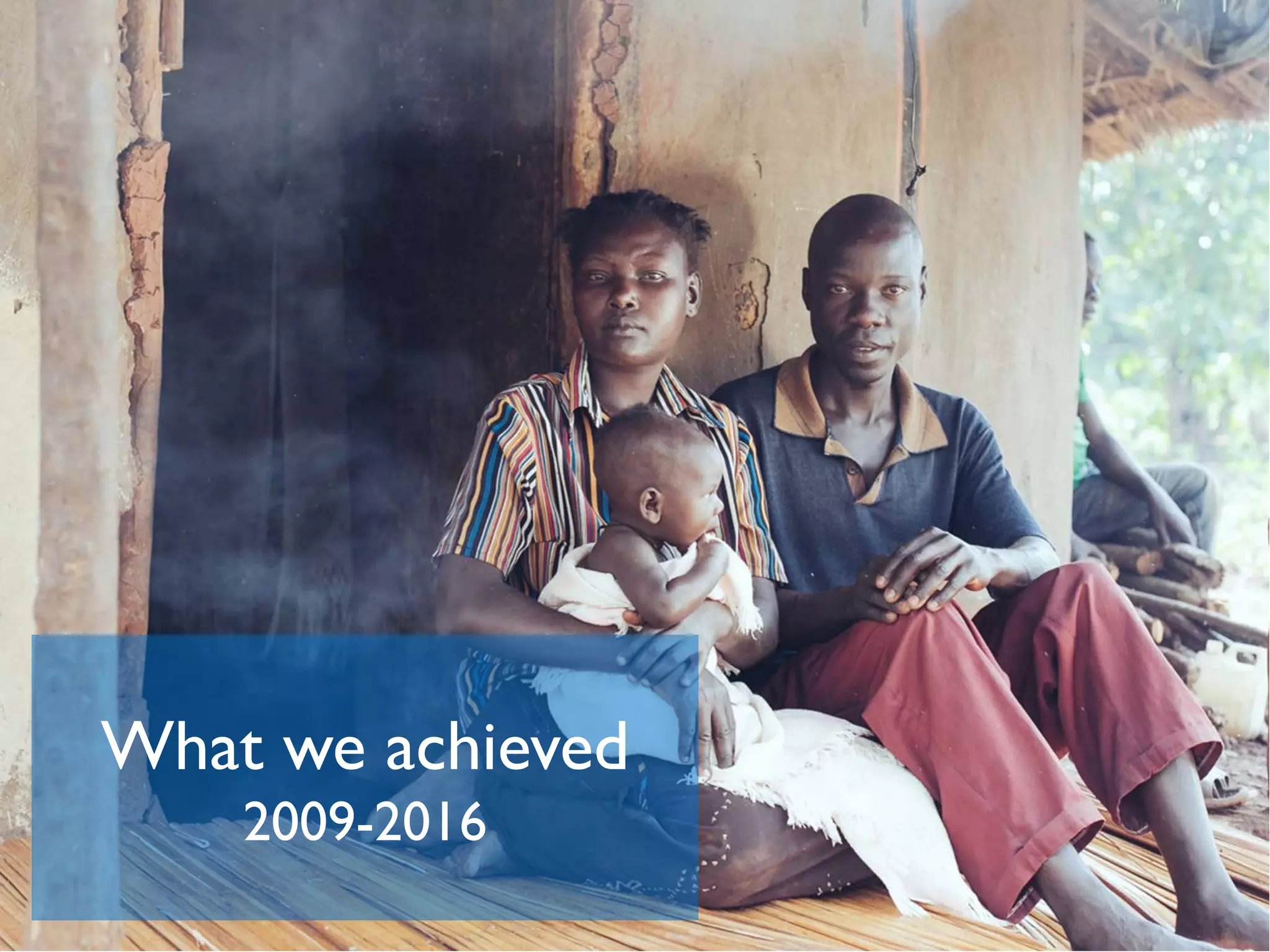
What we achieved
2009-2016
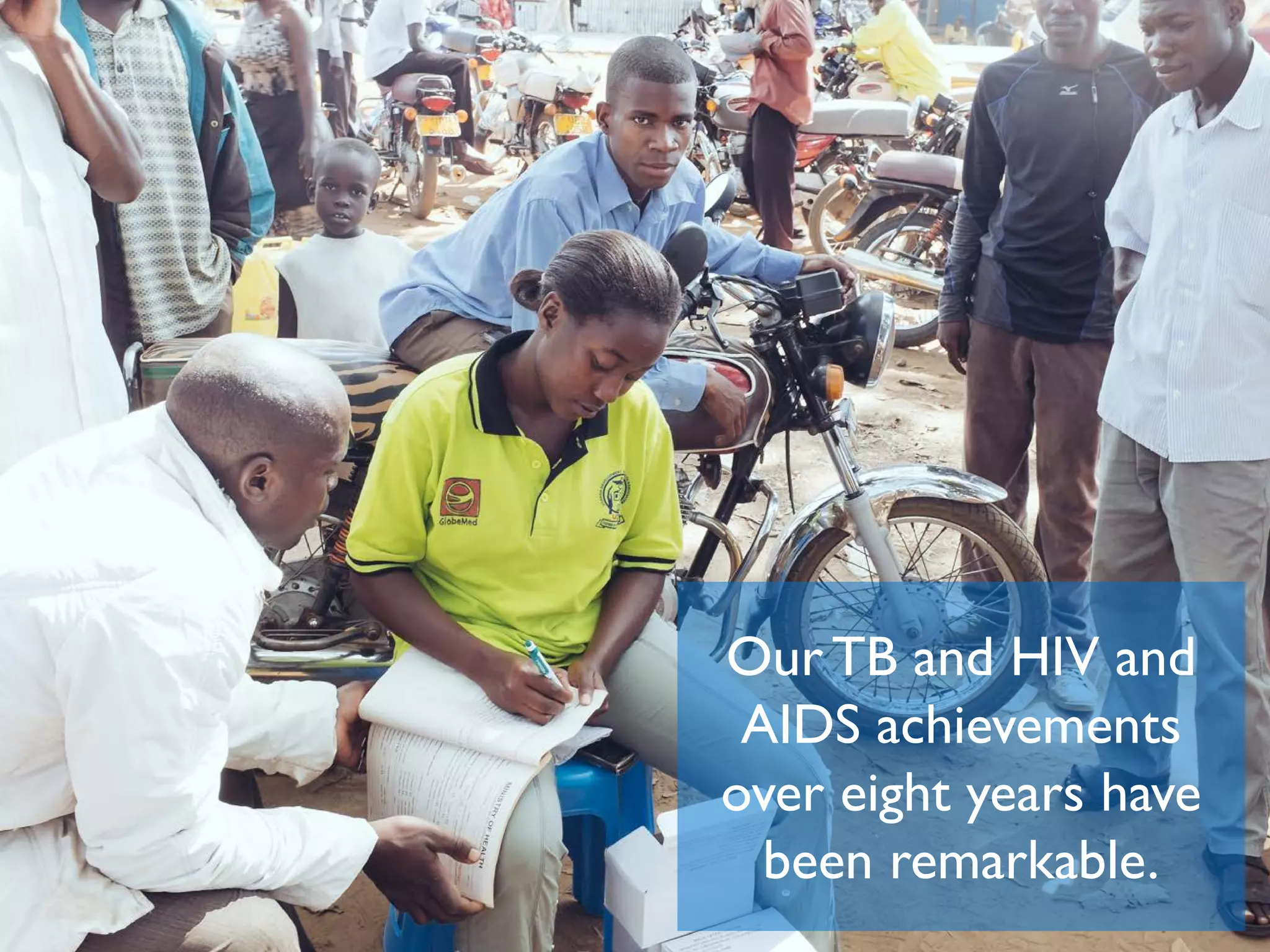
Our TB and HIV and
AIDS achievements
over eight years have
been remarkable.
HIV and AIDS
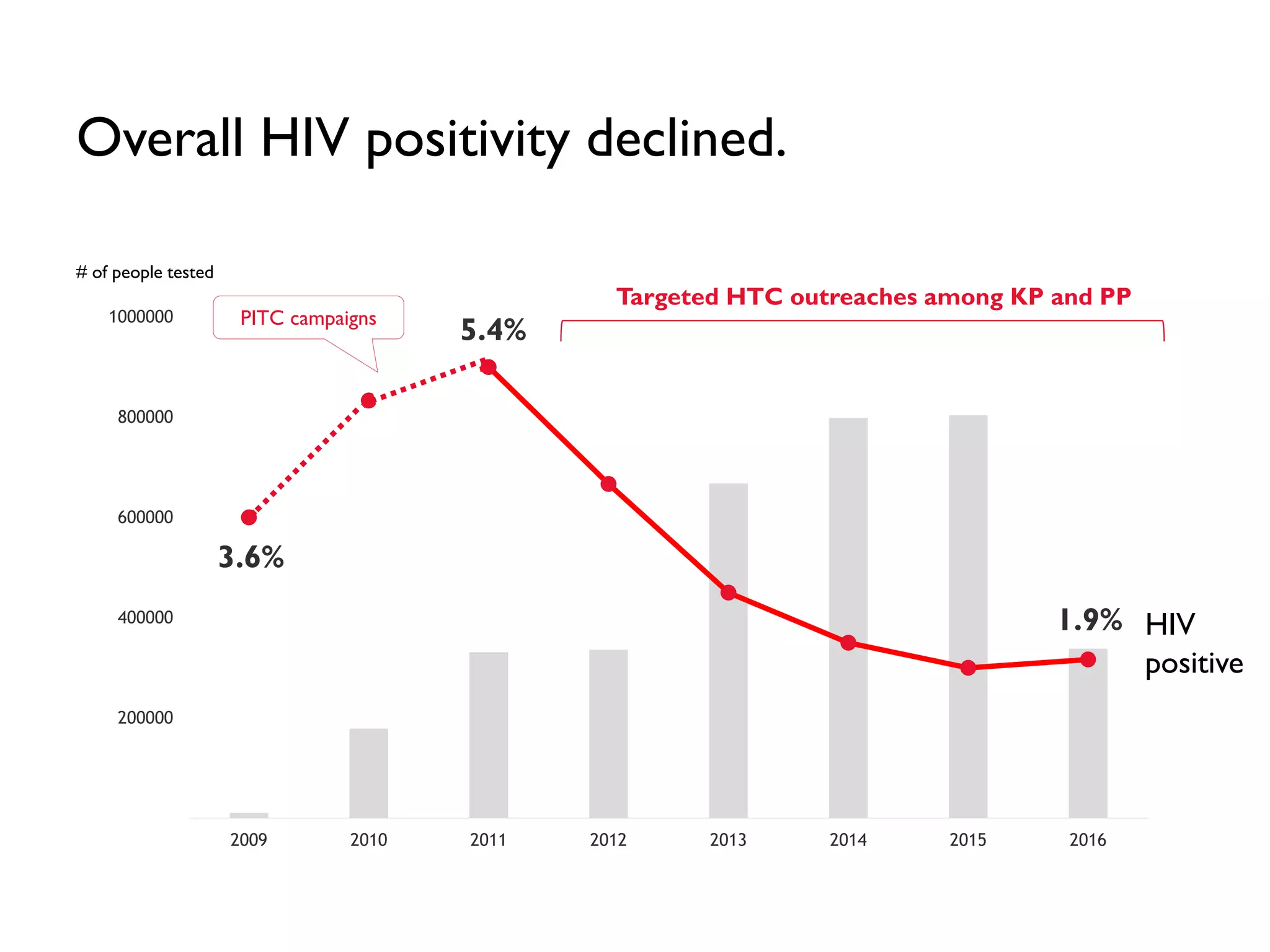
3.6%
5.4%
1.9%
0.0
1.0
2.0
3.0
4.0
5.0
6.0
200000
400000
600000
800000
1000000
2009 2010 2011 2012 2013 2014 2015 2016
Overall HIV positivity declined.
Targeted HTC outreaches among KP and PP
# of people tested
PITC campaigns
HIV
positive
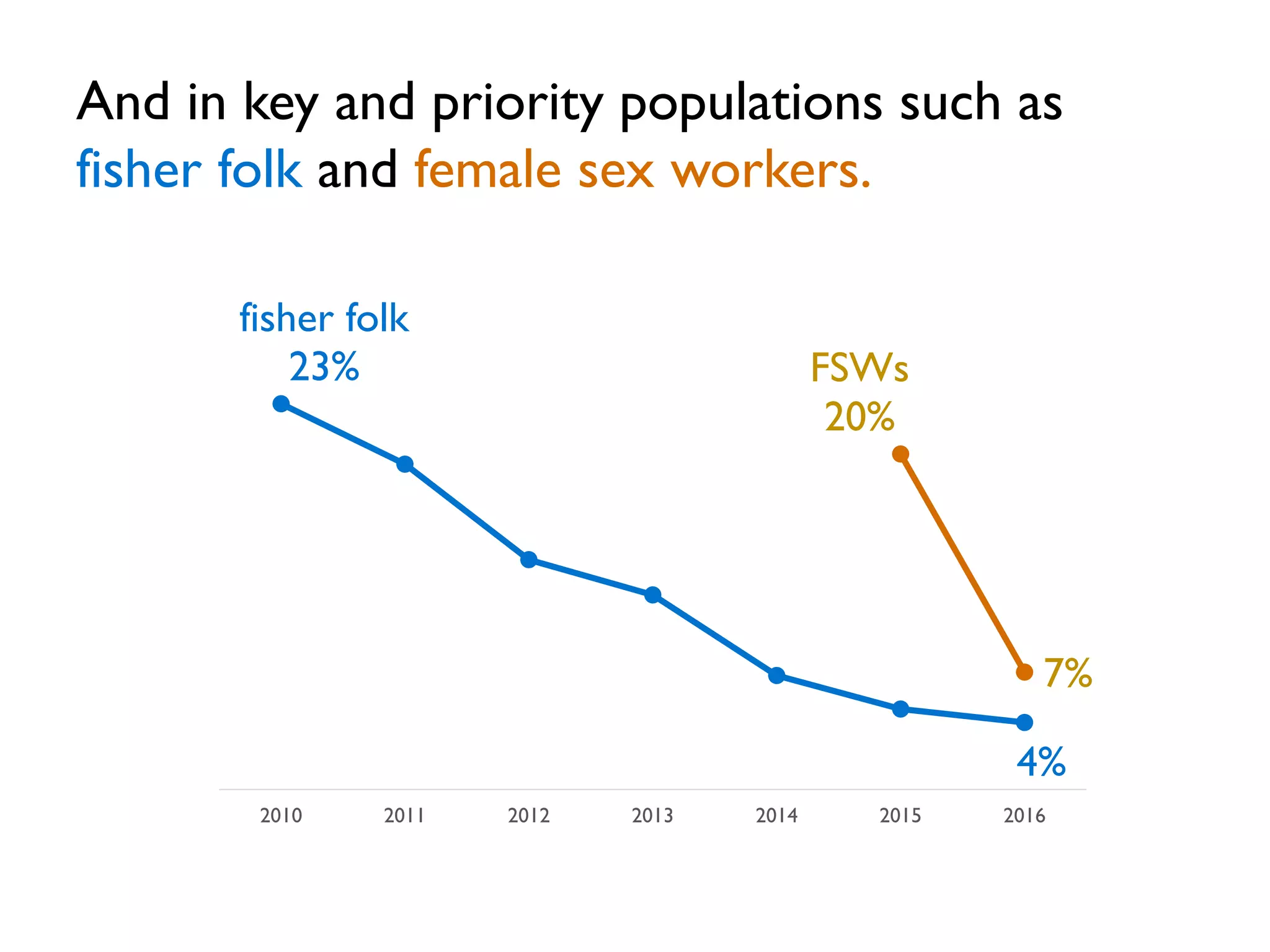
fisher folk
23%
4%
FSWs
20%
7%
2010 2011 2012 2013 2014 2015 2016
And in key and priority populations such as
fisher folk and female sex workers.
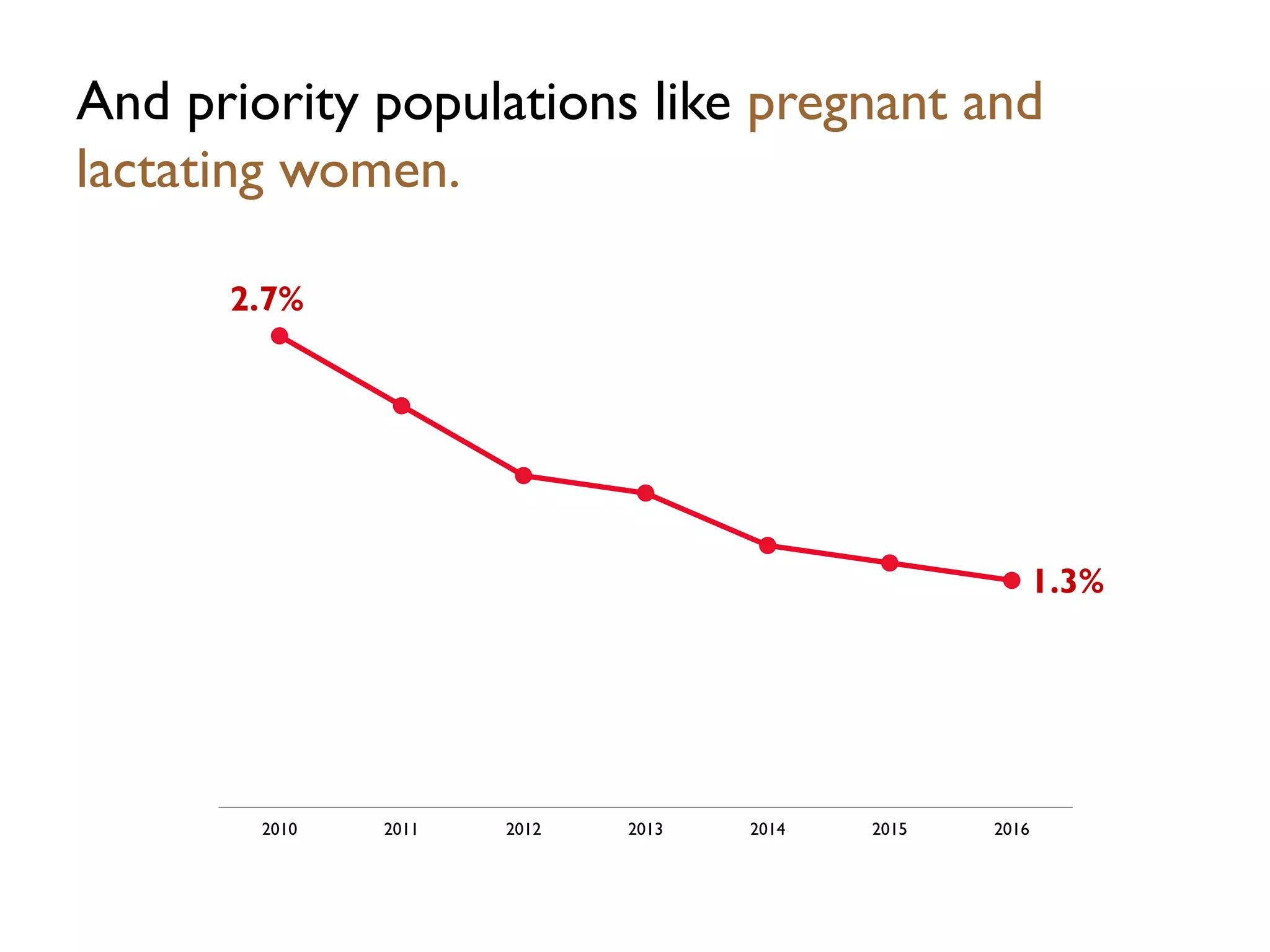
And priority populations like pregnant and
lactating women.
2.7%
1.3%
2010 2011 2012 2013 2014 2015 2016
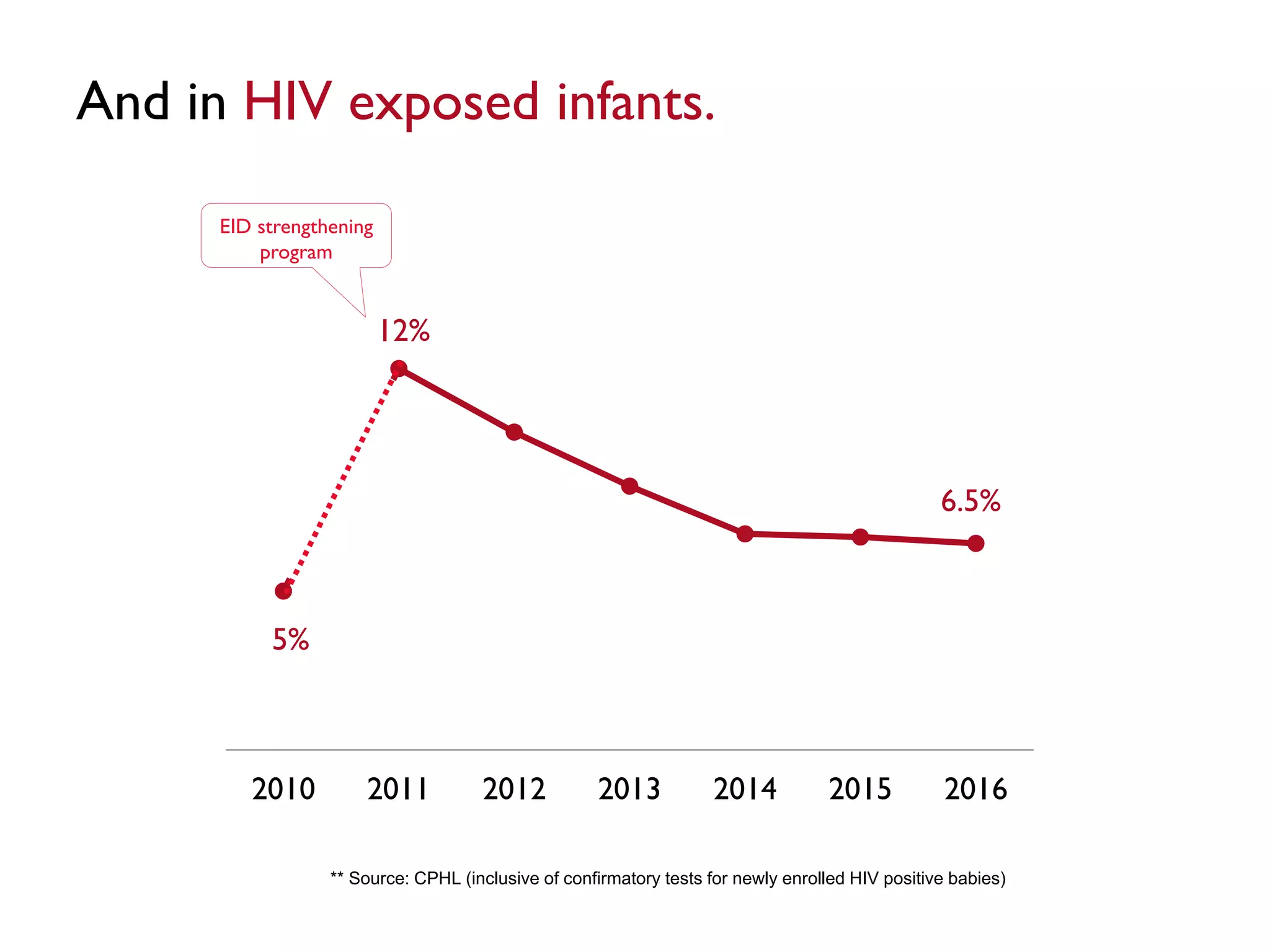
** Source: CPHL (inclusive of confirmatory tests for newly enrolled HIV positive babies)
5%
12%
6.5%
2010 2011 2012 2013 2014 2015 2016
And in HIV exposed infants.
EID strengthening
program
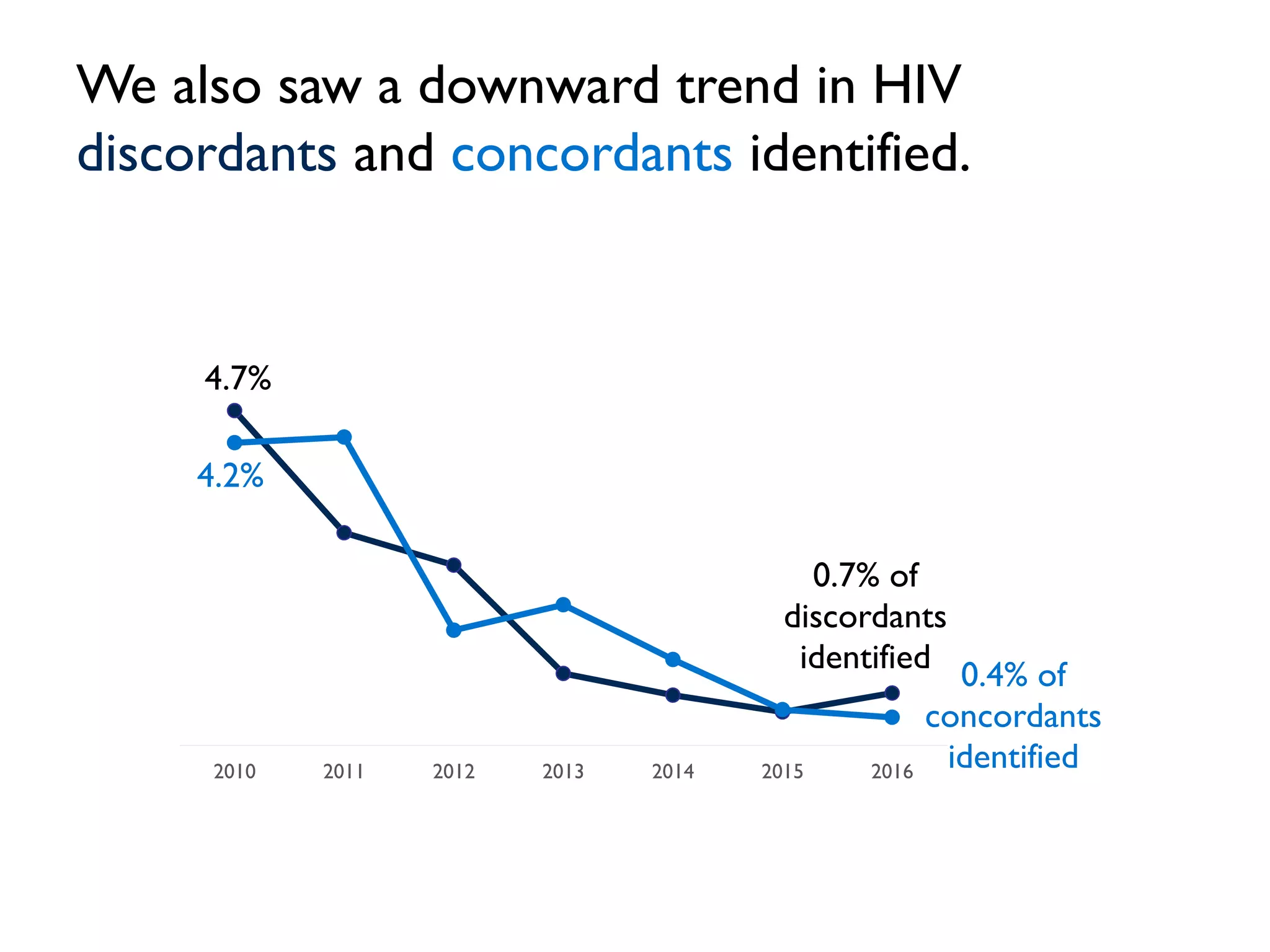
4.7%
0.7% of
discordants
identified
4.2%
0.4% of
concordants
identified2010 2011 2012 2013 2014 2015 2016
We also saw a downward trend in HIV
discordants and concordants identified.
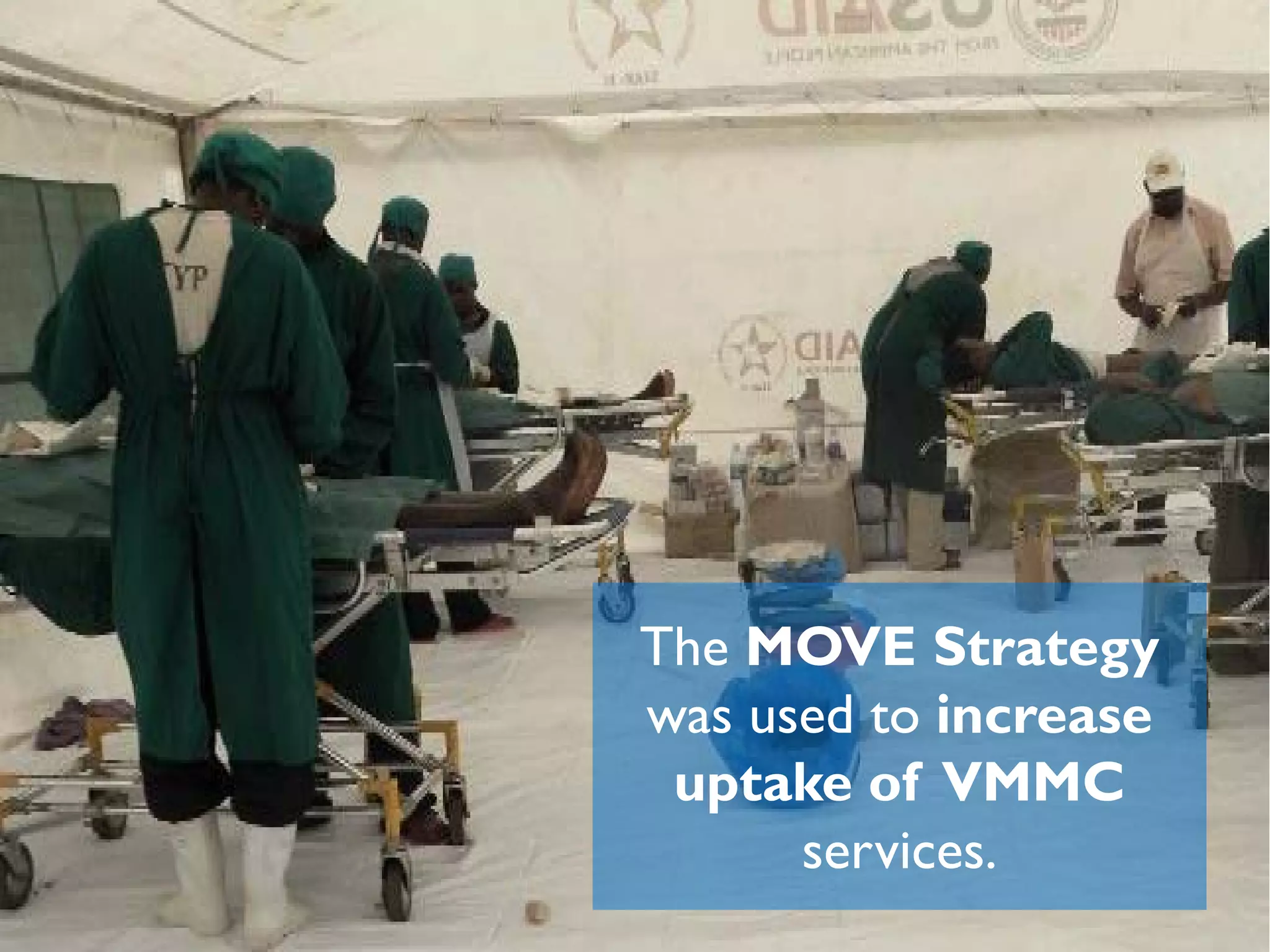
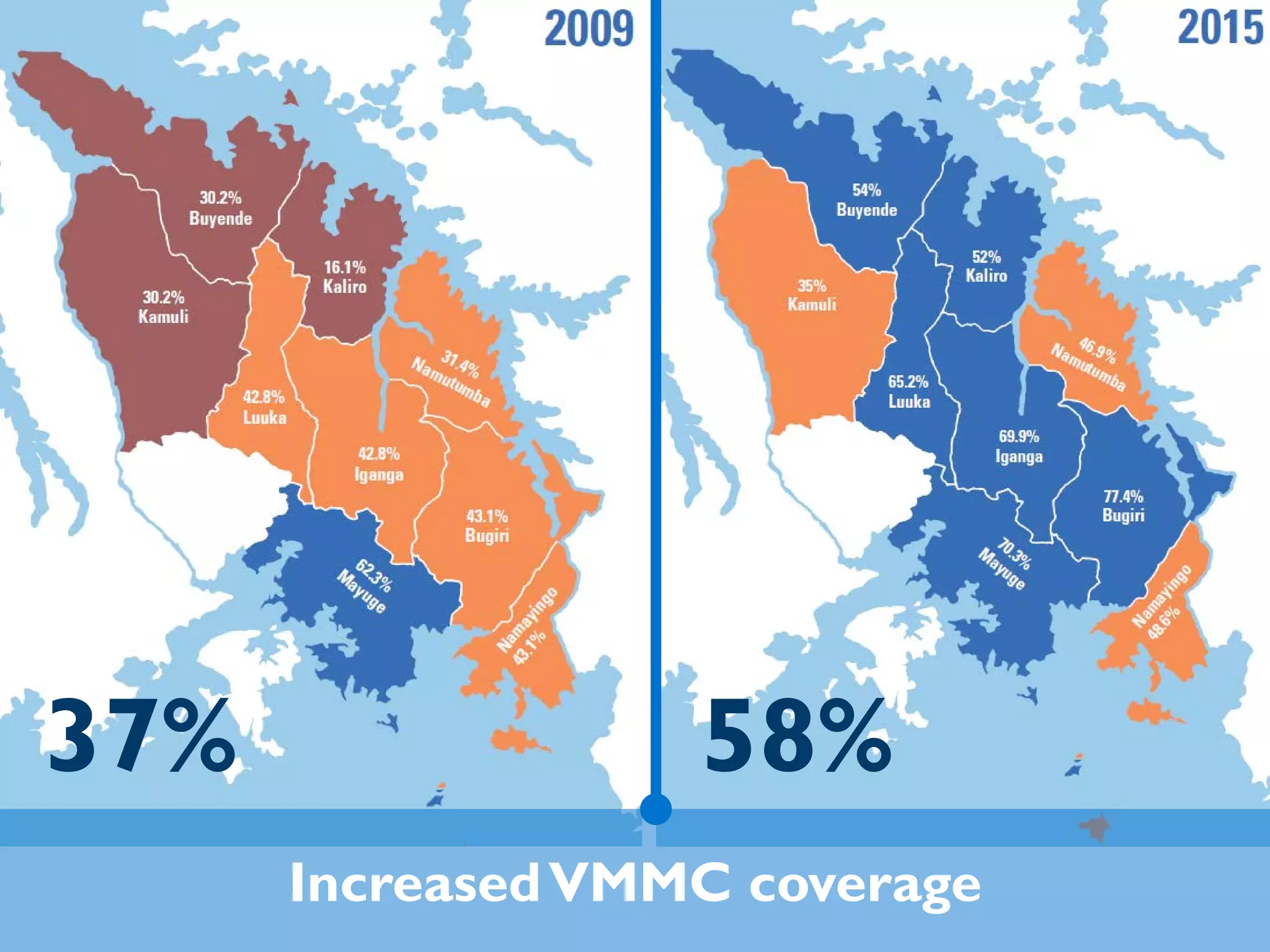
The MOVE Strategy
was used to increase
uptake of VMMC
services.
IncreasedVMMC coverage
37% 58%
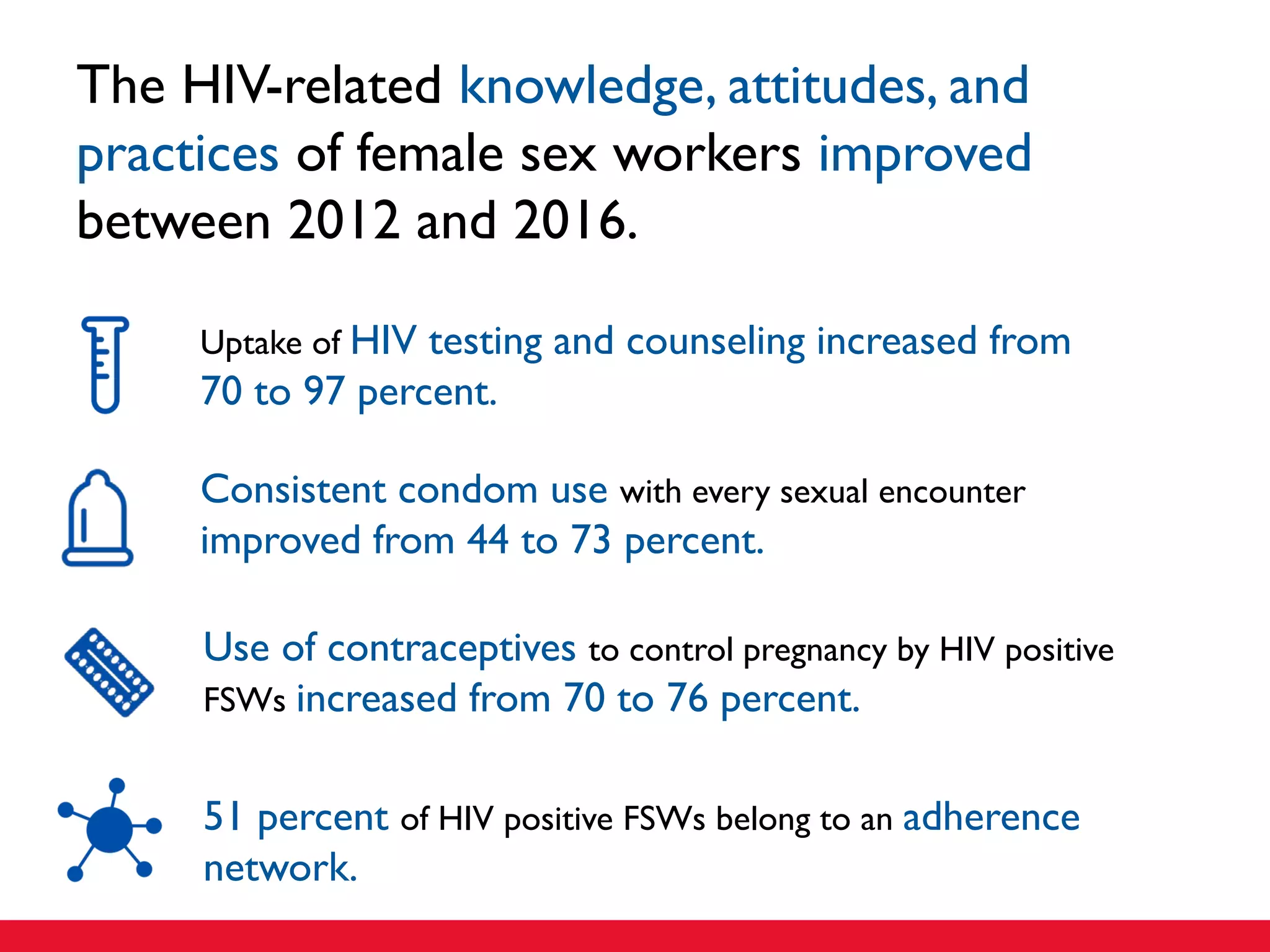
The HIV-related knowledge, attitudes, and
practices of female sex workers improved
between 2012 and 2016.
Uptake of HIV testing and counseling increased from
70 to 97 percent.
Consistent condom use with every sexual encounter
improved from 44 to 73 percent.
Use of contraceptives to control pregnancy by HIV positive
FSWs increased from 70 to 76 percent.
51 percent of HIV positive FSWs belong to an adherence
network.
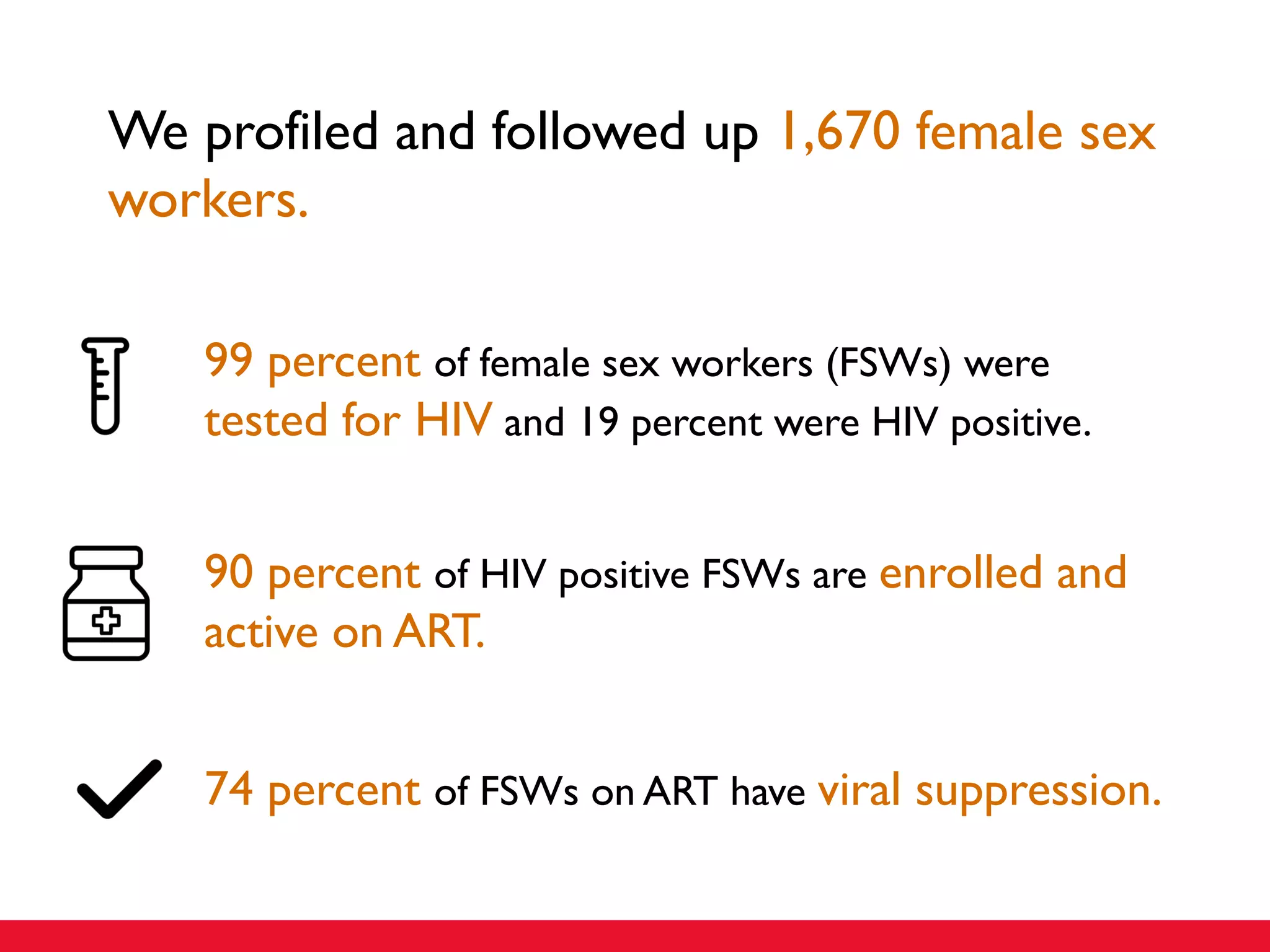
We profiled and followed up 1,670 female sex
workers.
99 percent of female sex workers (FSWs) were
tested for HIV and 19 percent were HIV positive.
90 percent of HIV positive FSWs are enrolled and
active on ART.
74 percent of FSWs on ART have viral suppression.
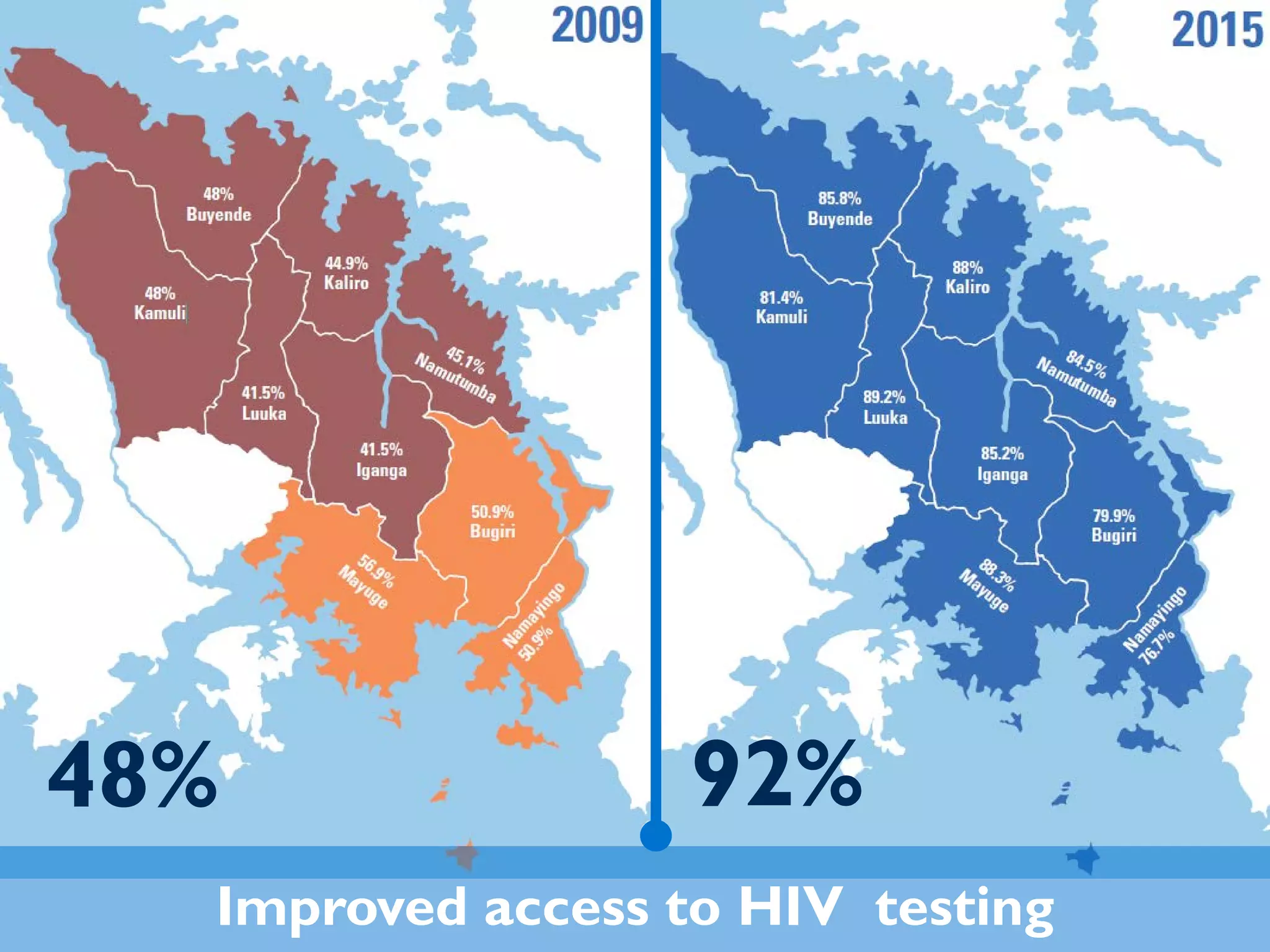
Improved access to HIV testing
48% 92%
The number of health facilities accredited to
provide ART sites increased dramatically during
the life of the project.
93 health facilities
4 health facilities
2009
2016
372
40,116
2009 2010 2011 2012 2013 2014 2015 2016
And in turn, we saw an increasing number of
clients on treatment.
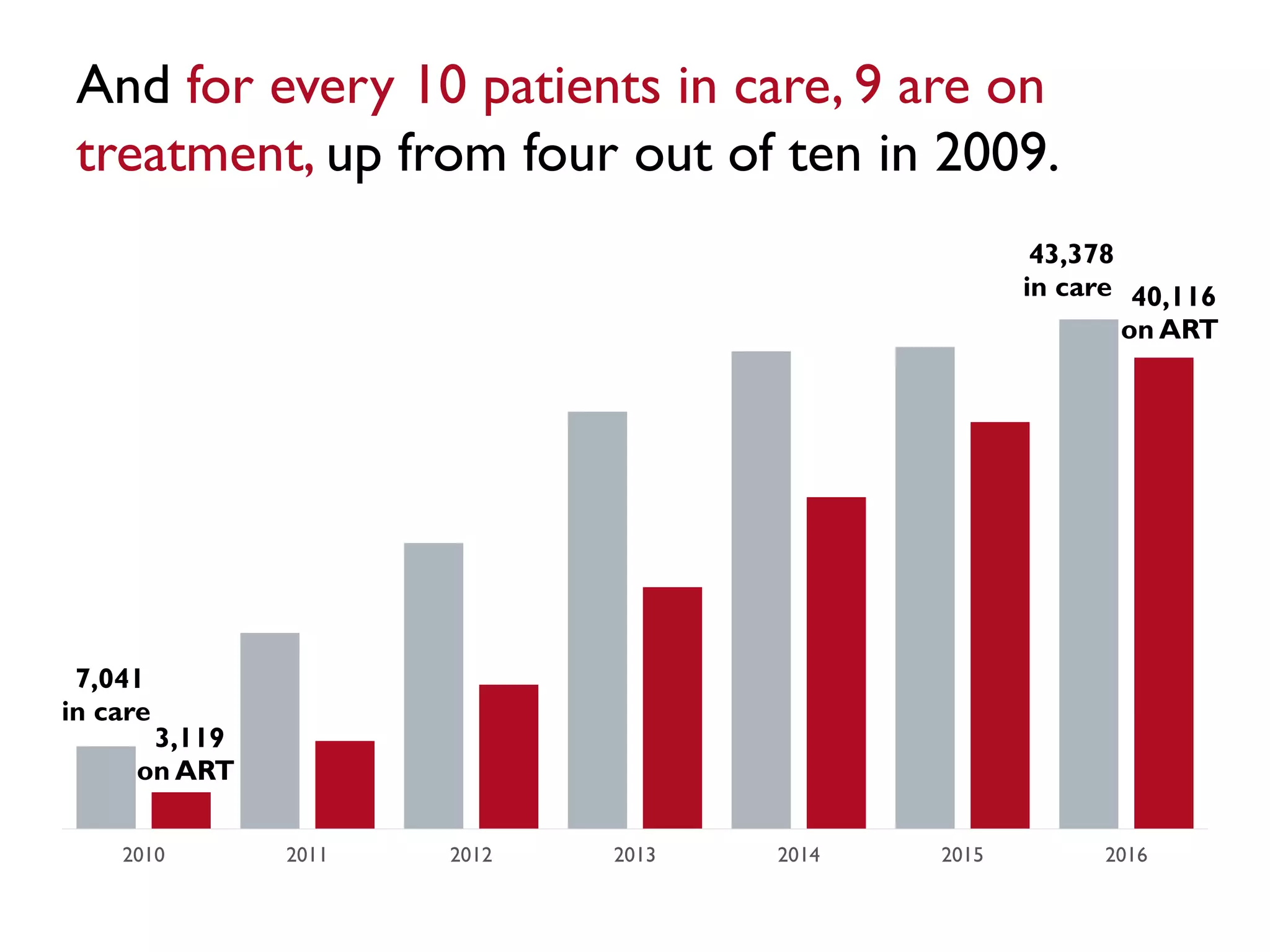
7,041
in care
43,378
in care
3,119
on ART
40,116
on ART
2010 2011 2012 2013 2014 2015 2016
And for every 10 patients in care, 9 are on
treatment, up from four out of ten in 2009.
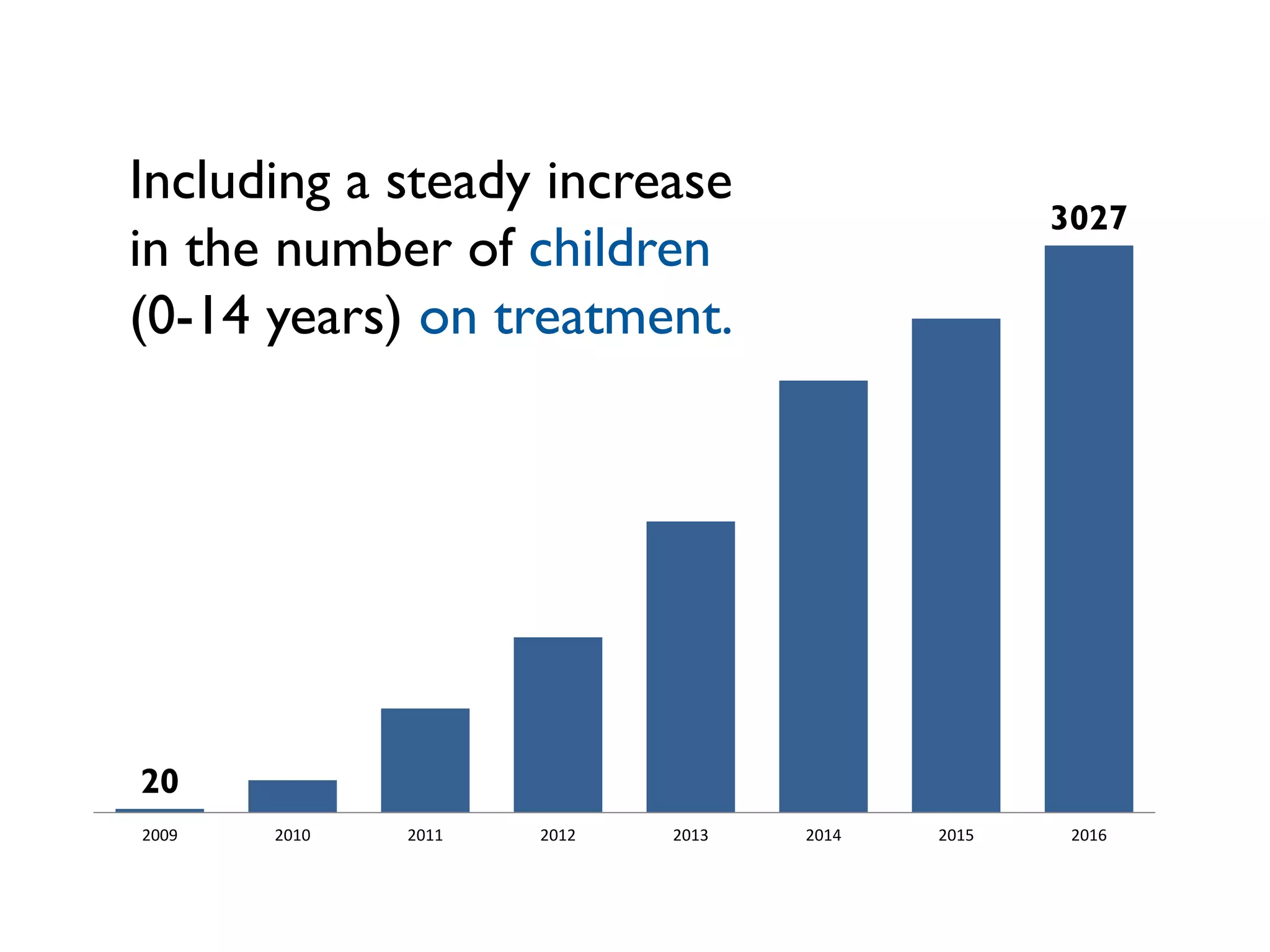
Including a steady increase
in the number of children
(0-14 years) on treatment.
20
3027
2009 2010 2011 2012 2013 2014 2015 2016
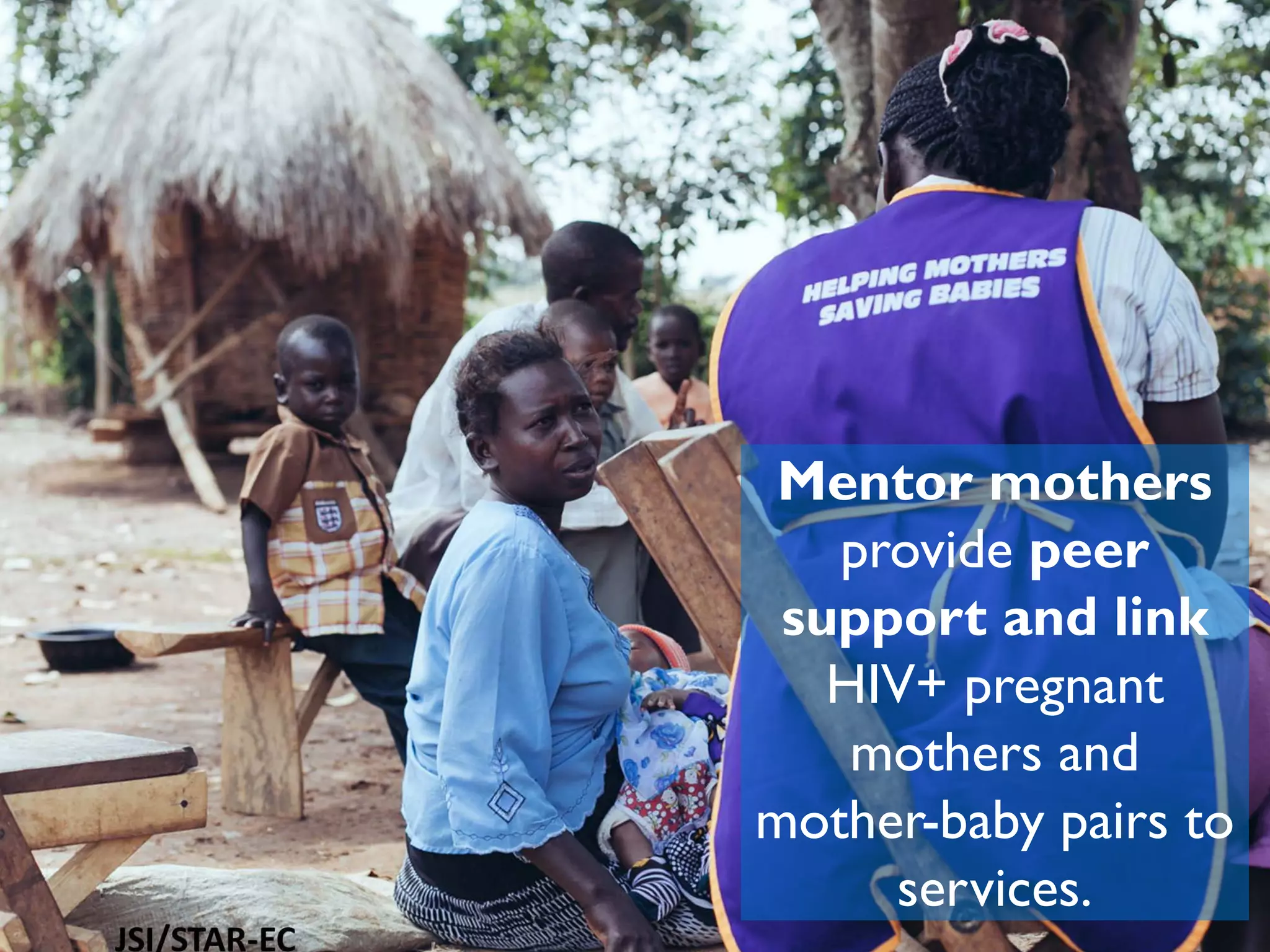
Mentor mothers
provide peer
support and link
HIV+ pregnant
mothers and
mother-baby pairs to
services.
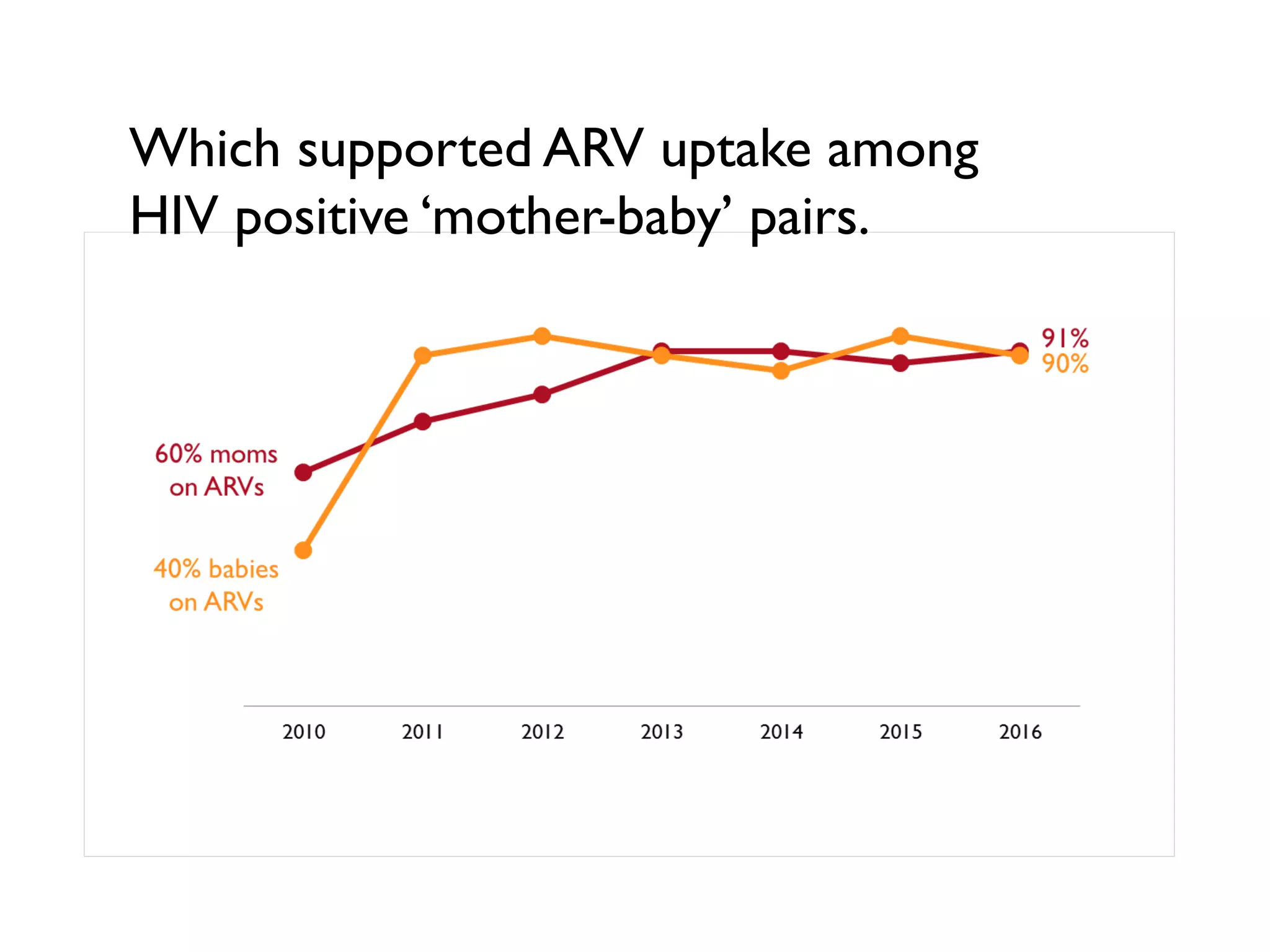
Which supported ARV uptake among
HIV positive ‘mother-baby’ pairs.
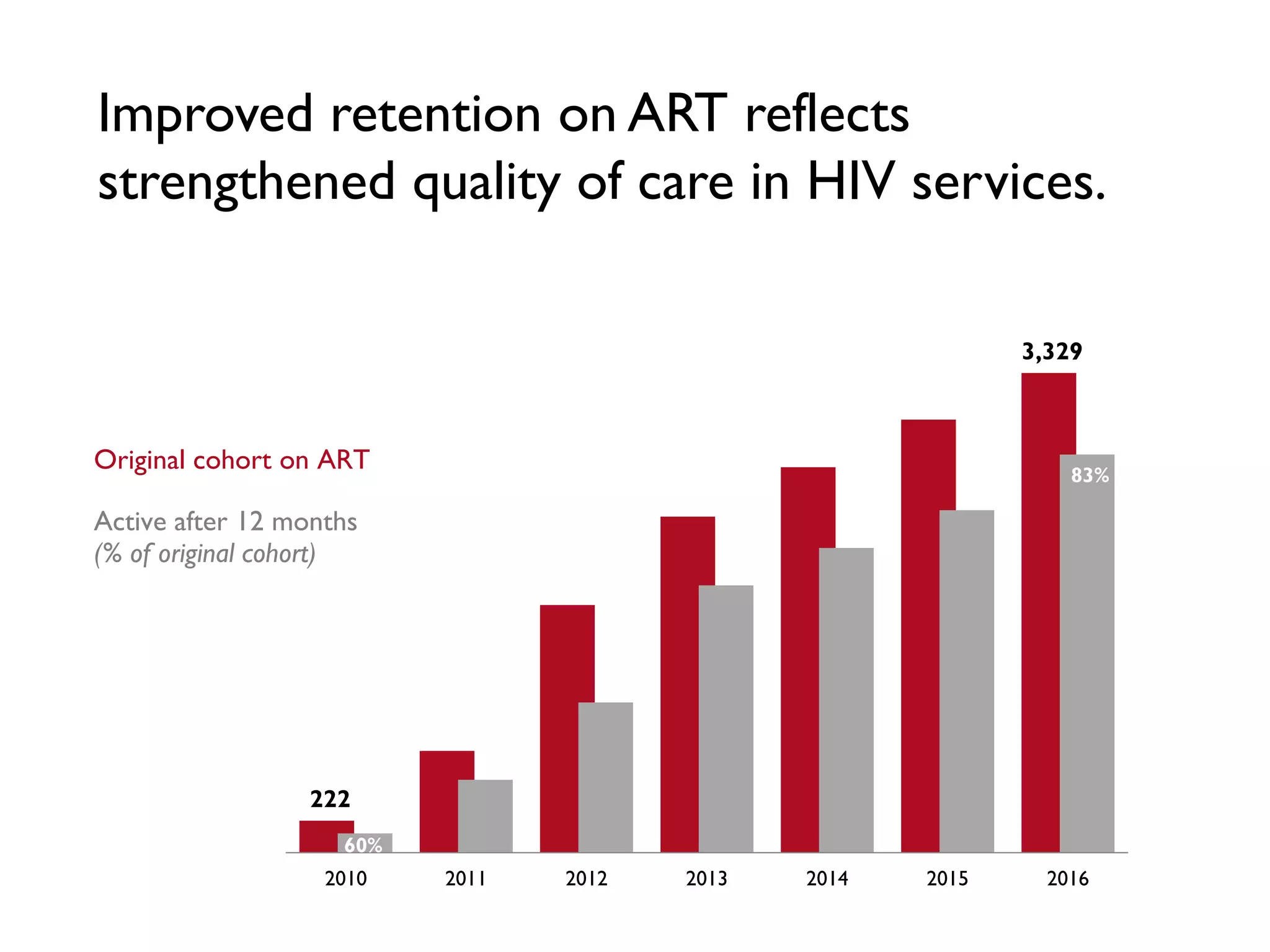
222
3,329
60%
83%
2010 2011 2012 2013 2014 2015 2016
Original cohort on ART
Active after 12 months
(% of original cohort)
Improved retention on ART reflects
strengthened quality of care in HIV services.
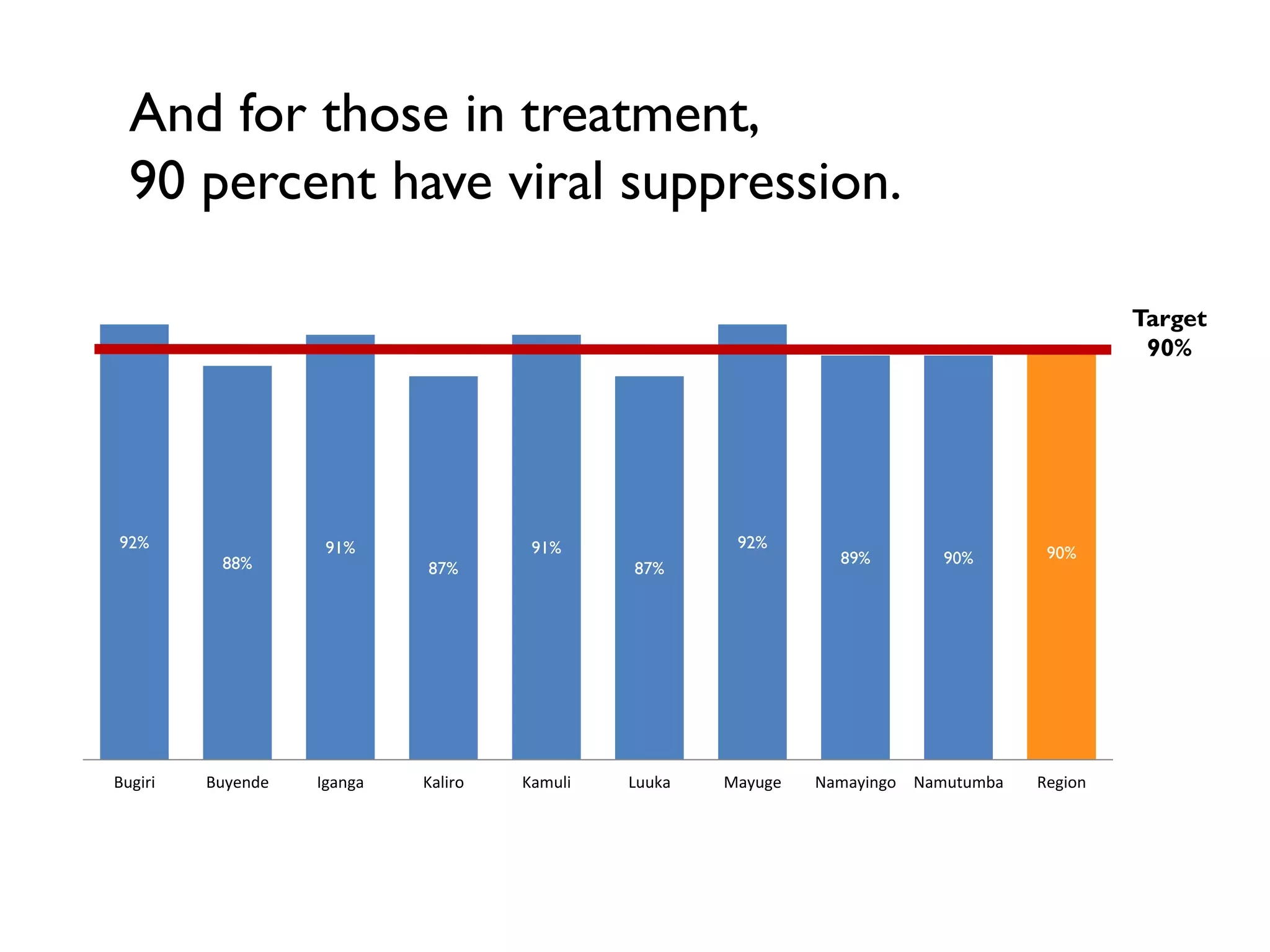
92%
88%
91%
87%
91%
87%
92%
89% 90% 90%
Bugiri Buyende Iganga Kaliro Kamuli Luuka Mayuge Namayingo Namutumba Region
And for those in treatment,
90 percent have viral suppression.
Target
90%
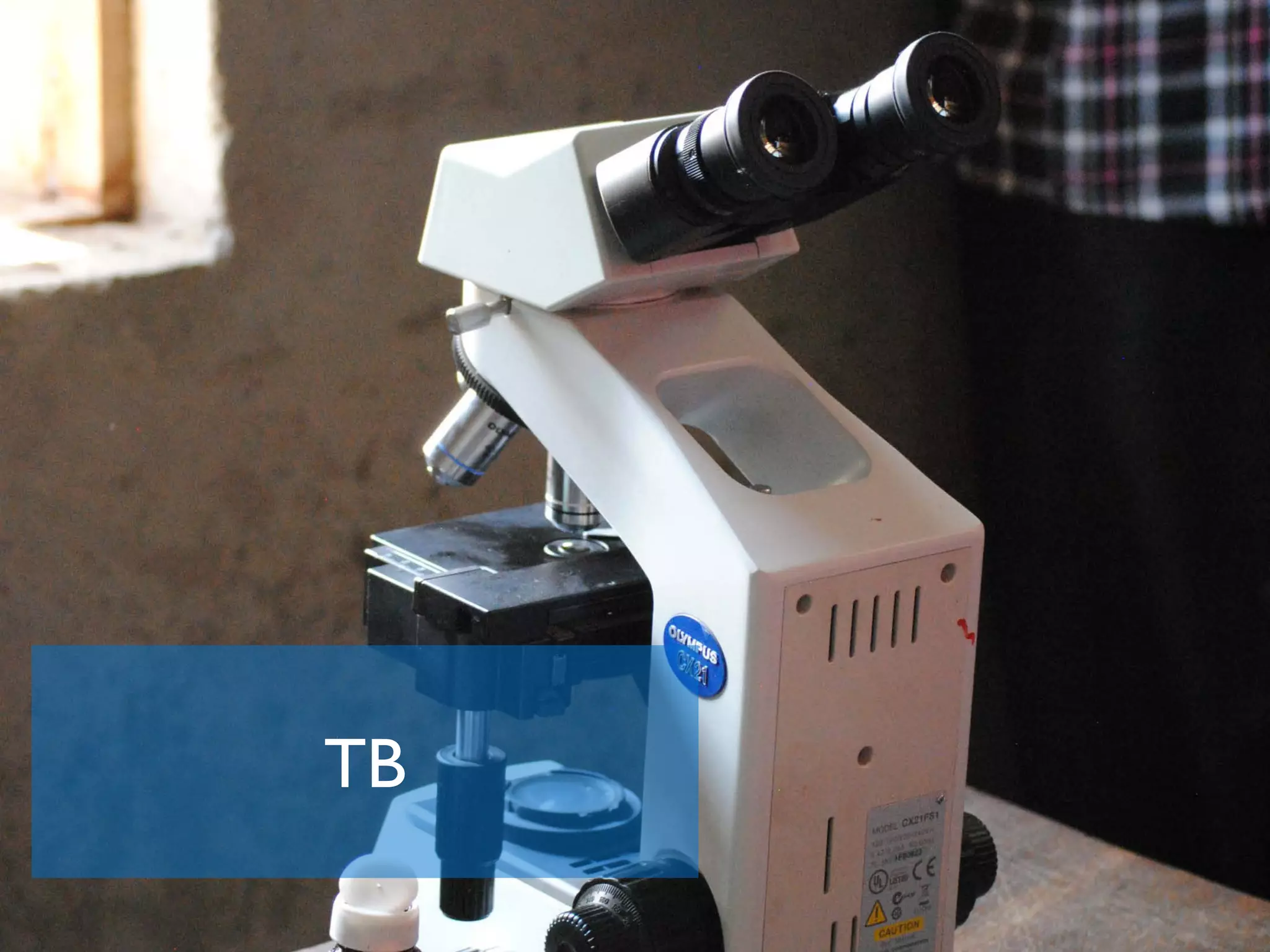
TB
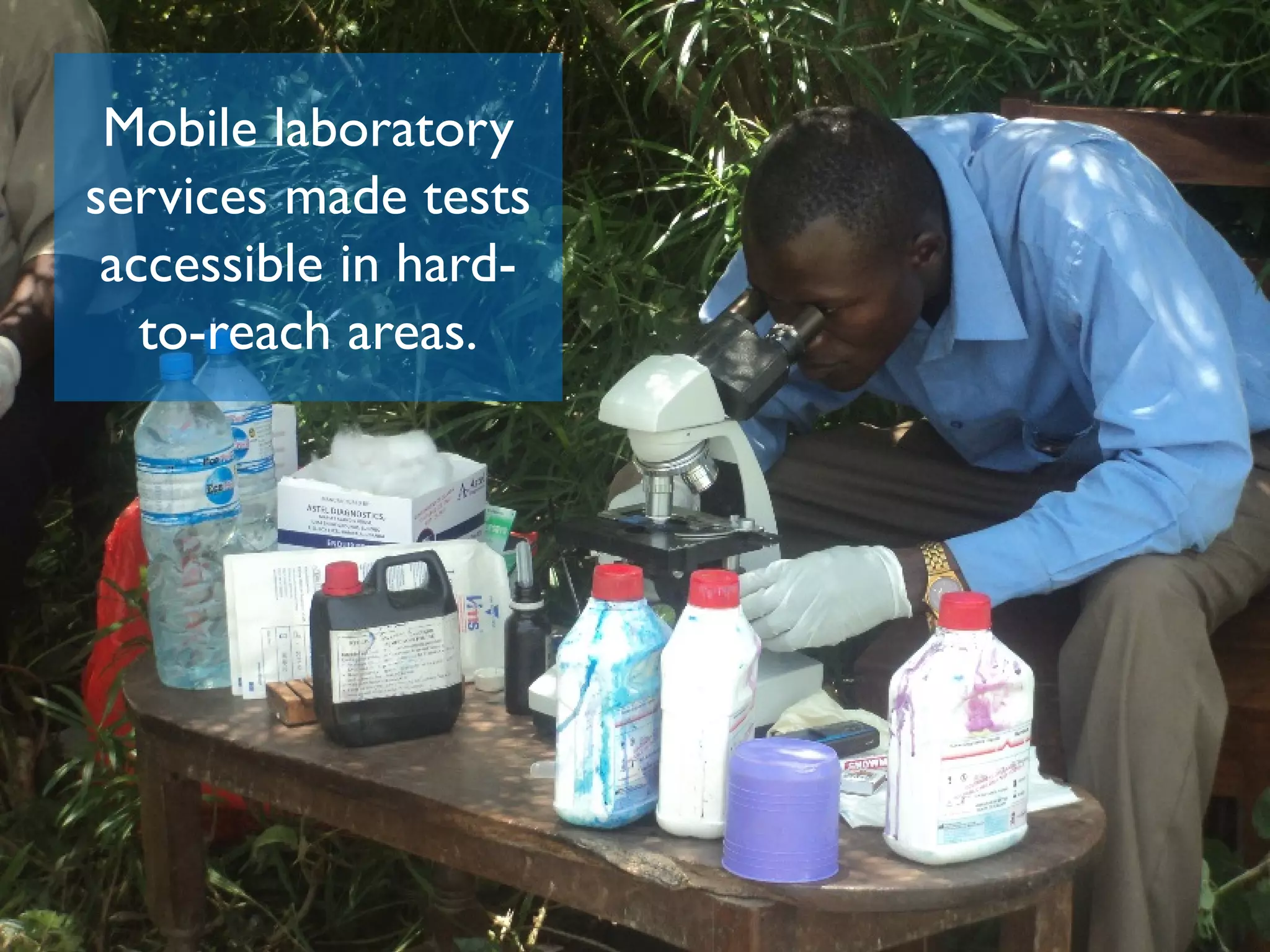
Mobile laboratory
services made tests
accessible in hard-
to-reach areas.
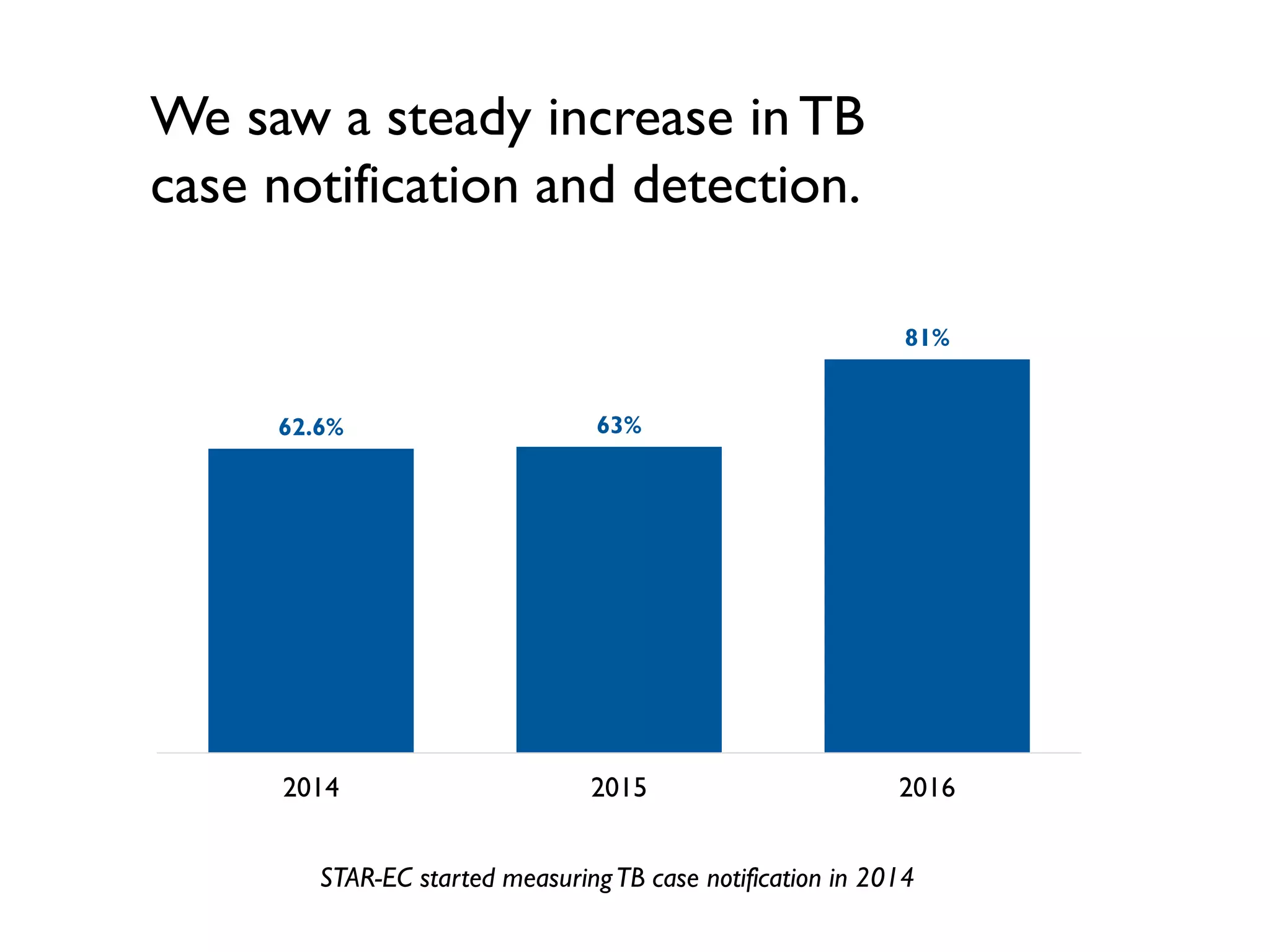
We saw a steady increase in TB
case notification and detection.
62.6% 63%
81%
2014 2015 2016
STAR-EC started measuringTB case notification in 2014
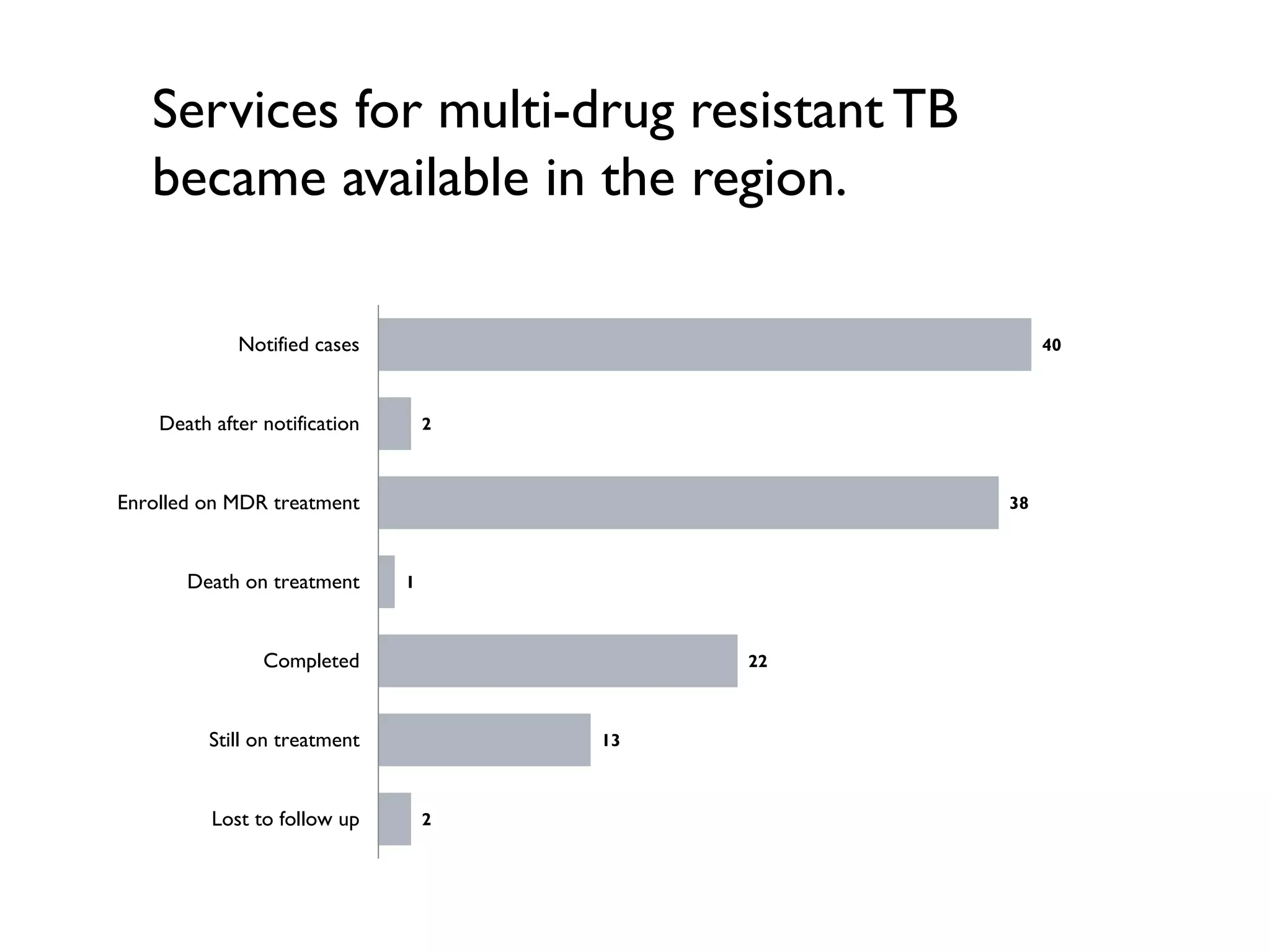
Services for multi-drug resistant TB
became available in the region.
40
2
38
1
22
13
2
Notified cases
Death after notification
Enrolled on MDR treatment
Death on treatment
Completed
Still on treatment
Lost to follow up
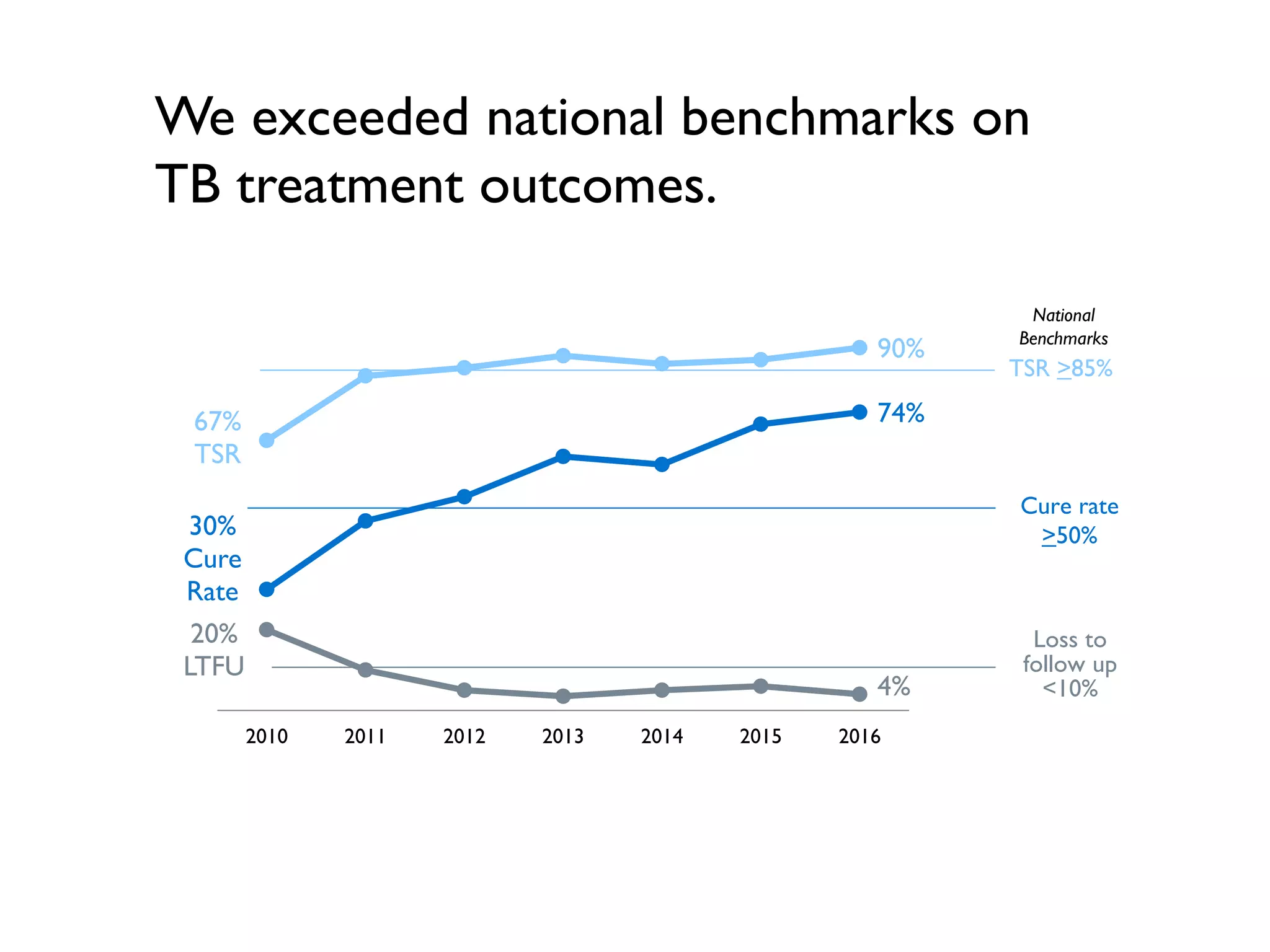
67%
TSR
90%
30%
Cure
Rate
74%
20%
LTFU
4%
2010 2011 2012 2013 2014 2015 2016
TSR >85%
Cure rate
>50%
Loss to
follow up
<10%
National
Benchmarks
We exceeded national benchmarks on
TB treatment outcomes.
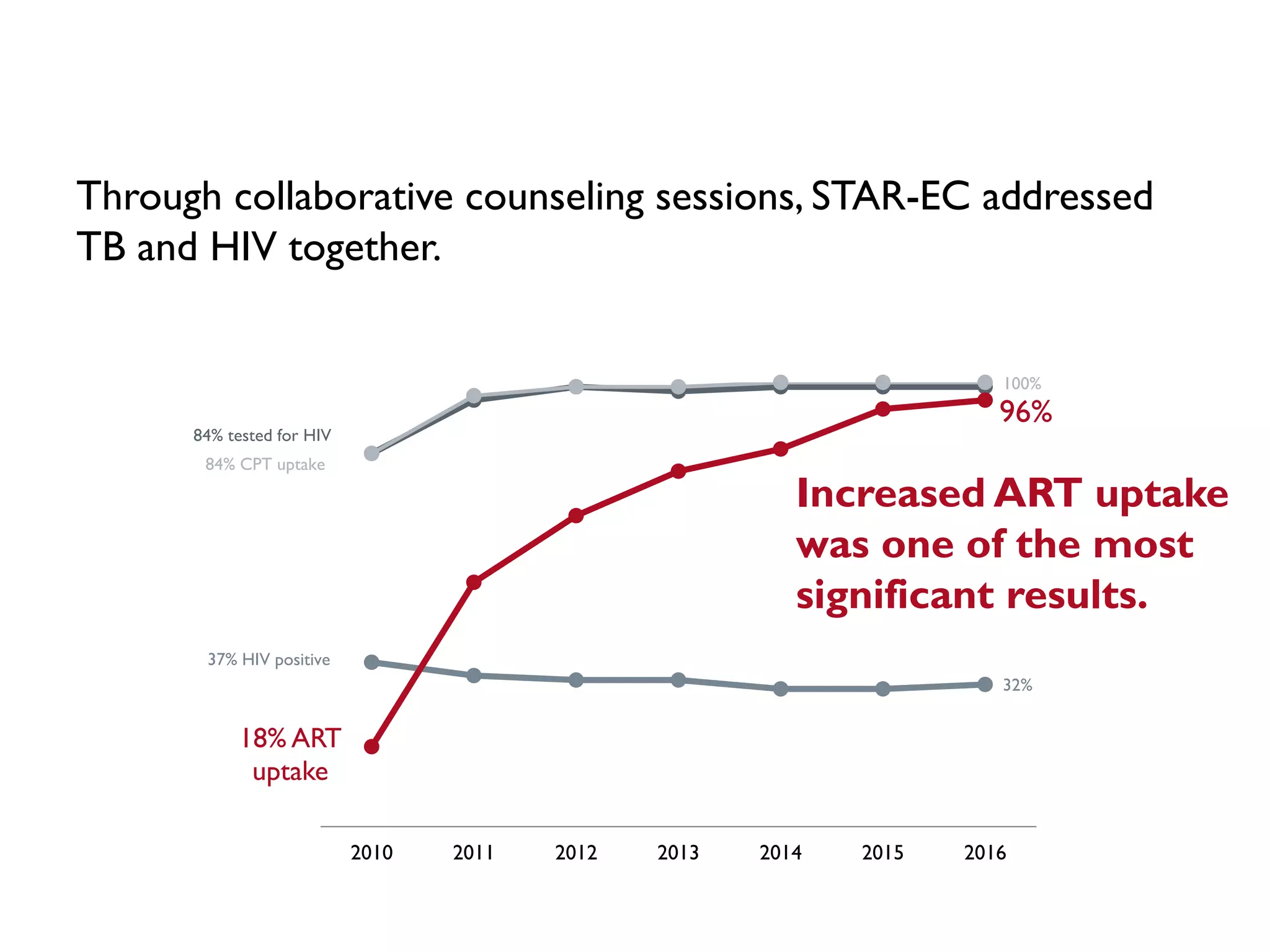
84% tested for HIV
37% HIV positive
32%
84% CPT uptake
100%
18% ART
uptake
96%
2010 2011 2012 2013 2014 2015 2016
Through collaborative counseling sessions, STAR-EC addressed
TB and HIV together.
Increased ART uptake
was one of the most
significant results.
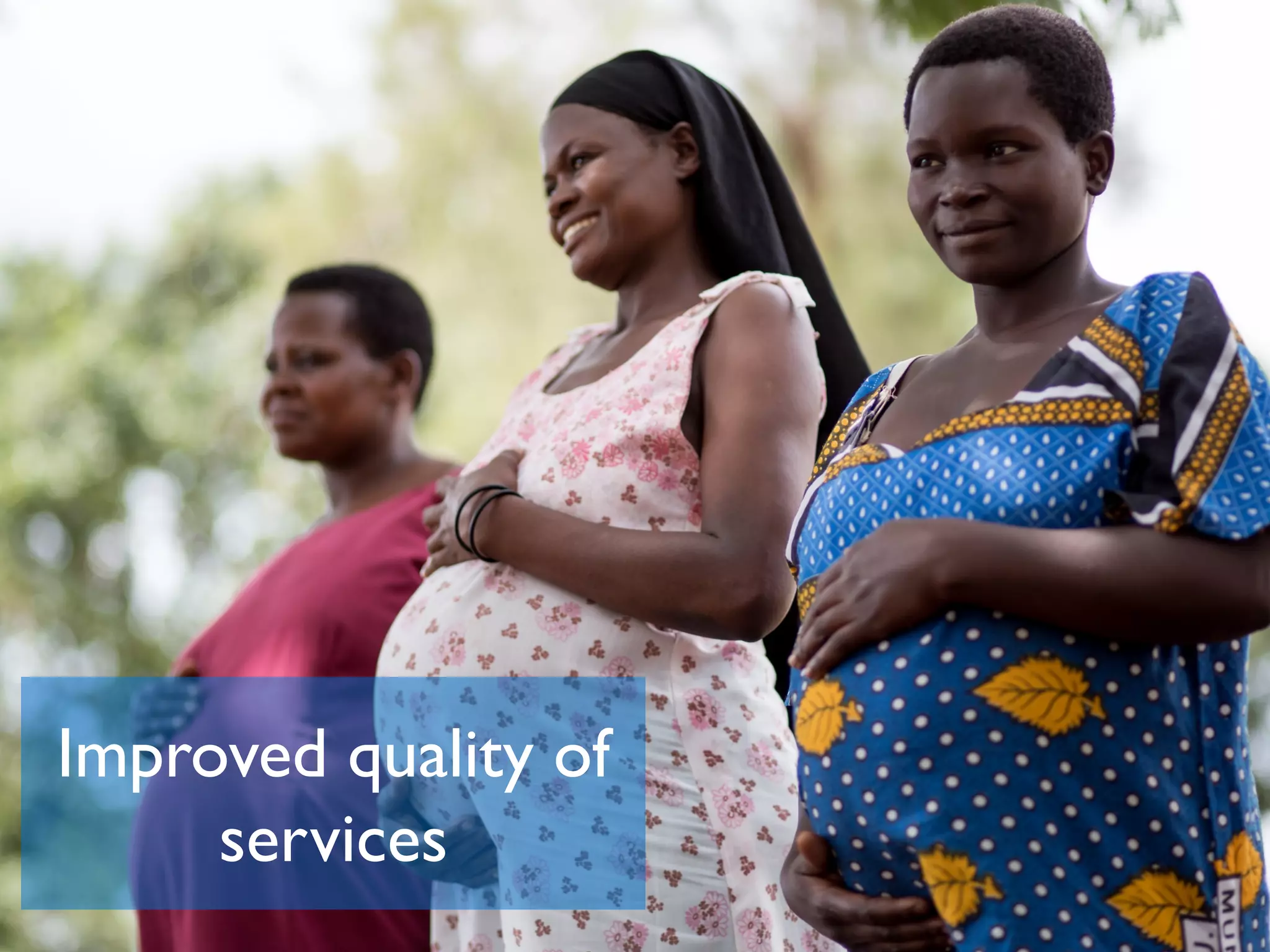
Improved quality of
services
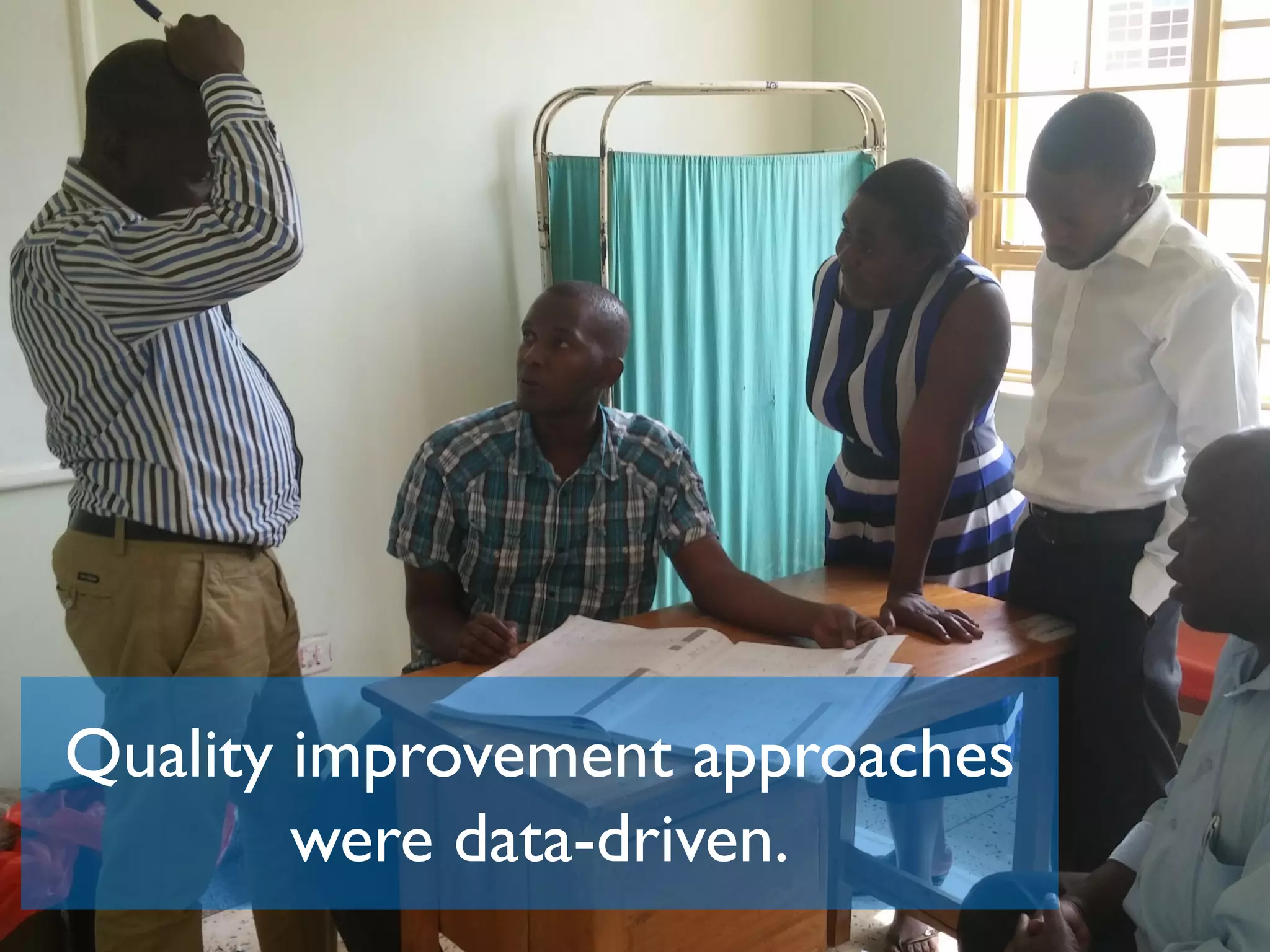
Quality improvement approaches
were data-driven.
Linkag
e
Retentio
n
QI
team
matu
rity
Linkag
e
Retentio
n
QI
team
matu
rity
Linkag
e
Retentio
n
QI
tea
m
mat
urity
Village District IP
%
linked
to
comm
unity
% kept
appoint
ment
2.5
on
TMI
%
linked
to
comm
unity
% kept
appoint
ment
2.5
on
TMI
%
linked
to
comm
unity
% kept
appoint
ment
2.5
on
TMI
1 Busanzi Bugiri STAR EC ND 41% 99 82 55 92
2 Busowa Bugiri STAR EC ND 52% 92 77 59 83
3 Butambula Bugiri STAR EC ND 48 89 77 56 77
4 Bwole Bugiri STAR EC ND 52% 92 64 73 84
5 Mukuba Bugiri STAR EC ND 64 86 75 90 92
6 Ndifakulya Bugiri STAR EC ND 49 92 73 96 98
7 Nkusi Bugiri STAR EC ND 58 93 83 68 67
8 Busoigo Kamuli STAR EC ND ND 100 100 100 47
9 Butekanga Kamuli STAR EC ND ND 73 67 98 72
10 Buwanzu Kamuli STAR EC ND ND 74 45 100 84
11 Kananage Kamuli STAR EC ND ND 74 49 82 68
12 Kulingo Kamuli STAR EC ND ND 93 82 90 74
13 Mandwa Kamuli STAR EC ND ND 100 60 92 72
KEY
MOH
standard
met
(>85%) Good 3.0- Good ≥90% Good
>60 (but
below
MOH
standard) Fair 2.0-2.5 Fair 89%-80% Fair
<60% poor 1.0-1.5 Poor ≤79% Poor
ND No Data ND No Data ND No Data
JULY - SEPT 2013 OCTOBER-DECEMBER 2013 JANUARY-MARCH 2014
Follow
up
Follow
up
Follow
up
%
complete
follow
up
%
complet
e follow
up
%
complete
follow
up
ND 34 81
ND 51 79
ND 28 85
ND 31 91
ND 58 88
ND 41 62
ND 71 90
ND 44 40
ND 74 66
ND 59 55
ND 75 72
ND 76 73
Linkage
ND 20 60
Appointment
keeping/follow up
Team
Maturity
Linkage
Retentio
n
QI team
maturity
Linkag
e
Retentio
n
QI team
maturity Linkage
Retentio
n
QI team
maturity
% linked
to
communi
ty
% kept
appoint
ment
3.0on
TMI
%
linked
to
comm
unity
% kept
appoint
ment
3.0on
TMI
% linked
to
communi
ty
% kept
appoint
ment
3.0on
TMI
97 90 96 87 95 94
92 85 91 92 90 93
84 90 95 87 91 98
84 89 93 82 93 99
88 92 96 83 87 95
90 96 93 97 95 100
88 97 100 100 100 98
93 86 95 86 94 91
96 86 90 83 96 100
94 96 96 89 95 95
97 85 97 93 88 81
100 93 95 93 96 96
100 96 100 92 97 95
Follow
up
OCTOBER-DECEMBER 2014 JANUARY-MARCH 2015
%
complet
e follow
up
%
complet
e follow
up
APRIL-JUNE 2015
Follow up
Follow
up
%
complete
follow up
93 78** 98
93 94 91
100 100 100
93 98 100
100 93 81
96 100 100
100 99 100
88 100 95
88 93 100
92 95 100
88 89 88
90 100 92
88 9894
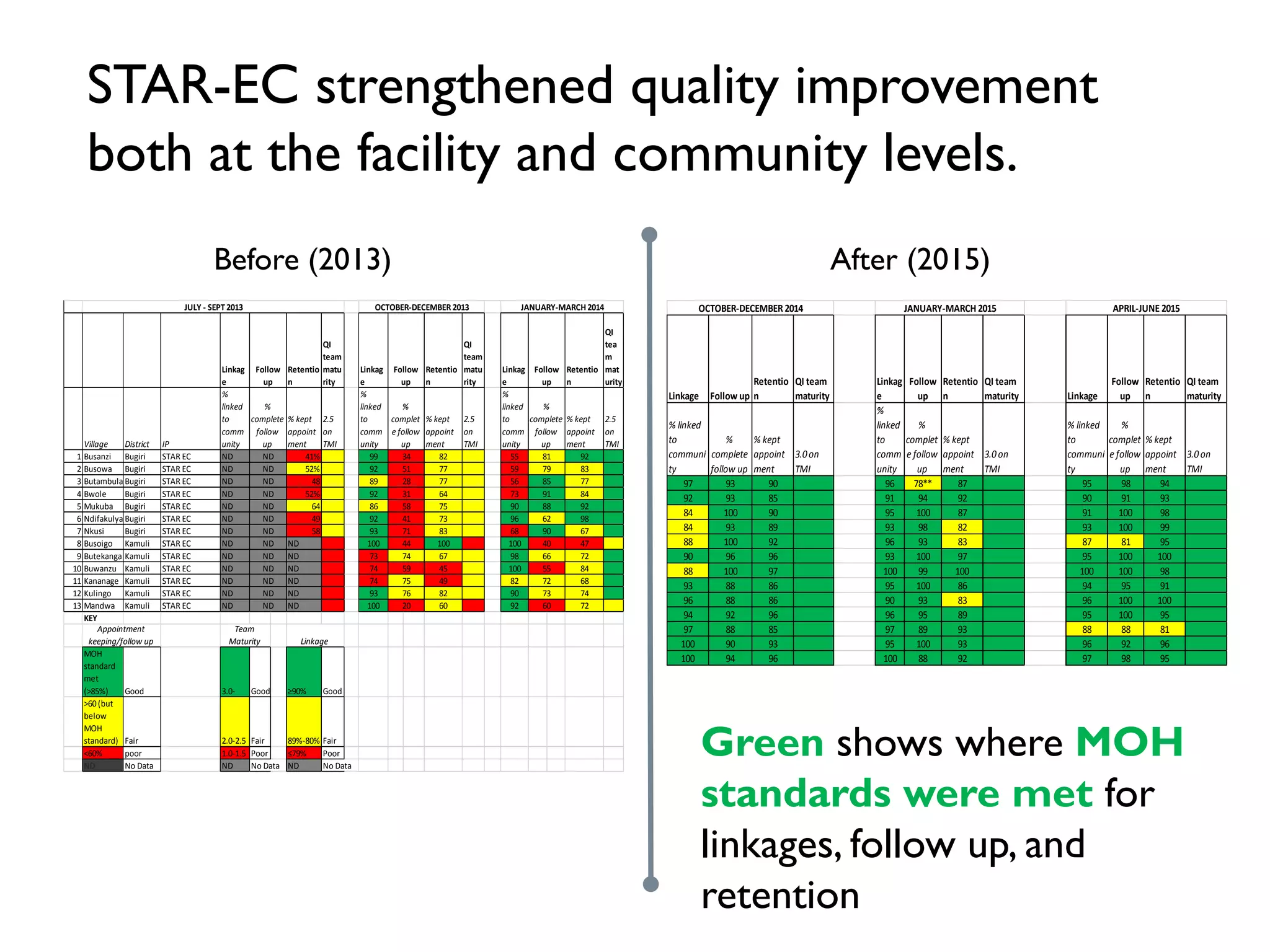
Before (2013) After (2015)
STAR-EC strengthened quality improvement
both at the facility and community levels.
Green shows where MOH
standards were met for
linkages, follow up, and
retention
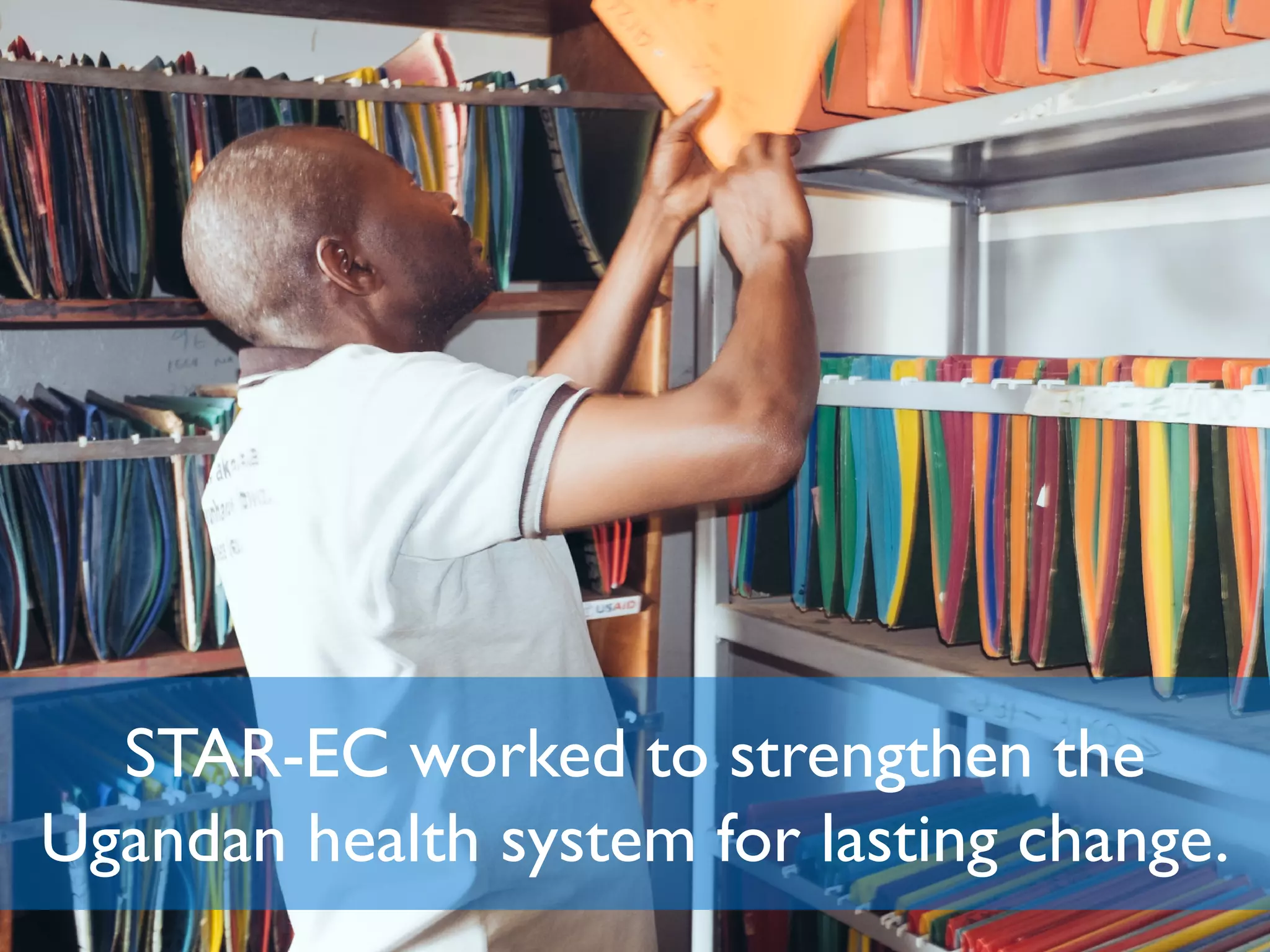
STAR-EC worked to strengthen the
Ugandan health system for lasting change.
Provided essential equipment such as
microscopes and CD4 machines.
Installed power back-up systems in 3
hospital laboratories.
Operationalized 7 laboratory hub
networks to scale up viral load and early
infant diagnosis, serving more than 130
health centers.
We improved the capacity of laboratories.
14 clinicians seconded to island health
facilities.
Installed solar systems in 18 health facilities.
Transitioned from paper-based medical logistics
to a web-based ordering system.
Provided delivery beds and related
equipment to 10 island facilities.
And improved the capacity of health facilities.
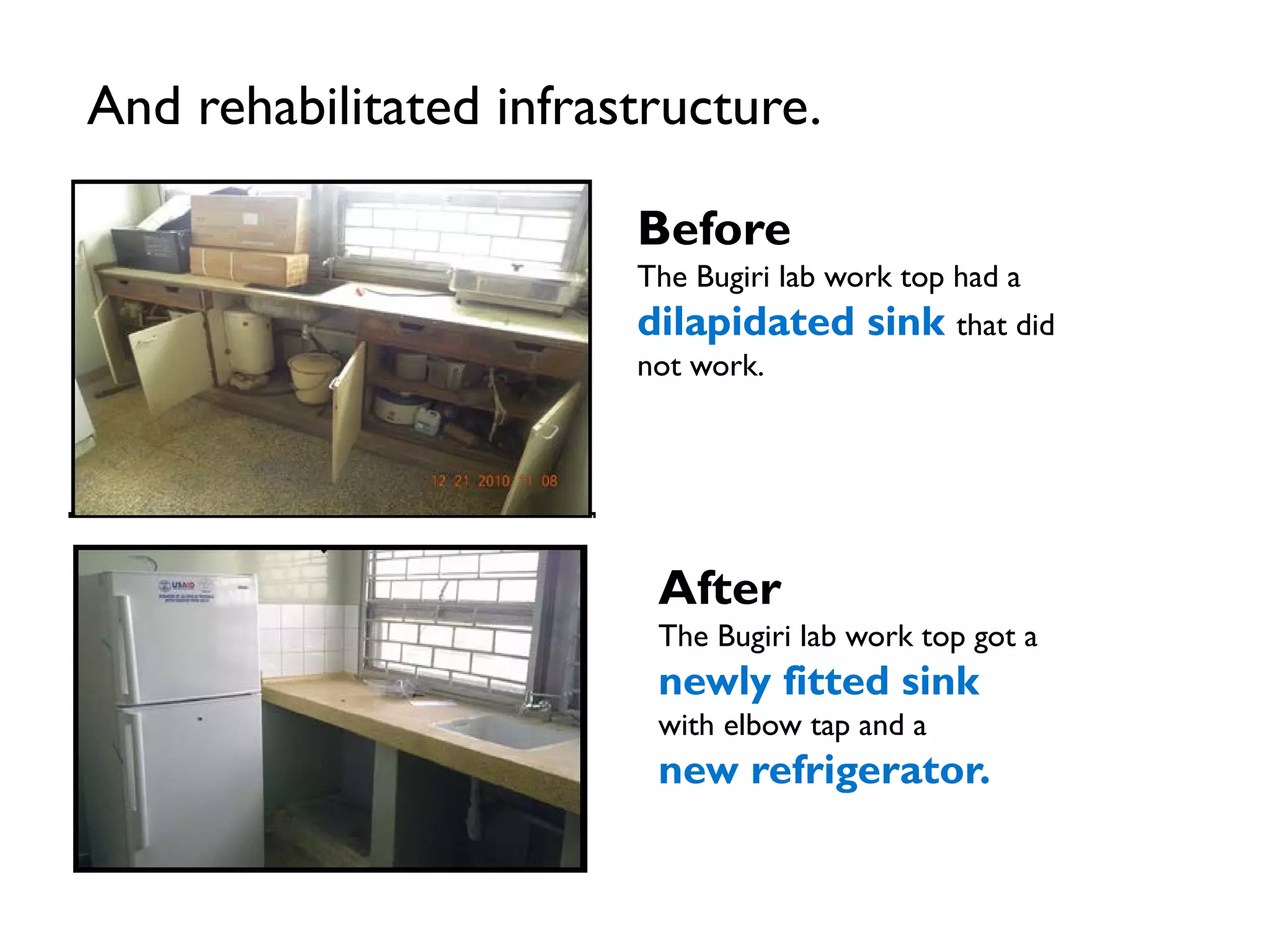
And rehabilitated infrastructure.
Before
The Bugiri lab work top had a
dilapidated sink that did
not work.
After
The Bugiri lab work top got a
newly fitted sink
with elbow tap and a
new refrigerator.
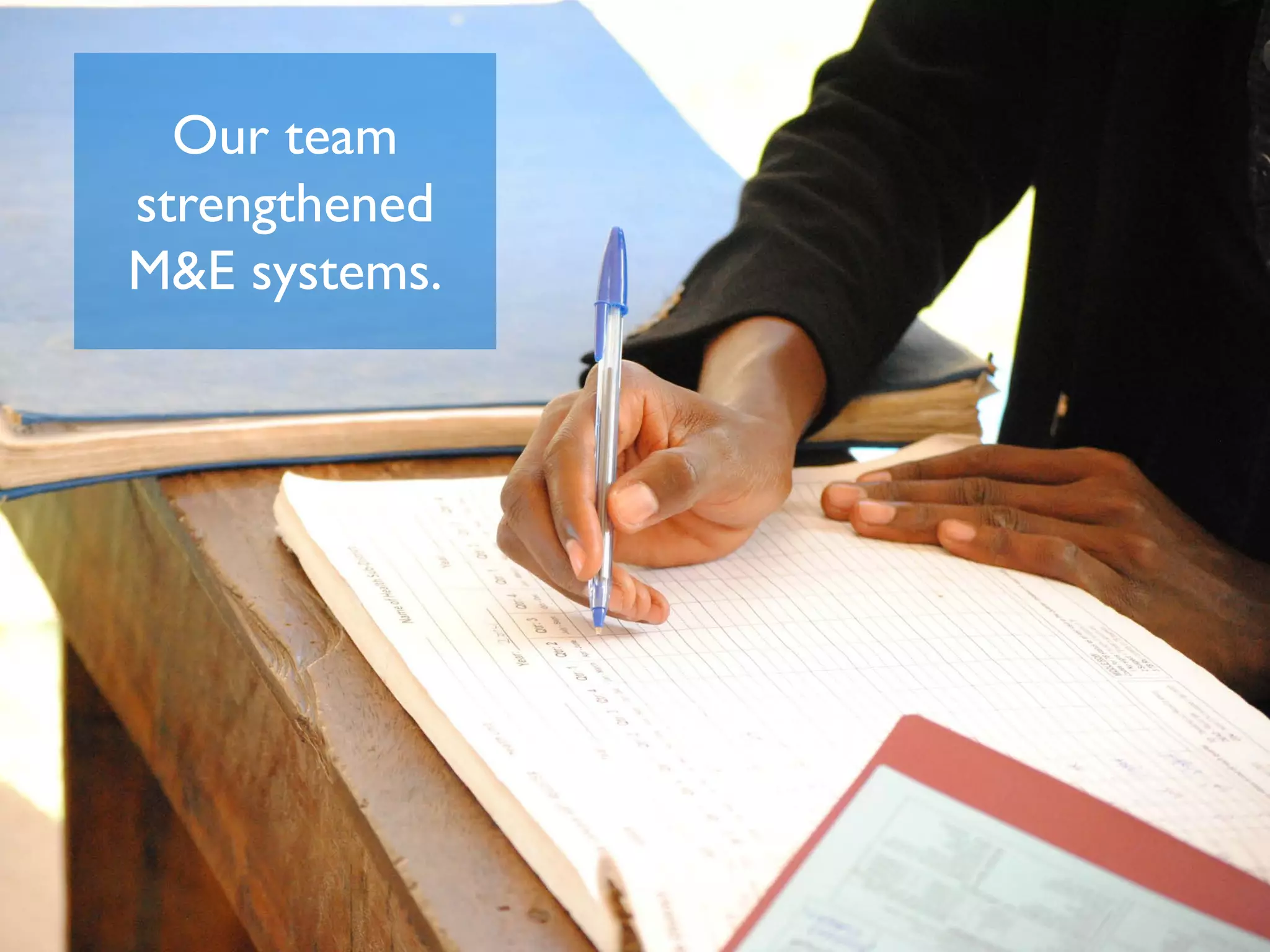
Our team
strengthened
M&E systems.
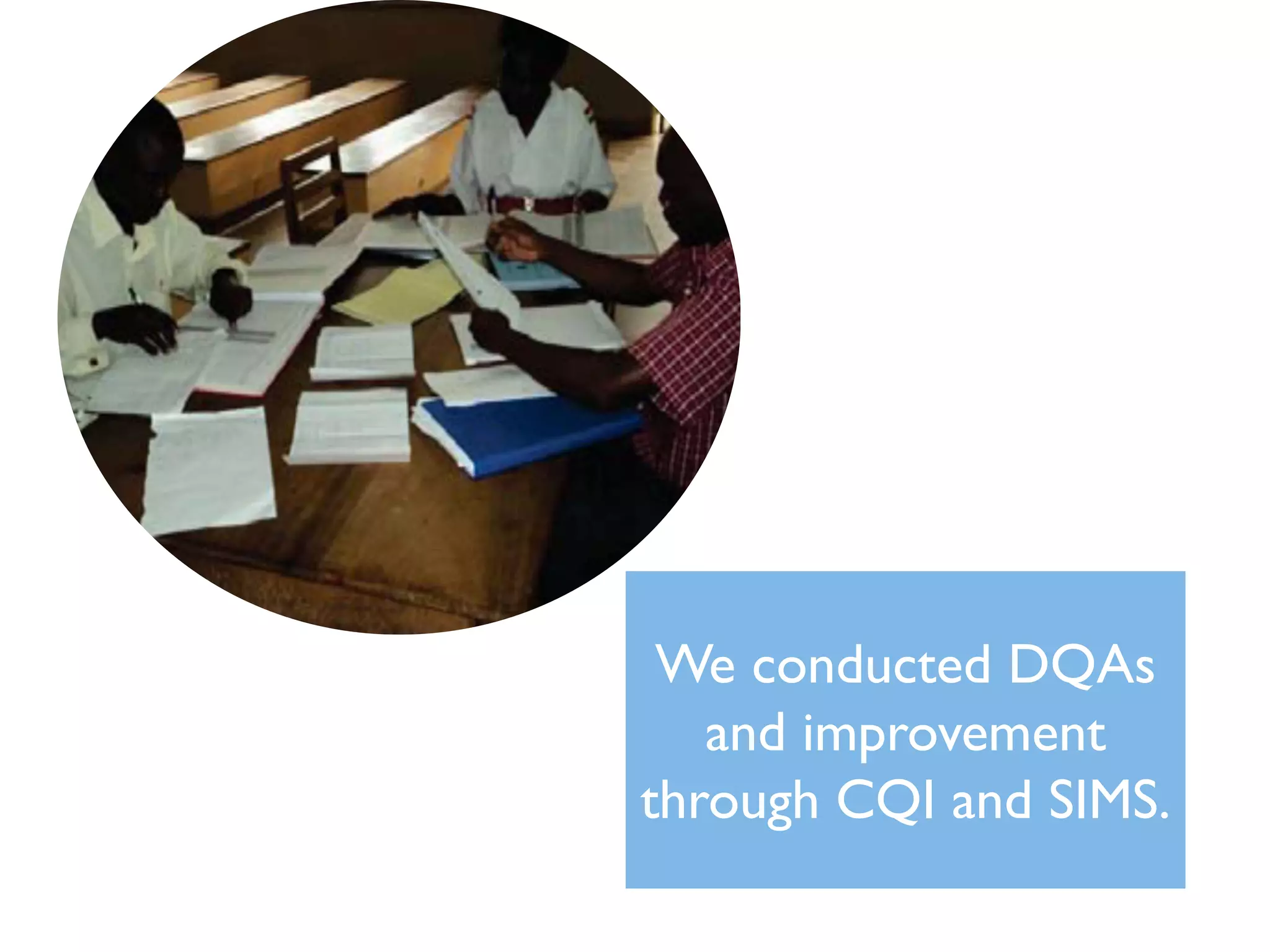
We conducted DQAs
and improvement
through CQI and SIMS.
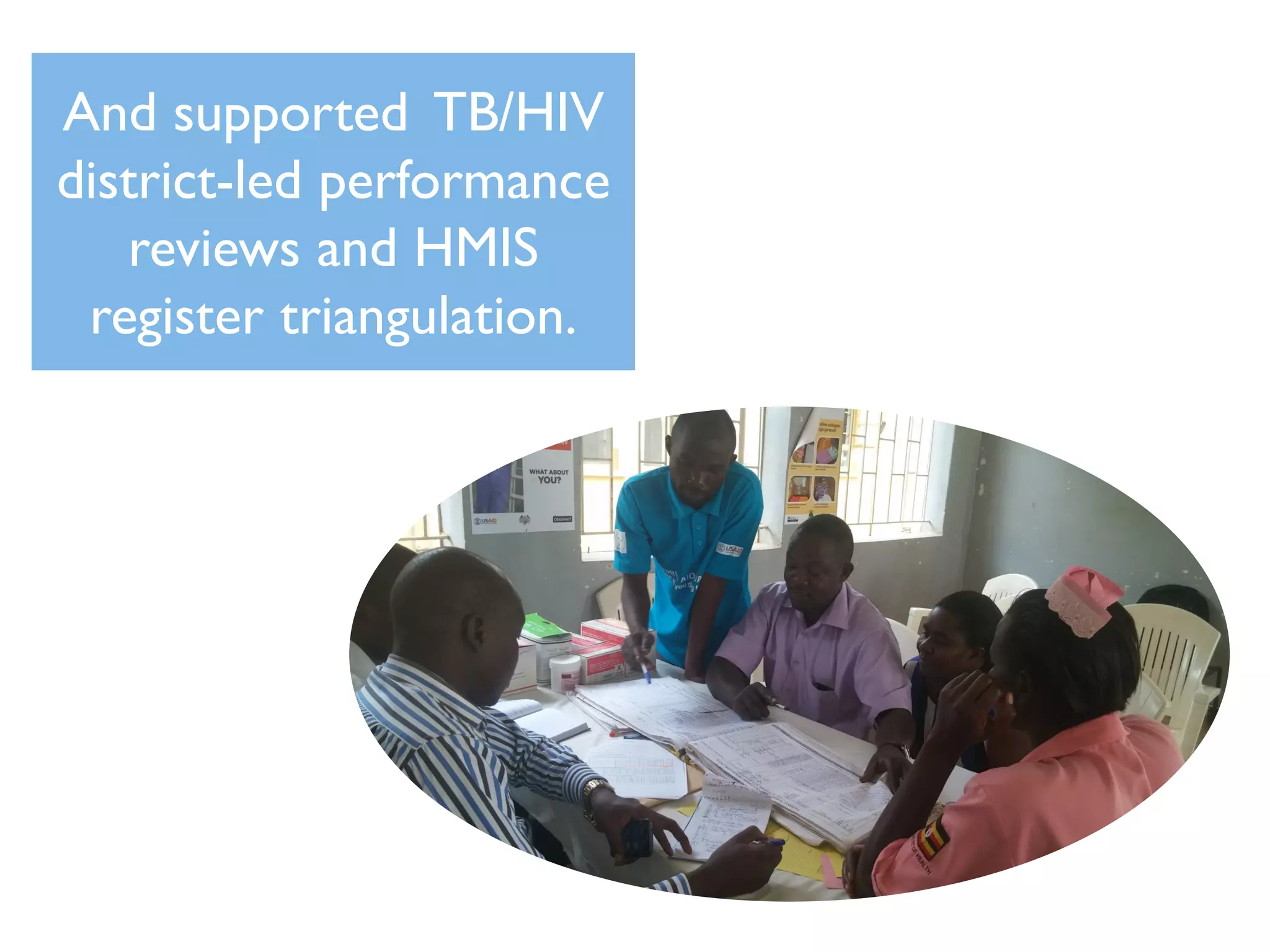
And supported TB/HIV
district-led performance
reviews and HMIS
register triangulation.
Challenges and
opportunities
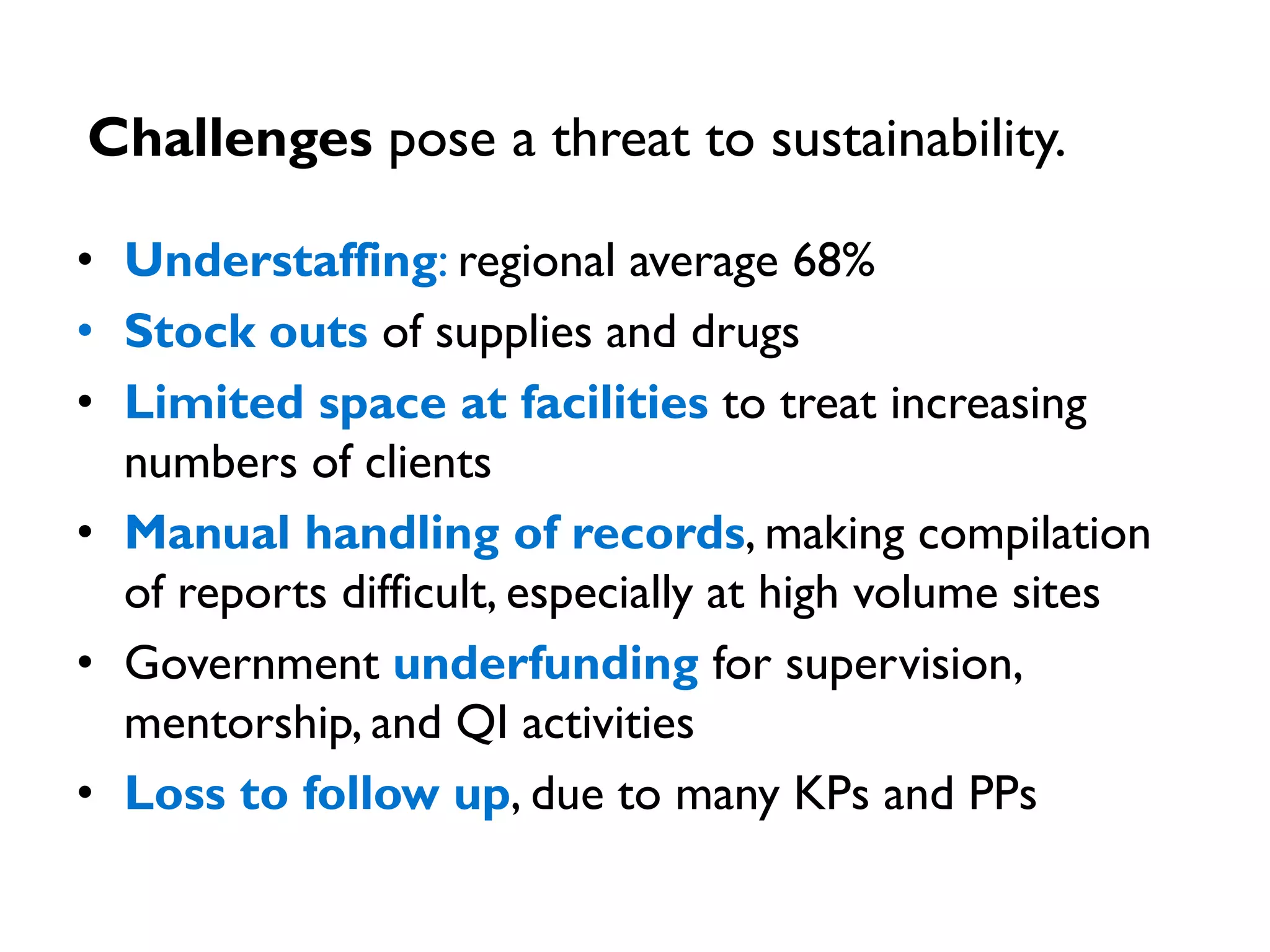
• Understaffing: regional average 68%
• Stock outs of supplies and drugs
• Limited space at facilities to treat increasing
numbers of clients
• Manual handling of records, making compilation
of reports difficult, especially at high volume sites
• Government underfunding for supervision,
mentorship, and QI activities
• Loss to follow up, due to many KPs and PPs
Challenges pose a threat to sustainability.
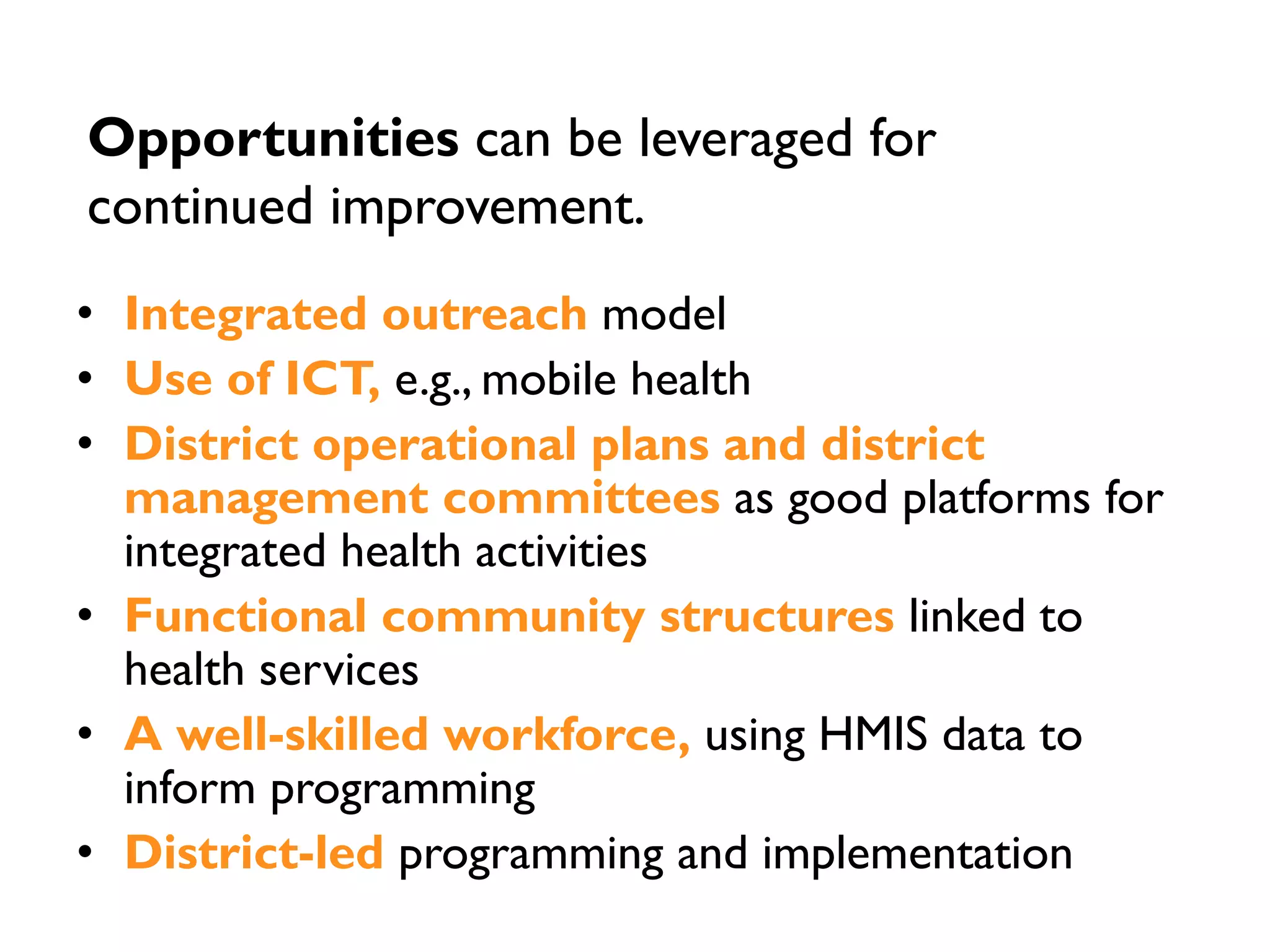
• Integrated outreach model
• Use of ICT, e.g., mobile health
• District operational plans and district
management committees as good platforms for
integrated health activities
• Functional community structures linked to
health services
• A well-skilled workforce, using HMIS data to
inform programming
• District-led programming and implementation
Opportunities can be leveraged for
continued improvement.
Legacy
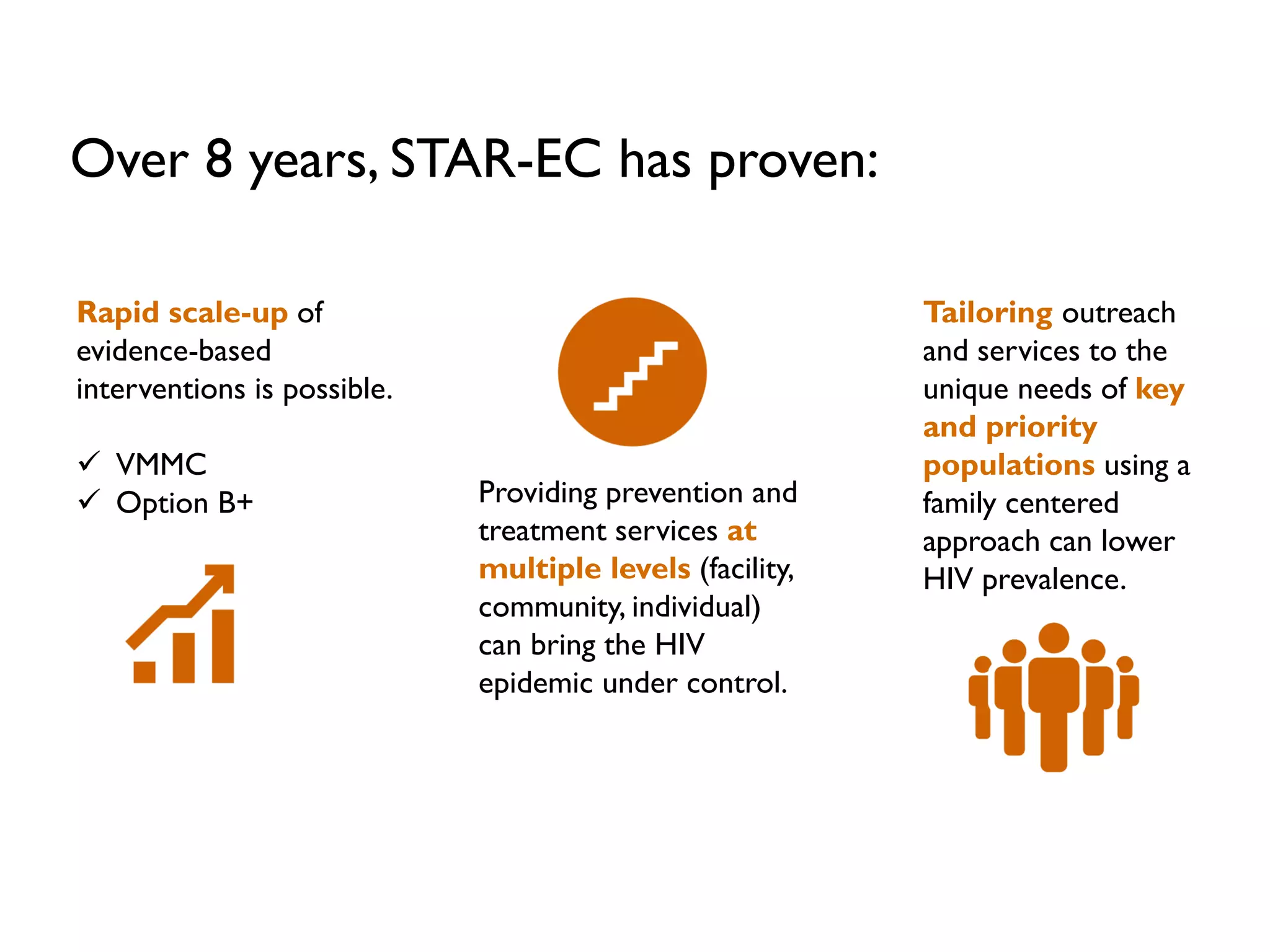
Rapid scale-up of
evidence-based
interventions is possible.
 VMMC
 Option B+ Providing prevention and
treatment services at
multiple levels (facility,
community, individual)
can bring the HIV
epidemic under control.
Tailoring outreach
and services to the
unique needs of key
and priority
populations using a
family centered
approach can lower
HIV prevalence.
Over 8 years, STAR-EC has proven:
Acknowledgements
• USAID
• MOH
• District leadership and health workers
• Implementing partners, e.g., ASSIST, SDS
• Sub-partners
• CSOs
• Communities
Sub-Partners
• AHF Uganda Cares
• Communications for
Development Foundation
Uganda (CDFU)
• Mothers to Mothers (m2m)
• World Education,
Inc./Bantwana Initiative
Pre-Qualified CSOs
• Family Life Education
Programme (FLEP)
• National Community of
Women Living with
HIV&AIDS in Uganda
(NACWOLA)
• Uganda Reproductive
Health Bureau (URHB)
• Youth Alive
Acknowledgements
• AIDS Information Centre (AIC)
• Integrated Development Activities
& AIDS Concern (IDAAC)
• Multi Community Based
Development Initiatives, Ltd.
(MUCOBADI)
• Uganda Development Health
Initiative (UDHA)
• UgandaWomen andYouth
Development Initiative (UWYDI)
• Youth andWomen in Action
(YAWIA)
• Bukooli Initiative forWomen in
HIV&AIDS (BIWIHI)
• Friends of Christ Revival
Ministries (FOCREV)
• Jinja Diocese Health Office
(JDHO)
• National Forum of People Living
with HIV&AIDS Network in
Uganda (NAFOPHANU)
• SiguluWomen AIDS Awareness
Organization (SIWAAO)
Acknowledgements
Additional Collaborating CSOs
Uganda JSI/STAR-EC end-of-project conference presentation

Uganda JSI/STAR-EC end-of-project conference presentation

  • 1.
    USAID StrengtheningTB andHIV & AIDS Responses in East Central Uganda (STAR-EC): An Eight-Year Journey End-of-Project Conference August 11, 2016
  • 3.
    What We’ll CoverToday: STAR-EC’s Eight-Year Journey 1. Where we started 2. STAR-EC goal and objectives 3. What we achieved a. HIV b. TB c. Health system strengthening 4. Challenges and opportunities 5. Legacy Photo: USAID
  • 4.
  • 5.
    STAR-EC covered 3.1 million people,roughly 11% of Uganda’s population.
  • 6.
    Our region hada large presence of high risk populations:  Female sex workers  Sero-discordant couples  Fishermen  Truckers  Sugar plantation workers  Boda boda riders
  • 7.
    1 in 4men engaged in multiple concurrent sexual partnerships.
  • 8.
    Weaknesses in thehealth system complicated an already challenging epidemic. Only four health facilities were accredited to provide ART. And only 372 clients were on treatment in 2009. 59%of health worker positions in the region were filled.
  • 9.
    Testing and counselingrates were below 50%. And only 59% of adults could name 3 ways to prevent HIV transmission.
  • 10.
    HIV infection was high,particularly in the lake shore communities. And 1 in 8 infants exposed to HIV tested positive. prevalence* positivity** positivity** * AIS (2005); ** HMIS
  • 11.
    1 in 5TB patients were lost to follow up. Tuberculosis was a persistent challenge.
  • 12.
  • 13.
    Goal: Increase access,coverage, and use of quality comprehensive TB and HIV and AIDS prevention, care, and treatment services Objective 1: Increase uptake of HIV and AIDS and TB services in supported districts Objective 2: Strengthen decentralized service delivery systems to improve uptake Objective 3: Quality HIV and AIDS and TB services delivered in all supported health facilities, community organizations, and activities Objective 4: Networks, linkages, and referral systems established or strengthened between health facilities and communities Objective 5: Increase demand for HIV and AIDS and TB prevention, care, and treatment services
  • 14.
    STAR-EC worked across3 areas to improve HIV and AIDS and TB service delivery system strengthening demand creation quality improvement Community mobilization BCC IEC Networks, referrals, linkages Meaningful involvement of PLHIV Training and capacity building HF accreditation Improving lab capacity Quality control Support supervision Data quality assessment Leadership and management Coordination M&E Drug logistics management HR for health Infrastructure renovation Providing key equipment
  • 15.
    Game changing interventionsat each level along the continuum of care facility family/individual community identification adherencetreatmentenrollment Adherence support groups Know your viral load campaigns Programs to prevent gender-based violence Monthly data triangulation Active client follow up by phone Female sex worker support clubs Active client follow up by linkage facilitators Active client referral using linkage facilitators Same day enrollment using integrated home outreach TB and HIV services Mother-baby care and cohort analysis Provider initiated testing and counseling Integrated outreach to hotspots and islands (PPs, KPs) Index client HIV testing and counseling continuum of care
  • 16.
  • 17.
    Our TB andHIV and AIDS achievements over eight years have been remarkable.
  • 18.
  • 19.
    3.6% 5.4% 1.9% 0.0 1.0 2.0 3.0 4.0 5.0 6.0 200000 400000 600000 800000 1000000 2009 2010 20112012 2013 2014 2015 2016 Overall HIV positivity declined. Targeted HTC outreaches among KP and PP # of people tested PITC campaigns HIV positive
  • 20.
    fisher folk 23% 4% FSWs 20% 7% 2010 20112012 2013 2014 2015 2016 And in key and priority populations such as fisher folk and female sex workers.
  • 21.
    And priority populationslike pregnant and lactating women. 2.7% 1.3% 2010 2011 2012 2013 2014 2015 2016
  • 22.
    ** Source: CPHL(inclusive of confirmatory tests for newly enrolled HIV positive babies) 5% 12% 6.5% 2010 2011 2012 2013 2014 2015 2016 And in HIV exposed infants. EID strengthening program
  • 23.
    4.7% 0.7% of discordants identified 4.2% 0.4% of concordants identified20102011 2012 2013 2014 2015 2016 We also saw a downward trend in HIV discordants and concordants identified.
  • 24.
    The MOVE Strategy wasused to increase uptake of VMMC services.
  • 25.
  • 26.
    The HIV-related knowledge,attitudes, and practices of female sex workers improved between 2012 and 2016. Uptake of HIV testing and counseling increased from 70 to 97 percent. Consistent condom use with every sexual encounter improved from 44 to 73 percent. Use of contraceptives to control pregnancy by HIV positive FSWs increased from 70 to 76 percent. 51 percent of HIV positive FSWs belong to an adherence network.
  • 27.
    We profiled andfollowed up 1,670 female sex workers. 99 percent of female sex workers (FSWs) were tested for HIV and 19 percent were HIV positive. 90 percent of HIV positive FSWs are enrolled and active on ART. 74 percent of FSWs on ART have viral suppression.
  • 28.
    Improved access toHIV testing 48% 92%
  • 29.
    The number ofhealth facilities accredited to provide ART sites increased dramatically during the life of the project. 93 health facilities 4 health facilities 2009 2016
  • 30.
    372 40,116 2009 2010 20112012 2013 2014 2015 2016 And in turn, we saw an increasing number of clients on treatment.
  • 31.
    7,041 in care 43,378 in care 3,119 onART 40,116 on ART 2010 2011 2012 2013 2014 2015 2016 And for every 10 patients in care, 9 are on treatment, up from four out of ten in 2009.
  • 32.
    Including a steadyincrease in the number of children (0-14 years) on treatment. 20 3027 2009 2010 2011 2012 2013 2014 2015 2016
  • 33.
    Mentor mothers provide peer supportand link HIV+ pregnant mothers and mother-baby pairs to services.
  • 34.
    Which supported ARVuptake among HIV positive ‘mother-baby’ pairs.
  • 35.
    222 3,329 60% 83% 2010 2011 20122013 2014 2015 2016 Original cohort on ART Active after 12 months (% of original cohort) Improved retention on ART reflects strengthened quality of care in HIV services.
  • 36.
    92% 88% 91% 87% 91% 87% 92% 89% 90% 90% BugiriBuyende Iganga Kaliro Kamuli Luuka Mayuge Namayingo Namutumba Region And for those in treatment, 90 percent have viral suppression. Target 90%
  • 37.
  • 38.
    Mobile laboratory services madetests accessible in hard- to-reach areas.
  • 39.
    We saw asteady increase in TB case notification and detection. 62.6% 63% 81% 2014 2015 2016 STAR-EC started measuringTB case notification in 2014
  • 40.
    Services for multi-drugresistant TB became available in the region. 40 2 38 1 22 13 2 Notified cases Death after notification Enrolled on MDR treatment Death on treatment Completed Still on treatment Lost to follow up
  • 41.
    67% TSR 90% 30% Cure Rate 74% 20% LTFU 4% 2010 2011 20122013 2014 2015 2016 TSR >85% Cure rate >50% Loss to follow up <10% National Benchmarks We exceeded national benchmarks on TB treatment outcomes.
  • 42.
    84% tested forHIV 37% HIV positive 32% 84% CPT uptake 100% 18% ART uptake 96% 2010 2011 2012 2013 2014 2015 2016 Through collaborative counseling sessions, STAR-EC addressed TB and HIV together. Increased ART uptake was one of the most significant results.
  • 43.
  • 44.
  • 45.
    Linkag e Retentio n QI team matu rity Linkag e Retentio n QI team matu rity Linkag e Retentio n QI tea m mat urity Village District IP % linked to comm unity %kept appoint ment 2.5 on TMI % linked to comm unity % kept appoint ment 2.5 on TMI % linked to comm unity % kept appoint ment 2.5 on TMI 1 Busanzi Bugiri STAR EC ND 41% 99 82 55 92 2 Busowa Bugiri STAR EC ND 52% 92 77 59 83 3 Butambula Bugiri STAR EC ND 48 89 77 56 77 4 Bwole Bugiri STAR EC ND 52% 92 64 73 84 5 Mukuba Bugiri STAR EC ND 64 86 75 90 92 6 Ndifakulya Bugiri STAR EC ND 49 92 73 96 98 7 Nkusi Bugiri STAR EC ND 58 93 83 68 67 8 Busoigo Kamuli STAR EC ND ND 100 100 100 47 9 Butekanga Kamuli STAR EC ND ND 73 67 98 72 10 Buwanzu Kamuli STAR EC ND ND 74 45 100 84 11 Kananage Kamuli STAR EC ND ND 74 49 82 68 12 Kulingo Kamuli STAR EC ND ND 93 82 90 74 13 Mandwa Kamuli STAR EC ND ND 100 60 92 72 KEY MOH standard met (>85%) Good 3.0- Good ≥90% Good >60 (but below MOH standard) Fair 2.0-2.5 Fair 89%-80% Fair <60% poor 1.0-1.5 Poor ≤79% Poor ND No Data ND No Data ND No Data JULY - SEPT 2013 OCTOBER-DECEMBER 2013 JANUARY-MARCH 2014 Follow up Follow up Follow up % complete follow up % complet e follow up % complete follow up ND 34 81 ND 51 79 ND 28 85 ND 31 91 ND 58 88 ND 41 62 ND 71 90 ND 44 40 ND 74 66 ND 59 55 ND 75 72 ND 76 73 Linkage ND 20 60 Appointment keeping/follow up Team Maturity Linkage Retentio n QI team maturity Linkag e Retentio n QI team maturity Linkage Retentio n QI team maturity % linked to communi ty % kept appoint ment 3.0on TMI % linked to comm unity % kept appoint ment 3.0on TMI % linked to communi ty % kept appoint ment 3.0on TMI 97 90 96 87 95 94 92 85 91 92 90 93 84 90 95 87 91 98 84 89 93 82 93 99 88 92 96 83 87 95 90 96 93 97 95 100 88 97 100 100 100 98 93 86 95 86 94 91 96 86 90 83 96 100 94 96 96 89 95 95 97 85 97 93 88 81 100 93 95 93 96 96 100 96 100 92 97 95 Follow up OCTOBER-DECEMBER 2014 JANUARY-MARCH 2015 % complet e follow up % complet e follow up APRIL-JUNE 2015 Follow up Follow up % complete follow up 93 78** 98 93 94 91 100 100 100 93 98 100 100 93 81 96 100 100 100 99 100 88 100 95 88 93 100 92 95 100 88 89 88 90 100 92 88 9894 Before (2013) After (2015) STAR-EC strengthened quality improvement both at the facility and community levels. Green shows where MOH standards were met for linkages, follow up, and retention
  • 46.
    STAR-EC worked tostrengthen the Ugandan health system for lasting change.
  • 47.
    Provided essential equipmentsuch as microscopes and CD4 machines. Installed power back-up systems in 3 hospital laboratories. Operationalized 7 laboratory hub networks to scale up viral load and early infant diagnosis, serving more than 130 health centers. We improved the capacity of laboratories.
  • 48.
    14 clinicians secondedto island health facilities. Installed solar systems in 18 health facilities. Transitioned from paper-based medical logistics to a web-based ordering system. Provided delivery beds and related equipment to 10 island facilities. And improved the capacity of health facilities.
  • 49.
    And rehabilitated infrastructure. Before TheBugiri lab work top had a dilapidated sink that did not work. After The Bugiri lab work top got a newly fitted sink with elbow tap and a new refrigerator.
  • 50.
  • 51.
    We conducted DQAs andimprovement through CQI and SIMS.
  • 52.
    And supported TB/HIV district-ledperformance reviews and HMIS register triangulation.
  • 53.
  • 54.
    • Understaffing: regionalaverage 68% • Stock outs of supplies and drugs • Limited space at facilities to treat increasing numbers of clients • Manual handling of records, making compilation of reports difficult, especially at high volume sites • Government underfunding for supervision, mentorship, and QI activities • Loss to follow up, due to many KPs and PPs Challenges pose a threat to sustainability.
  • 55.
    • Integrated outreachmodel • Use of ICT, e.g., mobile health • District operational plans and district management committees as good platforms for integrated health activities • Functional community structures linked to health services • A well-skilled workforce, using HMIS data to inform programming • District-led programming and implementation Opportunities can be leveraged for continued improvement.
  • 56.
  • 57.
    Rapid scale-up of evidence-based interventionsis possible.  VMMC  Option B+ Providing prevention and treatment services at multiple levels (facility, community, individual) can bring the HIV epidemic under control. Tailoring outreach and services to the unique needs of key and priority populations using a family centered approach can lower HIV prevalence. Over 8 years, STAR-EC has proven:
  • 58.
    Acknowledgements • USAID • MOH •District leadership and health workers • Implementing partners, e.g., ASSIST, SDS • Sub-partners • CSOs • Communities
  • 59.
    Sub-Partners • AHF UgandaCares • Communications for Development Foundation Uganda (CDFU) • Mothers to Mothers (m2m) • World Education, Inc./Bantwana Initiative Pre-Qualified CSOs • Family Life Education Programme (FLEP) • National Community of Women Living with HIV&AIDS in Uganda (NACWOLA) • Uganda Reproductive Health Bureau (URHB) • Youth Alive Acknowledgements
  • 60.
    • AIDS InformationCentre (AIC) • Integrated Development Activities & AIDS Concern (IDAAC) • Multi Community Based Development Initiatives, Ltd. (MUCOBADI) • Uganda Development Health Initiative (UDHA) • UgandaWomen andYouth Development Initiative (UWYDI) • Youth andWomen in Action (YAWIA) • Bukooli Initiative forWomen in HIV&AIDS (BIWIHI) • Friends of Christ Revival Ministries (FOCREV) • Jinja Diocese Health Office (JDHO) • National Forum of People Living with HIV&AIDS Network in Uganda (NAFOPHANU) • SiguluWomen AIDS Awareness Organization (SIWAAO) Acknowledgements Additional Collaborating CSOs