EBT Connect Basic Certification
Spiral Up Grind In
© 2015 EBT, Inc.
Learning Objectives
• Describe the neuroscience basis of the spiral
up grind in.
• Identify the three stages of the spiral up
grind in and identify how they differ.
Trust the Tools!
Coaching a cycle is easy.
Use the simple lead ins of the tool.
Stay emotionally attuned to the
participant. Trust yourself.
You don’t have to do this perfectly to
get great results.
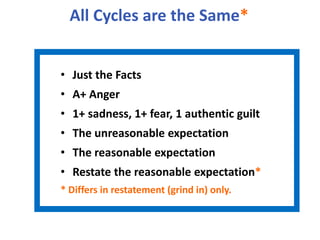
All Cycles are the Same*
• Just the Facts
• A+ Anger
• 1+ sadness, 1+ fear, 1 authentic guilt
• The unreasonable expectation
• The reasonable expectation
• Restate the reasonable expectation*
* Differs in restatement (grind in) only.
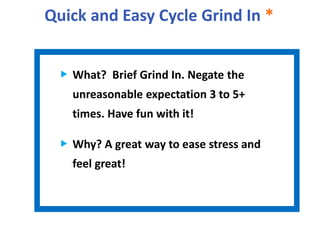
Quick and Easy Cycle Grind In *
What? Brief Grind In. Negate the
unreasonable expectation 3 to 5+
times. Have fun with it!
Why? A great way to ease stress and
feel great!
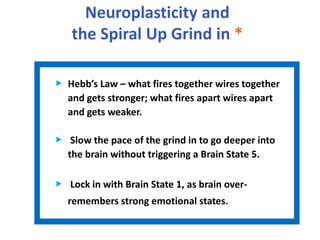
Neuroplasticity and
the Spiral Up Grind in *
Hebb’s Law – what fires together wires together
and gets stronger; what fires apart wires apart
and gets weaker.
Slow the pace of the grind in to go deeper into
the brain without triggering a Brain State 5.
Lock in with Brain State 1, as brain over-
remembers strong emotional states.
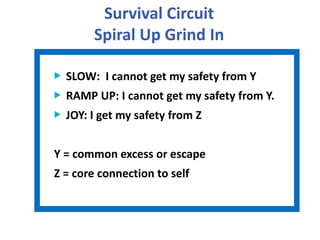
Survival Circuit
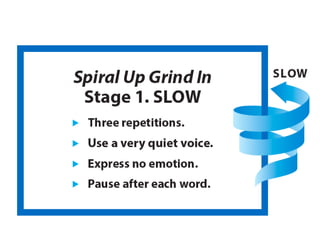
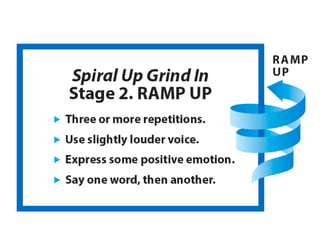
Spiral Up Grind In
SLOW: I cannot get my safety from Y
RAMP UP: I cannot get my safety from Y.
JOY: I get my safety from Z
Y = common excess or escape
Z = core connection to self
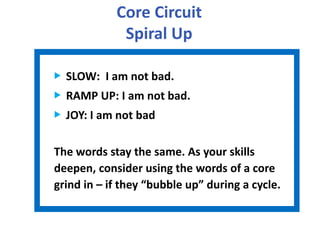
Core Circuit
Spiral Up
SLOW: I am not bad.
RAMP UP: I am not bad.
JOY: I am not bad
The words stay the same. As your skills
deepen, consider using the words of a core
grind in – if they “bubble up” during a cycle.
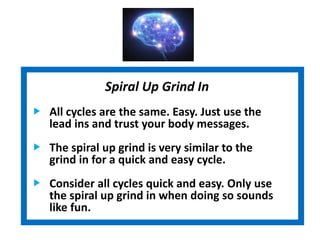
Spiral Up Grind In
All cycles are the same. Easy. Just use the
lead ins and trust your body messages.
The spiral up grind is very similar to the
grind in for a quick and easy cycle.
Consider all cycles quick and easy. Only use
the spiral up grind in when doing so sounds
like fun.
Pause and Reflect
• What is the benefit of using the spiral up
grind in?
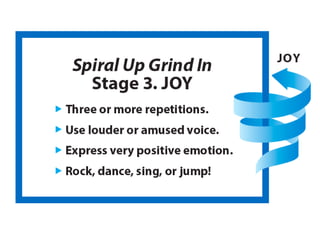
• What are the three stages of the spiral up
grind in?

5 7 Spiral Up Grind In

  • 1.
    EBT Connect BasicCertification Spiral Up Grind In © 2015 EBT, Inc.
  • 2.
    Learning Objectives • Describethe neuroscience basis of the spiral up grind in. • Identify the three stages of the spiral up grind in and identify how they differ.
  • 3.
    Trust the Tools! Coachinga cycle is easy. Use the simple lead ins of the tool. Stay emotionally attuned to the participant. Trust yourself. You don’t have to do this perfectly to get great results.
  • 4.
    All Cycles arethe Same* • Just the Facts • A+ Anger • 1+ sadness, 1+ fear, 1 authentic guilt • The unreasonable expectation • The reasonable expectation • Restate the reasonable expectation* * Differs in restatement (grind in) only.
  • 5.
    Quick and EasyCycle Grind In * What? Brief Grind In. Negate the unreasonable expectation 3 to 5+ times. Have fun with it! Why? A great way to ease stress and feel great!
  • 6.
    Neuroplasticity and the SpiralUp Grind in * Hebb’s Law – what fires together wires together and gets stronger; what fires apart wires apart and gets weaker. Slow the pace of the grind in to go deeper into the brain without triggering a Brain State 5. Lock in with Brain State 1, as brain over- remembers strong emotional states.
  • 10.
    Survival Circuit Spiral UpGrind In SLOW: I cannot get my safety from Y RAMP UP: I cannot get my safety from Y. JOY: I get my safety from Z Y = common excess or escape Z = core connection to self
  • 11.
    Core Circuit Spiral Up SLOW:I am not bad. RAMP UP: I am not bad. JOY: I am not bad The words stay the same. As your skills deepen, consider using the words of a core grind in – if they “bubble up” during a cycle.
  • 12.
    Spiral Up GrindIn All cycles are the same. Easy. Just use the lead ins and trust your body messages. The spiral up grind is very similar to the grind in for a quick and easy cycle. Consider all cycles quick and easy. Only use the spiral up grind in when doing so sounds like fun.
  • 13.
    Pause and Reflect •What is the benefit of using the spiral up grind in? • What are the three stages of the spiral up grind in?