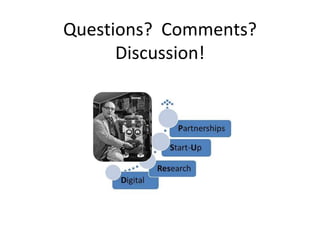
Digital
Research
Start-Up
Partnerships
UCLA Library
DH Infrastructure, 2016
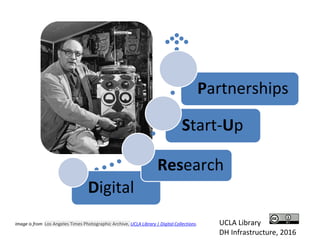
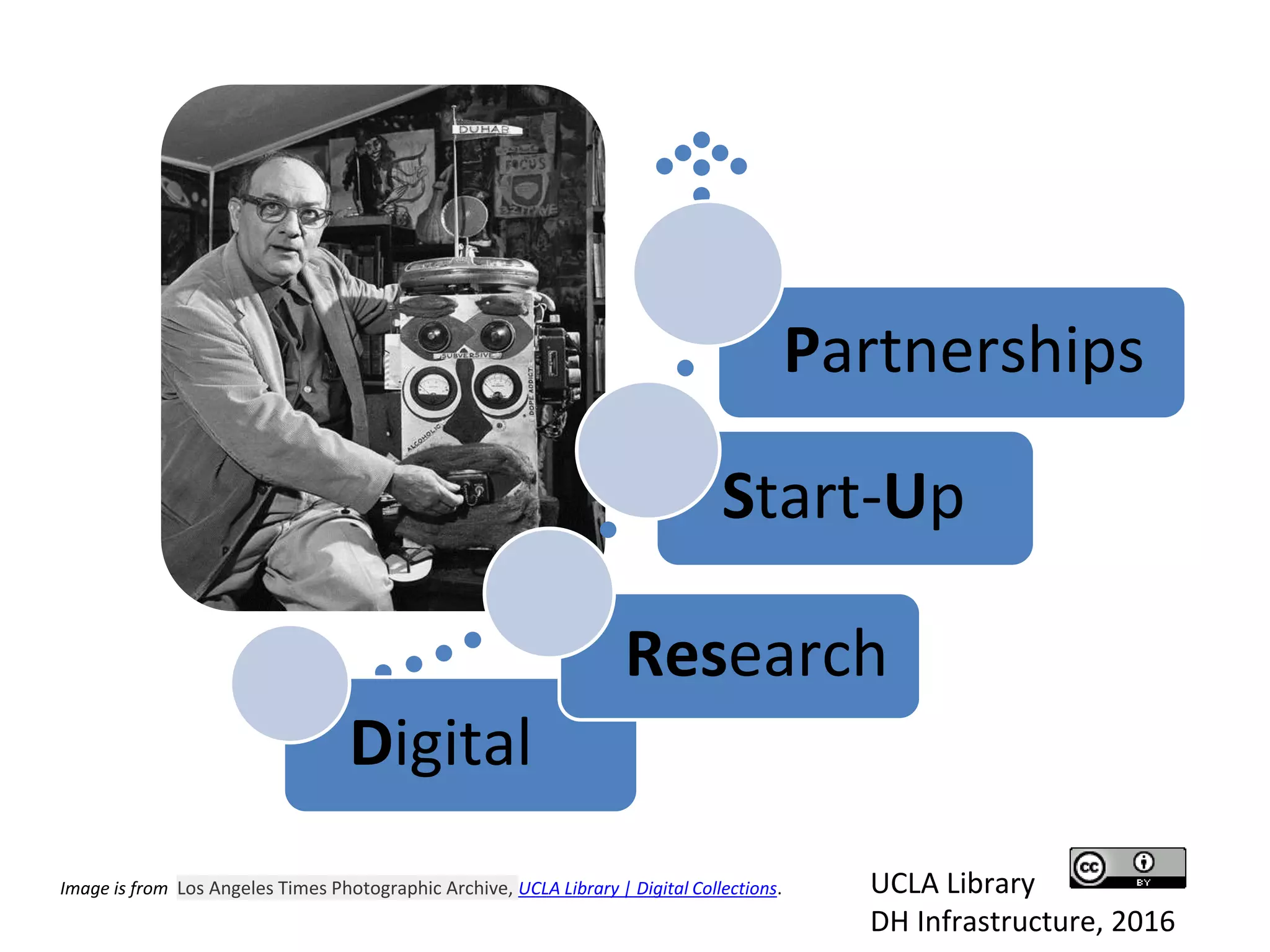
Image is from Los Angeles Times Photographic Archive, UCLA Library | Digital Collections.
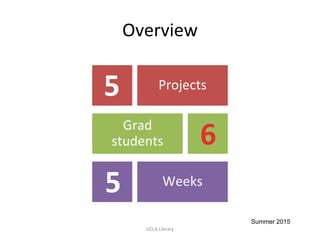
Overview
Projects
Grad
students
Weeks
5
5
6
UCLA Library
Summer 2015
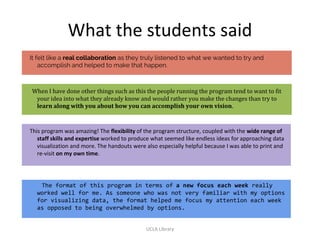
What the students said
The format of this program in terms of a new focus each week really
worked well for me. As someone who was not very familiar with my options
for visualizing data, the format helped me focus my attention each week
as opposed to being overwhelmed by options.
UCLA Library
It felt like a real collaboration as they truly listened to what we wanted to try and
accomplish and helped to make that happen.
When I have done other things such as this the people running the program tend to want to fit
your idea into what they already know and would rather you make the changes than try to
learn along with you about how you can accomplish your own vision.
This program was amazing! The flexibility of the program structure, coupled with the wide range of
staff skills and expertise worked to produce what seemed like endless ideas for approaching data
visualization and more. The handouts were also especially helpful because I was able to print and
re-visit on my own time.
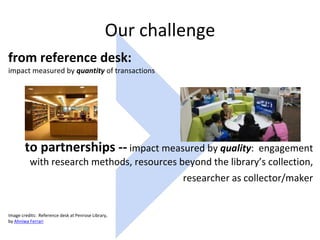
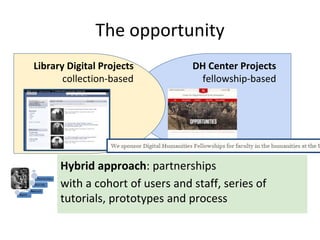
Our challenge
to partnerships -- impact measured by quality: engagement
with research methods, resources beyond the library’s collection,
researcher as collector/maker
Image credits: Reference desk at Penrose Library,
by Ahniwa Ferrari
from reference desk:
impact measured by quantity of transactions
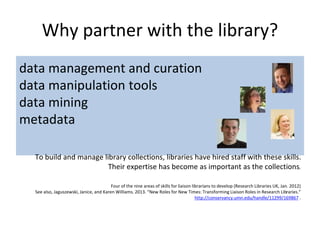
The opportunity
Library Digital Projects
collection-based
DH Center Projects
fellowship-based
Hybrid approach: partnerships
with a cohort of users and staff, series of
tutorials, prototypes and process
Why partner with the library?
data management and curation
data manipulation tools
data mining
metadata
To build and manage library collections, libraries have hired staff with these skills.
Their expertise has become as important as the collections.
Four of the nine areas of skills for liaison librarians to develop (Research Libraries UK, Jan. 2012)
See also, Jaguszewski, Janice, and Karen Williams. 2013. “New Roles for New Times: Transforming Liaison Roles in Research Libraries.”
http://conservancy.umn.edu/handle/11299/169867 .
Objectives
For the graduate students For library staff
Extended engagement with
graduate students doing digital
research projects (more than just a
workshop)
Create an infrastructure,
connecting experts in various
library departments
UCLA Library
Library staff as expert partners
Emphasis on process and
workflow
Prototypes rather than
finished projects
User-centered focus (rather than
tool-driven workshops)
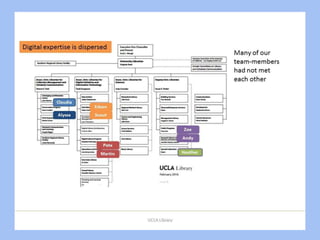
Actual infrastructure
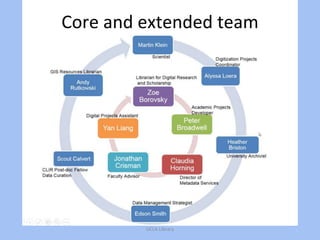
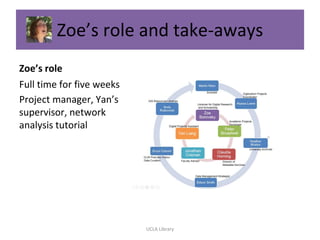
Core and extended team
UCLA Library
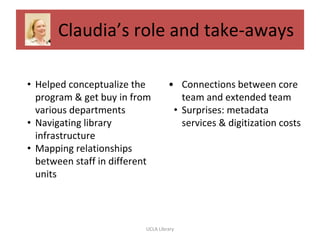
Claudia’s role and take-aways
• Helped conceptualize the
program & get buy in from
various departments
• Navigating library
infrastructure
• Mapping relationships
between staff in different
units
• Connections between core
team and extended team
• Surprises: metadata
services & digitization costs
UCLA Library
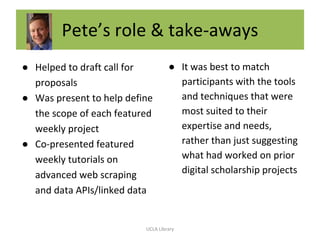
Pete’s role & take-aways
● Helped to draft call for
proposals
● Was present to help define
the scope of each featured
weekly project
● Co-presented featured
weekly tutorials on
advanced web scraping
and data APIs/linked data
● It was best to match
participants with the tools
and techniques that were
most suited to their
expertise and needs,
rather than just suggesting
what had worked on prior
digital scholarship projects
UCLA Library
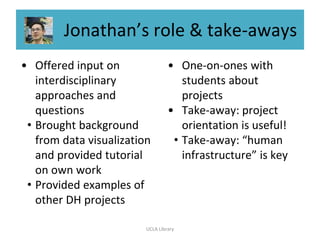
Jonathan’s role & take-aways
• Offered input on
interdisciplinary
approaches and
questions
• Brought background
from data visualization
and provided tutorial
on own work
• Provided examples of
other DH projects
• One-on-ones with
students about
projects
• Take-away: project
orientation is useful!
• Take-away: “human
infrastructure” is key
UCLA Library
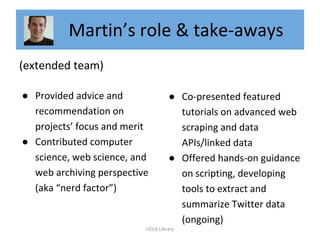
Martin’s role & take-aways
(extended team)
● Provided advice and
recommendation on
projects’ focus and merit
● Contributed computer
science, web science, and
web archiving perspective
(aka “nerd factor”)
● Co-presented featured
tutorials on advanced web
scraping and data
APIs/linked data
● Offered hands-on guidance
on scripting, developing
tools to extract and
summarize Twitter data
(ongoing)
UCLA Library
Yan’s role and take-aways
• Full-time Project Assistant
for five weeks
• Organized tutorials
• Taught web-scraping
(Import.io), geo-coding
(Google fusion table),
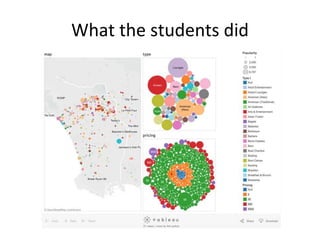
mapping (Tableau)
• Tested out the capabilities
of softwares according to
each project
• Peer learning by helping to
teach
• Tailored teaching approach
by learning before-hand
• Back-and-forth interaction
with students
UCLA Library
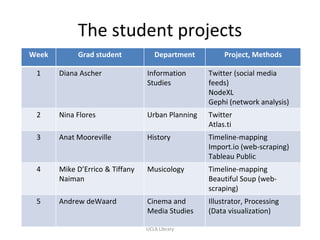
The student projects
Week Grad student Department Project, Methods
1 Diana Ascher Information
Studies
Twitter (social media
feeds)
NodeXL
Gephi (network analysis)
2 Nina Flores Urban Planning Twitter
Atlas.ti
3 Anat Mooreville History Timeline-mapping
Import.io (web-scraping)
Tableau Public
4 Mike D’Errico & Tiffany
Naiman
Musicology Timeline-mapping
Beautiful Soup (web-
scraping)
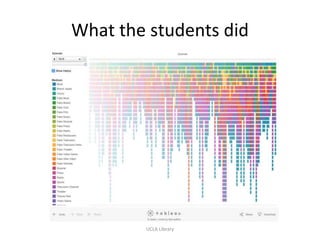
5 Andrew deWaard Cinema and
Media Studies
Illustrator, Processing
(Data visualization)
UCLA Library
What the students did
UCLA Library
What the students did
UCLA Library
Zoe’s role and take-aways
Zoe’s role
Full time for five weeks
Project manager, Yan’s
supervisor, network
analysis tutorial
UCLA Library
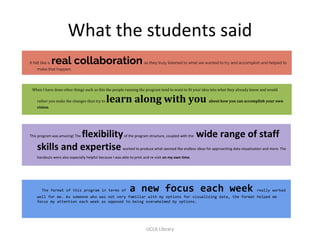
What the students said
The format of this program in terms of a new focus each week really worked
well for me. As someone who was not very familiar with my options for visualizing data, the format helped me
focus my attention each week as opposed to being overwhelmed by options.
UCLA Library
It felt like a real collaboration as they truly listened to what we wanted to try and accomplish and helped to
make that happen.
When I have done other things such as this the people running the program tend to want to fit your idea into what they already know and would
rather you make the changes than try to learn along with you about how you can accomplish your own
vision.
This program was amazing! The flexibilityof the program structure, coupled with the wide range of staff
skills and expertiseworked to produce what seemed like endless ideas for approaching data visualization and more. The
handouts were also especially helpful because I was able to print and re-visit on my own time.
Lessons learned…
1.Graduate students need this type of infrastructure
to accomplish dissertation-level research
2.Access to experts who can discuss their projects,
engage during an iterative, interactive process, not
just handing off the work to someone else
3.Libraries are at the hub of interdisciplinary work on
campus, but we need a broader network of library
staff who can engage with users on multiple levels --
including technology, legal issues, formats and
standards, all aspects.
UCLA Library
Questions? Comments?
Discussion!
Contacts
Zoe Borovsky
Peter Broadwell
Jonathan Crisman
Claudia Horning
Martin Klein
Yan Liang
zoe@library.ucla.edu
broadwell@library.ucla.edu
crisman@ucla.edu
chorning@library.ucla.edu
MartinKlein@library.ucla.edu
yanthinks@gmail.com

UCLALibrary_DResSUP.pptx

  • 1.
    Digital Research Start-Up Partnerships UCLA Library DH Infrastructure,2016 Image is from Los Angeles Times Photographic Archive, UCLA Library | Digital Collections.
  • 2.
  • 3.
    What the studentssaid The format of this program in terms of a new focus each week really worked well for me. As someone who was not very familiar with my options for visualizing data, the format helped me focus my attention each week as opposed to being overwhelmed by options. UCLA Library It felt like a real collaboration as they truly listened to what we wanted to try and accomplish and helped to make that happen. When I have done other things such as this the people running the program tend to want to fit your idea into what they already know and would rather you make the changes than try to learn along with you about how you can accomplish your own vision. This program was amazing! The flexibility of the program structure, coupled with the wide range of staff skills and expertise worked to produce what seemed like endless ideas for approaching data visualization and more. The handouts were also especially helpful because I was able to print and re-visit on my own time.
  • 4.
    Our challenge to partnerships-- impact measured by quality: engagement with research methods, resources beyond the library’s collection, researcher as collector/maker Image credits: Reference desk at Penrose Library, by Ahniwa Ferrari from reference desk: impact measured by quantity of transactions
  • 5.
    The opportunity Library DigitalProjects collection-based DH Center Projects fellowship-based Hybrid approach: partnerships with a cohort of users and staff, series of tutorials, prototypes and process
  • 6.
    Why partner withthe library? data management and curation data manipulation tools data mining metadata To build and manage library collections, libraries have hired staff with these skills. Their expertise has become as important as the collections. Four of the nine areas of skills for liaison librarians to develop (Research Libraries UK, Jan. 2012) See also, Jaguszewski, Janice, and Karen Williams. 2013. “New Roles for New Times: Transforming Liaison Roles in Research Libraries.” http://conservancy.umn.edu/handle/11299/169867 .
  • 7.
    Objectives For the graduatestudents For library staff Extended engagement with graduate students doing digital research projects (more than just a workshop) Create an infrastructure, connecting experts in various library departments UCLA Library Library staff as expert partners Emphasis on process and workflow Prototypes rather than finished projects User-centered focus (rather than tool-driven workshops)
  • 8.
  • 9.
    Core and extendedteam UCLA Library
  • 10.
    Claudia’s role andtake-aways • Helped conceptualize the program & get buy in from various departments • Navigating library infrastructure • Mapping relationships between staff in different units • Connections between core team and extended team • Surprises: metadata services & digitization costs UCLA Library
  • 11.
    Pete’s role &take-aways ● Helped to draft call for proposals ● Was present to help define the scope of each featured weekly project ● Co-presented featured weekly tutorials on advanced web scraping and data APIs/linked data ● It was best to match participants with the tools and techniques that were most suited to their expertise and needs, rather than just suggesting what had worked on prior digital scholarship projects UCLA Library
  • 12.
    Jonathan’s role &take-aways • Offered input on interdisciplinary approaches and questions • Brought background from data visualization and provided tutorial on own work • Provided examples of other DH projects • One-on-ones with students about projects • Take-away: project orientation is useful! • Take-away: “human infrastructure” is key UCLA Library
  • 13.
    Martin’s role &take-aways (extended team) ● Provided advice and recommendation on projects’ focus and merit ● Contributed computer science, web science, and web archiving perspective (aka “nerd factor”) ● Co-presented featured tutorials on advanced web scraping and data APIs/linked data ● Offered hands-on guidance on scripting, developing tools to extract and summarize Twitter data (ongoing) UCLA Library
  • 14.
    Yan’s role andtake-aways • Full-time Project Assistant for five weeks • Organized tutorials • Taught web-scraping (Import.io), geo-coding (Google fusion table), mapping (Tableau) • Tested out the capabilities of softwares according to each project • Peer learning by helping to teach • Tailored teaching approach by learning before-hand • Back-and-forth interaction with students UCLA Library
  • 15.
    The student projects WeekGrad student Department Project, Methods 1 Diana Ascher Information Studies Twitter (social media feeds) NodeXL Gephi (network analysis) 2 Nina Flores Urban Planning Twitter Atlas.ti 3 Anat Mooreville History Timeline-mapping Import.io (web-scraping) Tableau Public 4 Mike D’Errico & Tiffany Naiman Musicology Timeline-mapping Beautiful Soup (web- scraping) 5 Andrew deWaard Cinema and Media Studies Illustrator, Processing (Data visualization) UCLA Library
  • 16.
    What the studentsdid UCLA Library
  • 17.
    What the studentsdid UCLA Library
  • 18.
    Zoe’s role andtake-aways Zoe’s role Full time for five weeks Project manager, Yan’s supervisor, network analysis tutorial UCLA Library
  • 19.
    What the studentssaid The format of this program in terms of a new focus each week really worked well for me. As someone who was not very familiar with my options for visualizing data, the format helped me focus my attention each week as opposed to being overwhelmed by options. UCLA Library It felt like a real collaboration as they truly listened to what we wanted to try and accomplish and helped to make that happen. When I have done other things such as this the people running the program tend to want to fit your idea into what they already know and would rather you make the changes than try to learn along with you about how you can accomplish your own vision. This program was amazing! The flexibilityof the program structure, coupled with the wide range of staff skills and expertiseworked to produce what seemed like endless ideas for approaching data visualization and more. The handouts were also especially helpful because I was able to print and re-visit on my own time.
  • 20.
    Lessons learned… 1.Graduate studentsneed this type of infrastructure to accomplish dissertation-level research 2.Access to experts who can discuss their projects, engage during an iterative, interactive process, not just handing off the work to someone else 3.Libraries are at the hub of interdisciplinary work on campus, but we need a broader network of library staff who can engage with users on multiple levels -- including technology, legal issues, formats and standards, all aspects. UCLA Library
  • 21.
  • 22.
    Contacts Zoe Borovsky Peter Broadwell JonathanCrisman Claudia Horning Martin Klein Yan Liang zoe@library.ucla.edu broadwell@library.ucla.edu crisman@ucla.edu chorning@library.ucla.edu MartinKlein@library.ucla.edu yanthinks@gmail.com