Clinical and Translational 
Science Institute / CTSI 
at the University of California, San Francisco 
Profile Locally, Network Globally 
Eric Meeks and Brian Turner, CTSI at UCSF 
University of California Computing Services Conference, Aug 4, 2014
Research Networking 
• VIVO, Profiles, SciVal Experts, many others 
• Most universities have one (to several) in 
place 
• LinkedIn for Researchers
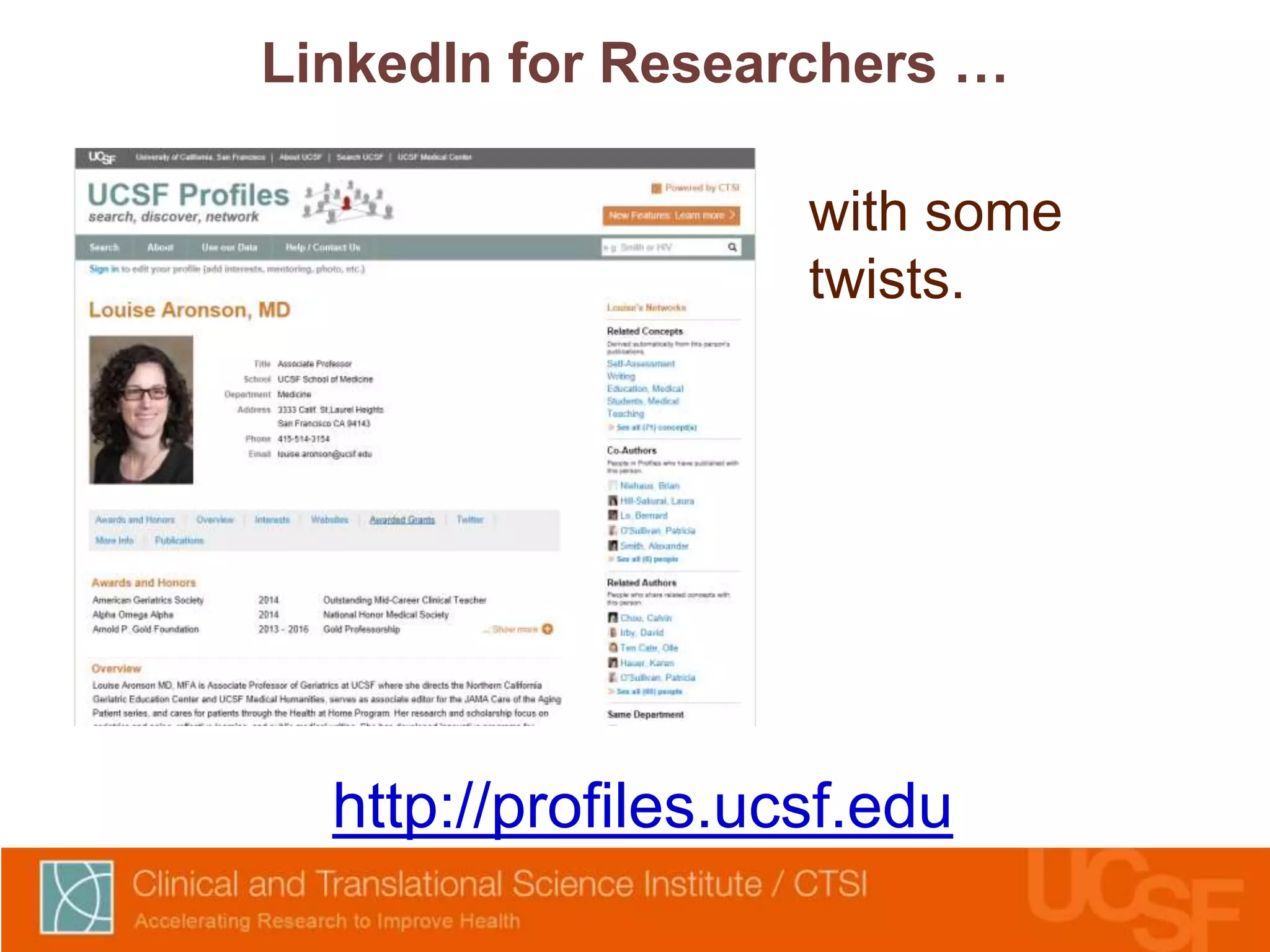
LinkedIn for Researchers … 
with some 
twists. 
http://profiles.ucsf.edu
Why do institutions roll their own?
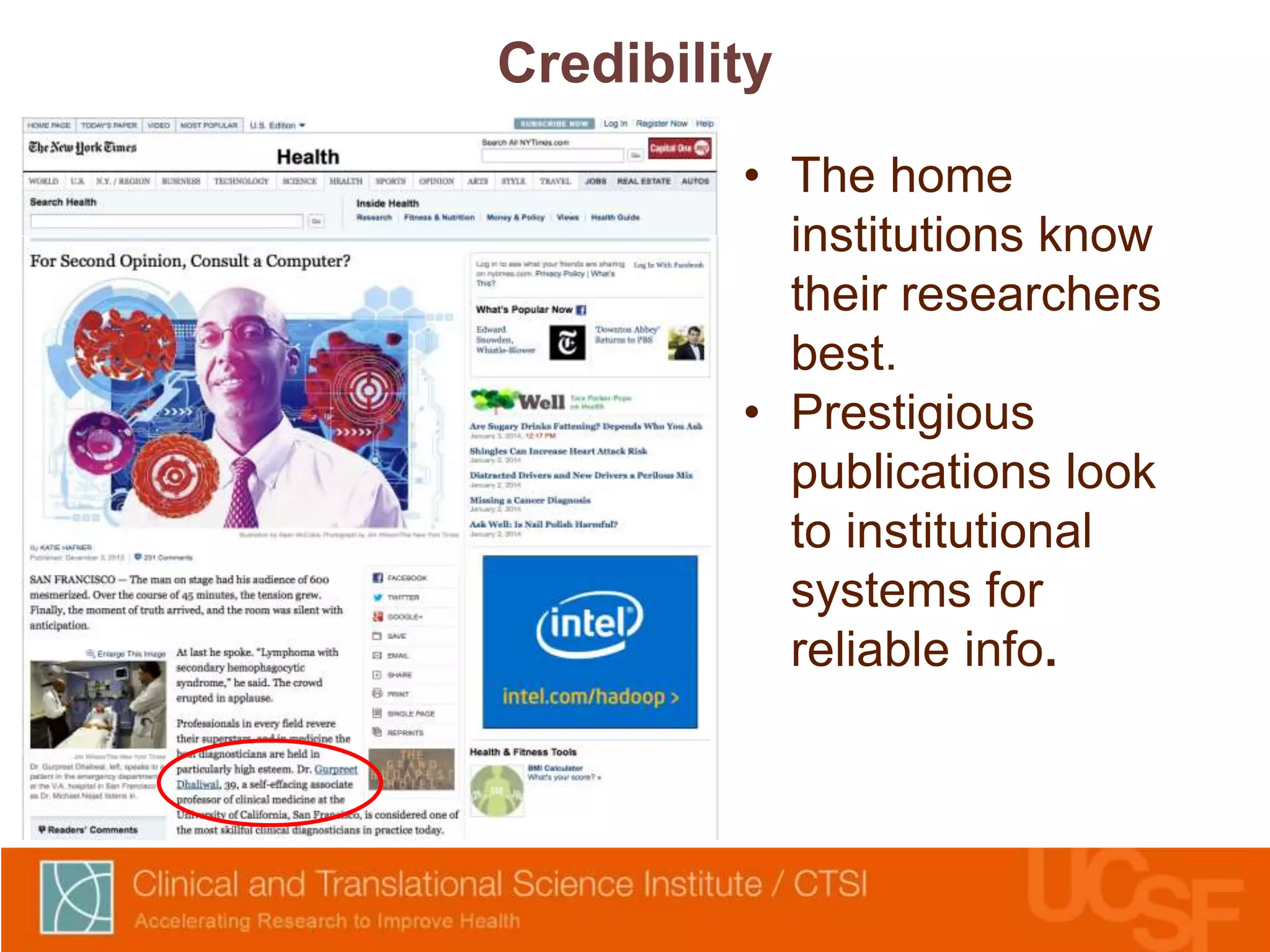
Credibility 
• The home 
institutions know 
their researchers 
best. 
• Prestigious 
publications look 
to institutional 
systems for 
reliable info.
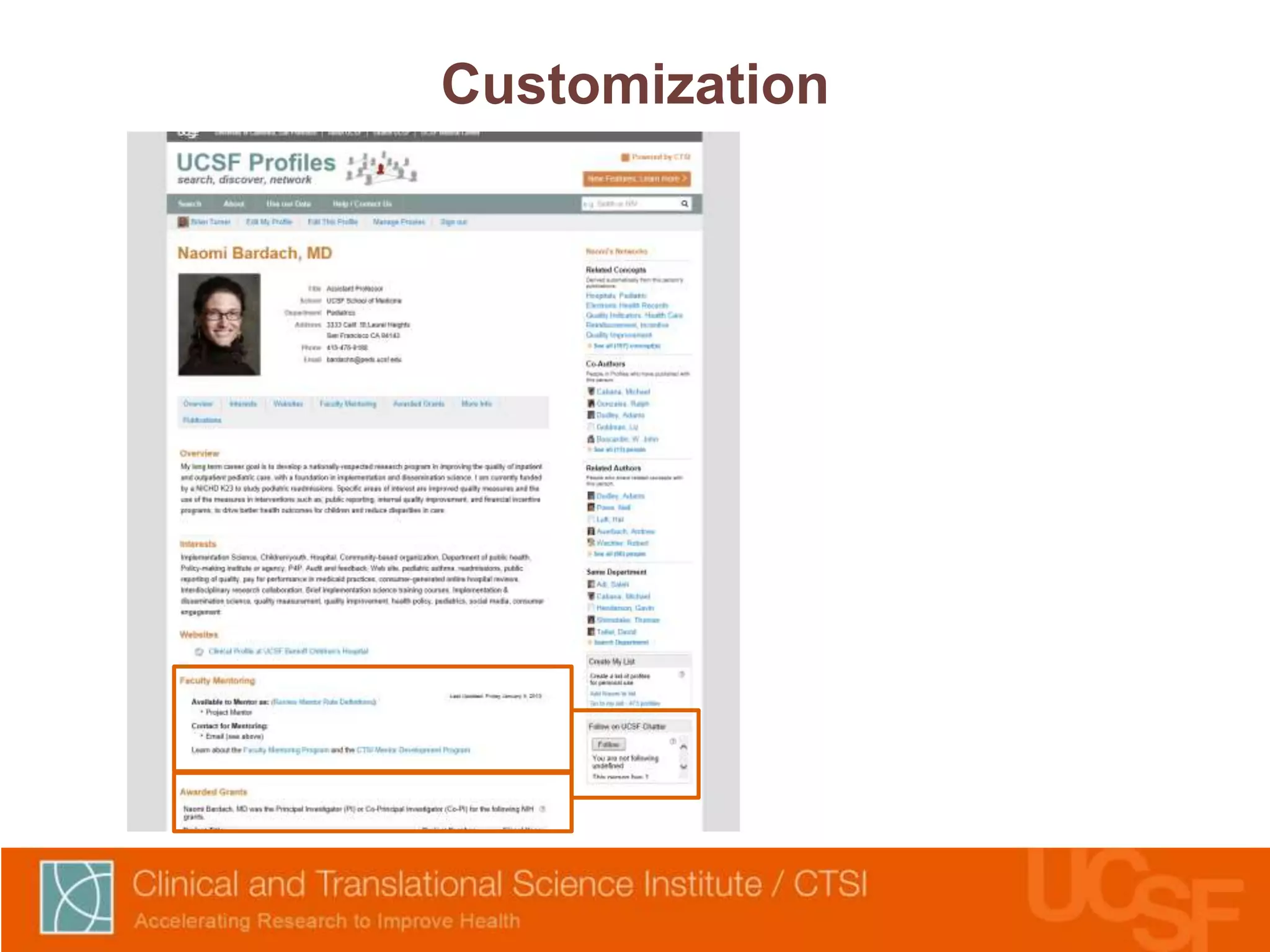
Customization
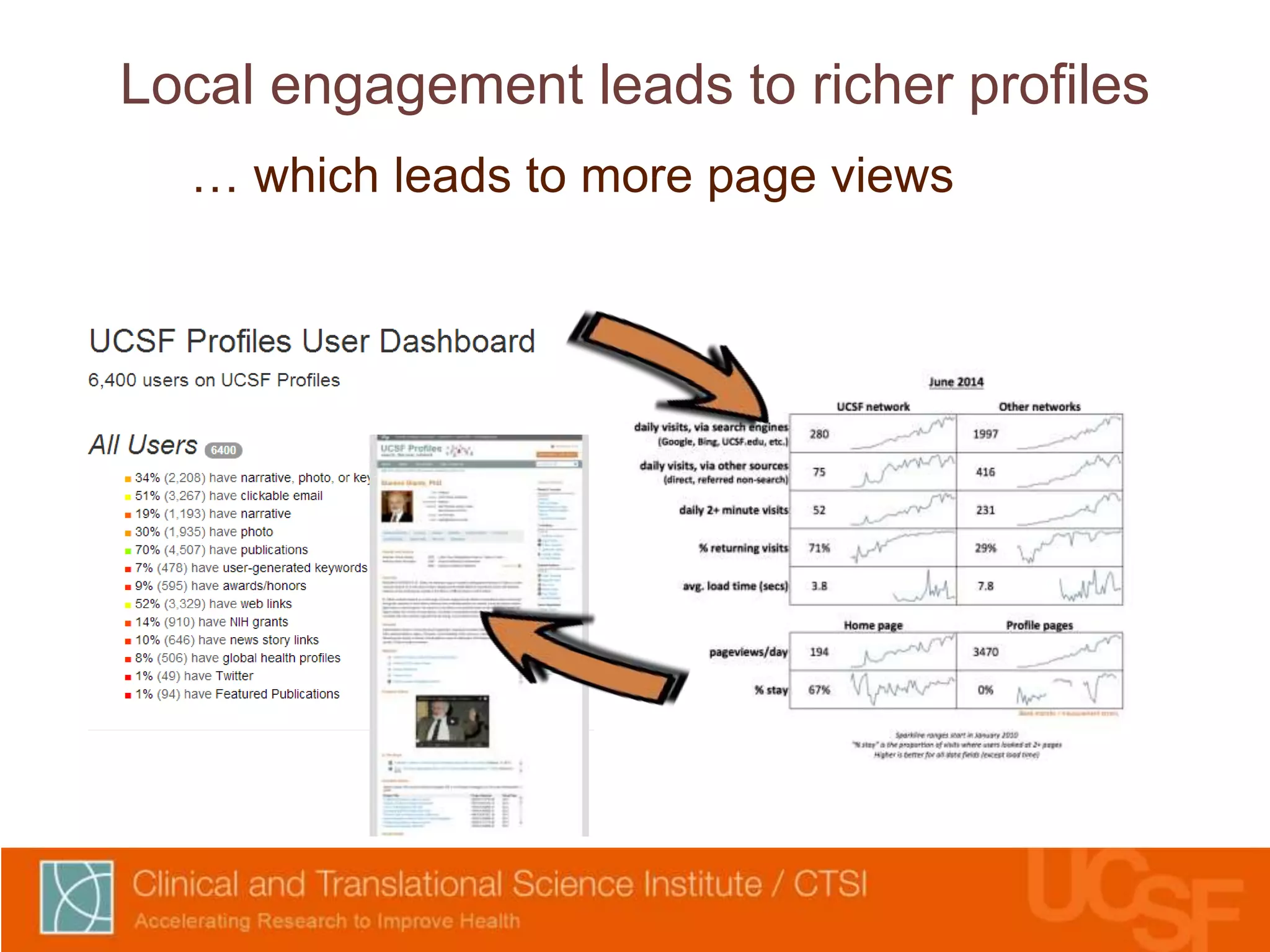
Local engagement leads to richer profiles 
… which leads to more page views
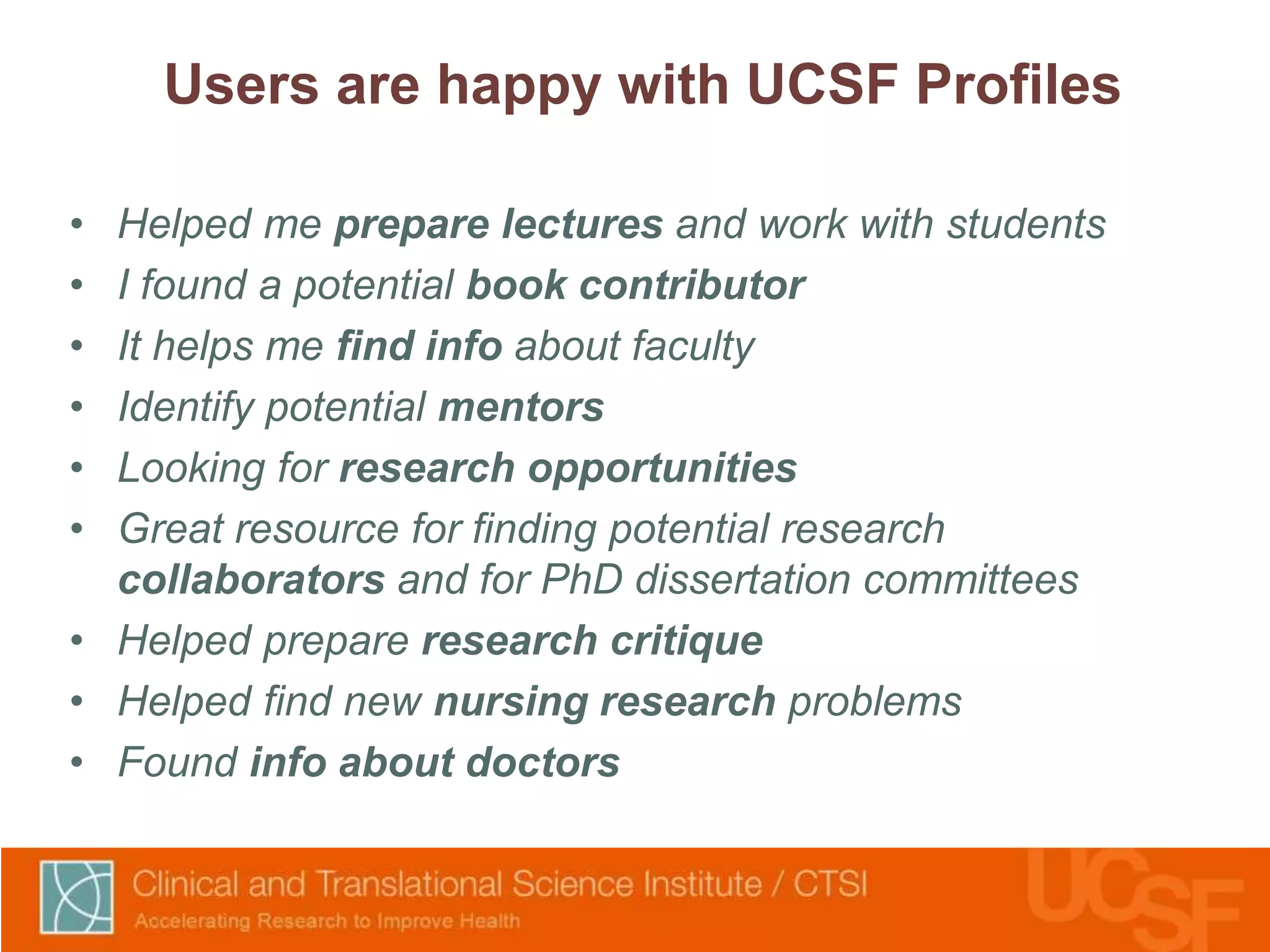
Users are happy with UCSF Profiles 
• Helped me prepare lectures and work with students 
• I found a potential book contributor 
• It helps me find info about faculty 
• Identify potential mentors 
• Looking for research opportunities 
• Great resource for finding potential research 
collaborators and for PhD dissertation committees 
• Helped prepare research critique 
• Helped find new nursing research problems 
• Found info about doctors
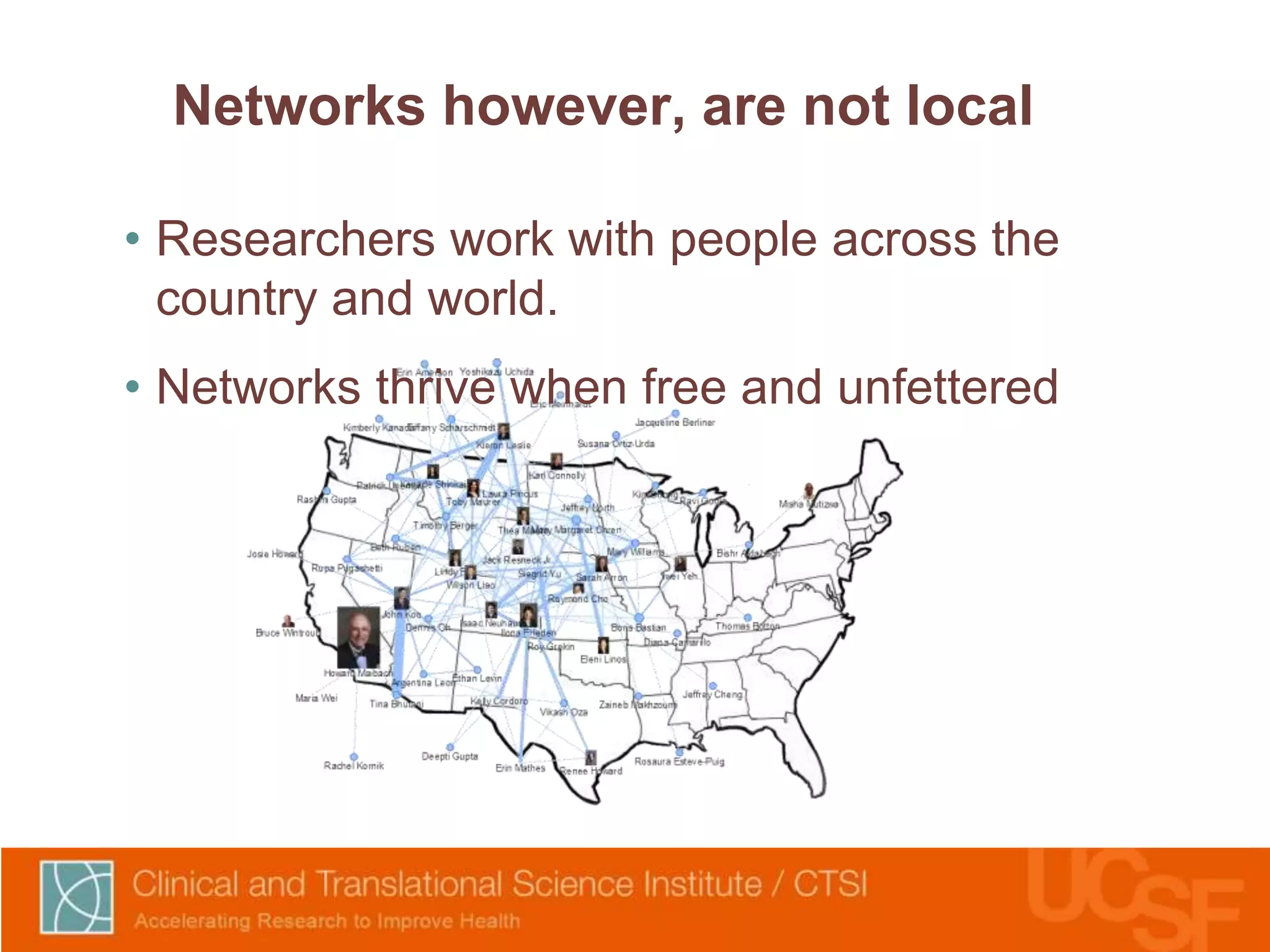
Networks however, are not local 
• Researchers work with people across the 
country and world. 
• Networks thrive when free and unfettered
The research environment has changed 
• Funding agencies ask/require that 
researchers collaborate 
• Harder problems require bigger and/or more 
selective teams 
• Larger networks will have more specialized 
expertise 
– Get the best person, not the best one close by
Challenges for Cross-Institutional 
Research Networking 
• Users can’t be expected to manually connect 
to collaborators at other institutions. 
• Data sources 
• Disparate systems don’t share information
The Technologies to Connect Local 
Profiles in a Global Network 
• Linked Open Data and a Common 
Ontology (VIVO) for data recognition 
• Shibboleth/Incommon/OAuth for 
Authentication 
• OpenSocial to connect different 
systems to common services
Linked Open Data and 
OpenSocial in Action 
Live Demo: 
http://stage-r2r.ucsf.edu/crosslinks/index 
click very slowly please…. 
http://stage-profiles.ucsf.edu/eric.meeks
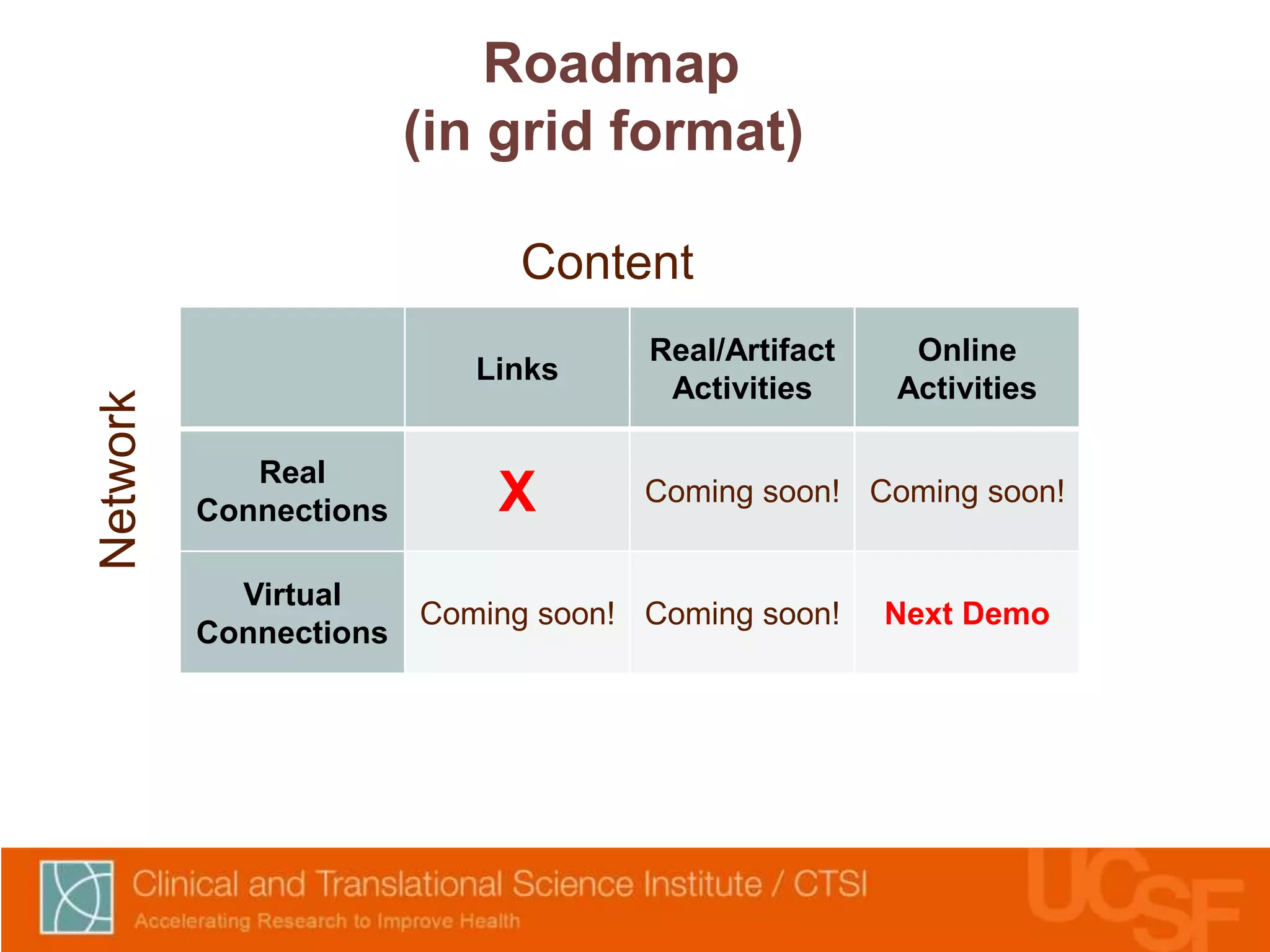
Roadmap 
(in grid format) 
Links 
Real/Artifact 
Activities 
Online 
Activities 
Real 
Connections X Coming soon! Coming soon! 
Virtual 
Connections 
Coming soon! Coming soon! Next Demo 
Network 
Content
Linked Open Data, OpenSocial, OAuth 
and ActivityStreams in Action 
http://activitystrea.ms/ 
• Webfinger 
• Pump.io 
• Indie Web Camp 
Live Demo: 
http://stage-profiles.ucsf.edu 
http://stage-profiles.ucsd.edu
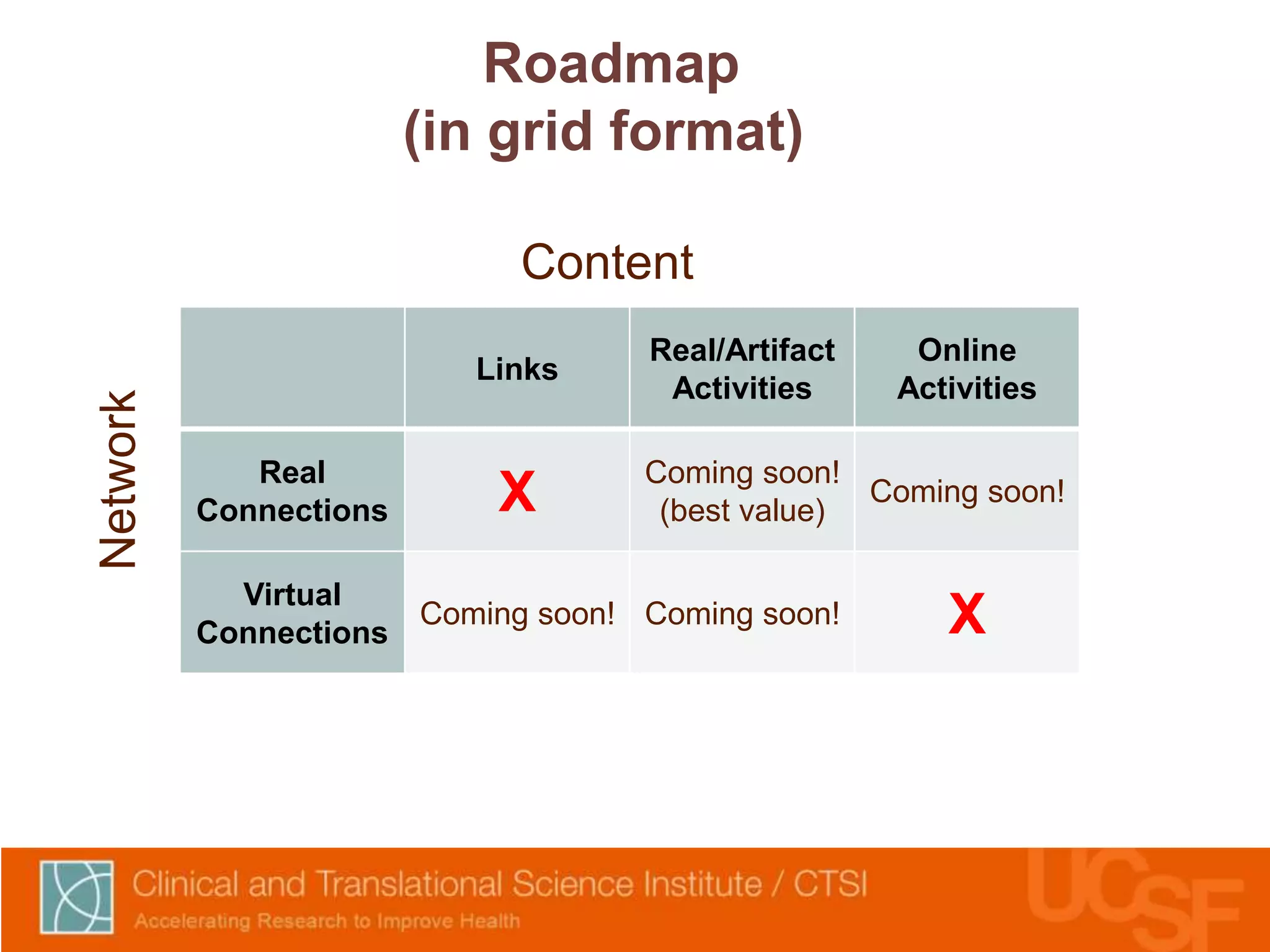
Roadmap 
(in grid format) 
Links 
Real/Artifact 
Activities 
Online 
Activities 
Real 
X Coming soon! 
Connections (best value) 
Coming soon! 
Virtual 
Connections 
Coming soon! Coming soon! X 
Network 
Content
Next Steps 
• Install our own ActivityStreams 
server 
• Consume activities from 
UCSF/UCSD/USC/LBNL 
• Consume activities from 
R2R/Crosslinks 
• Build more gadgets for displaying 
and generating activities 
• Share everything!
Thanks! 
http://profiles.ucsf.edu/brian.turner 
http://profiles.ucsf.edu/eric.meeks
Roadmap 
(in grid format) 
Links 
Real/Artifact 
Activities 
Online 
Activities 
Public n/a 
Chatter-> 
Activity 
Streams 
Chatter-> 
Activity 
Streams 
Real 
X Coming soon! 
Connections (best value) 
Coming soon! 
Virtual 
Connections 
Coming soon! Coming soon! X 
Network 
Content

Profile Locally Network Globally

  • 1.
    Clinical and Translational Science Institute / CTSI at the University of California, San Francisco Profile Locally, Network Globally Eric Meeks and Brian Turner, CTSI at UCSF University of California Computing Services Conference, Aug 4, 2014
  • 2.
    Research Networking •VIVO, Profiles, SciVal Experts, many others • Most universities have one (to several) in place • LinkedIn for Researchers
  • 3.
    LinkedIn for Researchers… with some twists. http://profiles.ucsf.edu
  • 4.
    Why do institutionsroll their own?
  • 5.
    Credibility • Thehome institutions know their researchers best. • Prestigious publications look to institutional systems for reliable info.
  • 6.
  • 7.
    Local engagement leadsto richer profiles … which leads to more page views
  • 8.
    Users are happywith UCSF Profiles • Helped me prepare lectures and work with students • I found a potential book contributor • It helps me find info about faculty • Identify potential mentors • Looking for research opportunities • Great resource for finding potential research collaborators and for PhD dissertation committees • Helped prepare research critique • Helped find new nursing research problems • Found info about doctors
  • 9.
    Networks however, arenot local • Researchers work with people across the country and world. • Networks thrive when free and unfettered
  • 10.
    The research environmenthas changed • Funding agencies ask/require that researchers collaborate • Harder problems require bigger and/or more selective teams • Larger networks will have more specialized expertise – Get the best person, not the best one close by
  • 11.
    Challenges for Cross-Institutional Research Networking • Users can’t be expected to manually connect to collaborators at other institutions. • Data sources • Disparate systems don’t share information
  • 12.
    The Technologies toConnect Local Profiles in a Global Network • Linked Open Data and a Common Ontology (VIVO) for data recognition • Shibboleth/Incommon/OAuth for Authentication • OpenSocial to connect different systems to common services
  • 13.
    Linked Open Dataand OpenSocial in Action Live Demo: http://stage-r2r.ucsf.edu/crosslinks/index click very slowly please…. http://stage-profiles.ucsf.edu/eric.meeks
  • 14.
    Roadmap (in gridformat) Links Real/Artifact Activities Online Activities Real Connections X Coming soon! Coming soon! Virtual Connections Coming soon! Coming soon! Next Demo Network Content
  • 15.
    Linked Open Data,OpenSocial, OAuth and ActivityStreams in Action http://activitystrea.ms/ • Webfinger • Pump.io • Indie Web Camp Live Demo: http://stage-profiles.ucsf.edu http://stage-profiles.ucsd.edu
  • 16.
    Roadmap (in gridformat) Links Real/Artifact Activities Online Activities Real X Coming soon! Connections (best value) Coming soon! Virtual Connections Coming soon! Coming soon! X Network Content
  • 17.
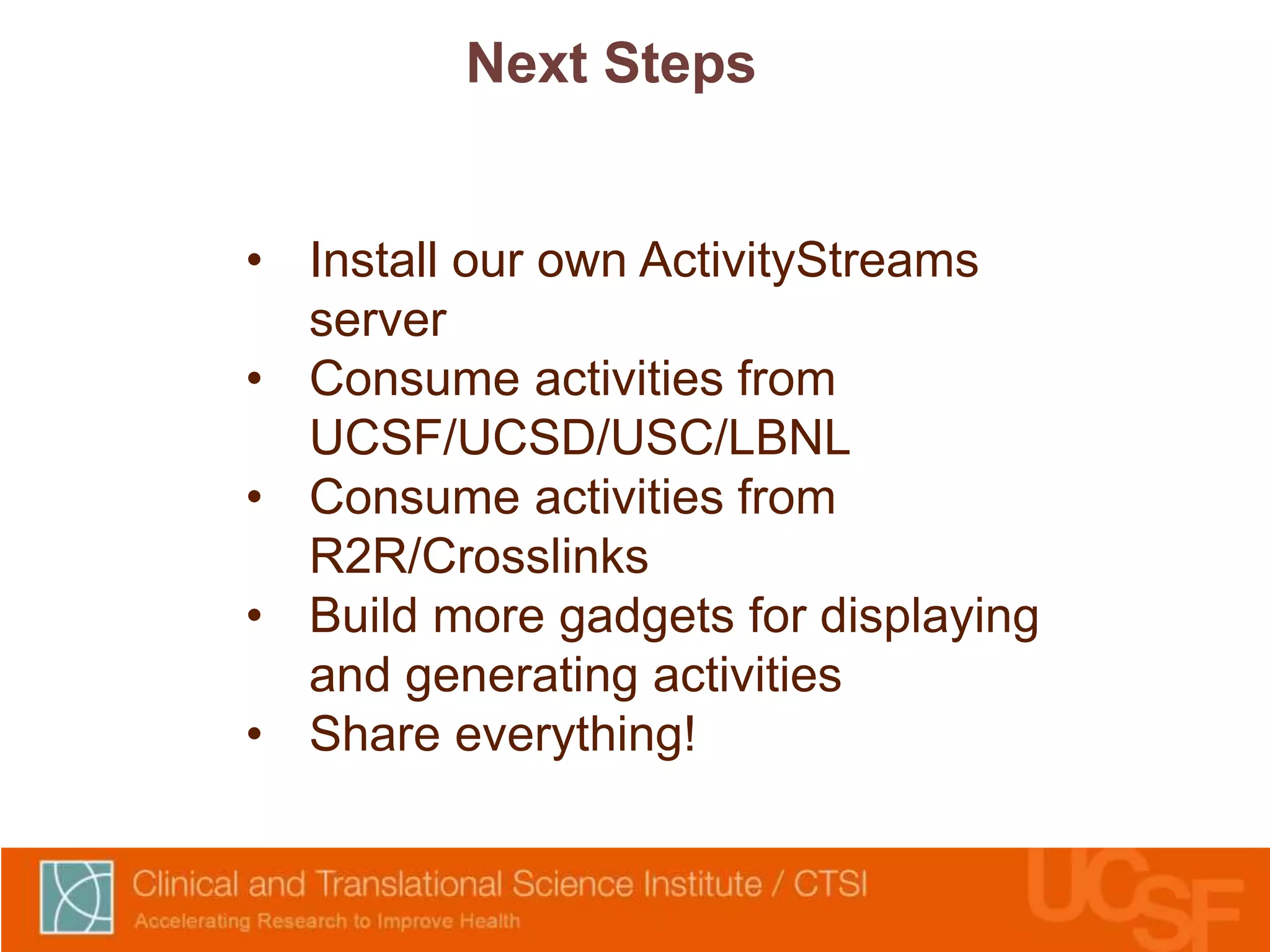
    Next Steps •Install our own ActivityStreams server • Consume activities from UCSF/UCSD/USC/LBNL • Consume activities from R2R/Crosslinks • Build more gadgets for displaying and generating activities • Share everything!
  • 18.
  • 19.
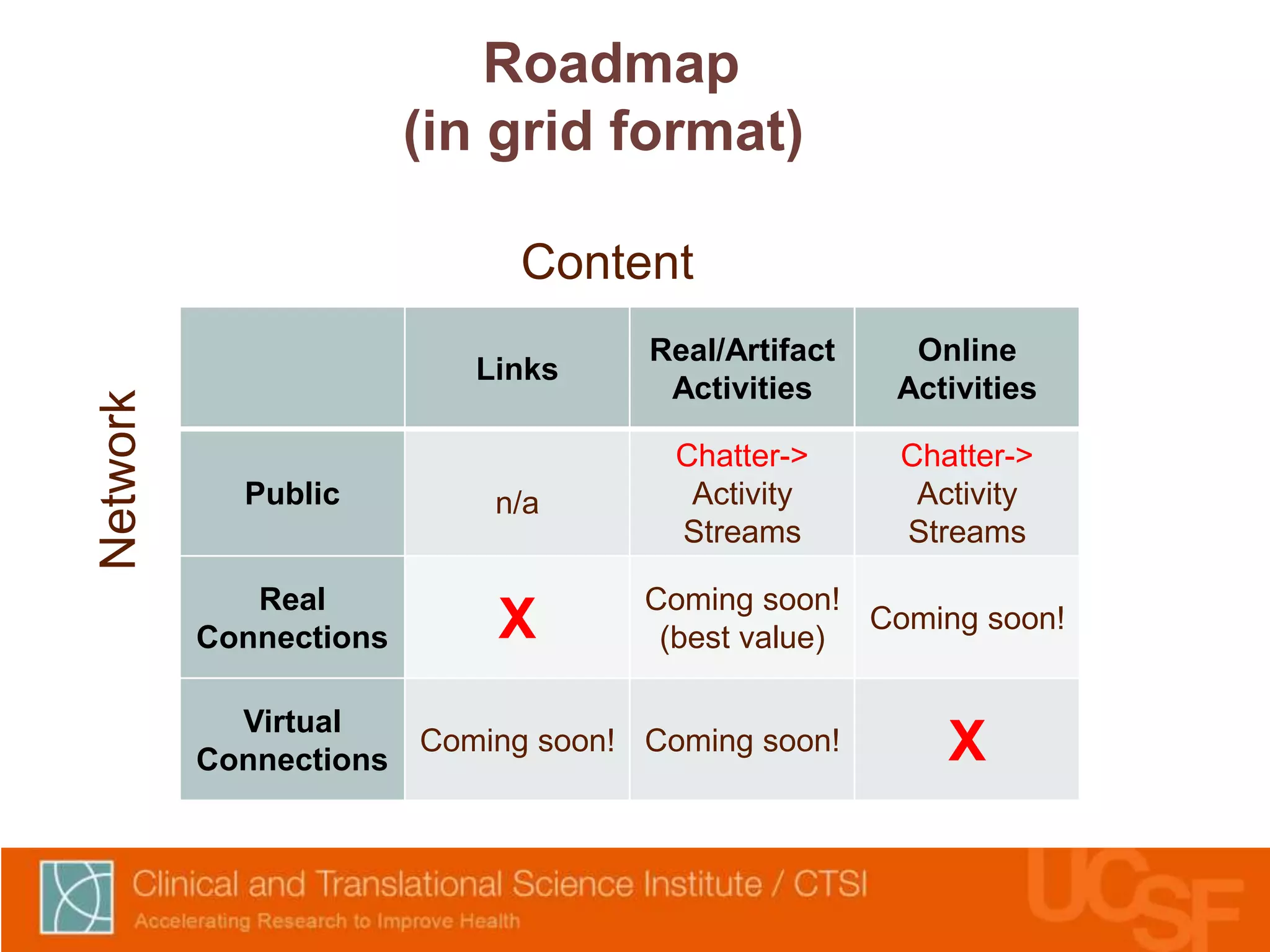
    Roadmap (in gridformat) Links Real/Artifact Activities Online Activities Public n/a Chatter-> Activity Streams Chatter-> Activity Streams Real X Coming soon! Connections (best value) Coming soon! Virtual Connections Coming soon! Coming soon! X Network Content

Editor's Notes

  • #4 We have added as much info about them automatically as possible Many small networks, instead of one big one like LinkedIn or FaceBook.
  • #6 The mainstream and research worlds see institutional pages as much more credible than GoogleScholar, Knode, etc. some of our biggest national news outlets are linking to our little res networking tool NYT WSJ Every news story on ucsf.edu that mentions a researcher links back to their profile
  • #7 Local sites can be customized for local needs No just branding, but functionality. This gives researchers and institutions exactly what they need/want in a RNS.
  • #8  83,000 visits = average 2,769 visits/day We let people how much and who is viewing their page. This leverages their vanity to encourage them to keep updating/enhancing their page. Google notices that pages are user-updated, often with rich content and links to other sites. Virtuous cycle
  • #9  We have a small survey that pops … surprisingly many folks do leave us substantive comments We actually are proud of our local instance of Profiles.
  • #10 Metcalfe’s Law states that the value of a communication network is proportional to the square of the number of connected users in the system: double the amount of users in your system and you will quadruple your value.
  • #12 If our experience with Profiles is any indication, users are in ‘network fatigue’ and automation is a necessity. Data sources like PubMed or Elsevier ARE ‘global’ but they’re not linked or indexed to researchers
  • #14 Go to my page to show r2r data
  • #15 Explain row and column header real connections: co-authors, on a clinical trial together, met at a conference (Nik Benniik) Virtual: follow online Show (link) Real Activities (publish a paper, awarded a grant, uploaded a photo Virtual Activities (tweet or microblog, send an email, like)
  • #16 http://profiles.ucsd.edu/profile/1312184 http://profiles.ucsd.edu/edmund.capparelli ecpparelli@pumpit.info login as carol 17154@ucsd.edu Firefox   http://stage-profiles.ucsf.edu/profiles200/francesca.aweeka faweeka@pumpit.info Chrome   I will log in as myself in Chrome. Via pumpit and profiles Show the demo gadget on my edit page Find aweeka Follow Capparelli Do his stuff below Go back to my edit page Refresh Show on phone     Log in as edmund on profiles, Edmund in pumpit.info Go to Capparelli’s edit page Look for json-ld and oauth folks
  • #17 Mention best value Seeing what your peeps are up to helps to engender the sense of community, and that’s important
  • #18 We only flow public activities out of the system R2R sees new pubs, narrative, photo, etc. Targeted content page showing google analytics, messages from co-authors, etc Share everything (network effects). Use incommon to allow folks to log into the activity stream serve Social networking should not be a company or a platform, it should be a standard. An open standard. Facebook will become tomorrows hotmail.
  • #20 Mention best value Seeing what your peeps are up to helps to engender the sense of community, and that’s important