Content Marketing Strategy: 9 Steps to
Formulate an Impactful Content
Marketing Strategy
Introduction
In digital marketing, content is king. But not just any content—strategic, purposeful content
that resonates with your audience and drives real results. Welcome to the world of content
marketing, where creativity meets strategy, and words have the power to transform
businesses.
Picture this: You're a small business owner, burning the midnight oil, pouring your heart and
soul into your passion project. You've got an amazing product or service, but somehow, it
feels like you're shouting into the void. Sound familiar? That's where content marketing
comes in, your trusty megaphone in the noisy digital world.
But what exactly is content marketing? It's not just about churning out blog posts or flooding
social media with memes (though who doesn't love a good meme?). Content marketing is
the art and science of creating and distributing valuable, relevant content to attract and
engage a clearly defined audience—with the ultimate goal of driving profitable customer
action.
Now, I know what you're thinking. "Sounds great, but where do I even begin?" Fear not,
intrepid marketer! We're about to embark on a journey through the nine key steps to
developing an effective content marketing strategy. By the end of this article, you'll be armed
with the knowledge and tools to create a content marketing plan that would make even the
savviest of marketers green with envy.
So, grab your favorite beverage, get comfortable, and let's dive into the wonderful world of
content marketing strategy. Trust me, by the time we're done, you'll be itching to put pen to
paper (or fingers to keyboard) and start creating content that truly connects.
Step 1: Define Your Goals
The North Star of Your Content Strategy
Imagine setting sail on a grand adventure without a destination in mind. Sounds thrilling,
right? Maybe for a while, but eventually, you'd find yourself adrift, with no way to measure
progress or know when you've succeeded. That's exactly what trying to do content
marketing without clear goals is like—an aimless journey with no real way to gauge success.
Why Clear Objectives Matter
Setting clear objectives for your content marketing strategy is like plotting your course on a
map. It gives you direction, helps you stay focused, and allows you to measure your
progress along the way. Without clear goals, you're essentially throwing content into the void
and hoping for the best. And let's face it, hope is not a strategy.
Types of Goals to Consider
When it comes to content marketing, there are several types of goals you might want to
focus on:
1. Brand Awareness: Getting your name out there and becoming a recognized player
in your industry.
2. Lead Generation: Attracting potential customers and getting them into your sales
funnel.
3. Customer Engagement: Building relationships with your audience and fostering
loyalty.
4. Thought Leadership: Establishing yourself or your brand as an authority in your
field.
5. SEO and Traffic: Improving your search engine rankings and driving more traffic to
your website.
6. Sales: Directly impacting your bottom line by converting readers into customers.
SMART Criteria: Your Goal-Setting Secret Weapon
Now, it's not enough to just say, "I want more leads" or "I want to increase brand
awareness." To be truly effective, your goals need to be SMART:
● Specific: Clearly define what you want to achieve.
● Measurable: Include concrete numbers and percentages.
● Achievable: Set realistic goals that you can actually attain.
● Relevant: Ensure your goals align with your overall business objectives.
● Time-bound: Set a specific timeframe for achieving your goals.
Examples of Effective Content Marketing Goals
Let's put this into practice with some examples:
1. "Increase website traffic from organic search by 25% within the next 6 months."
2. "Generate 100 new email newsletter sign-ups per month through blog content by the
end of Q3."
3. "Achieve a 15% increase in social media engagement (likes, comments, shares)
across all platforms within 3 months."
4. "Produce and publish 2 in-depth, research-based whitepapers that position us as
thought leaders in our industry by the end of the year."
See how these goals are specific, measurable, and time-bound? They give you a clear
target to aim for and a way to know when you've hit the bullseye.
Your Turn: Crafting Your Content Marketing Goals
Now it's time to roll up your sleeves and define your own content marketing goals. Start by
asking yourself:
● What are the biggest challenges facing my business right now?
● What do I want my content to achieve for my business?
● How will content marketing support my overall business objectives?
Once you've brainstormed some ideas, run them through the SMART criteria. Refine and
adjust until you have 3-5 solid, actionable goals that will guide your content marketing
strategy.
Remember, your goals aren't set in stone. As you progress in your content marketing
journey, you may find that you need to adjust your objectives. That's okay! The important
thing is to have a clear direction to start with.
With your goals defined, you've taken the first crucial step in developing your content
marketing strategy. You've set your destination—now it's time to figure out who you're taking
on this journey with you. In the next section, we'll dive into understanding your audience, the
key to creating content that truly resonates.
Step 2: Understand Your Audience
The Heart of Your Content Strategy
Picture this: You've crafted what you believe to be the most brilliant piece of content in the
history of the written word. It's witty, it's informative, it's beautifully designed. You hit publish
with a flourish, sit back, and wait for the accolades to roll in. But instead of applause, you're
met with... crickets. What went wrong?
The answer, my friend, lies in understanding your audience. You see, no matter how
objectively great your content is, if it doesn't resonate with the people you're trying to reach,
it's not going to have the impact you're hoping for. That's why getting to know your audience
isn't just important—it's absolutely crucial to your content marketing success.
The Importance of Audience Research
Audience research is like being a detective, except instead of solving crimes, you're
uncovering valuable insights about the people you want to reach. It's about digging deep to
understand their needs, desires, pain points, and preferences. This knowledge is pure gold
when it comes to creating content that truly connects.
Think about it: When you really understand your audience, you can:
● Speak their language, using terms and phrases that resonate with them
● Address the specific problems they're facing
● Provide solutions that are tailored to their needs
● Create content in formats they prefer and on platforms they frequent
● Develop a brand voice that appeals to them
In short, audience research allows you to create content that feels like it was made just for
them—because, in a way, it was.
Creating Buyer Personas: Getting to Know Your Ideal Customer
One of the most effective ways to understand your audience is by creating buyer personas.
These are semi-fictional representations of your ideal customers, based on real data and
some educated speculation about demographics, behaviors, motivations, and goals.
Think of buyer personas as characters in the story of your brand. By giving them names,
backgrounds, and personalities, you make it easier to create content that speaks directly to
them.
Here's what a basic buyer persona might include:
1. Demographics: Age, gender, income, education level, job title, etc.
2. Psychographics: Values, interests, lifestyle, personality traits
3. Goals and Challenges: What they're trying to achieve and what's standing in their
way
4. Preferred Content Types: Do they prefer long-form articles, quick video tutorials, or
interactive infographics?
5. Favorite Platforms: Where do they spend their time online?
6. Buying Behavior: How do they make purchasing decisions?
For example, let's say you run a fitness app. One of your personas might be "Busy Beth," a
35-year-old working mom who wants to get fit but struggles to find time for the gym. Knowing
this, you might create content like "5-Minute Workouts for Busy Moms" or "How to Sneak
Exercise into Your Daily Routine."
Tools and Methods for Audience Analysis
Now, you might be wondering, "This all sounds great, but how do I actually gather this
information?" Fear not! There are plenty of tools and methods at your disposal:
1. Surveys: Direct feedback from your audience is invaluable. Use tools like
SurveyMonkey or Google Forms to ask your customers about their preferences,
challenges, and content consumption habits.
2. Social Media Analytics: Platforms like Facebook Insights and Twitter Analytics can
provide a wealth of demographic and behavioral data about your followers.
3. Google Analytics: This powerful tool can tell you a lot about who's visiting your
website, what content they're engaging with, and how they're finding you.
4. Customer Interviews: Nothing beats a good old-fashioned conversation. Reach out
to some of your best customers and ask if they'd be willing to chat about their
experiences and needs.
5. Competitor Analysis: Take a look at what your competitors are doing. What kind of
content seems to be resonating with their audience?
6. Industry Reports: Many industries have comprehensive reports that can provide
valuable demographic and psychographic data about your target market.
Mapping Audience Needs and Pain Points
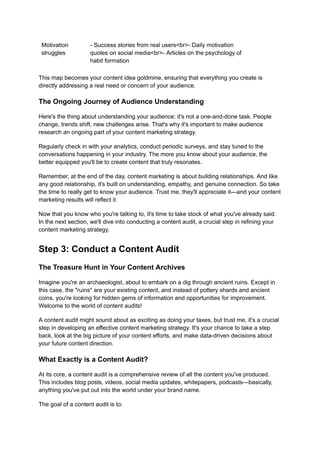
Once you've gathered all this juicy data, it's time to put it to work. One effective way to do
this is by creating a needs and pain points map. This involves listing out the primary
challenges or goals your audience has, and then brainstorming how your content can
address each one.
For example:
Need/Pain
Point
Content Ideas
Lack of time for
exercise
- Quick workout routines<br>- Tips for integrating exercise
into daily life<br>- Time management strategies for fitness
Confusion about
nutrition
- Easy, healthy recipe ideas<br>- Explainer videos on
macronutrients<br>- Myth-busting articles about popular
diets
Motivation
struggles
- Success stories from real users<br>- Daily motivation
quotes on social media<br>- Articles on the psychology of
habit formation
This map becomes your content idea goldmine, ensuring that everything you create is
directly addressing a real need or concern of your audience.
The Ongoing Journey of Audience Understanding
Here's the thing about understanding your audience: it's not a one-and-done task. People
change, trends shift, new challenges arise. That's why it's important to make audience
research an ongoing part of your content marketing strategy.
Regularly check in with your analytics, conduct periodic surveys, and stay tuned to the
conversations happening in your industry. The more you know about your audience, the
better equipped you'll be to create content that truly resonates.
Remember, at the end of the day, content marketing is about building relationships. And like
any good relationship, it's built on understanding, empathy, and genuine connection. So take
the time to really get to know your audience. Trust me, they'll appreciate it—and your content
marketing results will reflect it.
Now that you know who you're talking to, it's time to take stock of what you've already said.
In the next section, we'll dive into conducting a content audit, a crucial step in refining your
content marketing strategy.
Step 3: Conduct a Content Audit
The Treasure Hunt in Your Content Archives
Imagine you're an archaeologist, about to embark on a dig through ancient ruins. Except in
this case, the "ruins" are your existing content, and instead of pottery shards and ancient
coins, you're looking for hidden gems of information and opportunities for improvement.
Welcome to the world of content audits!
A content audit might sound about as exciting as doing your taxes, but trust me, it's a crucial
step in developing an effective content marketing strategy. It's your chance to take a step
back, look at the big picture of your content efforts, and make data-driven decisions about
your future content direction.
What Exactly is a Content Audit?
At its core, a content audit is a comprehensive review of all the content you've produced.
This includes blog posts, videos, social media updates, whitepapers, podcasts—basically,
anything you've put out into the world under your brand name.
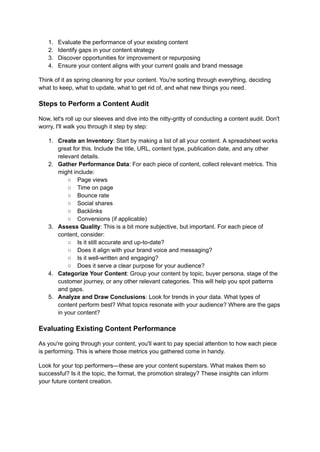
The goal of a content audit is to:
1. Evaluate the performance of your existing content
2. Identify gaps in your content strategy
3. Discover opportunities for improvement or repurposing
4. Ensure your content aligns with your current goals and brand message
Think of it as spring cleaning for your content. You're sorting through everything, deciding
what to keep, what to update, what to get rid of, and what new things you need.
Steps to Perform a Content Audit
Now, let's roll up our sleeves and dive into the nitty-gritty of conducting a content audit. Don't
worry, I'll walk you through it step by step:
1. Create an Inventory: Start by making a list of all your content. A spreadsheet works
great for this. Include the title, URL, content type, publication date, and any other
relevant details.
2. Gather Performance Data: For each piece of content, collect relevant metrics. This
might include:
○ Page views
○ Time on page
○ Bounce rate
○ Social shares
○ Backlinks
○ Conversions (if applicable)
3. Assess Quality: This is a bit more subjective, but important. For each piece of
content, consider:
○ Is it still accurate and up-to-date?
○ Does it align with your brand voice and messaging?
○ Is it well-written and engaging?
○ Does it serve a clear purpose for your audience?
4. Categorize Your Content: Group your content by topic, buyer persona, stage of the
customer journey, or any other relevant categories. This will help you spot patterns
and gaps.
5. Analyze and Draw Conclusions: Look for trends in your data. What types of
content perform best? What topics resonate with your audience? Where are the gaps
in your content?
Evaluating Existing Content Performance
As you're going through your content, you'll want to pay special attention to how each piece
is performing. This is where those metrics you gathered come in handy.
Look for your top performers—these are your content superstars. What makes them so
successful? Is it the topic, the format, the promotion strategy? These insights can inform
your future content creation.
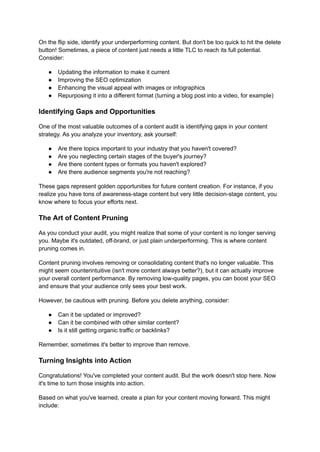
On the flip side, identify your underperforming content. But don't be too quick to hit the delete
button! Sometimes, a piece of content just needs a little TLC to reach its full potential.
Consider:
● Updating the information to make it current
● Improving the SEO optimization
● Enhancing the visual appeal with images or infographics
● Repurposing it into a different format (turning a blog post into a video, for example)
Identifying Gaps and Opportunities
One of the most valuable outcomes of a content audit is identifying gaps in your content
strategy. As you analyze your inventory, ask yourself:
● Are there topics important to your industry that you haven't covered?
● Are you neglecting certain stages of the buyer's journey?
● Are there content types or formats you haven't explored?
● Are there audience segments you're not reaching?
These gaps represent golden opportunities for future content creation. For instance, if you
realize you have tons of awareness-stage content but very little decision-stage content, you
know where to focus your efforts next.
The Art of Content Pruning
As you conduct your audit, you might realize that some of your content is no longer serving
you. Maybe it's outdated, off-brand, or just plain underperforming. This is where content
pruning comes in.
Content pruning involves removing or consolidating content that's no longer valuable. This
might seem counterintuitive (isn't more content always better?), but it can actually improve
your overall content performance. By removing low-quality pages, you can boost your SEO
and ensure that your audience only sees your best work.
However, be cautious with pruning. Before you delete anything, consider:
● Can it be updated or improved?
● Can it be combined with other similar content?
● Is it still getting organic traffic or backlinks?
Remember, sometimes it's better to improve than remove.
Turning Insights into Action
Congratulations! You've completed your content audit. But the work doesn't stop here. Now
it's time to turn those insights into action.
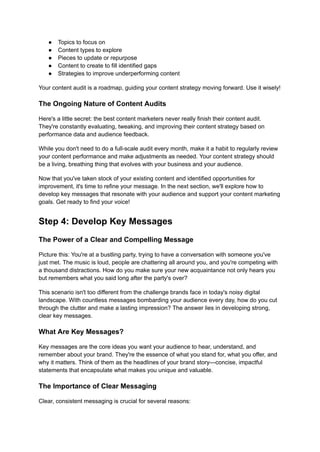
Based on what you've learned, create a plan for your content moving forward. This might
include:
● Topics to focus on
● Content types to explore
● Pieces to update or repurpose
● Content to create to fill identified gaps
● Strategies to improve underperforming content
Your content audit is a roadmap, guiding your content strategy moving forward. Use it wisely!
The Ongoing Nature of Content Audits
Here's a little secret: the best content marketers never really finish their content audit.
They're constantly evaluating, tweaking, and improving their content strategy based on
performance data and audience feedback.
While you don't need to do a full-scale audit every month, make it a habit to regularly review
your content performance and make adjustments as needed. Your content strategy should
be a living, breathing thing that evolves with your business and your audience.
Now that you've taken stock of your existing content and identified opportunities for
improvement, it's time to refine your message. In the next section, we'll explore how to
develop key messages that resonate with your audience and support your content marketing
goals. Get ready to find your voice!
Step 4: Develop Key Messages
The Power of a Clear and Compelling Message
Picture this: You're at a bustling party, trying to have a conversation with someone you've
just met. The music is loud, people are chattering all around you, and you're competing with
a thousand distractions. How do you make sure your new acquaintance not only hears you
but remembers what you said long after the party's over?
This scenario isn't too different from the challenge brands face in today's noisy digital
landscape. With countless messages bombarding your audience every day, how do you cut
through the clutter and make a lasting impression? The answer lies in developing strong,
clear key messages.
What Are Key Messages?
Key messages are the core ideas you want your audience to hear, understand, and
remember about your brand. They're the essence of what you stand for, what you offer, and
why it matters. Think of them as the headlines of your brand story—concise, impactful
statements that encapsulate what makes you unique and valuable.
The Importance of Clear Messaging
Clear, consistent messaging is crucial for several reasons:
1. It builds brand recognition: When you communicate the same core ideas
consistently, people start to associate those ideas with your brand.
2. It differentiates you from competitors: Well-crafted messages highlight what
makes you unique in the marketplace.
3. It guides content creation: Your key messages serve as a North Star for all your
content, ensuring everything you produce aligns with your brand's core values and
goals.
4. It helps your audience understand your value: Clear messages make it easy for
potential customers to grasp why they should choose you over alternatives.
5. It creates consistency across channels: Whether someone encounters your brand
on social media, your website, or in person, they should get the same core message.
Crafting Your Unique Value Proposition
At the heart of your key messages should be your Unique Value Proposition (UVP). This is a
clear statement that describes the benefit of your offer, how you solve your customer's
needs, and what distinguishes you from the competition.
To develop your UVP, ask yourself:
● What specific benefit do we provide?
● How do we solve our customers' problems or improve their situation?
● What makes us different from our competitors?
Your UVP should be clear, concise, and compelling. It's not a catchy slogan or a list of
features—it's a straightforward statement of the unique value you bring to your customers.
For example, Uber's UVP might be: "The smartest way to get around. One tap and a car
comes directly to you. Your driver knows exactly where to go. And payment is completely
cashless."
Aligning Messages with Audience Needs
Remember all that audience research we did in Step 2? This is where it really pays off. Your
key messages should directly address the needs, pain points, and desires of your target
audience.
For each of your primary audience segments, consider:
● What are their main challenges or goals?
● What do they value most?
● What objections might they have to your product or service?
● What language and tone resonate with them?
Then, craft messages that speak directly to these points. For instance, if you're targeting
busy professionals with a time-saving app, your message might focus on efficiency and
productivity rather than cost-savings.
Characteristics of Effective Key Messages
As you develop your key messages, keep these characteristics in mind:
1. Clear and Concise: Your messages should be easy to understand and remember.
Avoid jargon and complex language.
2. Relevant: They should matter to your target audience and address their needs or
interests.
3. Distinctive: Your messages should set you apart from competitors.
4. Credible: They need to be believable and supported by evidence.
5. Consistent: While the exact wording might vary, the core ideas should remain
constant across all your communications.
6. Memorable: Use language that sticks in people's minds.
7. Positive: Focus on the benefits and solutions you provide, not problems or
negatives.
Examples of Effective Key Messages
Let's look at some examples of strong key messages from well-known brands:
1. Apple: "Think Different." This simple phrase encapsulates Apple's brand identity as
innovative and unique.
2. Nike: "Just Do It." This message resonates with athletes and fitness enthusiasts,
encouraging action and determination.
3. Walmart: "Save money. Live better." This clearly communicates Walmart's value
proposition of affordable prices leading to improved quality of life.
4. Avis: "We try harder." As the number two car rental company, Avis turned their
underdog status into a key message about superior effort and service.
Developing Your Own Key Messages
Now it's time to roll up your sleeves and develop your own key messages. Here's a
step-by-step process:
1. Start with brainstorming: Write down all the potential messages you could
communicate about your brand. Don't worry about perfecting them yet—just get
ideas flowing.
2. Narrow it down: Look for common themes in your brainstorming and group similar
ideas together.
3. Refine and polish: Take your top ideas and start crafting them into clear, concise
statements.
4. Test with your audience: Get feedback from customers or team members to see
which messages resonate most.
5. Iterate and improve: Based on feedback, refine your messages further.
Remember, you're aiming for 3-5 key messages that capture the essence of your brand and
resonate with your audience.
Integrating Key Messages into Your Content
Once you've developed your key messages, the real work begins: consistently integrating
them into all your content. This doesn't mean repeating them word-for-word in every piece of
content. Rather, use them as themes to guide your content creation.
For example, if one of your key messages is about exceptional customer service, you might:
● Write blog posts with customer service tips
● Share customer success stories on social media
● Create videos showcasing your support team in action
● Include customer testimonials in your email marketing
The goal is to reinforce your key messages across all touchpoints, creating a consistent and
memorable brand experience for your audience.
The Evolution of Key Messages
Like many aspects of your content strategy, your key messages aren't set in stone. As your
business evolves, your market changes, or you gain new insights about your audience, you
may need to revisit and refine your messages.
Regularly review your key messages to ensure they still accurately reflect your brand and
resonate with your audience. Don't be afraid to make changes if needed, but do so
thoughtfully to maintain consistency and avoid confusing your audience.
With your key messages defined, you've laid a strong foundation for your content strategy.
These messages will guide what you say and how you say it across all your content. But
what exactly should that content look like? In the next section, we'll explore choosing the
right content types and channels to effectively deliver your messages to your audience. Get
ready to get creative!
Step 5: Choose Content Types and Channels
The Content Buffet: Serving Up a Variety of Options
Imagine walking into a restaurant where the only item on the menu is plain steamed broccoli.
Now, broccoli is great (and good for you!), but eating it for every meal would get pretty boring
pretty fast, right? The same principle applies to your content strategy. If you're only serving
up one type of content on one platform, you're likely to leave a lot of potential customers
hungry for something different.
In this digital age, we're blessed (and sometimes overwhelmed) with a smorgasbord of
content types and channels to choose from. The key is selecting the right mix to satisfy your
audience's appetite for information, entertainment, and value.
Overview of Different Content Types
Let's start by exploring some of the most popular types of content:
1. Blog Posts: The bread and butter of content marketing. Great for in-depth
explorations of topics, SEO, and establishing thought leadership.
2. Videos: From quick social media clips to long-form tutorials, videos are engaging and
shareable.
3. Infographics: Perfect for presenting complex information in a visually appealing,
easy-to-digest format.
4. Podcasts: Audio content is booming, allowing people to consume content while
multitasking.
5. Ebooks and Whitepapers: Long-form content that provides deep dives into topics
and is often used for lead generation.
6. Case Studies: Showcase your successes and provide social proof of your product or
service's value.
7. Social Media Posts: Quick, snackable content that keeps your audience engaged
on a daily basis.
8. Webinars: Live or recorded presentations that allow for direct interaction with your
audience.
9. Email Newsletters: Regular updates delivered directly to your audience's inbox.
10. Interactive Content: Quizzes, calculators, or tools that provide personalized value to
users.
Each of these content types has its own strengths and is suited to different purposes and
audience preferences.
The Importance of Multi-Channel Distribution
Now that we've covered content types, let's talk about where to put that content. In today's
fragmented media landscape, it's rarely enough to focus on just one channel. Your audience
is likely spread across multiple platforms, and to reach them effectively, you need to be
where they are.
A multi-channel approach offers several benefits:
1. Wider Reach: Different people prefer different platforms. By diversifying, you
increase your chances of connecting with more of your target audience.
2. Reinforced Messaging: When people encounter your brand across multiple
touchpoints, it reinforces your key messages and increases brand recall.
3. Different Strokes for Different Folks: Various channels allow you to cater to
different content consumption preferences (reading, watching, listening).
4. Improved SEO: A diverse content strategy can boost your search engine visibility.
5. Risk Mitigation: If one channel underperforms or changes its algorithm, you're not
putting all your eggs in one basket.
Matching Content Types to Audience Preferences
Remember all that audience research we did back in Step 2? This is where it really pays off.
Use your understanding of your audience to guide your choices of content types and
channels.
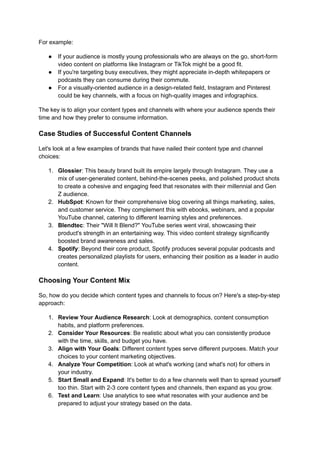
For example:
● If your audience is mostly young professionals who are always on the go, short-form
video content on platforms like Instagram or TikTok might be a good fit.
● If you're targeting busy executives, they might appreciate in-depth whitepapers or
podcasts they can consume during their commute.
● For a visually-oriented audience in a design-related field, Instagram and Pinterest
could be key channels, with a focus on high-quality images and infographics.
The key is to align your content types and channels with where your audience spends their
time and how they prefer to consume information.
Case Studies of Successful Content Channels
Let's look at a few examples of brands that have nailed their content type and channel
choices:
1. Glossier: This beauty brand built its empire largely through Instagram. They use a
mix of user-generated content, behind-the-scenes peeks, and polished product shots
to create a cohesive and engaging feed that resonates with their millennial and Gen
Z audience.
2. HubSpot: Known for their comprehensive blog covering all things marketing, sales,
and customer service. They complement this with ebooks, webinars, and a popular
YouTube channel, catering to different learning styles and preferences.
3. Blendtec: Their "Will It Blend?" YouTube series went viral, showcasing their
product's strength in an entertaining way. This video content strategy significantly
boosted brand awareness and sales.
4. Spotify: Beyond their core product, Spotify produces several popular podcasts and
creates personalized playlists for users, enhancing their position as a leader in audio
content.
Choosing Your Content Mix
So, how do you decide which content types and channels to focus on? Here's a step-by-step
approach:
1. Review Your Audience Research: Look at demographics, content consumption
habits, and platform preferences.
2. Consider Your Resources: Be realistic about what you can consistently produce
with the time, skills, and budget you have.
3. Align with Your Goals: Different content types serve different purposes. Match your
choices to your content marketing objectives.
4. Analyze Your Competition: Look at what's working (and what's not) for others in
your industry.
5. Start Small and Expand: It's better to do a few channels well than to spread yourself
too thin. Start with 2-3 core content types and channels, then expand as you grow.
6. Test and Learn: Use analytics to see what resonates with your audience and be
prepared to adjust your strategy based on the data.
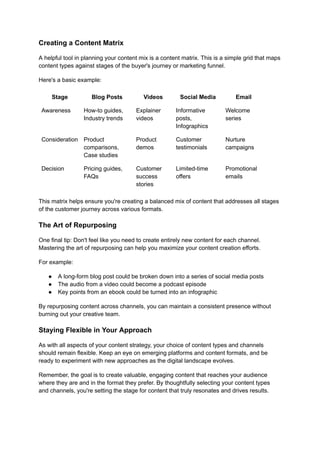
Creating a Content Matrix
A helpful tool in planning your content mix is a content matrix. This is a simple grid that maps
content types against stages of the buyer's journey or marketing funnel.
Here's a basic example:
Stage Blog Posts Videos Social Media Email
Awareness How-to guides,
Industry trends
Explainer
videos
Informative
posts,
Infographics
Welcome
series
Consideration Product
comparisons,
Case studies
Product
demos
Customer
testimonials
Nurture
campaigns
Decision Pricing guides,
FAQs
Customer
success
stories
Limited-time
offers
Promotional
emails
This matrix helps ensure you're creating a balanced mix of content that addresses all stages
of the customer journey across various formats.
The Art of Repurposing
One final tip: Don't feel like you need to create entirely new content for each channel.
Mastering the art of repurposing can help you maximize your content creation efforts.
For example:
● A long-form blog post could be broken down into a series of social media posts
● The audio from a video could become a podcast episode
● Key points from an ebook could be turned into an infographic
By repurposing content across channels, you can maintain a consistent presence without
burning out your creative team.
Staying Flexible in Your Approach
As with all aspects of your content strategy, your choice of content types and channels
should remain flexible. Keep an eye on emerging platforms and content formats, and be
ready to experiment with new approaches as the digital landscape evolves.
Remember, the goal is to create valuable, engaging content that reaches your audience
where they are and in the format they prefer. By thoughtfully selecting your content types
and channels, you're setting the stage for content that truly resonates and drives results.
Now that you know what type of content you'll be creating and where you'll be sharing it, it's
time to get organized. In the next section, we'll dive into creating a content calendar that will
keep your content strategy on track and your team aligned. Get ready to become a master of
content planning!
Step 6: Create a Content Calendar
Bringing Order to the Content Chaos
Picture this: It's Monday morning, and your team is huddled around the conference table,
frantically trying to figure out what content needs to be created this week. Sound familiar? If
so, you're not alone. Many businesses struggle with the day-to-day management of their
content marketing efforts. This is where a content calendar comes to the rescue.
A content calendar is more than just a schedule of what to post when. It's a strategic tool that
helps you plan, organize, and execute your content marketing strategy with precision and
purpose. It's the difference between a haphazard approach to content creation and a
well-oiled content marketing machine.
The Importance of Planning and Consistency
Before we dive into the nuts and bolts of creating a content calendar, let's talk about why it's
so crucial:
1. Consistency: Regular, predictable content helps build audience expectations and
keeps them coming back for more.
2. Strategic Alignment: A calendar ensures your content aligns with your overall
marketing goals and key events throughout the year.
3. Resource Management: By planning ahead, you can better manage your time,
budget, and team resources.
4. Collaboration: A shared calendar keeps everyone on the same page, from content
creators to social media managers.
5. Balance: It helps ensure a good mix of content types, topics, and promotional vs.
non-promotional content.
6. Accountability: Clear deadlines and responsibilities keep your team on track.
7. Adaptability: While providing structure, a good content calendar also allows for
flexibility to respond to current events or trending topics.
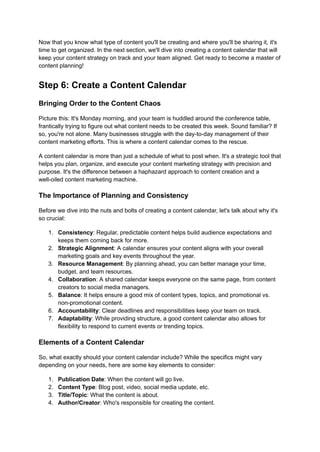
Elements of a Content Calendar
So, what exactly should your content calendar include? While the specifics might vary
depending on your needs, here are some key elements to consider:
1. Publication Date: When the content will go live.
2. Content Type: Blog post, video, social media update, etc.
3. Title/Topic: What the content is about.
4. Author/Creator: Who's responsible for creating the content.
5. Status: Draft, in review, scheduled, published, etc.
6. Channel: Where the content will be published (blog, YouTube, Instagram, etc.).
7. Target Audience: Which persona or segment the content is aimed at.
8. Buyer's Journey Stage: Awareness, consideration, or decision.
9. Key Message: Which of your key messages the content supports.
10. Call to Action: What you want the audience to do after consuming the content.
11. Promotion Plan: How you'll distribute and promote the content.
12. Keywords: For SEO purposes, if applicable.
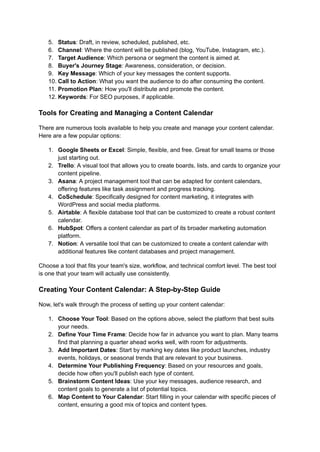
Tools for Creating and Managing a Content Calendar
There are numerous tools available to help you create and manage your content calendar.
Here are a few popular options:
1. Google Sheets or Excel: Simple, flexible, and free. Great for small teams or those
just starting out.
2. Trello: A visual tool that allows you to create boards, lists, and cards to organize your
content pipeline.
3. Asana: A project management tool that can be adapted for content calendars,
offering features like task assignment and progress tracking.
4. CoSchedule: Specifically designed for content marketing, it integrates with
WordPress and social media platforms.
5. Airtable: A flexible database tool that can be customized to create a robust content
calendar.
6. HubSpot: Offers a content calendar as part of its broader marketing automation
platform.
7. Notion: A versatile tool that can be customized to create a content calendar with
additional features like content databases and project management.
Choose a tool that fits your team's size, workflow, and technical comfort level. The best tool
is one that your team will actually use consistently.
Creating Your Content Calendar: A Step-by-Step Guide
Now, let's walk through the process of setting up your content calendar:
1. Choose Your Tool: Based on the options above, select the platform that best suits
your needs.
2. Define Your Time Frame: Decide how far in advance you want to plan. Many teams
find that planning a quarter ahead works well, with room for adjustments.
3. Add Important Dates: Start by marking key dates like product launches, industry
events, holidays, or seasonal trends that are relevant to your business.
4. Determine Your Publishing Frequency: Based on your resources and goals,
decide how often you'll publish each type of content.
5. Brainstorm Content Ideas: Use your key messages, audience research, and
content goals to generate a list of potential topics.
6. Map Content to Your Calendar: Start filling in your calendar with specific pieces of
content, ensuring a good mix of topics and content types.
7. Assign Responsibilities: Determine who will create, edit, and publish each piece of
content.
8. Set Deadlines: Work backwards from publication dates to set deadlines for drafts,
edits, and final approvals.
9. Plan for Promotion: Include notes on how each piece of content will be promoted
across channels.
10. Review and Adjust: Regularly review your calendar with your team and be prepared
to make adjustments as needed.
Tips for Effective Content Calendar Management
1. Color Code: Use colors to differentiate between content types, channels, or team
members for easy visual reference.
2. Build in Buffer Time: Allow some slack in your schedule for unexpected delays or
opportunities.
3. Include Evergreen Content: Mix in timeless pieces that can be repurposed or
reshared.
4. Plan for Content Clusters: Group related content together to create comprehensive
resources on key topics.
5. Use Content Themes: Consider organizing content around monthly themes to
create cohesion.
6. Track Performance: Include columns to note key metrics for each piece of content,
helping inform future planning.
7. Stay Flexible: While planning is crucial, be ready to adjust your calendar in response
to current events or emerging trends.
Balancing Planning and Agility
While a content calendar provides structure, it's important to strike a balance between
planning and flexibility. The digital landscape moves fast, and sometimes the most engaging
content is created in response to current events or trending topics.
To maintain agility:
1. Leave Some Gaps: Keep some slots open in your calendar for timely, reactive
content.
2. Have a Rapid Response Plan: Create a process for quickly producing and
approving time-sensitive content.
3. Regularly Review and Update: Set aside time each week or month to review your
calendar and make necessary adjustments.
4. Create Evergreen Backups: Have a bank of timeless content ready to fill gaps if
planned content falls through.
Measuring and Optimizing Your Content Calendar
Like all aspects of your content strategy, your content calendar should be subject to ongoing
analysis and optimization. Regularly review:
1. Content Performance: Which types of content are generating the most engagement
and conversions?
2. Publishing Frequency: Are you publishing too much, too little, or just right for your
audience?
3. Resource Allocation: Is your current schedule sustainable for your team?
4. Goal Alignment: Is your planned content supporting your overall marketing and
business objectives?
Use these insights to refine your approach over time, adjusting your content mix, publishing
frequency, or topic focus as needed.
The Power of a Well-Managed Content Calendar
A thoughtfully created and consistently maintained content calendar is a powerful tool in your
content marketing arsenal. It transforms your content strategy from a vague set of intentions
into a concrete plan of action. It aligns your team, streamlines your workflow, and ensures
that every piece of content you create serves a purpose in your overall strategy.
Remember, the goal isn't to create a rigid, unchangeable plan, but rather to provide a
framework that guides your efforts while allowing for creativity and adaptation. With a solid
content calendar in place, you'll be well-equipped to create consistent, high-quality content
that resonates with your audience and drives your business forward.
Now that you have a plan for what content you'll create and when, it's time to focus on how
you'll create it. In the next section, we'll dive into the process of content creation, exploring
best practices for crafting engaging, valuable content that your audience will love. Get ready
to unleash your creativity!
Step 7: Create Engaging Content
The Art and Science of Content Creation
Picture this: You've done your research, defined your strategy, planned your calendar... and
now you're staring at a blank page (or screen), wondering where to start. Don't
worry—you're not alone. Creating engaging content is both an art and a science, requiring
creativity, strategy, and a deep understanding of your audience.
In this section, we'll explore the process of content creation, from ideation to publication, and
share tips and best practices to help you create content that not only attracts your audience
but keeps them coming back for more.
Understanding What Makes Content Engaging
Before we dive into the how-to, let's consider what makes content truly engaging. Engaging
content typically:
1. Provides Value: It solves a problem, answers a question, or offers insight.
2. Is Relevant: It speaks directly to the interests, needs, or challenges of your
audience.
3. Is Timely: It addresses current trends, issues, or events.
4. Is Easy to Consume: It's well-structured, clear, and appropriately formatted for the
medium.
5. Tells a Story: It has a narrative element that captures attention and evokes emotion.
6. Is Authentic: It reflects your brand's voice and values.
7. Encourages Interaction: It invites comments, shares, or other forms of
engagement.
8. Is Visually Appealing: It uses images, videos, or design elements to enhance the
message.
Keep these elements in mind as we explore the content creation process.
The Content Creation Process
While the specific steps may vary depending on the type of content you're creating, here's a
general framework for the content creation process:
1. Ideation: Generate ideas for content topics.
2. Research: Gather information and data to support your content.
3. Outline: Create a structure for your content.
4. Draft: Write or produce the initial version of your content.
5. Edit: Refine and improve your content.
6. Design: Add visual elements to enhance your content.
7. Review: Have others check your content for quality and accuracy.
8. Optimize: Ensure your content is SEO-friendly and formatted correctly for your
chosen platform.
9. Publish: Share your content with the world.
10. Promote: Distribute your content across various channels.
Let's dive deeper into each of these steps.
1. Ideation: Coming Up with Great Content Ideas
Consistently coming up with fresh, relevant content ideas can be challenging. Here are some
strategies to keep your idea pipeline flowing:
● Use Your Buyer Personas: What questions or challenges do your ideal customers
have?
● Analyze Search Data: What are people searching for related to your industry?
● Monitor Social Media: What topics are trending in your field?
● Check Competitor Content: What are others in your industry talking about? How
can you add a unique perspective?
● Leverage Your Team: Encourage ideas from across your organization, not just the
marketing department.
● Use Idea Generation Tools: Tools like Answer the Public or BuzzSumo can help
identify popular topics and questions.
● Repurpose Existing Content: Can you update old content or present it in a new
format?
Remember to always tie your ideas back to your content strategy and key messages.
2. Research: Building a Solid Foundation
Once you have your topic, it's time to dig deeper. Thorough research not only ensures the
accuracy of your content but also helps you provide unique insights and value to your
audience.
● Use Credible Sources: Rely on reputable industry publications, academic papers,
and expert opinions.
● Conduct Original Research: Consider surveys, interviews, or data analysis to
generate unique insights.
● Check Your Facts: Always verify information, especially statistics or controversial
claims.
● Keep an Open Mind: Be prepared to adjust your angle if your research reveals new
perspectives.
3. Outline: Creating a Roadmap for Your Content
An outline helps organize your thoughts and ensures your content has a logical flow. Here's
a basic structure you can adapt:
1. Introduction: Hook your audience and state the purpose of your content.
2. Main Points: Break your topic into 3-5 key sections.
3. Supporting Details: Add sub-points under each main section.
4. Conclusion: Summarize key takeaways and include a call to action.
For visual content like videos or infographics, your outline might take the form of a
storyboard or rough sketch.
4. Draft: Getting Your Ideas Down
With your outline as a guide, it's time to create your first draft. Here are some tips:
● Just Start Writing: Don't worry about perfection at this stage. Get your ideas down
first.
● Write for Your Audience: Keep your target persona in mind and use language
they're comfortable with.
● Use Your Brand Voice: Ensure your content reflects your brand's personality and
tone.
● Include Examples: Illustrate your points with real-world examples or case studies.
● Break It Up: Use subheadings, bullet points, and short paragraphs to improve
readability.
5. Edit: Polishing Your Content
Good editing can transform decent content into great content. Here's what to focus on:
● Clarity: Is your message clear and easy to understand?
● Flow: Does your content progress logically from point to point?
● Conciseness: Can you say the same thing in fewer words?
● Grammar and Spelling: Use tools like Grammarly to catch basic errors.
● Tone: Does the tone match your brand voice and the content's purpose?
● Call to Action: Is it clear what you want the reader to do next?
6. Design: Adding Visual Appeal
Visual elements can significantly enhance the impact of your content. Consider:
● Images: Use high-quality, relevant images to break up text and illustrate points.
● Infographics: Present complex information in a visually appealing way.
● Videos: Incorporate short video clips to explain concepts or demonstrate products.
● Charts and Graphs: Use data visualization to make statistics more digestible.
● Formatting: Use consistent fonts, colors, and styles that align with your brand
guidelines.
7. Review: Ensuring Quality and Accuracy
Before publishing, have others review your content:
● Peer Review: Have a colleague check for clarity and relevance.
● Expert Review: For technical content, have a subject matter expert verify accuracy.
● Legal Review: If necessary, have your legal team check for any potential issues.
● Client/Stakeholder Review: If the content is for or about a specific client, get their
approval.
8. Optimize: Making Your Content SEO-Friendly
Help your content get found by optimizing it for search engines:
● Use Relevant Keywords: Include your target keywords naturally throughout the
content.
● Optimize Meta Descriptions and Titles: Write compelling, keyword-rich meta
descriptions and titles.
● Use Header Tags: Structure your content with H1, H2, H3 tags.
● Optimize Images: Use descriptive file names and alt text for images.
● Internal Linking: Link to other relevant content on your site.
● External Linking: Link to credible external sources to support your points.
9. Publish: Sharing Your Content with the World
When you're ready to publish:
● Choose the Right Time: Publish when your audience is most likely to engage.
● Double-Check Everything: Do a final review of your content, links, and formatting.
● Test on Different Devices: Ensure your content looks good on desktop, mobile, and
tablet.
10. Promote: Getting Your Content Seen
Creating great content is only half the battle—you also need to get it in front of your
audience:
● Social Media: Share your content across your social platforms.
● Email Marketing: Send your content to your email list.
● Influencer Outreach: Ask industry influencers to share your content.
● Paid Promotion: Consider using paid ads to boost visibility.
● Content Syndication: Share your content on platforms like Medium or LinkedIn
Articles.
Best Practices for Different Content Types
While the above process applies broadly, different types of content may require specific
approaches. Here are some quick tips for common content types:
Blog Posts
● Use a compelling headline
● Start with a strong hook
● Use subheadings to break up text
● Include a mix of short and long paragraphs
● End with a clear call to action
Videos
● Start with a strong opening to grab attention
● Keep it concise—attention spans are short
● Use captions for viewers watching without sound
● End with a clear next step for viewers
Infographics
● Start with a clear, attention-grabbing title
● Use a logical flow of information
● Keep text minimal—let the visuals do the talking
● Use a consistent color scheme and style
● Include your sources at the bottom
Social Media Posts
● Keep it short and snappy
● Use eye-catching visuals
● Include relevant hashtags
● Encourage engagement with questions or calls to action
● Tailor your content to each platform's unique style
Podcasts
● Start with a compelling introduction
● Use a conversational tone
● Include clear episode structure (intro, main content, conclusion)
● End with a teaser for the next episode
The Importance of Consistency and Authenticity
As you create content, remember two key principles:
1. Consistency: Maintain a consistent voice, style, and quality across all your content.
This helps build trust and recognition with your audience.
2. Authenticity: Be true to your brand's values and personality. Authentic content
resonates more deeply with audiences and helps build lasting relationships.
Embracing the Content Creation Journey
Creating engaging content is an ongoing process of learning and refinement. Don't be afraid
to experiment with different formats, topics, and styles. Pay attention to how your audience
responds and be willing to adjust your approach based on their feedback and your analytics.
Remember, the goal is not perfection, but continual improvement. Each piece of content you
create is an opportunity to learn, grow, and connect more deeply with your audience.
With these strategies and best practices in mind, you're well-equipped to create content that
not only engages your audience but also drives your business goals forward. In our next
section, we'll explore how to measure the success of your content efforts and use those
insights to continually refine your strategy. Get ready to dive into the world of content
analytics!
Step 8: Measure and Analyze Your Content
Performance
Creating great content is only part of the equation. To truly succeed in content marketing,
you need to understand how your content is performing and use those insights to continually
refine your strategy. This is where measurement and analysis come into play.
The Importance of Content Analytics
Content analytics provide valuable insights that can help you:
1. Understand what content resonates with your audience
2. Identify areas for improvement
3. Justify your content marketing investments
4. Inform future content strategy decisions
5. Demonstrate the ROI of your content efforts
Let's dive into how to effectively measure and analyze your content performance.
Key Metrics to Track
The specific metrics you track will depend on your goals, but here are some key
performance indicators (KPIs) to consider:
Traffic Metrics
● Pageviews
● Unique visitors
● Traffic sources
● Time on page
● Bounce rate
Engagement Metrics
● Social shares
● Comments
● Likes
● Scroll depth
Conversion Metrics
● Click-through rate (CTR)
● Conversion rate
● Lead generation
● Email sign-ups
SEO Metrics
● Keyword rankings
● Backlinks
● Domain authority
Sales Metrics
● Revenue attributed to content
● Sales qualified leads (SQLs) generated
Setting Up Your Analytics
To track these metrics, you'll need to set up analytics tools. Here are some popular options:
1. Google Analytics: A free, comprehensive tool for tracking website traffic and user
behavior.
2. SEMrush or Ahrefs: Useful for tracking SEO performance and competitor analysis.
3. Social Media Analytics: Most social platforms offer native analytics tools (e.g.,
Facebook Insights, Twitter Analytics).
4. Email Marketing Software: Tools like Mailchimp or Constant Contact provide email
engagement metrics.
5. Content-Specific Tools: Platforms like BuzzSumo can track content performance
across the web.
Ensure you have the necessary tracking codes and integrations set up on your website and
content platforms to collect accurate data.
Creating a Measurement Framework
To make sense of all this data, it's helpful to create a measurement framework. Here's a
simple process:
1. Define Your Goals: What are you trying to achieve with your content?
2. Choose Your KPIs: Based on your goals, what metrics will indicate success?
3. Set Benchmarks: What's your current performance? What's the industry standard?
4. Determine Measurement Frequency: How often will you analyze your data?
5. Create a Reporting Template: Design a standardized report to track performance
over time.
Analyzing Your Data
Once you're collecting data, it's time to analyze it. Here are some key questions to ask:
1. Which content is performing best? Look at your top-performing pieces across
different metrics. What do they have in common?
2. Where is your traffic coming from? Are certain channels driving more engaged
visitors?
3. How does content performance change over time? Do certain topics or formats
have more longevity?
4. What's the conversion path? How does content contribute to your overall
conversion funnel?
5. How does your content compare to competitors? Are there gaps or opportunities
you can capitalize on?
Turning Insights into Action
The real value of analytics comes from using these insights to improve your content strategy.
Here are some ways to do that:
1. Content Optimization: Use performance data to optimize existing content. This
might involve updating information, improving SEO, or tweaking formats.
2. Content Planning: Let your analytics inform future content topics and formats.
Double down on what works and reconsider what doesn't.
3. Distribution Strategy: If certain channels are driving more engaged traffic, consider
focusing more efforts there.
4. User Experience: Use behavioral data to improve your site's UX and content
presentation.
5. ROI Calculation: Use conversion data to calculate and demonstrate the ROI of your
content efforts.
Advanced Analysis Techniques
As you become more comfortable with basic analytics, consider these more advanced
techniques:
1. Content Scoring: Develop a system to score your content based on how well it
meets your objectives.
2. Cohort Analysis: Track how different user groups interact with your content over
time.
3. Attribution Modeling: Understand how different pieces of content contribute to
conversions across the customer journey.
4. Predictive Analytics: Use historical data to predict future content performance and
inform your strategy.
Overcoming Common Challenges in Content Measurement
Measuring content performance can be challenging. Here are some common obstacles and
how to overcome them:
1. Data Overload: Focus on the metrics that directly tie to your goals. Don't get lost in
vanity metrics.
2. Proving ROI: Tie content performance to business outcomes. Use tools like Google
Analytics' Goal Value feature to assign monetary value to conversions.
3. Long Sales Cycles: Use micro-conversions (like email sign-ups) as proxies for
eventual sales in B2B or considered purchase scenarios.
4. Cross-Channel Attribution: Use multi-touch attribution models to understand how
content across different channels contributes to conversions.
5. Qualitative Impact: Don't forget the qualitative impact of content. Use surveys or
interviews to gather feedback on how your content influences brand perception and
customer decisions.
The Continuous Improvement Cycle
Remember, measurement and analysis are not one-time tasks, but part of a continuous
improvement cycle:
1. Measure performance
2. Analyze the data
3. Generate insights
4. Implement changes
5. Repeat
This iterative process allows you to continually refine your content strategy, improving its
effectiveness over time.
Reporting and Stakeholder Communication
Finally, don't forget the importance of communicating your content performance to
stakeholders. Regular reporting helps justify content investments and can secure buy-in for
future initiatives.
Create clear, concise reports that tie content performance to business objectives. Use
visualizations to make the data easy to understand, and always include actionable insights
and next steps.
By implementing a robust measurement and analysis process, you'll be able to continually
improve your content marketing efforts, demonstrating clear value to your organization and
delivering ever-better results for your audience.
Step 9: Iterate and Improve
With a solid measurement and analysis framework in place, you're well-positioned to
continually refine and improve your content marketing strategy. This final step is all about
using the insights you've gained to make your content marketing even more effective.
The Importance of Iteration
Content marketing is not a "set it and forget it" endeavor. The digital landscape is constantly
evolving, as are your audience's needs and preferences. Successful content marketers are
those who can adapt and improve based on data and feedback.
Here's how to approach the iteration process:
1. Regular Strategy Reviews: Schedule quarterly or bi-annual reviews of your overall
content strategy. Use these sessions to assess your progress towards your goals and
make any necessary adjustments.
2. Content Audits: Conduct regular content audits to identify top-performing content,
underperforming content, and gaps in your content offering.
3. Experiment and Test: Don't be afraid to try new things. Use A/B testing to compare
different approaches and see what works best.
4. Stay Informed: Keep up with industry trends and new content marketing techniques.
Attend conferences, read industry publications, and network with other content
marketers.
5. Listen to Your Audience: Pay attention to comments, social media interactions, and
customer feedback. Your audience can provide valuable insights into what they want
to see more (or less) of.
Tactics for Continuous Improvement
Here are some specific tactics you can use to continually improve your content marketing:
1. Content Optimization
Regularly update and optimize your existing content:
● Refresh outdated information
● Improve SEO elements (titles, meta descriptions, headers)
● Enhance readability and formatting
● Add new sections or insights based on recent developments
● Update internal and external links
2. Content Repurposing
Get more mileage out of your best content by repurposing it into different formats:
● Turn a popular blog post into an infographic
● Create a video series based on a successful ebook
● Develop a podcast episode discussing insights from a well-received whitepaper
● Compile related blog posts into a comprehensive guide
3. Distribution Optimization
Continuously refine your content distribution strategy:
● Experiment with posting times on social media
● Try new promotional channels
● Adjust your email marketing frequency or format
● Test different types of social media posts (e.g., text-only vs. image vs. video)
4. Personalization
Use data to create more personalized content experiences:
● Segment your email list and tailor content to different groups
● Use dynamic content on your website based on user behavior or characteristics
● Create content paths that guide users through a personalized journey based on their
interests
5. Interactive Content
Incorporate more interactive elements to boost engagement:
● Create quizzes or assessments
● Develop interactive infographics
● Use polls or surveys to gather feedback and create user-generated content
● Experiment with augmented reality (AR) or virtual reality (VR) content
6. Workflow Optimization
Improve your content creation process:
● Streamline your content calendar management
● Implement new tools to enhance collaboration
● Develop clearer guidelines or templates for content creation
● Provide additional training for your content team
Staying Ahead of the Curve
To ensure your content marketing remains effective, stay informed about emerging trends
and technologies:
1. AI and Machine Learning: Explore how AI can enhance your content creation,
personalization, and analytics.
2. Voice Search: Optimize your content for voice search queries.
3. Video Content: Keep up with evolving video formats and platforms.
4. Data Privacy: Stay informed about data privacy regulations and adjust your
strategies accordingly.
5. New Platforms: Be ready to adapt your content for new and emerging platforms.
Fostering a Culture of Continuous Improvement
Finally, cultivate a mindset of continuous improvement within your team:
1. Encourage Experimentation: Create a safe environment for trying new ideas.
2. Celebrate Learning: Recognize efforts to improve, not just successes.
3. Share Insights: Regularly share learnings and best practices across the team.
4. Invest in Skills: Provide opportunities for your team to enhance their skills and
knowledge.
Remember, the goal of iteration is not perfection, but progress. Each small improvement
adds up over time, leading to significantly better results in the long run.
Recommendation
To further expand your knowledge on content management strategies, you may find the
following free online course helpful:
● Content Management Strategies by Alison: This course covers different aspects of
content management strategies for businesses. It provides a solid introduction to key
concepts like content management systems, content strategy principles, and content
marketing techniques. The course is free to enroll and study.
You can find the course here
Conclusion: Your Content Marketing Journey
Congratulations! You've now explored the key steps to creating and executing a successful
content marketing strategy:
1. Understanding Content Marketing
2. Setting Clear Goals
3. Knowing Your Audience
4. Developing Your Content Strategy
5. Planning Your Content
6. Creating a Content Calendar
7. Creating Engaging Content
8. Measuring and Analyzing Performance
9. Iterating and Improving
Remember, content marketing is a journey, not a destination. It requires ongoing effort,
analysis, and refinement. But with persistence and a strategic approach, it can yield
tremendous benefits for your business.
As you implement these steps, you'll likely face challenges and discover new insights
specific to your business and audience. Embrace these as opportunities to learn and grow.
Keep experimenting, keep measuring, and keep improving.
Most importantly, always keep your audience at the center of your efforts. Create content
that truly provides value, and you'll build lasting relationships with your customers that drive
sustainable business growth.
Best of luck on your content marketing journey!
Additional Resources
To further expand your knowledge on content management strategies, you may find the
following free online course helpful:
● Content Management Strategies by Alison: This course covers different aspects of
content management strategies for businesses. It provides a solid introduction to key
concepts like content management systems, content strategy principles, and content
marketing techniques. The course is free to enroll and study.
You can find the course here
This Alison course could be a great complement to the content marketing strategies we've
discussed, offering additional perspectives and potentially more in-depth coverage of certain
topics. As always, I recommend evaluating any course to ensure it meets your specific
learning needs and goals.