Content Marketing
Defining Content
         Marketing
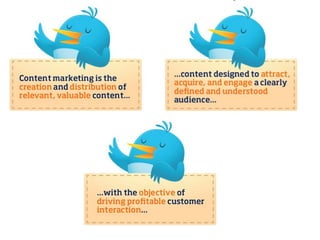
•   Content marketing is the art of communicating with your customers and
    prospects without selling.

•   Content Marketing is non-interruption marketing.

•   Instead of pitching your products or services, you are delivering information
    that makes your buyer more intelligent, informed and inspired.
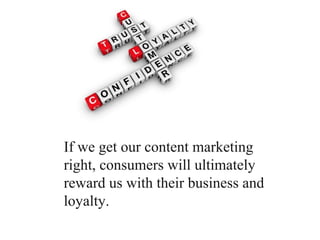
If we get our content marketing
right, consumers will ultimately
reward us with their business and
loyalty.
The history of content
             marketing
        Content marketing is a recent “buzzword”
 but its actually been around in one shape or another for
                         many years.

From the early days of radio, P&G created radio dramas for
                       housewives.

    Video: Content Marketing and the power of story
Why Content
          Marketing?
• Technology is changing consumer behaviour
  in ways we couldn’t imagine just a few years
  ago.
• We now ask others for information as a
  last resort
• Before making a purchase decision, we
  research
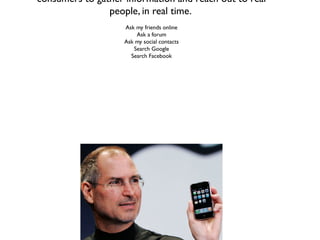
consumers to gather information and reach out to real
                people, in real time.
                    Ask my friends online
                        Ask a forum
                    Ask my social contacts
                       Search Google
                      Search Facebook
Behavioural Changes
• The age of Google: “Google It”
• In 2010, consumers went to 5.3 sources of
  information before making a purchase
  decision.
• In 2012 this doubled to 10.4 sources of
  information.
Trust in Advertising has
           changed.
           changed.
• A 2012 study found 90% of consumers
  trust:
• Brand or product recommendations from
  friends or family via social media or word-
  of-mouth.
• Brand recommendations and reviews that
  is professionally written, from influencers
  and from user generated content.
Yet.....


• Only 10% of consumes trust traditional
  advertising.
• Only 20% of consumers trust promotional
  advertising on digital media outlets.
The reality we face as marketers
•      Brand-led advertising online and offline has lost its allure.
•      Today’s consumers decide where, when, and how they want to engage
       with brands.

•      With multiple interconnected devices at their fingertips at any one
       time, these perpetually connected consumers can opt in or out of
       content as they choose… Marketers face a higher bar to engage
       consumers, who have more media options than ever before.

•      Content Marketing has the ability to create brand differentiation by
       bridging the gap between fading trust in traditional advertising and
       digital media’s efficient reach.


- Tracey Stokes, Forrester Digital Marketing Analyst
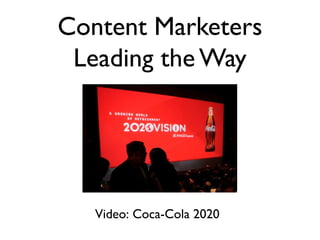
Content Marketers
 Leading the Way


   Video: Coca-Cola 2020
Coke will use content marketing to
reach a “disproportionate share of
pop culture and consumer
conversations”
- Jonathan Mildenhall, Coca-Cola
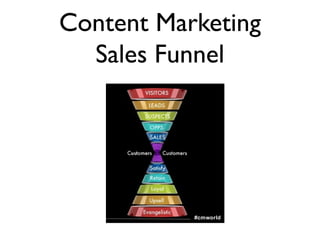
Content Marketing
  Sales Funnel
Client Case Study:

  HIF Australia
Mission
• Inform, engage and inspire the next
  generation of Australian health insurance
  buyers, and attract them to the HIF brand.
• To do this, we will provide useful,
  informative and entertaining content to
  Australians aged 21-39.
• Content will be primarily focused on health,
  diet, fitness, inspiration and positive life
  messages.
Step 1: We Defined our
        Audience
• We Identified who our target audience.
• This should be done via a consultation and
  fact finding process with the client.
• Key finding: They were loosing market share
  to big players like BUPA.
Step 2: Research
• We set out to find about out what our
  audience likes.
• We looked at TV ratings, successful online
  content, popular news stories and pop
  culture.
• We undertook a landscape analysis, asking
  their current audience and testing.
• We settled on Food, fitness and fun!
Step 3: Content
          Streams
• We determined relevant content streams
  that would engage our target demographic
• We searched high and low for a
  food/diet/healthy eating bloggers
Step 4: Distribution
         Outlets
• We chose to host our content on the
  website blog.
• We chose to distribute this content and
  engage users on: Facebook, Twitter,
  Google+, Instagram & LinkedIn
• We used paid media (Facebook ads) &
  influencer outreach (Promoted Twitter
  posts)
Step 5: Measurement
• We spent time gathering and analysing data,
  including:
• Reach (Unique people reached with each
  content piece)
• Engagement (How many comments, shares
  per content piece)
• Leads (How much interest are we
  generating per content piece)
• Sales (How many conversions have we
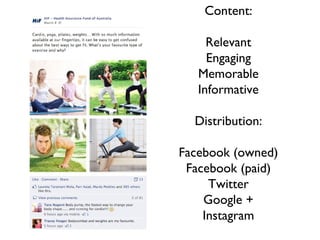
Content:

     Relevant
     Engaging
   Memorable
   Informative

  Distribution:

Facebook (owned)
 Facebook (paid)
     Twitter
    Google +
    Instagram
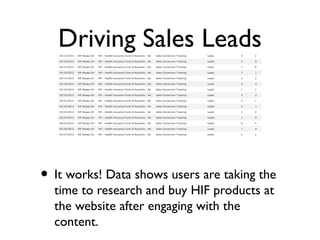
Driving Sales Leads


• It works! Data shows users are taking the
  time to research and buy HIF products at
  the website after engaging with the
  content.
HIF new member sales:

In the entire 2012 calendar year HIF sold 100 new
                memberships online.

 In the first 3 months of 2013, HIF had sold 160
                memberships online.
Our other clients
      West N Fresh
   Brookfield Place Perth
      Brownes Dairy
   Mercedes-Benz Perth
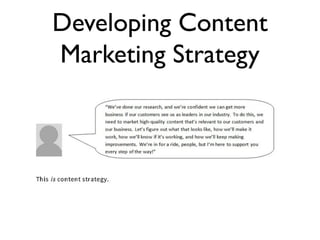
Developing Content
Marketing Strategy
How to Develop Your Own
Content Marketing Strategy
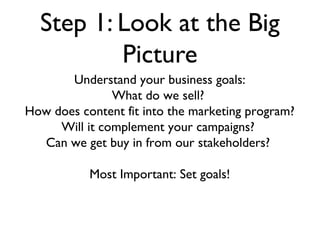
Step 1: Look at the Big
          Picture
       Understand your business goals:
               What do we sell?
How does content fit into the marketing program?
     Will it complement your campaigns?
  Can we get buy in from our stakeholders?

           Most Important: Set goals!
Step 2: Develop a
         Customer theory of
                       Mind who knows most
     Find someone in the business
                 about your customers:

                    Their motivations
                      Their needs
                      Their desires

It could be the call centre, could be the CMO, it could be
                the customers themselves.
Step 3: Research and
       analysis
Search the internet for 3rd party sources
               Case studies
                 Reports
               Competitors
              Industry peers
   Audit your current social activities
      Audit your library of content
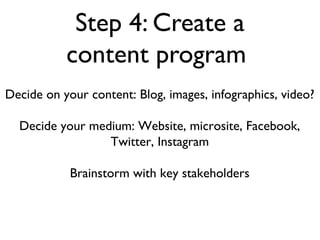
Step 4: Create a
           content program
Decide on your content: Blog, images, infographics, video?

  Decide your medium: Website, microsite, Facebook,
                 Twitter, Instagram

            Brainstorm with key stakeholders
Step 5: Execute
  Create a content calendar: Outline dates, content
             categories and post timing.

Change your tone, content length etc depending on the
               medium you posts to:
        Twitter is limited by text restrictions
  Facebook wont allow you to post certain imagery

       Be engaging and build your community:
               Ask lots of questions
                Respond to feedback
Step 6: Report and refine
      Create monthly reports.

         Measure key data.

              Tools:
          Google analytics
    Facebook conversion tracking
              Radian6

      Do more of what works!

    Do less of what doesn’t work
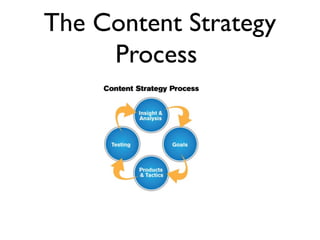
The Content Strategy
     Process
Content Marketing is a
Marathon, not a sprint

ContentMarketingADMA

  • 1.
  • 3.
    Defining Content Marketing • Content marketing is the art of communicating with your customers and prospects without selling. • Content Marketing is non-interruption marketing. • Instead of pitching your products or services, you are delivering information that makes your buyer more intelligent, informed and inspired.
  • 4.
    If we getour content marketing right, consumers will ultimately reward us with their business and loyalty.
  • 5.
    The history ofcontent marketing Content marketing is a recent “buzzword” but its actually been around in one shape or another for many years. From the early days of radio, P&G created radio dramas for housewives. Video: Content Marketing and the power of story
  • 6.
    Why Content Marketing? • Technology is changing consumer behaviour in ways we couldn’t imagine just a few years ago. • We now ask others for information as a last resort • Before making a purchase decision, we research
  • 7.
    consumers to gatherinformation and reach out to real people, in real time. Ask my friends online Ask a forum Ask my social contacts Search Google Search Facebook
  • 8.
    Behavioural Changes • Theage of Google: “Google It” • In 2010, consumers went to 5.3 sources of information before making a purchase decision. • In 2012 this doubled to 10.4 sources of information.
  • 9.
    Trust in Advertisinghas changed. changed. • A 2012 study found 90% of consumers trust: • Brand or product recommendations from friends or family via social media or word- of-mouth. • Brand recommendations and reviews that is professionally written, from influencers and from user generated content.
  • 10.
    Yet..... • Only 10%of consumes trust traditional advertising. • Only 20% of consumers trust promotional advertising on digital media outlets.
  • 11.
    The reality weface as marketers • Brand-led advertising online and offline has lost its allure. • Today’s consumers decide where, when, and how they want to engage with brands. • With multiple interconnected devices at their fingertips at any one time, these perpetually connected consumers can opt in or out of content as they choose… Marketers face a higher bar to engage consumers, who have more media options than ever before. • Content Marketing has the ability to create brand differentiation by bridging the gap between fading trust in traditional advertising and digital media’s efficient reach. - Tracey Stokes, Forrester Digital Marketing Analyst
  • 12.
    Content Marketers Leadingthe Way Video: Coca-Cola 2020
  • 13.
    Coke will usecontent marketing to reach a “disproportionate share of pop culture and consumer conversations” - Jonathan Mildenhall, Coca-Cola
  • 14.
    Content Marketing Sales Funnel
  • 15.
    Client Case Study: HIF Australia
  • 16.
    Mission • Inform, engageand inspire the next generation of Australian health insurance buyers, and attract them to the HIF brand. • To do this, we will provide useful, informative and entertaining content to Australians aged 21-39. • Content will be primarily focused on health, diet, fitness, inspiration and positive life messages.
  • 17.
    Step 1: WeDefined our Audience • We Identified who our target audience. • This should be done via a consultation and fact finding process with the client. • Key finding: They were loosing market share to big players like BUPA.
  • 18.
    Step 2: Research •We set out to find about out what our audience likes. • We looked at TV ratings, successful online content, popular news stories and pop culture. • We undertook a landscape analysis, asking their current audience and testing. • We settled on Food, fitness and fun!
  • 19.
    Step 3: Content Streams • We determined relevant content streams that would engage our target demographic • We searched high and low for a food/diet/healthy eating bloggers
  • 21.
    Step 4: Distribution Outlets • We chose to host our content on the website blog. • We chose to distribute this content and engage users on: Facebook, Twitter, Google+, Instagram & LinkedIn • We used paid media (Facebook ads) & influencer outreach (Promoted Twitter posts)
  • 22.
    Step 5: Measurement •We spent time gathering and analysing data, including: • Reach (Unique people reached with each content piece) • Engagement (How many comments, shares per content piece) • Leads (How much interest are we generating per content piece) • Sales (How many conversions have we
  • 23.
    Content: Relevant Engaging Memorable Informative Distribution: Facebook (owned) Facebook (paid) Twitter Google + Instagram
  • 24.
    Driving Sales Leads •It works! Data shows users are taking the time to research and buy HIF products at the website after engaging with the content.
  • 25.
    HIF new membersales: In the entire 2012 calendar year HIF sold 100 new memberships online. In the first 3 months of 2013, HIF had sold 160 memberships online.
  • 26.
    Our other clients West N Fresh Brookfield Place Perth Brownes Dairy Mercedes-Benz Perth
  • 27.
  • 28.
    How to DevelopYour Own Content Marketing Strategy
  • 29.
    Step 1: Lookat the Big Picture Understand your business goals: What do we sell? How does content fit into the marketing program? Will it complement your campaigns? Can we get buy in from our stakeholders? Most Important: Set goals!
  • 30.
    Step 2: Developa Customer theory of Mind who knows most Find someone in the business about your customers: Their motivations Their needs Their desires It could be the call centre, could be the CMO, it could be the customers themselves.
  • 31.
    Step 3: Researchand analysis Search the internet for 3rd party sources Case studies Reports Competitors Industry peers Audit your current social activities Audit your library of content
  • 32.
    Step 4: Createa content program Decide on your content: Blog, images, infographics, video? Decide your medium: Website, microsite, Facebook, Twitter, Instagram Brainstorm with key stakeholders
  • 33.
    Step 5: Execute Create a content calendar: Outline dates, content categories and post timing. Change your tone, content length etc depending on the medium you posts to: Twitter is limited by text restrictions Facebook wont allow you to post certain imagery Be engaging and build your community: Ask lots of questions Respond to feedback
  • 34.
    Step 6: Reportand refine Create monthly reports. Measure key data. Tools: Google analytics Facebook conversion tracking Radian6 Do more of what works! Do less of what doesn’t work
  • 35.
  • 36.
    Content Marketing isa Marathon, not a sprint