Chapter 6
Intermediate Languages
2
Introduction
Intermediate code
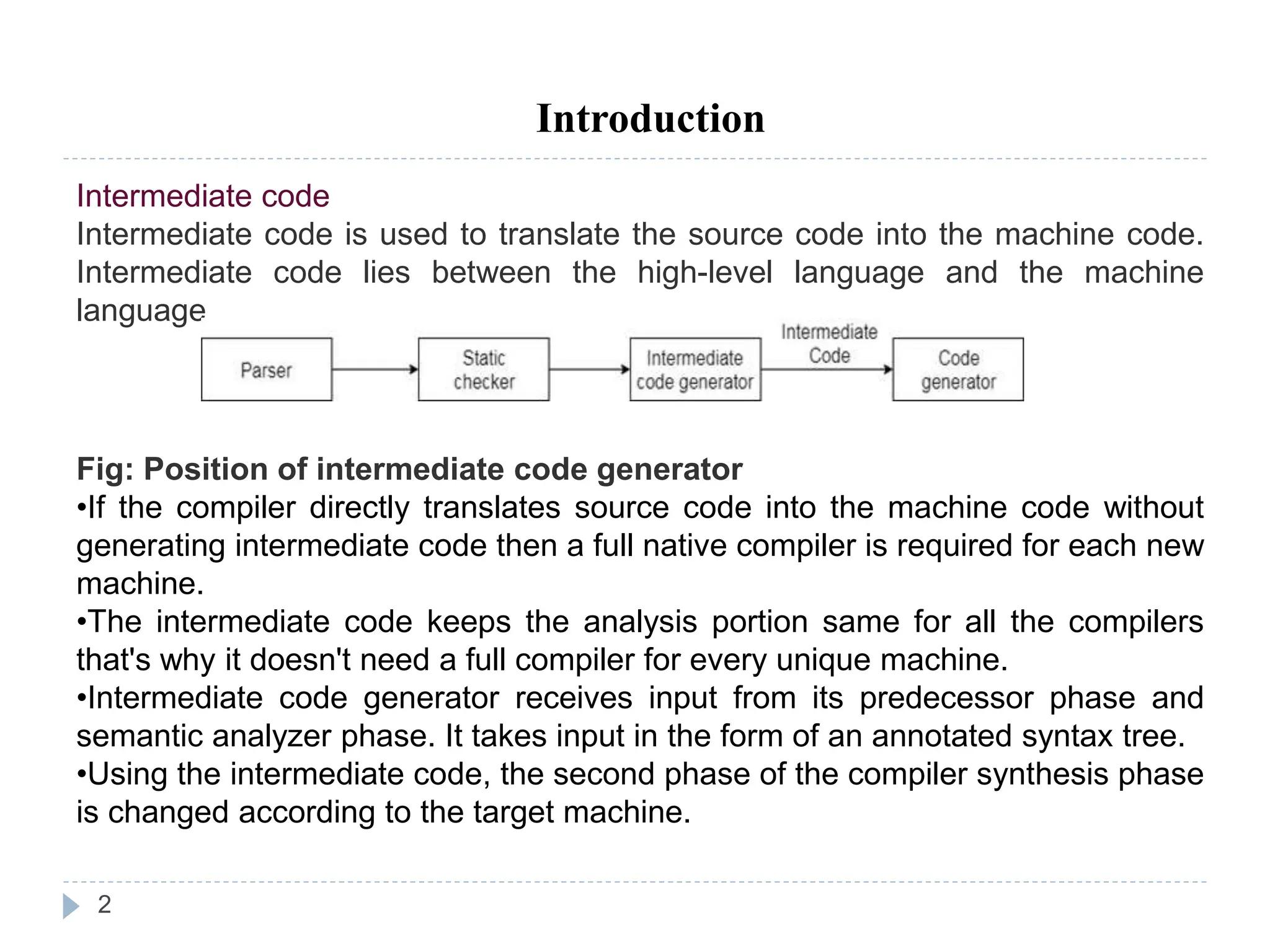
Intermediate code is used to translate the source code into the machine code.
Intermediate code lies between the high-level language and the machine
language.
Fig: Position of intermediate code generator
•If the compiler directly translates source code into the machine code without
generating intermediate code then a full native compiler is required for each new
machine.
•The intermediate code keeps the analysis portion same for all the compilers
that's why it doesn't need a full compiler for every unique machine.
•Intermediate code generator receives input from its predecessor phase and
semantic analyzer phase. It takes input in the form of an annotated syntax tree.
•Using the intermediate code, the second phase of the compiler synthesis phase
is changed according to the target machine.
3
Introduction
Intermediate representation
Intermediate code can be represented in two ways:
1. High Level intermediate code:
High level intermediate code can be represented as source
code. To enhance performance of source code, we can easily
apply code modification. But to optimize the target machine, it is
less preferred.
2. Low Level intermediate code
Low level intermediate code is close to the target machine,
which makes it suitable for register and memory allocation
etc. it is used for machine-dependent optimizations.
Current T
4
Introduction
Postfix Notation
•Postfix notation is the useful form of intermediate code if the
given language is expressions.
•Postfix notation is also called as 'suffix notation' and 'reverse
polish'.
•Postfix notation is a linear representation of a syntax tree.
•In the postfix notation, any expression can be written
unambiguously without parentheses.
•The ordinary (infix) way of writing the sum of x and y is with
operator in the middle: x * y. But in the postfix notation, we place
the operator at the right end as xy *.
•In postfix notation, the operator follows the operand.
Example
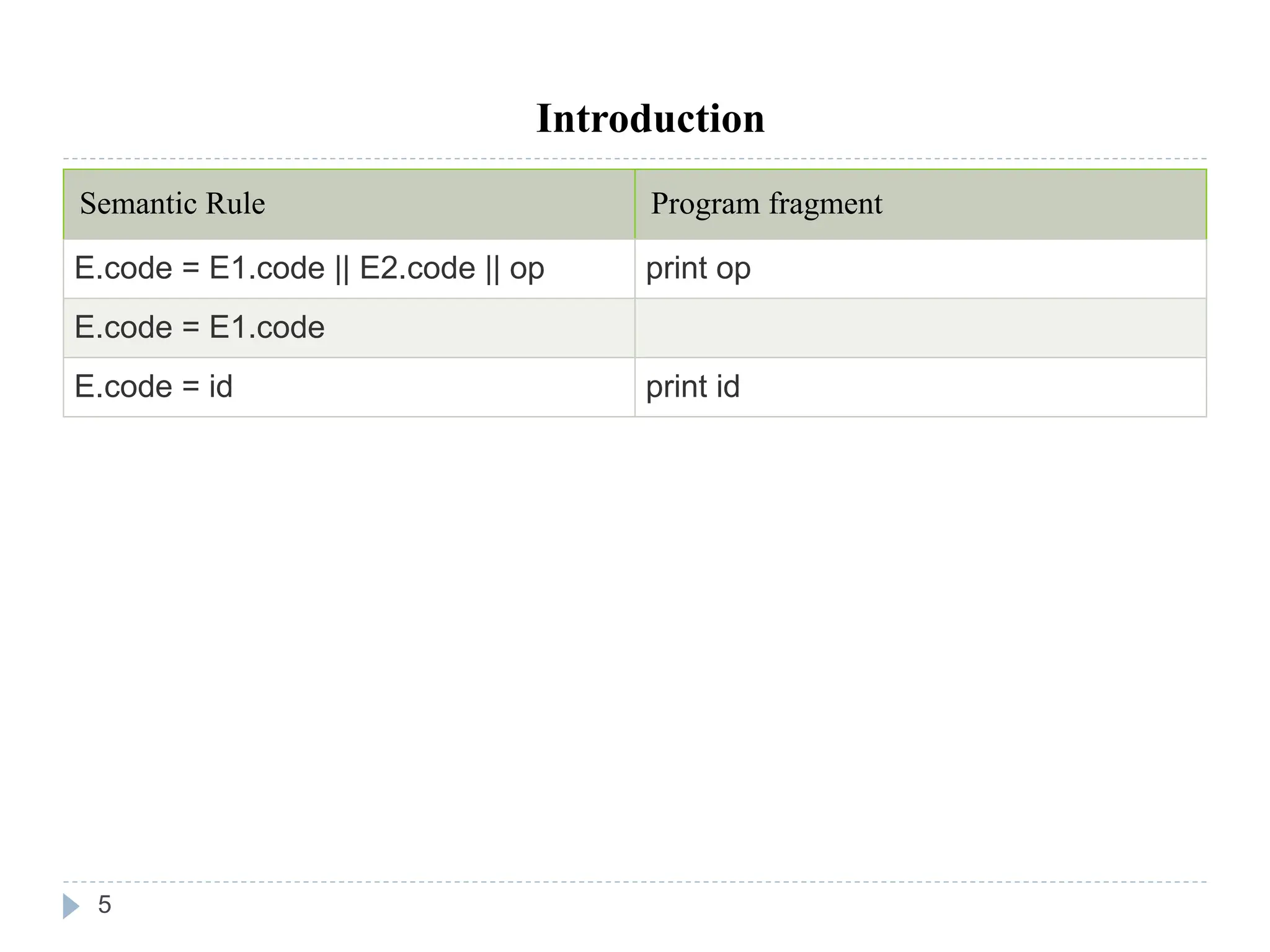
Production
1.E → E1 op E2
2.E → (E1)
3.E → id
5
Introduction
Semantic Rule Program fragment
E.code = E1.code || E2.code || op print op
E.code = E1.code
E.code = id print id
6
Introduction
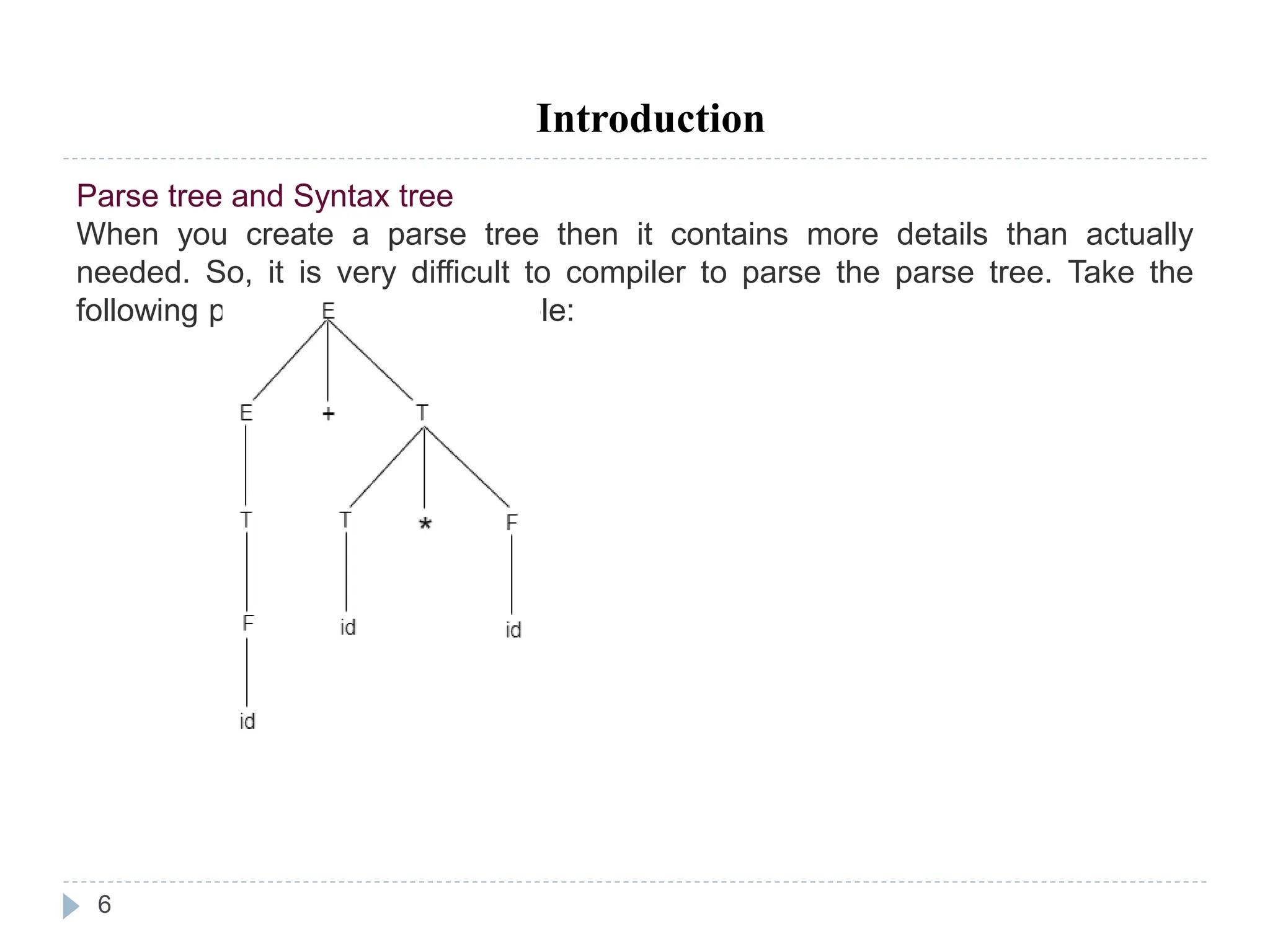
Parse tree and Syntax tree
When you create a parse tree then it contains more details than actually
needed. So, it is very difficult to compiler to parse the parse tree. Take the
following parse tree as an example:
7
Introduction
•In the parse tree, most of the leaf nodes are single child to their parent nodes.
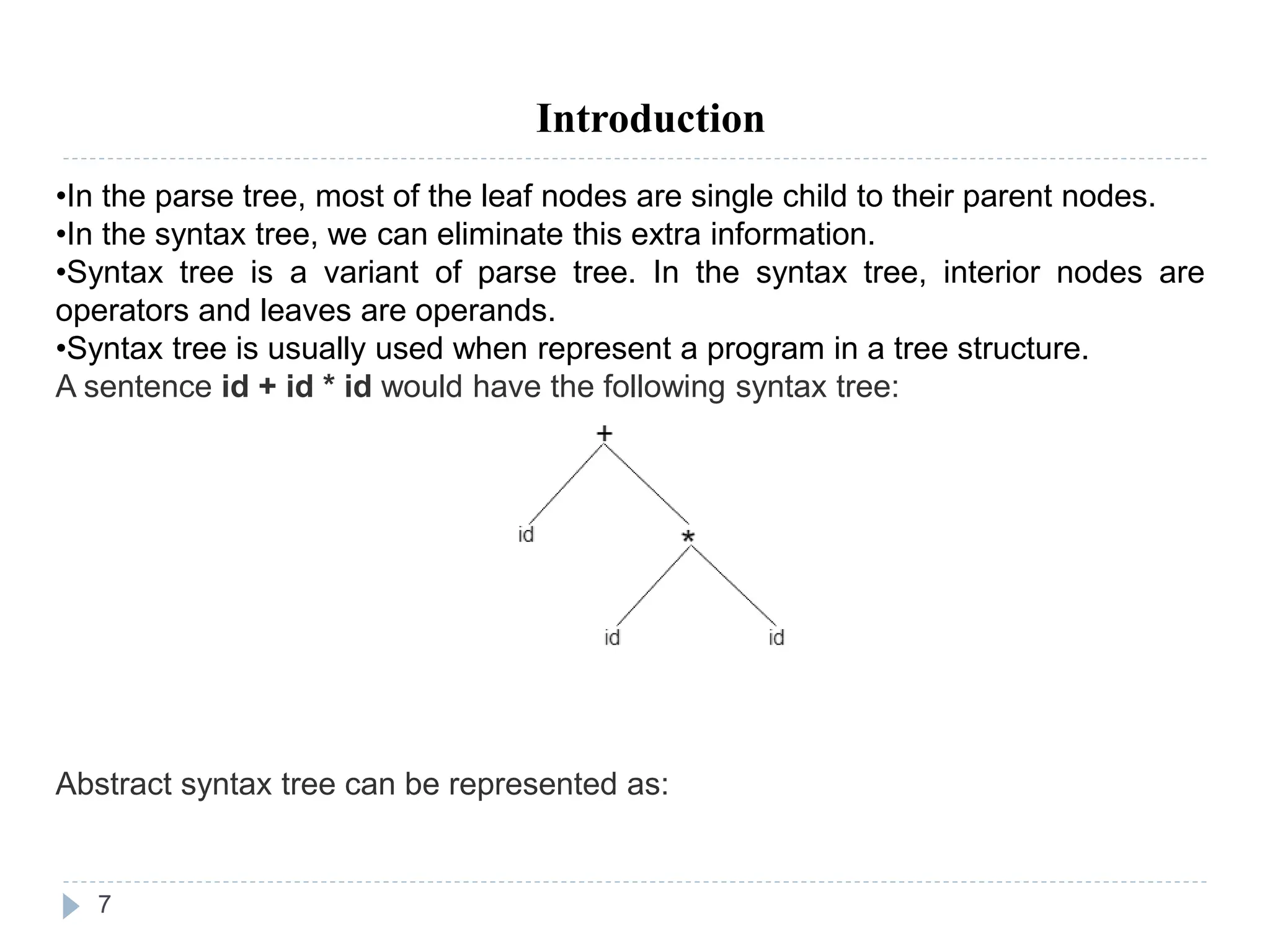
•In the syntax tree, we can eliminate this extra information.
•Syntax tree is a variant of parse tree. In the syntax tree, interior nodes are
operators and leaves are operands.
•Syntax tree is usually used when represent a program in a tree structure.
A sentence id + id * id would have the following syntax tree:
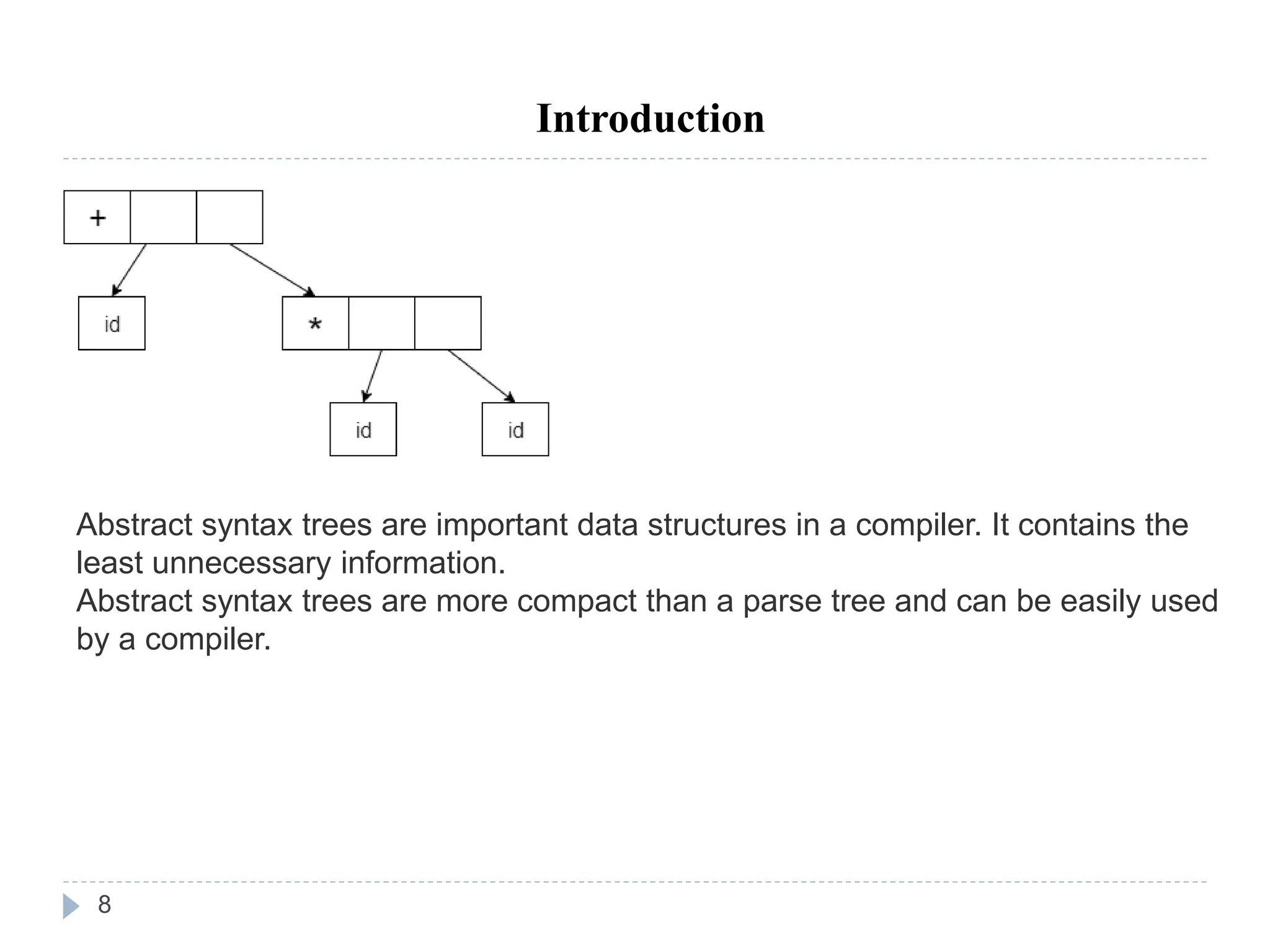
Abstract syntax tree can be represented as:
8
Introduction
Abstract syntax trees are important data structures in a compiler. It contains the
least unnecessary information.
Abstract syntax trees are more compact than a parse tree and can be easily used
by a compiler.
9
Introduction
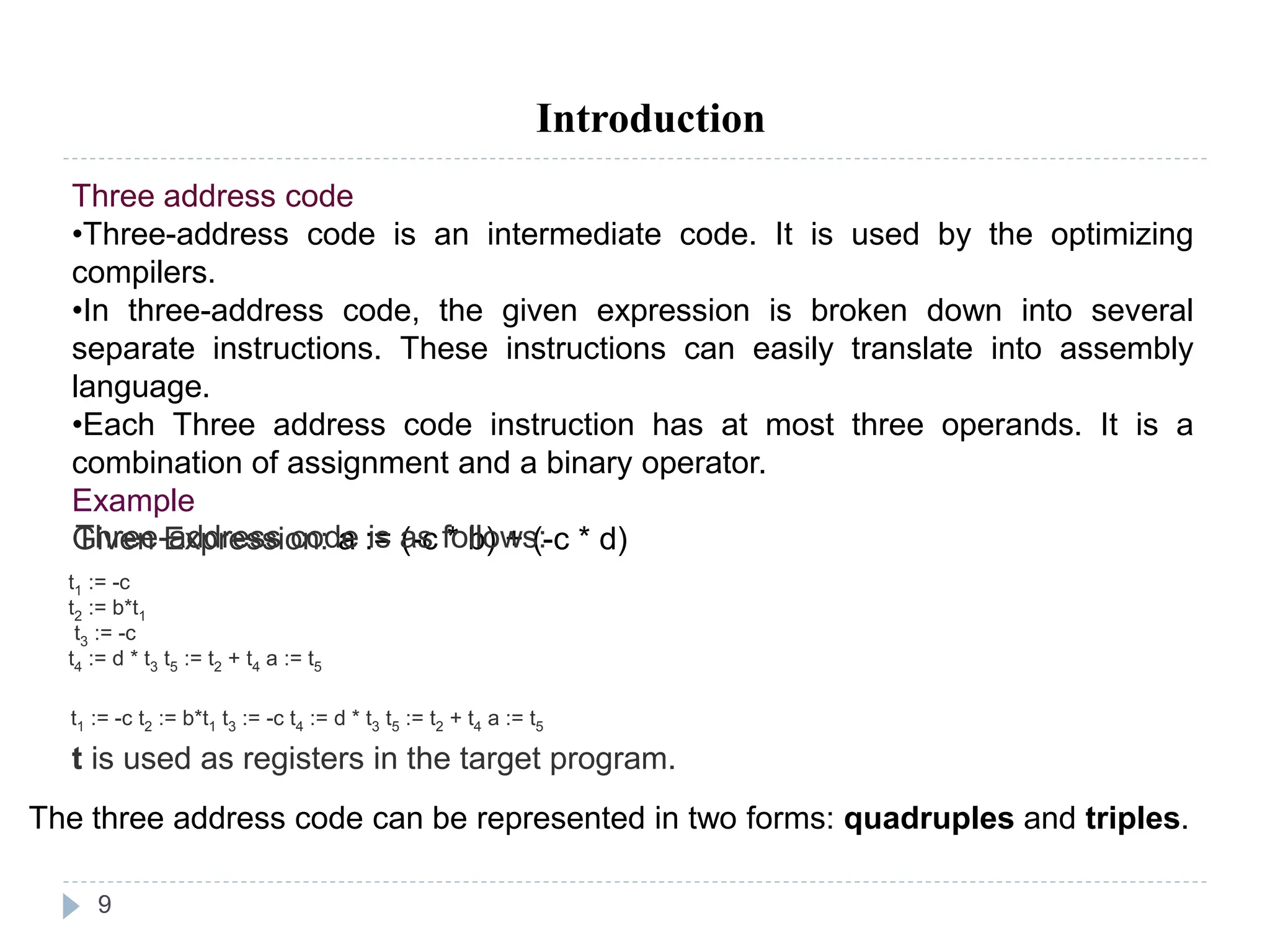
Three address code
•Three-address code is an intermediate code. It is used by the optimizing
compilers.
•In three-address code, the given expression is broken down into several
separate instructions. These instructions can easily translate into assembly
language.
•Each Three address code instruction has at most three operands. It is a
combination of assignment and a binary operator.
Example
Given Expression: a := (-c * b) + (-c * d)
Three-address code is as follows:
t1 := -c
t2 := b*t1
t3 := -c
t4 := d * t3 t5 := t2 + t4 a := t5
t1 := -c t2 := b*t1 t3 := -c t4 := d * t3 t5 := t2 + t4 a := t5
t is used as registers in the target program.
The three address code can be represented in two forms: quadruples and triples.
10
Introduction
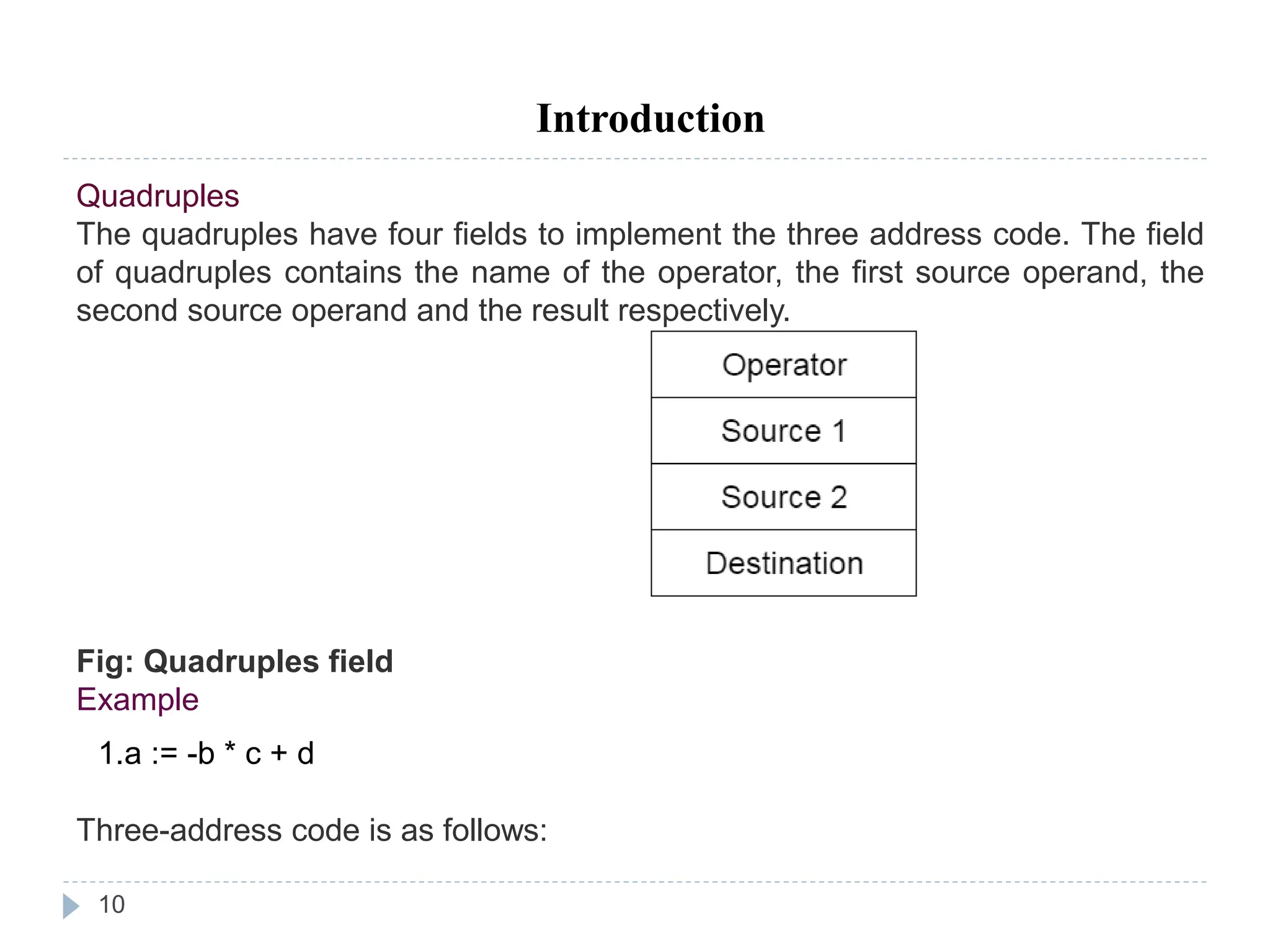
Quadruples
The quadruples have four fields to implement the three address code. The field
of quadruples contains the name of the operator, the first source operand, the
second source operand and the result respectively.
Fig: Quadruples field
Example
1.a := -b * c + d
Three-address code is as follows:
11
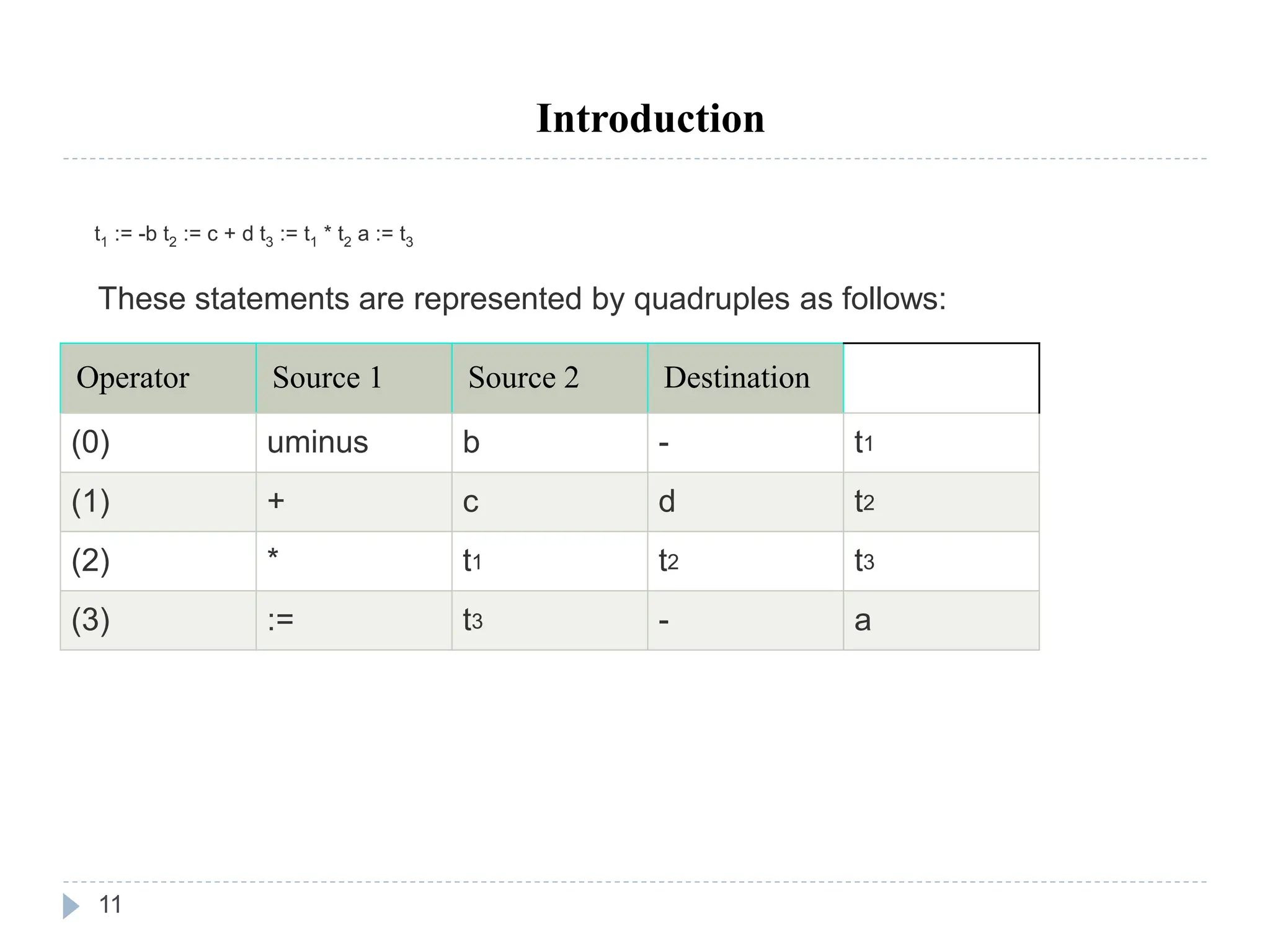
t1 := -b t2 := c + d t3 := t1 * t2 a := t3
Introduction
These statements are represented by quadruples as follows:
Operator Source 1 Source 2 Destination
(0) uminus b - t1
(1) + c d t2
(2) * t1 t2 t3
(3) := t3 - a
12
Introduction
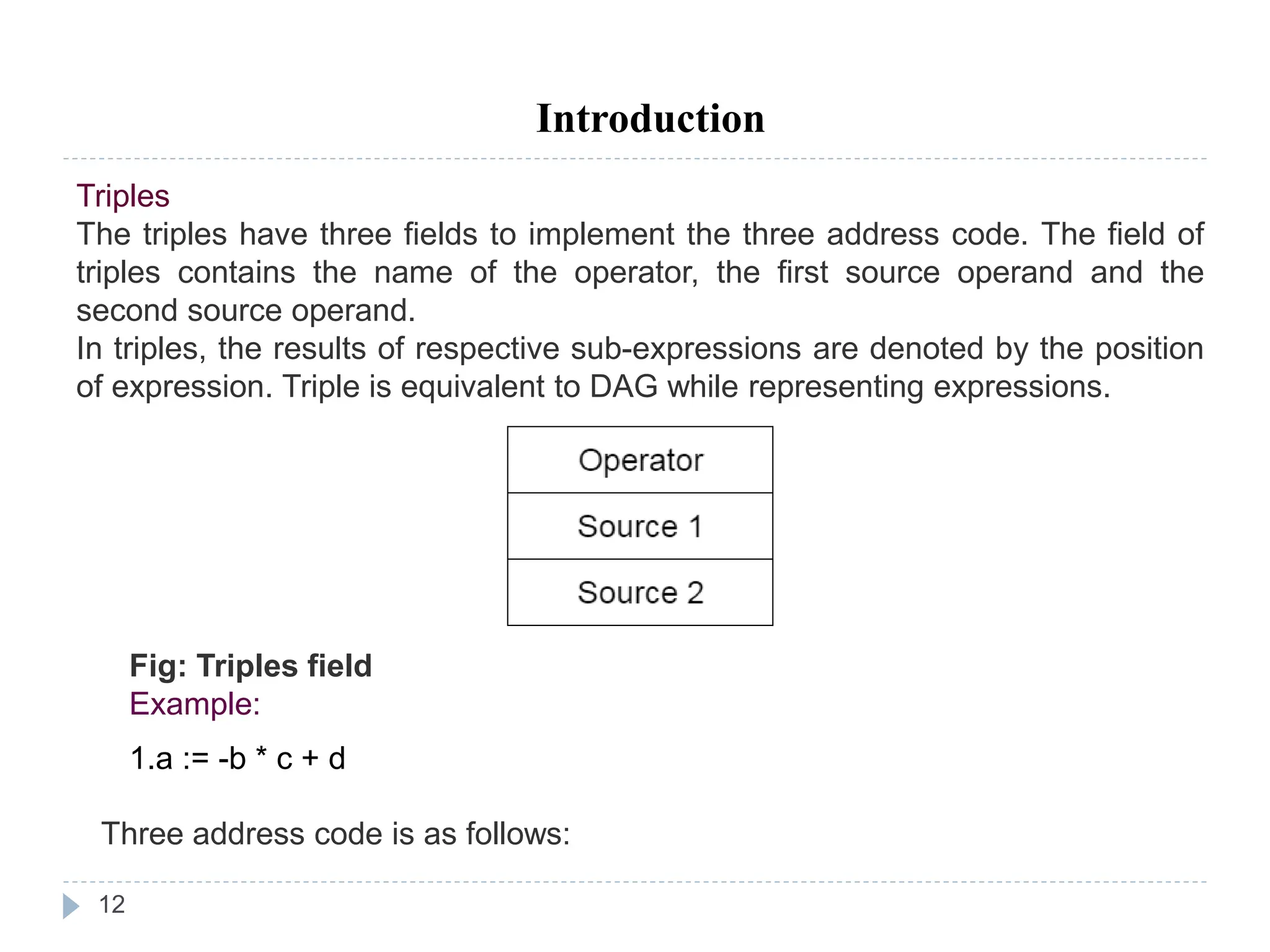
Triples
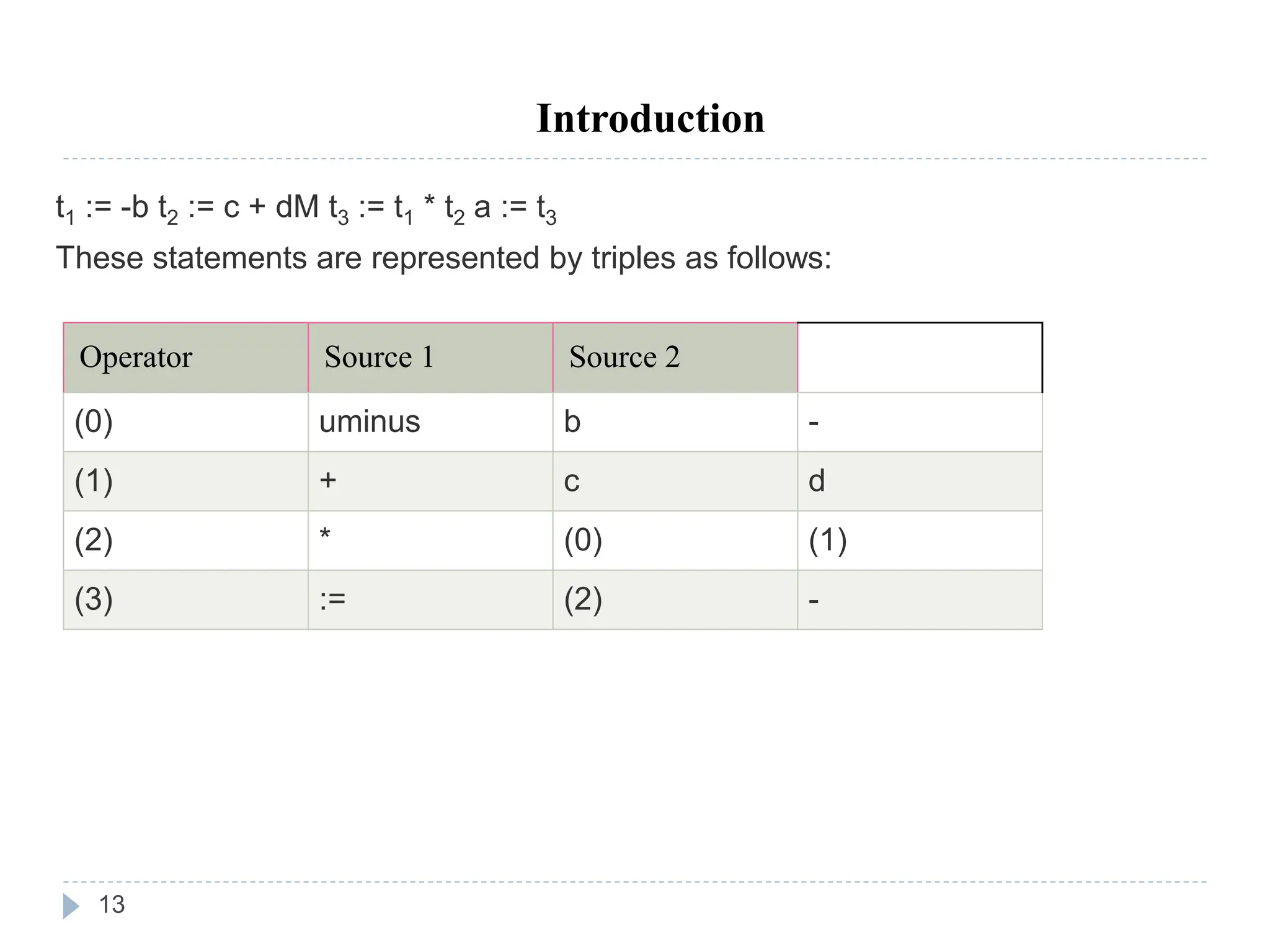
The triples have three fields to implement the three address code. The field of
triples contains the name of the operator, the first source operand and the
second source operand.
In triples, the results of respective sub-expressions are denoted by the position
of expression. Triple is equivalent to DAG while representing expressions.
Fig: Triples field
Example:
1.a := -b * c + d
Three address code is as follows:
13
Introduction
t1 := -b t2 := c + dM t3 := t1 * t2 a := t3
These statements are represented by triples as follows:
Operator Source 1 Source 2
(0) uminus b -
(1) + c d
(2) * (0) (1)
(3) := (2) -
14
Introduction
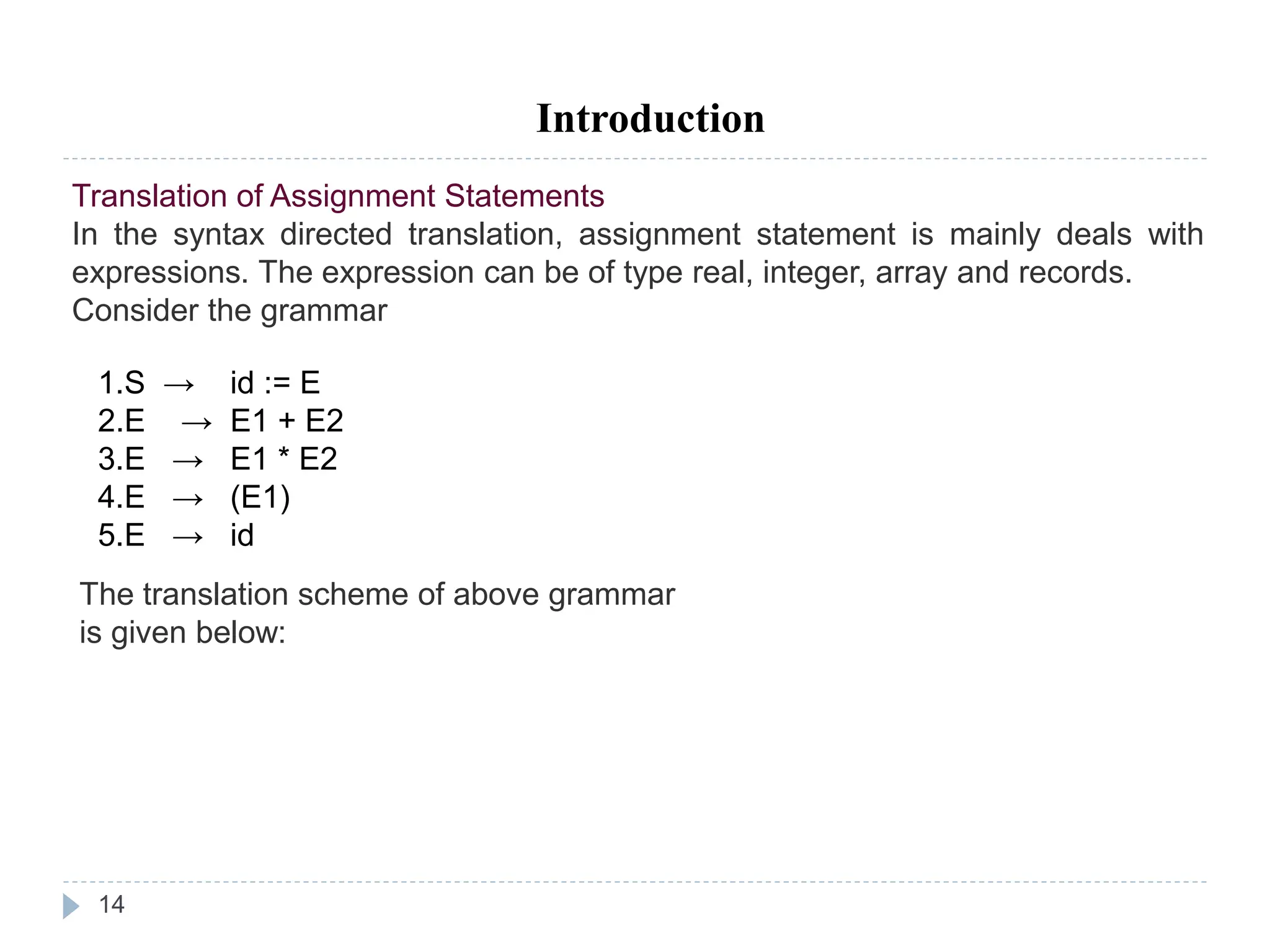
Translation of Assignment Statements
In the syntax directed translation, assignment statement is mainly deals with
expressions. The expression can be of type real, integer, array and records.
Consider the grammar
1.S → id := E
2.E → E1 + E2
3.E → E1 * E2
4.E → (E1)
5.E → id
The translation scheme of above grammar
is given below:
15
Introduction
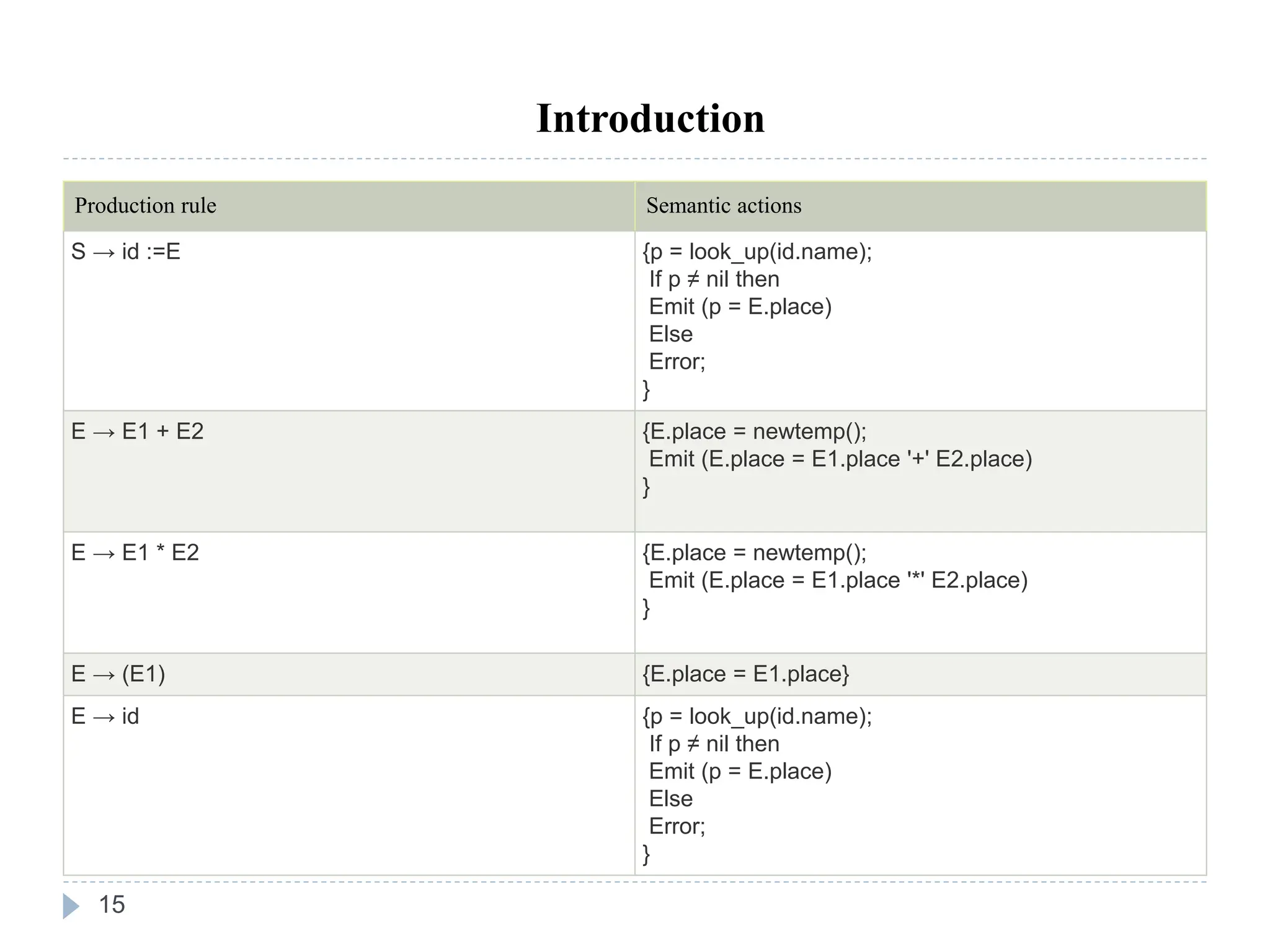
Production rule Semantic actions
S → id :=E {p = look_up(id.name);
If p ≠ nil then
Emit (p = E.place)
Else
Error;
}
E → E1 + E2 {E.place = newtemp();
Emit (E.place = E1.place '+' E2.place)
}
E → E1 * E2 {E.place = newtemp();
Emit (E.place = E1.place '*' E2.place)
}
E → (E1) {E.place = E1.place}
E → id {p = look_up(id.name);
If p ≠ nil then
Emit (p = E.place)
Else
Error;
}
16
Introduction
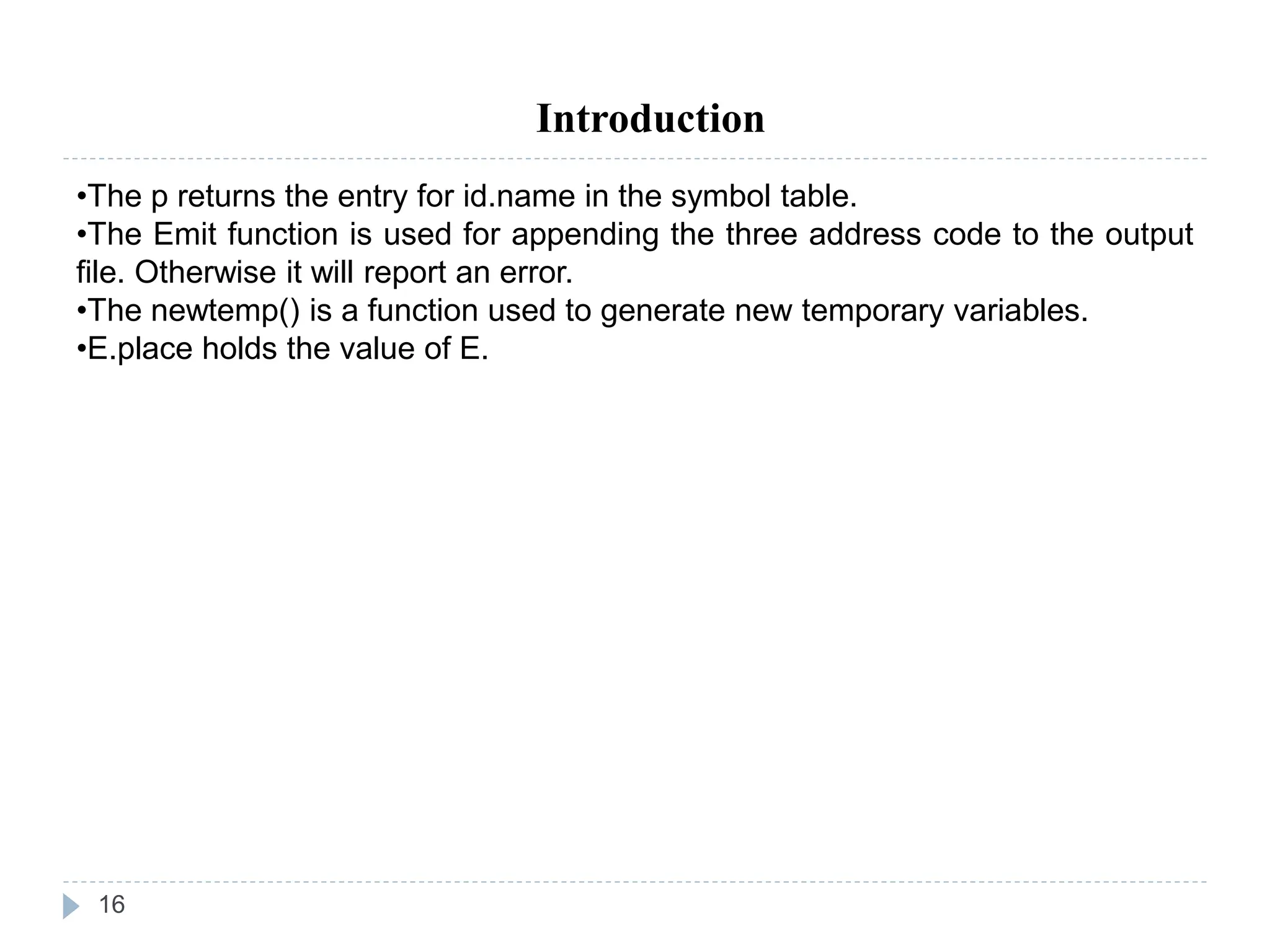
•The p returns the entry for id.name in the symbol table.
•The Emit function is used for appending the three address code to the output
file. Otherwise it will report an error.
•The newtemp() is a function used to generate new temporary variables.
•E.place holds the value of E.
17
Introduction
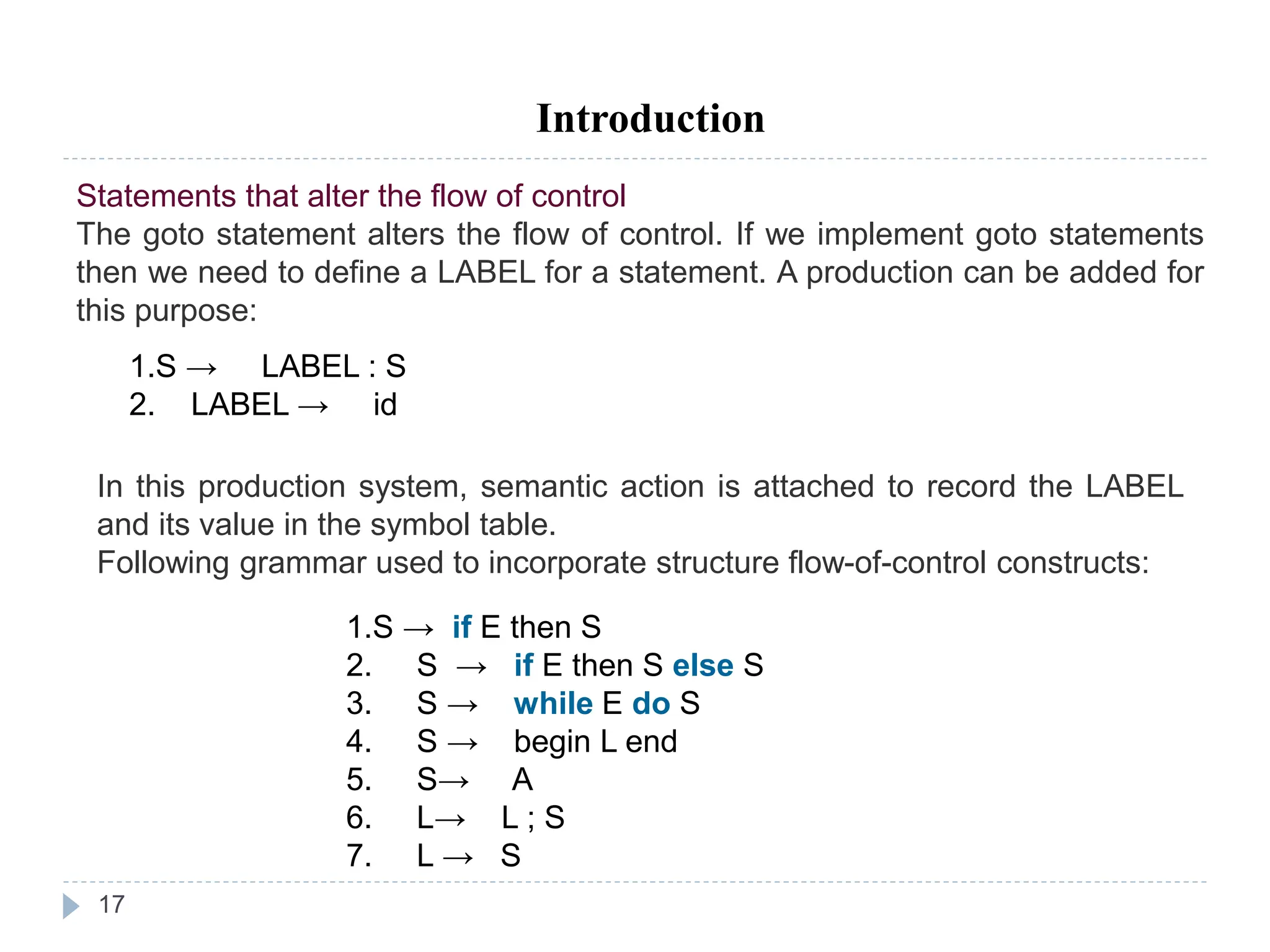
Statements that alter the flow of control
The goto statement alters the flow of control. If we implement goto statements
then we need to define a LABEL for a statement. A production can be added for
this purpose:
1.S → LABEL : S
2. LABEL → id
In this production system, semantic action is attached to record the LABEL
and its value in the symbol table.
Following grammar used to incorporate structure flow-of-control constructs:
1.S → if E then S
2. S → if E then S else S
3. S → while E do S
4. S → begin L end
5. S→ A
6. L→ L ; S
7. L → S
18
Introduction
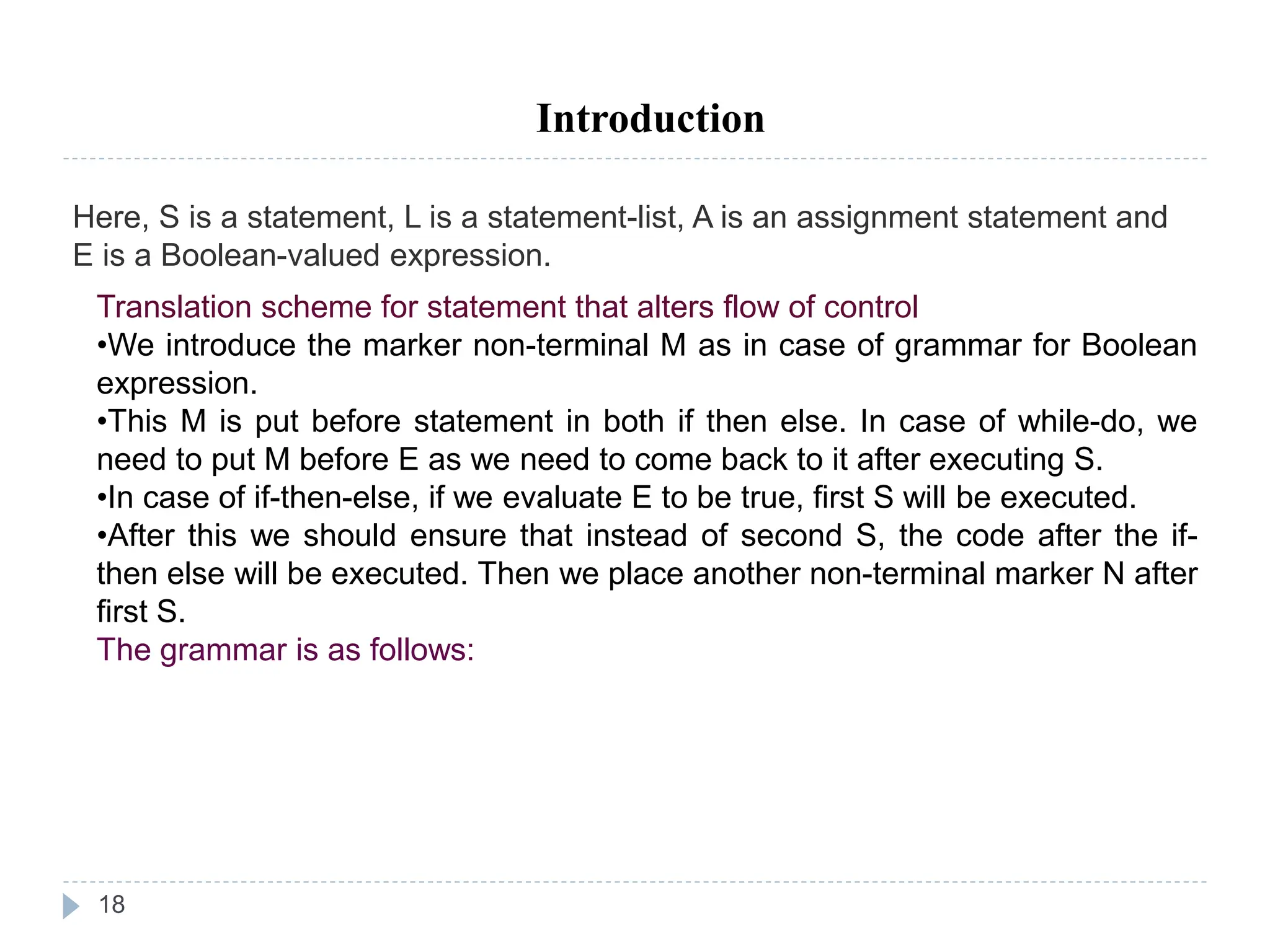
Here, S is a statement, L is a statement-list, A is an assignment statement and
E is a Boolean-valued expression.
Translation scheme for statement that alters flow of control
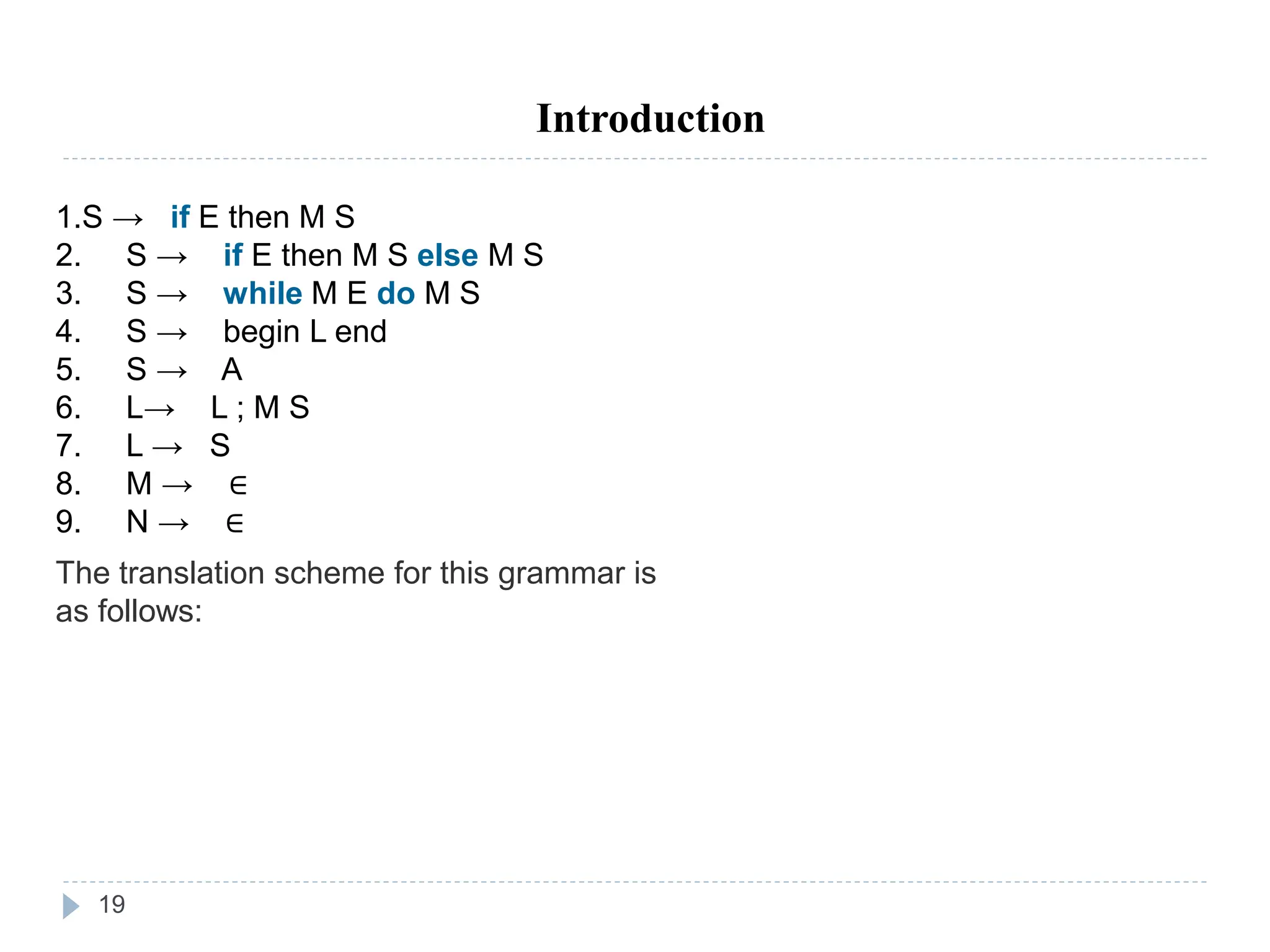
•We introduce the marker non-terminal M as in case of grammar for Boolean
expression.
•This M is put before statement in both if then else. In case of while-do, we
need to put M before E as we need to come back to it after executing S.
•In case of if-then-else, if we evaluate E to be true, first S will be executed.
•After this we should ensure that instead of second S, the code after the if-
then else will be executed. Then we place another non-terminal marker N after
first S.
The grammar is as follows:
19
Introduction
1.S → if E then M S
2. S → if E then M S else M S
3. S → while M E do M S
4. S → begin L end
5. S → A
6. L→ L ; M S
7. L → S
8. M → ∈
9. N → ∈
The translation scheme for this grammar is
as follows:
20
Introduction
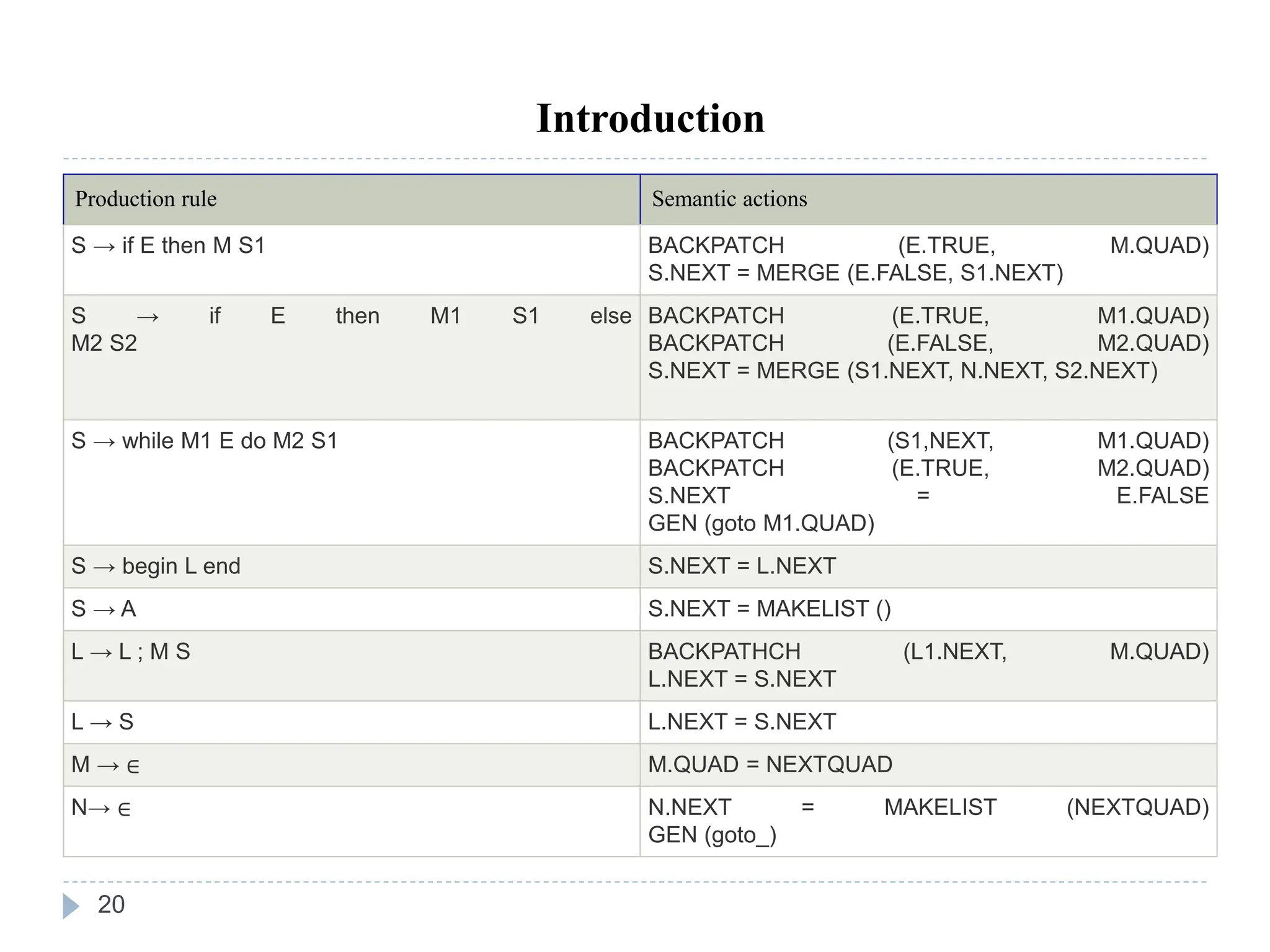
Production rule Semantic actions
S → if E then M S1 BACKPATCH (E.TRUE, M.QUAD)
S.NEXT = MERGE (E.FALSE, S1.NEXT)
S → if E then M1 S1 else
M2 S2
BACKPATCH (E.TRUE, M1.QUAD)
BACKPATCH (E.FALSE, M2.QUAD)
S.NEXT = MERGE (S1.NEXT, N.NEXT, S2.NEXT)
S → while M1 E do M2 S1 BACKPATCH (S1,NEXT, M1.QUAD)
BACKPATCH (E.TRUE, M2.QUAD)
S.NEXT = E.FALSE
GEN (goto M1.QUAD)
S → begin L end S.NEXT = L.NEXT
S → A S.NEXT = MAKELIST ()
L → L ; M S BACKPATHCH (L1.NEXT, M.QUAD)
L.NEXT = S.NEXT
L → S L.NEXT = S.NEXT
M → ∈ M.QUAD = NEXTQUAD
N→ ∈ N.NEXT = MAKELIST (NEXTQUAD)
GEN (goto_)
21
Introduction
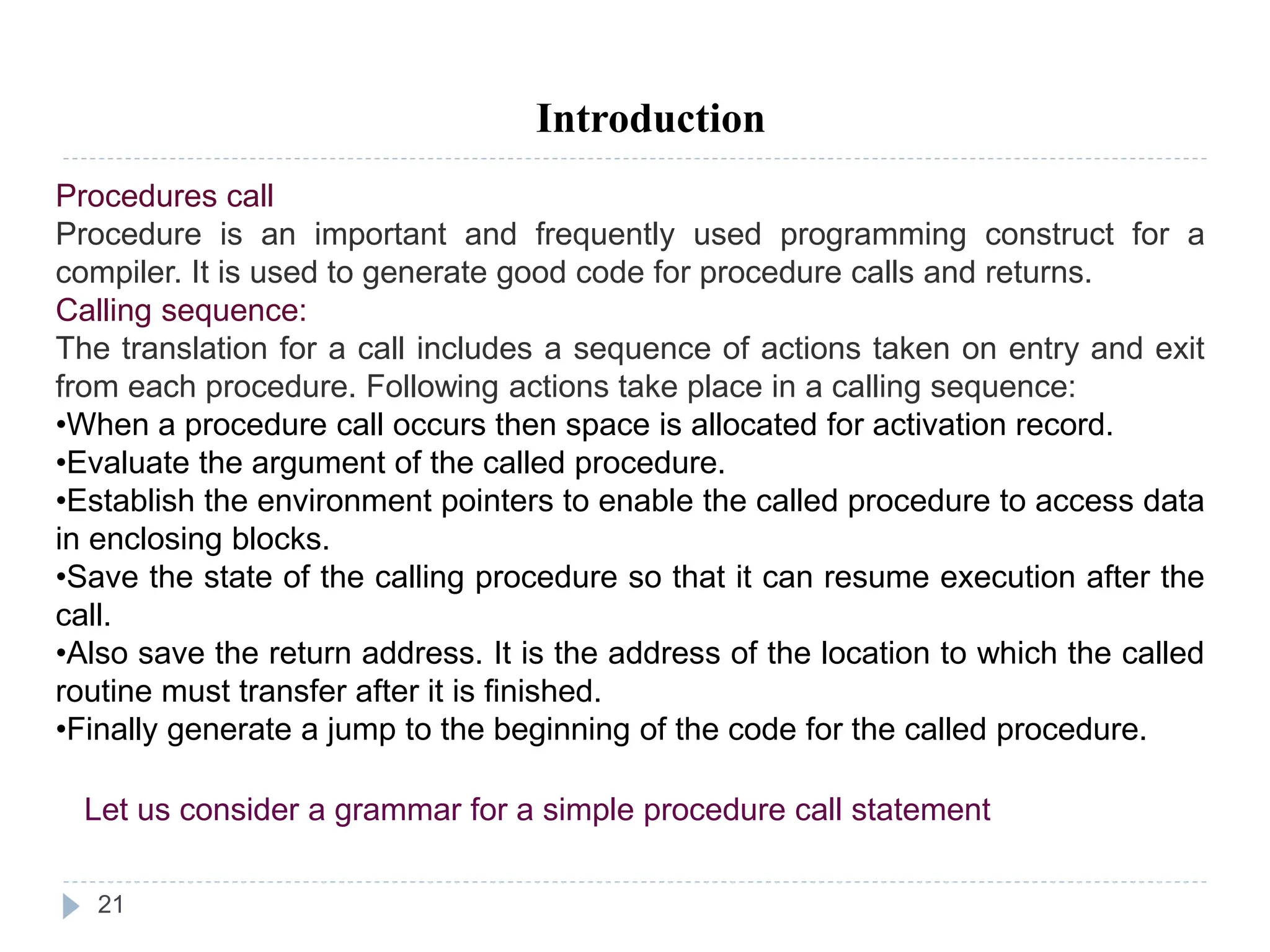
Procedures call
Procedure is an important and frequently used programming construct for a
compiler. It is used to generate good code for procedure calls and returns.
Calling sequence:
The translation for a call includes a sequence of actions taken on entry and exit
from each procedure. Following actions take place in a calling sequence:
•When a procedure call occurs then space is allocated for activation record.
•Evaluate the argument of the called procedure.
•Establish the environment pointers to enable the called procedure to access data
in enclosing blocks.
•Save the state of the calling procedure so that it can resume execution after the
call.
•Also save the return address. It is the address of the location to which the called
routine must transfer after it is finished.
•Finally generate a jump to the beginning of the code for the called procedure.
Let us consider a grammar for a simple procedure call statement
22
Introduction
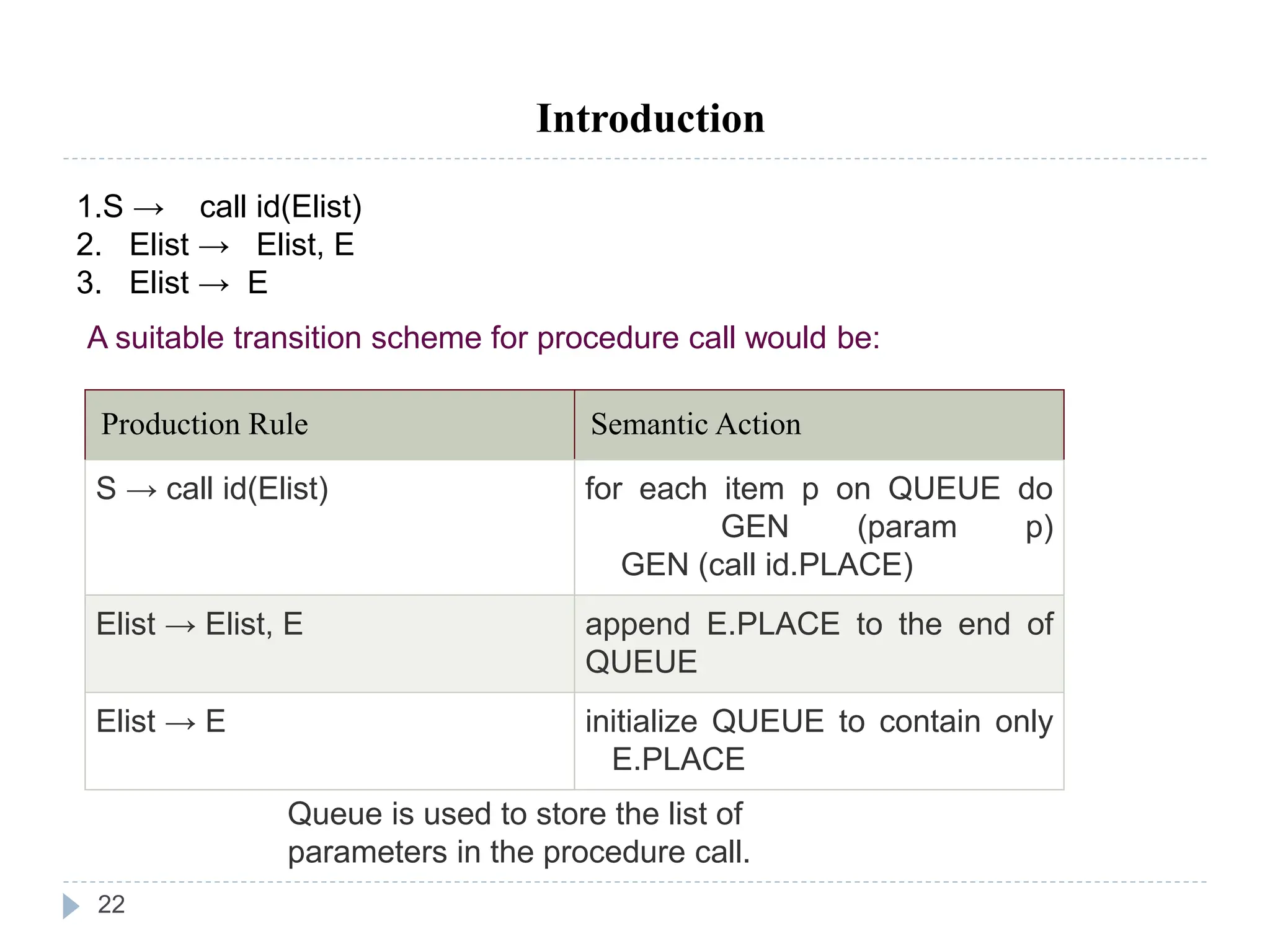
1.S → call id(Elist)
2. Elist → Elist, E
3. Elist → E
A suitable transition scheme for procedure call would be:
Production Rule Semantic Action
S → call id(Elist) for each item p on QUEUE do
GEN (param p)
GEN (call id.PLACE)
Elist → Elist, E append E.PLACE to the end of
QUEUE
Elist → E initialize QUEUE to contain only
E.PLACE
Queue is used to store the list of
parameters in the procedure call.
23
Introduction
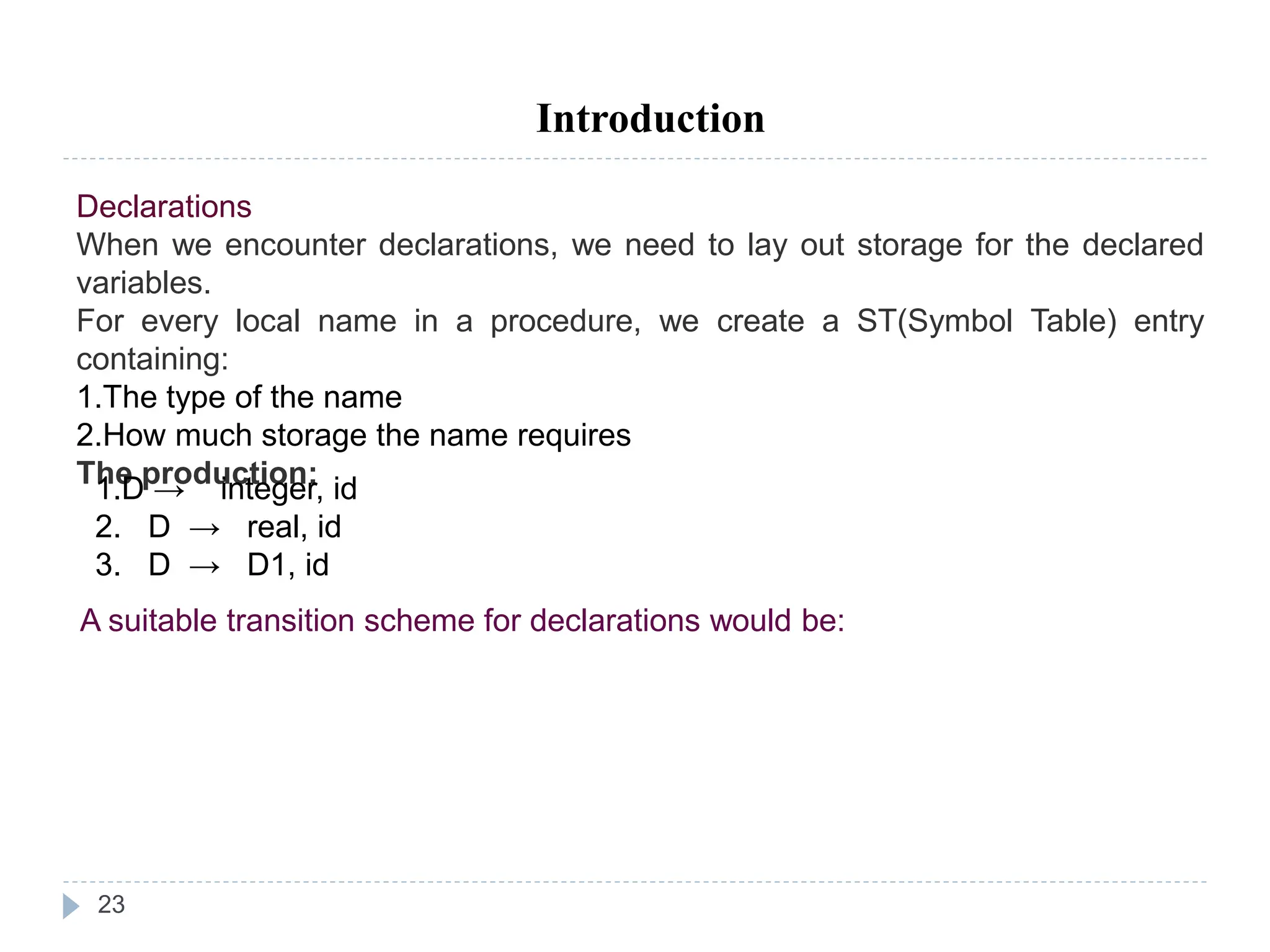
Declarations
When we encounter declarations, we need to lay out storage for the declared
variables.
For every local name in a procedure, we create a ST(Symbol Table) entry
containing:
1.The type of the name
2.How much storage the name requires
The production:
1.D → integer, id
2. D → real, id
3. D → D1, id
A suitable transition scheme for declarations would be:
24
Introduction
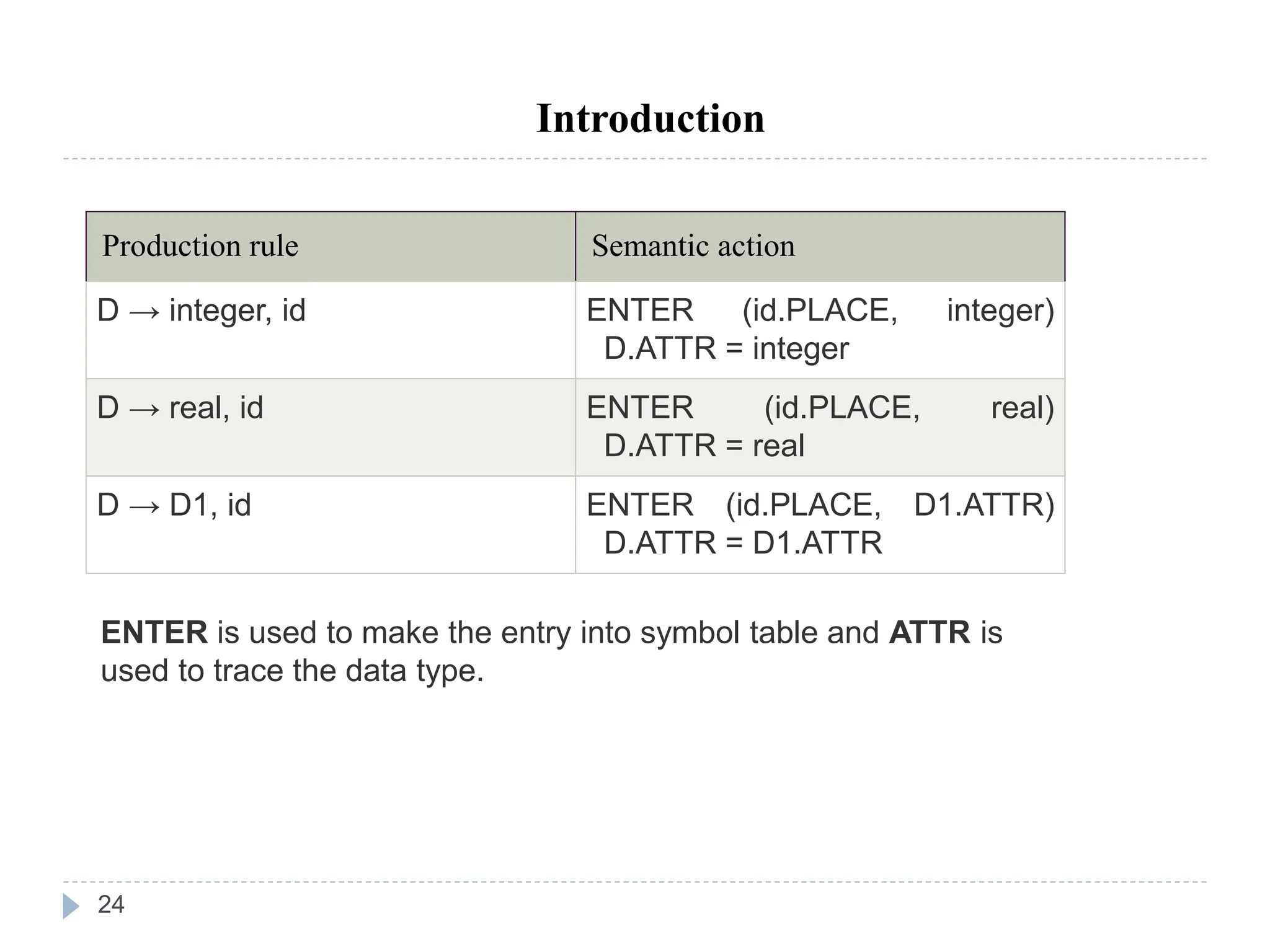
Production rule Semantic action
D → integer, id ENTER (id.PLACE, integer)
D.ATTR = integer
D → real, id ENTER (id.PLACE, real)
D.ATTR = real
D → D1, id ENTER (id.PLACE, D1.ATTR)
D.ATTR = D1.ATTR
ENTER is used to make the entry into symbol table and ATTR is
used to trace the data type.
25
Introduction
Backpatching in Compiler Design
Backpatching is basically a process of fulfilling unspecified information. This
information is of labels. It basically uses the appropriate semantic actions during
the process of code generation. It may indicate the address of the Label in goto
statements while producing TACs for the given expressions. Here basically two
passes are used because assigning the positions of these label statements in
one pass is quite challenging. It can leave these addresses unidentified in the
first pass and then populate them in the second round. Backpatching is the
process of filling up gaps in incomplete transformations and information.
Need for Backpatching:
Backpatching is mainly used for two purposes:
26
Introduction
1. Boolean expression:
Boolean expressions are statements whose results can be either true or false. A
boolean expression which is named for mathematician George Boole is an
expression that evaluates to either true or false. Let’s look at some common
language examples:
•My favorite color is blue. → true
•I am afraid of mathematics. → false
•2 is greater than 5. → false
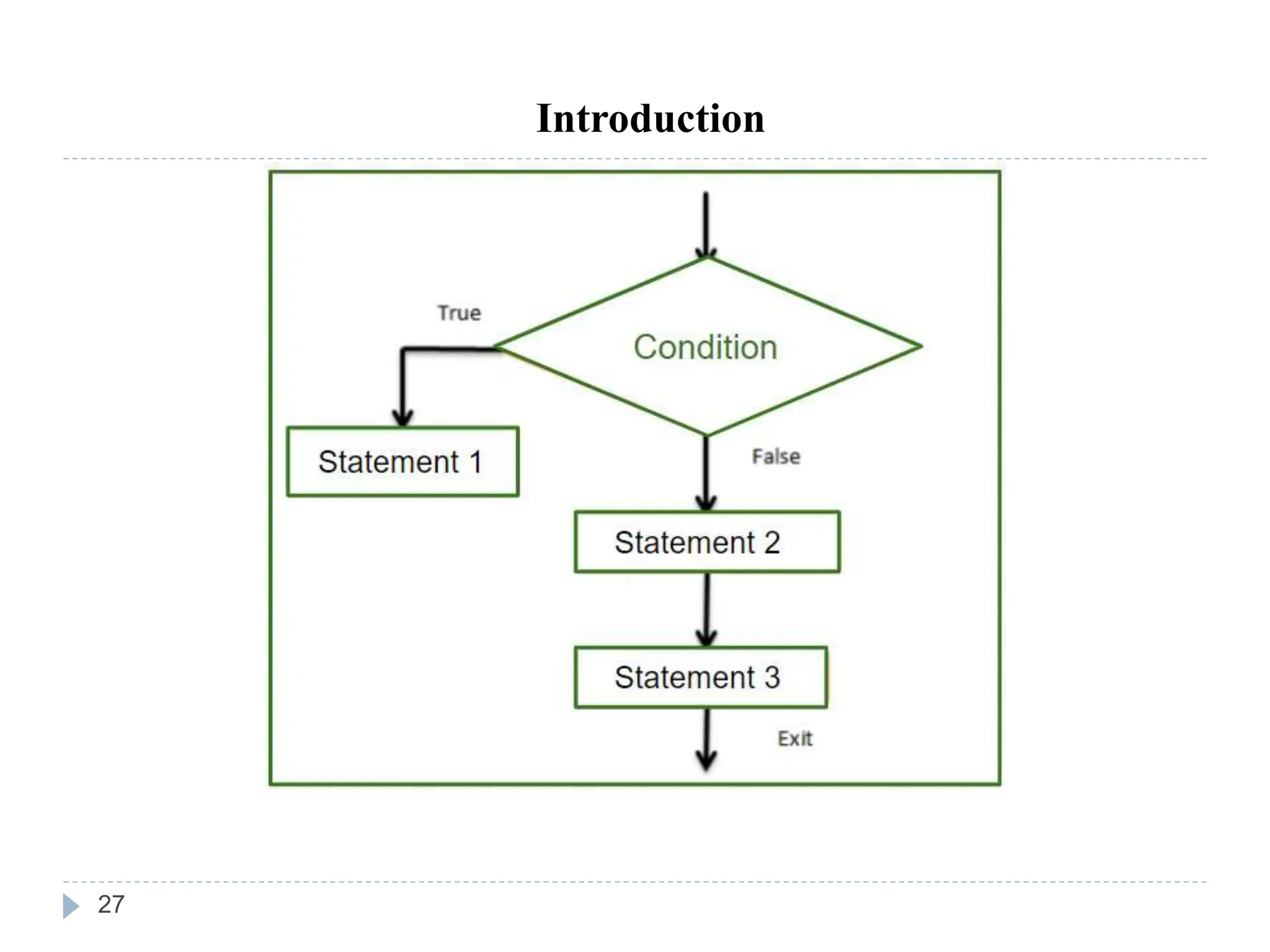
2. Flow of control statements:
The flow of control statements needs to be controlled during the execution of
statements in a program. For example:
27
Introduction
28
Introduction
3. Labels and Gotos:
The most elementary programming language construct for changing the flow of
control in a program is a label and goto. When a compiler encounters a
statement like goto L, it must check that there is exactly one statement with
label L in the scope of this goto statement. If the label has already appeared,
then the symbol table will have an entry giving the compiler-generated label for
the first three-address instruction associated with the source statement labeled L.
For the translation, we generate a goto three-address statement with that
compiler-generated label as a target.
When a label L is encountered for the first time in the source program, either in a
declaration or as the target of the forward goto, we enter L into the symbol table
and generate a symbolic table for L.
29
Introduction
One-pass code generation using backpatching:
In a single pass, backpatching may be used to create a boolean expressions
program as well as the flow of control statements. The synthesized properties
truelist and falselist of non-terminal B are used to handle labels in jumping code
for Boolean statements. The label to which control should go if B is true should
be added to B.truelist, which is a list of a jump or conditional jump instructions.
B.falselist is the list of instructions that eventually get the label to which control
is assigned when B is false. The jumps to true and false exist, as well as the label
field, are left blank when the program is generated for B. The lists B.truelist and
B.falselist, respectively, contain these early jumps.
A statement S, for example, has a synthesized attribute S.nextlist, which indicates
a list of jumps to the instruction immediately after the code for S. It can generate
instructions into an instruction array, with labels serving as indexes. We utilize
three functions to modify the list of jumps:
30
Introduction
•Makelist (i): Create a new list including only i, an index into the array of
instructions and the makelist also returns a pointer to the newly generated list.
•Merge(p1,p2): Concatenates the lists pointed to by p1, and p2 and returns a
pointer to the concatenated list.
•Backpatch (p, i): Inserts i as the target label for each of the instructions on the
record pointed to by p.
Backpatching for Boolean Expressions:
Using a translation technique, it can create code for Boolean expressions
during bottom-up parsing. In grammar, a non-terminal marker M creates a
semantic action that picks up the index of the next instruction to be created at
the proper time.
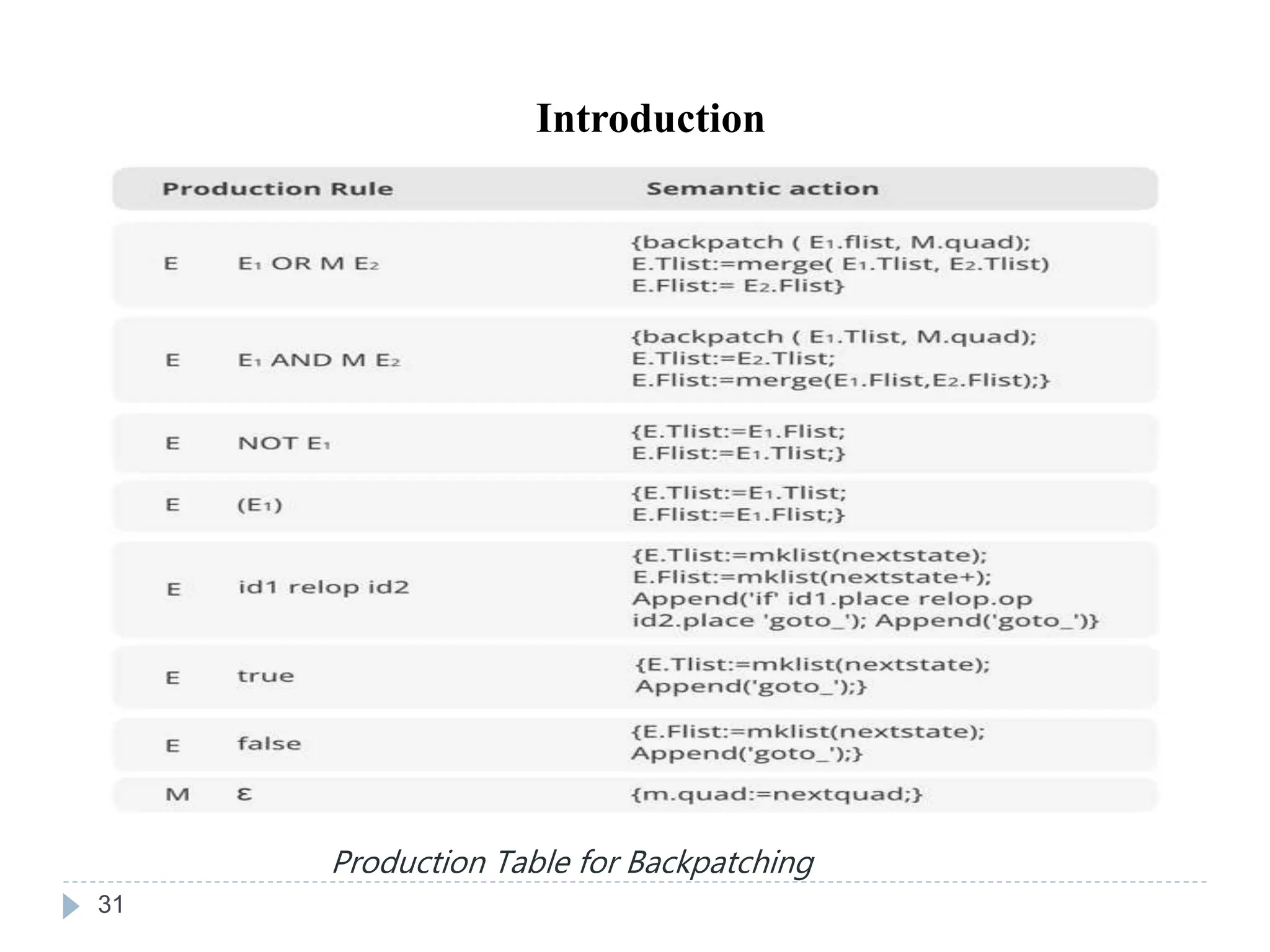
For Example, Backpatching using boolean expressions production rules table:
Step 1: Generation of the production table
31
Introduction
Production Table for Backpatching
32
Introduction
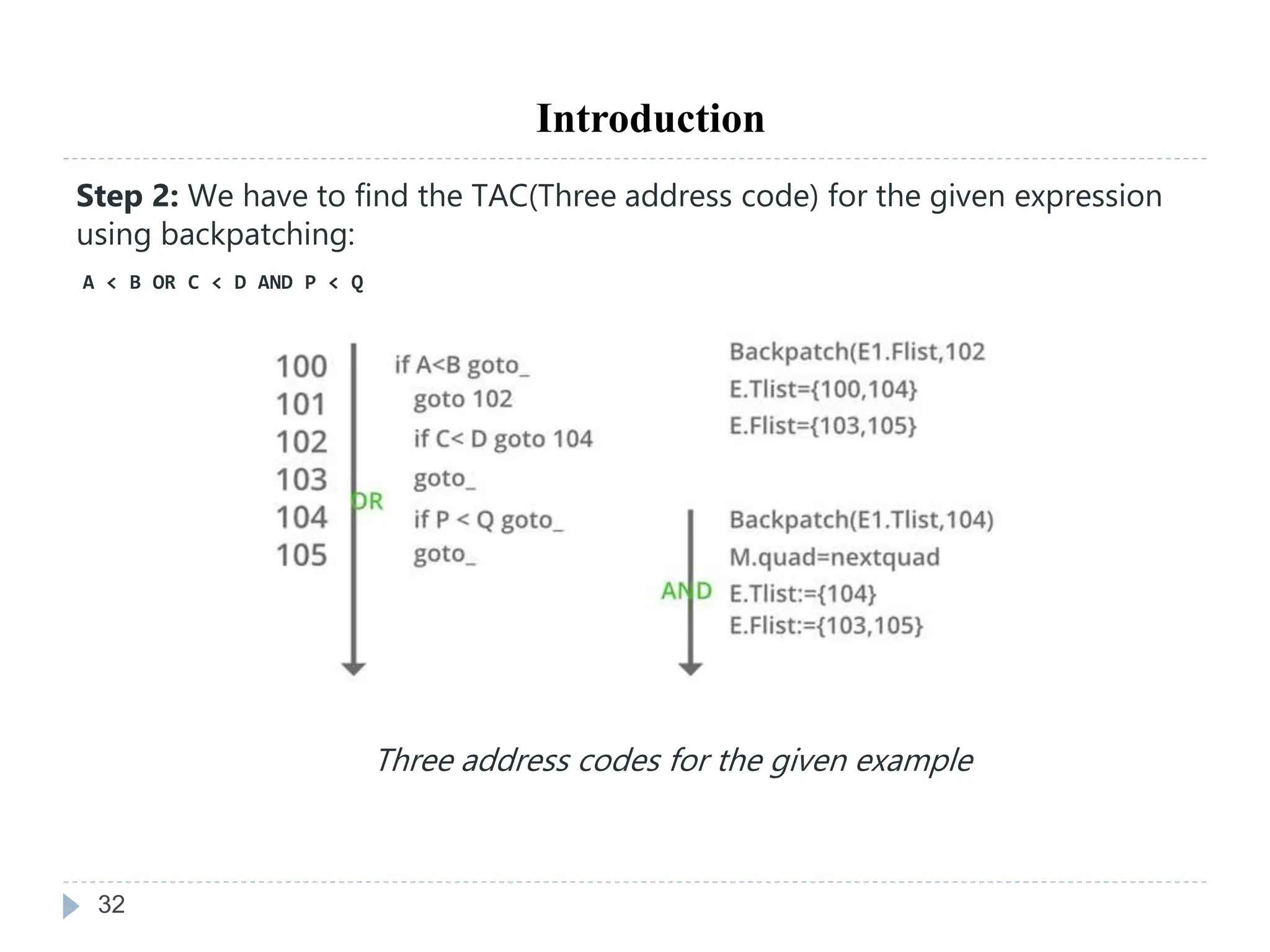
Step 2: We have to find the TAC(Three address code) for the given expression
using backpatching:
A < B OR C < D AND P < Q
Three address codes for the given example
33
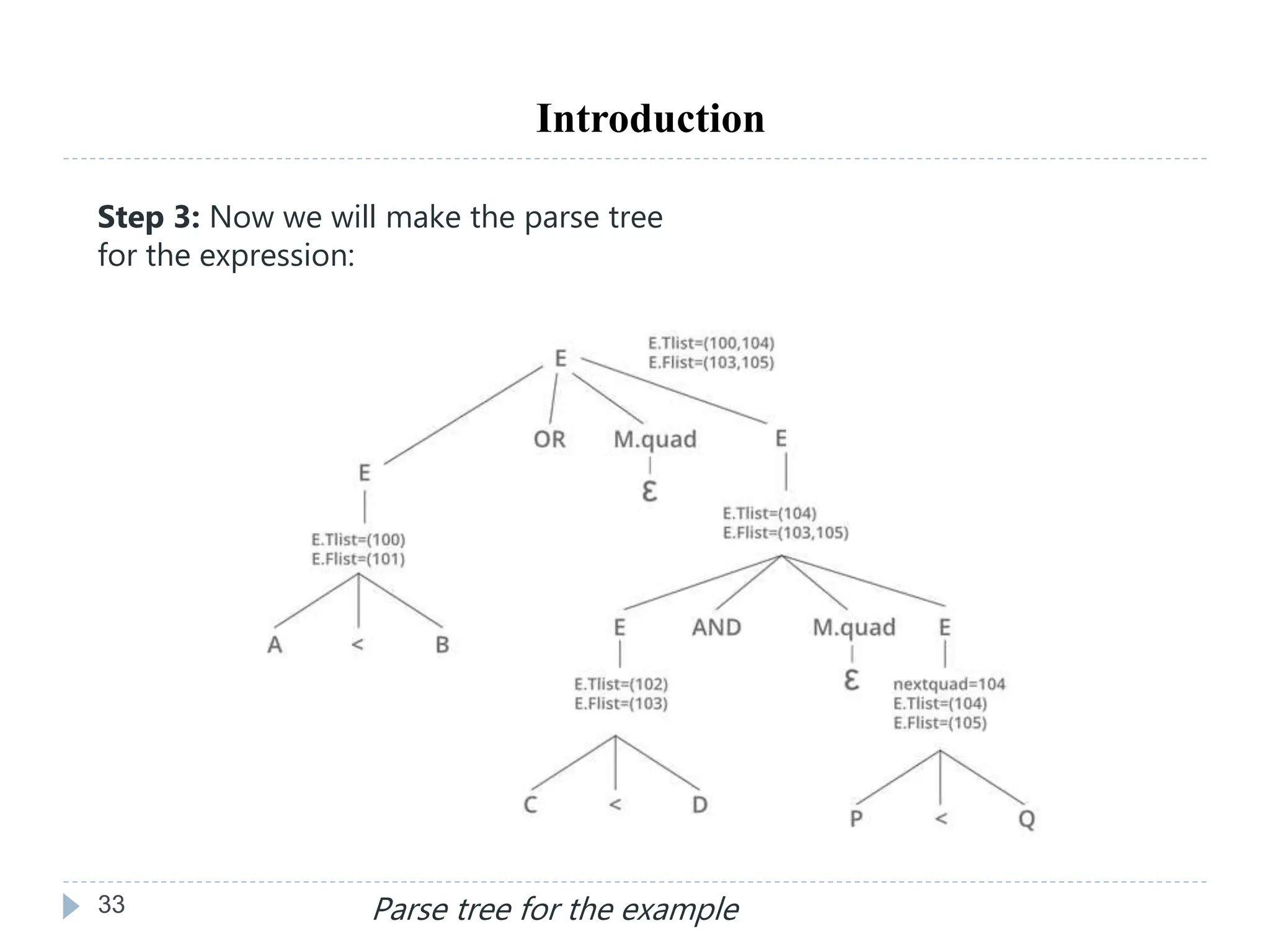
Introduction
Step 3: Now we will make the parse tree
for the expression:
Parse tree for the example
34
Introduction
The flow of Control Statements:
Control statements are those that alter the order in which statements are
executed. If, If-else, Switch-Case, and while-do statements are examples.
Boolean expressions are often used in computer languages to
•Alter the flow of control: Boolean expressions are conditional expressions
that change the flow of control in a statement. The value of such a Boolean
statement is implicit in the program’s position. For example, if (A) B, the
expression A must be true if statement B is reached.
•Compute logical values: During bottom-up parsing, it may generate code for
Boolean statements via a translation mechanism. A non-terminal marker M in
the grammar establishes a semantic action that takes the index of the following
instruction to be formed at the appropriate moment.
35
Introduction
Applications of Backpatching:
•Backpatching is used to translate flow-of-control statements in one pass itself.
•Backpatching is used for producing quadruples for boolean expressions during
bottom-up parsing.
•It is the activity of filling up unspecified information of labels during the code
generation process.
•It helps to resolve forward branches that have been planted in the code.
36
Introduction
37
Introduction
38
Introduction
39
Introduction
40
Introduction
41
Introduction
42
Introduction
43
Introduction
44
Introduction
45
Introduction
46
Introduction
47
Introduction
48
Introduction
49
Introduction
50
End

Chapter 6 - Intermediate Languages.pptxjfjgj

  • 1.
  • 2.
    2 Introduction Intermediate code Intermediate codeis used to translate the source code into the machine code. Intermediate code lies between the high-level language and the machine language. Fig: Position of intermediate code generator •If the compiler directly translates source code into the machine code without generating intermediate code then a full native compiler is required for each new machine. •The intermediate code keeps the analysis portion same for all the compilers that's why it doesn't need a full compiler for every unique machine. •Intermediate code generator receives input from its predecessor phase and semantic analyzer phase. It takes input in the form of an annotated syntax tree. •Using the intermediate code, the second phase of the compiler synthesis phase is changed according to the target machine.
  • 3.
    3 Introduction Intermediate representation Intermediate codecan be represented in two ways: 1. High Level intermediate code: High level intermediate code can be represented as source code. To enhance performance of source code, we can easily apply code modification. But to optimize the target machine, it is less preferred. 2. Low Level intermediate code Low level intermediate code is close to the target machine, which makes it suitable for register and memory allocation etc. it is used for machine-dependent optimizations. Current T
  • 4.
    4 Introduction Postfix Notation •Postfix notationis the useful form of intermediate code if the given language is expressions. •Postfix notation is also called as 'suffix notation' and 'reverse polish'. •Postfix notation is a linear representation of a syntax tree. •In the postfix notation, any expression can be written unambiguously without parentheses. •The ordinary (infix) way of writing the sum of x and y is with operator in the middle: x * y. But in the postfix notation, we place the operator at the right end as xy *. •In postfix notation, the operator follows the operand. Example Production 1.E → E1 op E2 2.E → (E1) 3.E → id
  • 5.
    5 Introduction Semantic Rule Programfragment E.code = E1.code || E2.code || op print op E.code = E1.code E.code = id print id
  • 6.
    6 Introduction Parse tree andSyntax tree When you create a parse tree then it contains more details than actually needed. So, it is very difficult to compiler to parse the parse tree. Take the following parse tree as an example:
  • 7.
    7 Introduction •In the parsetree, most of the leaf nodes are single child to their parent nodes. •In the syntax tree, we can eliminate this extra information. •Syntax tree is a variant of parse tree. In the syntax tree, interior nodes are operators and leaves are operands. •Syntax tree is usually used when represent a program in a tree structure. A sentence id + id * id would have the following syntax tree: Abstract syntax tree can be represented as:
  • 8.
    8 Introduction Abstract syntax treesare important data structures in a compiler. It contains the least unnecessary information. Abstract syntax trees are more compact than a parse tree and can be easily used by a compiler.
  • 9.
    9 Introduction Three address code •Three-addresscode is an intermediate code. It is used by the optimizing compilers. •In three-address code, the given expression is broken down into several separate instructions. These instructions can easily translate into assembly language. •Each Three address code instruction has at most three operands. It is a combination of assignment and a binary operator. Example Given Expression: a := (-c * b) + (-c * d) Three-address code is as follows: t1 := -c t2 := b*t1 t3 := -c t4 := d * t3 t5 := t2 + t4 a := t5 t1 := -c t2 := b*t1 t3 := -c t4 := d * t3 t5 := t2 + t4 a := t5 t is used as registers in the target program. The three address code can be represented in two forms: quadruples and triples.
  • 10.
    10 Introduction Quadruples The quadruples havefour fields to implement the three address code. The field of quadruples contains the name of the operator, the first source operand, the second source operand and the result respectively. Fig: Quadruples field Example 1.a := -b * c + d Three-address code is as follows:
  • 11.
    11 t1 := -bt2 := c + d t3 := t1 * t2 a := t3 Introduction These statements are represented by quadruples as follows: Operator Source 1 Source 2 Destination (0) uminus b - t1 (1) + c d t2 (2) * t1 t2 t3 (3) := t3 - a
  • 12.
    12 Introduction Triples The triples havethree fields to implement the three address code. The field of triples contains the name of the operator, the first source operand and the second source operand. In triples, the results of respective sub-expressions are denoted by the position of expression. Triple is equivalent to DAG while representing expressions. Fig: Triples field Example: 1.a := -b * c + d Three address code is as follows:
  • 13.
    13 Introduction t1 := -bt2 := c + dM t3 := t1 * t2 a := t3 These statements are represented by triples as follows: Operator Source 1 Source 2 (0) uminus b - (1) + c d (2) * (0) (1) (3) := (2) -
  • 14.
    14 Introduction Translation of AssignmentStatements In the syntax directed translation, assignment statement is mainly deals with expressions. The expression can be of type real, integer, array and records. Consider the grammar 1.S → id := E 2.E → E1 + E2 3.E → E1 * E2 4.E → (E1) 5.E → id The translation scheme of above grammar is given below:
  • 15.
    15 Introduction Production rule Semanticactions S → id :=E {p = look_up(id.name); If p ≠ nil then Emit (p = E.place) Else Error; } E → E1 + E2 {E.place = newtemp(); Emit (E.place = E1.place '+' E2.place) } E → E1 * E2 {E.place = newtemp(); Emit (E.place = E1.place '*' E2.place) } E → (E1) {E.place = E1.place} E → id {p = look_up(id.name); If p ≠ nil then Emit (p = E.place) Else Error; }
  • 16.
    16 Introduction •The p returnsthe entry for id.name in the symbol table. •The Emit function is used for appending the three address code to the output file. Otherwise it will report an error. •The newtemp() is a function used to generate new temporary variables. •E.place holds the value of E.
  • 17.
    17 Introduction Statements that alterthe flow of control The goto statement alters the flow of control. If we implement goto statements then we need to define a LABEL for a statement. A production can be added for this purpose: 1.S → LABEL : S 2. LABEL → id In this production system, semantic action is attached to record the LABEL and its value in the symbol table. Following grammar used to incorporate structure flow-of-control constructs: 1.S → if E then S 2. S → if E then S else S 3. S → while E do S 4. S → begin L end 5. S→ A 6. L→ L ; S 7. L → S
  • 18.
    18 Introduction Here, S isa statement, L is a statement-list, A is an assignment statement and E is a Boolean-valued expression. Translation scheme for statement that alters flow of control •We introduce the marker non-terminal M as in case of grammar for Boolean expression. •This M is put before statement in both if then else. In case of while-do, we need to put M before E as we need to come back to it after executing S. •In case of if-then-else, if we evaluate E to be true, first S will be executed. •After this we should ensure that instead of second S, the code after the if- then else will be executed. Then we place another non-terminal marker N after first S. The grammar is as follows:
  • 19.
    19 Introduction 1.S → ifE then M S 2. S → if E then M S else M S 3. S → while M E do M S 4. S → begin L end 5. S → A 6. L→ L ; M S 7. L → S 8. M → ∈ 9. N → ∈ The translation scheme for this grammar is as follows:
  • 20.
    20 Introduction Production rule Semanticactions S → if E then M S1 BACKPATCH (E.TRUE, M.QUAD) S.NEXT = MERGE (E.FALSE, S1.NEXT) S → if E then M1 S1 else M2 S2 BACKPATCH (E.TRUE, M1.QUAD) BACKPATCH (E.FALSE, M2.QUAD) S.NEXT = MERGE (S1.NEXT, N.NEXT, S2.NEXT) S → while M1 E do M2 S1 BACKPATCH (S1,NEXT, M1.QUAD) BACKPATCH (E.TRUE, M2.QUAD) S.NEXT = E.FALSE GEN (goto M1.QUAD) S → begin L end S.NEXT = L.NEXT S → A S.NEXT = MAKELIST () L → L ; M S BACKPATHCH (L1.NEXT, M.QUAD) L.NEXT = S.NEXT L → S L.NEXT = S.NEXT M → ∈ M.QUAD = NEXTQUAD N→ ∈ N.NEXT = MAKELIST (NEXTQUAD) GEN (goto_)
  • 21.
    21 Introduction Procedures call Procedure isan important and frequently used programming construct for a compiler. It is used to generate good code for procedure calls and returns. Calling sequence: The translation for a call includes a sequence of actions taken on entry and exit from each procedure. Following actions take place in a calling sequence: •When a procedure call occurs then space is allocated for activation record. •Evaluate the argument of the called procedure. •Establish the environment pointers to enable the called procedure to access data in enclosing blocks. •Save the state of the calling procedure so that it can resume execution after the call. •Also save the return address. It is the address of the location to which the called routine must transfer after it is finished. •Finally generate a jump to the beginning of the code for the called procedure. Let us consider a grammar for a simple procedure call statement
  • 22.
    22 Introduction 1.S → callid(Elist) 2. Elist → Elist, E 3. Elist → E A suitable transition scheme for procedure call would be: Production Rule Semantic Action S → call id(Elist) for each item p on QUEUE do GEN (param p) GEN (call id.PLACE) Elist → Elist, E append E.PLACE to the end of QUEUE Elist → E initialize QUEUE to contain only E.PLACE Queue is used to store the list of parameters in the procedure call.
  • 23.
    23 Introduction Declarations When we encounterdeclarations, we need to lay out storage for the declared variables. For every local name in a procedure, we create a ST(Symbol Table) entry containing: 1.The type of the name 2.How much storage the name requires The production: 1.D → integer, id 2. D → real, id 3. D → D1, id A suitable transition scheme for declarations would be:
  • 24.
    24 Introduction Production rule Semanticaction D → integer, id ENTER (id.PLACE, integer) D.ATTR = integer D → real, id ENTER (id.PLACE, real) D.ATTR = real D → D1, id ENTER (id.PLACE, D1.ATTR) D.ATTR = D1.ATTR ENTER is used to make the entry into symbol table and ATTR is used to trace the data type.
  • 25.
    25 Introduction Backpatching in CompilerDesign Backpatching is basically a process of fulfilling unspecified information. This information is of labels. It basically uses the appropriate semantic actions during the process of code generation. It may indicate the address of the Label in goto statements while producing TACs for the given expressions. Here basically two passes are used because assigning the positions of these label statements in one pass is quite challenging. It can leave these addresses unidentified in the first pass and then populate them in the second round. Backpatching is the process of filling up gaps in incomplete transformations and information. Need for Backpatching: Backpatching is mainly used for two purposes:
  • 26.
    26 Introduction 1. Boolean expression: Booleanexpressions are statements whose results can be either true or false. A boolean expression which is named for mathematician George Boole is an expression that evaluates to either true or false. Let’s look at some common language examples: •My favorite color is blue. → true •I am afraid of mathematics. → false •2 is greater than 5. → false 2. Flow of control statements: The flow of control statements needs to be controlled during the execution of statements in a program. For example:
  • 27.
  • 28.
    28 Introduction 3. Labels andGotos: The most elementary programming language construct for changing the flow of control in a program is a label and goto. When a compiler encounters a statement like goto L, it must check that there is exactly one statement with label L in the scope of this goto statement. If the label has already appeared, then the symbol table will have an entry giving the compiler-generated label for the first three-address instruction associated with the source statement labeled L. For the translation, we generate a goto three-address statement with that compiler-generated label as a target. When a label L is encountered for the first time in the source program, either in a declaration or as the target of the forward goto, we enter L into the symbol table and generate a symbolic table for L.
  • 29.
    29 Introduction One-pass code generationusing backpatching: In a single pass, backpatching may be used to create a boolean expressions program as well as the flow of control statements. The synthesized properties truelist and falselist of non-terminal B are used to handle labels in jumping code for Boolean statements. The label to which control should go if B is true should be added to B.truelist, which is a list of a jump or conditional jump instructions. B.falselist is the list of instructions that eventually get the label to which control is assigned when B is false. The jumps to true and false exist, as well as the label field, are left blank when the program is generated for B. The lists B.truelist and B.falselist, respectively, contain these early jumps. A statement S, for example, has a synthesized attribute S.nextlist, which indicates a list of jumps to the instruction immediately after the code for S. It can generate instructions into an instruction array, with labels serving as indexes. We utilize three functions to modify the list of jumps:
  • 30.
    30 Introduction •Makelist (i): Createa new list including only i, an index into the array of instructions and the makelist also returns a pointer to the newly generated list. •Merge(p1,p2): Concatenates the lists pointed to by p1, and p2 and returns a pointer to the concatenated list. •Backpatch (p, i): Inserts i as the target label for each of the instructions on the record pointed to by p. Backpatching for Boolean Expressions: Using a translation technique, it can create code for Boolean expressions during bottom-up parsing. In grammar, a non-terminal marker M creates a semantic action that picks up the index of the next instruction to be created at the proper time. For Example, Backpatching using boolean expressions production rules table: Step 1: Generation of the production table
  • 31.
  • 32.
    32 Introduction Step 2: Wehave to find the TAC(Three address code) for the given expression using backpatching: A < B OR C < D AND P < Q Three address codes for the given example
  • 33.
    33 Introduction Step 3: Nowwe will make the parse tree for the expression: Parse tree for the example
  • 34.
    34 Introduction The flow ofControl Statements: Control statements are those that alter the order in which statements are executed. If, If-else, Switch-Case, and while-do statements are examples. Boolean expressions are often used in computer languages to •Alter the flow of control: Boolean expressions are conditional expressions that change the flow of control in a statement. The value of such a Boolean statement is implicit in the program’s position. For example, if (A) B, the expression A must be true if statement B is reached. •Compute logical values: During bottom-up parsing, it may generate code for Boolean statements via a translation mechanism. A non-terminal marker M in the grammar establishes a semantic action that takes the index of the following instruction to be formed at the appropriate moment.
  • 35.
    35 Introduction Applications of Backpatching: •Backpatchingis used to translate flow-of-control statements in one pass itself. •Backpatching is used for producing quadruples for boolean expressions during bottom-up parsing. •It is the activity of filling up unspecified information of labels during the code generation process. •It helps to resolve forward branches that have been planted in the code.
  • 36.
  • 37.
  • 38.
  • 39.
  • 40.
  • 41.
  • 42.
  • 43.
  • 44.
  • 45.
  • 46.
  • 47.
  • 48.
  • 49.
  • 50.