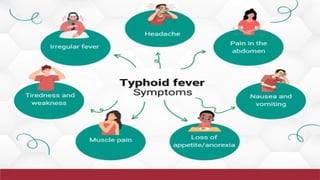
Typhoid or typhoidfever or enteric fever is a bacterial infection that spreads
through contaminated food and water.
MODE OF TRANSMISSION
Contaminated food and water
Fecal - oral route
Vomiting and urine disposals from infected person
Carriers like Flies , cockroaches
Improper hygiene
3.
Causative agent
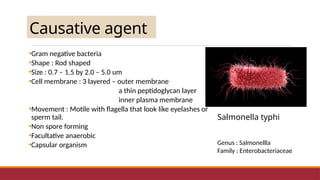
•Gram negativebacteria
•Shape : Rod shaped
•Size : 0.7 – 1.5 by 2.0 – 5.0 um
•Cell membrane : 3 layered – outer membrane
a thin peptidoglycan layer
inner plasma membrane
•Movement : Motile with flagella that look like eyelashes or
sperm tail.
•Non spore forming
•Facultative anaerobic
•Capsular organism
Salmonella typhi
Genus : Salmonellla
Family : Enterobacteriaceae
4.
Virulent Factors
The bacteriacauses the infection due to the following virulent factors –
• H antigen present on the flagella
• O antigen is a somatic antigen present on the body surface of the antigen
• Vi capsular antigen which is a capsular producing antigen
• Endotoxin called lipopolysaccharides
• Secretory protein called invasion which enters the non phagocytic cells of the host
Due to these virulent factors the bacteria can escape from the host’s immune
mechanism.
5.
Pathogenesis
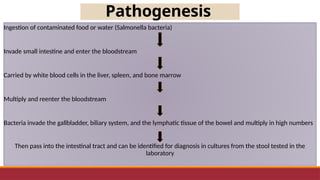
Ingestion of contaminatedfood or water (Salmonella bacteria)
Invade small intestine and enter the bloodstream
Carried by white blood cells in the liver, spleen, and bone marrow
Multiply and reenter the bloodstream
Bacteria invade the gallbladder, biliary system, and the lymphatic tissue of the bowel and multiply in high numbers
Then pass into the intestinal tract and can be identified for diagnosis in cultures from the stool tested in the
laboratory
7.
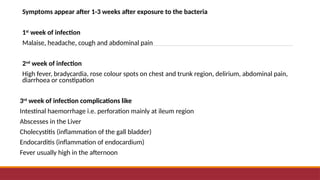
Symptoms appear after1-3 weeks after exposure to the bacteria
1st
week of infection
Malaise, headache, cough and abdominal pain
2nd
week of infection
High fever, bradycardia, rose colour spots on chest and trunk region, delirium, abdominal pain,
diarrhoea or constipation
3rd
week of infection complications like
Intestinal haemorrhage i.e. perforation mainly at ileum region
Abscesses in the Liver
Cholecystitis (inflammation of the gall bladder)
Endocarditis (inflammation of endocardium)
Fever usually high in the afternoon
8.
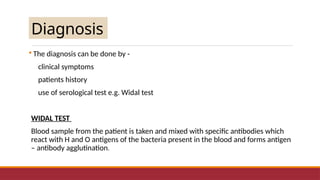
Diagnosis
The diagnosiscan be done by -
clinical symptoms
patients history
use of serological test e.g. Widal test
WIDAL TEST
Blood sample from the patient is taken and mixed with specific antibodies which
react with H and O antigens of the bacteria present in the blood and forms antigen
– antibody agglutination.
9.
Other confirmationtests
Stool culture
Urine culture
Blood culture
Bone marrow culture
Advanced techniques like PCR and blot test are also used
10.
S T AN D A R D T R E A T M E N T
Typhoid fever is usually treated with antibiotics, and the treatment depends on the severity of the
infection and the type of bacteria causing it:
Antibiotics Common antibiotics used to treat typhoid fever include:
• Fluoroquinolones , such as ciprofloxacin, levoflaxin , or ofloxacin
• Cephalosporins, which prevent bacteria from building cell walls
• Macrolides, which prevent bacteria from making proteins
• Carbapenems
• Chloramphenicol
• Trimethoprim-Sulfamethoxazole as an combination
• Ampicillin/Amoxycillin
First choice of the drug is Fluoroquinolones and third generation Cephalosporins.
11.
Immunization
Immunization is theprocess of making someone resistant to disease , usually by giving
them vaccines.
Types of typhoid vaccines
Vi polysaccharide vaccine:
A single injection that's approved for children aged two and older
Ty21a vaccine:
An oral vaccine that's approved for children aged six and older
Typhoid conjugate vaccine:
An intramuscular injection that's approved for children aged six months and older
12.
Prevention
Typhoid infection canbe prevented by –
• Practicing proper sanitation and hygienic lifestyle
• Careful food preparation
• Controlling flies
• Water purification
• Complete treatment for infected person
• Educating the public about the disease