TYPES OF
NETWORK
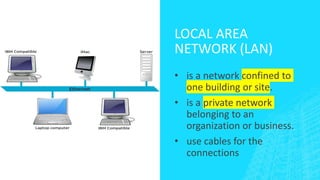
LOCAL AREA
NETWORK (LAN)
• is a network confined to
one building or site.
• is a private network
belonging to an
organization or business.
• use cables for the
connections
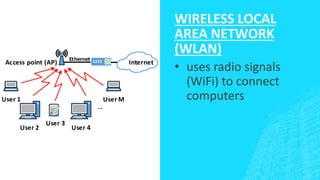
WIRELESS LOCAL
AREA NETWORK
(WLAN)
• uses radio signals
(WiFi) to connect
computers
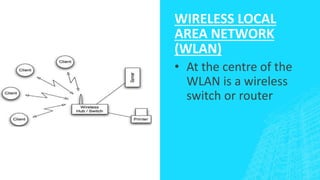
WIRELESS LOCAL
AREA NETWORK
(WLAN)
• At the centre of the
WLAN is a wireless
switch or router
WIRELESS LOCAL AREA NETWORK
(WLAN)
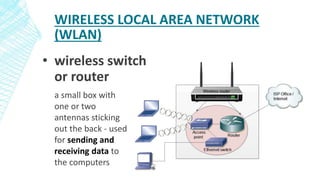
• wireless switch
or router
a small box with
one or two
antennas sticking
out the back - used
for sending and
receiving data to
the computers
WIDE AREA
NETWORK (WAN)
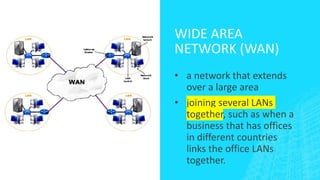
• a network that extends
over a large area
• joining several LANs
together, such as when a
business that has offices
in different countries
links the office LANs
together.
WIDE AREA
NETWORK (WAN)
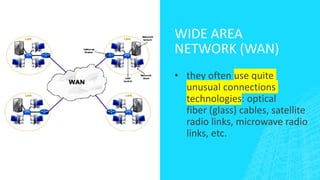
• they often use quite
unusual connections
technologies: optical
fiber (glass) cables, satellite
radio links, microwave radio
links, etc.
WIDE AREA
NETWORK (WAN)
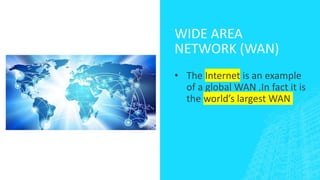
• The Internet is an example
of a global WAN .In fact it is
the world’s largest WAN
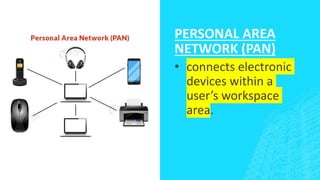
PERSONAL AREA
NETWORK (PAN)
• connects electronic
devices within a
user’s workspace
area.
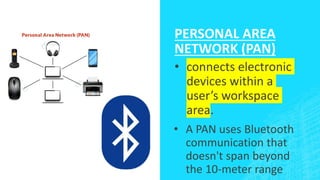
PERSONAL AREA
NETWORK (PAN)
• connects electronic
devices within a
user’s workspace
area.
• A PAN uses Bluetooth
communication that
doesn't span beyond
the 10-meter range
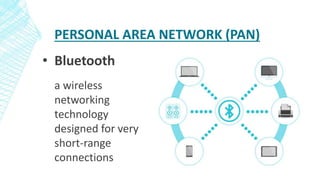
PERSONAL AREA NETWORK (PAN)
• Bluetooth
a wireless
networking
technology
designed for very
short-range
connections
PERSONAL AREA NETWORK (PAN)
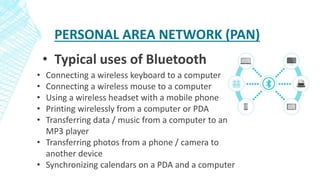
• Typical uses of Bluetooth
• Connecting a wireless keyboard to a computer
• Connecting a wireless mouse to a computer
• Using a wireless headset with a mobile phone
• Printing wirelessly from a computer or PDA
• Transferring data / music from a computer to an
MP3 player
• Transferring photos from a phone / camera to
another device
• Synchronizing calendars on a PDA and a computer
LAN
TOPOLOGIES
WHAT IS TOPOLOGY?
▪Topology = arrangement
WHAT IS TOPOLOGY?
▪the structure of the network of
how all the components are
interconnected to each other
THERE ARE THREE COMMON NETWORK
TOPOLOGIES:
1. BUS TOPOLOGY
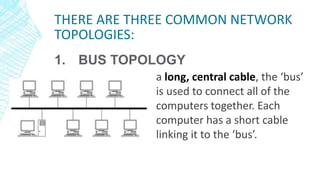
a long, central cable, the ‘bus’
is used to connect all of the
computers together. Each
computer has a short cable
linking it to the ‘bus’.
THERE ARE THREE COMMON NETWORK
TOPOLOGIES:
1. BUS TOPOLOGY
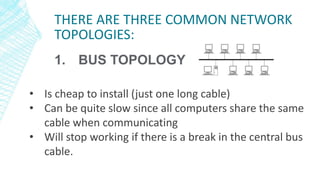
• Is cheap to install (just one long cable)
• Can be quite slow since all computers share the same
cable when communicating
• Will stop working if there is a break in the central bus
cable.
THERE ARE THREE COMMON NETWORK
TOPOLOGIES:
2. Ring Topology
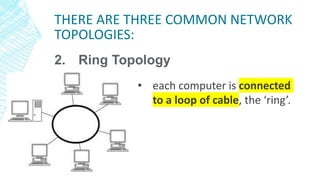
• each computer is connected
to a loop of cable, the ‘ring’.
THERE ARE THREE COMMON NETWORK
TOPOLOGIES:
2. Ring Topology
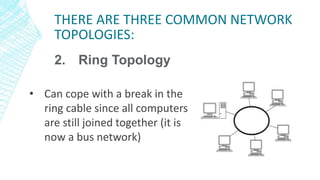
• Can cope with a break in the
ring cable since all computers
are still joined together (it is
now a bus network)
THERE ARE THREE COMMON NETWORK
TOPOLOGIES:
3. Star Topology
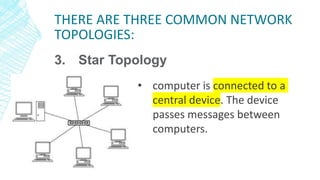
• computer is connected to a
central device. The device
passes messages between
computers.
THERE ARE THREE COMMON NETWORK
TOPOLOGIES:
3. Star Topology
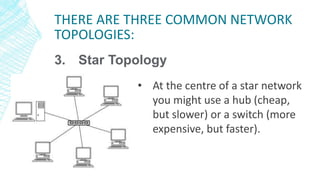
• At the centre of a star network
you might use a hub (cheap,
but slower) or a switch (more
expensive, but faster).
THERE ARE THREE COMMON NETWORK
TOPOLOGIES:
3. Star Topology
• Is quite expensive to install (you have to buy
lots of cable and the central device)
• Is very fast since each computer has its own
cable which it doesn’t need to share
• Can cope with a broken cable (only one computer will be
affected)
• Will stop working if the central device breaks
• Is the most common network topology
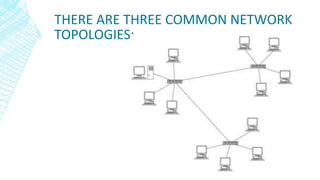
THERE ARE THREE COMMON NETWORK
TOPOLOGIES:
THERE ARE THREE COMMON NETWORK
TOPOLOGIES:
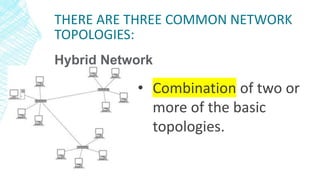
Hybrid Network
• Combination of two or
more of the basic
topologies.
PROJECT
▪Select one (1) network topology and
make 3D diagram

types os network with activity quiz P2.pptx

  • 1.
  • 2.
    LOCAL AREA NETWORK (LAN) •is a network confined to one building or site. • is a private network belonging to an organization or business. • use cables for the connections
  • 3.
    WIRELESS LOCAL AREA NETWORK (WLAN) •uses radio signals (WiFi) to connect computers
  • 4.
    WIRELESS LOCAL AREA NETWORK (WLAN) •At the centre of the WLAN is a wireless switch or router
  • 5.
    WIRELESS LOCAL AREANETWORK (WLAN) • wireless switch or router a small box with one or two antennas sticking out the back - used for sending and receiving data to the computers
  • 6.
    WIDE AREA NETWORK (WAN) •a network that extends over a large area • joining several LANs together, such as when a business that has offices in different countries links the office LANs together.
  • 7.
    WIDE AREA NETWORK (WAN) •they often use quite unusual connections technologies: optical fiber (glass) cables, satellite radio links, microwave radio links, etc.
  • 8.
    WIDE AREA NETWORK (WAN) •The Internet is an example of a global WAN .In fact it is the world’s largest WAN
  • 9.
    PERSONAL AREA NETWORK (PAN) •connects electronic devices within a user’s workspace area.
  • 10.
    PERSONAL AREA NETWORK (PAN) •connects electronic devices within a user’s workspace area. • A PAN uses Bluetooth communication that doesn't span beyond the 10-meter range
  • 11.
    PERSONAL AREA NETWORK(PAN) • Bluetooth a wireless networking technology designed for very short-range connections
  • 12.
    PERSONAL AREA NETWORK(PAN) • Typical uses of Bluetooth • Connecting a wireless keyboard to a computer • Connecting a wireless mouse to a computer • Using a wireless headset with a mobile phone • Printing wirelessly from a computer or PDA • Transferring data / music from a computer to an MP3 player • Transferring photos from a phone / camera to another device • Synchronizing calendars on a PDA and a computer
  • 13.
  • 14.
  • 15.
    WHAT IS TOPOLOGY? ▪thestructure of the network of how all the components are interconnected to each other
  • 16.
    THERE ARE THREECOMMON NETWORK TOPOLOGIES: 1. BUS TOPOLOGY a long, central cable, the ‘bus’ is used to connect all of the computers together. Each computer has a short cable linking it to the ‘bus’.
  • 17.
    THERE ARE THREECOMMON NETWORK TOPOLOGIES: 1. BUS TOPOLOGY • Is cheap to install (just one long cable) • Can be quite slow since all computers share the same cable when communicating • Will stop working if there is a break in the central bus cable.
  • 18.
    THERE ARE THREECOMMON NETWORK TOPOLOGIES: 2. Ring Topology • each computer is connected to a loop of cable, the ‘ring’.
  • 19.
    THERE ARE THREECOMMON NETWORK TOPOLOGIES: 2. Ring Topology • Can cope with a break in the ring cable since all computers are still joined together (it is now a bus network)
  • 20.
    THERE ARE THREECOMMON NETWORK TOPOLOGIES: 3. Star Topology • computer is connected to a central device. The device passes messages between computers.
  • 21.
    THERE ARE THREECOMMON NETWORK TOPOLOGIES: 3. Star Topology • At the centre of a star network you might use a hub (cheap, but slower) or a switch (more expensive, but faster).
  • 22.
    THERE ARE THREECOMMON NETWORK TOPOLOGIES: 3. Star Topology • Is quite expensive to install (you have to buy lots of cable and the central device) • Is very fast since each computer has its own cable which it doesn’t need to share • Can cope with a broken cable (only one computer will be affected) • Will stop working if the central device breaks • Is the most common network topology
  • 23.
    THERE ARE THREECOMMON NETWORK TOPOLOGIES:
  • 24.
    THERE ARE THREECOMMON NETWORK TOPOLOGIES: Hybrid Network • Combination of two or more of the basic topologies.
  • 25.
    PROJECT ▪Select one (1)network topology and make 3D diagram

Editor's Notes

  • #3 A local area network is a computer network that interconnects computers within a limited area such as a residence, school, laboratory, university campus or office building. 
  • #6 It is much more convenient to use wireless connections instead of running long wires all over a building   However, WLANs are more difficult to make secure since other people can also try to connect to the wireless network. So, it is very important to have a good, hard-to-guess password for the WLAN connections. Typically, the range of a wireless connection is about 50m, but it depends how many walls, etc. are in the way.
  • #7 Because WANs are often geographically spread over large areas and links between computers over long distances, they often use quite unusual connections technologies: optical fiber (glass) cables, satellite radio links, microwave radio links, etc.
  • #8 Because WANs are often geographically spread over large areas and links between computers over long distances, they often use quite unusual connections technologies: optical fiber (glass) cables, satellite radio links, microwave radio links, etc.
  • #9 Computers on the International Space Station are linked to the Internet, so the you could say the Internet is now the first off-planet WAN
  • #12 What is Bluetooth device? The idea of Bluetooth is to get rid of the need for all of those cables (e.g. USB cables) that connect our computer to peripheral devices such as printers, mice, keyboards, etc. Bluetooth devices contain small, low-power radio transmitters and receivers. When devices are in range of other Bluetooth devices, they detect each other and can be 'paired' (connected)
  • #15 The word topology means ‘arrangement’, so when we talk about the topology of a network, we mean how the different parts are arranged and connected together
  • #16 The word topology means ‘arrangement’, so when we talk about the topology of a network, we mean how the different parts are arranged and connected together
  • #19 (If you took a bus network and connected the ends of the bus cable together, you would have a ring network.)
  • #24 What do you call the combinations of different topology
  • #25 A network that has several star networks linked together is a hybrid network