A shield volcano is
known for its explosive
eruptions.
Lava from a cinder
cone volcano is very
thick and slow-moving.
FICTION
FACT
Lava from a shield
volcano flows easily
and covers a wide area.
Volcanoes can be
inactive for thousand
of years and still be
classified as active.
FACT
FICTION
Types of
Volcano
es
Learning Objectives:
1
2
Identify the four main types of
volcanoes and describe their
distinct characteristics
Differentiate between active and
inactive volcanoes based on their
features and activity
TYPES OF
VOLCANOES
(BASED ON STRUCTURE)
SHEILD VOLCANOES
 Large, broad volcanoes with gentle
slopes formed by low- viscosity lava
that flows easily.
 Non-explosive, with lava spreading
over large areas.
 Example: Mauna Loa (Hawaii). The
largest volcano in the world, producing
vast amounts of fluid lava that flows
over long distances.
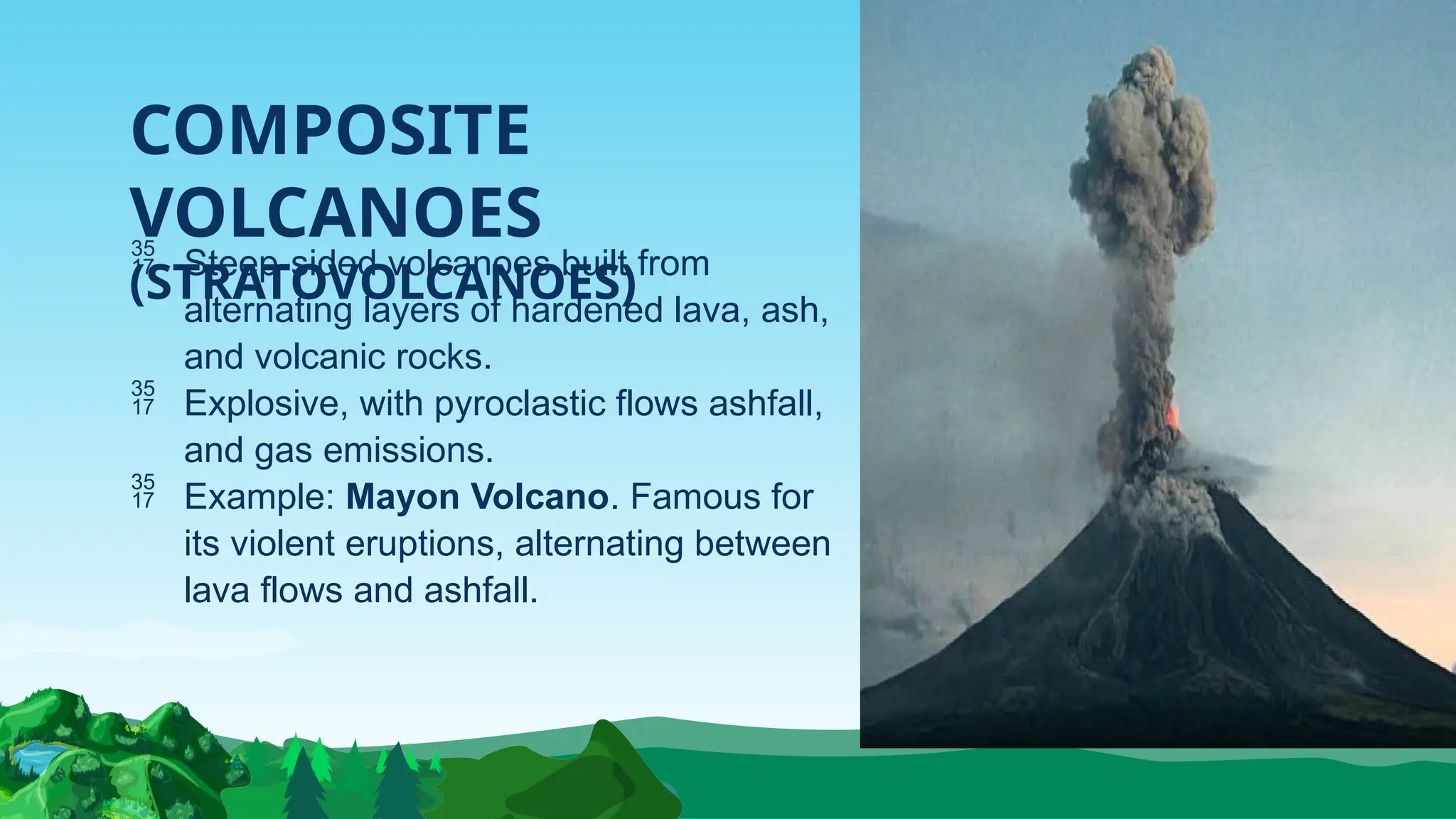
COMPOSITE
VOLCANOES
(STRATOVOLCANOES)
 Steep-sided volcanoes built from
alternating layers of hardened lava, ash,
and volcanic rocks.
 Explosive, with pyroclastic flows ashfall,
and gas emissions.
 Example: Mayon Volcano. Famous for
its violent eruptions, alternating between
lava flows and ashfall.
CINDER CONE
VOLCANOES
 Small, steep-sided volcanoes formed
from volcanic ash, cinders, and rocks
ejected during eruptions.
 Moderately explosive but less powerful
than composite volcanoes
 Example is the Smith volcano. Found
in the Babuyan Islands, it is active and
ejected ash, rocks, and cinders during
eruptions. Paricutin (Mexico) a cinder
cone that erupted in 1943
LAVA DOMES
VOLCANOES
 Dome-shaped volcanoes formed by
slow, viscous lava that piles up around
the vent
 Generally non-explosive, but can lead
to dome collapse and pyroclastic
flows.
 Example: Mt. Bulusan. Features a
growing lava dome collapse and
pyroclastic flows. Another example is
Novarupta (Alaska) and Mount St.
Helen in USA.
TYPES OF
VOLCANOES
(BASED ON THE
ACTIVITY)
ACTIVE
VOLCANOES
 Currently erupting, showing
signs of imminent eruption,
or has erupted the past 10,
000 years.
 Examples are Taal Volcano,
Kanlaon and Mayon Volcano
INACTIVE VOLCANOES
 Volcanoes with no recorded
eruptions in historical times
and no seismic activity
indicating potential
eruptions.
 Examples are Mt. Apo in
Mindanao and Mt. Arayat in
Pampanga.
ACTIVE OR INACTIVE
VOLCANO
MAYON VOLCANO
MOUNT APO
MOUNT ARAYAT
MT. KANLAON
TAAL VOLCANO
Quiz: Multiple Choice
1. Which type of volcano has broad, gentle slopes and produces non-
explosive eruptions?
a. Composite Volcano
b. Cinder Cone Volcano
c. Shield Volcano
d. Dormant Volcano
2. Which of the following is a characteristic of a composite volcano?
a. Steep, conical shape
b. Non-explosive eruptions
c. Fluid lava
d. Small, steep slopes
3. What types of volcanoes is formed primarily from ash, cinders and
rocks?
a. Shield Volcano
b. Composite Volcano
c. Cinder Cone Volcano
d. Extinct Volcano
4. Which volcano type is characterized by alternating layers of a lava
and ash?
a. Shield Volcano
b. Cinder Cone Volcano
c. Composite Volcano
d. Hotspot Volcano
Correct Answers:
1. C
2. A
3. C
4. C
+1
Assignment!
Choose one type of volcano. Draw it, label
it’s characteristics (e.g., shape, eruption
style, lava type), and give an example.
Submit your work next class.
THANK YOU FOR
PARTICIPATING!

TYPES OF VOLCANOES IN GRADE 9 LEVEL .pptx

  • 2.
    A shield volcanois known for its explosive eruptions. Lava from a cinder cone volcano is very thick and slow-moving. FICTION FACT
  • 3.
    Lava from ashield volcano flows easily and covers a wide area. Volcanoes can be inactive for thousand of years and still be classified as active. FACT FICTION
  • 5.
  • 6.
    Learning Objectives: 1 2 Identify thefour main types of volcanoes and describe their distinct characteristics Differentiate between active and inactive volcanoes based on their features and activity
  • 7.
  • 8.
    SHEILD VOLCANOES  Large,broad volcanoes with gentle slopes formed by low- viscosity lava that flows easily.  Non-explosive, with lava spreading over large areas.  Example: Mauna Loa (Hawaii). The largest volcano in the world, producing vast amounts of fluid lava that flows over long distances.
  • 9.
    COMPOSITE VOLCANOES (STRATOVOLCANOES)  Steep-sided volcanoesbuilt from alternating layers of hardened lava, ash, and volcanic rocks.  Explosive, with pyroclastic flows ashfall, and gas emissions.  Example: Mayon Volcano. Famous for its violent eruptions, alternating between lava flows and ashfall.
  • 10.
    CINDER CONE VOLCANOES  Small,steep-sided volcanoes formed from volcanic ash, cinders, and rocks ejected during eruptions.  Moderately explosive but less powerful than composite volcanoes  Example is the Smith volcano. Found in the Babuyan Islands, it is active and ejected ash, rocks, and cinders during eruptions. Paricutin (Mexico) a cinder cone that erupted in 1943
  • 11.
    LAVA DOMES VOLCANOES  Dome-shapedvolcanoes formed by slow, viscous lava that piles up around the vent  Generally non-explosive, but can lead to dome collapse and pyroclastic flows.  Example: Mt. Bulusan. Features a growing lava dome collapse and pyroclastic flows. Another example is Novarupta (Alaska) and Mount St. Helen in USA.
  • 12.
  • 13.
    ACTIVE VOLCANOES  Currently erupting,showing signs of imminent eruption, or has erupted the past 10, 000 years.  Examples are Taal Volcano, Kanlaon and Mayon Volcano
  • 14.
    INACTIVE VOLCANOES  Volcanoeswith no recorded eruptions in historical times and no seismic activity indicating potential eruptions.  Examples are Mt. Apo in Mindanao and Mt. Arayat in Pampanga.
  • 15.
  • 16.
  • 17.
  • 18.
  • 19.
  • 20.
  • 21.
    Quiz: Multiple Choice 1.Which type of volcano has broad, gentle slopes and produces non- explosive eruptions? a. Composite Volcano b. Cinder Cone Volcano c. Shield Volcano d. Dormant Volcano 2. Which of the following is a characteristic of a composite volcano? a. Steep, conical shape b. Non-explosive eruptions c. Fluid lava d. Small, steep slopes
  • 22.
    3. What typesof volcanoes is formed primarily from ash, cinders and rocks? a. Shield Volcano b. Composite Volcano c. Cinder Cone Volcano d. Extinct Volcano 4. Which volcano type is characterized by alternating layers of a lava and ash? a. Shield Volcano b. Cinder Cone Volcano c. Composite Volcano d. Hotspot Volcano
  • 23.
  • 24.
    Assignment! Choose one typeof volcano. Draw it, label it’s characteristics (e.g., shape, eruption style, lava type), and give an example. Submit your work next class.
  • 25.