Types of
Recommender
Systems
Shubham Mehta
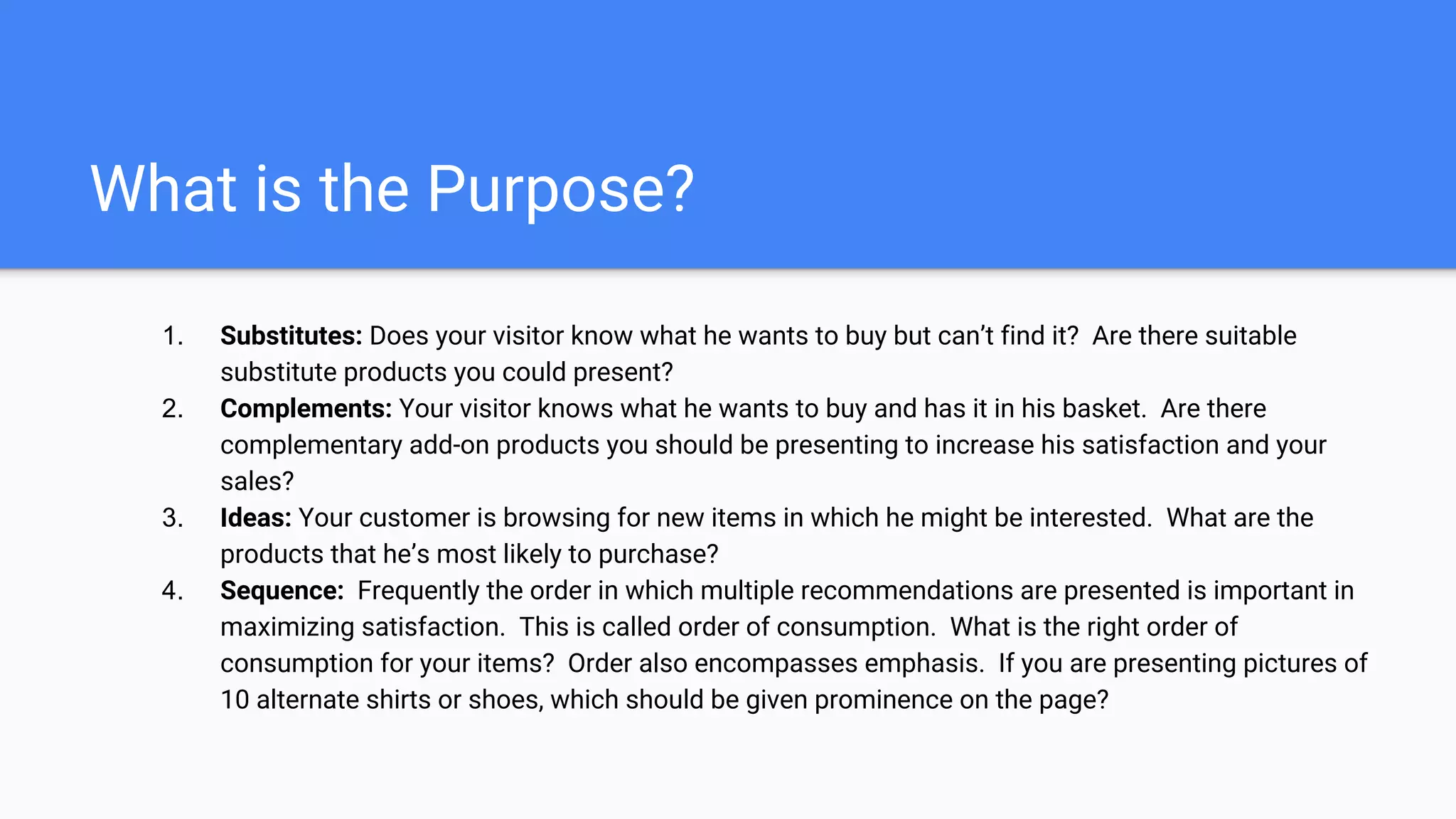
What is the Purpose?
1. Substitutes: Does your visitor know what he wants to buy but can’t find it? Are there suitable
substitute products you could present?
2. Complements: Your visitor knows what he wants to buy and has it in his basket. Are there
complementary add-on products you should be presenting to increase his satisfaction and your
sales?
3. Ideas: Your customer is browsing for new items in which he might be interested. What are the
products that he’s most likely to purchase?
4. Sequence: Frequently the order in which multiple recommendations are presented is important in
maximizing satisfaction. This is called order of consumption. What is the right order of
consumption for your items? Order also encompasses emphasis. If you are presenting pictures of
10 alternate shirts or shoes, which should be given prominence on the page?
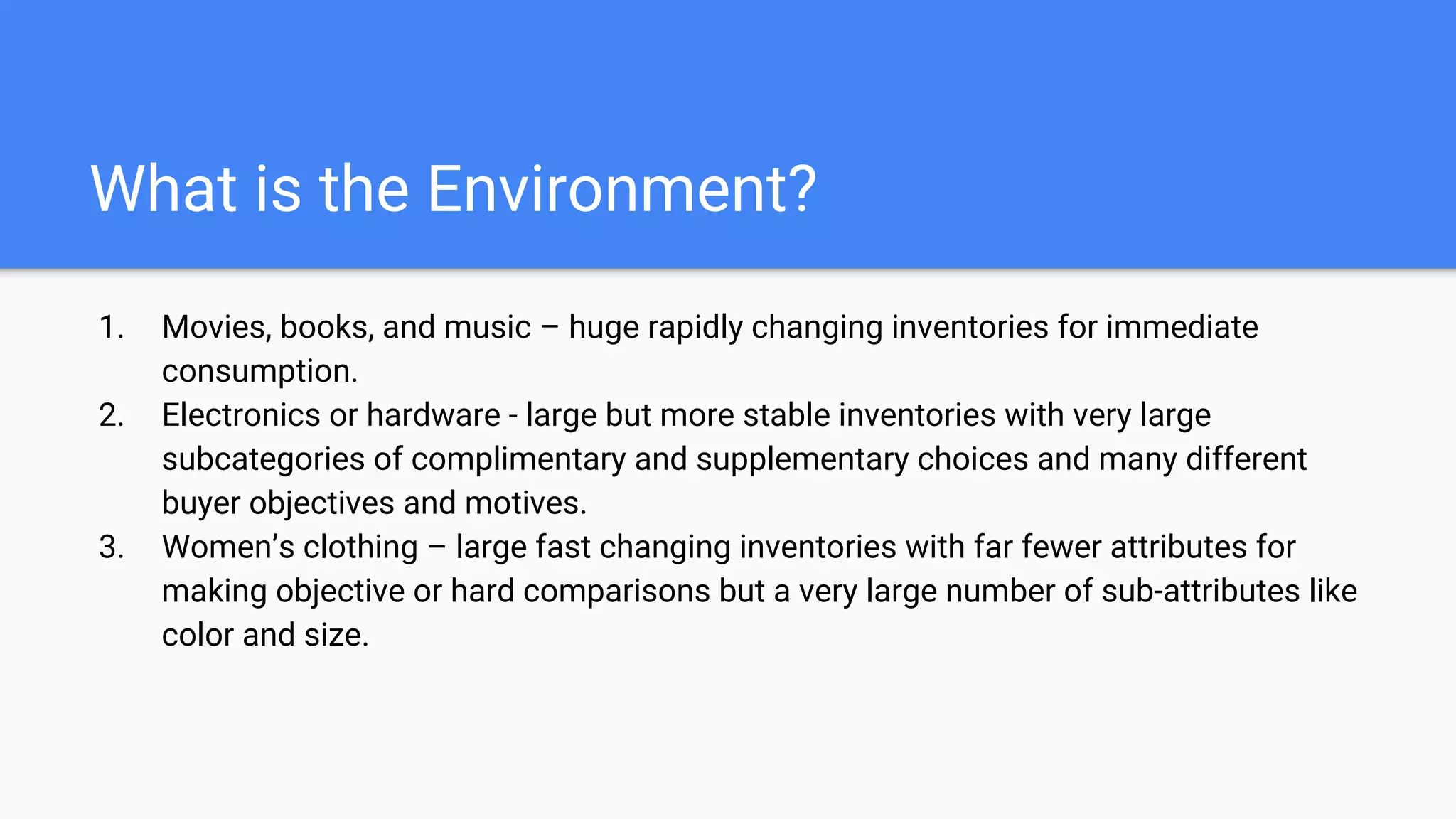
What is the Environment?
1. Movies, books, and music – huge rapidly changing inventories for immediate
consumption.
2. Electronics or hardware - large but more stable inventories with very large
subcategories of complimentary and supplementary choices and many different
buyer objectives and motives.
3. Women’s clothing – large fast changing inventories with far fewer attributes for
making objective or hard comparisons but a very large number of sub-attributes like
color and size.
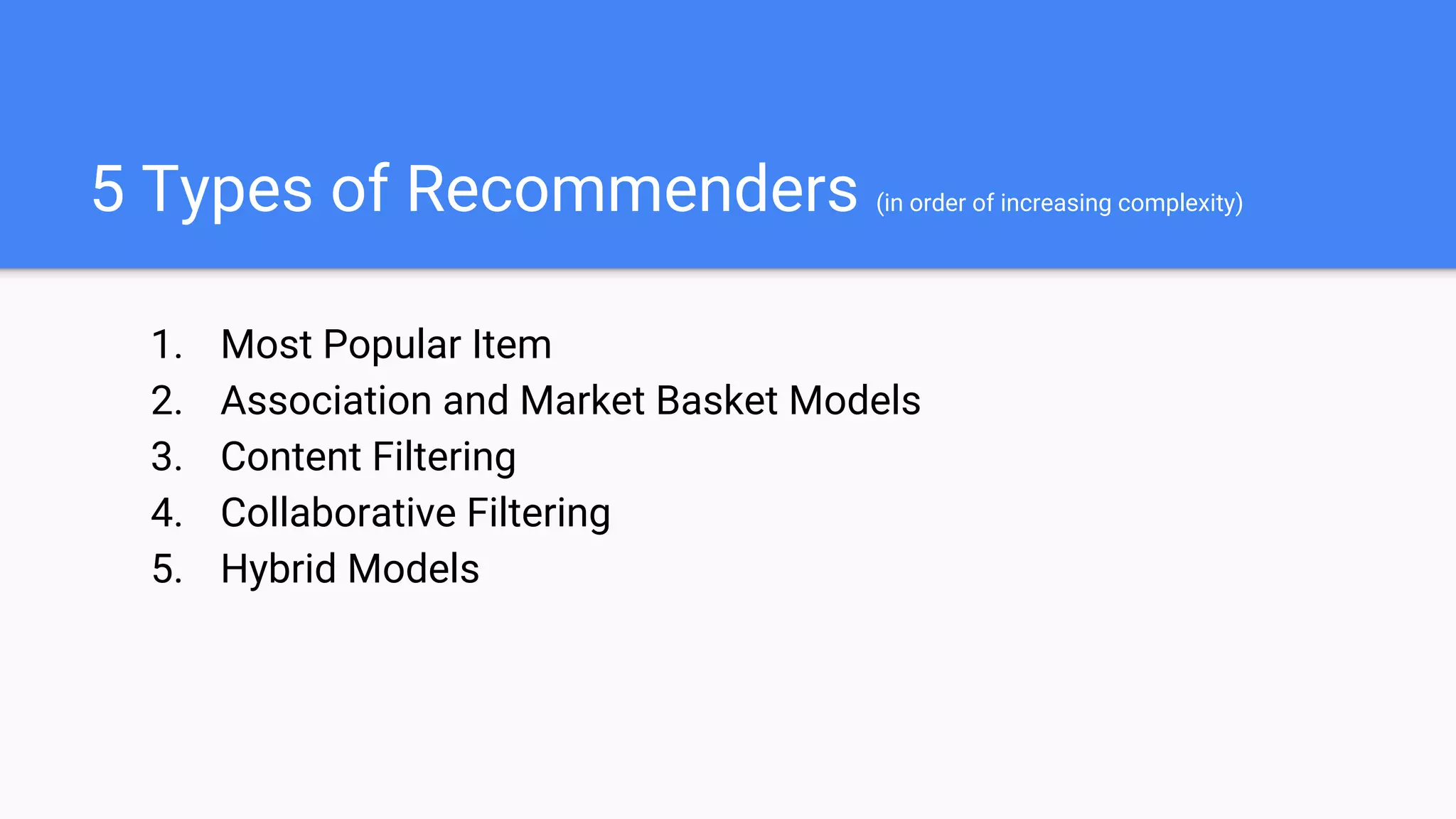
5 Types of Recommenders (in order of increasing complexity)
1. Most Popular Item
2. Association and Market Basket Models
3. Content Filtering
4. Collaborative Filtering
5. Hybrid Models
1. Most Popular Item
● Simply offer what is most popular.
● Very little data requirements. Just sales figures.
● Non-personalized.
● Can be personalized according to category preferences of the user (eg. if
the user is interested in books->novel, recommend the most popular or the
latest release novel)
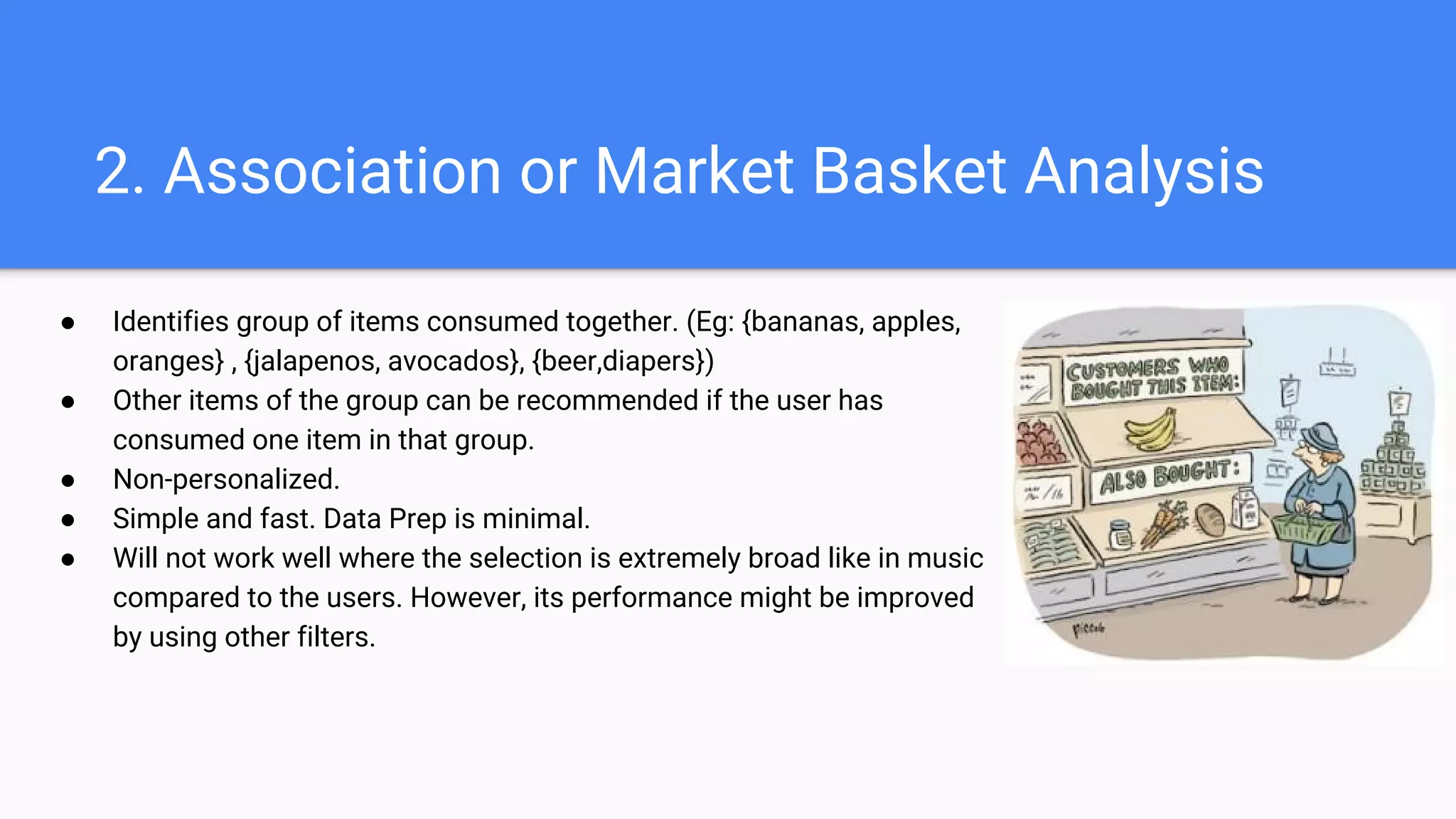
2. Association or Market Basket Analysis
● Identifies group of items consumed together. (Eg: {bananas, apples,
oranges} , {jalapenos, avocados}, {beer,diapers})
● Other items of the group can be recommended if the user has
consumed one item in that group.
● Non-personalized.
● Simple and fast. Data Prep is minimal.
● Will not work well where the selection is extremely broad like in music
compared to the users. However, its performance might be improved
by using other filters.
3. Content Filtering
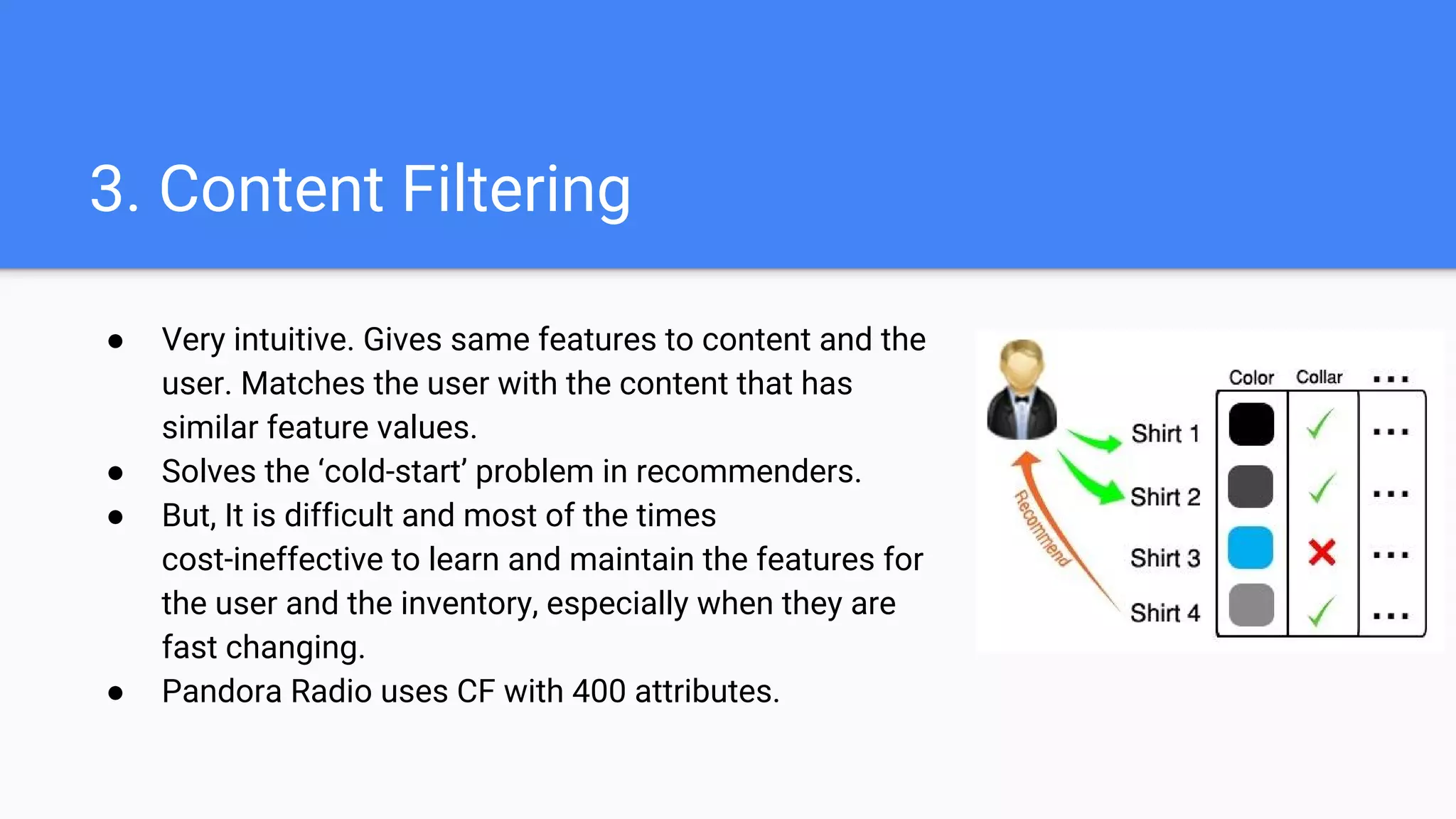
● Very intuitive. Gives same features to content and the
user. Matches the user with the content that has
similar feature values.
● Solves the ‘cold-start’ problem in recommenders.
● But, It is difficult and most of the times
cost-ineffective to learn and maintain the features for
the user and the inventory, especially when they are
fast changing.
● Pandora Radio uses CF with 400 attributes.
4. Collaborative Filtering
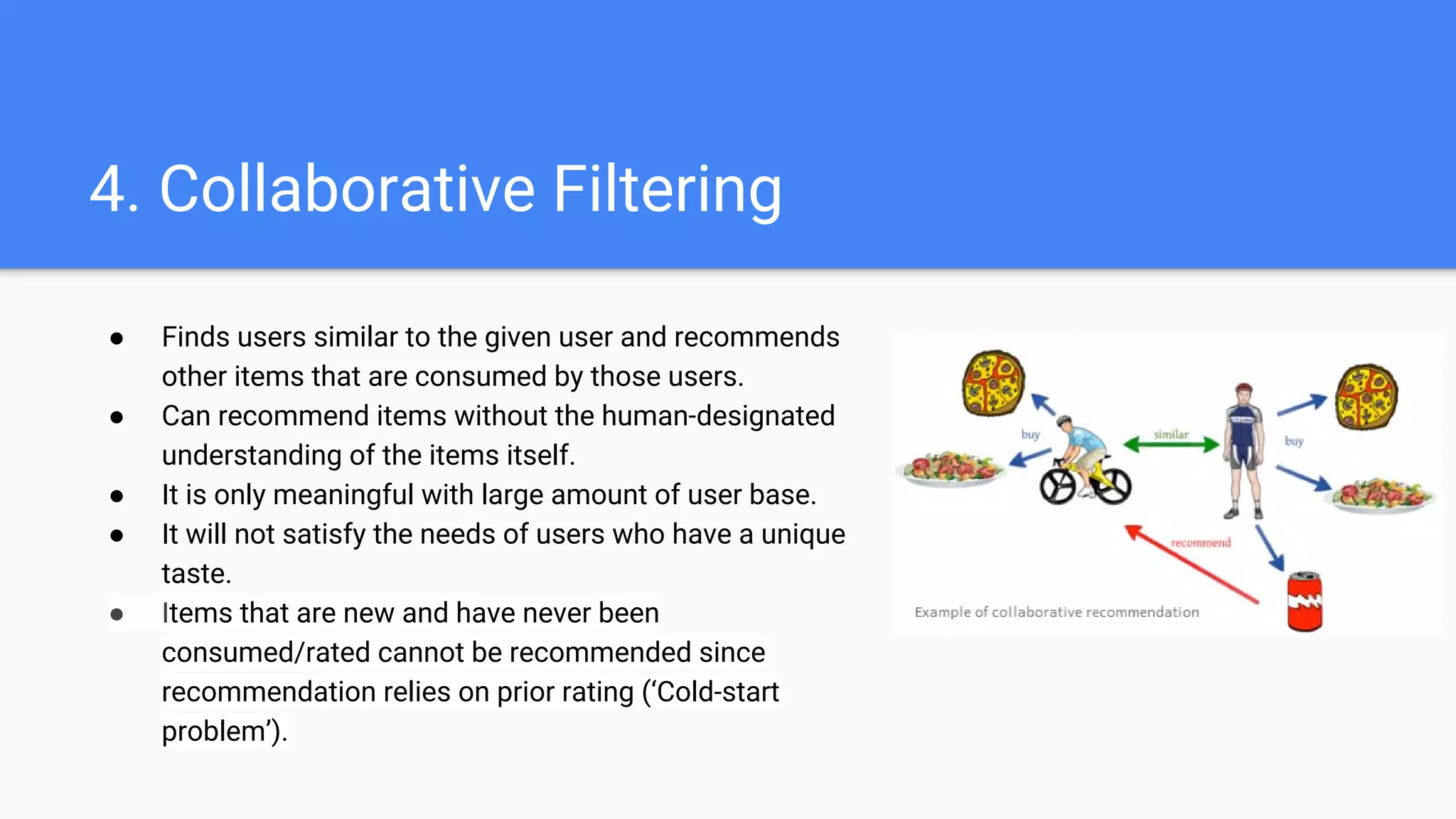
● Finds users similar to the given user and recommends
other items that are consumed by those users.
● Can recommend items without the human-designated
understanding of the items itself.
● It is only meaningful with large amount of user base.
● It will not satisfy the needs of users who have a unique
taste.
● Items that are new and have never been
consumed/rated cannot be recommended since
recommendation relies on prior rating (‘Cold-start
problem’).
5. Hybrid Recommender
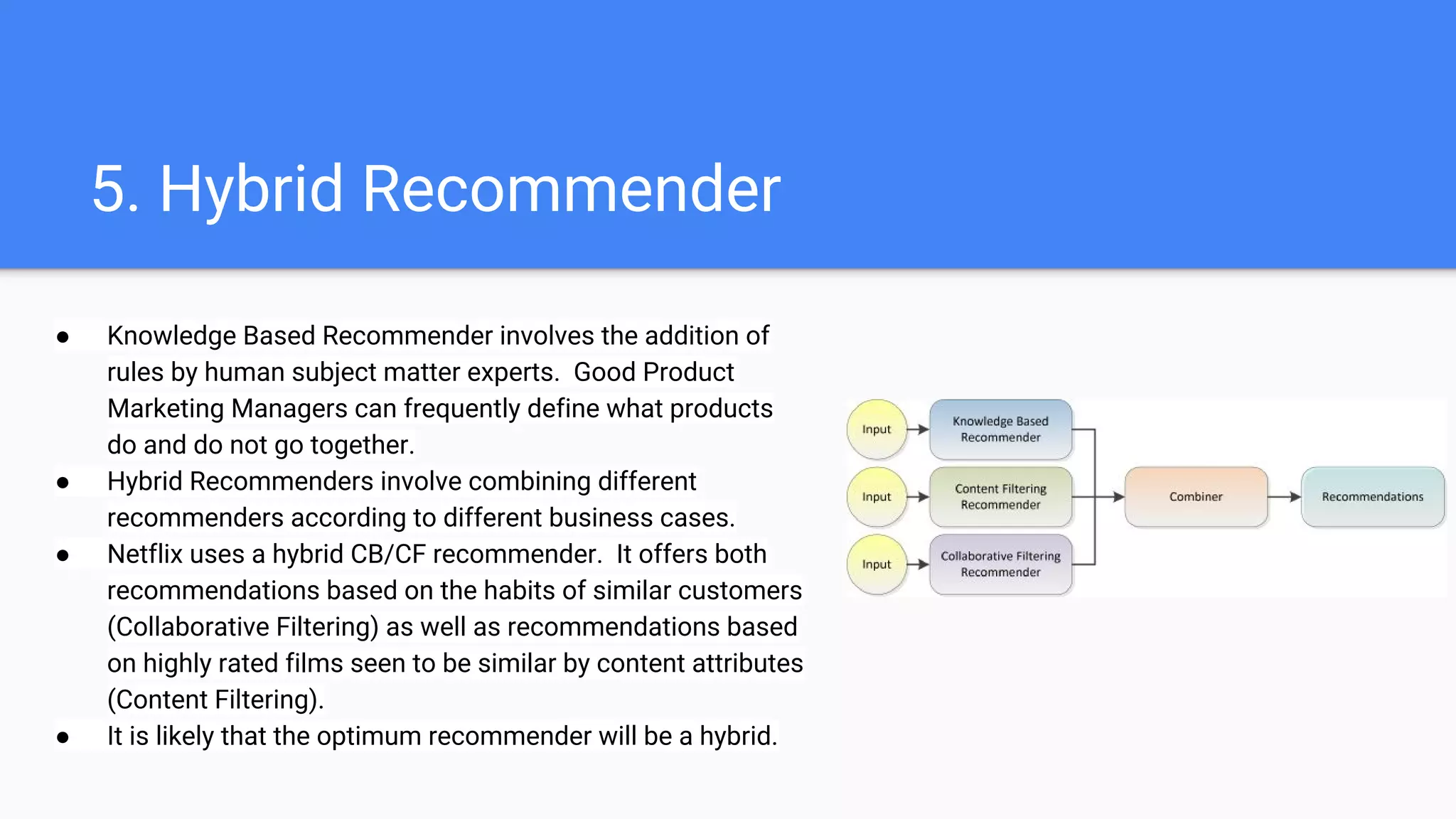
● Knowledge Based Recommender involves the addition of
rules by human subject matter experts. Good Product
Marketing Managers can frequently define what products
do and do not go together.
● Hybrid Recommenders involve combining different
recommenders according to different business cases.
● Netflix uses a hybrid CB/CF recommender. It offers both
recommendations based on the habits of similar customers
(Collaborative Filtering) as well as recommendations based
on highly rated films seen to be similar by content attributes
(Content Filtering).
● It is likely that the optimum recommender will be a hybrid.
Deep Learning and Recommenders
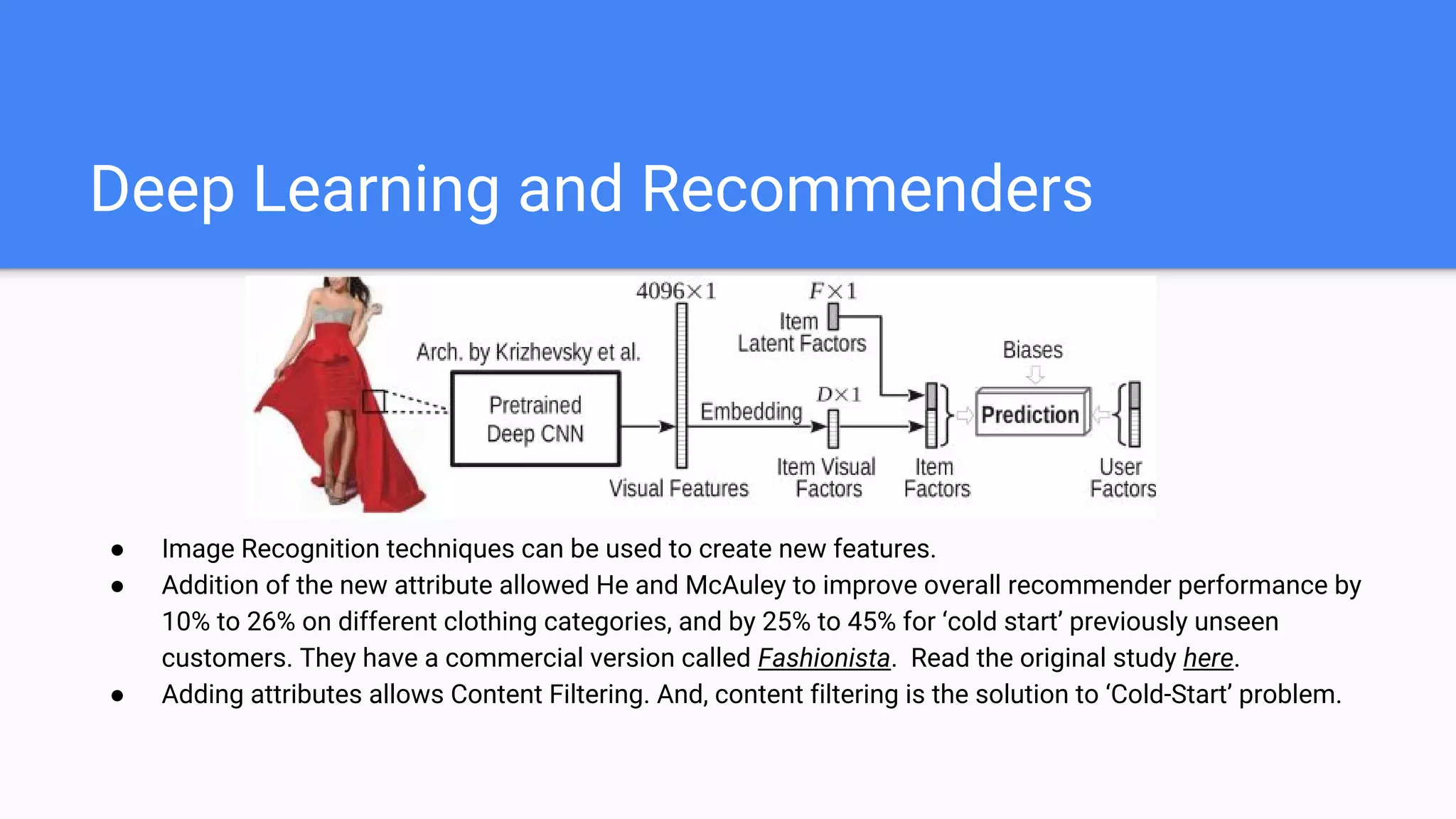
● Image Recognition techniques can be used to create new features.
● Addition of the new attribute allowed He and McAuley to improve overall recommender performance by
10% to 26% on different clothing categories, and by 25% to 45% for ‘cold start’ previously unseen
customers. They have a commercial version called Fashionista. Read the original study here.
● Adding attributes allows Content Filtering. And, content filtering is the solution to ‘Cold-Start’ problem.
Thank You!
Please, provide your feedback on postforshubham@gmail.com .

Types of recommender systems

  • 1.
  • 2.
    What is thePurpose? 1. Substitutes: Does your visitor know what he wants to buy but can’t find it? Are there suitable substitute products you could present? 2. Complements: Your visitor knows what he wants to buy and has it in his basket. Are there complementary add-on products you should be presenting to increase his satisfaction and your sales? 3. Ideas: Your customer is browsing for new items in which he might be interested. What are the products that he’s most likely to purchase? 4. Sequence: Frequently the order in which multiple recommendations are presented is important in maximizing satisfaction. This is called order of consumption. What is the right order of consumption for your items? Order also encompasses emphasis. If you are presenting pictures of 10 alternate shirts or shoes, which should be given prominence on the page?
  • 3.
    What is theEnvironment? 1. Movies, books, and music – huge rapidly changing inventories for immediate consumption. 2. Electronics or hardware - large but more stable inventories with very large subcategories of complimentary and supplementary choices and many different buyer objectives and motives. 3. Women’s clothing – large fast changing inventories with far fewer attributes for making objective or hard comparisons but a very large number of sub-attributes like color and size.
  • 4.
    5 Types ofRecommenders (in order of increasing complexity) 1. Most Popular Item 2. Association and Market Basket Models 3. Content Filtering 4. Collaborative Filtering 5. Hybrid Models
  • 5.
    1. Most PopularItem ● Simply offer what is most popular. ● Very little data requirements. Just sales figures. ● Non-personalized. ● Can be personalized according to category preferences of the user (eg. if the user is interested in books->novel, recommend the most popular or the latest release novel)
  • 6.
    2. Association orMarket Basket Analysis ● Identifies group of items consumed together. (Eg: {bananas, apples, oranges} , {jalapenos, avocados}, {beer,diapers}) ● Other items of the group can be recommended if the user has consumed one item in that group. ● Non-personalized. ● Simple and fast. Data Prep is minimal. ● Will not work well where the selection is extremely broad like in music compared to the users. However, its performance might be improved by using other filters.
  • 7.
    3. Content Filtering ●Very intuitive. Gives same features to content and the user. Matches the user with the content that has similar feature values. ● Solves the ‘cold-start’ problem in recommenders. ● But, It is difficult and most of the times cost-ineffective to learn and maintain the features for the user and the inventory, especially when they are fast changing. ● Pandora Radio uses CF with 400 attributes.
  • 8.
    4. Collaborative Filtering ●Finds users similar to the given user and recommends other items that are consumed by those users. ● Can recommend items without the human-designated understanding of the items itself. ● It is only meaningful with large amount of user base. ● It will not satisfy the needs of users who have a unique taste. ● Items that are new and have never been consumed/rated cannot be recommended since recommendation relies on prior rating (‘Cold-start problem’).
  • 9.
    5. Hybrid Recommender ●Knowledge Based Recommender involves the addition of rules by human subject matter experts. Good Product Marketing Managers can frequently define what products do and do not go together. ● Hybrid Recommenders involve combining different recommenders according to different business cases. ● Netflix uses a hybrid CB/CF recommender. It offers both recommendations based on the habits of similar customers (Collaborative Filtering) as well as recommendations based on highly rated films seen to be similar by content attributes (Content Filtering). ● It is likely that the optimum recommender will be a hybrid.
  • 10.
    Deep Learning andRecommenders ● Image Recognition techniques can be used to create new features. ● Addition of the new attribute allowed He and McAuley to improve overall recommender performance by 10% to 26% on different clothing categories, and by 25% to 45% for ‘cold start’ previously unseen customers. They have a commercial version called Fashionista. Read the original study here. ● Adding attributes allows Content Filtering. And, content filtering is the solution to ‘Cold-Start’ problem.
  • 11.
    Thank You! Please, provideyour feedback on postforshubham@gmail.com .