ADM6274
Personalized Marketing
Péter Bence Valentovics
Ese Djetore
Kartik Goyal
Neha Gupta
Muzzamil Saqlain
Personalized Marketing
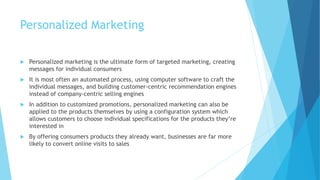
 Personalized marketing is the ultimate form of targeted marketing, creating
messages for individual consumers
 It is most often an automated process, using computer software to craft the
individual messages, and building customer-centric recommendation engines
instead of company-centric selling engines
 In addition to customized promotions, personalized marketing can also be
applied to the products themselves by using a configuration system which
allows customers to choose individual specifications for the products they’re
interested in
 By offering consumers products they already want, businesses are far more
likely to convert online visits to sales
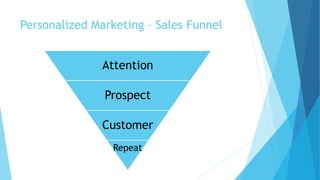
Personalized Marketing – Sales Funnel
Attention
Prospect
Customer
Repeat
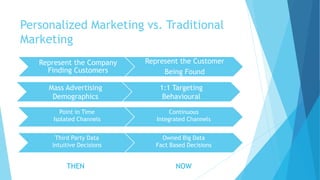
Personalized Marketing vs. Traditional
Marketing
Represent the Company
Finding Customers
Represent the Customer
Being Found
Mass Advertising
Demographics
1:1 Targeting
Behavioural
Point in Time
Isolated Channels
Continuous
Integrated Channels
Third Party Data
Intuitive Decisions
Owned Big Data
Fact Based Decisions
THEN NOW
Personalized Marketing - Recommender
Systems
 Recommender systems or recommendation systems (sometimes replacing
"system" with a synonym such as platform or engine) are a subclass of
information filtering system that seek to predict the 'rating' or 'preference'
that a user would give to an item.
 Examples
 eBay.com – Buyer and Seller Feedback
 Levis.com – Style finder
Types of Recommender Systems
 Content based filtering
 Collaborative Filtering
 Hybrid Filtering
 Knowledge-based marketing
CONTENT BASED RECOMMENDER SYSTEM
Content Based Filtering
 In content based filtering , the system processes information from various
sources and tries to extract useful elements about its content.
 Filtering is based on User Profile i.e. each user act independently and the
system require a profile for user’s unique needs and preferences.
 Profile includes information about the items of user’s interest such as songs,
Apparels , movies, grocery , articles etc and a record of their characteristics
(such as TF.IDF in case of document)
 Content based filtering techniques try to identify items similar to user’s
profile and return it as recommendation.
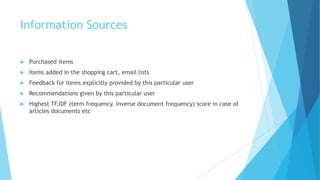
Information Sources
 Purchased items
 Items added in the shopping cart, email lists
 Feedback for items explicitly provided by this particular user
 Recommendations given by this particular user
 Highest TF.IDF (term frequency. Inverse document frequency) score in case of
articles documents etc
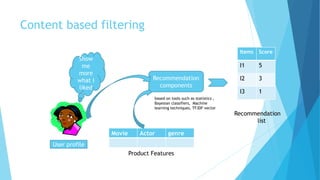
Content based filtering
Show
me
more
what I
liked
User profile
Movie Actor genre
Product Features
Recommendation
components
Items Score
I1 5
I2 3
I3 1
Recommendation
list
based on tools such as statistics ,
Bayesian classifiers, Machine
learning techniques, TF.IDF vector
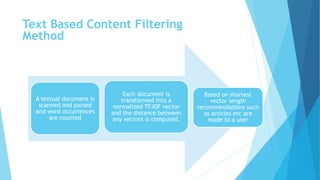
A textual document is
scanned and parsed
and word occurrences
are counted
Each document is
transformed into a
normalized TF.IDF vector
and the distance between
any vectors is computed.
Based on shortest
vector length
recommendations such
as articles etc are
made to a user
Text Based Content Filtering
Method
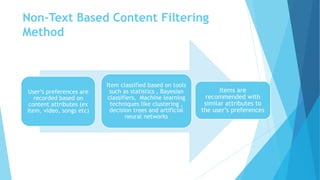
Non-Text Based Content Filtering
Method
User’s preferences are
recorded based on
content attributes (ex
item, video, songs etc)
Item classified based on tools
such as statistics , Bayesian
classifiers, Machine learning
techniques like clustering ,
decision trees and artificial
neural networks
Items are
recommended with
similar attributes to
the user’s preferences
Examples
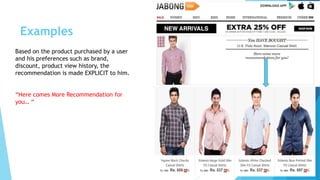
Based on the product purchased by a user
and his preferences such as brand,
discount, product view history, the
recommendation is made EXPLICIT to him.
“Here comes More Recommendation for
you… “
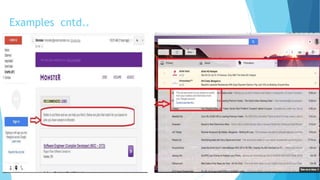
Examples cntd..
Advantages of Content-Based Approach
 No need for data on other users.
 Able to recommend to users with unique tastes.
 Able to recommend new and unpopular items
 Can provide explanations of recommended items by listing content-features
that caused an item to be recommended
Issues With Content-Based Approach
 User Profile : User needs to be active and provide the feedbacks time to time
for accurate and usable recommendation
 It requires the content encoding in meaningful features
 It does not allow the user to see other user’s judgment for the products
 Limited to the topics of interest of a user
 Continuous monitoring required for change in user’s interest
COLLABORATIVE FILTERING
Collaborative Filtering
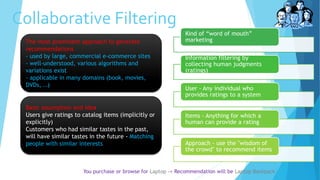
You purchase or browse for Laptop -> Recommendation will be Laptop Backpack
Kind of “word of mouth”
marketing
Information filtering by
collecting human judgments
(ratings)
User - Any individual who
provides ratings to a system
Items - Anything for which a
human can provide a rating
Approach - use the "wisdom of
the crowd" to recommend items
Basic assumption and idea
Users give ratings to catalog items (implicitly or
explicitly)
Customers who had similar tastes in the past,
will have similar tastes in the future - Matching
people with similar interests
The most prominent approach to generate
recommendations
- used by large, commercial e-commerce sites
- well-understood, various algorithms and
variations exist
- applicable in many domains (book, movies,
DVDs, ..)
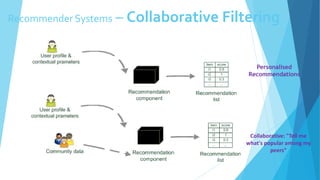
Recommender Systems – Collaborative Filtering
Personalised
Recommendations
Collaborative: "Tell me
what's popular among my
peers"
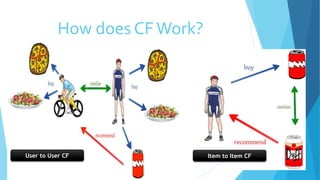
How does CFWork?
User to User CF Item to Item CF
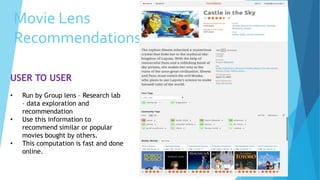
Movie Lens
Recommendations
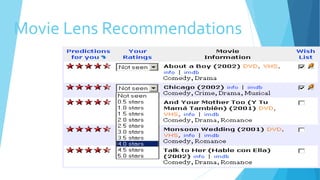
USER TO USER
• Run by Group lens – Research lab
– data exploration and
recommendation
• Use this information to
recommend similar or popular
movies bought by others.
• This computation is fast and done
online.
Movie Lens Recommendations
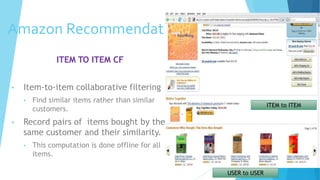
Amazon Recommendations
ITEM TO ITEM CF
• Item-to-item collaborative filtering
• Find similar items rather than similar
customers.
• Record pairs of items bought by the
same customer and their similarity.
• This computation is done offline for all
items.
ITEM to ITEM
USER to USER
KNOWLEDGE BASED RECOMMENDER
SYSTEM
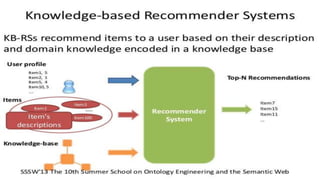
Knowledge-based marketing
 Uses knowledge about users and products to generate recommendations
and reasoning about what products meet the user’s requirements.
 Emphasis on guiding search interactions, through tweaking or altering
the characteristics of an example.
 Alternative approach where Content-based and Collaborative filtering
cannot be used.
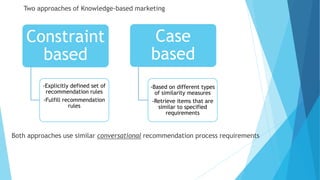
Two approaches of Knowledge-based marketing
Both approaches use similar conversational recommendation process requirements
Constraint
based
-Explicitly defined set of
recommendation rules
-Fulfill recommendation
rules
Case
based
-Based on different types
of similarity measures
-Retrieve items that are
similar to specified
requirements
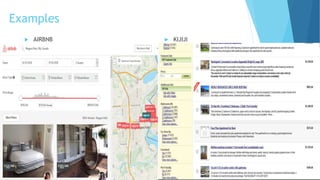
Examples
 AIRBNB  KIJIJI
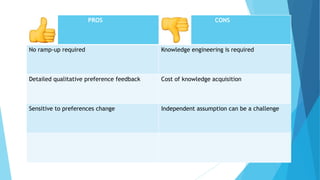
PROS CONS
No ramp-up required Knowledge engineering is required
Detailed qualitative preference feedback Cost of knowledge acquisition
Sensitive to preferences change Independent assumption can be a challenge
HYBRID RECOMMENDER SYSTEM
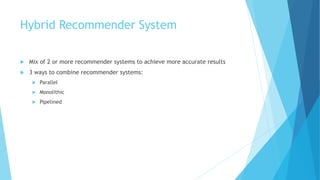
Hybrid Recommender System
 Mix of 2 or more recommender systems to achieve more accurate results
 3 ways to combine recommender systems:
 Parallel
 Monolithic
 Pipelined
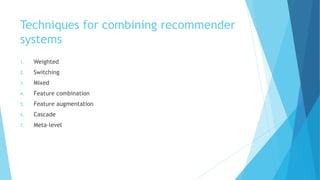
Techniques for combining recommender
systems
1. Weighted
2. Switching
3. Mixed
4. Feature combination
5. Feature augmentation
6. Cascade
7. Meta-level
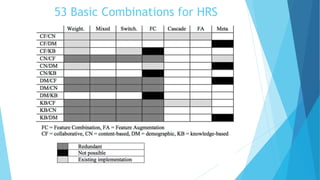
53 Basic Combinations for HRS
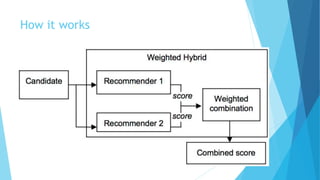
How it works
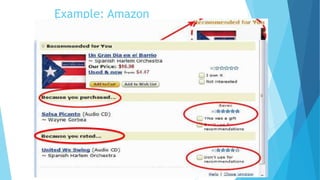
Example: Amazon
Benefits
 Creates synergy between recommender systems
 Emphasizes the strengths of each recommender system
 Can be used to solve “cold-start” problem
 Problem 1: new items
 Problem 2: new users
 Can also be used to solve plasticity and stability problem
 Example: change in user profile
Benefits
 Creates synergy between recommender systems
 Emphasizes the strengths of each recommender system
 Can be used to solve “cold-start” problem
 Problem 1: new items
 Problem 2: new users
 Can also be used to solve plasticity and stability problem
 Example: change in user profile
Personalized Marketing - Challenges
 Measuring actual impact of personalized marketing
 Already underlying trend towards increased online sales
 How much impact does it really have?
 Cold starters and how to market to them?
 New potential customers
 No data existing anywhere about the customer
 Privacy concerns
 Customers are constantly under surveillance
 How far would you go?
Personalized Marketing - Future Trends
 Moving towards the ultimate segmentation . . . . One customer, one segment!
 Personalized marketing and . . . . Personalized products!
 Increased use by niche product firms
 Huge reduction in advertising costs
 Use of personalized marketing by brick and mortar stores
THANK YOU!

ADM6274 - Final (NEHA)

  • 1.
    ADM6274 Personalized Marketing Péter BenceValentovics Ese Djetore Kartik Goyal Neha Gupta Muzzamil Saqlain
  • 2.
    Personalized Marketing  Personalizedmarketing is the ultimate form of targeted marketing, creating messages for individual consumers  It is most often an automated process, using computer software to craft the individual messages, and building customer-centric recommendation engines instead of company-centric selling engines  In addition to customized promotions, personalized marketing can also be applied to the products themselves by using a configuration system which allows customers to choose individual specifications for the products they’re interested in  By offering consumers products they already want, businesses are far more likely to convert online visits to sales
  • 3.
    Personalized Marketing –Sales Funnel Attention Prospect Customer Repeat
  • 4.
    Personalized Marketing vs.Traditional Marketing Represent the Company Finding Customers Represent the Customer Being Found Mass Advertising Demographics 1:1 Targeting Behavioural Point in Time Isolated Channels Continuous Integrated Channels Third Party Data Intuitive Decisions Owned Big Data Fact Based Decisions THEN NOW
  • 5.
    Personalized Marketing -Recommender Systems  Recommender systems or recommendation systems (sometimes replacing "system" with a synonym such as platform or engine) are a subclass of information filtering system that seek to predict the 'rating' or 'preference' that a user would give to an item.  Examples  eBay.com – Buyer and Seller Feedback  Levis.com – Style finder
  • 6.
    Types of RecommenderSystems  Content based filtering  Collaborative Filtering  Hybrid Filtering  Knowledge-based marketing
  • 7.
  • 8.
    Content Based Filtering In content based filtering , the system processes information from various sources and tries to extract useful elements about its content.  Filtering is based on User Profile i.e. each user act independently and the system require a profile for user’s unique needs and preferences.  Profile includes information about the items of user’s interest such as songs, Apparels , movies, grocery , articles etc and a record of their characteristics (such as TF.IDF in case of document)  Content based filtering techniques try to identify items similar to user’s profile and return it as recommendation.
  • 9.
    Information Sources  Purchaseditems  Items added in the shopping cart, email lists  Feedback for items explicitly provided by this particular user  Recommendations given by this particular user  Highest TF.IDF (term frequency. Inverse document frequency) score in case of articles documents etc
  • 10.
    Content based filtering Show me more whatI liked User profile Movie Actor genre Product Features Recommendation components Items Score I1 5 I2 3 I3 1 Recommendation list based on tools such as statistics , Bayesian classifiers, Machine learning techniques, TF.IDF vector
  • 11.
    A textual documentis scanned and parsed and word occurrences are counted Each document is transformed into a normalized TF.IDF vector and the distance between any vectors is computed. Based on shortest vector length recommendations such as articles etc are made to a user Text Based Content Filtering Method
  • 12.
    Non-Text Based ContentFiltering Method User’s preferences are recorded based on content attributes (ex item, video, songs etc) Item classified based on tools such as statistics , Bayesian classifiers, Machine learning techniques like clustering , decision trees and artificial neural networks Items are recommended with similar attributes to the user’s preferences
  • 13.
    Examples Based on theproduct purchased by a user and his preferences such as brand, discount, product view history, the recommendation is made EXPLICIT to him. “Here comes More Recommendation for you… “
  • 14.
  • 15.
    Advantages of Content-BasedApproach  No need for data on other users.  Able to recommend to users with unique tastes.  Able to recommend new and unpopular items  Can provide explanations of recommended items by listing content-features that caused an item to be recommended Issues With Content-Based Approach  User Profile : User needs to be active and provide the feedbacks time to time for accurate and usable recommendation  It requires the content encoding in meaningful features  It does not allow the user to see other user’s judgment for the products  Limited to the topics of interest of a user  Continuous monitoring required for change in user’s interest
  • 16.
  • 17.
    Collaborative Filtering You purchaseor browse for Laptop -> Recommendation will be Laptop Backpack Kind of “word of mouth” marketing Information filtering by collecting human judgments (ratings) User - Any individual who provides ratings to a system Items - Anything for which a human can provide a rating Approach - use the "wisdom of the crowd" to recommend items Basic assumption and idea Users give ratings to catalog items (implicitly or explicitly) Customers who had similar tastes in the past, will have similar tastes in the future - Matching people with similar interests The most prominent approach to generate recommendations - used by large, commercial e-commerce sites - well-understood, various algorithms and variations exist - applicable in many domains (book, movies, DVDs, ..)
  • 18.
    Recommender Systems –Collaborative Filtering Personalised Recommendations Collaborative: "Tell me what's popular among my peers"
  • 19.
    How does CFWork? Userto User CF Item to Item CF
  • 20.
    Movie Lens Recommendations USER TOUSER • Run by Group lens – Research lab – data exploration and recommendation • Use this information to recommend similar or popular movies bought by others. • This computation is fast and done online.
  • 21.
  • 22.
    Amazon Recommendations ITEM TOITEM CF • Item-to-item collaborative filtering • Find similar items rather than similar customers. • Record pairs of items bought by the same customer and their similarity. • This computation is done offline for all items. ITEM to ITEM USER to USER
  • 23.
  • 24.
    Knowledge-based marketing  Usesknowledge about users and products to generate recommendations and reasoning about what products meet the user’s requirements.  Emphasis on guiding search interactions, through tweaking or altering the characteristics of an example.  Alternative approach where Content-based and Collaborative filtering cannot be used.
  • 26.
    Two approaches ofKnowledge-based marketing Both approaches use similar conversational recommendation process requirements Constraint based -Explicitly defined set of recommendation rules -Fulfill recommendation rules Case based -Based on different types of similarity measures -Retrieve items that are similar to specified requirements
  • 27.
  • 28.
    PROS CONS No ramp-uprequired Knowledge engineering is required Detailed qualitative preference feedback Cost of knowledge acquisition Sensitive to preferences change Independent assumption can be a challenge
  • 29.
  • 30.
    Hybrid Recommender System Mix of 2 or more recommender systems to achieve more accurate results  3 ways to combine recommender systems:  Parallel  Monolithic  Pipelined
  • 31.
    Techniques for combiningrecommender systems 1. Weighted 2. Switching 3. Mixed 4. Feature combination 5. Feature augmentation 6. Cascade 7. Meta-level
  • 32.
  • 33.
  • 34.
  • 35.
    Benefits  Creates synergybetween recommender systems  Emphasizes the strengths of each recommender system  Can be used to solve “cold-start” problem  Problem 1: new items  Problem 2: new users  Can also be used to solve plasticity and stability problem  Example: change in user profile
  • 36.
    Benefits  Creates synergybetween recommender systems  Emphasizes the strengths of each recommender system  Can be used to solve “cold-start” problem  Problem 1: new items  Problem 2: new users  Can also be used to solve plasticity and stability problem  Example: change in user profile
  • 37.
    Personalized Marketing -Challenges  Measuring actual impact of personalized marketing  Already underlying trend towards increased online sales  How much impact does it really have?  Cold starters and how to market to them?  New potential customers  No data existing anywhere about the customer  Privacy concerns  Customers are constantly under surveillance  How far would you go?
  • 38.
    Personalized Marketing -Future Trends  Moving towards the ultimate segmentation . . . . One customer, one segment!  Personalized marketing and . . . . Personalized products!  Increased use by niche product firms  Huge reduction in advertising costs  Use of personalized marketing by brick and mortar stores
  • 39.