TYPES OF PARAGRAPH
María del Carmen Díaz Vargas
Leidy Nayely Díaz Tovar
Cindy Lorena Romero Muñoz
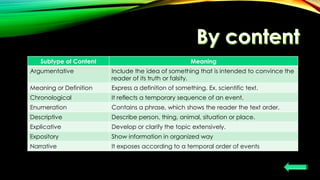
Subtype of Content Meaning
Argumentative Include the idea of something that is intended to convince the
reader of its truth or falsity.
Meaning or Definition Express a definition of something. Ex. scientific text.
Chronological It reflects a temporary sequence of an event.
Enumeration Contains a phrase, which shows the reader the text order.
Descriptive Describe person, thing, animal, situation or place.
Explicative Develop or clarify the topic extensively.
Expository Show information in organized way
Narrative It exposes according to a temporal order of events
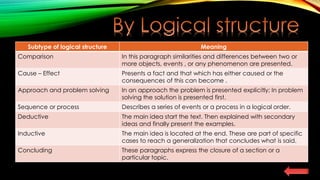
Subtype of logical structure Meaning
Comparison In this paragraph similarities and differences between two or
more objects, events , or any phenomenon are presented.
Cause – Effect Presents a fact and that which has either caused or the
consequences of this can become .
Approach and problem solving In an approach the problem is presented explicitly; In problem
solving the solution is presented first.
Sequence or process Describes a series of events or a process in a logical order.
Deductive The main idea start the text. Then explained with secondary
ideas and finally present the examples.
Inductive The main idea is located at the end. These are part of specific
cases to reach a generalization that concludes what is said.
Concluding These paragraphs express the closure of a section or a
particular topic.
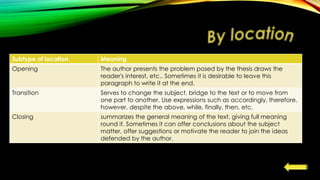
Subtype of location Meaning
Opening The author presents the problem posed by the thesis draws the
reader's interest, etc.. Sometimes it is desirable to leave this
paragraph to write it at the end.
Transition Serves to change the subject, bridge to the text or to move from
one part to another. Use expressions such as accordingly, therefore,
however, despite the above, while, finally, then, etc.
Closing summarizes the general meaning of the text, giving full meaning
round it. Sometimes it can offer conclusions about the subject
matter, offer suggestions or motivate the reader to join the ideas
defended by the author.
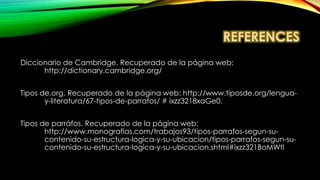
Diccionario de Cambridge. Recuperado de la página web:
http://dictionary.cambridge.org/
Tipos de.org. Recuperado de la página web: http://www.tiposde.org/lengua-
y-literatura/67-tipos-de-parrafos/ # ixzz3218xaGe0.
Tipos de parráfos. Recuperado de la página web:
http://www.monografias.com/trabajos93/tipos-parrafos-segun-su-
contenido-su-estructura-logica-y-su-ubicacion/tipos-parrafos-segun-su-
contenido-su-estructura-logica-y-su-ubicacion.shtml#ixzz321BoMWtl

Types of paragraph

  • 1.
    TYPES OF PARAGRAPH Maríadel Carmen Díaz Vargas Leidy Nayely Díaz Tovar Cindy Lorena Romero Muñoz
  • 3.
    Subtype of ContentMeaning Argumentative Include the idea of something that is intended to convince the reader of its truth or falsity. Meaning or Definition Express a definition of something. Ex. scientific text. Chronological It reflects a temporary sequence of an event. Enumeration Contains a phrase, which shows the reader the text order. Descriptive Describe person, thing, animal, situation or place. Explicative Develop or clarify the topic extensively. Expository Show information in organized way Narrative It exposes according to a temporal order of events
  • 4.
    Subtype of logicalstructure Meaning Comparison In this paragraph similarities and differences between two or more objects, events , or any phenomenon are presented. Cause – Effect Presents a fact and that which has either caused or the consequences of this can become . Approach and problem solving In an approach the problem is presented explicitly; In problem solving the solution is presented first. Sequence or process Describes a series of events or a process in a logical order. Deductive The main idea start the text. Then explained with secondary ideas and finally present the examples. Inductive The main idea is located at the end. These are part of specific cases to reach a generalization that concludes what is said. Concluding These paragraphs express the closure of a section or a particular topic.
  • 5.
    Subtype of locationMeaning Opening The author presents the problem posed by the thesis draws the reader's interest, etc.. Sometimes it is desirable to leave this paragraph to write it at the end. Transition Serves to change the subject, bridge to the text or to move from one part to another. Use expressions such as accordingly, therefore, however, despite the above, while, finally, then, etc. Closing summarizes the general meaning of the text, giving full meaning round it. Sometimes it can offer conclusions about the subject matter, offer suggestions or motivate the reader to join the ideas defended by the author.
  • 6.
    Diccionario de Cambridge.Recuperado de la página web: http://dictionary.cambridge.org/ Tipos de.org. Recuperado de la página web: http://www.tiposde.org/lengua- y-literatura/67-tipos-de-parrafos/ # ixzz3218xaGe0. Tipos de parráfos. Recuperado de la página web: http://www.monografias.com/trabajos93/tipos-parrafos-segun-su- contenido-su-estructura-logica-y-su-ubicacion/tipos-parrafos-segun-su- contenido-su-estructura-logica-y-su-ubicacion.shtml#ixzz321BoMWtl