DIFFERENT TYPES OF
FLUTES
Phamox Music
Introduction
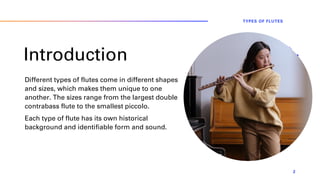
Different types of flutes come in different shapes
and sizes, which makes them unique to one
another. The sizes range from the largest double
contrabass flute to the smallest piccolo.
Each type of flute has its own historical
background and identifiable form and sound.
TYPES OF FLUTES
2
WHAT IS FLUTE?
The flute is an aerophone instrument
and a member of the woodwind family.
It produces sound by blowing air across
an opening in its body, rather than using
a reed for their sound production.
Depending on the form of the flute, it
can only be played by playing vertically
or horizontally.
The flute is made from a tube with
different holes along its body. These
holes are used to play the flute.
TYPES
OF
FLUTES
3
Brief History of The
Flute
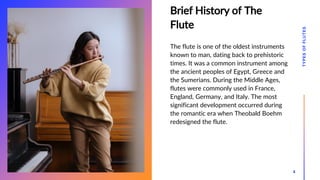
The flute is one of the oldest instruments
known to man, dating back to prehistoric
times. It was a common instrument among
the ancient peoples of Egypt, Greece and
the Sumerians. During the Middle Ages,
flutes were commonly used in France,
England, Germany, and Italy. The most
significant development occurred during
the romantic era when Theobald Boehm
redesigned the flute.
TYPES
OF
FLUTES
4
Different
Types Of Flutes
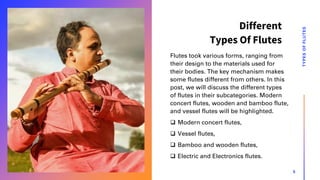
Flutes took various forms, ranging from
their design to the materials used for
their bodies. The key mechanism makes
some flutes different from others. In this
post, we will discuss the different types
of flutes in their subcategories. Modern
concert flutes, wooden and bamboo flute,
and vessel flutes will be highlighted.
❑ Modern concert flutes,
❑ Vessel flutes,
❑ Bamboo and wooden flutes,
❑ Electric and Electronics flutes.
TYPES
OF
FLUTES
5
Modern Concert
Flute Family
TYPES
OF
FLUTES
6
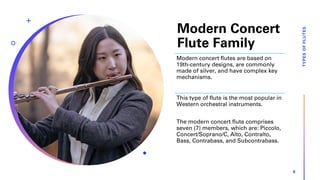
Modern concert flutes are based on
19th-century designs, are commonly
made of silver, and have complex key
mechanisms.
This type of flute is the most popular in
Western orchestral instruments.
The modern concert flute comprises
seven (7) members, which are: Piccolo,
Concert/Soprano/C, Alto, Contralto,
Bass, Contrabass, and Subcontrabass.
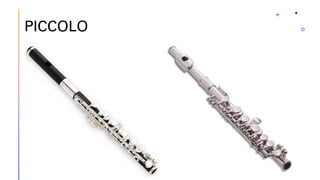
Piccolo
The piccolo is a type of flute and a member
of the western flute family.
The piccolo is much smaller than the regular
flute. It is approximately half the length of
the concert flute.
It is an octave higher than the regular flute,
and its octave reaches almost the upper limit
of the perceptible pitch.
The piccolo adds brilliance to a march and is
a very popular instrument in military
marches.
TYPES
OF
FLUTES
7
PICCOLO
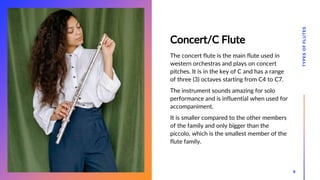
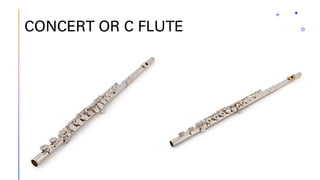
Concert/C Flute
The concert flute is the main flute used in
western orchestras and plays on concert
pitches. It is in the key of C and has a range
of three (3) octaves starting from C4 to C7.
The instrument sounds amazing for solo
performance and is influential when used for
accompaniment.
It is smaller compared to the other members
of the family and only bigger than the
piccolo, which is the smallest member of the
flute family.
TYPES
OF
FLUTES
9
CONCERT OR C FLUTE
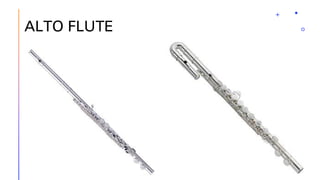
Alto Flute
The alto flute is a transposing instrument
pitched to the key of G. It is the only
member of the western flute family that is
not in C.
It has a range that extends from G3 to G6.
Alto flutes are heavier, longer, and typically
made of thicker metal.
The alto flute has a wider dynamic range, a
stronger tone and highly expressive beautiful
tone.
TYPES
OF
FLUTES
11
ALTO FLUTE
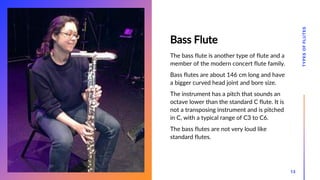
Bass Flute
The bass flute is another type of flute and a
member of the modern concert flute family.
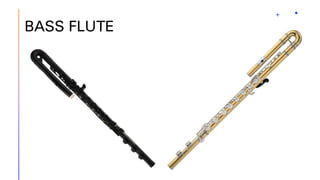
Bass flutes are about 146 cm long and have
a bigger curved head joint and bore size.
The instrument has a pitch that sounds an
octave lower than the standard C flute. It is
not a transposing instrument and is pitched
in C, with a typical range of C3 to C6.
The bass flutes are not very loud like
standard flutes.
TYPES
OF
FLUTES
13
BASS FLUTE
Vessel Flutes
TYPES
OF
FLUTES
15
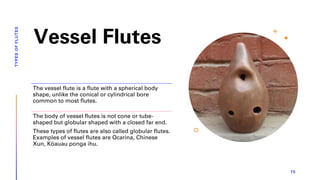
The vessel flute is a flute with a spherical body
shape, unlike the conical or cylindrical bore
common to most flutes.
The body of vessel flutes is not cone or tube-
shaped but globular shaped with a closed far end.
These types of flutes are also called globular flutes.
Examples of vessel flutes are Ocarina, Chinese
Xun, Kōauau ponga ihu.
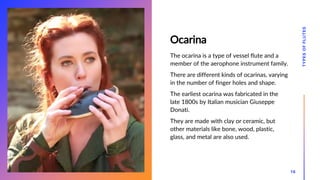
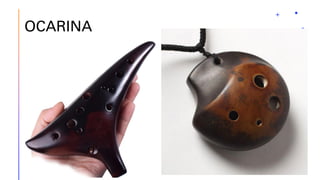
Ocarina
The ocarina is a type of vessel flute and a
member of the aerophone instrument family.
There are different kinds of ocarinas, varying
in the number of finger holes and shape.
The earliest ocarina was fabricated in the
late 1800s by Italian musician Giuseppe
Donati.
They are made with clay or ceramic, but
other materials like bone, wood, plastic,
glass, and metal are also used.
TYPES
OF
FLUTES
16
OCARINA
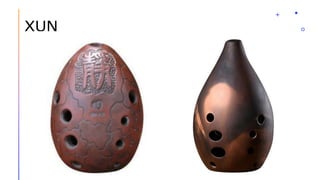
XUN
The Xun is an ancient vessel flute that was
used in ancient China.
The earliest examples of the instrument
were found in the tomb of Marquis Yi of
Zeng, who died in 433 BC.
The instrument has a warm, mellow tone
that is perfect for playing slow, relaxing
music.
It can be used to play solo melodies or to
accompany other instruments.
TYPES
OF
FLUTES
18
XUN
Bamboo Flute
TYPES
OF
FLUTES
20
There are many types of wooden and
bamboo flutes, and they are peculiar
to different ethnic groups and
nations around the world.
For instance, the Chinese have
different types of bamboo flutes like
Dizi, Koudi, Xiao, and many others.
Bamboo flutes are native to India, the
Andes, Cambodia, and Thailand,
respectively. Other well-known
wooden flutes around the world are
Flabiol, Fujara, Frula, Recorder, Shvi,
Spilåpipa, and Txistu.
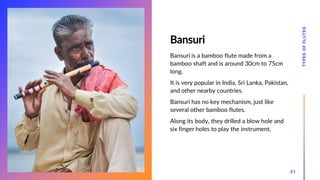
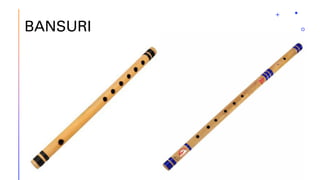
Bansuri
Bansuri is a bamboo flute made from a
bamboo shaft and is around 30cm to 75cm
long.
It is very popular in India, Sri Lanka, Pakistan,
and other nearby countries.
Bansuri has no key mechanism, just like
several other bamboo flutes.
Along its body, they drilled a blow hole and
six finger holes to play the instrument.
TYPES
OF
FLUTES
21
BANSURI
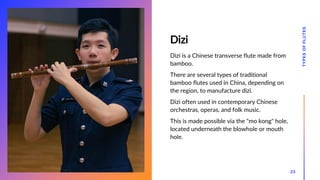
Dizi
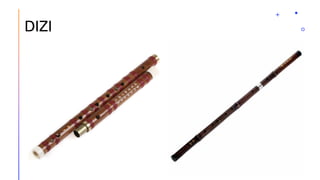
Dizi is a Chinese transverse flute made from
bamboo.
There are several types of traditional
bamboo flutes used in China, depending on
the region, to manufacture dizi.
Dizi often used in contemporary Chinese
orchestras, operas, and folk music.
This is made possible via the "mo kong" hole,
located underneath the blowhole or mouth
hole.
TYPES
OF
FLUTES
23
DIZI
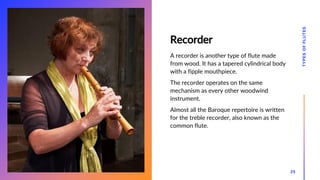
Recorder
A recorder is another type of flute made
from wood. It has a tapered cylindrical body
with a fipple mouthpiece.
The recorder operates on the same
mechanism as every other woodwind
instrument.
Almost all the Baroque repertoire is written
for the treble recorder, also known as the
common flute.
TYPES
OF
FLUTES
25
RECORDER
Summary
There are different types of flutes
apart from the ones that come to
mind when most people think of
them.
Indeed, there are a lot of options
when it comes to the flute.
In fact, there are more that we
haven't discussed here, but
perhaps this presentation has
given you a better understanding
of the many types of flutes.
VISIT: https://tinyurl.com/37fe93sj
for more details on types of flute.
TYPES
OF
FLUTES
27
THANK
YOU
TYPES
OF
FLUTES
• Kayode (Phamox Music)
• admin@phamoxmusic.com
• https://phamoxmusic.com
28

Types Of Flutes.pdf

  • 1.
  • 2.
    Introduction Different types offlutes come in different shapes and sizes, which makes them unique to one another. The sizes range from the largest double contrabass flute to the smallest piccolo. Each type of flute has its own historical background and identifiable form and sound. TYPES OF FLUTES 2
  • 3.
    WHAT IS FLUTE? Theflute is an aerophone instrument and a member of the woodwind family. It produces sound by blowing air across an opening in its body, rather than using a reed for their sound production. Depending on the form of the flute, it can only be played by playing vertically or horizontally. The flute is made from a tube with different holes along its body. These holes are used to play the flute. TYPES OF FLUTES 3
  • 4.
    Brief History ofThe Flute The flute is one of the oldest instruments known to man, dating back to prehistoric times. It was a common instrument among the ancient peoples of Egypt, Greece and the Sumerians. During the Middle Ages, flutes were commonly used in France, England, Germany, and Italy. The most significant development occurred during the romantic era when Theobald Boehm redesigned the flute. TYPES OF FLUTES 4
  • 5.
    Different Types Of Flutes Flutestook various forms, ranging from their design to the materials used for their bodies. The key mechanism makes some flutes different from others. In this post, we will discuss the different types of flutes in their subcategories. Modern concert flutes, wooden and bamboo flute, and vessel flutes will be highlighted. ❑ Modern concert flutes, ❑ Vessel flutes, ❑ Bamboo and wooden flutes, ❑ Electric and Electronics flutes. TYPES OF FLUTES 5
  • 6.
    Modern Concert Flute Family TYPES OF FLUTES 6 Modernconcert flutes are based on 19th-century designs, are commonly made of silver, and have complex key mechanisms. This type of flute is the most popular in Western orchestral instruments. The modern concert flute comprises seven (7) members, which are: Piccolo, Concert/Soprano/C, Alto, Contralto, Bass, Contrabass, and Subcontrabass.
  • 7.
    Piccolo The piccolo isa type of flute and a member of the western flute family. The piccolo is much smaller than the regular flute. It is approximately half the length of the concert flute. It is an octave higher than the regular flute, and its octave reaches almost the upper limit of the perceptible pitch. The piccolo adds brilliance to a march and is a very popular instrument in military marches. TYPES OF FLUTES 7
  • 8.
  • 9.
    Concert/C Flute The concertflute is the main flute used in western orchestras and plays on concert pitches. It is in the key of C and has a range of three (3) octaves starting from C4 to C7. The instrument sounds amazing for solo performance and is influential when used for accompaniment. It is smaller compared to the other members of the family and only bigger than the piccolo, which is the smallest member of the flute family. TYPES OF FLUTES 9
  • 10.
  • 11.
    Alto Flute The altoflute is a transposing instrument pitched to the key of G. It is the only member of the western flute family that is not in C. It has a range that extends from G3 to G6. Alto flutes are heavier, longer, and typically made of thicker metal. The alto flute has a wider dynamic range, a stronger tone and highly expressive beautiful tone. TYPES OF FLUTES 11
  • 12.
  • 13.
    Bass Flute The bassflute is another type of flute and a member of the modern concert flute family. Bass flutes are about 146 cm long and have a bigger curved head joint and bore size. The instrument has a pitch that sounds an octave lower than the standard C flute. It is not a transposing instrument and is pitched in C, with a typical range of C3 to C6. The bass flutes are not very loud like standard flutes. TYPES OF FLUTES 13
  • 14.
  • 15.
    Vessel Flutes TYPES OF FLUTES 15 The vesselflute is a flute with a spherical body shape, unlike the conical or cylindrical bore common to most flutes. The body of vessel flutes is not cone or tube- shaped but globular shaped with a closed far end. These types of flutes are also called globular flutes. Examples of vessel flutes are Ocarina, Chinese Xun, Kōauau ponga ihu.
  • 16.
    Ocarina The ocarina isa type of vessel flute and a member of the aerophone instrument family. There are different kinds of ocarinas, varying in the number of finger holes and shape. The earliest ocarina was fabricated in the late 1800s by Italian musician Giuseppe Donati. They are made with clay or ceramic, but other materials like bone, wood, plastic, glass, and metal are also used. TYPES OF FLUTES 16
  • 17.
  • 18.
    XUN The Xun isan ancient vessel flute that was used in ancient China. The earliest examples of the instrument were found in the tomb of Marquis Yi of Zeng, who died in 433 BC. The instrument has a warm, mellow tone that is perfect for playing slow, relaxing music. It can be used to play solo melodies or to accompany other instruments. TYPES OF FLUTES 18
  • 19.
  • 20.
    Bamboo Flute TYPES OF FLUTES 20 There aremany types of wooden and bamboo flutes, and they are peculiar to different ethnic groups and nations around the world. For instance, the Chinese have different types of bamboo flutes like Dizi, Koudi, Xiao, and many others. Bamboo flutes are native to India, the Andes, Cambodia, and Thailand, respectively. Other well-known wooden flutes around the world are Flabiol, Fujara, Frula, Recorder, Shvi, Spilåpipa, and Txistu.
  • 21.
    Bansuri Bansuri is abamboo flute made from a bamboo shaft and is around 30cm to 75cm long. It is very popular in India, Sri Lanka, Pakistan, and other nearby countries. Bansuri has no key mechanism, just like several other bamboo flutes. Along its body, they drilled a blow hole and six finger holes to play the instrument. TYPES OF FLUTES 21
  • 22.
  • 23.
    Dizi Dizi is aChinese transverse flute made from bamboo. There are several types of traditional bamboo flutes used in China, depending on the region, to manufacture dizi. Dizi often used in contemporary Chinese orchestras, operas, and folk music. This is made possible via the "mo kong" hole, located underneath the blowhole or mouth hole. TYPES OF FLUTES 23
  • 24.
  • 25.
    Recorder A recorder isanother type of flute made from wood. It has a tapered cylindrical body with a fipple mouthpiece. The recorder operates on the same mechanism as every other woodwind instrument. Almost all the Baroque repertoire is written for the treble recorder, also known as the common flute. TYPES OF FLUTES 25
  • 26.
  • 27.
    Summary There are differenttypes of flutes apart from the ones that come to mind when most people think of them. Indeed, there are a lot of options when it comes to the flute. In fact, there are more that we haven't discussed here, but perhaps this presentation has given you a better understanding of the many types of flutes. VISIT: https://tinyurl.com/37fe93sj for more details on types of flute. TYPES OF FLUTES 27
  • 28.
    THANK YOU TYPES OF FLUTES • Kayode (PhamoxMusic) • admin@phamoxmusic.com • https://phamoxmusic.com 28