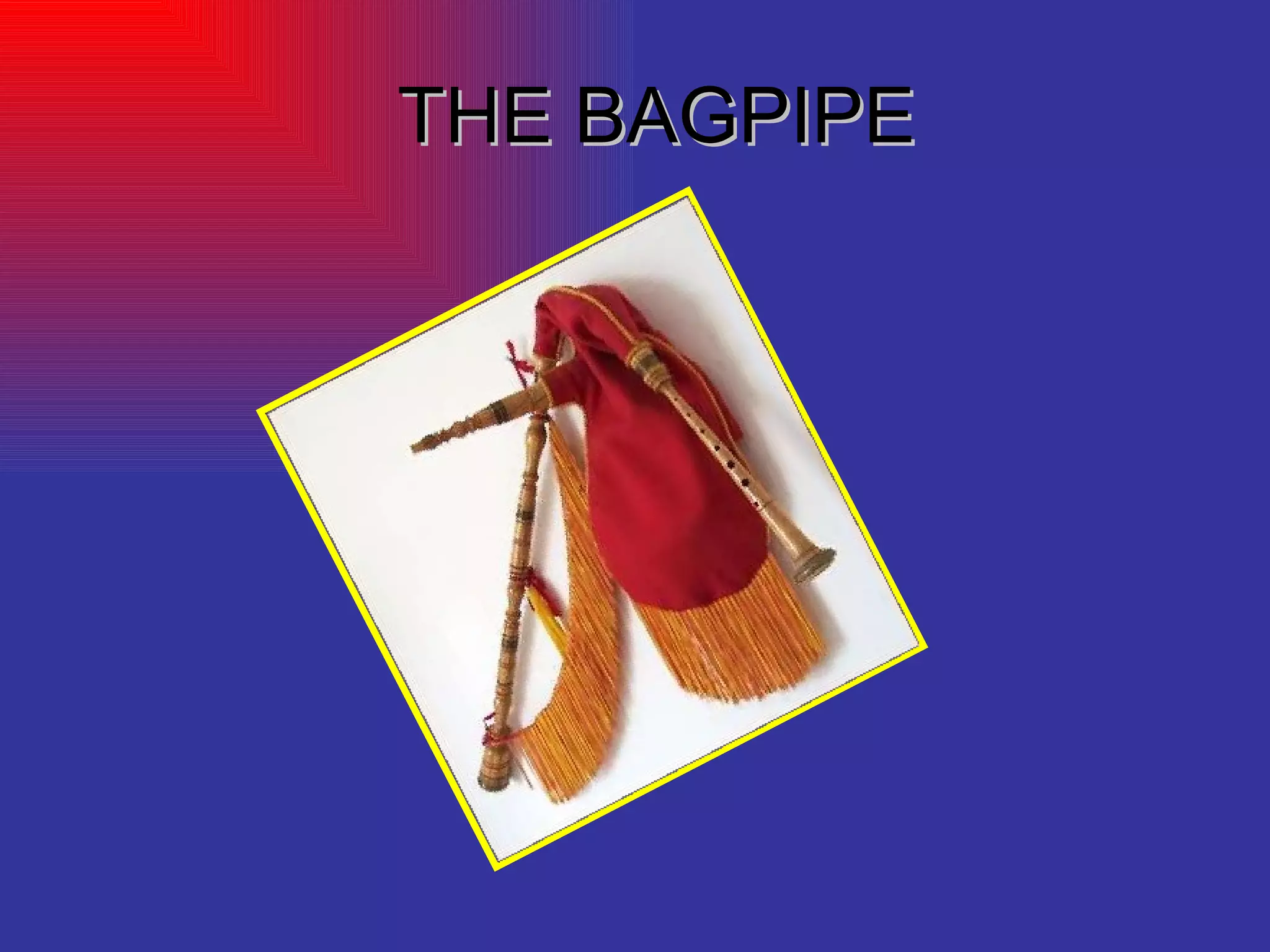
THE BAGPIPE
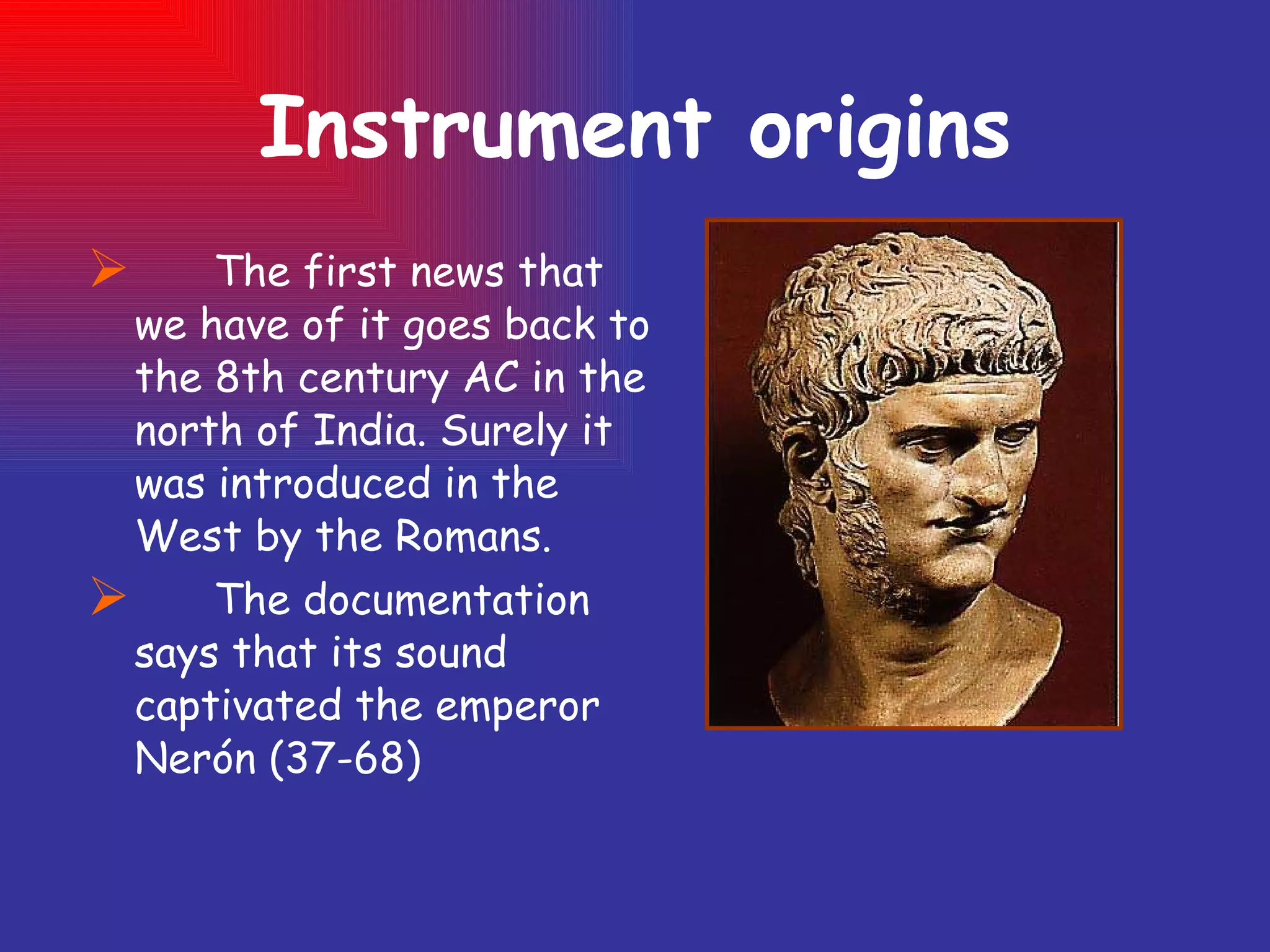
Instrument origins The first news that we have of it goes back to the 8th century AC in the north of India. Surely it was introduced in the West by the Romans.  The documentation says that its sound captivated the emperor Nerón (37-68)
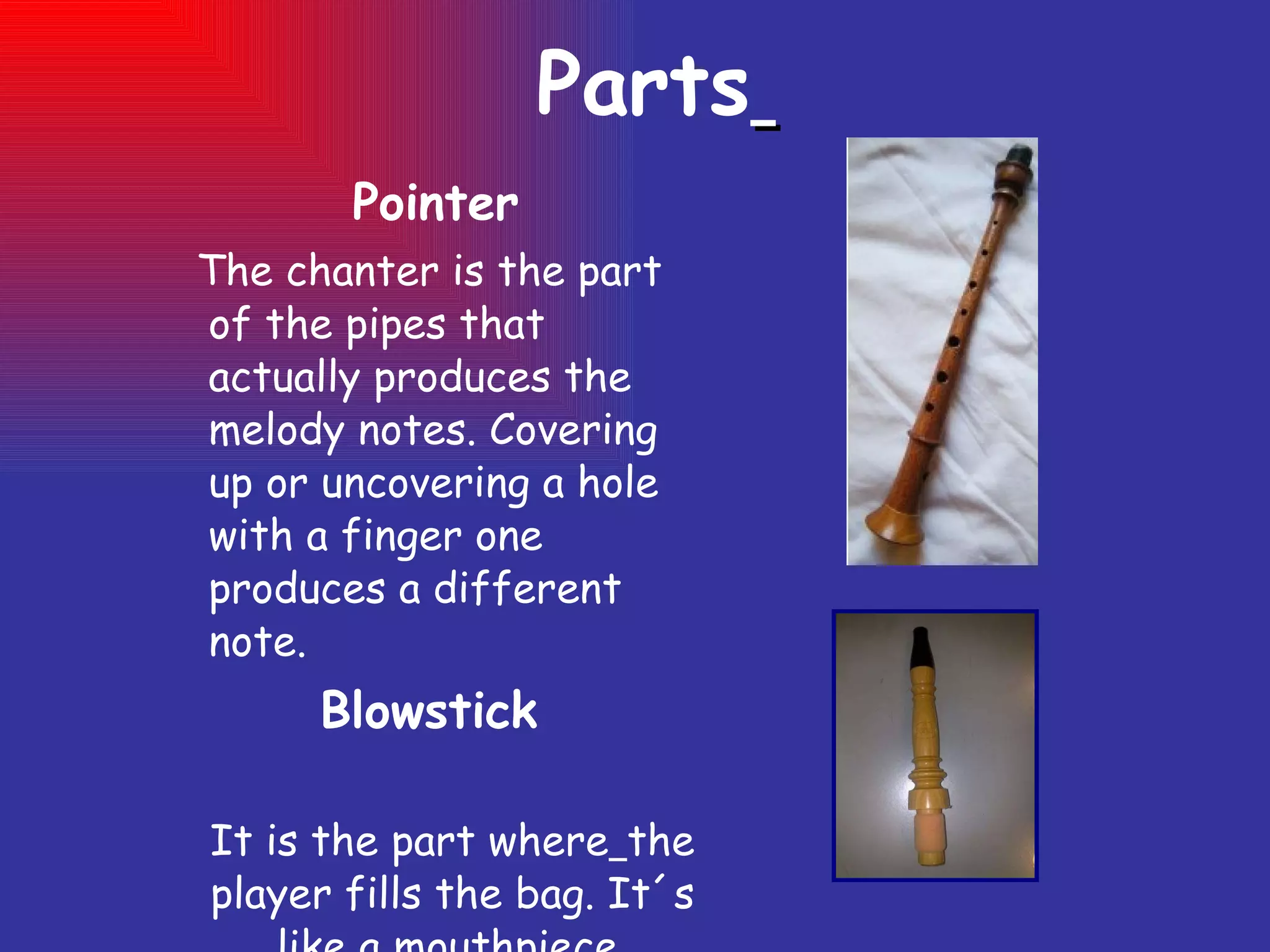
Parts   Pointer  The chanter is the part of the pipes that actually produces the  melody notes. Covering up or uncovering a hole with a finger one produces a different note. Blowstick It is the part where   the player fills the bag. It´s like a mouthpiece.
Parts Drones:  The drones are responsible for the characteristic low "humming" sound that emanates from the pipes. Bag (Fol in Galicia): It´s the part of the bagpipe  that is continuously filled with air. Once the bag is filled, the player must squeeze air out of the bag (using his arm).
Bagpipes in the Middle Ages In Roman archaeological sites statues of bagpipers suggest that were the Romans who introduced the bagpipe in Spain. In the early part of the second millennium, bagpipes appear in European art and iconography. For example in “Cantigas de Santa Maria”
FAMOUS BAGPIPERS Avelino Cachafeiro
FAMOUS BAGPIPERS   Carlos Nuñez
Jigs and Bulls
Secondary Woodwinds REQUINTA, OCARINA PITO DE PARAGÜERO
Requinta
“  REQUINTA" It is a type of  Galician transverse flute.  It was born like an accompaning  instrument. It is used in traditional music with bagpipes,bass drum  and tamboril.  At first  it was made of bone and wood (elder) . After it was made of boxwood , and nowdays it can be of tropical wood like:Rosewood, “palo santo” or “granadino”because they are more resistent to humidity conditions. It is divided in five sections . The first section contains the mouth piece and the  junction of the top part to main body and  the bottom part has one key to play cromatic notes.
SOUND In this page there is an example about  “ requinta”. The group is formed by requinta, two different drums (“pandero” and tamboril) and bagpipe. http://www.youtube.com/watch?v=xBRCrHziai4
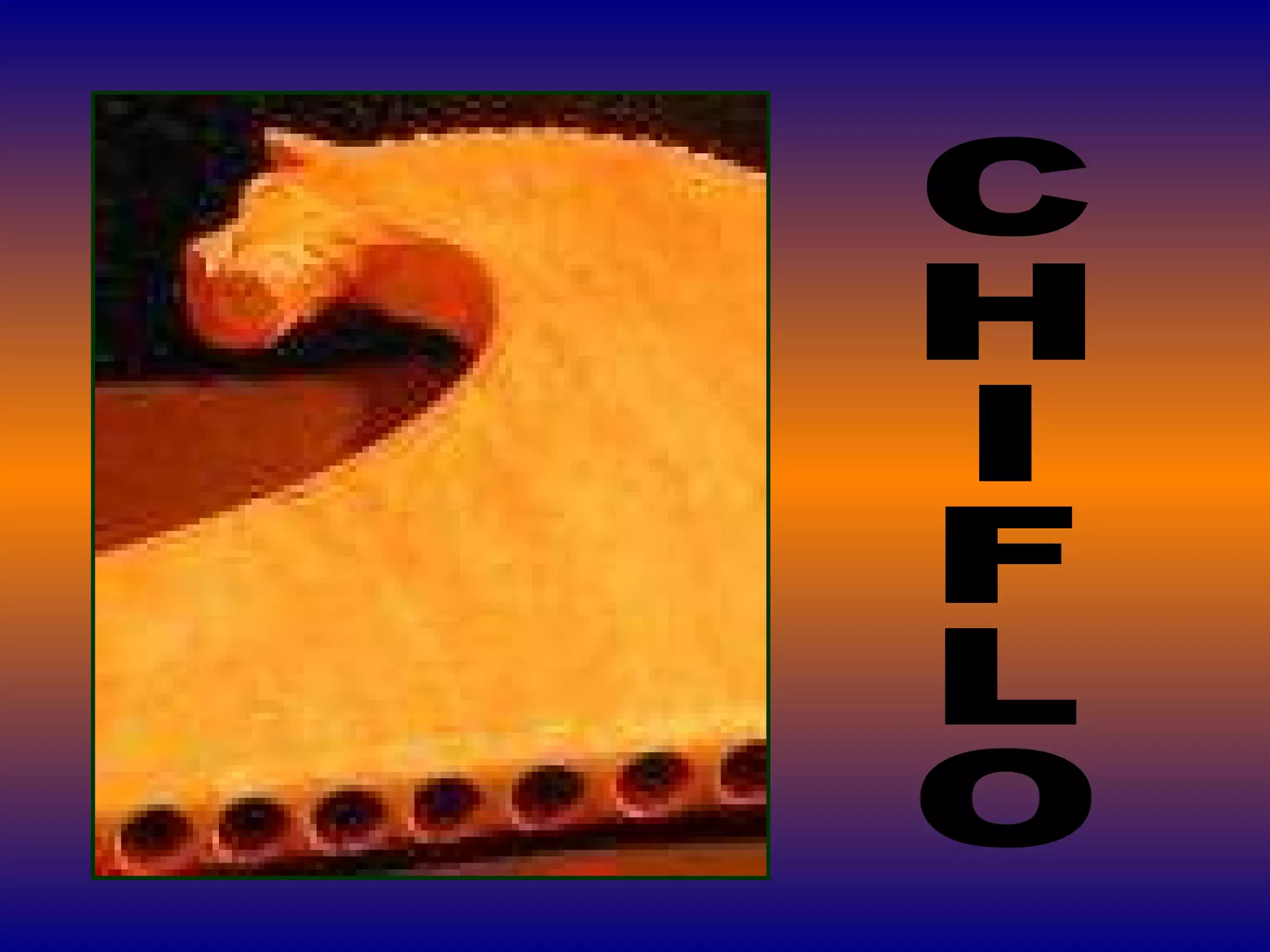
CHIFLO
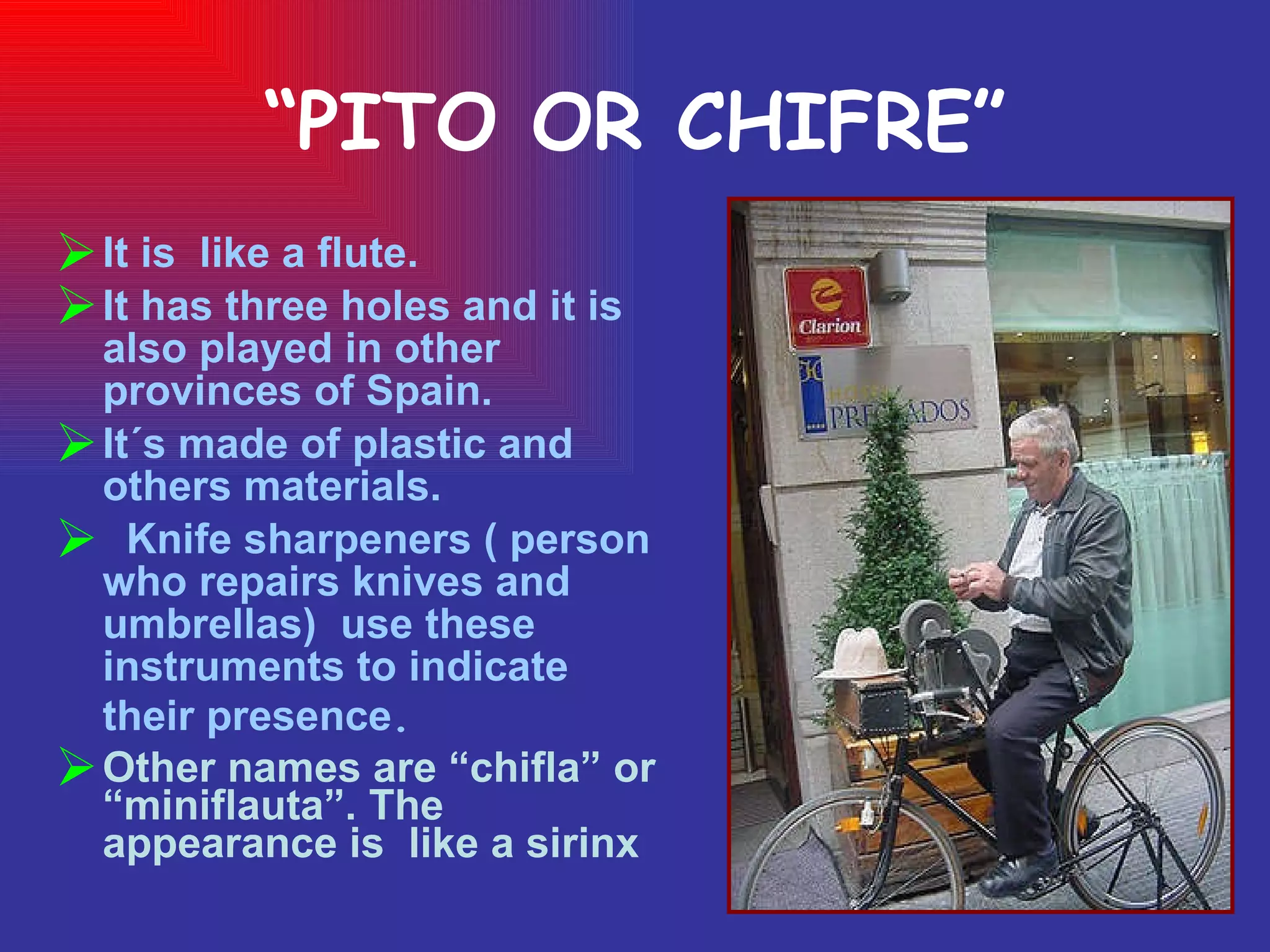
“ PITO OR CHIFRE” It is  like a flute.  It has three holes and it is also played in other provinces of Spain. It´s made of plastic and others materials. Knife sharpeners ( person who repairs knives and  umbrellas)  use these instruments to indicate their presence . Other names are “chifla” or “miniflauta”. The appearance is  like a sirinx
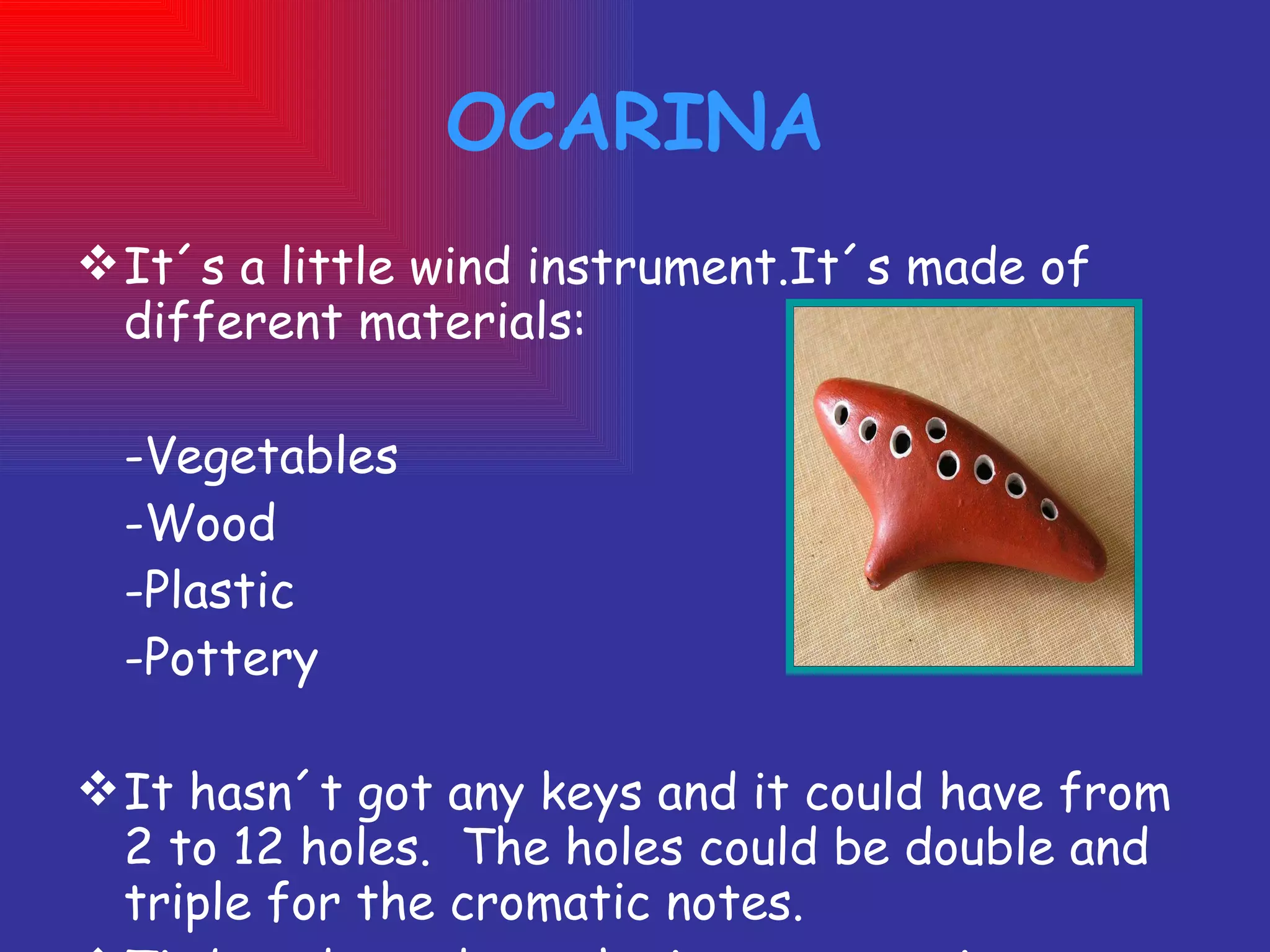
OCARINA It´s a little wind instrument.It´s made of different materials: -Vegetables -Wood -Plastic -Pottery It hasn´t got any keys and it could have from 2 to 12 holes.  The holes could be double and triple for the cromatic notes. Timbre depends on the instrument size.
thanks for your attention By: Edgar Domínguez Pérez and Josué Amado Pérez (2º ESO C y 4º PDC) IES San Tome do Freixeiro
Irene Núñez Mariño Gabriel Costas  2º E.S.O  C 4 PDC
END

Woodwinds

  • 1.
  • 2.
    Instrument origins Thefirst news that we have of it goes back to the 8th century AC in the north of India. Surely it was introduced in the West by the Romans. The documentation says that its sound captivated the emperor Nerón (37-68)
  • 3.
    Parts Pointer The chanter is the part of the pipes that actually produces the melody notes. Covering up or uncovering a hole with a finger one produces a different note. Blowstick It is the part where the player fills the bag. It´s like a mouthpiece.
  • 4.
    Parts Drones: The drones are responsible for the characteristic low "humming" sound that emanates from the pipes. Bag (Fol in Galicia): It´s the part of the bagpipe that is continuously filled with air. Once the bag is filled, the player must squeeze air out of the bag (using his arm).
  • 5.
    Bagpipes in theMiddle Ages In Roman archaeological sites statues of bagpipers suggest that were the Romans who introduced the bagpipe in Spain. In the early part of the second millennium, bagpipes appear in European art and iconography. For example in “Cantigas de Santa Maria”
  • 6.
  • 7.
    FAMOUS BAGPIPERS Carlos Nuñez
  • 8.
  • 9.
    Secondary Woodwinds REQUINTA,OCARINA PITO DE PARAGÜERO
  • 10.
  • 11.
    “ REQUINTA"It is a type of Galician transverse flute. It was born like an accompaning instrument. It is used in traditional music with bagpipes,bass drum and tamboril. At first it was made of bone and wood (elder) . After it was made of boxwood , and nowdays it can be of tropical wood like:Rosewood, “palo santo” or “granadino”because they are more resistent to humidity conditions. It is divided in five sections . The first section contains the mouth piece and the junction of the top part to main body and the bottom part has one key to play cromatic notes.
  • 12.
    SOUND In thispage there is an example about “ requinta”. The group is formed by requinta, two different drums (“pandero” and tamboril) and bagpipe. http://www.youtube.com/watch?v=xBRCrHziai4
  • 13.
  • 14.
    “ PITO ORCHIFRE” It is like a flute. It has three holes and it is also played in other provinces of Spain. It´s made of plastic and others materials. Knife sharpeners ( person who repairs knives and umbrellas) use these instruments to indicate their presence . Other names are “chifla” or “miniflauta”. The appearance is like a sirinx
  • 15.
    OCARINA It´s alittle wind instrument.It´s made of different materials: -Vegetables -Wood -Plastic -Pottery It hasn´t got any keys and it could have from 2 to 12 holes. The holes could be double and triple for the cromatic notes. Timbre depends on the instrument size.
  • 16.
    thanks for yourattention By: Edgar Domínguez Pérez and Josué Amado Pérez (2º ESO C y 4º PDC) IES San Tome do Freixeiro
  • 17.
    Irene Núñez MariñoGabriel Costas 2º E.S.O C 4 PDC
  • 18.

Editor's Notes

  • #2 <embed src="http://www.listengo.com/mediaplayer.swf" width="360" height="150" allowscriptaccess="always" allowfullscreen="true" flashvars="height=150&width=360&config=http://www.listengo.com/configfile.php?c=8562398/Gaita y Tradicion la ideal/Gaitas 2008">
  • #9 <object width="640" height="505"><param name="movie" value="http://www.youtube.com/v/C1bffYZdRm0&hl=es_ES&fs=1&color1=0x5d1719&color2=0xcd311b"></param><param name="allowFullScreen" value="true"></param><param name="allowscriptaccess" value="always"></param><embed src="http://www.youtube.com/v/C1bffYZdRm0&hl=es_ES&fs=1&color1=0x5d1719&color2=0xcd311b" type="application/x-shockwave-flash" allowscriptaccess="always" allowfullscreen="true" width="640" height="505"></embed></object>