Power plugs and sockets are devices that allow
electrically operated equipment to be connected to
the primary alternating current (AC) power supply in
a building. Electrical plugs and sockets differ in
voltage and current rating, shape, size and type of
connectors. The types used in each country are set
by national standards, Plugs and socket-outlets for
domestic and similar general use standardized in
member countries of IEC.
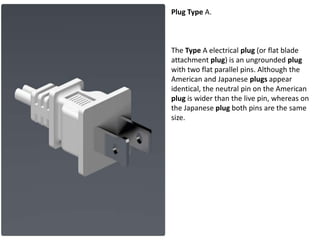
Plug Type A.
The Type A electrical plug (or flat blade
attachment plug) is an ungrounded plug
with two flat parallel pins. Although the
American and Japanese plugs appear
identical, the neutral pin on the American
plug is wider than the live pin, whereas on
the Japanese plug both pins are the same
size.
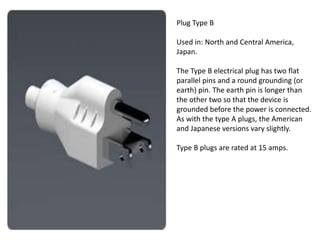
Plug Type B
Used in: North and Central America,
Japan.
The Type B electrical plug has two flat
parallel pins and a round grounding (or
earth) pin. The earth pin is longer than
the other two so that the device is
grounded before the power is connected.
As with the type A plugs, the American
and Japanese versions vary slightly.
Type B plugs are rated at 15 amps.
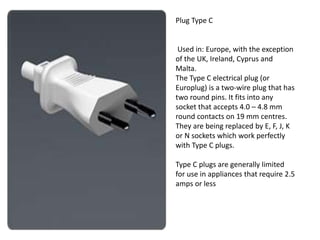
Plug Type C
Used in: Europe, with the exception
of the UK, Ireland, Cyprus and
Malta.
The Type C electrical plug (or
Europlug) is a two-wire plug that has
two round pins. It fits into any
socket that accepts 4.0 – 4.8 mm
round contacts on 19 mm centres.
They are being replaced by E, F, J, K
or N sockets which work perfectly
with Type C plugs.
Type C plugs are generally limited
for use in appliances that require 2.5
amps or less
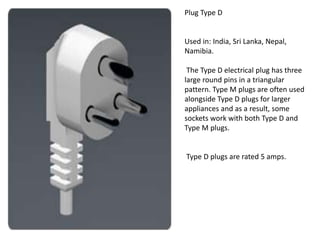
Plug Type D
Used in: India, Sri Lanka, Nepal,
Namibia.
The Type D electrical plug has three
large round pins in a triangular
pattern. Type M plugs are often used
alongside Type D plugs for larger
appliances and as a result, some
sockets work with both Type D and
Type M plugs.
Type D plugs are rated 5 amps.
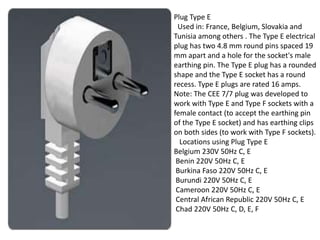
Plug Type E
Used in: France, Belgium, Slovakia and
Tunisia among others . The Type E electrical
plug has two 4.8 mm round pins spaced 19
mm apart and a hole for the socket's male
earthing pin. The Type E plug has a rounded
shape and the Type E socket has a round
recess. Type E plugs are rated 16 amps.
Note: The CEE 7/7 plug was developed to
work with Type E and Type F sockets with a
female contact (to accept the earthing pin
of the Type E socket) and has earthing clips
on both sides (to work with Type F sockets).
Locations using Plug Type E
Belgium 230V 50Hz C, E
Benin 220V 50Hz C, E
Burkina Faso 220V 50Hz C, E
Burundi 220V 50Hz C, E
Cameroon 220V 50Hz C, E
Central African Republic 220V 50Hz C, E
Chad 220V 50Hz C, D, E, F
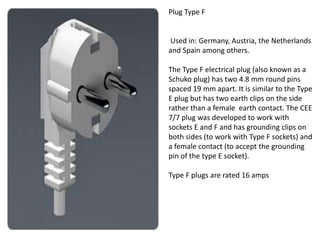
Plug Type F
Used in: Germany, Austria, the Netherlands
and Spain among others.
The Type F electrical plug (also known as a
Schuko plug) has two 4.8 mm round pins
spaced 19 mm apart. It is similar to the Type
E plug but has two earth clips on the side
rather than a female earth contact. The CEE
7/7 plug was developed to work with
sockets E and F and has grounding clips on
both sides (to work with Type F sockets) and
a female contact (to accept the grounding
pin of the type E socket).
Type F plugs are rated 16 amps
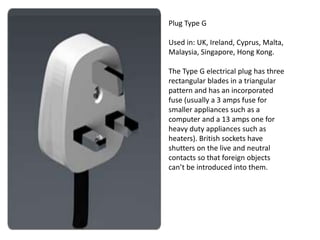
Plug Type G
Used in: UK, Ireland, Cyprus, Malta,
Malaysia, Singapore, Hong Kong.
The Type G electrical plug has three
rectangular blades in a triangular
pattern and has an incorporated
fuse (usually a 3 amps fuse for
smaller appliances such as a
computer and a 13 amps one for
heavy duty appliances such as
heaters). British sockets have
shutters on the live and neutral
contacts so that foreign objects
can’t be introduced into them.
Plug Type H
Used in: Israel
The Type H plug is unique to Israel and has
two flat pins in a V-shape as well as a
grounding pin. It is however currently
being phased out in favour of a round-
pinned version. The holes in Type H
sockets are wide in the middle so as to
accommodate the round-pinned version of
the Type H plug as well as Type C plugs.
Type H plugs are rated 16 amps.
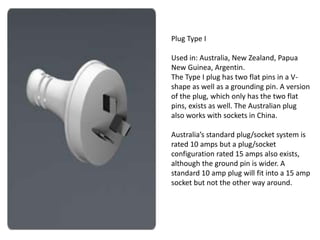
Plug Type I
Used in: Australia, New Zealand, Papua
New Guinea, Argentin.
The Type I plug has two flat pins in a V-
shape as well as a grounding pin. A version
of the plug, which only has the two flat
pins, exists as well. The Australian plug
also works with sockets in China.
Australia’s standard plug/socket system is
rated 10 amps but a plug/socket
configuration rated 15 amps also exists,
although the ground pin is wider. A
standard 10 amp plug will fit into a 15 amp
socket but not the other way around.
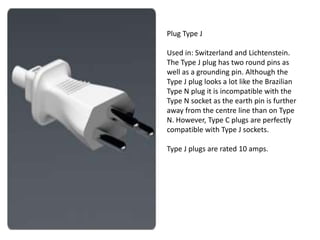
Plug Type J
Used in: Switzerland and Lichtenstein.
The Type J plug has two round pins as
well as a grounding pin. Although the
Type J plug looks a lot like the Brazilian
Type N plug it is incompatible with the
Type N socket as the earth pin is further
away from the centre line than on Type
N. However, Type C plugs are perfectly
compatible with Type J sockets.
Type J plugs are rated 10 amps.
Plug Type K
Used in: Denmark and Greenland.
The Type K plug has two round pins as well as
a grounding pin. It is similar to Type F, the
difference being that Type F has grounding
clips instead of a grounding pin. Type C plugs
are perfectly compatible with Type F sockets.
Type E plugs and sockets are also used in
Denmark.
Plug Type L
Used in: Italy.
There are two variations of the Type L plug,
one rated at 10 amps, and one at 16 amps.
The 10 amp version has two round pins that
are 4 mm think and spaced 5.5 mm apart,
with a grounding pin in the middle. The 16
amp version has two round pins that are 5
mm thick, spaced 8mm apart, as well as a
grounding pin. Italy has a kind of “universal”
socket that comprises a “schuko” socket for
C, E, F and L plugs and a “bipasso” socket for
L and C plugs.
Plug Type M
Used in: South Africa, Swaziland, Lesotho.
The Type M plug has three round pins in a
triangular pattern and looks similar to the
Indian Type D plug, but its pins are much
larger. Type M plugs are sometimes used for
bigger appliances in countries that make use of
Type D plugs, as well as in Israel (Type H).
Therefore, sockets in these countries
sometimes work with Type M plugs.
Plug Type N
Used in: Brazil.
There are two variations of the Type N plug,
one rated at 10 amps, and one at 20 amps. The
10 amp version has two round pins that are 4
mm thick, and a grounding pin. The 20 amp
version, used for heavier appliances, has two
round pins 4.8 mm in diameter, and a
grounding pin. The Type N socket was
designed to work with Type C plugs as well.
Brazil is one of the few countries that uses two
types of voltage. While most states use 127 V,
some of them use 220 V. It is therefore
important to find out the local voltage before
plugging in your appliance (note: wrong
voltage can destroy your appliance). Many
appliances sold in Brazil are dual voltage.
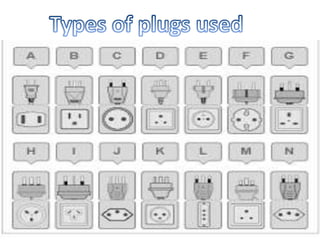
Types of eplugs
Types of eplugs

Types of eplugs

  • 2.
    Power plugs andsockets are devices that allow electrically operated equipment to be connected to the primary alternating current (AC) power supply in a building. Electrical plugs and sockets differ in voltage and current rating, shape, size and type of connectors. The types used in each country are set by national standards, Plugs and socket-outlets for domestic and similar general use standardized in member countries of IEC.
  • 4.
    Plug Type A. TheType A electrical plug (or flat blade attachment plug) is an ungrounded plug with two flat parallel pins. Although the American and Japanese plugs appear identical, the neutral pin on the American plug is wider than the live pin, whereas on the Japanese plug both pins are the same size.
  • 5.
    Plug Type B Usedin: North and Central America, Japan. The Type B electrical plug has two flat parallel pins and a round grounding (or earth) pin. The earth pin is longer than the other two so that the device is grounded before the power is connected. As with the type A plugs, the American and Japanese versions vary slightly. Type B plugs are rated at 15 amps.
  • 6.
    Plug Type C Usedin: Europe, with the exception of the UK, Ireland, Cyprus and Malta. The Type C electrical plug (or Europlug) is a two-wire plug that has two round pins. It fits into any socket that accepts 4.0 – 4.8 mm round contacts on 19 mm centres. They are being replaced by E, F, J, K or N sockets which work perfectly with Type C plugs. Type C plugs are generally limited for use in appliances that require 2.5 amps or less
  • 7.
    Plug Type D Usedin: India, Sri Lanka, Nepal, Namibia. The Type D electrical plug has three large round pins in a triangular pattern. Type M plugs are often used alongside Type D plugs for larger appliances and as a result, some sockets work with both Type D and Type M plugs. Type D plugs are rated 5 amps.
  • 8.
    Plug Type E Usedin: France, Belgium, Slovakia and Tunisia among others . The Type E electrical plug has two 4.8 mm round pins spaced 19 mm apart and a hole for the socket's male earthing pin. The Type E plug has a rounded shape and the Type E socket has a round recess. Type E plugs are rated 16 amps. Note: The CEE 7/7 plug was developed to work with Type E and Type F sockets with a female contact (to accept the earthing pin of the Type E socket) and has earthing clips on both sides (to work with Type F sockets). Locations using Plug Type E Belgium 230V 50Hz C, E Benin 220V 50Hz C, E Burkina Faso 220V 50Hz C, E Burundi 220V 50Hz C, E Cameroon 220V 50Hz C, E Central African Republic 220V 50Hz C, E Chad 220V 50Hz C, D, E, F
  • 9.
    Plug Type F Usedin: Germany, Austria, the Netherlands and Spain among others. The Type F electrical plug (also known as a Schuko plug) has two 4.8 mm round pins spaced 19 mm apart. It is similar to the Type E plug but has two earth clips on the side rather than a female earth contact. The CEE 7/7 plug was developed to work with sockets E and F and has grounding clips on both sides (to work with Type F sockets) and a female contact (to accept the grounding pin of the type E socket). Type F plugs are rated 16 amps
  • 10.
    Plug Type G Usedin: UK, Ireland, Cyprus, Malta, Malaysia, Singapore, Hong Kong. The Type G electrical plug has three rectangular blades in a triangular pattern and has an incorporated fuse (usually a 3 amps fuse for smaller appliances such as a computer and a 13 amps one for heavy duty appliances such as heaters). British sockets have shutters on the live and neutral contacts so that foreign objects can’t be introduced into them.
  • 11.
    Plug Type H Usedin: Israel The Type H plug is unique to Israel and has two flat pins in a V-shape as well as a grounding pin. It is however currently being phased out in favour of a round- pinned version. The holes in Type H sockets are wide in the middle so as to accommodate the round-pinned version of the Type H plug as well as Type C plugs. Type H plugs are rated 16 amps.
  • 12.
    Plug Type I Usedin: Australia, New Zealand, Papua New Guinea, Argentin. The Type I plug has two flat pins in a V- shape as well as a grounding pin. A version of the plug, which only has the two flat pins, exists as well. The Australian plug also works with sockets in China. Australia’s standard plug/socket system is rated 10 amps but a plug/socket configuration rated 15 amps also exists, although the ground pin is wider. A standard 10 amp plug will fit into a 15 amp socket but not the other way around.
  • 13.
    Plug Type J Usedin: Switzerland and Lichtenstein. The Type J plug has two round pins as well as a grounding pin. Although the Type J plug looks a lot like the Brazilian Type N plug it is incompatible with the Type N socket as the earth pin is further away from the centre line than on Type N. However, Type C plugs are perfectly compatible with Type J sockets. Type J plugs are rated 10 amps.
  • 14.
    Plug Type K Usedin: Denmark and Greenland. The Type K plug has two round pins as well as a grounding pin. It is similar to Type F, the difference being that Type F has grounding clips instead of a grounding pin. Type C plugs are perfectly compatible with Type F sockets. Type E plugs and sockets are also used in Denmark.
  • 15.
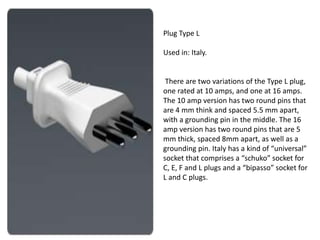
    Plug Type L Usedin: Italy. There are two variations of the Type L plug, one rated at 10 amps, and one at 16 amps. The 10 amp version has two round pins that are 4 mm think and spaced 5.5 mm apart, with a grounding pin in the middle. The 16 amp version has two round pins that are 5 mm thick, spaced 8mm apart, as well as a grounding pin. Italy has a kind of “universal” socket that comprises a “schuko” socket for C, E, F and L plugs and a “bipasso” socket for L and C plugs.
  • 16.
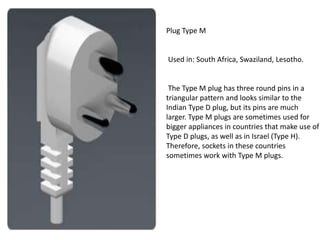
    Plug Type M Usedin: South Africa, Swaziland, Lesotho. The Type M plug has three round pins in a triangular pattern and looks similar to the Indian Type D plug, but its pins are much larger. Type M plugs are sometimes used for bigger appliances in countries that make use of Type D plugs, as well as in Israel (Type H). Therefore, sockets in these countries sometimes work with Type M plugs.
  • 17.
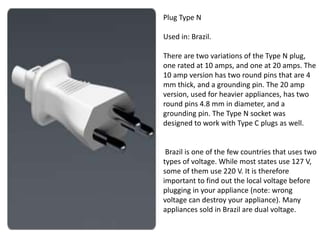
    Plug Type N Usedin: Brazil. There are two variations of the Type N plug, one rated at 10 amps, and one at 20 amps. The 10 amp version has two round pins that are 4 mm thick, and a grounding pin. The 20 amp version, used for heavier appliances, has two round pins 4.8 mm in diameter, and a grounding pin. The Type N socket was designed to work with Type C plugs as well. Brazil is one of the few countries that uses two types of voltage. While most states use 127 V, some of them use 220 V. It is therefore important to find out the local voltage before plugging in your appliance (note: wrong voltage can destroy your appliance). Many appliances sold in Brazil are dual voltage.