Types of Biodegradable
Polymers
Dr.D.Syam Babu
Introduction
Rise of environmental pollution by synthetic
polymers in developing countries have reached
dangerous levels. Plastics produced from
petroleum resources are not biodegradable.
• Because they defy microbial degradation, they
end up in the landfills and damage the
environment.
• Totop that off, oil prices have increased
remarkably.
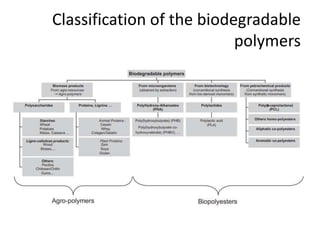
Classification of the biodegradable
polymers
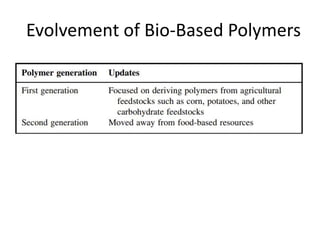
Evolvement of Bio-Based Polymers
Bio-Based Polymers
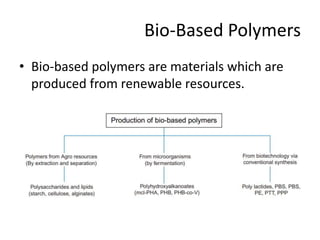
• Bio-based polymers are materials which are
produced from renewable resources.
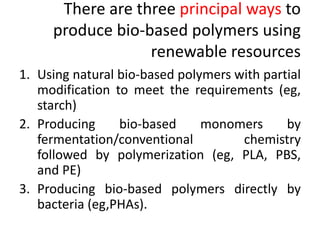
There are three principal ways to
produce bio-based polymers using
renewable resources
1. Using natural bio-based polymers with partial
modification to meet the requirements (eg,
starch)
2. Producing bio-based monomers by
fermentation/conventional chemistry
followed by polymerization (eg, PLA, PBS,
and PE)
3. Producing bio-based polymers directly by
bacteria (eg,PHAs).
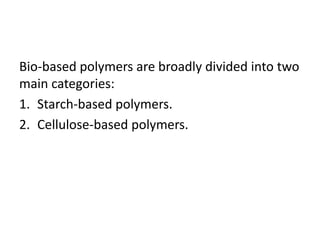
Bio-based polymers are broadly divided into two
main categories:
1. Starch-based polymers.
2. Cellulose-based polymers.
Starch-Based
Polymers
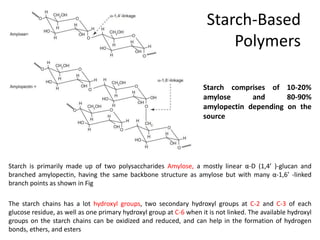
Starch is primarily made up of two polysaccharides Amylose, a mostly linear α-D (1,4’ )-glucan and
branched amylopectin, having the same backbone structure as amylose but with many α-1,6’ -linked
branch points as shown in Fig
The starch chains has a lot hydroxyl groups, two secondary hydroxyl groups at C-2 and C-3 of each
glucose residue, as well as one primary hydroxyl group at C-6 when it is not linked. The available hydroxyl
groups on the starch chains can be oxidized and reduced, and can help in the formation of hydrogen
bonds, ethers, and esters
Starch comprises of 10-20%
amylose and 80-90%
amylopectin depending on the
source
Characteristics of starch-based
polymers
Some of the market drivers of starch-based polymers are:
• Lower cost materials than some other types of
biodegradable polymers such as synthetic co-
polyesters and PLA because of relatively cheap
agricultural feedstock and simpler manufacturing
process.
• Environmental-friendly than synthetic biopolymers;
• Starch blends have better physical and mechanical
properties than pure plant based polymers.
Starch-based polymers are used in
• Applications which are used in natural
environment such as agricultural and fishery
materials.
• Applications where reuse of the product is
difficult and composting organic waste is
effective.
• Applications with specific features, where
functionality and performance can also be
completely separated from the main function.
Starch-based polymers are typically
classified into four types:
1. Thermoplastic starch (TPS)
2. Starchsynthetic aliphatic polyester blends
3. StarchPBS/PBSA polyester blends
4. StarchPVOH blend
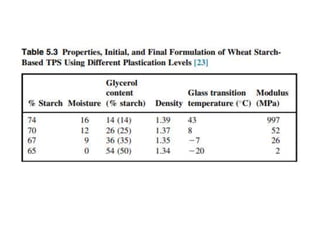
1. Thermoplastic Starch
TPS is similar to other polymers with
linear and branched structures, molar mass, glass
transition temperature, crystallinity, and melting
temperature.
However, in the presence of a plasticizer such as
water, glycerin, sorbitol high temperatures
(9001800C) and shearing, it melts and fluidizes,
enabling its use in injection, extrusion, and blowing
equipment such as those for synthetic plastics.
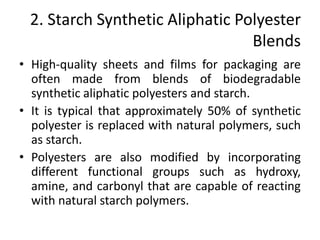
2. Starch Synthetic Aliphatic Polyester
Blends
• High-quality sheets and films for packaging are
often made from blends of biodegradable
synthetic aliphatic polyesters and starch.
• It is typical that approximately 50% of synthetic
polyester is replaced with natural polymers, such
as starch.
• Polyesters are also modified by incorporating
different functional groups such as hydroxy,
amine, and carbonyl that are capable of reacting
with natural starch polymers.
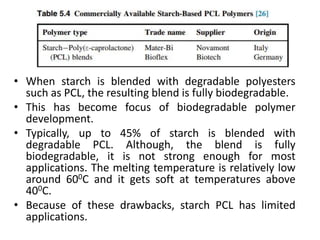
• When starch is blended with degradable polyesters
such as PCL, the resulting blend is fully biodegradable.
• This has become focus of biodegradable polymer
development.
• Typically, up to 45% of starch is blended with
degradable PCL. Although, the blend is fully
biodegradable, it is not strong enough for most
applications. The melting temperature is relatively low
around 600C and it gets soft at temperatures above
400C.
• Because of these drawbacks, starch PCL has limited
applications.
3. StarchPBS/PBSA Polyester Blends
• One of the major starch-based synthetic aliphatic
polyester blends are starch PBS/PBSA polyester
blends. PBS and polybutylene succinate adi pate
(PBSA) are synthesized from 1,4-butanediol and
succinic and/or adipic acid at 21502250C under high
vacuum.
• The resulting average molecular weight of 40 kg/mol is
not sufficient. In order to increase molecular weight to
the desired level, a small amount of unsaturated
carboxylic acid is added under addition polymerization
initiated by peroxides.
• StarchPBS/PBSA blends disintegrate in
compost after 6 weeks.
• Some of their applications includes films for
compostable trash bags, paper lamination,
magnetic cards, sheets for thermoforming,
extrusion forming, monofilament for fishing
lines, woven nets, and ropes.
4. Starch PVOH Blends
• Blending starch with biodegradable polyester
results in phase separation and poor interfacial
properties.
• Because PVOH degrades at high temperature
when processed by melt processing, starch PVOH
blend uses solution casting to produce films.
However, low efficiency and high processing cost
makes solution casting economically not viable
and hence not the process of choice.
• Mechanical properties of starch PVOH blends
are directly impacted by the amount of the
plasticizers added. Higher concentration of
plasti cizer drastically improves mechanical
properties and reduces waterabsorbance.
• In the case of citric acid, mechanical
properties such as tensile strength and
elongation at break are improved drastically
with increase in the citric acid concentration.
THANK YOU

Types of Biodegradable Polymers.pptx

  • 1.
  • 2.
    Introduction Rise of environmentalpollution by synthetic polymers in developing countries have reached dangerous levels. Plastics produced from petroleum resources are not biodegradable. • Because they defy microbial degradation, they end up in the landfills and damage the environment. • Totop that off, oil prices have increased remarkably.
  • 3.
    Classification of thebiodegradable polymers
  • 4.
  • 5.
    Bio-Based Polymers • Bio-basedpolymers are materials which are produced from renewable resources.
  • 6.
    There are threeprincipal ways to produce bio-based polymers using renewable resources 1. Using natural bio-based polymers with partial modification to meet the requirements (eg, starch) 2. Producing bio-based monomers by fermentation/conventional chemistry followed by polymerization (eg, PLA, PBS, and PE) 3. Producing bio-based polymers directly by bacteria (eg,PHAs).
  • 7.
    Bio-based polymers arebroadly divided into two main categories: 1. Starch-based polymers. 2. Cellulose-based polymers.
  • 8.
    Starch-Based Polymers Starch is primarilymade up of two polysaccharides Amylose, a mostly linear α-D (1,4’ )-glucan and branched amylopectin, having the same backbone structure as amylose but with many α-1,6’ -linked branch points as shown in Fig The starch chains has a lot hydroxyl groups, two secondary hydroxyl groups at C-2 and C-3 of each glucose residue, as well as one primary hydroxyl group at C-6 when it is not linked. The available hydroxyl groups on the starch chains can be oxidized and reduced, and can help in the formation of hydrogen bonds, ethers, and esters Starch comprises of 10-20% amylose and 80-90% amylopectin depending on the source
  • 9.
    Characteristics of starch-based polymers Someof the market drivers of starch-based polymers are: • Lower cost materials than some other types of biodegradable polymers such as synthetic co- polyesters and PLA because of relatively cheap agricultural feedstock and simpler manufacturing process. • Environmental-friendly than synthetic biopolymers; • Starch blends have better physical and mechanical properties than pure plant based polymers.
  • 10.
    Starch-based polymers areused in • Applications which are used in natural environment such as agricultural and fishery materials. • Applications where reuse of the product is difficult and composting organic waste is effective. • Applications with specific features, where functionality and performance can also be completely separated from the main function.
  • 11.
    Starch-based polymers aretypically classified into four types: 1. Thermoplastic starch (TPS) 2. Starchsynthetic aliphatic polyester blends 3. StarchPBS/PBSA polyester blends 4. StarchPVOH blend
  • 12.
    1. Thermoplastic Starch TPSis similar to other polymers with linear and branched structures, molar mass, glass transition temperature, crystallinity, and melting temperature. However, in the presence of a plasticizer such as water, glycerin, sorbitol high temperatures (9001800C) and shearing, it melts and fluidizes, enabling its use in injection, extrusion, and blowing equipment such as those for synthetic plastics.
  • 16.
    2. Starch SyntheticAliphatic Polyester Blends • High-quality sheets and films for packaging are often made from blends of biodegradable synthetic aliphatic polyesters and starch. • It is typical that approximately 50% of synthetic polyester is replaced with natural polymers, such as starch. • Polyesters are also modified by incorporating different functional groups such as hydroxy, amine, and carbonyl that are capable of reacting with natural starch polymers.
  • 17.
    • When starchis blended with degradable polyesters such as PCL, the resulting blend is fully biodegradable. • This has become focus of biodegradable polymer development. • Typically, up to 45% of starch is blended with degradable PCL. Although, the blend is fully biodegradable, it is not strong enough for most applications. The melting temperature is relatively low around 600C and it gets soft at temperatures above 400C. • Because of these drawbacks, starch PCL has limited applications.
  • 18.
    3. StarchPBS/PBSA PolyesterBlends • One of the major starch-based synthetic aliphatic polyester blends are starch PBS/PBSA polyester blends. PBS and polybutylene succinate adi pate (PBSA) are synthesized from 1,4-butanediol and succinic and/or adipic acid at 21502250C under high vacuum. • The resulting average molecular weight of 40 kg/mol is not sufficient. In order to increase molecular weight to the desired level, a small amount of unsaturated carboxylic acid is added under addition polymerization initiated by peroxides.
  • 19.
    • StarchPBS/PBSA blendsdisintegrate in compost after 6 weeks. • Some of their applications includes films for compostable trash bags, paper lamination, magnetic cards, sheets for thermoforming, extrusion forming, monofilament for fishing lines, woven nets, and ropes.
  • 20.
    4. Starch PVOHBlends • Blending starch with biodegradable polyester results in phase separation and poor interfacial properties. • Because PVOH degrades at high temperature when processed by melt processing, starch PVOH blend uses solution casting to produce films. However, low efficiency and high processing cost makes solution casting economically not viable and hence not the process of choice.
  • 21.
    • Mechanical propertiesof starch PVOH blends are directly impacted by the amount of the plasticizers added. Higher concentration of plasti cizer drastically improves mechanical properties and reduces waterabsorbance. • In the case of citric acid, mechanical properties such as tensile strength and elongation at break are improved drastically with increase in the citric acid concentration.
  • 22.