Type and Usage of
Important Studio Cables
Presentation Content
• Introduction
• Balanced and Unbalanced Cables
• Type and Usage of Important Studio
Cables
• Reflection
Introduction
• My name is Rıdvan and I work as an Electrical
and Electronics Engineer.
• I live in Turkey.
• I want to build a home studio. I believe, this
course is a great place to start.
• In this presentation, you are going to find
information about types and usage of
important studio cables.
Balanced and Unbalanced
Cables
Before starting to look into cable
types, it is essential to define Balanced
cable and Unbalanced cable.
1. Unbalanced Cable
There are two lines that transmits the audio
signal in unbalanced cables:
• Hot line: Carries the signal
• Earth line: Carries the ground
1. Unbalanced Cable
These cables are highly susceptible to noise.
Therefore it’s better not to use unbalanced
cables in long runs. Generally these type of
cables are common in short cables or less
professional practices.
2. Balanced Cable
There are three lines that transmits the audio
signal in balanced cables (remember two lines in
unbalanced):
• Hot line: Carries the signal
• Cold line: Carries the inverted signal
• Earth line: Carries the ground
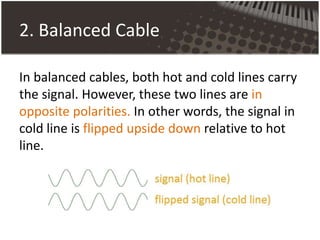
2. Balanced Cable
In balanced cables, both hot and cold lines carry
the signal. However, these two lines are in
opposite polarities. In other words, the signal in
cold line is flipped upside down relative to hot
line.
2. Balanced Cable
What is the advantage of using Balanced cables?
On the path of the cable, both lines are affected
by noise. When signals reach to the terminal,
cold signal is inverted. Therefore, when these
two signals are combined, noise cancels out.
2. Balanced Cable
To conclude, balanced cables are more resistant
to noise and they can be used in longer runs.
Type and Usage of
Important Studio Cables
We can classify studio cables in the
following two groups;
• Analog Cables
• Digital Cables
1. Analog Cables
Analog cables that are used in studio are:
• XLR cables
• TRS cables
• TS cables
• Stereo Headphone Connectors
• RCA Connectors
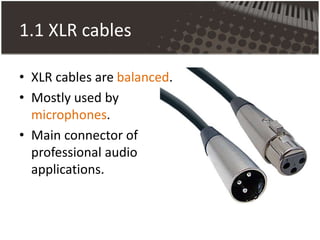
1.1 XLR cables
• XLR cables are balanced.
• Mostly used by
microphones.
• Main connector of
professional audio
applications.
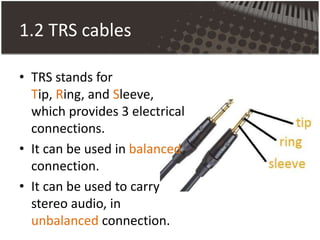
1.2 TRS cables
• TRS stands for
Tip, Ring, and Sleeve,
which provides 3 electrical
connections.
• It can be used in balanced
connection.
• It can be used to carry
stereo audio, in
unbalanced connection.
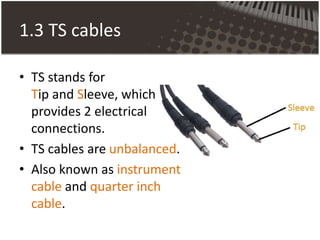
1.3 TS cables
• TS stands for
Tip and Sleeve, which
provides 2 electrical
connections.
• TS cables are unbalanced.
• Also known as instrument
cable and quarter inch
cable.
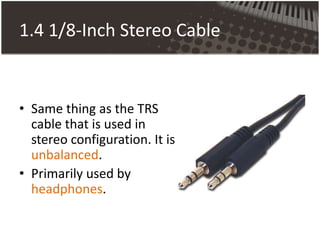
1.4 1/8-Inch Stereo Cable
• Same thing as the TRS
cable that is used in
stereo configuration. It is
unbalanced.
• Primarily used by
headphones.
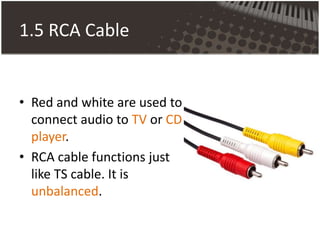
1.5 RCA Cable
• Red and white are used to
connect audio to TV or CD
player.
• RCA cable functions just
like TS cable. It is
unbalanced.
2. Digital Cables
Analog cables possibly wont change much in the
near future.
However, new digital cables are invented all the
time.
In this work, some of the most common digital
cables are going to be presented.
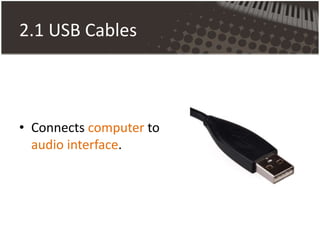
2.1 USB Cables
• Connects computer to
audio interface.
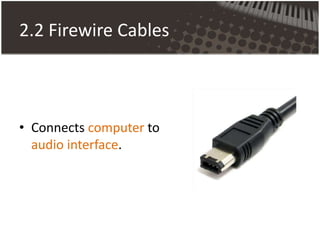
2.2 Firewire Cables
• Connects computer to
audio interface.
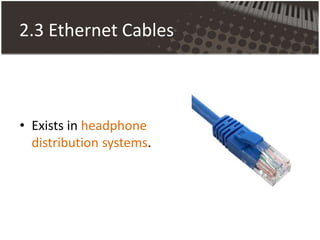
2.3 Ethernet Cables
• Exists in headphone
distribution systems.
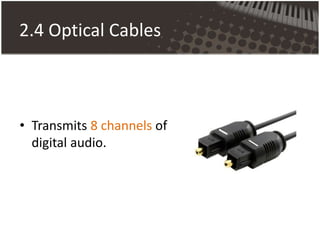
2.4 Optical Cables
• Transmits 8 channels of
digital audio.
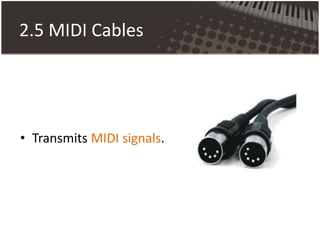
2.5 MIDI Cables
• Transmits MIDI signals.
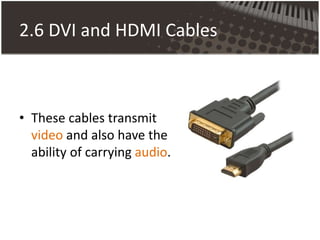
2.6 DVI and HDMI Cables
• These cables transmit
video and also have the
ability of carrying audio.
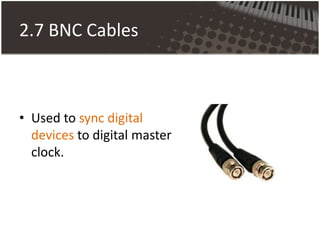
2.7 BNC Cables
• Used to sync digital
devices to digital master
clock.
Reflection
• This material was new to me. I mostly learn
the topic from course material. In this work, I
prepared a presentation that covers the
lecture notes in cables. I also added some
extra material, such as digital cable types.
• Finding course material on internet was quite
easy.
• In the future assignments, I would like to add
audio to presentations.
Thank you for reading and evaluating my
assignment. I will be glad to hear about your
critiques.

Type and usage of important studio cables

  • 1.
    Type and Usageof Important Studio Cables
  • 2.
    Presentation Content • Introduction •Balanced and Unbalanced Cables • Type and Usage of Important Studio Cables • Reflection
  • 3.
    Introduction • My nameis Rıdvan and I work as an Electrical and Electronics Engineer. • I live in Turkey. • I want to build a home studio. I believe, this course is a great place to start. • In this presentation, you are going to find information about types and usage of important studio cables.
  • 4.
    Balanced and Unbalanced Cables Beforestarting to look into cable types, it is essential to define Balanced cable and Unbalanced cable.
  • 5.
    1. Unbalanced Cable Thereare two lines that transmits the audio signal in unbalanced cables: • Hot line: Carries the signal • Earth line: Carries the ground
  • 6.
    1. Unbalanced Cable Thesecables are highly susceptible to noise. Therefore it’s better not to use unbalanced cables in long runs. Generally these type of cables are common in short cables or less professional practices.
  • 7.
    2. Balanced Cable Thereare three lines that transmits the audio signal in balanced cables (remember two lines in unbalanced): • Hot line: Carries the signal • Cold line: Carries the inverted signal • Earth line: Carries the ground
  • 8.
    2. Balanced Cable Inbalanced cables, both hot and cold lines carry the signal. However, these two lines are in opposite polarities. In other words, the signal in cold line is flipped upside down relative to hot line.
  • 9.
    2. Balanced Cable Whatis the advantage of using Balanced cables? On the path of the cable, both lines are affected by noise. When signals reach to the terminal, cold signal is inverted. Therefore, when these two signals are combined, noise cancels out.
  • 10.
    2. Balanced Cable Toconclude, balanced cables are more resistant to noise and they can be used in longer runs.
  • 11.
    Type and Usageof Important Studio Cables We can classify studio cables in the following two groups; • Analog Cables • Digital Cables
  • 12.
    1. Analog Cables Analogcables that are used in studio are: • XLR cables • TRS cables • TS cables • Stereo Headphone Connectors • RCA Connectors
  • 13.
    1.1 XLR cables •XLR cables are balanced. • Mostly used by microphones. • Main connector of professional audio applications.
  • 14.
    1.2 TRS cables •TRS stands for Tip, Ring, and Sleeve, which provides 3 electrical connections. • It can be used in balanced connection. • It can be used to carry stereo audio, in unbalanced connection.
  • 15.
    1.3 TS cables •TS stands for Tip and Sleeve, which provides 2 electrical connections. • TS cables are unbalanced. • Also known as instrument cable and quarter inch cable.
  • 16.
    1.4 1/8-Inch StereoCable • Same thing as the TRS cable that is used in stereo configuration. It is unbalanced. • Primarily used by headphones.
  • 17.
    1.5 RCA Cable •Red and white are used to connect audio to TV or CD player. • RCA cable functions just like TS cable. It is unbalanced.
  • 18.
    2. Digital Cables Analogcables possibly wont change much in the near future. However, new digital cables are invented all the time. In this work, some of the most common digital cables are going to be presented.
  • 19.
    2.1 USB Cables •Connects computer to audio interface.
  • 20.
    2.2 Firewire Cables •Connects computer to audio interface.
  • 21.
    2.3 Ethernet Cables •Exists in headphone distribution systems.
  • 22.
    2.4 Optical Cables •Transmits 8 channels of digital audio.
  • 23.
    2.5 MIDI Cables •Transmits MIDI signals.
  • 24.
    2.6 DVI andHDMI Cables • These cables transmit video and also have the ability of carrying audio.
  • 25.
    2.7 BNC Cables •Used to sync digital devices to digital master clock.
  • 26.
    Reflection • This materialwas new to me. I mostly learn the topic from course material. In this work, I prepared a presentation that covers the lecture notes in cables. I also added some extra material, such as digital cable types. • Finding course material on internet was quite easy. • In the future assignments, I would like to add audio to presentations.
  • 27.
    Thank you forreading and evaluating my assignment. I will be glad to hear about your critiques.