Type and usage of 
important studio 
cables 
A powerpoint presentation 
by Sean Drennan
Presentation Content 
 Introduction 
 Unbalanced and Balanced 
 Cable Types and Uses 
 Recommendations 
 Reflection
Introduction 
 Hi, my name is Sean 
 I’m a student 
 I live in Ireland 
 I started this course because I am interested 
in pursuing music production as a career 
later in life
 Unbalanced and Balanced 
 An unbalanced cable has two conductors/wires. One 
of the wires carries the audio signal and the other is 
the ground wire. 
 There is nothing wrong with unbalanced cables but at 
times they might be susceptible to picking up radio 
frequencies or electro magnetic fields causing a 
buzzing noise. 
 Your better off using short unbalanced cables because 
they are more unlikely to pick up a buzzing sound 
 Examples of unbalanced cables are ¼ inch TS cable 
and an RCA cable which I will be showing you later
 Unbalanced and Balanced 
 A balanced cable has three conductors/wires. One of 
them is the ground wire and the other two are copies 
of the same signal, so when an audio signal is sent 
down the two wires, in one of the wires the polarity is 
switched and then at the end of the cable the polarity 
of the other wire is switched so the two wires are 
back in phase with each other. 
 Balanced cables are better than unbalanced cables 
because they aren't as susceptible to picking up noise 
 You can also have much longer runs of balanced 
cables because they don't pick up as much noise. 
 Examples of balanced cables are ¼ inch TRS cables 
and XLR cables which I will also be showing you later.
 Cable Types and Usage 
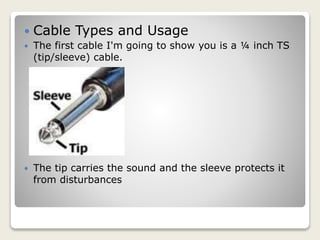
 The first cable I'm going to show you is a ¼ inch TS 
(tip/sleeve) cable. 
 The tip carries the sound and the sleeve protects it 
from disturbances
 Cable Types and Usage 
 RCA cables are commonly found in consumer 
products e.g. home speakers, gaming consoles etc. 
 The yellow cable is for video and the red and white 
cables are for audio (left and right)
 Cable Types and Usage 
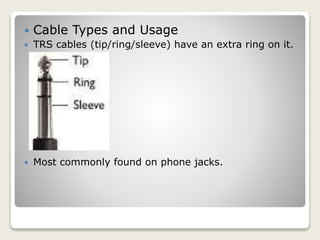
 TRS cables (tip/ring/sleeve) have an extra ring on it. 
 Most commonly found on phone jacks.
 Cable Types and Usage 
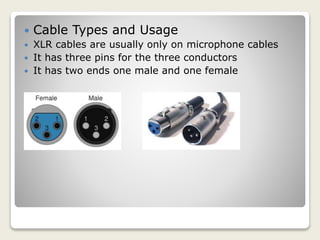
 XLR cables are usually only on microphone cables 
 It has three pins for the three conductors 
 It has two ends one male and one female
 Recommendations 
 Invest in high quality cables, they will last longer 
and the quality of the sound will be better 
 Use short unbalanced cables so you don't get 
any interference when using them. 
 When you need a long run of cable use a direct 
box (DI box) to convert an unbalanced TS cable 
into a balanced TRS cable
 Reflection 
 Thank you for reading this powerpoint 
presentation hope you liked it and if you have 
any feedback or questions feel free to ask me 
and Thank you again.

Type and usage of important studio cables.

  • 1.
    Type and usageof important studio cables A powerpoint presentation by Sean Drennan
  • 2.
    Presentation Content Introduction  Unbalanced and Balanced  Cable Types and Uses  Recommendations  Reflection
  • 3.
    Introduction  Hi,my name is Sean  I’m a student  I live in Ireland  I started this course because I am interested in pursuing music production as a career later in life
  • 4.
     Unbalanced andBalanced  An unbalanced cable has two conductors/wires. One of the wires carries the audio signal and the other is the ground wire.  There is nothing wrong with unbalanced cables but at times they might be susceptible to picking up radio frequencies or electro magnetic fields causing a buzzing noise.  Your better off using short unbalanced cables because they are more unlikely to pick up a buzzing sound  Examples of unbalanced cables are ¼ inch TS cable and an RCA cable which I will be showing you later
  • 5.
     Unbalanced andBalanced  A balanced cable has three conductors/wires. One of them is the ground wire and the other two are copies of the same signal, so when an audio signal is sent down the two wires, in one of the wires the polarity is switched and then at the end of the cable the polarity of the other wire is switched so the two wires are back in phase with each other.  Balanced cables are better than unbalanced cables because they aren't as susceptible to picking up noise  You can also have much longer runs of balanced cables because they don't pick up as much noise.  Examples of balanced cables are ¼ inch TRS cables and XLR cables which I will also be showing you later.
  • 6.
     Cable Typesand Usage  The first cable I'm going to show you is a ¼ inch TS (tip/sleeve) cable.  The tip carries the sound and the sleeve protects it from disturbances
  • 7.
     Cable Typesand Usage  RCA cables are commonly found in consumer products e.g. home speakers, gaming consoles etc.  The yellow cable is for video and the red and white cables are for audio (left and right)
  • 8.
     Cable Typesand Usage  TRS cables (tip/ring/sleeve) have an extra ring on it.  Most commonly found on phone jacks.
  • 9.
     Cable Typesand Usage  XLR cables are usually only on microphone cables  It has three pins for the three conductors  It has two ends one male and one female
  • 10.
     Recommendations Invest in high quality cables, they will last longer and the quality of the sound will be better  Use short unbalanced cables so you don't get any interference when using them.  When you need a long run of cable use a direct box (DI box) to convert an unbalanced TS cable into a balanced TRS cable
  • 11.
     Reflection Thank you for reading this powerpoint presentation hope you liked it and if you have any feedback or questions feel free to ask me and Thank you again.