Two Pointers Technique
Competitive Programming
From Problem 2 Solution in O(1)
Mostafa Saad Ibrahim
PhD Student @ Simon Fraser University
P S
T I N K
H F S T
A
Two Pointers Technique
◼ Pointer = index
▪ No relationship to C++ pointers int **x;
◼ It is not a specific algorithm. Just easy idea
that might be effective for specific problems
◼ You probably coded it before, but don’t know
a name for it
◼ In 2010, with a Codeforces tag, the name
become more popular
◼ I will utilize this tutorial
Two Pointers Technique
◼ Technique that uses 2 constrained indices
(move of one can be limited by the another)
▪ Typically each pointer iterates on O(N) array positions.
▪ Hence overall increment/decrement is O(N)
◼ Applications
▪ In sorted arrays, where we want to find some positions
▪ Or cumulative array of positive numbers array (sorted)
▪ Variable size sliding window, where we search for a
window (range) of specific property (max sum)
▪ Ad Hoc cases
Sum of 2 numbers problem
◼ It is one of the best problems to clarify the 2-
pointers technique
◼ Given a sorted array A, having N integers.
You need to find any pair(i,j) having sum as
given number X.
▪ O(N^2): 2 nested loops and compare the sum
▪ O(Nlogn): For each array value V, binary search for X-V
▪ O(N) using 2-pointers!
Sum of 2 numbers problem
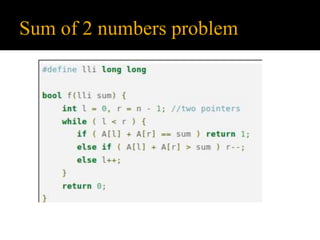
◼ 2-pointers based on the sortedness of array
▪ Let pointer(index) p1 on the first element of array
▪ Let p2 on the last element of the array
▪ Let Y = the sum of these 2 numbers
▪ If Y > X => shift p2 to the left => decrease Y
▪ If Y < X => shift p1 to the right => increase Y
▪ Keep doing so untill Y == X or no way
▪ Then each pointer moves O(N), total O(N)
Sum of 2 numbers problem
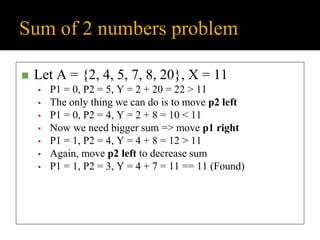
◼ Let A = {2, 4, 5, 7, 8, 20}, X = 11
▪ P1 = 0, P2 = 5, Y = 2 + 20 = 22 > 11
▪ The only thing we can do is to move p2 left
▪ P1 = 0, P2 = 4, Y = 2 + 8 = 10 < 11
▪ Now we need bigger sum => move p1 right
▪ P1 = 1, P2 = 4, Y = 4 + 8 = 12 > 11
▪ Again, move p2 left to decrease sum
▪ P1 = 1, P2 = 3, Y = 4 + 7 = 11 == 11 (Found)
Sum of 2 numbers problem
Sliding Windows
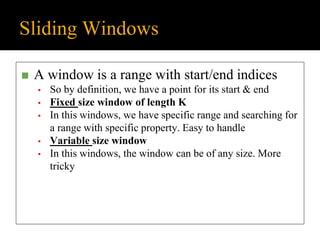
◼ A window is a range with start/end indices
▪ So by definition, we have a point for its start & end
▪ Fixed size window of length K
▪ In this windows, we have specific range and searching for
a range with specific property. Easy to handle
▪ Variable size window
▪ In this windows, the window can be of any size. More
tricky
Recall: Fixed size sliding window
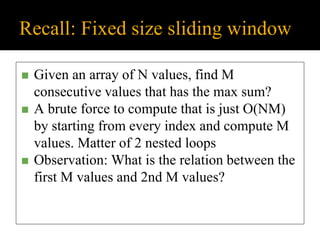
◼ Given an array of N values, find M
consecutive values that has the max sum?
◼ A brute force to compute that is just O(NM)
by starting from every index and compute M
values. Matter of 2 nested loops
◼ Observation: What is the relation between the
first M values and 2nd M values?
Fixed size sliding window
◼ Let A = {1, 2, 3, 4, 5, 6, -3}, M = 4
▪ 1st M values = 1+2+3+4 = 10
▪ 2nd M values = 2+3+4+5 = 10-1+5 = 14
▪ 3rd M values = 3+4+5+6 = 14-2+6 = 18
▪ 4th M values = 4+5+6-3 = 18-3-3 = 12
▪ So answer is max(14, 18, 12) = 18
◼ We create a window of fixed size M
▪ cur window = last window - its first item + new mth item
▪ Window start = pointer 1
▪ Window end = pointer 2
▪ P2 = P1+K-1
Variable size sliding window
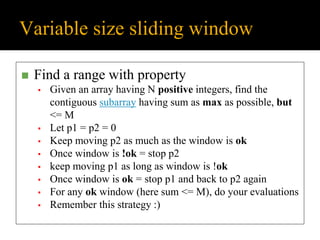
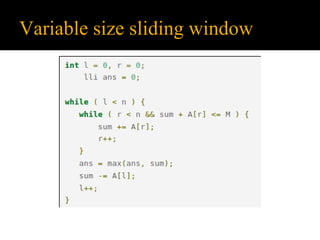
◼ Find a range with property
▪ Given an array having N positive integers, find the
contiguous subarray having sum as max as possible, but
<= M
▪ Let p1 = p2 = 0
▪ Keep moving p2 as much as the window is ok
▪ Once window is !ok = stop p2
▪ keep moving p1 as long as window is !ok
▪ Once window is ok = stop p1 and back to p2 again
▪ For any ok window (here sum <= M), do your evaluations
▪ Remember this strategy :)
Variable size sliding window
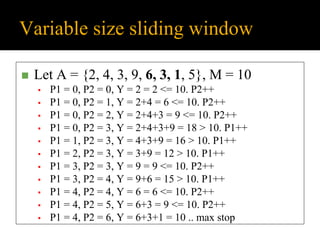
◼ Let A = {2, 4, 3, 9, 6, 3, 1, 5}, M = 10
▪ P1 = 0, P2 = 0, Y = 2 = 2 <= 10. P2++
▪ P1 = 0, P2 = 1, Y = 2+4 = 6 <= 10. P2++
▪ P1 = 0, P2 = 2, Y = 2+4+3 = 9 <= 10. P2++
▪ P1 = 0, P2 = 3, Y = 2+4+3+9 = 18 > 10. P1++
▪ P1 = 1, P2 = 3, Y = 4+3+9 = 16 > 10. P1++
▪ P1 = 2, P2 = 3, Y = 3+9 = 12 > 10. P1++
▪ P1 = 3, P2 = 3, Y = 9 = 9 <= 10. P2++
▪ P1 = 3, P2 = 4, Y = 9+6 = 15 > 10. P1++
▪ P1 = 4, P2 = 4, Y = 6 = 6 <= 10. P2++
▪ P1 = 4, P2 = 5, Y = 6+3 = 9 <= 10. P2++
▪ P1 = 4, P2 = 6, Y = 6+3+1 = 10 .. max stop
Variable size sliding window
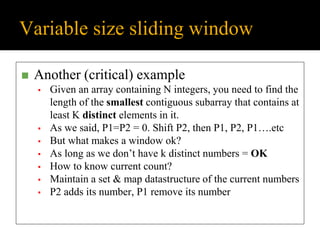
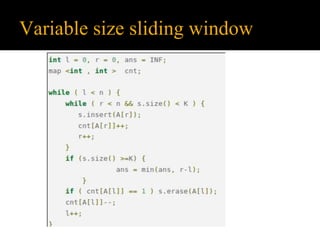
◼ Another (critical) example
▪ Given an array containing N integers, you need to find the
length of the smallest contiguous subarray that contains at
least K distinct elements in it.
▪ As we said, P1=P2 = 0. Shift P2, then P1, P2, P1….etc
▪ But what makes a window ok?
▪ As long as we don’t have k distinct numbers = OK
▪ How to know current count?
▪ Maintain a set & map datastructure of the current numbers
▪ P2 adds its number, P1 remove its number
Variable size sliding window
Your turn
◼ Given an array having N integers, find the contiguous
subarray having sum as max as possible
▪ Now 2 changes occurred.
▪ Numbers can be +ve or -ve
▪ We are not limited by a limit
▪ What makes a window ok? When to P2++ or P1++?
▪ This problem is know as Maximum Sum 1D
Your turn
◼ Given two sorted arrays A and B, each having
length N and M respectively. Form a new
sorted merged array having values of both the
arrays in sorted format.
▪ This is 2 arrays not just one! They are also sorted
▪ Let P1 = 0 on Array A
▪ Let P2 = 0 on Array B
▪ Let C is the new array
▪ What is C[0]? A[p1] or B[P2]?
▪ This is an important step of the merge sort algorithm
Summary
◼ Examples summary
▪ So we maintain 2 (or more?) pointers on an array
▪ Case: p1 = start, p2 = end
▪ Case: p1 = start, p2 = start+fixed_length
▪ Case: p1 = start, p2 = start
▪ Case: p1 = start of array, p2 = start of another array
◼ Some popular algorithms are related,
explicitly or implicitly, to 2-pointers
▪ Reverse string (We can do that with 2 points (0, n-1) and
do swapping)
▪ Quick sort, Mrege sort, Z-function, Prefix function
‫تم‬
‫بحمد‬
‫هللا‬
‫علمكم‬
‫هللا‬
‫ما‬
‫ينفعكم‬
‫ونفعكم‬
‫بما‬
‫تعلمتم‬
‫وزادكم‬
ً
‫علما‬

Two pointers technique Mostafa Saad.pptx

  • 1.
    Two Pointers Technique CompetitiveProgramming From Problem 2 Solution in O(1) Mostafa Saad Ibrahim PhD Student @ Simon Fraser University P S T I N K H F S T A
  • 2.
    Two Pointers Technique ◼Pointer = index ▪ No relationship to C++ pointers int **x; ◼ It is not a specific algorithm. Just easy idea that might be effective for specific problems ◼ You probably coded it before, but don’t know a name for it ◼ In 2010, with a Codeforces tag, the name become more popular ◼ I will utilize this tutorial
  • 3.
    Two Pointers Technique ◼Technique that uses 2 constrained indices (move of one can be limited by the another) ▪ Typically each pointer iterates on O(N) array positions. ▪ Hence overall increment/decrement is O(N) ◼ Applications ▪ In sorted arrays, where we want to find some positions ▪ Or cumulative array of positive numbers array (sorted) ▪ Variable size sliding window, where we search for a window (range) of specific property (max sum) ▪ Ad Hoc cases
  • 4.
    Sum of 2numbers problem ◼ It is one of the best problems to clarify the 2- pointers technique ◼ Given a sorted array A, having N integers. You need to find any pair(i,j) having sum as given number X. ▪ O(N^2): 2 nested loops and compare the sum ▪ O(Nlogn): For each array value V, binary search for X-V ▪ O(N) using 2-pointers!
  • 5.
    Sum of 2numbers problem ◼ 2-pointers based on the sortedness of array ▪ Let pointer(index) p1 on the first element of array ▪ Let p2 on the last element of the array ▪ Let Y = the sum of these 2 numbers ▪ If Y > X => shift p2 to the left => decrease Y ▪ If Y < X => shift p1 to the right => increase Y ▪ Keep doing so untill Y == X or no way ▪ Then each pointer moves O(N), total O(N)
  • 6.
    Sum of 2numbers problem ◼ Let A = {2, 4, 5, 7, 8, 20}, X = 11 ▪ P1 = 0, P2 = 5, Y = 2 + 20 = 22 > 11 ▪ The only thing we can do is to move p2 left ▪ P1 = 0, P2 = 4, Y = 2 + 8 = 10 < 11 ▪ Now we need bigger sum => move p1 right ▪ P1 = 1, P2 = 4, Y = 4 + 8 = 12 > 11 ▪ Again, move p2 left to decrease sum ▪ P1 = 1, P2 = 3, Y = 4 + 7 = 11 == 11 (Found)
  • 7.
    Sum of 2numbers problem
  • 8.
    Sliding Windows ◼ Awindow is a range with start/end indices ▪ So by definition, we have a point for its start & end ▪ Fixed size window of length K ▪ In this windows, we have specific range and searching for a range with specific property. Easy to handle ▪ Variable size window ▪ In this windows, the window can be of any size. More tricky
  • 9.
    Recall: Fixed sizesliding window ◼ Given an array of N values, find M consecutive values that has the max sum? ◼ A brute force to compute that is just O(NM) by starting from every index and compute M values. Matter of 2 nested loops ◼ Observation: What is the relation between the first M values and 2nd M values?
  • 10.
    Fixed size slidingwindow ◼ Let A = {1, 2, 3, 4, 5, 6, -3}, M = 4 ▪ 1st M values = 1+2+3+4 = 10 ▪ 2nd M values = 2+3+4+5 = 10-1+5 = 14 ▪ 3rd M values = 3+4+5+6 = 14-2+6 = 18 ▪ 4th M values = 4+5+6-3 = 18-3-3 = 12 ▪ So answer is max(14, 18, 12) = 18 ◼ We create a window of fixed size M ▪ cur window = last window - its first item + new mth item ▪ Window start = pointer 1 ▪ Window end = pointer 2 ▪ P2 = P1+K-1
  • 11.
    Variable size slidingwindow ◼ Find a range with property ▪ Given an array having N positive integers, find the contiguous subarray having sum as max as possible, but <= M ▪ Let p1 = p2 = 0 ▪ Keep moving p2 as much as the window is ok ▪ Once window is !ok = stop p2 ▪ keep moving p1 as long as window is !ok ▪ Once window is ok = stop p1 and back to p2 again ▪ For any ok window (here sum <= M), do your evaluations ▪ Remember this strategy :)
  • 12.
    Variable size slidingwindow ◼ Let A = {2, 4, 3, 9, 6, 3, 1, 5}, M = 10 ▪ P1 = 0, P2 = 0, Y = 2 = 2 <= 10. P2++ ▪ P1 = 0, P2 = 1, Y = 2+4 = 6 <= 10. P2++ ▪ P1 = 0, P2 = 2, Y = 2+4+3 = 9 <= 10. P2++ ▪ P1 = 0, P2 = 3, Y = 2+4+3+9 = 18 > 10. P1++ ▪ P1 = 1, P2 = 3, Y = 4+3+9 = 16 > 10. P1++ ▪ P1 = 2, P2 = 3, Y = 3+9 = 12 > 10. P1++ ▪ P1 = 3, P2 = 3, Y = 9 = 9 <= 10. P2++ ▪ P1 = 3, P2 = 4, Y = 9+6 = 15 > 10. P1++ ▪ P1 = 4, P2 = 4, Y = 6 = 6 <= 10. P2++ ▪ P1 = 4, P2 = 5, Y = 6+3 = 9 <= 10. P2++ ▪ P1 = 4, P2 = 6, Y = 6+3+1 = 10 .. max stop
  • 13.
  • 14.
    Variable size slidingwindow ◼ Another (critical) example ▪ Given an array containing N integers, you need to find the length of the smallest contiguous subarray that contains at least K distinct elements in it. ▪ As we said, P1=P2 = 0. Shift P2, then P1, P2, P1….etc ▪ But what makes a window ok? ▪ As long as we don’t have k distinct numbers = OK ▪ How to know current count? ▪ Maintain a set & map datastructure of the current numbers ▪ P2 adds its number, P1 remove its number
  • 15.
  • 16.
    Your turn ◼ Givenan array having N integers, find the contiguous subarray having sum as max as possible ▪ Now 2 changes occurred. ▪ Numbers can be +ve or -ve ▪ We are not limited by a limit ▪ What makes a window ok? When to P2++ or P1++? ▪ This problem is know as Maximum Sum 1D
  • 17.
    Your turn ◼ Giventwo sorted arrays A and B, each having length N and M respectively. Form a new sorted merged array having values of both the arrays in sorted format. ▪ This is 2 arrays not just one! They are also sorted ▪ Let P1 = 0 on Array A ▪ Let P2 = 0 on Array B ▪ Let C is the new array ▪ What is C[0]? A[p1] or B[P2]? ▪ This is an important step of the merge sort algorithm
  • 18.
    Summary ◼ Examples summary ▪So we maintain 2 (or more?) pointers on an array ▪ Case: p1 = start, p2 = end ▪ Case: p1 = start, p2 = start+fixed_length ▪ Case: p1 = start, p2 = start ▪ Case: p1 = start of array, p2 = start of another array ◼ Some popular algorithms are related, explicitly or implicitly, to 2-pointers ▪ Reverse string (We can do that with 2 points (0, n-1) and do swapping) ▪ Quick sort, Mrege sort, Z-function, Prefix function
  • 19.