
The Council for Research Excellence
Consists of 35+ senior-level research
professionals
Represents advertisers, agencies, networks,
cable companies, and station groups
Seeks to advance the knowledge and
practice of methodological research
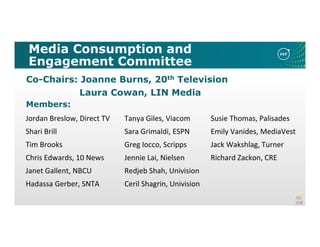
Media Consumption and
Engagement Committee
Members:
Jordan Breslow, Direct TV
Shari Brill
Tim Brooks
Chris Edwards, 10 News
Janet Gallent, NBCU
Hadassa Gerber, SNTA
Co-Chairs: Joanne Burns, 20th Television
Laura Cowan, LIN Media
Tanya Giles, Viacom
Sara Grimaldi, ESPN
Greg Iocco, Scripps
Jennie Lai, Nielsen
Redjeb Shah, Univision
Ceril Shagrin, Univision
Susie Thomas, Palisades
Emily Vanides, MediaVest
Jack Wakshlag, Turner
Richard Zackon, CRE
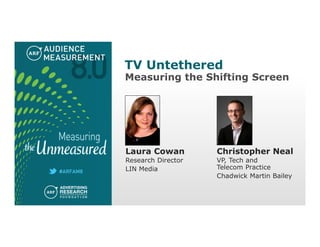
Measuring the Shifting Screen
TV Untethered
Laura Cowan
Research Director
LIN Media
Christopher Neal
VP, Tech and
Telecom Practice
Chadwick Martin Bailey
Photo
*1-pt black border
shadow
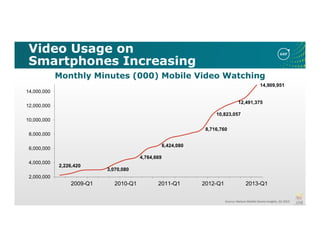
Video Usage on
Smartphones Increasing
Source: Nielsen Mobile Device Insights, Q1 2013
Monthly Minutes (000) Mobile Video Watching
2,226,420
3,070,080
4,764,669
6,424,080
8,716,760
10,823,057
12,491,375
14,909,951
2,000,000
4,000,000
6,000,000
8,000,000
10,000,000
12,000,000
14,000,000
2009-Q1 2010-Q1 2011-Q1 2012-Q1 2013-Q1
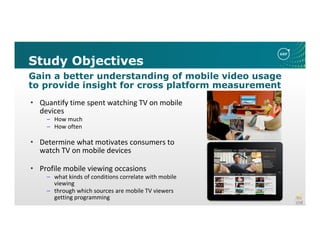
Study Objectives
Gain a better understanding of mobile video usage
to provide insight for cross platform measurement
• Quantify time spent watching TV on mobile
devices
– How much
– How often
• Determine what motivates consumers to
watch TV on mobile devices
• Profile mobile viewing occasions
– what kinds of conditions correlate with mobile
viewing
– through which sources are mobile TV viewers
getting programming
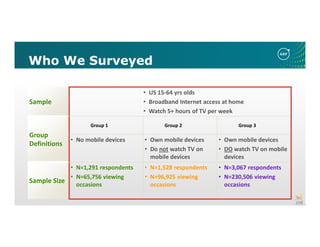
Who We Surveyed
Sample
• US 15-64 yrs olds
• Broadband Internet access at home
• Watch 5+ hours of TV per week
Group
Definitions
Group 1 Group 2 Group 3
• No mobile devices • Own mobile devices
• Do not watch TV on
mobile devices
• Own mobile devices
• DO watch TV on mobile
devices
Sample Size
• N=1,291 respondents
• N=65,756 viewing
occasions
• N=1,528 respondents
• N=96,925 viewing
occasions
• N=3,067 respondents
• N=230,506 viewing
occasions
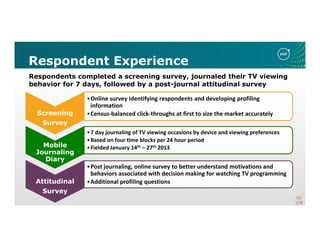
Respondent Experience
Screening
Survey
•Online survey identifying respondents and developing profiling
information
•Census-balanced click-throughs at first to size the market accurately
Mobile
Journaling
Diary
•7 day journaling of TV viewing occasions by device and viewing preferences
•Based on four time blocks per 24 hour period
•Fielded January 14th – 27th 2013
Attitudinal
Survey
•Post journaling, online survey to better understand motivations and
behaviors associated with decision making for watching TV programming
•Additional profiling questions
Respondents completed a screening survey, journaled their TV viewing
behavior for 7 days, followed by a post-journal attitudinal survey
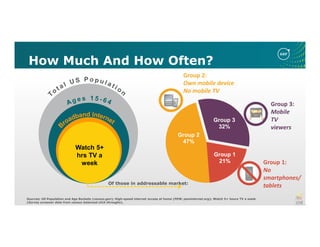
How Much And How Often?
Group 1
21%
Group 2
47%
Group 3
32%
Group 1:
No
smartphones/
tablets
Group 2:
Own mobile device
No mobile TV
Group 3:
Mobile
TV
viewers
Watch 5+
hrs TV a
week
Of those in addressable market:
Sources: US Population and Age Buckets (census.gov); High-speed internet access at home (PEW: pewinternet.org); Watch 5+ hours TV a week
(Survey screener data from census balanced click throughs).
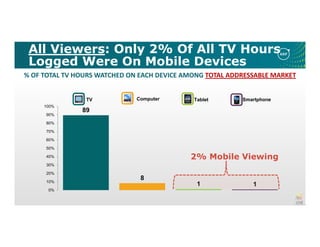
All Viewers: Only 2% Of All TV Hours
Logged Were On Mobile Devices
% OF TOTAL TV HOURS WATCHED ON EACH DEVICE AMONG TOTAL ADDRESSABLE MARKET
89
8
1 1
0%
10%
20%
30%
40%
50%
60%
70%
80%
90%
100%
TV Computer Tablet Smartphone
2% Mobile Viewing
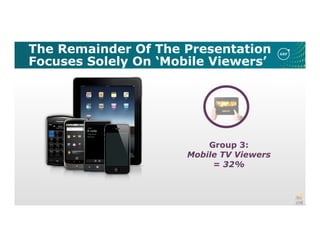
The Remainder Of The Presentation
Focuses Solely On ‘Mobile Viewers’
Group 3:
Mobile TV Viewers
= 32%
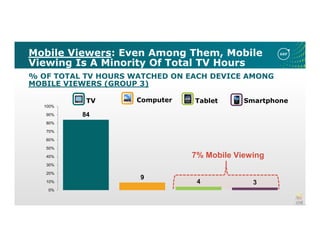
Mobile Viewers: Even Among Them, Mobile
Viewing Is A Minority Of Total TV Hours
% OF TOTAL TV HOURS WATCHED ON EACH DEVICE AMONG
MOBILE VIEWERS (GROUP 3)
84
9
4 3
0%
10%
20%
30%
40%
50%
60%
70%
80%
90%
100%
TV Computer Tablet Smartphone
7% Mobile Viewing
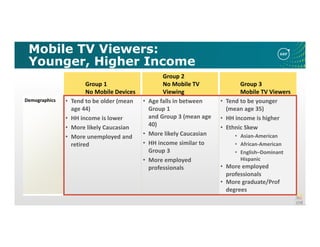
Mobile TV Viewers:
Younger, Higher Income
Group 1
No Mobile Devices
Group 2
No Mobile TV
Viewing
Group 3
Mobile TV Viewers
Demographics • Tend to be older (mean
age 44)
• HH income is lower
• More likely Caucasian
• More unemployed and
retired
• Age falls in between
Group 1
and Group 3 (mean age
40)
• More likely Caucasian
• HH income similar to
Group 3
• More employed
professionals
• Tend to be younger
(mean age 35)
• HH income is higher
• Ethnic Skew
• Asian-American
• African-American
• English–Dominant
Hispanic
• More employed
professionals
• More graduate/Prof
degrees
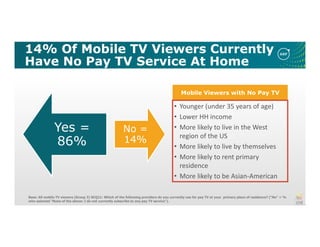
14% Of Mobile TV Viewers Currently
Have No Pay TV Service At Home
Yes =
86%
No =
14%
Mobile Viewers with No Pay TV
• Younger (under 35 years of age)
• Lower HH income
• More likely to live in the West
region of the US
• More likely to live by themselves
• More likely to rent primary
residence
• More likely to be Asian-American
Base: All mobile TV viewers (Group 3) SCQ11: Which of the following providers do you currently use for pay TV at your primary place of residence? (“No” = %
who selected “None of the above: I do not currently subscribe to any pay TV service”).
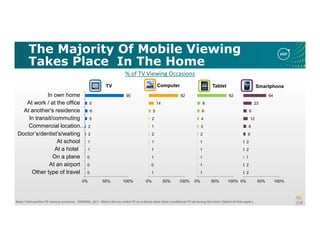
The Majority Of Mobile Viewing
Takes Place In The Home
Base: Total positive TV viewing occasions. JOURNAL_Q17: Where did you watch TV on a device other than a traditional TV set during this time? (Select all that apply.)
% of TV Viewing Occasions
2
2
1
2
2
6
8
12
9
23
64
0% 50% 100%
Smartphone
1
1
1
1
1
2
3
4
6
8
82
0% 50% 100%
Tablet
1
0
1
1
1
2
1
2
5
14
82
0% 50% 100%
Computer
0
0
0
1
1
2
2
5
6
5
90
0% 50% 100%
Other type of travel
At an airport
On a plane
At a hotel
At school
Doctor’s/dentist’s/waiting
Commercial location
In transit/commuting
At another's residence
At work / at the office
In own home
TV
Most Mobile Viewing Is
Through Online Services
Base: Total positive viewing occasions. JOURNAL Q6/Q8/Q10/Q12/Q14: What was the source of TV shows or movies that you watched on a [DEVICE] during this time? All data is within Group 3.
% of TV Viewing Occasions
8
4
3
2
16
10
26
64
0% 50% 100%
Smartphone
17
3
17
6
24
49
0% 50% 100%
Computer
3
3
4
4
10
11
26
54
0% 50% 100%
Tablet
3
12
4
27
80
0% 50% 100%
DVD of TV series
TV program: online source
Unofficial app or website
On demand (TV/website/app)
DVR
iTunes or similar service
TV aggregator site - free
TV service provider site/app
Broadcast/cable net site, free
Online subscription service
Live
TV
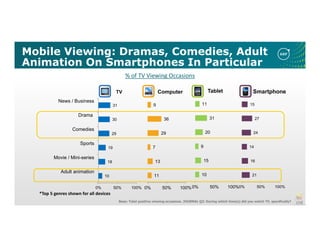
Mobile Viewing: Dramas, Comedies, Adult
Animation On Smartphones In Particular
Base: Total positive viewing occasions. JOURNAL Q3: During which time(s) did you watch TV, specifically?
% of TV Viewing Occasions
10
18
19
29
30
31
0% 50% 100%
Adult animation
Movie / Mini-series
Sports
Comedies
Drama
News / Business
TV
21
16
14
24
27
15
0% 50% 100%
Smartphone
11
13
7
29
36
9
0% 50% 100%
Computer
10
15
9
20
31
11
0% 50% 100%
Tablet
*Top 5 genres shown for all devices
12
5
2
14
3
8
10
28
14
5
0% 50% 100%
Smartphone
15
6
4
20
5
7
8
22
9
3
0% 50% 100%
Tablet
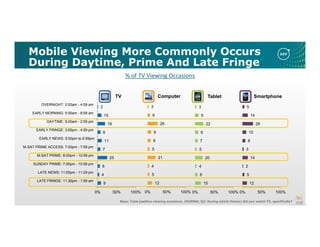
Mobile Viewing More Commonly Occurs
During Daytime, Prime And Late Fringe
Base: Total positive viewing occasions. JOURNAL Q3: During which time(s) did you watch TV, specifically?
9
4
6
25
7
11
8
19
10
2
0% 50% 100%
LATE FRINGE: 11:30pm - 1:59 am
LATE NEWS: 11:00pm - 11:29 pm
SUNDAY PRIME: 7:00pm - 10:59 pm
M-SAT PRIME: 8:00pm - 10:59 pm
M-SAT PRIME ACCESS: 7:00pm - 7:59 pm
EARLY NEWS: 5:00pm to 6:59pm
EARLY FRINGE: 3:00pm - 4:59 pm
DAYTIME: 9:00am - 2:59 pm
EARLY MORNING: 5:00am - 8:59 am
OVERNIGHT: 2:00am - 4:59 am
TV
12
5
4
21
5
8
9
26
6
3
0% 50% 100%
Computer
% of TV Viewing Occasions
Convenience And Multi-Episode
Availability Drive Mobile Viewing
Base: Those who watched on device other than TV set (Group 3 Mobile Viewers). QADQ10: Why did you choose to watch television programming on a [DEVICE] instead of on a TV set?
.
Ad avoidance is not a primary motivator
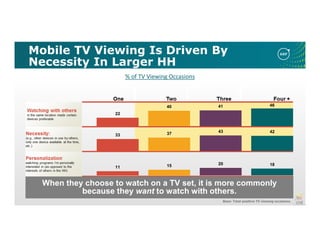
Mobile TV Viewing Is Driven By
Necessity In Larger HH
% of TV Viewing Occasions
When they choose to watch on a TV set, it is more commonly
because they want to watch with others.
When they choose to watch on a TV set, it is more commonly
because they want to watch with others.
11 15 20 18
33 37 43 42
22
40 41 46
Base: Total positive TV viewing occasions.
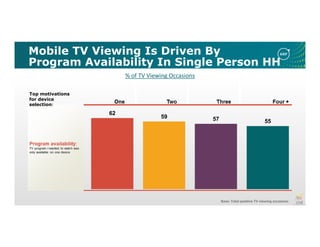
Mobile TV Viewing Is Driven By
Program Availability In Single Person HH
Base: Total positive TV viewing occasions.
62
59 57 55
Top motivations
for device
selection:
% of TV Viewing Occasions
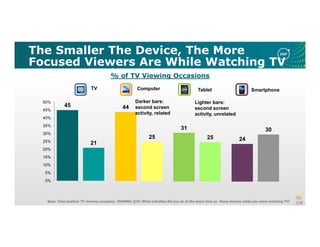
The Smaller The Device, The More
Focused Viewers Are While Watching TV
Base: Total positive TV viewing occasions. JOURNAL Q19: What activities did you do at the same time on these devices while you were watching TV?
% of TV Viewing Occasions
45
21
0%
5%
10%
15%
20%
25%
30%
35%
40%
45%
50%
TV
44
25
Computer
Darker bars:
second screen
activity, related
31
25
Tablet
Lighter bars:
second screen
activity, unrelated
24
30
Smartphone
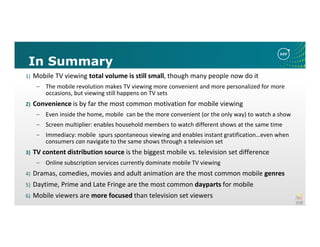
In Summary
1) Mobile TV viewing total volume is still small, though many people now do it
– The mobile revolution makes TV viewing more convenient and more personalized for more
occasions, but viewing still happens on TV sets
2) Convenience is by far the most common motivation for mobile viewing
– Even inside the home, mobile can be the more convenient (or the only way) to watch a show
– Screen multiplier: enables household members to watch different shows at the same time
– Immediacy: mobile spurs spontaneous viewing and enables instant gratification…even when
consumers can navigate to the same shows through a television set
3) TV content distribution source is the biggest mobile vs. television set difference
– Online subscription services currently dominate mobile TV viewing
4) Dramas, comedies, movies and adult animation are the most common mobile genres
5) Daytime, Prime and Late Fringe are the most common dayparts for mobile
6) Mobile viewers are more focused than television set viewers
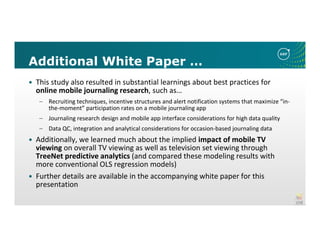
Additional White Paper …
This study also resulted in substantial learnings about best practices for
online mobile journaling research, such as…
– Recruiting techniques, incentive structures and alert notification systems that maximize “in-
the-moment” participation rates on a mobile journaling app
– Journaling research design and mobile app interface considerations for high data quality
– Data QC, integration and analytical considerations for occasion-based journaling data
Additionally, we learned much about the implied impact of mobile TV
viewing on overall TV viewing as well as television set viewing through
TreeNet predictive analytics (and compared these modeling results with
more conventional OLS regression models)
Further details are available in the accompanying white paper for this
presentation
TV Untethered: Measuring the Shifting Screen

TV Untethered: Measuring the Shifting Screen

  • 2.
    The Council forResearch Excellence Consists of 35+ senior-level research professionals Represents advertisers, agencies, networks, cable companies, and station groups Seeks to advance the knowledge and practice of methodological research
  • 3.
    Media Consumption and EngagementCommittee Members: Jordan Breslow, Direct TV Shari Brill Tim Brooks Chris Edwards, 10 News Janet Gallent, NBCU Hadassa Gerber, SNTA Co-Chairs: Joanne Burns, 20th Television Laura Cowan, LIN Media Tanya Giles, Viacom Sara Grimaldi, ESPN Greg Iocco, Scripps Jennie Lai, Nielsen Redjeb Shah, Univision Ceril Shagrin, Univision Susie Thomas, Palisades Emily Vanides, MediaVest Jack Wakshlag, Turner Richard Zackon, CRE
  • 4.
    Measuring the ShiftingScreen TV Untethered Laura Cowan Research Director LIN Media Christopher Neal VP, Tech and Telecom Practice Chadwick Martin Bailey Photo *1-pt black border shadow
  • 5.
    Video Usage on SmartphonesIncreasing Source: Nielsen Mobile Device Insights, Q1 2013 Monthly Minutes (000) Mobile Video Watching 2,226,420 3,070,080 4,764,669 6,424,080 8,716,760 10,823,057 12,491,375 14,909,951 2,000,000 4,000,000 6,000,000 8,000,000 10,000,000 12,000,000 14,000,000 2009-Q1 2010-Q1 2011-Q1 2012-Q1 2013-Q1
  • 6.
    Study Objectives Gain abetter understanding of mobile video usage to provide insight for cross platform measurement • Quantify time spent watching TV on mobile devices – How much – How often • Determine what motivates consumers to watch TV on mobile devices • Profile mobile viewing occasions – what kinds of conditions correlate with mobile viewing – through which sources are mobile TV viewers getting programming
  • 7.
    Who We Surveyed Sample •US 15-64 yrs olds • Broadband Internet access at home • Watch 5+ hours of TV per week Group Definitions Group 1 Group 2 Group 3 • No mobile devices • Own mobile devices • Do not watch TV on mobile devices • Own mobile devices • DO watch TV on mobile devices Sample Size • N=1,291 respondents • N=65,756 viewing occasions • N=1,528 respondents • N=96,925 viewing occasions • N=3,067 respondents • N=230,506 viewing occasions
  • 8.
    Respondent Experience Screening Survey •Online surveyidentifying respondents and developing profiling information •Census-balanced click-throughs at first to size the market accurately Mobile Journaling Diary •7 day journaling of TV viewing occasions by device and viewing preferences •Based on four time blocks per 24 hour period •Fielded January 14th – 27th 2013 Attitudinal Survey •Post journaling, online survey to better understand motivations and behaviors associated with decision making for watching TV programming •Additional profiling questions Respondents completed a screening survey, journaled their TV viewing behavior for 7 days, followed by a post-journal attitudinal survey
  • 9.
    How Much AndHow Often? Group 1 21% Group 2 47% Group 3 32% Group 1: No smartphones/ tablets Group 2: Own mobile device No mobile TV Group 3: Mobile TV viewers Watch 5+ hrs TV a week Of those in addressable market: Sources: US Population and Age Buckets (census.gov); High-speed internet access at home (PEW: pewinternet.org); Watch 5+ hours TV a week (Survey screener data from census balanced click throughs).
  • 10.
    All Viewers: Only2% Of All TV Hours Logged Were On Mobile Devices % OF TOTAL TV HOURS WATCHED ON EACH DEVICE AMONG TOTAL ADDRESSABLE MARKET 89 8 1 1 0% 10% 20% 30% 40% 50% 60% 70% 80% 90% 100% TV Computer Tablet Smartphone 2% Mobile Viewing
  • 11.
    The Remainder OfThe Presentation Focuses Solely On ‘Mobile Viewers’ Group 3: Mobile TV Viewers = 32%
  • 12.
    Mobile Viewers: EvenAmong Them, Mobile Viewing Is A Minority Of Total TV Hours % OF TOTAL TV HOURS WATCHED ON EACH DEVICE AMONG MOBILE VIEWERS (GROUP 3) 84 9 4 3 0% 10% 20% 30% 40% 50% 60% 70% 80% 90% 100% TV Computer Tablet Smartphone 7% Mobile Viewing
  • 13.
    Mobile TV Viewers: Younger,Higher Income Group 1 No Mobile Devices Group 2 No Mobile TV Viewing Group 3 Mobile TV Viewers Demographics • Tend to be older (mean age 44) • HH income is lower • More likely Caucasian • More unemployed and retired • Age falls in between Group 1 and Group 3 (mean age 40) • More likely Caucasian • HH income similar to Group 3 • More employed professionals • Tend to be younger (mean age 35) • HH income is higher • Ethnic Skew • Asian-American • African-American • English–Dominant Hispanic • More employed professionals • More graduate/Prof degrees
  • 14.
    14% Of MobileTV Viewers Currently Have No Pay TV Service At Home Yes = 86% No = 14% Mobile Viewers with No Pay TV • Younger (under 35 years of age) • Lower HH income • More likely to live in the West region of the US • More likely to live by themselves • More likely to rent primary residence • More likely to be Asian-American Base: All mobile TV viewers (Group 3) SCQ11: Which of the following providers do you currently use for pay TV at your primary place of residence? (“No” = % who selected “None of the above: I do not currently subscribe to any pay TV service”).
  • 15.
    The Majority OfMobile Viewing Takes Place In The Home Base: Total positive TV viewing occasions. JOURNAL_Q17: Where did you watch TV on a device other than a traditional TV set during this time? (Select all that apply.) % of TV Viewing Occasions 2 2 1 2 2 6 8 12 9 23 64 0% 50% 100% Smartphone 1 1 1 1 1 2 3 4 6 8 82 0% 50% 100% Tablet 1 0 1 1 1 2 1 2 5 14 82 0% 50% 100% Computer 0 0 0 1 1 2 2 5 6 5 90 0% 50% 100% Other type of travel At an airport On a plane At a hotel At school Doctor’s/dentist’s/waiting Commercial location In transit/commuting At another's residence At work / at the office In own home TV
  • 16.
    Most Mobile ViewingIs Through Online Services Base: Total positive viewing occasions. JOURNAL Q6/Q8/Q10/Q12/Q14: What was the source of TV shows or movies that you watched on a [DEVICE] during this time? All data is within Group 3. % of TV Viewing Occasions 8 4 3 2 16 10 26 64 0% 50% 100% Smartphone 17 3 17 6 24 49 0% 50% 100% Computer 3 3 4 4 10 11 26 54 0% 50% 100% Tablet 3 12 4 27 80 0% 50% 100% DVD of TV series TV program: online source Unofficial app or website On demand (TV/website/app) DVR iTunes or similar service TV aggregator site - free TV service provider site/app Broadcast/cable net site, free Online subscription service Live TV
  • 17.
    Mobile Viewing: Dramas,Comedies, Adult Animation On Smartphones In Particular Base: Total positive viewing occasions. JOURNAL Q3: During which time(s) did you watch TV, specifically? % of TV Viewing Occasions 10 18 19 29 30 31 0% 50% 100% Adult animation Movie / Mini-series Sports Comedies Drama News / Business TV 21 16 14 24 27 15 0% 50% 100% Smartphone 11 13 7 29 36 9 0% 50% 100% Computer 10 15 9 20 31 11 0% 50% 100% Tablet *Top 5 genres shown for all devices
  • 18.
    12 5 2 14 3 8 10 28 14 5 0% 50% 100% Smartphone 15 6 4 20 5 7 8 22 9 3 0%50% 100% Tablet Mobile Viewing More Commonly Occurs During Daytime, Prime And Late Fringe Base: Total positive viewing occasions. JOURNAL Q3: During which time(s) did you watch TV, specifically? 9 4 6 25 7 11 8 19 10 2 0% 50% 100% LATE FRINGE: 11:30pm - 1:59 am LATE NEWS: 11:00pm - 11:29 pm SUNDAY PRIME: 7:00pm - 10:59 pm M-SAT PRIME: 8:00pm - 10:59 pm M-SAT PRIME ACCESS: 7:00pm - 7:59 pm EARLY NEWS: 5:00pm to 6:59pm EARLY FRINGE: 3:00pm - 4:59 pm DAYTIME: 9:00am - 2:59 pm EARLY MORNING: 5:00am - 8:59 am OVERNIGHT: 2:00am - 4:59 am TV 12 5 4 21 5 8 9 26 6 3 0% 50% 100% Computer % of TV Viewing Occasions
  • 19.
    Convenience And Multi-Episode AvailabilityDrive Mobile Viewing Base: Those who watched on device other than TV set (Group 3 Mobile Viewers). QADQ10: Why did you choose to watch television programming on a [DEVICE] instead of on a TV set? . Ad avoidance is not a primary motivator
  • 20.
    Mobile TV ViewingIs Driven By Necessity In Larger HH % of TV Viewing Occasions When they choose to watch on a TV set, it is more commonly because they want to watch with others. When they choose to watch on a TV set, it is more commonly because they want to watch with others. 11 15 20 18 33 37 43 42 22 40 41 46 Base: Total positive TV viewing occasions.
  • 21.
    Mobile TV ViewingIs Driven By Program Availability In Single Person HH Base: Total positive TV viewing occasions. 62 59 57 55 Top motivations for device selection: % of TV Viewing Occasions
  • 22.
    The Smaller TheDevice, The More Focused Viewers Are While Watching TV Base: Total positive TV viewing occasions. JOURNAL Q19: What activities did you do at the same time on these devices while you were watching TV? % of TV Viewing Occasions 45 21 0% 5% 10% 15% 20% 25% 30% 35% 40% 45% 50% TV 44 25 Computer Darker bars: second screen activity, related 31 25 Tablet Lighter bars: second screen activity, unrelated 24 30 Smartphone
  • 23.
    In Summary 1) MobileTV viewing total volume is still small, though many people now do it – The mobile revolution makes TV viewing more convenient and more personalized for more occasions, but viewing still happens on TV sets 2) Convenience is by far the most common motivation for mobile viewing – Even inside the home, mobile can be the more convenient (or the only way) to watch a show – Screen multiplier: enables household members to watch different shows at the same time – Immediacy: mobile spurs spontaneous viewing and enables instant gratification…even when consumers can navigate to the same shows through a television set 3) TV content distribution source is the biggest mobile vs. television set difference – Online subscription services currently dominate mobile TV viewing 4) Dramas, comedies, movies and adult animation are the most common mobile genres 5) Daytime, Prime and Late Fringe are the most common dayparts for mobile 6) Mobile viewers are more focused than television set viewers
  • 24.
    Additional White Paper… This study also resulted in substantial learnings about best practices for online mobile journaling research, such as… – Recruiting techniques, incentive structures and alert notification systems that maximize “in- the-moment” participation rates on a mobile journaling app – Journaling research design and mobile app interface considerations for high data quality – Data QC, integration and analytical considerations for occasion-based journaling data Additionally, we learned much about the implied impact of mobile TV viewing on overall TV viewing as well as television set viewing through TreeNet predictive analytics (and compared these modeling results with more conventional OLS regression models) Further details are available in the accompanying white paper for this presentation