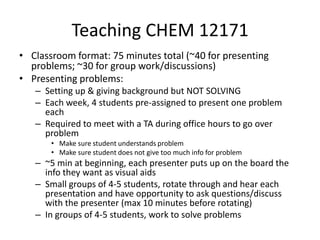
Teaching CHEM 12171Classroom format: 75 minutes total (~40 for presenting problems; ~30 for group work/discussions)Presenting problems:Setting up & giving background but NOT SOLVINGEach week, 4 students pre-assigned to present one problem each Required to meet with a TA during office hours to go over problemMake sure student understands problemMake sure student does not give too much info for problem~5 min at beginning, each presenter puts up on the board the info they want as visual aidsSmall groups of 4-5 students, rotate through and hear each presentation and have opportunity to ask questions/discuss with the presenter (max 10 minutes before rotating)In groups of 4-5 students, work to solve problems
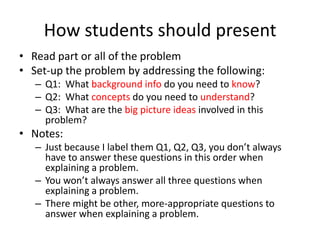
How students should presentRead part or all of the problemSet-up the problem by addressing the following:Q1:  What background info do you need to know?Q2:  What concepts do you need to understand?Q3:  What are the big picture ideas involved in this problem?Notes:Just because I label them Q1, Q2, Q3, you don’t always have to answer these questions in this order when explaining a problem.You won’t always answer all three questions when explaining a problem.There might be other, more-appropriate questions to answer when explaining a problem.
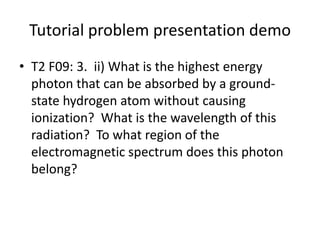
Tutorial problem presentation demoT2 F09: 3.  ii) What is the highest energy photon that can be absorbed by a ground-state hydrogen atom without causing ionization?  What is the wavelength of this radiation?  To what region of the electromagnetic spectrum does this photon belong?

Tutorial Problem Demo

  • 1.
    Teaching CHEM 12171Classroomformat: 75 minutes total (~40 for presenting problems; ~30 for group work/discussions)Presenting problems:Setting up & giving background but NOT SOLVINGEach week, 4 students pre-assigned to present one problem each Required to meet with a TA during office hours to go over problemMake sure student understands problemMake sure student does not give too much info for problem~5 min at beginning, each presenter puts up on the board the info they want as visual aidsSmall groups of 4-5 students, rotate through and hear each presentation and have opportunity to ask questions/discuss with the presenter (max 10 minutes before rotating)In groups of 4-5 students, work to solve problems
  • 2.
    How students shouldpresentRead part or all of the problemSet-up the problem by addressing the following:Q1: What background info do you need to know?Q2: What concepts do you need to understand?Q3: What are the big picture ideas involved in this problem?Notes:Just because I label them Q1, Q2, Q3, you don’t always have to answer these questions in this order when explaining a problem.You won’t always answer all three questions when explaining a problem.There might be other, more-appropriate questions to answer when explaining a problem.
  • 3.
    Tutorial problem presentationdemoT2 F09: 3. ii) What is the highest energy photon that can be absorbed by a ground-state hydrogen atom without causing ionization? What is the wavelength of this radiation? To what region of the electromagnetic spectrum does this photon belong?