
Services to Support FAIR data
Linking Open Science in Austria
24th April 2019
Dr. Natalie Harrower
@natalieharrower
Core Trust Seal:
certification…with added benefits!
Director, Digital Repository of Ireland
• CTS certified (2018) trustworthy digital repository
• National repository for archiving, curation, preservation
• Humanities & Social Sciences research data
• Cultural heritage digital collections
Member of the EC FAIR Data expert group
• ‘Turning FAIR into Reality’ report, published @ EOSC launch Nov 2018 Vienna
Partner in the RDA Europe project (RDA4/H2020)
Partner in the Europeana Common Culture CEF
Brief Introduction
What is it?
Why is it important (to the data community at large)?
How does it enable FAIR data?
What are the wider benefits of CTS certification?
Limits of CTS for FAIR data
Core Trust Seal (CTS) certification
?
?
?
• A core certification scheme for Trustworthy Data Repositories
• 16 core TDR requirements that are mandatory, stand-alone, and
equally weighted
• Self-certification, then assessed by Assembly of reviewers
• First step in a global framework for repository certification which
includes the extended level certification (Nestor-Seal DIN 31644)
and the formal level certification (ISO 16363)
• Legal entity under Dutch law; not-for-profit
What is the Core Trust Seal?
• Provides an entry level step to certifying trustworthy digital repositories
against agreed common criteria
• Rapidly emerging community consensus that CTS is the first step to choose
• Fits well into emerging ecosystem of Open Science, RDM, and FAIR data
• Depositors can trust that their data is safe, well structured and accessible for
the long term
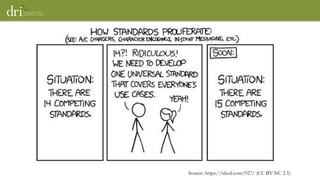
• And also, it avoids this…
Why is the Core Trust Seal important?
Source: https://xkcd.com/927/ (CC BY-NC 2.5)
Importance: built by the research & data communities
• RDA-WDS Group on Repository
Audit and Certification to create
harmonised catalogue
• Merger of two existing schema:
DSA (Humanities & Social Sciences)
and WDS (Earth & Space Sciences)
• Domain agnostic: interdisciplinary
Core Trust Seal emerged
from two previous
repository certifications
• ‘Building the social and technical bridges to
enable the open sharing of data’
• Grassroots activity with 100 Groups working
on global interoperability challenges
• 8,000+ global members from 137 countries
• Get involved! Individual Membership is free
• Next plenary: Helsinki, Oct 2019
• Grants for early-careers, experts, ambassadors:
• https://grants.rd-alliance.org/
rd-alliance.org
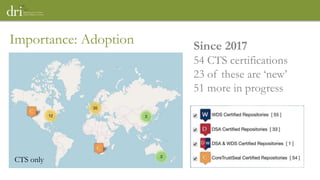
Importance: Adoption Since 2017
54 CTS certifications
23 of these are ‘new’
51 more in progress
CTS only
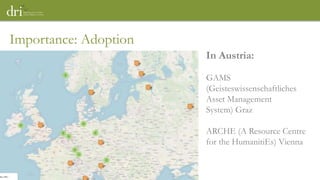
Importance: Adoption
In Austria:
GAMS
(Geisteswissenschaftliches
Asset Management
System) Graz
ARCHE (A Resource Centre
for the HumanitiEs) Vienna
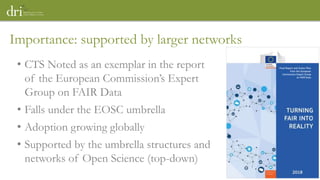
• CTS Noted as an exemplar in the report
of the European Commission’s Expert
Group on FAIR Data
• Falls under the EOSC umbrella
• Adoption growing globally
• Supported by the umbrella structures and
networks of Open Science (top-down)
Importance: supported by larger networks
• There are several concepts essential to enabling FAIR data that are implied
by, if not explicitly noted in the FAIR principles: one is the need for long-
term data stewardship and preservation.
• To be realised, FAIR data relies on an ecosystem of components: policies,
DMPs, PIDs, standards, repositories. These components must support
FAIR
• CTS fundamentally about LTP (long term preservation), but goes further
• Specific criteria for repositories under CTS lead clearly in the direction
called for by the FAIR principles
How does CTS enable FAIR data?
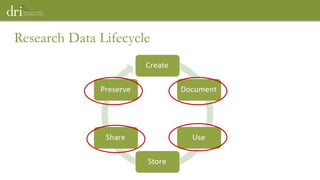
Research Data Lifecycle
R1. Mission of the repository must be to preserve and provide
access to data in its domain. A
R2. The repository maintains all applicable licenses covering data
access and use and monitors compliance. A, R
R3. The repository has a continuity plan to ensure ongoing access to
and preservation of its holdings. A
R6. The repository adopts mechanism(s) to secure ongoing expert
guidance and feedback (either inhouse, or external, including
scientific guidance, if relevant). I?
CTS criteria mapping to FAIR (a first pass)
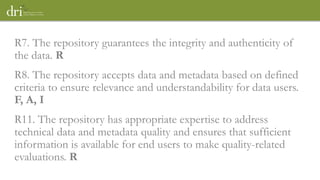
R7. The repository guarantees the integrity and authenticity of
the data. R
R8. The repository accepts data and metadata based on defined
criteria to ensure relevance and understandability for data users.
F, A, I
R11. The repository has appropriate expertise to address
technical data and metadata quality and ensures that sufficient
information is available for end users to make quality-related
evaluations. R
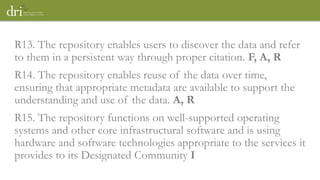
R13. The repository enables users to discover the data and refer
to them in a persistent way through proper citation. F, A, R
R14. The repository enables reuse of the data over time,
ensuring that appropriate metadata are available to support the
understanding and use of the data. A, R
R15. The repository functions on well-supported operating
systems and other core infrastructural software and is using
hardware and software technologies appropriate to the services it
provides to its Designated Community I
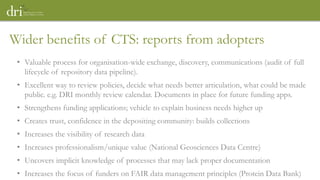
• Valuable process for organisation-wide exchange, discovery, communications (audit of full
lifecycle of repository data pipeline).
• Excellent way to review policies, decide what needs better articulation, what could be made
public. e.g. DRI monthly review calendar. Documents in place for future funding apps.
• Strengthens funding applications; vehicle to explain business needs higher up
• Creates trust, confidence in the depositing community: builds collections
• Increases the visibility of research data
• Increases professionalism/unique value (National Geosciences Data Centre)
• Uncovers implicit knowledge of processes that may lack proper documentation
• Increases the focus of funders on FAIR data management principles (Protein Data Bank)
Wider benefits of CTS: reports from adopters
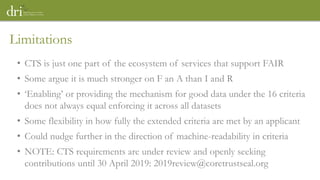
• CTS is just one part of the ecosystem of services that support FAIR
• Some argue it is much stronger on F an A than I and R
• ‘Enabling’ or providing the mechanism for good data under the 16 criteria
does not always equal enforcing it across all datasets
• Some flexibility in how fully the extended criteria are met by an applicant
• Could nudge further in the direction of machine-readability in criteria
• NOTE: CTS requirements are under review and openly seeking
contributions until 30 April 2019: 2019review@coretrustseal.org
Limitations
17 – 20 February 2020
Dublin, Ireland
Organised by
www.dcc.ac.uk www.dri.ie
15th International Digital Curation Conference
Collective Curation:
the many hands that make data work
IDCC 2020

How the Core Trust Seal (CTS) Enables FAIR Data

  • 1.
    Services to SupportFAIR data Linking Open Science in Austria 24th April 2019 Dr. Natalie Harrower @natalieharrower
  • 2.
  • 3.
    Director, Digital Repositoryof Ireland • CTS certified (2018) trustworthy digital repository • National repository for archiving, curation, preservation • Humanities & Social Sciences research data • Cultural heritage digital collections Member of the EC FAIR Data expert group • ‘Turning FAIR into Reality’ report, published @ EOSC launch Nov 2018 Vienna Partner in the RDA Europe project (RDA4/H2020) Partner in the Europeana Common Culture CEF Brief Introduction
  • 4.
    What is it? Whyis it important (to the data community at large)? How does it enable FAIR data? What are the wider benefits of CTS certification? Limits of CTS for FAIR data Core Trust Seal (CTS) certification ? ? ?
  • 5.
    • A corecertification scheme for Trustworthy Data Repositories • 16 core TDR requirements that are mandatory, stand-alone, and equally weighted • Self-certification, then assessed by Assembly of reviewers • First step in a global framework for repository certification which includes the extended level certification (Nestor-Seal DIN 31644) and the formal level certification (ISO 16363) • Legal entity under Dutch law; not-for-profit What is the Core Trust Seal?
  • 6.
    • Provides anentry level step to certifying trustworthy digital repositories against agreed common criteria • Rapidly emerging community consensus that CTS is the first step to choose • Fits well into emerging ecosystem of Open Science, RDM, and FAIR data • Depositors can trust that their data is safe, well structured and accessible for the long term • And also, it avoids this… Why is the Core Trust Seal important?
  • 7.
  • 8.
    Importance: built bythe research & data communities • RDA-WDS Group on Repository Audit and Certification to create harmonised catalogue • Merger of two existing schema: DSA (Humanities & Social Sciences) and WDS (Earth & Space Sciences) • Domain agnostic: interdisciplinary Core Trust Seal emerged from two previous repository certifications
  • 9.
    • ‘Building thesocial and technical bridges to enable the open sharing of data’ • Grassroots activity with 100 Groups working on global interoperability challenges • 8,000+ global members from 137 countries • Get involved! Individual Membership is free • Next plenary: Helsinki, Oct 2019 • Grants for early-careers, experts, ambassadors: • https://grants.rd-alliance.org/ rd-alliance.org
  • 10.
    Importance: Adoption Since2017 54 CTS certifications 23 of these are ‘new’ 51 more in progress CTS only
  • 11.
    Importance: Adoption In Austria: GAMS (Geisteswissenschaftliches AssetManagement System) Graz ARCHE (A Resource Centre for the HumanitiEs) Vienna
  • 12.
    • CTS Notedas an exemplar in the report of the European Commission’s Expert Group on FAIR Data • Falls under the EOSC umbrella • Adoption growing globally • Supported by the umbrella structures and networks of Open Science (top-down) Importance: supported by larger networks
  • 13.
    • There areseveral concepts essential to enabling FAIR data that are implied by, if not explicitly noted in the FAIR principles: one is the need for long- term data stewardship and preservation. • To be realised, FAIR data relies on an ecosystem of components: policies, DMPs, PIDs, standards, repositories. These components must support FAIR • CTS fundamentally about LTP (long term preservation), but goes further • Specific criteria for repositories under CTS lead clearly in the direction called for by the FAIR principles How does CTS enable FAIR data?
  • 14.
  • 15.
    R1. Mission ofthe repository must be to preserve and provide access to data in its domain. A R2. The repository maintains all applicable licenses covering data access and use and monitors compliance. A, R R3. The repository has a continuity plan to ensure ongoing access to and preservation of its holdings. A R6. The repository adopts mechanism(s) to secure ongoing expert guidance and feedback (either inhouse, or external, including scientific guidance, if relevant). I? CTS criteria mapping to FAIR (a first pass)
  • 16.
    R7. The repositoryguarantees the integrity and authenticity of the data. R R8. The repository accepts data and metadata based on defined criteria to ensure relevance and understandability for data users. F, A, I R11. The repository has appropriate expertise to address technical data and metadata quality and ensures that sufficient information is available for end users to make quality-related evaluations. R
  • 17.
    R13. The repositoryenables users to discover the data and refer to them in a persistent way through proper citation. F, A, R R14. The repository enables reuse of the data over time, ensuring that appropriate metadata are available to support the understanding and use of the data. A, R R15. The repository functions on well-supported operating systems and other core infrastructural software and is using hardware and software technologies appropriate to the services it provides to its Designated Community I
  • 18.
    • Valuable processfor organisation-wide exchange, discovery, communications (audit of full lifecycle of repository data pipeline). • Excellent way to review policies, decide what needs better articulation, what could be made public. e.g. DRI monthly review calendar. Documents in place for future funding apps. • Strengthens funding applications; vehicle to explain business needs higher up • Creates trust, confidence in the depositing community: builds collections • Increases the visibility of research data • Increases professionalism/unique value (National Geosciences Data Centre) • Uncovers implicit knowledge of processes that may lack proper documentation • Increases the focus of funders on FAIR data management principles (Protein Data Bank) Wider benefits of CTS: reports from adopters
  • 19.
    • CTS isjust one part of the ecosystem of services that support FAIR • Some argue it is much stronger on F an A than I and R • ‘Enabling’ or providing the mechanism for good data under the 16 criteria does not always equal enforcing it across all datasets • Some flexibility in how fully the extended criteria are met by an applicant • Could nudge further in the direction of machine-readability in criteria • NOTE: CTS requirements are under review and openly seeking contributions until 30 April 2019: 2019review@coretrustseal.org Limitations
  • 20.
    17 – 20February 2020 Dublin, Ireland Organised by www.dcc.ac.uk www.dri.ie 15th International Digital Curation Conference Collective Curation: the many hands that make data work IDCC 2020

Editor's Notes

  • #6 Nestor: 4; ISO: 2