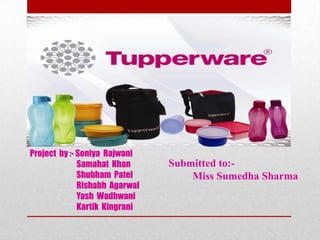
Project by :- Soniya Rajwani
Samahat Khan
Shubham Patel
Rishabh Agarwal
Yash Wadhwani
Kartik Kingrani

Submitted to:Miss Sumedha Sharma
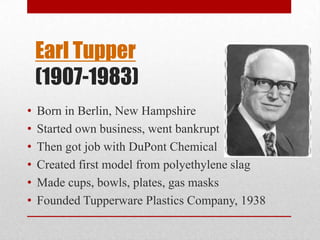
Earl Tupper
(1907-1983)
•
•
•
•
•
•

Born in Berlin, New Hampshire
Started own business, went bankrupt
Then got job with DuPont Chemical
Created first model from polyethylene slag
Made cups, bowls, plates, gas masks
Founded Tupperware Plastics Company, 1938
About
• Year 1938- Earl S. Tupper founded the Tupperware company.
• It started by using mold parts for navy signal lamps and gas masks. Its
products were durable and easy to handle.

• Year 1946- designed the renowned air tight, liquid proof lid.
• So they started the strategy to educate the customers about the quality
and properties of the product.
• Late 1940’s – Brownie Wise a Sales women who was selling
household products for Stanley Home Products was hired by
Tupperware company.
• She introduced the unique “Party Plan” method of marketing.
• Year 1948- First home party for Tupperware was conducted.
• Improvement made my Brownie WiseShe removed all Tupperware products from retail outlets and
marketed them through the party plan method .

Women were the prime sellers and consumers for the company.
Products of Tupperware
Tupperware always designed its products keeping in mind
the consumers taste, preferances and changing trends:
 Plastic carrying cases for women.
 Designed toys for children keeping in mind each stage of a child’s
development.
 Designed containers which could be exclusively used for
microwaves.
 Contemporary designs
 Their strategy was to save money, time, cabinet space.
Cookware
Kitchen Mates

Serving
Microwave
Storage
Water Storage
Bulk Storage

Cold Storage
Vegesafe
Kid
On The Go
Gift Set

Limited Release
BeautiControl
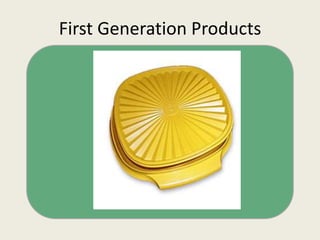
First Generation Products
Second Generation Products
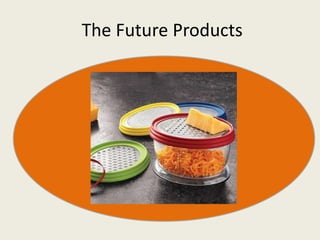
The Future Products
• Tupperware always looked for new products and newer markets. It
set up manufacturing units in 14 countries . When it entered a
country it appointed a distributor from another country waited for
her to grow and then promoted others from her team as
distributors.

• When its profit increased it expanded its business into various lines
such as beauty control, jewellery, apparels
Tupperware in India
• It entered in India in the year 1996. started its operations from New Delhi.
• Appointed 15 distributors in the 1st 12 months. Its initial focus was on utility
rather than style. These 15 were given training on a 14 week designed training
program.

• It launched 11 products in India , which were useful rather than decorative.
• Tupperware India added new products at regular intervals and dropped those
which didn’t sell well.
• Direct selling and party plan both was implemented.
• Tupperware standards were maintained by selecting units in Bangalore and
Baroda
• Within four years of operation in India, Tupperware India became the
fastest growing market for the company in developing countries.
• Company’s Turnover- in 1999 it was 400 million and by 2000 it was
Rs 570 million.

• By 2002 Tupperware India had 75 products and more than 40,000
sales people and a reach in 31 cities.
COMPENSATION
•
•
•
•

Performance based compensation was given
Dealers earned 25% commission on sales.
Manager made profit on sales, training
Distributer made profit on sales of the entire distribution team.
Marketing strategy
•
•
•
•
•

Its marketing strategy is the three P’s
1. Product
2. Party Plan
3. People
Product – Tupperware products carried a lifetime guarantee.
Any damage to the product could be replaced at any point of
time anywhere in the world.
• Party Plan- Tupperware used a direct selling method called
the “party plan”. In this the women dealer approaches a lady
and asks her to host a party at her place, the investment in the
party was borne by the hostess.
• The Tupperware women demonstrates the benefits and usages
of the products to the invitees to the party. And the hostess gets
a free gift of tupperware product.
• This method allows the Tupperware products to be demonstrated
physically and their utility explained and by this process they
justify the reason for the higher costs of the products.
• People- Tupperware believed that there business success was
through people therefore Brownie had said “built the people, and
they will build the business”. They had reward system for
employees. They organized three social events per month.
The Tupperware Model
• In case of Tupperware the network structure had three levels.
First the lowest level was the Dealer then was the Manager and
Finally at the top level was the Distributor.
• The network of Tupperware in any country had 90% women
employees , whereas in India it was 100% women employees.
• As said by the executives that Tupperware only offered food
storage products in India and kitchens in India are primarily
looked after by women, it was easier to promote products through
women. And they felt that Indian women were not comfortable
working with men.
DISTRIBUTER

MANAGER

DEALER
Comparing Amway
• Amway another direct selling company followed a model where
the distributors were the center of the model.
• The compensation plan followed by Amway resembled a
pyramid structure with the people at the top (top distributors)
earning the most.
• They earned commissions on the sales of the distributors under
them.
• The distributors at the base of the hierarchy earned the least.
• A distributor at the top could earn even without selling Amway
products through the chain below.
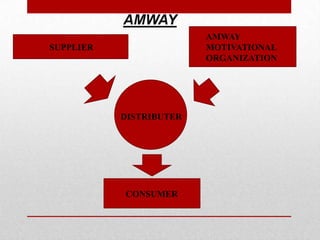
AMWAY
AMWAY
MOTIVATIONAL
ORGANIZATION

SUPPLIER

DISTRIBUTER

CONSUMER
ADVANTAGES
• Reached to individual customers.
• Women accepted it as part time job
• This method allows the Tupperware products to be demonstrated
physically and their utility explained and by this process they justify
the reason for the higher costs of the products through party plan.
• Their focus on customization, product, people earned them a
recognition
• With the involvement with other companies helped in the promotion
of Tupperware products in India.
Disadvantages
• Disadvantages came on the part of employees who
wanted a full time job.
• Party plan requires the hostess bear the costs.
• Advertising and promotions created a suspicion that
company is taking direct orders and reducing their
commissions
• This type of party plan and direct selling did not attract
the competent personnel.
SOME FACTS REGARDING
ITS GROWTH
• By 2002 Tupperware India offered more than 75
products, had more than 40,000 sales people and a reach
in 31 cities.
• It comes under the category of Direct Marketing and can
be the ideal flexi time job.
• Tupperware - All in the party!
• Extraordinary design for everyday living is what the
Tupperware motto says.
Summary
• For almost 50 years, Tupperware has been making it all
possible in homes around the world - not just providing
products, but giving women rewarding careers too.

• Today, Tupperware is one of the world's leading direct selling
companies, with nearly one million independent sales people
bringing Tupperware's premium food storage containers,
serving products, microwave cookware and children's toys to
life in more than 100 countries.
Tupperware ppt ...

Tupperware ppt ...

  • 1.
    Project by :-Soniya Rajwani Samahat Khan Shubham Patel Rishabh Agarwal Yash Wadhwani Kartik Kingrani Submitted to:Miss Sumedha Sharma
  • 2.
    Earl Tupper (1907-1983) • • • • • • Born inBerlin, New Hampshire Started own business, went bankrupt Then got job with DuPont Chemical Created first model from polyethylene slag Made cups, bowls, plates, gas masks Founded Tupperware Plastics Company, 1938
  • 3.
    About • Year 1938-Earl S. Tupper founded the Tupperware company. • It started by using mold parts for navy signal lamps and gas masks. Its products were durable and easy to handle. • Year 1946- designed the renowned air tight, liquid proof lid. • So they started the strategy to educate the customers about the quality and properties of the product.
  • 4.
    • Late 1940’s– Brownie Wise a Sales women who was selling household products for Stanley Home Products was hired by Tupperware company. • She introduced the unique “Party Plan” method of marketing. • Year 1948- First home party for Tupperware was conducted. • Improvement made my Brownie WiseShe removed all Tupperware products from retail outlets and marketed them through the party plan method . Women were the prime sellers and consumers for the company.
  • 5.
    Products of Tupperware Tupperwarealways designed its products keeping in mind the consumers taste, preferances and changing trends:  Plastic carrying cases for women.  Designed toys for children keeping in mind each stage of a child’s development.  Designed containers which could be exclusively used for microwaves.  Contemporary designs  Their strategy was to save money, time, cabinet space.
  • 6.
    Cookware Kitchen Mates Serving Microwave Storage Water Storage BulkStorage Cold Storage Vegesafe Kid On The Go Gift Set Limited Release BeautiControl
  • 7.
  • 8.
  • 9.
  • 10.
    • Tupperware alwayslooked for new products and newer markets. It set up manufacturing units in 14 countries . When it entered a country it appointed a distributor from another country waited for her to grow and then promoted others from her team as distributors. • When its profit increased it expanded its business into various lines such as beauty control, jewellery, apparels
  • 11.
    Tupperware in India •It entered in India in the year 1996. started its operations from New Delhi. • Appointed 15 distributors in the 1st 12 months. Its initial focus was on utility rather than style. These 15 were given training on a 14 week designed training program. • It launched 11 products in India , which were useful rather than decorative. • Tupperware India added new products at regular intervals and dropped those which didn’t sell well. • Direct selling and party plan both was implemented. • Tupperware standards were maintained by selecting units in Bangalore and Baroda
  • 12.
    • Within fouryears of operation in India, Tupperware India became the fastest growing market for the company in developing countries. • Company’s Turnover- in 1999 it was 400 million and by 2000 it was Rs 570 million. • By 2002 Tupperware India had 75 products and more than 40,000 sales people and a reach in 31 cities.
  • 13.
    COMPENSATION • • • • Performance based compensationwas given Dealers earned 25% commission on sales. Manager made profit on sales, training Distributer made profit on sales of the entire distribution team.
  • 14.
    Marketing strategy • • • • • Its marketingstrategy is the three P’s 1. Product 2. Party Plan 3. People Product – Tupperware products carried a lifetime guarantee. Any damage to the product could be replaced at any point of time anywhere in the world. • Party Plan- Tupperware used a direct selling method called the “party plan”. In this the women dealer approaches a lady and asks her to host a party at her place, the investment in the party was borne by the hostess.
  • 15.
    • The Tupperwarewomen demonstrates the benefits and usages of the products to the invitees to the party. And the hostess gets a free gift of tupperware product. • This method allows the Tupperware products to be demonstrated physically and their utility explained and by this process they justify the reason for the higher costs of the products. • People- Tupperware believed that there business success was through people therefore Brownie had said “built the people, and they will build the business”. They had reward system for employees. They organized three social events per month.
  • 16.
    The Tupperware Model •In case of Tupperware the network structure had three levels. First the lowest level was the Dealer then was the Manager and Finally at the top level was the Distributor. • The network of Tupperware in any country had 90% women employees , whereas in India it was 100% women employees. • As said by the executives that Tupperware only offered food storage products in India and kitchens in India are primarily looked after by women, it was easier to promote products through women. And they felt that Indian women were not comfortable working with men.
  • 17.
  • 18.
    Comparing Amway • Amwayanother direct selling company followed a model where the distributors were the center of the model. • The compensation plan followed by Amway resembled a pyramid structure with the people at the top (top distributors) earning the most. • They earned commissions on the sales of the distributors under them. • The distributors at the base of the hierarchy earned the least. • A distributor at the top could earn even without selling Amway products through the chain below.
  • 19.
  • 20.
    ADVANTAGES • Reached toindividual customers. • Women accepted it as part time job • This method allows the Tupperware products to be demonstrated physically and their utility explained and by this process they justify the reason for the higher costs of the products through party plan. • Their focus on customization, product, people earned them a recognition • With the involvement with other companies helped in the promotion of Tupperware products in India.
  • 21.
    Disadvantages • Disadvantages cameon the part of employees who wanted a full time job. • Party plan requires the hostess bear the costs. • Advertising and promotions created a suspicion that company is taking direct orders and reducing their commissions • This type of party plan and direct selling did not attract the competent personnel.
  • 22.
    SOME FACTS REGARDING ITSGROWTH • By 2002 Tupperware India offered more than 75 products, had more than 40,000 sales people and a reach in 31 cities. • It comes under the category of Direct Marketing and can be the ideal flexi time job. • Tupperware - All in the party! • Extraordinary design for everyday living is what the Tupperware motto says.
  • 23.
    Summary • For almost50 years, Tupperware has been making it all possible in homes around the world - not just providing products, but giving women rewarding careers too. • Today, Tupperware is one of the world's leading direct selling companies, with nearly one million independent sales people bringing Tupperware's premium food storage containers, serving products, microwave cookware and children's toys to life in more than 100 countries.